 SNMP Definition
 SNMP Network Management
 Basic Components and their functionalities
 MIB
 SNMP Architecture
 SNMP commands
 Safety aspects(version)
 SNMP Application.
 Simple Network Management Protocol
(SNMP) is an application–layer protocol
defined by the Internet Architecture Board
(IAB) in RFC1157 for exchanging
management information between
network devices such as routers, switches
Wireless devices, processors, servers etc.
SNMP consists of
 SNMP manager or NMS - Network-
Management Systems
 Managed devices
 SNMP agent
 System responsible for monitoring and control managed
devices .
 Allows administrators to view SNMP reading information
through Graphics, tables, reports, email alerts, or
sending sms.
 Is usually installed in a (or more than one) network server
used for management operations, which receives
information (SNMP packets) of all devices managed by
a network.
 Examples of NMS include: MRTG, Cacti, Nagios, PRTG,
CiscoWorks
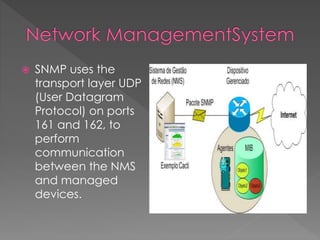
 SNMP uses the
transport layer UDP
(User Datagram
Protocol) on ports
161 and 162, to
perform
communication
between the NMS
and managed
devices.
 Queries agents
 SETs variables in
agents
 GETS responses from
agents
 TRAP-Allows the
agent to notify the
management
station of significant
events.
 A managed device or the network
element is a part of the network that
requires some form of monitoring and
management e.g. routers, switches,
servers, workstations, printers, UPSs, etc...
 The agent is a program that is packaged
within the network element. Enabling the
agent allows it to collect the
management information database
from the device locally and makes it
available to the SNMP manager, when it
is queried for. These agents could be
standard (e.g. Net-SNMP) or specific to a
vendor (e.g. HP insight agent)
 Collects management information about
its local environment.
 Stores and retrieves management
information as defined in the MIB.
 Signals an event to the manager.
 Acts as a proxy for some non–SNMP
manageable network node.
 Management Information Base (MIB) is a
collection of Information for managing
network element.
 The MIBs comprises of managed objects
identified by the name Object Identifier
(Object ID or OID).
 is one of any number of specific
characteristics of a managed device
 Types of managed objects are:
 Scalar –defines a single object instance
 Tabular-define multiple related object instances
that are grouped in MIB tables.
 uniquely identifies a managed object in
the MIB hierarchy.
 The MIB hierarchy can be depicted as a
tree with a nameless root, the levels of
which are assigned by different
organizations.
The SNMP framework consists of
 Master Agent-software program running on a device
that supports SNMP, for example a router which
interacts with a Managed station.
 Subagent- are responsible for passing information
specific to the Masters Agent.
 Management stations-Works as a client in a client /
server communication. Performs information requests to
managed devices, which can be temporary or through
commands at any time.
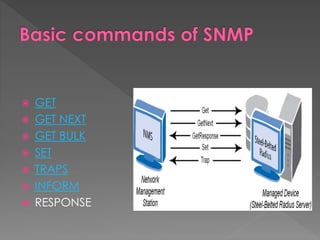
 GET
 GET NEXT
 GET BULK
 SET
 TRAPS
 INFORM
 RESPONSE
SNMP security Versions
SNMP v1
SNMP v2
Both versions are not
safe!
SNMP v3
 Real time tracking device (sysUpTimeInstance).
 Gather information from the interface (ifName,
ifDescr, ifSpeed, ifType, ifPhysAddr).
 Measurement transfer network (iflnOctets,
ifOutOctets) interface.
 Querying a remote ARP cache (ipNetToMedia).
 SNMP is a simple protocol with single
purpose, Transport management
information.
 http://www.ti-
redes.com/gerenciamento/snmp/intro/
 http://pt.wikipedia.org/wiki/Simple_Network_Management_P
rotocol
 http://www.manageengine.com/network-monitoring/what-
is-snmp.html
 http://www.slidefinder.net/s/snmp/snmp/7250937/p4
Thank you for listening

Protocol snmp

  • 2.
     SNMP Definition SNMP Network Management  Basic Components and their functionalities  MIB  SNMP Architecture  SNMP commands  Safety aspects(version)  SNMP Application.
  • 3.
     Simple NetworkManagement Protocol (SNMP) is an application–layer protocol defined by the Internet Architecture Board (IAB) in RFC1157 for exchanging management information between network devices such as routers, switches Wireless devices, processors, servers etc.
  • 4.
    SNMP consists of SNMP manager or NMS - Network- Management Systems  Managed devices  SNMP agent
  • 5.
     System responsiblefor monitoring and control managed devices .  Allows administrators to view SNMP reading information through Graphics, tables, reports, email alerts, or sending sms.  Is usually installed in a (or more than one) network server used for management operations, which receives information (SNMP packets) of all devices managed by a network.  Examples of NMS include: MRTG, Cacti, Nagios, PRTG, CiscoWorks
  • 6.
     SNMP usesthe transport layer UDP (User Datagram Protocol) on ports 161 and 162, to perform communication between the NMS and managed devices.
  • 7.
     Queries agents SETs variables in agents  GETS responses from agents  TRAP-Allows the agent to notify the management station of significant events.
  • 8.
     A manageddevice or the network element is a part of the network that requires some form of monitoring and management e.g. routers, switches, servers, workstations, printers, UPSs, etc...
  • 9.
     The agentis a program that is packaged within the network element. Enabling the agent allows it to collect the management information database from the device locally and makes it available to the SNMP manager, when it is queried for. These agents could be standard (e.g. Net-SNMP) or specific to a vendor (e.g. HP insight agent)
  • 10.
     Collects managementinformation about its local environment.  Stores and retrieves management information as defined in the MIB.  Signals an event to the manager.  Acts as a proxy for some non–SNMP manageable network node.
  • 12.
     Management InformationBase (MIB) is a collection of Information for managing network element.  The MIBs comprises of managed objects identified by the name Object Identifier (Object ID or OID).
  • 13.
     is oneof any number of specific characteristics of a managed device  Types of managed objects are:  Scalar –defines a single object instance  Tabular-define multiple related object instances that are grouped in MIB tables.
  • 14.
     uniquely identifiesa managed object in the MIB hierarchy.  The MIB hierarchy can be depicted as a tree with a nameless root, the levels of which are assigned by different organizations.
  • 16.
    The SNMP frameworkconsists of  Master Agent-software program running on a device that supports SNMP, for example a router which interacts with a Managed station.  Subagent- are responsible for passing information specific to the Masters Agent.  Management stations-Works as a client in a client / server communication. Performs information requests to managed devices, which can be temporary or through commands at any time.
  • 18.
     GET  GETNEXT  GET BULK  SET  TRAPS  INFORM  RESPONSE
  • 19.
    SNMP security Versions SNMPv1 SNMP v2 Both versions are not safe! SNMP v3
  • 20.
     Real timetracking device (sysUpTimeInstance).  Gather information from the interface (ifName, ifDescr, ifSpeed, ifType, ifPhysAddr).  Measurement transfer network (iflnOctets, ifOutOctets) interface.  Querying a remote ARP cache (ipNetToMedia).
  • 21.
     SNMP isa simple protocol with single purpose, Transport management information.
  • 22.
     http://www.ti- redes.com/gerenciamento/snmp/intro/  http://pt.wikipedia.org/wiki/Simple_Network_Management_P rotocol http://www.manageengine.com/network-monitoring/what- is-snmp.html  http://www.slidefinder.net/s/snmp/snmp/7250937/p4
  • 23.
    Thank you forlistening