Web Services
Web Technology - 2ID60
26 November 2013
Katrien Verbert
Natasha Stash
George Fletcher
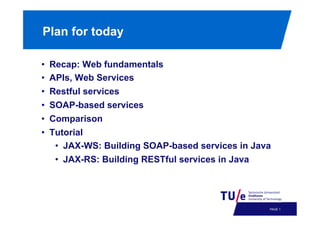
Plan for today
• 
• 
• 
• 
• 
• 

Recap: Web fundamentals
APIs, Web Services
Restful services
SOAP-based services
Comparison
Tutorial
•  JAX-WS: Building SOAP-based services in Java
•  JAX-RS: Building RESTful services in Java

PAGE 4
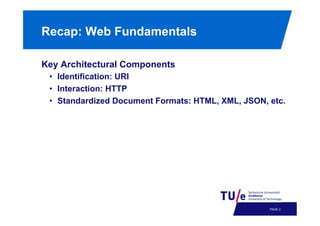
Recap: Web Fundamentals
Key Architectural Components
•  Identification: URI
•  Interaction: HTTP
•  Standardized Document Formats: HTML, XML, JSON, etc.

PAGE 5
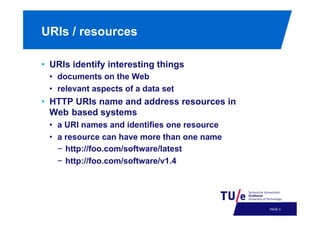
URIs / resources
•  URIs identify interesting things
•  documents on the Web
•  relevant aspects of a data set

•  HTTP URIs name and address resources in
Web based systems
•  a URI names and identifies one resource
•  a resource can have more than one name
−  http://foo.com/software/latest
−  http://foo.com/software/v1.4

PAGE 6
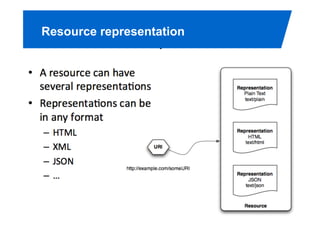
Resource representation

PAGE 7
Plan for today
• 
• 
• 
• 
• 
• 

Recap: Web fundamentals
APIs, Web Services
RESTful services
SOAP-based services
Comparison
Tutorial
•  JAX-WS: Building SOAP-based services in Java
•  JAX-RS: Building RESTful services in Java

PAGE 8
APIs
What is an API?
and
Why do we need APIs?

PAGE 9
(Web) APIs
•  Application Programming Interface
•  Specifies how software components communicate
with each other
•  e.g., Java API, 3rd party library APIs
•  usually come with documentation

•  Web API: specify how applications communicate
with other over the Web (HTTP, URI, XML, etc.)

PAGE 10
Web Services, Web Applications and
APIs (Application Programming Interface)
•  Web Applications == Web Services == Web APIs ?

PAGE 11
Web Services, Web Applications and
APIs (Application Programming Interface)
•  Web Applications are designed to be accessed by
end users through Web client software
•  Web Services are intended to be used by other
software applications
•  Web APIs ≈ Web Services

PAGE 12
Web Services
•  “Web Services”

“Web APIs”

•  Build on the design principles and architectural
components of the Web
•  Provide certain operations
•  Exchange structured data in standard formats
(JSON, XML, etc.)

PAGE 13
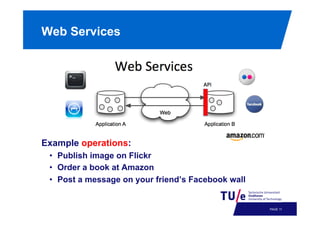
Web Services

Example operations:
•  Publish image on Flickr
•  Order a book at Amazon
•  Post a message on your friend’s Facebook wall

PAGE 14
What Are Web Services?

PAGE 15
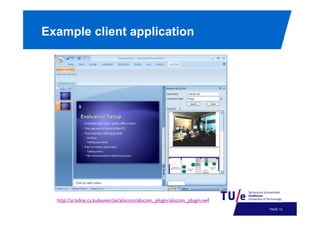
Example client application

http://ariadne.cs.kuleuven.be/alocom/alocom_plugin/alocom_plugin.swf
PAGE 16
PAGE 17
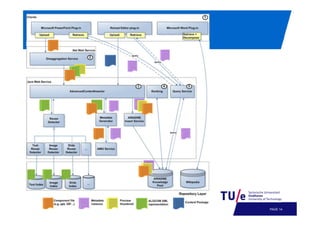
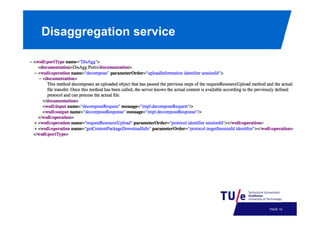
Disaggregation service

PAGE 18
What Are Web Services?
•  W3C definition:
•  A software system designed to support
interoperable machine-to-machine interaction over a
network...

PAGE 19
Web Services Use
•  Connect existing software
•  Reusable application components

PAGE 20
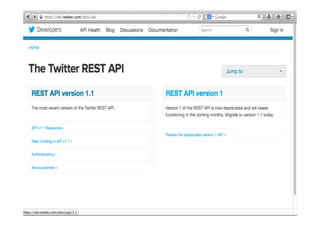
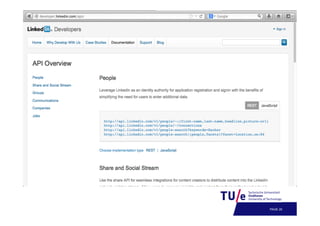
Major classes of Web Services
•  Big Web Services (L. Richardson and S. Ruby)
•  RESTful (REST-compliant) Web Services

PAGE 21
PAGE 22
PAGE 23
Overview
• 
• 
• 
• 
• 

Introduction
RESTful services
SOAP-based services
Comparison
Tutorial
•  JAX-WS: Building SOAP-based services in Java
•  JAX-RS: Building RESTful services in Java

PAGE 24
A RESTful Web service...
•  ... exposes its data and functionality through
interlinked Web resources identified by URI.
•  ... is more data-centric, and less functionality-centric
(as opposed to SOAP services).
•  ... embeds functionality of the service in the uniform
HTTP interfaces for interaction: GET, PUT, DELETE,
POST.
•  ... uses HTTP as the application protocol instead of
SOAP
PAGE 25
Four basic design principles
• 
• 
• 
• 

Use HTTP methods explicitly.
Be stateless.
Expose directory structure-like URIs.
Transfer XML, JavaScript Object Notation (JSON), or
both.

PAGE 26
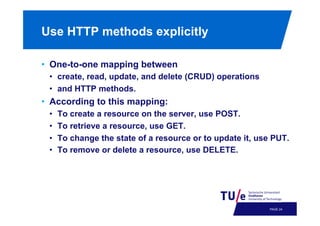
Use HTTP methods explicitly
•  One-to-one mapping between
•  create, read, update, and delete (CRUD) operations
•  and HTTP methods.

•  According to this mapping:
• 
• 
• 
• 

To create a resource on the server, use POST.
To retrieve a resource, use GET.
To change the state of a resource or to update it, use PUT.
To remove or delete a resource, use DELETE.

PAGE 27
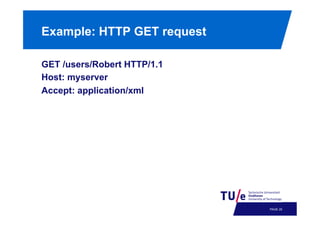
Example: HTTP GET request
GET /users/Robert HTTP/1.1
Host: myserver
Accept: application/xml

PAGE 28
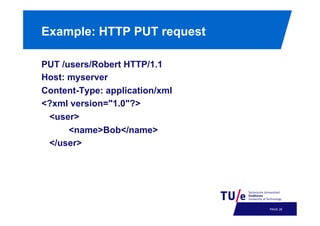
Example: HTTP PUT request
PUT /users/Robert HTTP/1.1
Host: myserver
Content-Type: application/xml
<?xml version="1.0"?>
<user>
<name>Bob</name>
</user>

PAGE 29
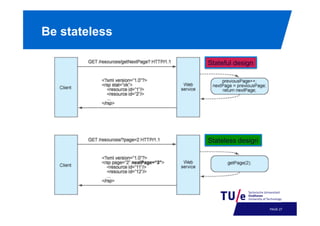
Be stateless
Stateful design

Stateless design

PAGE 30
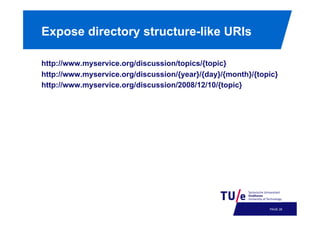
Expose directory structure-like URIs
http://www.myservice.org/discussion/topics/{topic}
http://www.myservice.org/discussion/{year}/{day}/{month}/{topic}
http://www.myservice.org/discussion/2008/12/10/{topic}

PAGE 31
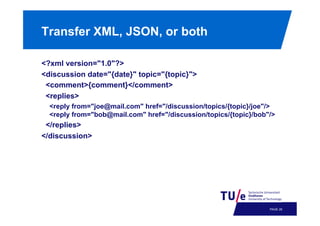
Transfer XML, JSON, or both
<?xml version="1.0"?>
<discussion date="{date}" topic="{topic}">
<comment>{comment}</comment>
<replies>
<reply from="joe@mail.com" href="/discussion/topics/{topic}/joe"/>
<reply from="bob@mail.com" href="/discussion/topics/{topic}/bob"/>

</replies>
</discussion>

PAGE 32
Tools and frameworks
•  Ruby on Rails -- a framework for building RESTful Web
applications – http://www.rubyonrails.org/
•  Restlet -- framework for mapping REST concepts to Java
classes http://www.restlet.org
•  Django - framework for building RESTful Web applications in
Python
•  JAX-RC specification (http://jsr311.java.net/) -provides a Java
API for RESTful Web Services over the HTTP
•  RESTEasy (http://www.jboss.org/resteasy/) - Jboss project that
provides various frameworks for building RESTful Web
Services and RESTful Java applications.

PAGE 33
Overview
• 
• 
• 
• 
• 

Introduction
Restful services
Big web services
Comparison
Tutorial
•  JAX-WS: Building SOAP-based services in Java
•  JAX-RS: Building RESTful services in Java

PAGE 34
Big web services
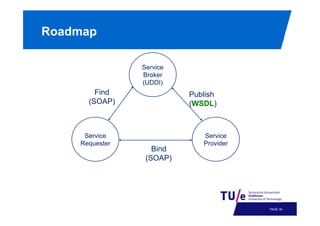
•  SOAP (Simple Object Access Protocol)
•  WSDL (Web Services Description Language)
•  UDDI (Universal Description, Discovery, and
Integration)

PAGE 35
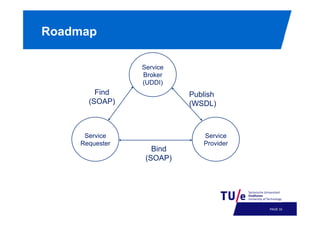
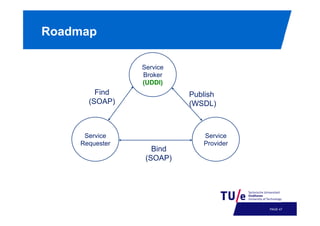
Roadmap
Service
Broker
(UDDI)

Find
(SOAP)

Service
Requester

Publish
(WSDL)

Bind
(SOAP)

Service
Provider

PAGE 36
What is SOAP
• 
• 
• 
• 
• 
• 
• 

SOAP used to stand for Simple Object Access Protocol
SOAP is a communication protocol
SOAP is designed to communicate via Internet
SOAP is based on XML
SOAP is simple and extensible
SOAP is platform and language independent
SOAP is a W3C standard

PAGE 37
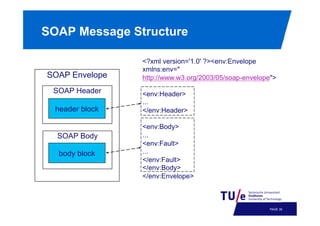
SOAP Message Structure

SOAP Envelope
SOAP Header
header block
SOAP Body
body block

<?xml version='1.0' ?><env:Envelope
xmlns:env="
http://www.w3.org/2003/05/soap-envelope">
<env:Header>
...
</env:Header>
<env:Body>
...
<env:Fault>
...
</env:Fault>
</env:Body>
</env:Envelope>

PAGE 38
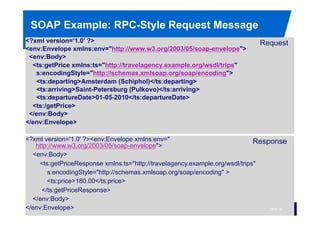
SOAP Example: RPC-Style Request Message
<?xml version='1.0' ?>
<env:Envelope xmlns:env="http://www.w3.org/2003/05/soap-envelope">
<env:Body>
<ts:getPrice xmlns:ts="http://travelagency.example.org/wsdl/trips"
s:encodingStyle="http://schemas.xmlsoap.org/soap/encoding">
<ts:departing>Amsterdam (Schiphol)</ts:departing>
<ts:arriving>Saint-Petersburg (Pulkovo)</ts:arriving>
<ts:departureDate>01-05-2010</ts:departureDate>
<ts:/getPrice>
</env:Body>
</env:Envelope>

Request

<?xml version='1.0' ?><env:Envelope xmlns:env="
Response
http://www.w3.org/2003/05/soap-envelope">
<env:Body>
<ts:getPriceResponse xmlns:ts="http://travelagency.example.org/wsdl/trips"
s:encodingStyle="http://schemas.xmlsoap.org/soap/encoding" >
<ts:price>180.00</ts:price>
</ts:getPriceResponse>
</env:Body>
</env:Envelope>
PAGE 39
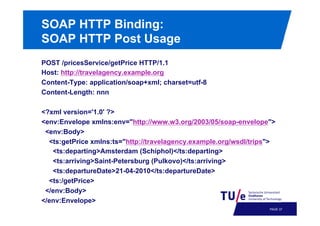
SOAP HTTP Binding:
SOAP HTTP Post Usage
POST /pricesService/getPrice HTTP/1.1
Host: http://travelagency.example.org
Content-Type: application/soap+xml; charset=utf-8
Content-Length: nnn
<?xml version='1.0' ?>
<env:Envelope xmlns:env="http://www.w3.org/2003/05/soap-envelope">
<env:Body>
<ts:getPrice xmlns:ts="http://travelagency.example.org/wsdl/trips">
<ts:departing>Amsterdam (Schiphol)</ts:departing>
<ts:arriving>Saint-Petersburg (Pulkovo)</ts:arriving>
<ts:departureDate>21-04-2010</ts:departureDate>
<ts:/getPrice>
</env:Body>
</env:Envelope>
PAGE 40
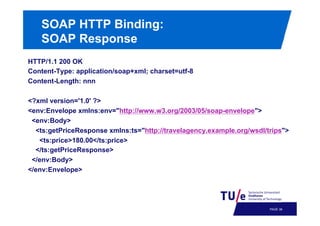
SOAP HTTP Binding:
SOAP Response
HTTP/1.1 200 OK
Content-Type: application/soap+xml; charset=utf-8
Content-Length: nnn
<?xml version='1.0' ?>
<env:Envelope xmlns:env="http://www.w3.org/2003/05/soap-envelope">
<env:Body>
<ts:getPriceResponse xmlns:ts="http://travelagency.example.org/wsdl/trips">
<ts:price>180.00</ts:price>
</ts:getPriceResponse>
</env:Body>
</env:Envelope>

PAGE 41
Roadmap
Service
Broker
(UDDI)

Find
(SOAP)

Service
Requester

Publish
(WSDL)

Bind
(SOAP)

Service
Provider

PAGE 42
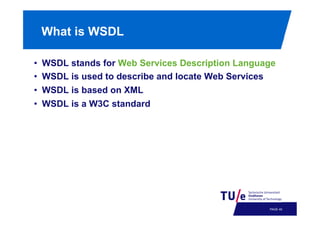
What is WSDL
• 
• 
• 
• 

WSDL stands for Web Services Description Language
WSDL is used to describe and locate Web Services
WSDL is based on XML
WSDL is a W3C standard

PAGE 43
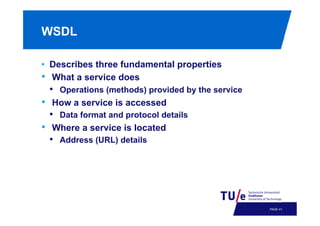
WSDL
•  Describes three fundamental properties
•  What a service does

• 

• 

How a service is accessed

• 

• 

Operations (methods) provided by the service
Data format and protocol details

Where a service is located

• 

Address (URL) details

PAGE 44
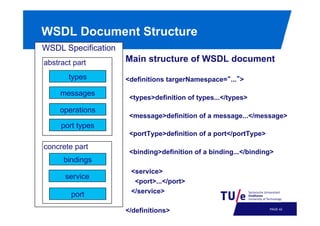
WSDL Document Structure
WSDL Specification
abstract part
types
messages
operations

Main structure of WSDL document
<definitions targerNamespace= ... >
<types>definition of types...</types>
<message>definition of a message...</message>

port types
<portType>definition of a port</portType>

concrete part
bindings
service
port

<binding>definition of a binding...</binding>
<service>
<port>...</port>
</service>
</definitions>

PAGE 45
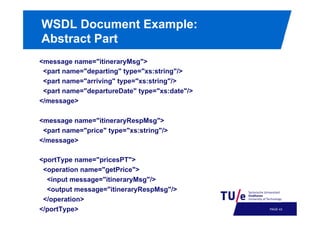
WSDL Document Example:
Abstract Part
<message name="itineraryMsg">
<part name="departing" type="xs:string"/>
<part name="arriving" type="xs:string"/>
<part name="departureDate" type="xs:date"/>
</message>
<message name="itineraryRespMsg">
<part name="price" type="xs:string"/>
</message>
<portType name="pricesPT">
<operation name="getPrice">
<input message="itineraryMsg"/>
<output message="itineraryRespMsg"/>
</operation>
</portType>

PAGE 46
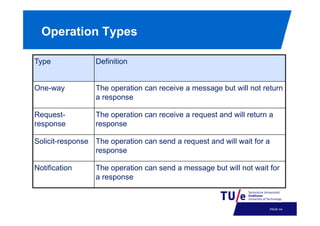
Operation Types
Type

Definition

One-way

The operation can receive a message but will not return
a response

Requestresponse

The operation can receive a request and will return a
response

Solicit-response The operation can send a request and will wait for a
response
Notification

The operation can send a message but will not wait for
a response

PAGE 47
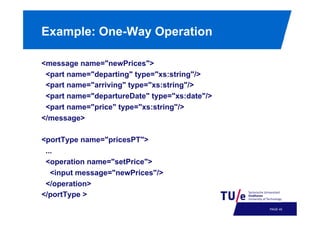
Example: One-Way Operation
<message name="newPrices">
<part name="departing" type="xs:string"/>
<part name="arriving" type="xs:string"/>
<part name="departureDate" type="xs:date"/>
<part name="price" type="xs:string"/>
</message>
<portType name="pricesPT">
...
<operation name="setPrice">
<input message="newPrices"/>
</operation>
</portType >
PAGE 48
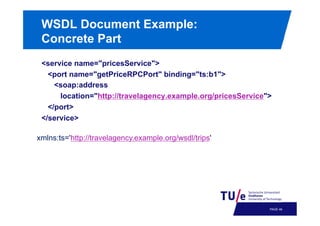
WSDL Document Example:
Concrete Part
<service name="pricesService">
<port name="getPriceRPCPort" binding="ts:b1">
<soap:address
location="http://travelagency.example.org/pricesService">
</port>
</service>
xmlns:ts='http://travelagency.example.org/wsdl/trips'

PAGE 49
Roadmap
Service
Broker
(UDDI)

Find
(SOAP)

Service
Requester

Publish
(WSDL)

Bind
(SOAP)

Service
Provider

PAGE 50
What is UDDI
•  UDDI stands for Universal Description, Discovery and Integration
•  UDDI a standard for publishing and discovering Web services
•  UDDI is a specification for a distributed registry of Web services
•  UDDI is built upon standards such as HTTP, XML, XML Schema,
SOAP, WSDL
•  UDDI can communicate via SOAP, CORBA, Java RMI Protocol
•  UDDI uses WSDL to describe interfaces to Web Services

PAGE 51
Ways to Use UDDI Registry
•  White pages
–  name, address, contact person, Web site

•  Yellow pages
–  types of business, locations, products, services,
categorizations

•  Green pages
–  technical information about business services, pointers
to WSDL descriptions of the services

PAGE 52
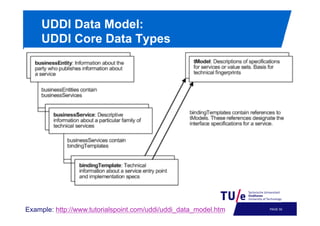
UDDI Data Model:
UDDI Core Data Types

Example: http://www.tutorialspoint.com/uddi/uddi_data_model.htm

PAGE 53
UDDI Data Model:
tModel example
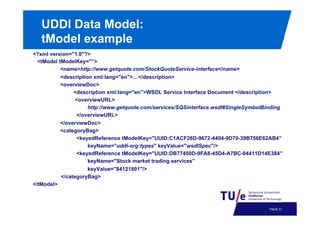
<?xml version="1.0"?>
<tModel tModelKey="”>
<name>http://www.getquote.com/StockQuoteService-interface</name>
<description xml:lang="en">…</description>
<overviewDoc>
<description xml:lang="en”>WSDL Service Interface Document </description>
<overviewURL>
http://www.getquote.com/services/SQSinterface.wsdl#SingleSymbolBinding
</overviewURL>
</overviewDoc>
<categoryBag>
<keyedReference tModelKey="UUID:C1ACF26D-9672-4404-9D70-39B756E62AB4”
keyName="uddi-org:types" keyValue="wsdlSpec"/>
<keyedReference tModelKey="UUID:DB77450D-9FA8-45D4-A7BC-04411D14E384”
keyName="Stock market trading services”
keyValue="84121801"/>
</categoryBag>
</tModel>

PAGE 54
UDDI: Programmatic Interfaces
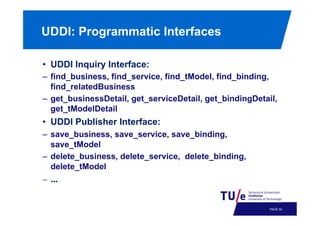
•  UDDI Inquiry Interface:
–  find_business, find_service, find_tModel, find_binding,
find_relatedBusiness
–  get_businessDetail, get_serviceDetail, get_bindingDetail,
get_tModelDetail

•  UDDI Publisher Interface:
–  save_business, save_service, save_binding,
save_tModel
–  delete_business, delete_service, delete_binding,
delete_tModel

–  ...!

PAGE 55
Big Web Services Examples
•  http://www.xmethods.com
•  http://www.programmableweb.com/

PAGE 56
Web services enable
1. 
2. 
3. 
4. 

data exchange between various applications and different platforms
to resolve interoperability issues
applications to function between two different operating systems server
all of the above

PAGE 57
Which of the following is used to locate
and describe web services?
1. 
2. 
3. 
4. 

SOAP
Web page
WSDL
UDDI

PAGE 58
Overview
• 
• 
• 
• 
• 

Introduction
Restful services
SOAP-based services
Comparison
Tutorial
•  JAX-WS: Building SOAP-based services in Java
•  JAX-RS: Building RESTful services in Java

PAGE 59
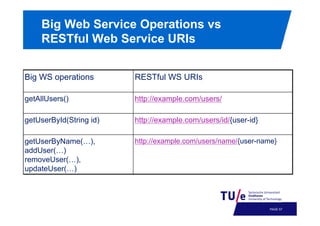
Big Web Service Operations vs
RESTful Web Service URIs
Big WS operations

RESTful WS URIs

getAllUsers()

http://example.com/users/
"

getUserById(String id)

http://example.com/users/id/{user-id}

getUserByName(…),
addUser(…)
removeUser(…),
updateUser(…)

http://example.com/users/name/{user-name}

PAGE 60
Big Web Services versus REST

•  A SOAP service has a single endpoint
•  that handles all the operations
•  therefore it has to have an application-specific
interface.

•  A RESTful service has a number of resources
•  so the operations can be distributed onto the resources
•  and mapped to a small uniform set of operations.

PAGE 61
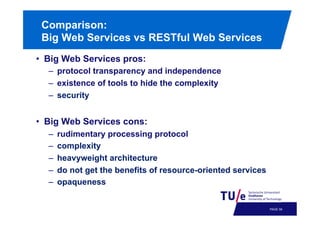
Comparison:
Big Web Services vs RESTful Web Services
•  Big Web Services pros:
–  protocol transparency and independence
–  existence of tools to hide the complexity
–  security

•  Big Web Services cons:
– 
– 
– 
– 
– 

rudimentary processing protocol
complexity
heavyweight architecture
do not get the benefits of resource-oriented services
opaqueness

PAGE 62
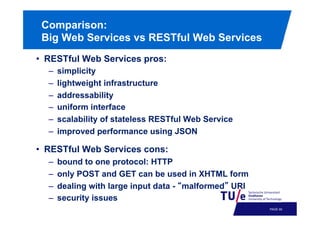
Comparison:
Big Web Services vs RESTful Web Services
•  RESTful Web Services pros:
– 
– 
– 
– 
– 
– 

simplicity
lightweight infrastructure
addressability
uniform interface
scalability of stateless RESTful Web Service
improved performance using JSON

•  RESTful Web Services cons:
– 
– 
– 
– 

bound to one protocol: HTTP
only POST and GET can be used in XHTML form
dealing with large input data - malformed URI
security issues
PAGE 63
Sources
•  Cesare Pautasso,Olaf Zimmermann,Frank Leymann (2008)
RESTful Web Services vs. Big Web Services: Making the Right
Architectural Decision. Proc. of the 17th International World
Wide Web Conference (WWW2008), Bejing, China, April 2008.
•  Alex Rodriguez. (2008). RESTful Web services: The basics.
Available at:
http://www.ibm.com/developerworks/webservices/library/wsrestful/
•  Cesare Pautasso and Erik Wilde. Design Principles, Patterns
and Emerging Technologies for RESTful Web Services.
http://dret.net/netdret/docs/rest-icwe2010/
•  Bernhard Hasl. RESTful web service APIs
http://courses2.cit.cornell.edu/info4302_2012fa/lectures/week7/
INFO_CS4302_Lecture12.pdf

PAGE 64
k.verbert@tue.nl
n.v.stash@tue.nl
g.h.l.fletcher@tue.nl

PAGE 65

Web Services

  • 1.
    Web Services Web Technology- 2ID60 26 November 2013 Katrien Verbert Natasha Stash George Fletcher
  • 2.
    Plan for today •  •  •  •  •  •  Recap:Web fundamentals APIs, Web Services Restful services SOAP-based services Comparison Tutorial •  JAX-WS: Building SOAP-based services in Java •  JAX-RS: Building RESTful services in Java PAGE 4
  • 3.
    Recap: Web Fundamentals KeyArchitectural Components •  Identification: URI •  Interaction: HTTP •  Standardized Document Formats: HTML, XML, JSON, etc. PAGE 5
  • 4.
    URIs / resources • URIs identify interesting things •  documents on the Web •  relevant aspects of a data set •  HTTP URIs name and address resources in Web based systems •  a URI names and identifies one resource •  a resource can have more than one name −  http://foo.com/software/latest −  http://foo.com/software/v1.4 PAGE 6
  • 5.
  • 6.
    Plan for today •  •  •  •  •  •  Recap:Web fundamentals APIs, Web Services RESTful services SOAP-based services Comparison Tutorial •  JAX-WS: Building SOAP-based services in Java •  JAX-RS: Building RESTful services in Java PAGE 8
  • 7.
    APIs What is anAPI? and Why do we need APIs? PAGE 9
  • 8.
    (Web) APIs •  ApplicationProgramming Interface •  Specifies how software components communicate with each other •  e.g., Java API, 3rd party library APIs •  usually come with documentation •  Web API: specify how applications communicate with other over the Web (HTTP, URI, XML, etc.) PAGE 10
  • 9.
    Web Services, WebApplications and APIs (Application Programming Interface) •  Web Applications == Web Services == Web APIs ? PAGE 11
  • 10.
    Web Services, WebApplications and APIs (Application Programming Interface) •  Web Applications are designed to be accessed by end users through Web client software •  Web Services are intended to be used by other software applications •  Web APIs ≈ Web Services PAGE 12
  • 11.
    Web Services •  “WebServices” “Web APIs” •  Build on the design principles and architectural components of the Web •  Provide certain operations •  Exchange structured data in standard formats (JSON, XML, etc.) PAGE 13
  • 12.
    Web Services Example operations: • Publish image on Flickr •  Order a book at Amazon •  Post a message on your friend’s Facebook wall PAGE 14
  • 13.
    What Are WebServices? PAGE 15
  • 14.
  • 15.
  • 16.
  • 17.
    What Are WebServices? •  W3C definition: •  A software system designed to support interoperable machine-to-machine interaction over a network... PAGE 19
  • 18.
    Web Services Use • Connect existing software •  Reusable application components PAGE 20
  • 19.
    Major classes ofWeb Services •  Big Web Services (L. Richardson and S. Ruby) •  RESTful (REST-compliant) Web Services PAGE 21
  • 20.
  • 21.
  • 22.
    Overview •  •  •  •  •  Introduction RESTful services SOAP-based services Comparison Tutorial • JAX-WS: Building SOAP-based services in Java •  JAX-RS: Building RESTful services in Java PAGE 24
  • 23.
    A RESTful Webservice... •  ... exposes its data and functionality through interlinked Web resources identified by URI. •  ... is more data-centric, and less functionality-centric (as opposed to SOAP services). •  ... embeds functionality of the service in the uniform HTTP interfaces for interaction: GET, PUT, DELETE, POST. •  ... uses HTTP as the application protocol instead of SOAP PAGE 25
  • 24.
    Four basic designprinciples •  •  •  •  Use HTTP methods explicitly. Be stateless. Expose directory structure-like URIs. Transfer XML, JavaScript Object Notation (JSON), or both. PAGE 26
  • 25.
    Use HTTP methodsexplicitly •  One-to-one mapping between •  create, read, update, and delete (CRUD) operations •  and HTTP methods. •  According to this mapping: •  •  •  •  To create a resource on the server, use POST. To retrieve a resource, use GET. To change the state of a resource or to update it, use PUT. To remove or delete a resource, use DELETE. PAGE 27
  • 26.
    Example: HTTP GETrequest GET /users/Robert HTTP/1.1 Host: myserver Accept: application/xml PAGE 28
  • 27.
    Example: HTTP PUTrequest PUT /users/Robert HTTP/1.1 Host: myserver Content-Type: application/xml <?xml version="1.0"?> <user> <name>Bob</name> </user> PAGE 29
  • 28.
  • 29.
    Expose directory structure-likeURIs http://www.myservice.org/discussion/topics/{topic} http://www.myservice.org/discussion/{year}/{day}/{month}/{topic} http://www.myservice.org/discussion/2008/12/10/{topic} PAGE 31
  • 30.
    Transfer XML, JSON,or both <?xml version="1.0"?> <discussion date="{date}" topic="{topic}"> <comment>{comment}</comment> <replies> <reply from="joe@mail.com" href="/discussion/topics/{topic}/joe"/> <reply from="bob@mail.com" href="/discussion/topics/{topic}/bob"/> </replies> </discussion> PAGE 32
  • 31.
    Tools and frameworks • Ruby on Rails -- a framework for building RESTful Web applications – http://www.rubyonrails.org/ •  Restlet -- framework for mapping REST concepts to Java classes http://www.restlet.org •  Django - framework for building RESTful Web applications in Python •  JAX-RC specification (http://jsr311.java.net/) -provides a Java API for RESTful Web Services over the HTTP •  RESTEasy (http://www.jboss.org/resteasy/) - Jboss project that provides various frameworks for building RESTful Web Services and RESTful Java applications. PAGE 33
  • 32.
    Overview •  •  •  •  •  Introduction Restful services Big webservices Comparison Tutorial •  JAX-WS: Building SOAP-based services in Java •  JAX-RS: Building RESTful services in Java PAGE 34
  • 33.
    Big web services • SOAP (Simple Object Access Protocol) •  WSDL (Web Services Description Language) •  UDDI (Universal Description, Discovery, and Integration) PAGE 35
  • 34.
  • 35.
    What is SOAP •  •  •  •  •  •  •  SOAPused to stand for Simple Object Access Protocol SOAP is a communication protocol SOAP is designed to communicate via Internet SOAP is based on XML SOAP is simple and extensible SOAP is platform and language independent SOAP is a W3C standard PAGE 37
  • 36.
    SOAP Message Structure SOAPEnvelope SOAP Header header block SOAP Body body block <?xml version='1.0' ?><env:Envelope xmlns:env=" http://www.w3.org/2003/05/soap-envelope"> <env:Header> ... </env:Header> <env:Body> ... <env:Fault> ... </env:Fault> </env:Body> </env:Envelope> PAGE 38
  • 37.
    SOAP Example: RPC-StyleRequest Message <?xml version='1.0' ?> <env:Envelope xmlns:env="http://www.w3.org/2003/05/soap-envelope"> <env:Body> <ts:getPrice xmlns:ts="http://travelagency.example.org/wsdl/trips" s:encodingStyle="http://schemas.xmlsoap.org/soap/encoding"> <ts:departing>Amsterdam (Schiphol)</ts:departing> <ts:arriving>Saint-Petersburg (Pulkovo)</ts:arriving> <ts:departureDate>01-05-2010</ts:departureDate> <ts:/getPrice> </env:Body> </env:Envelope> Request <?xml version='1.0' ?><env:Envelope xmlns:env=" Response http://www.w3.org/2003/05/soap-envelope"> <env:Body> <ts:getPriceResponse xmlns:ts="http://travelagency.example.org/wsdl/trips" s:encodingStyle="http://schemas.xmlsoap.org/soap/encoding" > <ts:price>180.00</ts:price> </ts:getPriceResponse> </env:Body> </env:Envelope> PAGE 39
  • 38.
    SOAP HTTP Binding: SOAPHTTP Post Usage POST /pricesService/getPrice HTTP/1.1 Host: http://travelagency.example.org Content-Type: application/soap+xml; charset=utf-8 Content-Length: nnn <?xml version='1.0' ?> <env:Envelope xmlns:env="http://www.w3.org/2003/05/soap-envelope"> <env:Body> <ts:getPrice xmlns:ts="http://travelagency.example.org/wsdl/trips"> <ts:departing>Amsterdam (Schiphol)</ts:departing> <ts:arriving>Saint-Petersburg (Pulkovo)</ts:arriving> <ts:departureDate>21-04-2010</ts:departureDate> <ts:/getPrice> </env:Body> </env:Envelope> PAGE 40
  • 39.
    SOAP HTTP Binding: SOAPResponse HTTP/1.1 200 OK Content-Type: application/soap+xml; charset=utf-8 Content-Length: nnn <?xml version='1.0' ?> <env:Envelope xmlns:env="http://www.w3.org/2003/05/soap-envelope"> <env:Body> <ts:getPriceResponse xmlns:ts="http://travelagency.example.org/wsdl/trips"> <ts:price>180.00</ts:price> </ts:getPriceResponse> </env:Body> </env:Envelope> PAGE 41
  • 40.
  • 41.
    What is WSDL •  •  •  •  WSDLstands for Web Services Description Language WSDL is used to describe and locate Web Services WSDL is based on XML WSDL is a W3C standard PAGE 43
  • 42.
    WSDL •  Describes threefundamental properties •  What a service does •  •  How a service is accessed •  •  Operations (methods) provided by the service Data format and protocol details Where a service is located •  Address (URL) details PAGE 44
  • 43.
    WSDL Document Structure WSDLSpecification abstract part types messages operations Main structure of WSDL document <definitions targerNamespace= ... > <types>definition of types...</types> <message>definition of a message...</message> port types <portType>definition of a port</portType> concrete part bindings service port <binding>definition of a binding...</binding> <service> <port>...</port> </service> </definitions> PAGE 45
  • 44.
    WSDL Document Example: AbstractPart <message name="itineraryMsg"> <part name="departing" type="xs:string"/> <part name="arriving" type="xs:string"/> <part name="departureDate" type="xs:date"/> </message> <message name="itineraryRespMsg"> <part name="price" type="xs:string"/> </message> <portType name="pricesPT"> <operation name="getPrice"> <input message="itineraryMsg"/> <output message="itineraryRespMsg"/> </operation> </portType> PAGE 46
  • 45.
    Operation Types Type Definition One-way The operationcan receive a message but will not return a response Requestresponse The operation can receive a request and will return a response Solicit-response The operation can send a request and will wait for a response Notification The operation can send a message but will not wait for a response PAGE 47
  • 46.
    Example: One-Way Operation <messagename="newPrices"> <part name="departing" type="xs:string"/> <part name="arriving" type="xs:string"/> <part name="departureDate" type="xs:date"/> <part name="price" type="xs:string"/> </message> <portType name="pricesPT"> ... <operation name="setPrice"> <input message="newPrices"/> </operation> </portType > PAGE 48
  • 47.
    WSDL Document Example: ConcretePart <service name="pricesService"> <port name="getPriceRPCPort" binding="ts:b1"> <soap:address location="http://travelagency.example.org/pricesService"> </port> </service> xmlns:ts='http://travelagency.example.org/wsdl/trips' PAGE 49
  • 48.
  • 49.
    What is UDDI • UDDI stands for Universal Description, Discovery and Integration •  UDDI a standard for publishing and discovering Web services •  UDDI is a specification for a distributed registry of Web services •  UDDI is built upon standards such as HTTP, XML, XML Schema, SOAP, WSDL •  UDDI can communicate via SOAP, CORBA, Java RMI Protocol •  UDDI uses WSDL to describe interfaces to Web Services PAGE 51
  • 50.
    Ways to UseUDDI Registry •  White pages –  name, address, contact person, Web site •  Yellow pages –  types of business, locations, products, services, categorizations •  Green pages –  technical information about business services, pointers to WSDL descriptions of the services PAGE 52
  • 51.
    UDDI Data Model: UDDICore Data Types Example: http://www.tutorialspoint.com/uddi/uddi_data_model.htm PAGE 53
  • 52.
    UDDI Data Model: tModelexample <?xml version="1.0"?> <tModel tModelKey="”> <name>http://www.getquote.com/StockQuoteService-interface</name> <description xml:lang="en">…</description> <overviewDoc> <description xml:lang="en”>WSDL Service Interface Document </description> <overviewURL> http://www.getquote.com/services/SQSinterface.wsdl#SingleSymbolBinding </overviewURL> </overviewDoc> <categoryBag> <keyedReference tModelKey="UUID:C1ACF26D-9672-4404-9D70-39B756E62AB4” keyName="uddi-org:types" keyValue="wsdlSpec"/> <keyedReference tModelKey="UUID:DB77450D-9FA8-45D4-A7BC-04411D14E384” keyName="Stock market trading services” keyValue="84121801"/> </categoryBag> </tModel> PAGE 54
  • 53.
    UDDI: Programmatic Interfaces • UDDI Inquiry Interface: –  find_business, find_service, find_tModel, find_binding, find_relatedBusiness –  get_businessDetail, get_serviceDetail, get_bindingDetail, get_tModelDetail •  UDDI Publisher Interface: –  save_business, save_service, save_binding, save_tModel –  delete_business, delete_service, delete_binding, delete_tModel –  ...! PAGE 55
  • 54.
    Big Web ServicesExamples •  http://www.xmethods.com •  http://www.programmableweb.com/ PAGE 56
  • 55.
    Web services enable 1.  2.  3.  4.  dataexchange between various applications and different platforms to resolve interoperability issues applications to function between two different operating systems server all of the above PAGE 57
  • 56.
    Which of thefollowing is used to locate and describe web services? 1.  2.  3.  4.  SOAP Web page WSDL UDDI PAGE 58
  • 57.
    Overview •  •  •  •  •  Introduction Restful services SOAP-based services Comparison Tutorial • JAX-WS: Building SOAP-based services in Java •  JAX-RS: Building RESTful services in Java PAGE 59
  • 58.
    Big Web ServiceOperations vs RESTful Web Service URIs Big WS operations RESTful WS URIs getAllUsers() http://example.com/users/ " getUserById(String id) http://example.com/users/id/{user-id} getUserByName(…), addUser(…) removeUser(…), updateUser(…) http://example.com/users/name/{user-name} PAGE 60
  • 59.
    Big Web Servicesversus REST •  A SOAP service has a single endpoint •  that handles all the operations •  therefore it has to have an application-specific interface. •  A RESTful service has a number of resources •  so the operations can be distributed onto the resources •  and mapped to a small uniform set of operations. PAGE 61
  • 60.
    Comparison: Big Web Servicesvs RESTful Web Services •  Big Web Services pros: –  protocol transparency and independence –  existence of tools to hide the complexity –  security •  Big Web Services cons: –  –  –  –  –  rudimentary processing protocol complexity heavyweight architecture do not get the benefits of resource-oriented services opaqueness PAGE 62
  • 61.
    Comparison: Big Web Servicesvs RESTful Web Services •  RESTful Web Services pros: –  –  –  –  –  –  simplicity lightweight infrastructure addressability uniform interface scalability of stateless RESTful Web Service improved performance using JSON •  RESTful Web Services cons: –  –  –  –  bound to one protocol: HTTP only POST and GET can be used in XHTML form dealing with large input data - malformed URI security issues PAGE 63
  • 62.
    Sources •  Cesare Pautasso,OlafZimmermann,Frank Leymann (2008) RESTful Web Services vs. Big Web Services: Making the Right Architectural Decision. Proc. of the 17th International World Wide Web Conference (WWW2008), Bejing, China, April 2008. •  Alex Rodriguez. (2008). RESTful Web services: The basics. Available at: http://www.ibm.com/developerworks/webservices/library/wsrestful/ •  Cesare Pautasso and Erik Wilde. Design Principles, Patterns and Emerging Technologies for RESTful Web Services. http://dret.net/netdret/docs/rest-icwe2010/ •  Bernhard Hasl. RESTful web service APIs http://courses2.cit.cornell.edu/info4302_2012fa/lectures/week7/ INFO_CS4302_Lecture12.pdf PAGE 64
  • 63.