Approach to snake bite and scorpion
bite
Dr. H.N. Bhitkar
Associate professor
Department of general medicine
B.J.G.M.C & S.G.H. Pune
Classification of snakes
Poisonous snakes belong to three Families on the basis of poison secreted :
 1. Elapidae : Neurotoxic
 2. Viperidae : Vasculotoxic
 3. Hydrophidae : Myotoxic
1. ELAPIDAE
 A) Common Cobra
 B) King Cobra
 C) Krait
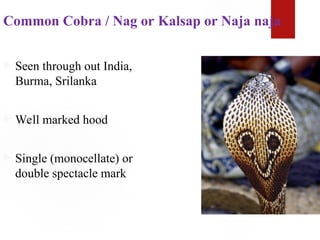
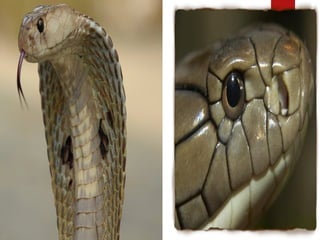
Common Cobra / Nag or Kalsap or Naja naja
 Seen through out India,
Burma, Srilanka
 Well marked hood
 Single (monocellate) or
double spectacle mark
Common krait
Neurotoxic
2. VIPERIDAE
They are grouped into
a) Russel ‘s Viper
b) Saw-scaled Viper
c) Pit Viper- Crotalidae
d) Common Green Pit Viper
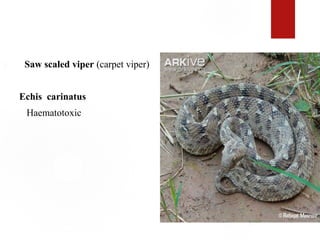
1. Saw scaled viper (carpet viper)
Echis carinatus
Haematotoxic
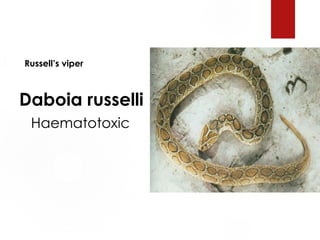
1. Russell’s viper
Daboia russelli
Haematotoxic
3. HYDROPHIDAE
 20 types of sea snakes found in India.
 All are poisonous.
 They are myotoxic.
Snake Bite and Snake Venom
 When a snake bites, it may excrete venom but this is dependent on the
type of snake – venomous or non venomous.
 Snake Venom is a Toxin
 (Hematotoxin, Neurotoxin, or Cytotoxin)
Mechanism of Toxicity of Venom
 The most common types of enzymes are proteolytic, phospholipases
and hyaluronidases
 Proteolytic Enzymes: digestive properties
 Phospholipases: degrade lipids
 Hyaluronidases: facilitates venom spread through out the body
SIGNS AND SYMPTOMS
 A. Elapid Bite:
a). Local Features :
Fang marks
Burning pain
Swelling and discoloration
Serosanguinous discharge
Local symptoms are milder in comparison to that in Viperine bite.
Systemic features
 Preparalytic stage:
 Vomiting
 Headache
 Giddiness
 Weakness and lethargy
 Paralytic stage:
 Ptosis.
 Ophthalmoplegia
Drowsiness
 Convulsion
 Bulbar paralysis
 Respiratory failure
 death
 B. Viperid bite :
 Local features : Rapid swelling at bite site
Discoloration
Blister formation
Bleeding from bite site
Pain
 Systemic features:
.Generalized bleeding : Epistaxis ,hemoptysis ,
hemetemesis ,bleeding gums ,hematuria , malena , hemaorrhagic
areas over skin and mucosa
.Shock
.Renal failure
C. Hydrophid bite
 Local features:
Local swelling
Pain
Systemic Features :
Myalgia
Muscle stiffness
Myoglobinuria
Renal failure
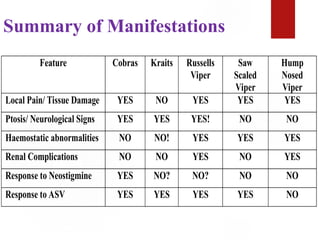
Summary of Manifestations
Feature Cobras Kraits Russells
Viper
Saw
Scaled
Viper
Hump
Nosed
Viper
Local Pain/ Tissue Damage YES NO YES YES YES
Ptosis/ Neurological Signs YES YES YES! NO NO
Haemostatic abnormalities NO NO! YES YES YES
Renal Complications NO NO YES NO YES
Response to Neostigmine YES NO? NO? NO NO
Response to ASV YES YES YES YES NO
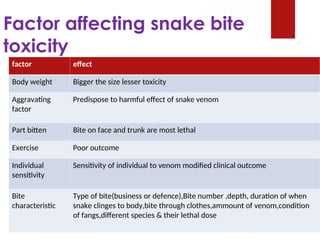
Factor affecting snake bite
toxicity
factor effect
Body weight Bigger the size lesser toxicity
Aggravating
factor
Predispose to harmful effect of snake venom
Part bitten Bite on face and trunk are most lethal
Exercise Poor outcome
Individual
sensitivity
Sensitivity of individual to venom modified clinical outcome
Bite
characteristic
Type of bite(business or defence),Bite number ,depth, duration of when
snake clinges to body,bite through clothes,ammount of venom,condition
of fangs,different species & their lethal dose
Prognosis assesment
 Time of bite
 Activity at the time of bite
 First aid action taken since the bite
 Clinical examination
 20 mn whole Blood Clotting Test
Lab investigations
20 WBCT-Test positive for viperine bite
Non Specific- Hemogram, S.Creatinine, S.Amylase, CPK, Creatine
Phosphokinase,
 PT, FDP & Fibrinogen level in viper bite interfer with clotting
mechanism.
 ABG, Electrolyte-for systemic manifestion.
 Urine Examination for Proteinuria , Myoglobinuria
 ECG-non specific changes like bradycardia, AV-block.
 EEG-mainly in temporal lobe.60% in Grade-I,31% Grade-II,4%
Grade III
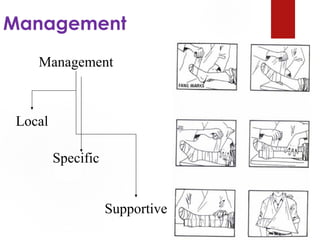
Management
Management
Local
Specific
Supportive
Management
 The first aid being currently recommended is based around the mnemonic:
“Do it R.I.G.H.T.”
R =Reassure the patient. 70% of all snakebites are from non-venomous species.
Only 50% of bites by venomous species actually envenomate the patient.
I = Immobilise in the same way as a fractured limb. Use bandages or cloth to
hold the splints, not to block the blood supply or apply pressure. Do not
apply any compression in the form of tight ligatures, they can be dangerous!
G.H. = Get to Hospital Immediately. Traditional remedies have NO PROVEN
benefit in treating snakebite.
T = Tell the doctor of any systemic symptoms such as ptosis that manifest on
the way to hospital.
First Aid
DOs-
Assurance of patient
Immobilisation
Application of tourniquet????
DON’TS-
Incision
Suction
Application of Ice ,massage or any chemical treatment
Specific treatment
Anti snake Venom
Indication for ASV
 Spontaneous systemic Bleeding
 WBCT > 20 min
 Thrombocytopenia (platelet < 1 lac)
 Shock, paralysis, ARF, Rhabdomyolysis, Hyperkalemia.
 Local swelling involving > ½ of bitten limb
 Rapid extension of swelling
Anti venom Therapy
 Ideally administer with in 4 hr but effective if given with in 24 hrs
In mild cases-5 vial (50 ml)
In moderate cases-5 to 10 vial
In severe cases-10 to 20 vial
Additional infusion containing 5 to 10 vial are infused until progression
of swelling ceased and systemic symptoms are disappeared.
 ASV can be administer slow i.v. injection or infusion @ rate of
2ml/min
 AVS dilute 5-10 ml/kg body weight of normal saline or 5%
dextrose and infused over 1 hr
 ASV should never given locally at site of snake bite.
Disadvantage of ASV
 Pain at injection site
 Hematoma formation
 Increase intra compartmental pressure
ASV SENSTIVITY IS NOT RECOMMONDED NOW A DAYS
Adverse reaction of ASV
 Seen in 20 % patient
Early anaphylactic reaction-
 Seen with in 10 min to 3 hrs
 Urticaria, diarrhoea, tachycardia, fever, hypotension, etc.
Late Serum Sickness
 1-12 days
 Fever,nausea,vomiting,diarhoea,artheritis,nephrits,myoglobinuria.etc.
Treatment Of Early ASV reaction
 Adrenaline -1:1000 i.m.
0.5 mg in adult
0.01 mg/kg in children
can be repeated every 5 min if necessary
H1 antihistaminic-i.v. 1 mg of CPM
I.V. Hydrocortisone
Treatment Of Late ASV reaction
 5 days course of oral anti histaminic CPM
2mg/6hour-adult
0.25 mg/kg/day in divided dose
Patient who fail to response with in 24 hr Predinisolone-
5mg/6h in adult
0.7 mg/kg/day in divided dose in children
Supportive therapy
 For Coagulopathy - if not reverse after ASV therapy
Fresh frozen plasma
Cryoprecipitate (fibrinogen, Factor VIII),
Fresh whole blood,
Platelet concentrate.
For Bulbar Paralysis & Resp. Failure-
 ASV alone not sufficient
 Tracheotomy, Endotrachial intubation,& mechanical ventilation
 Inj. of neostigmine-50 to 100 microgram/kg/4hrs as a continuous
infusion
 Glycopyrrolate-0.25 mg can be given before neostigmine in place of
atropine
don’t cross blood brain barrier
 Care of bitten part-
Antibiotic prophylaxis & ATS injection
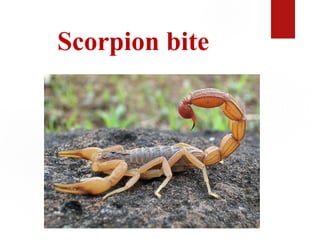
Scorpion bite
Introduction
 There are more than 1250 species of scorpions.
 About 100 species are found in India
 Eight legged arthropods, have a hollow sting in the last joint of their tail
 Venom is clear, colourless toxalbumen,and can be classified as either
neurotoxic or haemolytic.
 Toxicity is more than snake but only small quantity is injected.
 Venom is potent autonomic stimulator resulting in the release of
massive amount of catecholamine from adrenals.
 The mortality, except in children is negligible.
Signs And Symptoms
In case of haemolytic venom-
 reaction is mainly local and simulates the viper snake bite, but the
scorpion sting will have only one hole in the centre of reddened area.
 The extremity will have pain and oedema.
In case of neurotoxic venom-
 symptoms produced are similar to cobra bite.
 There are usually no mark reaction in local area.
 Nausea,vomiting,extreme restlessness,fever,
paralysis,cardiac arrythmia,convulsions,coma and cyanosis,respiratory
depression,and death may occur with in hours from pulmonary oedema and
cardiac failure.
 Diagnosis is confirmed by ELISA testing.
Treatment
 Immobilise the limb and apply a torniquet above the location of sting
 Pack sting in ice, and incise and use suction, and wash with week
solution of ammonia, borax or potassium permanganate
 A local anaesthetic (2% novocaine or 5% cocaine) is injected at site of
pain
 A specific antivenin is available foe most species
 Calcium gluconate i.v. to control local swelling.
 Barbiturate to reduce convulsions.
 Morphine is contraindicated
 Atropine is valuable to prevent pulmonary oedema
Thank you

snake&scorpion bites and their management

  • 1.
    Approach to snakebite and scorpion bite Dr. H.N. Bhitkar Associate professor Department of general medicine B.J.G.M.C & S.G.H. Pune
  • 2.
    Classification of snakes Poisonoussnakes belong to three Families on the basis of poison secreted :  1. Elapidae : Neurotoxic  2. Viperidae : Vasculotoxic  3. Hydrophidae : Myotoxic
  • 3.
    1. ELAPIDAE  A)Common Cobra  B) King Cobra  C) Krait
  • 4.
    Common Cobra /Nag or Kalsap or Naja naja  Seen through out India, Burma, Srilanka  Well marked hood  Single (monocellate) or double spectacle mark
  • 6.
  • 7.
    2. VIPERIDAE They aregrouped into a) Russel ‘s Viper b) Saw-scaled Viper c) Pit Viper- Crotalidae d) Common Green Pit Viper
  • 8.
    1. Saw scaledviper (carpet viper) Echis carinatus Haematotoxic
  • 9.
    1. Russell’s viper Daboiarusselli Haematotoxic
  • 10.
    3. HYDROPHIDAE  20types of sea snakes found in India.  All are poisonous.  They are myotoxic.
  • 11.
    Snake Bite andSnake Venom  When a snake bites, it may excrete venom but this is dependent on the type of snake – venomous or non venomous.  Snake Venom is a Toxin  (Hematotoxin, Neurotoxin, or Cytotoxin)
  • 12.
    Mechanism of Toxicityof Venom  The most common types of enzymes are proteolytic, phospholipases and hyaluronidases  Proteolytic Enzymes: digestive properties  Phospholipases: degrade lipids  Hyaluronidases: facilitates venom spread through out the body
  • 13.
    SIGNS AND SYMPTOMS A. Elapid Bite: a). Local Features : Fang marks Burning pain Swelling and discoloration Serosanguinous discharge Local symptoms are milder in comparison to that in Viperine bite.
  • 14.
    Systemic features  Preparalyticstage:  Vomiting  Headache  Giddiness  Weakness and lethargy  Paralytic stage:  Ptosis.  Ophthalmoplegia Drowsiness  Convulsion  Bulbar paralysis  Respiratory failure  death
  • 15.
     B. Viperidbite :  Local features : Rapid swelling at bite site Discoloration Blister formation Bleeding from bite site Pain
  • 16.
     Systemic features: .Generalizedbleeding : Epistaxis ,hemoptysis , hemetemesis ,bleeding gums ,hematuria , malena , hemaorrhagic areas over skin and mucosa .Shock .Renal failure
  • 17.
    C. Hydrophid bite Local features: Local swelling Pain Systemic Features : Myalgia Muscle stiffness Myoglobinuria Renal failure
  • 18.
    Summary of Manifestations FeatureCobras Kraits Russells Viper Saw Scaled Viper Hump Nosed Viper Local Pain/ Tissue Damage YES NO YES YES YES Ptosis/ Neurological Signs YES YES YES! NO NO Haemostatic abnormalities NO NO! YES YES YES Renal Complications NO NO YES NO YES Response to Neostigmine YES NO? NO? NO NO Response to ASV YES YES YES YES NO
  • 19.
    Factor affecting snakebite toxicity factor effect Body weight Bigger the size lesser toxicity Aggravating factor Predispose to harmful effect of snake venom Part bitten Bite on face and trunk are most lethal Exercise Poor outcome Individual sensitivity Sensitivity of individual to venom modified clinical outcome Bite characteristic Type of bite(business or defence),Bite number ,depth, duration of when snake clinges to body,bite through clothes,ammount of venom,condition of fangs,different species & their lethal dose
  • 20.
    Prognosis assesment  Timeof bite  Activity at the time of bite  First aid action taken since the bite  Clinical examination  20 mn whole Blood Clotting Test
  • 21.
    Lab investigations 20 WBCT-Testpositive for viperine bite Non Specific- Hemogram, S.Creatinine, S.Amylase, CPK, Creatine Phosphokinase,  PT, FDP & Fibrinogen level in viper bite interfer with clotting mechanism.  ABG, Electrolyte-for systemic manifestion.  Urine Examination for Proteinuria , Myoglobinuria
  • 22.
     ECG-non specificchanges like bradycardia, AV-block.  EEG-mainly in temporal lobe.60% in Grade-I,31% Grade-II,4% Grade III
  • 23.
  • 24.
    Management  The firstaid being currently recommended is based around the mnemonic: “Do it R.I.G.H.T.” R =Reassure the patient. 70% of all snakebites are from non-venomous species. Only 50% of bites by venomous species actually envenomate the patient. I = Immobilise in the same way as a fractured limb. Use bandages or cloth to hold the splints, not to block the blood supply or apply pressure. Do not apply any compression in the form of tight ligatures, they can be dangerous! G.H. = Get to Hospital Immediately. Traditional remedies have NO PROVEN benefit in treating snakebite. T = Tell the doctor of any systemic symptoms such as ptosis that manifest on the way to hospital.
  • 25.
    First Aid DOs- Assurance ofpatient Immobilisation Application of tourniquet???? DON’TS- Incision Suction Application of Ice ,massage or any chemical treatment
  • 26.
    Specific treatment Anti snakeVenom Indication for ASV  Spontaneous systemic Bleeding  WBCT > 20 min  Thrombocytopenia (platelet < 1 lac)  Shock, paralysis, ARF, Rhabdomyolysis, Hyperkalemia.  Local swelling involving > ½ of bitten limb  Rapid extension of swelling
  • 27.
    Anti venom Therapy Ideally administer with in 4 hr but effective if given with in 24 hrs In mild cases-5 vial (50 ml) In moderate cases-5 to 10 vial In severe cases-10 to 20 vial Additional infusion containing 5 to 10 vial are infused until progression of swelling ceased and systemic symptoms are disappeared.
  • 28.
     ASV canbe administer slow i.v. injection or infusion @ rate of 2ml/min  AVS dilute 5-10 ml/kg body weight of normal saline or 5% dextrose and infused over 1 hr  ASV should never given locally at site of snake bite.
  • 29.
    Disadvantage of ASV Pain at injection site  Hematoma formation  Increase intra compartmental pressure ASV SENSTIVITY IS NOT RECOMMONDED NOW A DAYS
  • 30.
    Adverse reaction ofASV  Seen in 20 % patient Early anaphylactic reaction-  Seen with in 10 min to 3 hrs  Urticaria, diarrhoea, tachycardia, fever, hypotension, etc. Late Serum Sickness  1-12 days  Fever,nausea,vomiting,diarhoea,artheritis,nephrits,myoglobinuria.etc.
  • 31.
    Treatment Of EarlyASV reaction  Adrenaline -1:1000 i.m. 0.5 mg in adult 0.01 mg/kg in children can be repeated every 5 min if necessary H1 antihistaminic-i.v. 1 mg of CPM I.V. Hydrocortisone
  • 32.
    Treatment Of LateASV reaction  5 days course of oral anti histaminic CPM 2mg/6hour-adult 0.25 mg/kg/day in divided dose Patient who fail to response with in 24 hr Predinisolone- 5mg/6h in adult 0.7 mg/kg/day in divided dose in children
  • 33.
    Supportive therapy  ForCoagulopathy - if not reverse after ASV therapy Fresh frozen plasma Cryoprecipitate (fibrinogen, Factor VIII), Fresh whole blood, Platelet concentrate.
  • 34.
    For Bulbar Paralysis& Resp. Failure-  ASV alone not sufficient  Tracheotomy, Endotrachial intubation,& mechanical ventilation  Inj. of neostigmine-50 to 100 microgram/kg/4hrs as a continuous infusion  Glycopyrrolate-0.25 mg can be given before neostigmine in place of atropine don’t cross blood brain barrier  Care of bitten part- Antibiotic prophylaxis & ATS injection
  • 35.
  • 36.
    Introduction  There aremore than 1250 species of scorpions.  About 100 species are found in India  Eight legged arthropods, have a hollow sting in the last joint of their tail  Venom is clear, colourless toxalbumen,and can be classified as either neurotoxic or haemolytic.
  • 37.
     Toxicity ismore than snake but only small quantity is injected.  Venom is potent autonomic stimulator resulting in the release of massive amount of catecholamine from adrenals.  The mortality, except in children is negligible.
  • 38.
    Signs And Symptoms Incase of haemolytic venom-  reaction is mainly local and simulates the viper snake bite, but the scorpion sting will have only one hole in the centre of reddened area.  The extremity will have pain and oedema.
  • 39.
    In case ofneurotoxic venom-  symptoms produced are similar to cobra bite.  There are usually no mark reaction in local area.  Nausea,vomiting,extreme restlessness,fever, paralysis,cardiac arrythmia,convulsions,coma and cyanosis,respiratory depression,and death may occur with in hours from pulmonary oedema and cardiac failure.  Diagnosis is confirmed by ELISA testing.
  • 40.
    Treatment  Immobilise thelimb and apply a torniquet above the location of sting  Pack sting in ice, and incise and use suction, and wash with week solution of ammonia, borax or potassium permanganate  A local anaesthetic (2% novocaine or 5% cocaine) is injected at site of pain
  • 41.
     A specificantivenin is available foe most species  Calcium gluconate i.v. to control local swelling.  Barbiturate to reduce convulsions.  Morphine is contraindicated  Atropine is valuable to prevent pulmonary oedema
  • 42.