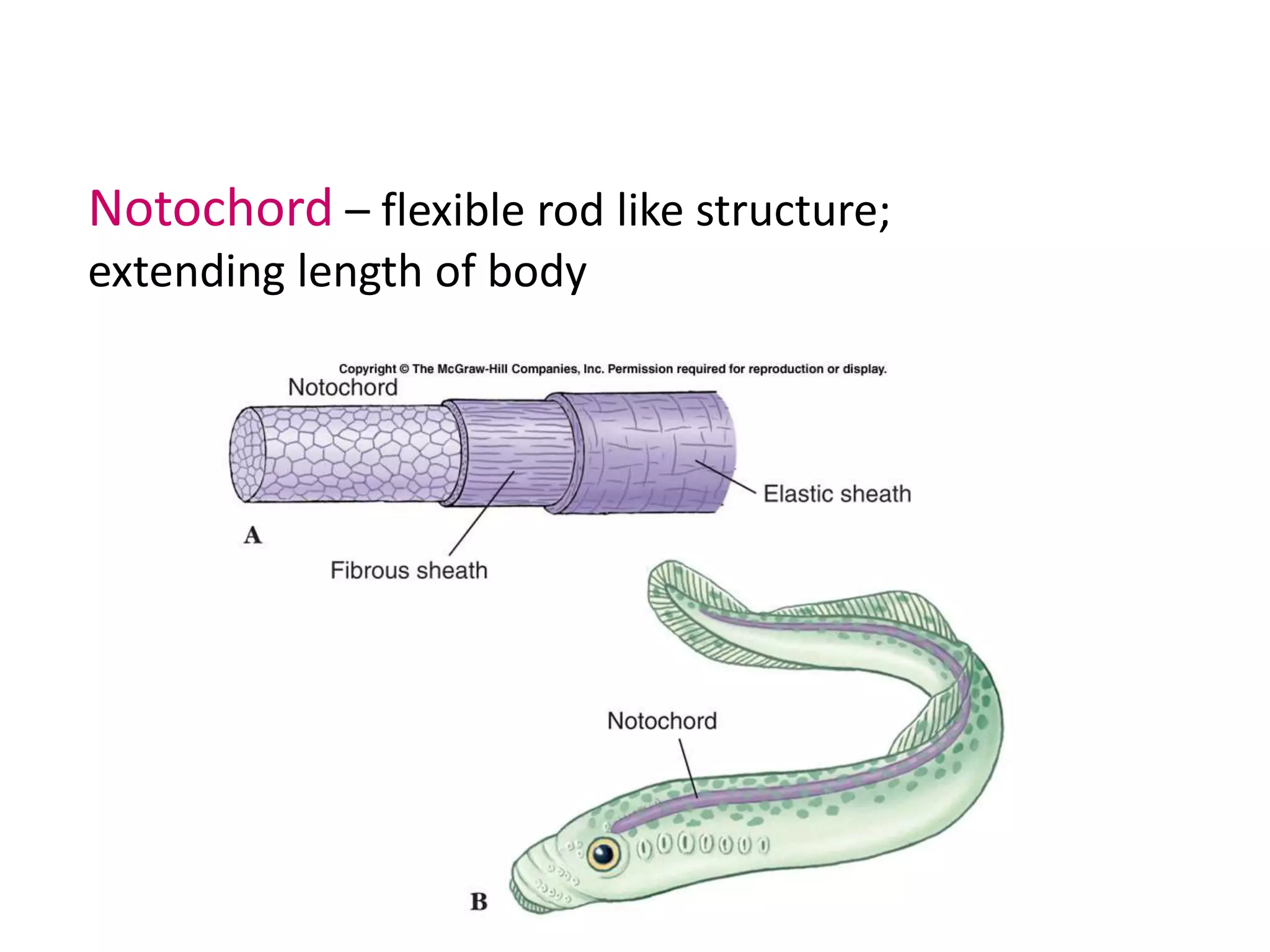
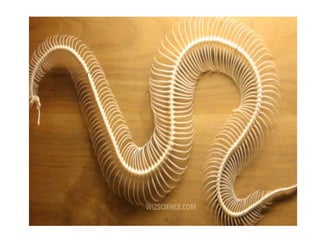

Notochord – flexible rod like structure;
extending length of body
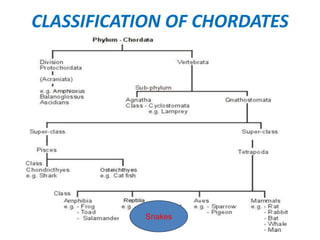
CLASSIFICATION OF CHORDATES
Snakes
SNAKES
Dr.K.RAMESHKUMAR
Assistant Professor
PG & Research Dept. of Zoology
Vivekananda College
Tiruvedakam West
OBJECTIVES
• Characteristics of Reptilia
• Systematic position of Snake
• Characteristics of Snake
• Biting Mechanism
• Snake Venom
• Effect of Venom
• Antivenine
• Poisonous Snakes of South India
• Management & Treatment
CHARACTERISTICS OF REPTILIA
Disliked animal group
First Land Vertebrates
Creeping Animals
Bilaterally Symmetry
Herpetology
Poikilotherms
Dry & Scales
Two Pairs of limbs
Heart – 3 Chambers
Respiration – lungs
Carnivores
Uricotelic Animals
Sexual Dimorphism
Fertilization is Internal
Oviparous/Viviparous
Parental Care is absent
INTRODUCTION
• In Sanskrit snakes – Chakshu shravaa
• In World, 300/3000 species of snakes
• 30000 to 40000 persons die of snake
bite in the world every year (WHO)
• In India, 69/330 species of snakes
• 15000 to 20000 persons die of snake
bite in the world every year (WHO)
SYSTEMATIC POSITION –
SNAKE
PHYLUM : Chordata
SUB PHYLUM : Vertebrates
CLASS : Reptilia
ORDER : Squamata
SUB ORDER : Ophidia/Serpentes
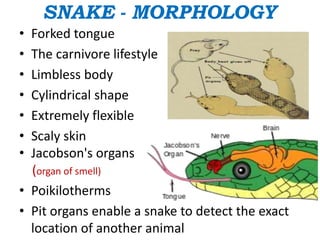
SNAKE - MORPHOLOGY
• Forked tongue
• The carnivore lifestyle
• Limbless body
• Cylindrical shape
• Extremely flexible
• Scaly skin
• Jacobson's organs
(organ of smell)
• Poikilotherms
• Pit organs enable a snake to detect the exact
location of another animal
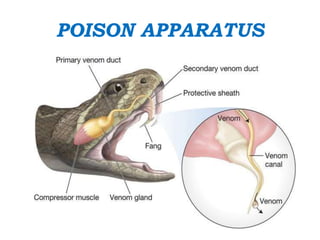
POISON APPARATUS
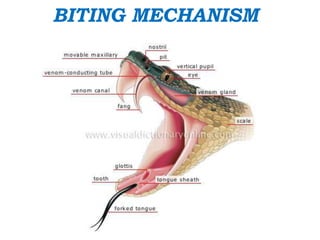
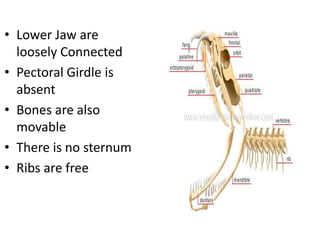
BITING MECHANISM
• Lower Jaw are
loosely Connected
• Pectoral Girdle is
absent
• Bones are also
movable
• There is no sternum
• Ribs are free
SNAKE VENOM
 Yellow or Greenish colour
 Complex mixture of various enzymes and
specific toxins
 Digestive juice
 90% protein
 Have 25 different enzymes found in
various venoms and 10 of these occur
frequently in most venoms
Cont…
 Synergistic in effects: different venoms
contain different combinations of enzymes
causing a more potent effect than any of
the individual effects
COMPOSITION OF SNAKE
VENOM
Enzymes:
• Phospholipase A2(Lecithinase), 5’-nucleotidase,
collaginase, L-aminoacid oxidase, proteinases,
hyaluronidase,
• Phospholipase-b (Cobra)
• Endopeptidases, kininogenase, factor-X,
prothrombin activating enzyme (Viper)
Toxins:
• α- bungarotoxin, β- bungarotoxin, Crotoxin,
Crotamine, Cardiotoxin.
Peptide - Pyroglutamyl peptide
Nucleoside - Adenine, Guanine, Inosine.
Lipid - Phospholipid, Cholestrol
Amine – Histamine – engage the pathogen
infection
Serotonin – affect the brain function
Metal - Cu,Zn,Ni,Mg.
Mechanism of Toxicity of Venom
• The most common types of enzymes are
proteolytic, phospholipases and
hyaluronidases
– Proteolytic Enzymes: digestive properties
– Phospholipases: degrade lipids
– Hyaluronidases: facilitates venom spread through
out the body
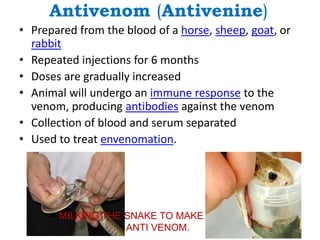
Antivenom (Antivenine)
• Prepared from the blood of a horse, sheep, goat, or
rabbit
• Repeated injections for 6 months
• Doses are gradually increased
• Animal will undergo an immune response to the
venom, producing antibodies against the venom
• Collection of blood and serum separated
• Used to treat envenomation.
MILKING THE SNAKE TO MAKE
ANTI VENOM.
Poisonous Snakes
Classification of snakes
Three Families:
• 1. Elapidae : Neurotoxic (Eg. Cobra,
Krait & Coral Snake)
• 2. Viperidae : Haemotoxic (Eg. Viper,
Saw Scaled Viper)
• 3. Hydrophidae : Myotoxic/Cytotoxic
(Eg. Sea Snake)
1. ELAPIDAE
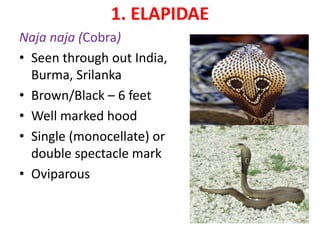
Naja naja (Cobra)
• Seen through out India,
Burma, Srilanka
• Brown/Black – 6 feet
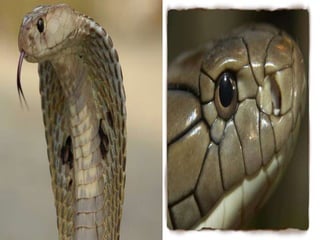
• Well marked hood
• Single (monocellate) or
double spectacle mark
• Oviparous
1. ELAPIDAE
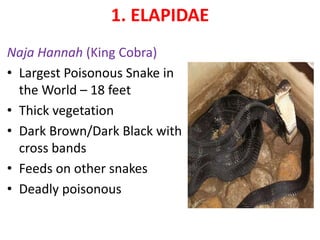
Naja Hannah (King Cobra)
• Largest Poisonous Snake in
the World – 18 feet
• Thick vegetation
• Dark Brown/Dark Black with
cross bands
• Feeds on other snakes
• Deadly poisonous
1. ELAPIDAE
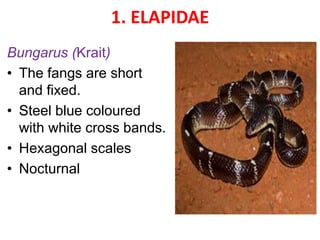
Bungarus (Krait)
• The fangs are short
and fixed.
• Steel blue coloured
with white cross bands.
• Hexagonal scales
• Nocturnal
1. ELAPIDAE
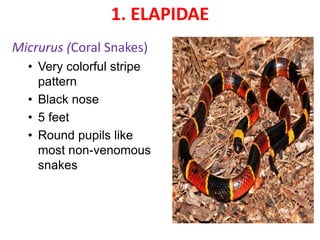
Micrurus (Coral Snakes)
• Very colorful stripe
pattern
• Black nose
• 5 feet
• Round pupils like
most non-venomous
snakes
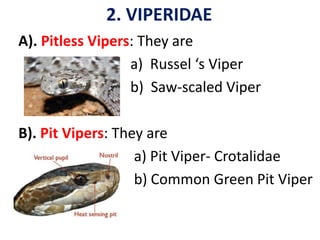
2. VIPERIDAE
A). Pitless Vipers: They are
a) Russel ‘s Viper
b) Saw-scaled Viper
B). Pit Vipers: They are
a) Pit Viper- Crotalidae
b) Common Green Pit Viper
2. VIPERIDAE
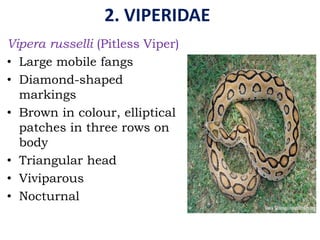
Vipera russelli (Pitless Viper)
• Large mobile fangs
• Diamond-shaped
markings
• Brown in colour, elliptical
patches in three rows on
body
• Triangular head
• Viviparous
• Nocturnal
2. VIPERIDAE
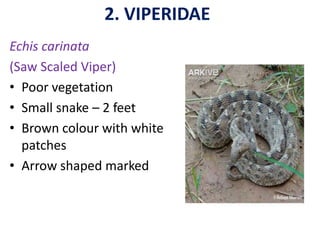
Echis carinata
(Saw Scaled Viper)
• Poor vegetation
• Small snake – 2 feet
• Brown colour with white
patches
• Arrow shaped marked
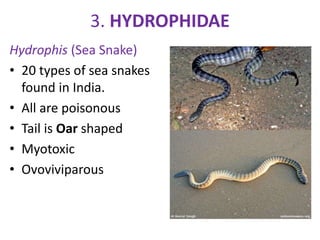
3. HYDROPHIDAE
Hydrophis (Sea Snake)
• 20 types of sea snakes
found in India.
• All are poisonous
• Tail is Oar shaped
• Myotoxic
• Ovoviviparous
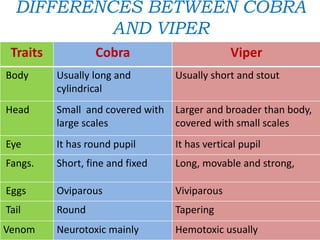
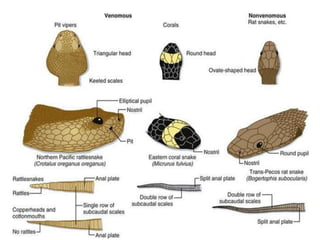
DIFFERENCES BETWEEN COBRA
AND VIPER
Traits Cobra Viper
Body Usually long and
cylindrical
Usually short and stout
Head Small and covered with
large scales
Larger and broader than body,
covered with small scales
Eye It has round pupil It has vertical pupil
Fangs. Short, fine and fixed Long, movable and strong,
Eggs Oviparous Viviparous
Tail Round Tapering
Venom Neurotoxic mainly Hemotoxic usually
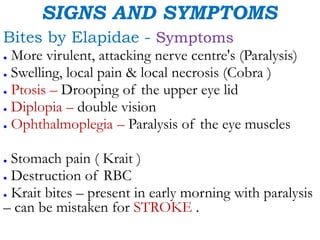
SIGNS AND SYMPTOMS
Bites by Elapidae - Symptoms
● More virulent, attacking nerve centre's (Paralysis)
● Swelling, local pain & local necrosis (Cobra )
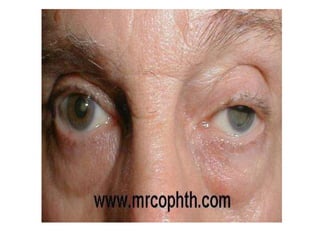
● Ptosis – Drooping of the upper eye lid
● Diplopia – double vision
● Ophthalmoplegia – Paralysis of the eye muscles
● Stomach pain ( Krait )
● Destruction of RBC
● Krait bites – present in early morning with paralysis
– can be mistaken for STROKE .
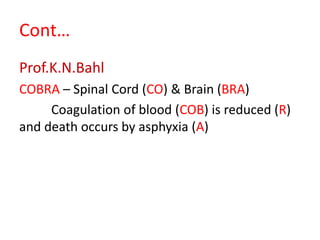
Cont…
Prof.K.N.Bahl
COBRA – Spinal Cord (CO) & Brain (BRA)
Coagulation of blood (COB) is reduced (R)
and death occurs by asphyxia (A)
Bites by Viperidae
Symptoms
● Severe local effects – as early as within 15 min of
bite
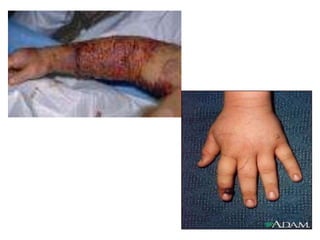
● Extensive Swelling – spreading quickly to involve
whole limb.
● Necrosis – destruction of tissue
● Hemostatic abnormality
● Abdominal Pain
● Passage of reddish/dark brown
urine/diminishing/ nil urine output
● Low back pain , indicative of early renal failure
● Renal failure – Viper
Bites by Hydrophidae
Symptoms
 Local swelling
 Rhabdomyolysis – damage of skeletal muscle
 Myalgia – Muscle pain
 Muscle stiffness
 Myoglobinuria - Presence of myoglobin in the
urine
 Paralysis (inability to move) legs
 Excessive saliva production
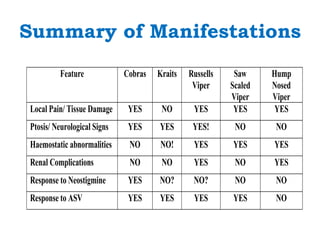
Summary of Manifestations
Feature Cobras Kraits Russells
Viper
Saw
Scaled
Viper
Hump
Nosed
Viper
Local Pain/ Tissue Damage YES NO YES YES YES
Ptosis/ Neurological Signs YES YES YES! NO NO
Haemostatic abnormalities NO NO! YES YES YES
Renal Complications NO NO YES NO YES
Response to Neostigmine YES NO? NO? NO NO
Response to ASV YES YES YES YES NO
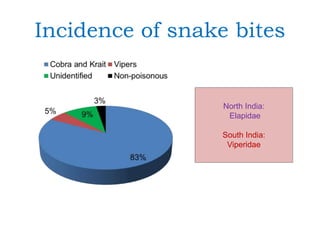
Incidence of snake bites
North India:
Elapidae
South India:
Viperidae
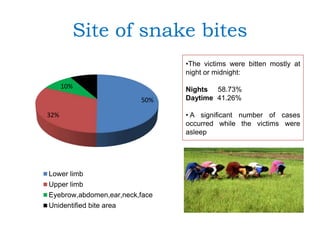
Site of snake bites
50%
32%
10%
8%
Lower limb
Upper limb
Eyebrow,abdomen,ear,neck,face
Unidentified bite area
•The victims were bitten mostly at
night or midnight:
Nights 58.73%
Daytime 41.26%
• A significant number of cases
occurred while the victims were
asleep
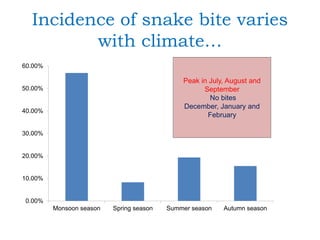
Incidence of snake bite varies
with climate…
0.00%
10.00%
20.00%
30.00%
40.00%
50.00%
60.00%
Monsoon season Spring season Summer season Autumn season
Peak in July, August and
September
No bites
December, January and
February
Management
 The first aid being currently recommended is based around the
mnemonic: “Do it R.I.G.H.T.”
R =Reassure the patient. 70% of all snakebites are from non-venomous
species. Only 50% of bites by venomous species actually envenomate
the patient.
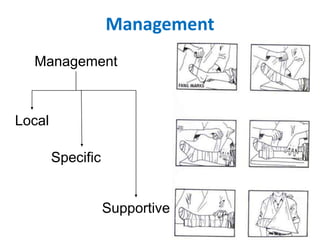
I = Immobilise in the same way as a fractured limb. Use bandages or
cloth to hold the splints, not to block the blood supply or apply
pressure. Do not apply any compression in the form of tight ligatures,
they can be dangerous!
G.H. = Get to Hospital Immediately. Traditional remedies have NO
PROVEN benefit in treating snakebite.
T = Tell the doctor of any systemic symptoms such as ptosis that
manifest on the way to hospital.
Management
Management
Local
Specific
Supportive
Do’s in Snake Bite…
• Encouragement
• Relieve anxiety
• Call for help
• Wash with water and soap (gloves)
• Remove constricting clothes
• Take to hospital – May need AVS
• If possible; the dead/alive snake or photo too
Dont’s in Snake Bite…
• Waste time trying to kill the snake
• No cutting or sucking
• Do not apply any oils/home medications on
the wound
• Do not elevate the limb/keep below heart
level
• Do not tie with anything
• Assume the snake is non-poisonous
TREATMENT FOR SNAKE BITE
• Call for emergency assistance immediately if someone has
been bitten by a snake. Responding quickly in this type of
emergency is crucial. While waiting for emergency assistance:
• Wash the bite with soap and water.
Immobilize the bitten area and keep it lower than the heart.
Cover the area with a clean, cool compress or a moist dressing
to minimize swelling and discomfort.
• Give Anti venom.
Investigations
● Complete Blood Count – Anemia, Leucocytosis,
Thrombocytopenia, Hematocrit
● Evidence of Hemolysis – Fragmented RBCs
● Prolonged Clotting Time – Activated Partial
Thromboplastin Time (APTT)
● Serum Electrolytes – Hyperkalemia, Raised Urea,
Creatinine
Cont..
● Urine for RBC – Viper Bite – Hematuria,
Proteinuria, Hemoglobinuria, Myoglobinuria
● ECG – Normal, Bradycardia with ST elevation or
depression, T inversion, QT prolongation
● ABG – Hypoxemia with Respiratory Acidosis,
Metabolic / lactic Acidosis
● Chest X- ray – Normal, Pulmonary Oedema,
Intrapulmonary Hemorhages, Pleural
Effusion
Monitor Vital Signs
● Observe every patient for minimum 24 hours
● Pulse, BP, Respiration
● Urine output
● Blood urea, Creatinine
● Bleeding tendency
● Local swelling
● Vomiting
● Diplopia, Ptosis, Muscle Weakness, Breathlessness
LIST OF ANTIVENOM MANUFACTURERS
IN INDIA
1. Central Research Institute of Kasauli, HP*
2. Haffkine Biopharmaceutical Co., Mumbai,
MS *
3. Serum Institute of India Ltd., Pune, MS *
4. VINS Bioproducts Ltd., Andhra Pradesh
5. Kings Institute of Preventive Medicines,
Chennai *
6. Bharat Serums & Vaccines Ltd., Mumbai
* Approximately 5 lakh vials are produced
annually.
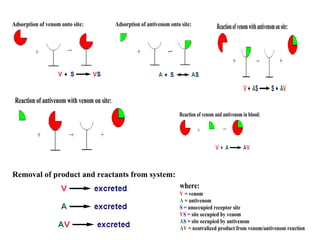
Adsorption of venom onto site: Adsorption of antivenom onto site:
where:
V = venom
A = antivenom
S = unoccupied receptor site
VS = site occupied by venom
AS = site occupied by antivenom
AV = neutralized product from venom/antivenom reaction
Reactionofvenomwithantivenomonsite:
Reaction of antivenom with venom on site:
Reaction of venom and antivenom in blood:
Removal of product and reactants from system:
Questions

Snake

  • 1.
    Notochord – flexiblerod like structure; extending length of body
  • 2.
  • 3.
    SNAKES Dr.K.RAMESHKUMAR Assistant Professor PG &Research Dept. of Zoology Vivekananda College Tiruvedakam West
  • 4.
    OBJECTIVES • Characteristics ofReptilia • Systematic position of Snake • Characteristics of Snake • Biting Mechanism • Snake Venom • Effect of Venom • Antivenine • Poisonous Snakes of South India • Management & Treatment
  • 5.
    CHARACTERISTICS OF REPTILIA Dislikedanimal group First Land Vertebrates Creeping Animals Bilaterally Symmetry Herpetology Poikilotherms Dry & Scales Two Pairs of limbs Heart – 3 Chambers Respiration – lungs Carnivores Uricotelic Animals Sexual Dimorphism Fertilization is Internal Oviparous/Viviparous Parental Care is absent
  • 6.
    INTRODUCTION • In Sanskritsnakes – Chakshu shravaa • In World, 300/3000 species of snakes • 30000 to 40000 persons die of snake bite in the world every year (WHO) • In India, 69/330 species of snakes • 15000 to 20000 persons die of snake bite in the world every year (WHO)
  • 7.
    SYSTEMATIC POSITION – SNAKE PHYLUM: Chordata SUB PHYLUM : Vertebrates CLASS : Reptilia ORDER : Squamata SUB ORDER : Ophidia/Serpentes
  • 8.
    SNAKE - MORPHOLOGY •Forked tongue • The carnivore lifestyle • Limbless body • Cylindrical shape • Extremely flexible • Scaly skin • Jacobson's organs (organ of smell) • Poikilotherms • Pit organs enable a snake to detect the exact location of another animal
  • 9.
  • 10.
  • 11.
    • Lower Jaware loosely Connected • Pectoral Girdle is absent • Bones are also movable • There is no sternum • Ribs are free
  • 13.
    SNAKE VENOM  Yellowor Greenish colour  Complex mixture of various enzymes and specific toxins  Digestive juice  90% protein  Have 25 different enzymes found in various venoms and 10 of these occur frequently in most venoms
  • 14.
    Cont…  Synergistic ineffects: different venoms contain different combinations of enzymes causing a more potent effect than any of the individual effects
  • 15.
    COMPOSITION OF SNAKE VENOM Enzymes: •Phospholipase A2(Lecithinase), 5’-nucleotidase, collaginase, L-aminoacid oxidase, proteinases, hyaluronidase, • Phospholipase-b (Cobra) • Endopeptidases, kininogenase, factor-X, prothrombin activating enzyme (Viper)
  • 16.
    Toxins: • α- bungarotoxin,β- bungarotoxin, Crotoxin, Crotamine, Cardiotoxin. Peptide - Pyroglutamyl peptide Nucleoside - Adenine, Guanine, Inosine. Lipid - Phospholipid, Cholestrol Amine – Histamine – engage the pathogen infection Serotonin – affect the brain function Metal - Cu,Zn,Ni,Mg.
  • 17.
    Mechanism of Toxicityof Venom • The most common types of enzymes are proteolytic, phospholipases and hyaluronidases – Proteolytic Enzymes: digestive properties – Phospholipases: degrade lipids – Hyaluronidases: facilitates venom spread through out the body
  • 18.
    Antivenom (Antivenine) • Preparedfrom the blood of a horse, sheep, goat, or rabbit • Repeated injections for 6 months • Doses are gradually increased • Animal will undergo an immune response to the venom, producing antibodies against the venom • Collection of blood and serum separated • Used to treat envenomation. MILKING THE SNAKE TO MAKE ANTI VENOM.
  • 19.
    Poisonous Snakes Classification ofsnakes Three Families: • 1. Elapidae : Neurotoxic (Eg. Cobra, Krait & Coral Snake) • 2. Viperidae : Haemotoxic (Eg. Viper, Saw Scaled Viper) • 3. Hydrophidae : Myotoxic/Cytotoxic (Eg. Sea Snake)
  • 20.
    1. ELAPIDAE Naja naja(Cobra) • Seen through out India, Burma, Srilanka • Brown/Black – 6 feet • Well marked hood • Single (monocellate) or double spectacle mark • Oviparous
  • 22.
    1. ELAPIDAE Naja Hannah(King Cobra) • Largest Poisonous Snake in the World – 18 feet • Thick vegetation • Dark Brown/Dark Black with cross bands • Feeds on other snakes • Deadly poisonous
  • 23.
    1. ELAPIDAE Bungarus (Krait) •The fangs are short and fixed. • Steel blue coloured with white cross bands. • Hexagonal scales • Nocturnal
  • 24.
    1. ELAPIDAE Micrurus (CoralSnakes) • Very colorful stripe pattern • Black nose • 5 feet • Round pupils like most non-venomous snakes
  • 25.
    2. VIPERIDAE A). PitlessVipers: They are a) Russel ‘s Viper b) Saw-scaled Viper B). Pit Vipers: They are a) Pit Viper- Crotalidae b) Common Green Pit Viper
  • 26.
    2. VIPERIDAE Vipera russelli(Pitless Viper) • Large mobile fangs • Diamond-shaped markings • Brown in colour, elliptical patches in three rows on body • Triangular head • Viviparous • Nocturnal
  • 27.
    2. VIPERIDAE Echis carinata (SawScaled Viper) • Poor vegetation • Small snake – 2 feet • Brown colour with white patches • Arrow shaped marked
  • 28.
    3. HYDROPHIDAE Hydrophis (SeaSnake) • 20 types of sea snakes found in India. • All are poisonous • Tail is Oar shaped • Myotoxic • Ovoviviparous
  • 29.
    DIFFERENCES BETWEEN COBRA ANDVIPER Traits Cobra Viper Body Usually long and cylindrical Usually short and stout Head Small and covered with large scales Larger and broader than body, covered with small scales Eye It has round pupil It has vertical pupil Fangs. Short, fine and fixed Long, movable and strong, Eggs Oviparous Viviparous Tail Round Tapering Venom Neurotoxic mainly Hemotoxic usually
  • 30.
    SIGNS AND SYMPTOMS Bitesby Elapidae - Symptoms ● More virulent, attacking nerve centre's (Paralysis) ● Swelling, local pain & local necrosis (Cobra ) ● Ptosis – Drooping of the upper eye lid ● Diplopia – double vision ● Ophthalmoplegia – Paralysis of the eye muscles ● Stomach pain ( Krait ) ● Destruction of RBC ● Krait bites – present in early morning with paralysis – can be mistaken for STROKE .
  • 31.
    Cont… Prof.K.N.Bahl COBRA – SpinalCord (CO) & Brain (BRA) Coagulation of blood (COB) is reduced (R) and death occurs by asphyxia (A)
  • 33.
    Bites by Viperidae Symptoms ●Severe local effects – as early as within 15 min of bite ● Extensive Swelling – spreading quickly to involve whole limb. ● Necrosis – destruction of tissue ● Hemostatic abnormality ● Abdominal Pain ● Passage of reddish/dark brown urine/diminishing/ nil urine output ● Low back pain , indicative of early renal failure ● Renal failure – Viper
  • 35.
    Bites by Hydrophidae Symptoms Local swelling  Rhabdomyolysis – damage of skeletal muscle  Myalgia – Muscle pain  Muscle stiffness  Myoglobinuria - Presence of myoglobin in the urine  Paralysis (inability to move) legs  Excessive saliva production
  • 36.
    Summary of Manifestations FeatureCobras Kraits Russells Viper Saw Scaled Viper Hump Nosed Viper Local Pain/ Tissue Damage YES NO YES YES YES Ptosis/ Neurological Signs YES YES YES! NO NO Haemostatic abnormalities NO NO! YES YES YES Renal Complications NO NO YES NO YES Response to Neostigmine YES NO? NO? NO NO Response to ASV YES YES YES YES NO
  • 38.
    Incidence of snakebites North India: Elapidae South India: Viperidae
  • 39.
    Site of snakebites 50% 32% 10% 8% Lower limb Upper limb Eyebrow,abdomen,ear,neck,face Unidentified bite area •The victims were bitten mostly at night or midnight: Nights 58.73% Daytime 41.26% • A significant number of cases occurred while the victims were asleep
  • 40.
    Incidence of snakebite varies with climate… 0.00% 10.00% 20.00% 30.00% 40.00% 50.00% 60.00% Monsoon season Spring season Summer season Autumn season Peak in July, August and September No bites December, January and February
  • 41.
    Management  The firstaid being currently recommended is based around the mnemonic: “Do it R.I.G.H.T.” R =Reassure the patient. 70% of all snakebites are from non-venomous species. Only 50% of bites by venomous species actually envenomate the patient. I = Immobilise in the same way as a fractured limb. Use bandages or cloth to hold the splints, not to block the blood supply or apply pressure. Do not apply any compression in the form of tight ligatures, they can be dangerous! G.H. = Get to Hospital Immediately. Traditional remedies have NO PROVEN benefit in treating snakebite. T = Tell the doctor of any systemic symptoms such as ptosis that manifest on the way to hospital.
  • 42.
  • 43.
    Do’s in SnakeBite… • Encouragement • Relieve anxiety • Call for help • Wash with water and soap (gloves) • Remove constricting clothes • Take to hospital – May need AVS • If possible; the dead/alive snake or photo too
  • 44.
    Dont’s in SnakeBite… • Waste time trying to kill the snake • No cutting or sucking • Do not apply any oils/home medications on the wound • Do not elevate the limb/keep below heart level • Do not tie with anything • Assume the snake is non-poisonous
  • 45.
    TREATMENT FOR SNAKEBITE • Call for emergency assistance immediately if someone has been bitten by a snake. Responding quickly in this type of emergency is crucial. While waiting for emergency assistance: • Wash the bite with soap and water. Immobilize the bitten area and keep it lower than the heart. Cover the area with a clean, cool compress or a moist dressing to minimize swelling and discomfort. • Give Anti venom.
  • 46.
    Investigations ● Complete BloodCount – Anemia, Leucocytosis, Thrombocytopenia, Hematocrit ● Evidence of Hemolysis – Fragmented RBCs ● Prolonged Clotting Time – Activated Partial Thromboplastin Time (APTT) ● Serum Electrolytes – Hyperkalemia, Raised Urea, Creatinine
  • 47.
    Cont.. ● Urine forRBC – Viper Bite – Hematuria, Proteinuria, Hemoglobinuria, Myoglobinuria ● ECG – Normal, Bradycardia with ST elevation or depression, T inversion, QT prolongation ● ABG – Hypoxemia with Respiratory Acidosis, Metabolic / lactic Acidosis ● Chest X- ray – Normal, Pulmonary Oedema, Intrapulmonary Hemorhages, Pleural Effusion
  • 48.
    Monitor Vital Signs ●Observe every patient for minimum 24 hours ● Pulse, BP, Respiration ● Urine output ● Blood urea, Creatinine ● Bleeding tendency ● Local swelling ● Vomiting ● Diplopia, Ptosis, Muscle Weakness, Breathlessness
  • 49.
    LIST OF ANTIVENOMMANUFACTURERS IN INDIA 1. Central Research Institute of Kasauli, HP* 2. Haffkine Biopharmaceutical Co., Mumbai, MS * 3. Serum Institute of India Ltd., Pune, MS * 4. VINS Bioproducts Ltd., Andhra Pradesh 5. Kings Institute of Preventive Medicines, Chennai * 6. Bharat Serums & Vaccines Ltd., Mumbai * Approximately 5 lakh vials are produced annually.
  • 50.
    Adsorption of venomonto site: Adsorption of antivenom onto site: where: V = venom A = antivenom S = unoccupied receptor site VS = site occupied by venom AS = site occupied by antivenom AV = neutralized product from venom/antivenom reaction Reactionofvenomwithantivenomonsite: Reaction of antivenom with venom on site: Reaction of venom and antivenom in blood: Removal of product and reactants from system:
  • 52.