Snakes of India & ASV Biological E.
Topics for discussion Type of snakes found in India Geographical Availability Approximate death in India due to snake bite Venom of different snakes & their mechnism of action. An ideal Anti Snake preparation Currently available anti snake preparation Dosages schedule of anti snake preparation Polyvalent anti snake preparation and advantages and disadvantages over monovalent ASV. How new ASVs scores over older ASVs.
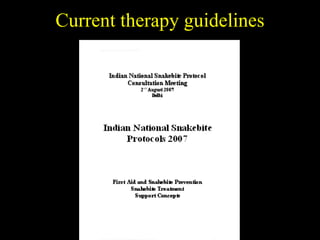
Current therapy guidelines
Future therapy guidelines National survey on antisnake venom utilization & administration (2008) being conducted by the Indian society of toxicology To cover 500 major hospitals across India Questionnaire-based survey QUESTIONNAIRES MAILED TWICE (August & October) RESPONSE RECEIVED: 112 HOSPITALS (as on 15 Nov) Findings to be published in 2009 May form basis of future use guidelines
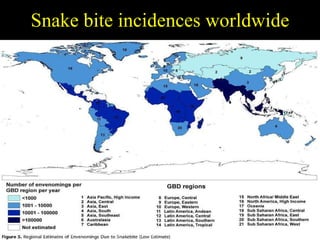
Snake bite incidences worldwide
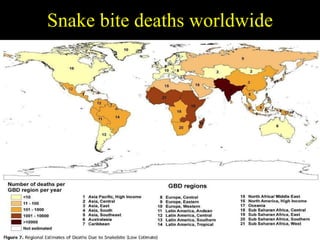
Snake bite deaths worldwide
Statistics of relevance INDIA  Records the highest annual incidence of total snake bites as well as fatal snake bites in the world 2,00,000 bites/year 15,000 deaths/year (some estimates put this at more than 50,000 deaths per year) Number of Indian snake species:  250 [ some say 272] Venomous species:  52
Snake Bite and snake Venom When a snake bites, it may excrete venom but this is dependent on the type of snake – venomous or non venomous. Snake Venom is a Toxin (Hemotoxin Neurotoxin, or Cytotoxin) It is a varied form of saliva and excreted through a modified parotid salivary gland Located on each side of the skull, behind the eye Produced through a pumping mechanism from a sac that stores the venom, proceeds through a channel, down a tubular fang, hollow in the center to project the venom.
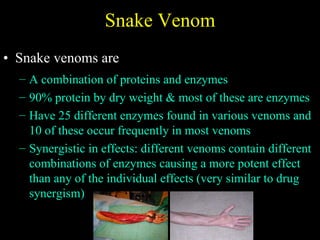
Snake Venom Snake venoms are A combination of proteins and enzymes 90% protein by dry weight & most of these are enzymes Have 25 different enzymes found in various venoms and 10 of these occur frequently in most venoms Synergistic in effects: different venoms contain different combinations of enzymes causing a more potent effect than any of the individual effects (very similar to drug synergism)
Mechanism of Toxicity of Venom The most common types of enzymes are proteolytic, phospholipases and hyaluronidases Proteolytic Enzymes: digestive properties Phospholipases: degrade lipids Hyaluronidases: speed venom spread through the body
Commonest Indian venomous snakes The big 4 – Common cobra  Naja Naja - neurotoxic venom Common krait  Bungarus Caeruleus - neurotoxic venom Saw scaled viper (carpet viper) Echis carinatus - haemotoxic Venom Russell’s viper Daboia russelli - haemotoxic   Venom
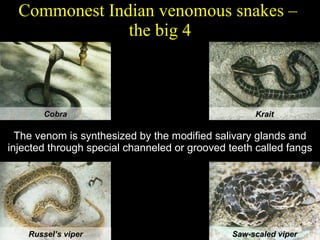
Commonest Indian venomous snakes –  the big 4 The venom is synthesized by the modified salivary glands and injected through special channeled or grooved teeth called fangs Cobra Krait Russel’s viper Saw-scaled viper
Commonly encountered venomous snakes in most parts of India In terms of frequency of encounters - Russell’s viper Common cobra Saw scaled viper Common krait Miscellaneous
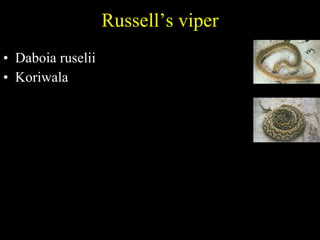
Russell’s viper Daboia ruselii  Koriwala
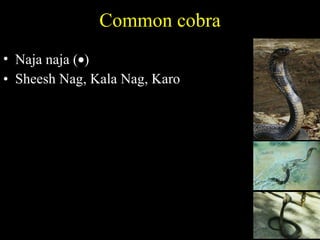
Common cobra Naja naja (  ) Sheesh Nag, Kala Nag, Karo
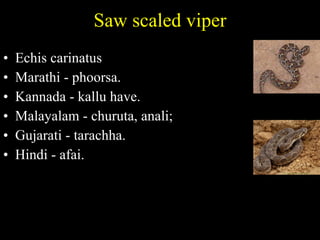
Saw scaled viper Echis carinatus  Marathi - phoorsa.  Kannada - kallu have.  Malayalam - churuta, anali;  Gujarati - tarachha. Hindi - afai.
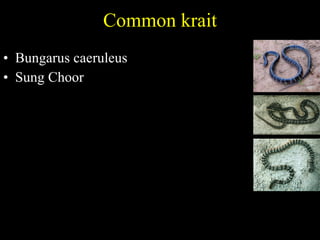
Common krait Bungarus caeruleus Sung Choor
Other less commonly encountered venomous snakes Pit vipers Rarely encountered venomous snakes King cobra Banded krait Coral snake Sea snakes
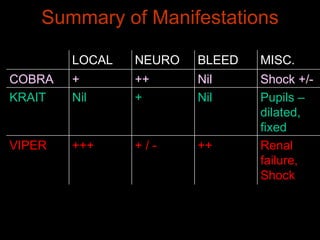
Summary of Manifestations Renal failure, Shock ++ + / - +++ VIPER Pupils –dilated, fixed Nil + Nil KRAIT Shock +/- Nil ++ + COBRA MISC. BLEED NEURO LOCAL
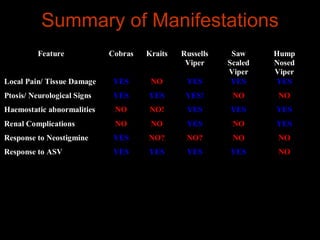
Summary of Manifestations
Snake bites Management
Local signs Fang marks  Local pain Local bleeding  Bruising Lymphangitis, lymph node enlargement Inflammation (swelling, redness, heat) Blistering  Local infection, abscess formation Necrosis
General symptoms (0) Local effects:  This is related to the digestive function of the venom and causes local tissue necrosis. It is maximal with a viper bite and least with krait  (so much so that the bite may go unnoticed and symptoms which follow may not be attributed to snake bite).
General symptoms (1) General:  Nausea, vomiting, malaise, abdominal pain, weakness, drowsiness, prostration Cardiovascular (Viperidae):  Visual disturbances, dizziness, faintness, collapse, shock, hypotension, cardiac arrhythmias, pulmonary oedema,
General symptoms (2) Bleeding and clotting disorders (Viperidae) bleeding from recent wounds (including fang marks, venepunctures etc) and from old partly-healed wounds spontaneous systemic bleeding - from gums, epistaxis, bleeding into  the  tears, haemoptysis, haematemesis, rectal bleeding or melaena, haematuria, vaginal bleeding, bleeding into the skin (petechiae, purpura, ecchymoses) and mucosae (eg conjunctivae), intracranial haemorrhage..
General symptoms (3) Neurological (Elapidae, Russell’s viper):  Drowsiness, paraesthesiae, abnormalities of taste and smell, “heavy” eyelids, ptosis, external ophthalmoplegia, paralysis of facial muscles and other muscles innervated by the cranial nerves, aphonia, difficulty in swallowing secretions, respiratory and generalised flaccid paralysis Skeletal muscle breakdown (sea snakes, Russell’s viper):  Generalised pain, stiffness and tenderness of muscles, trismus, myoglobinuria, hyperkalaemia, cardiac arrest, acute renal failure
General symptoms (4) Renal (Viperidae, sea snakes):  Loin (lower back) pain, haematuria, haemoglobinuria, myoglobinuria, oliguria/anuria, symptoms and signs of uraemia (acidotic breathing, hiccups, nausea, pleuritic chest pain....) Endocrine (acute pituitary/adrenal insufficiency) (Russell’s viper) Acute phase: shock, hypoglycaemia Chronic phase (months to years after the bite): weakness, loss of secondary sexual hair, amenorrhoea, testicular atrophy, hypothyroidism etc
Prognosis assesment Time of bite Activity at the time of bite First aid action taken since the bite Clinical examination 20 mn whole Blood Clotting Test
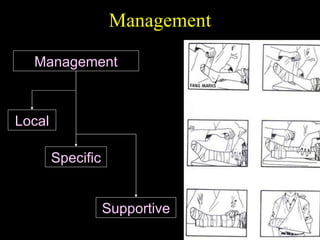
Management Management Local Specific Supportive
Management The first aid being currently recommended is based around the mnemonic: “Do it R.I.G.H.T.” R. = Reassure the patient. 70% of all snakebites are from non-venomous species. Only 50% of bites by venomous species actually envenomate the patient I =  Immobilise in the same way as a fractured limb. Use bandages or cloth to hold the splints, not to block the blood supply or apply pressure. Do not apply any compression in the form of tight ligatures, they can be dangerous! G. H. =  Get to Hospital Immediately. Traditional remedies have NO PROVEN benefit in treating snakebite. T=  Tell the doctor of any systemic symptoms such as ptosis that manifest on the way to hospital.
Management - Local The local wound should be cleaned gently with normal saline. Short skin incisions and suction has been advised if the bite is less than 1 hour old. Immobilise the affected limb. Apply tourniquet around a single boned part of the bitten limb between the wound and the heart.  Pressure should be adequate to occlude lymphatics but not the distal arterial pulse.  Tourniquet can be released briefly for a few seconds every 10minutes.  No compressive therapy if necrosis as in viper bite.
Management: Specific 1 Use Polyvalent ASV, available in a lyophilized form (as liquid antivenin is unstable at room temperature).  Active against the 4 common poisonous snakes in India – cobra, krait, Russel’s viper and saw scaled viper (Echis).  Average potency of the ASV available is such that  1 ml will neutralize  0.6mg cobra,  0.45mg krait,  0.6mg Russel’s viper and  0.45mg saw scaled viper venom
Management: Specific 2 Reconstitution involves the addition of 10ml of distilled water to an ampoule and shaking till the solution is clear.  It should be administered intravenously as early as possible.  It is essential to enquire about allergy (specially to horse serum).  It is well to be prepared for an anaphylactic reaction during the antivenin administration.
Criteria for giving ASV ASV’s only role is to neutralize unbound free flowing venom 50% of Cobra bites inject no venom to the victim Criteria : Incoagulable blood (20WBCT) Visible neurological signs (ptosis, ophtalmoplegia, descending paralysis,  inability to lift the head ) Clear evidence of current systemic bleeding ASV to be given only if one or more of these signs are present, but p urely local swelling, even if accompanied by a bite mark from an apparently venomous snake, is not grounds for administering ASV.
20WBCT -  20 Minute Whole Blood Clotting Test Few ml of fresh venous blood placed in a NEW, CLEAN, DRY, GLASS test tube Left undisturbed for 20 mn Gently tilted to 45° and examined If it has remained liquid:  consumption coagulopathy    ASV required Clotted:  ASV not necessary (at this stage) Done every 30 minutes from admission for 3 hours and then hourly after that.  If incoagulable blood is there, 6 hourly cycle will then be adopted to test for the requirement for repeat doses of ASV.
Prevention of adverse reactions to ASV No intradermal test is indicative:  Because intradermal allergy testing is targeted at IgE mediated reaction whereas ASV reactions are complement mediated Risk of pre sensitizing the patient and making the reaction more likely Waste of precious time Premedication with  hydrocortsisone, anti-histamine or Sc adrenaline: only for the first dose, efficacy unproven
Therapy of adverse reactions to ASV Anaphylaxis can be rapid onset, u sually within 20 mn from start of ASV  and can deteriorate into a life-threatening emergency very rapidly. Adrenaline should always be immediately available. Urticaria, itching, fever, chills, nausea, vomiting, diarrhoea, abdominal cramps, hypotension, bronchospasm and angio-oedema  ASV will be discontinued and  Treatment and drugs of choice  Adrenaline, 0.5 mg IM, to be repeated if symptoms do not improve within 15 mn 100 mg hydrocortisone + 25 mg Promethazine IM /  10 mg chlorphenimarine IV Children are given 0.01mg/kg body weight of adrenaline IM.
Management: Supportive 1 Analgesics for pain -  Prefer paracetamol to aspirin Antibiotics for infection, only if necrosis choice to cover anaerobes. Antitetanus prophylaxis Avoid heparin. Replacement of coagulation factors / platelets if there is active significant bleeding or bleeding into a vital organ. Primary mean of restoring clotting factors is by ASV Once venom has been adequately neutralized, liver will begin to restore factors to normal levels Blood products are used exceptionally  in case of severe bleeding, after coagulation has been restored
Referral criteria for indoor management Transportation of the patient: NPA + bag mask ventilation  Occult systemic bleeding / renal failure Neurotoxic envinemation  Inability to perform neck lift suggests imminent respiratory failure Requiring longer term mechanical ventilation Surgical cases  requiring debridement of necrotic tissue
Antisnake venom ASV
Types of ASV available Liquid ASV Requires no reconstitution but problem of cold chain Lyophilized Requires no refrigeration but time required for reconstitution with distilled water
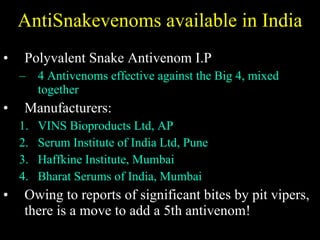
AntiSnakevenoms available in India Polyvalent Snake Antivenom I.P 4 Antivenoms effective against the Big 4, mixed together Manufacturers:  VINS Bioproducts Ltd, AP Serum Institute of India Ltd, Pune Haffkine Institute, Mumbai Bharat Serums of India, Mumbai Owing to reports of significant bites by pit vipers, there is a move to add a 5th antivenom!
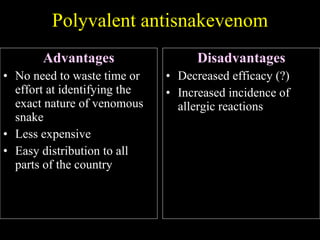
Polyvalent antisnakevenom Advantages No need to waste time or effort at identifying the exact nature of venomous snake Less expensive Easy distribution to all parts of the country Disadvantages Decreased efficacy (?) Increased incidence of allergic reactions
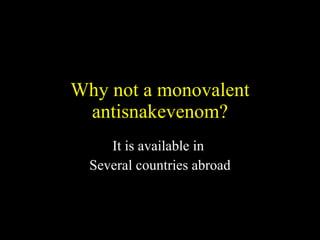
Why not a monovalent antisnakevenom? It is available in  Several countries abroad
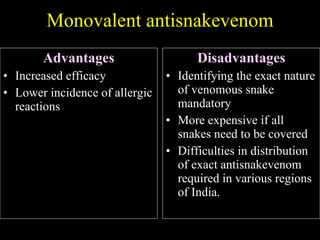
Monovalent antisnakevenom Advantages Increased efficacy Lower incidence of allergic reactions Disadvantages Identifying the exact nature of venomous snake mandatory More expensive if all snakes need to be covered Difficulties in distribution of exact antisnakevenom required in various regions of India.
Anti snake venom Dosing criteria and details
Dose of ASV - basis Logic suggests that our initial dose should be calculated to neutralise the average dose of venom injected.  This ensures that the majority of victims should be covered by the initial dose and keeps the cost of ASV to acceptable levels.  The range of venom injected is 5mg – 147 mg.  Average potency of the polyvalent ASV available is such that 1 ml will neutralize  0.6mg cobra,  0.6mg Russel’s viper  0.45mg krait, and  0.45mg saw scaled viper venom
Dose of ASV - basis Initial dose 8-10 vials and exact dosing amount depends on the amount of venom injected by the snake Cobra and Russel’s viper 60mg   Krait inject less venom but neurological symptoms similar to Cobra. Saw scaled viper bite = around 15 mg of venom On average, 15 vials required to restore coagulation In cases other than confirmed SSV bite, 8-10 vials
Dose of ASV - basis If confirmed SSV give 4 vials if 20WBCT un coagulable monitor coagulation and repeat ASV 6 hourly  Check series of patient  if 50-60% restore their coagulation, 4 vials is the correct starting dose If 10-20% restore their coagulation after 6 hours increase the starting dose to all patients by one vial and monitor
Repeat doses of ASV ASV should be given as long as blood  is shown incoagulable on 20WBCT  performed 6 hourly  (time required by the liver to restore clotting factors) Neurotoxic: patient review 1 hour after initial dose: if worsening, give 2nd dose of ASV if not worsened, review again after 2 hours,  if not improved, give 2nd dose of ASV After 2 doses, ASV should be stopped, no role for very large dose in neurotoxic bites
Dosing All ASV to be administered over 1 hour at constant speed, either by  IV injection or continuous infusion SC, IM, around bite site : no Each vial is 10ml of reconstituted ASV. ASV can be administered in two ways: Intravenous Injection: reconstituted or liquid ASV is administered by slow intravenous injection. (2ml/ minute). Each vial is 10ml of reconstituted ASV. Infusion: liquid or reconstituted ASV is diluted in 5-10ml/kg body weight of isotonic saline or glucose. No change in dose for children as the amount of venom injected may be the same as in an adult.
Dosing in patients arriving late Victims who arrive several days after the bite, usually have acute renal failure.  The key determining factor to administer ASV is there are any signs of current venom activity Venom can only be neutralised if it is unattached! Perform a 20WBCT and determine if any coagulopathy is present.  If coagulopathy is present, administer ASV.  If no coagulopathy is evident treat any renal failure by reference to a nephrologist and dialysis. In the case of neurotoxic symptoms such as ptosis, respiratory failure etc, it is probably wise to administer 1 dose of 8-10 vials of ASV to ensure that no unbound venom is present.
Neurotoxic Envenomation Cobra venom is a post synaptic neurotoxin and blocks the nicotinic receptor causing acetylcholine to be unable to bind Neostigmine prolongs the life of acetylcholine by inhibiting cholinesterase, increasing the likelywood of acetylcholine binding with unblocked receptor Baseline test: single breath count, time upward gaze 1.5 mg neostigmine + 0.6 mg Atropine  [Repeat tests] If objective improvement, repeat neostigmine + atropine every 30 min.
Research options ahead Anti snake venoms
Possible solution for India Bivalent (or trivalent) antivenom After all, there are only 2 main categories of venomous snakes ELAPIDS Neurotoxic venom VIPERIDS Vasculotoxic venom So, why not have one bivalent antisnakevenom for common elapids? And, one trivalent antisnakevenom for common viperids?
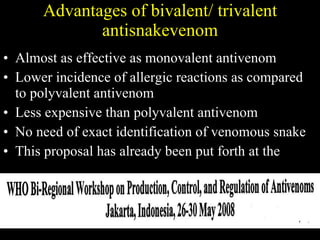
Advantages of bivalent/ trivalent antisnakevenom Almost as effective as monovalent antivenom Lower incidence of allergic reactions as compared to polyvalent antivenom Less expensive than polyvalent antivenom No need of exact identification of venomous snake This proposal has already been put forth at the
Thank you

Snakes 1

  • 1.
    Snakes of India& ASV Biological E.
  • 2.
    Topics for discussionType of snakes found in India Geographical Availability Approximate death in India due to snake bite Venom of different snakes & their mechnism of action. An ideal Anti Snake preparation Currently available anti snake preparation Dosages schedule of anti snake preparation Polyvalent anti snake preparation and advantages and disadvantages over monovalent ASV. How new ASVs scores over older ASVs.
  • 3.
  • 4.
    Future therapy guidelinesNational survey on antisnake venom utilization & administration (2008) being conducted by the Indian society of toxicology To cover 500 major hospitals across India Questionnaire-based survey QUESTIONNAIRES MAILED TWICE (August & October) RESPONSE RECEIVED: 112 HOSPITALS (as on 15 Nov) Findings to be published in 2009 May form basis of future use guidelines
  • 5.
  • 6.
  • 7.
    Statistics of relevanceINDIA Records the highest annual incidence of total snake bites as well as fatal snake bites in the world 2,00,000 bites/year 15,000 deaths/year (some estimates put this at more than 50,000 deaths per year) Number of Indian snake species: 250 [ some say 272] Venomous species: 52
  • 8.
    Snake Bite andsnake Venom When a snake bites, it may excrete venom but this is dependent on the type of snake – venomous or non venomous. Snake Venom is a Toxin (Hemotoxin Neurotoxin, or Cytotoxin) It is a varied form of saliva and excreted through a modified parotid salivary gland Located on each side of the skull, behind the eye Produced through a pumping mechanism from a sac that stores the venom, proceeds through a channel, down a tubular fang, hollow in the center to project the venom.
  • 9.
    Snake Venom Snakevenoms are A combination of proteins and enzymes 90% protein by dry weight & most of these are enzymes Have 25 different enzymes found in various venoms and 10 of these occur frequently in most venoms Synergistic in effects: different venoms contain different combinations of enzymes causing a more potent effect than any of the individual effects (very similar to drug synergism)
  • 10.
    Mechanism of Toxicityof Venom The most common types of enzymes are proteolytic, phospholipases and hyaluronidases Proteolytic Enzymes: digestive properties Phospholipases: degrade lipids Hyaluronidases: speed venom spread through the body
  • 11.
    Commonest Indian venomoussnakes The big 4 – Common cobra Naja Naja - neurotoxic venom Common krait Bungarus Caeruleus - neurotoxic venom Saw scaled viper (carpet viper) Echis carinatus - haemotoxic Venom Russell’s viper Daboia russelli - haemotoxic Venom
  • 12.
    Commonest Indian venomoussnakes – the big 4 The venom is synthesized by the modified salivary glands and injected through special channeled or grooved teeth called fangs Cobra Krait Russel’s viper Saw-scaled viper
  • 13.
    Commonly encountered venomoussnakes in most parts of India In terms of frequency of encounters - Russell’s viper Common cobra Saw scaled viper Common krait Miscellaneous
  • 14.
    Russell’s viper Daboiaruselii Koriwala
  • 15.
    Common cobra Najanaja (  ) Sheesh Nag, Kala Nag, Karo
  • 16.
    Saw scaled viperEchis carinatus Marathi - phoorsa. Kannada - kallu have. Malayalam - churuta, anali; Gujarati - tarachha. Hindi - afai.
  • 17.
    Common krait Bungaruscaeruleus Sung Choor
  • 18.
    Other less commonlyencountered venomous snakes Pit vipers Rarely encountered venomous snakes King cobra Banded krait Coral snake Sea snakes
  • 19.
    Summary of ManifestationsRenal failure, Shock ++ + / - +++ VIPER Pupils –dilated, fixed Nil + Nil KRAIT Shock +/- Nil ++ + COBRA MISC. BLEED NEURO LOCAL
  • 20.
  • 21.
  • 22.
    Local signs Fangmarks Local pain Local bleeding Bruising Lymphangitis, lymph node enlargement Inflammation (swelling, redness, heat) Blistering Local infection, abscess formation Necrosis
  • 23.
    General symptoms (0)Local effects: This is related to the digestive function of the venom and causes local tissue necrosis. It is maximal with a viper bite and least with krait (so much so that the bite may go unnoticed and symptoms which follow may not be attributed to snake bite).
  • 24.
    General symptoms (1)General: Nausea, vomiting, malaise, abdominal pain, weakness, drowsiness, prostration Cardiovascular (Viperidae): Visual disturbances, dizziness, faintness, collapse, shock, hypotension, cardiac arrhythmias, pulmonary oedema,
  • 25.
    General symptoms (2)Bleeding and clotting disorders (Viperidae) bleeding from recent wounds (including fang marks, venepunctures etc) and from old partly-healed wounds spontaneous systemic bleeding - from gums, epistaxis, bleeding into the tears, haemoptysis, haematemesis, rectal bleeding or melaena, haematuria, vaginal bleeding, bleeding into the skin (petechiae, purpura, ecchymoses) and mucosae (eg conjunctivae), intracranial haemorrhage..
  • 26.
    General symptoms (3)Neurological (Elapidae, Russell’s viper): Drowsiness, paraesthesiae, abnormalities of taste and smell, “heavy” eyelids, ptosis, external ophthalmoplegia, paralysis of facial muscles and other muscles innervated by the cranial nerves, aphonia, difficulty in swallowing secretions, respiratory and generalised flaccid paralysis Skeletal muscle breakdown (sea snakes, Russell’s viper): Generalised pain, stiffness and tenderness of muscles, trismus, myoglobinuria, hyperkalaemia, cardiac arrest, acute renal failure
  • 27.
    General symptoms (4)Renal (Viperidae, sea snakes): Loin (lower back) pain, haematuria, haemoglobinuria, myoglobinuria, oliguria/anuria, symptoms and signs of uraemia (acidotic breathing, hiccups, nausea, pleuritic chest pain....) Endocrine (acute pituitary/adrenal insufficiency) (Russell’s viper) Acute phase: shock, hypoglycaemia Chronic phase (months to years after the bite): weakness, loss of secondary sexual hair, amenorrhoea, testicular atrophy, hypothyroidism etc
  • 28.
    Prognosis assesment Timeof bite Activity at the time of bite First aid action taken since the bite Clinical examination 20 mn whole Blood Clotting Test
  • 29.
    Management Management LocalSpecific Supportive
  • 30.
    Management The firstaid being currently recommended is based around the mnemonic: “Do it R.I.G.H.T.” R. = Reassure the patient. 70% of all snakebites are from non-venomous species. Only 50% of bites by venomous species actually envenomate the patient I = Immobilise in the same way as a fractured limb. Use bandages or cloth to hold the splints, not to block the blood supply or apply pressure. Do not apply any compression in the form of tight ligatures, they can be dangerous! G. H. = Get to Hospital Immediately. Traditional remedies have NO PROVEN benefit in treating snakebite. T= Tell the doctor of any systemic symptoms such as ptosis that manifest on the way to hospital.
  • 31.
    Management - LocalThe local wound should be cleaned gently with normal saline. Short skin incisions and suction has been advised if the bite is less than 1 hour old. Immobilise the affected limb. Apply tourniquet around a single boned part of the bitten limb between the wound and the heart. Pressure should be adequate to occlude lymphatics but not the distal arterial pulse. Tourniquet can be released briefly for a few seconds every 10minutes. No compressive therapy if necrosis as in viper bite.
  • 32.
    Management: Specific 1Use Polyvalent ASV, available in a lyophilized form (as liquid antivenin is unstable at room temperature). Active against the 4 common poisonous snakes in India – cobra, krait, Russel’s viper and saw scaled viper (Echis). Average potency of the ASV available is such that 1 ml will neutralize 0.6mg cobra, 0.45mg krait, 0.6mg Russel’s viper and 0.45mg saw scaled viper venom
  • 33.
    Management: Specific 2Reconstitution involves the addition of 10ml of distilled water to an ampoule and shaking till the solution is clear. It should be administered intravenously as early as possible. It is essential to enquire about allergy (specially to horse serum). It is well to be prepared for an anaphylactic reaction during the antivenin administration.
  • 34.
    Criteria for givingASV ASV’s only role is to neutralize unbound free flowing venom 50% of Cobra bites inject no venom to the victim Criteria : Incoagulable blood (20WBCT) Visible neurological signs (ptosis, ophtalmoplegia, descending paralysis, inability to lift the head ) Clear evidence of current systemic bleeding ASV to be given only if one or more of these signs are present, but p urely local swelling, even if accompanied by a bite mark from an apparently venomous snake, is not grounds for administering ASV.
  • 35.
    20WBCT - 20 Minute Whole Blood Clotting Test Few ml of fresh venous blood placed in a NEW, CLEAN, DRY, GLASS test tube Left undisturbed for 20 mn Gently tilted to 45° and examined If it has remained liquid: consumption coagulopathy  ASV required Clotted: ASV not necessary (at this stage) Done every 30 minutes from admission for 3 hours and then hourly after that. If incoagulable blood is there, 6 hourly cycle will then be adopted to test for the requirement for repeat doses of ASV.
  • 36.
    Prevention of adversereactions to ASV No intradermal test is indicative: Because intradermal allergy testing is targeted at IgE mediated reaction whereas ASV reactions are complement mediated Risk of pre sensitizing the patient and making the reaction more likely Waste of precious time Premedication with hydrocortsisone, anti-histamine or Sc adrenaline: only for the first dose, efficacy unproven
  • 37.
    Therapy of adversereactions to ASV Anaphylaxis can be rapid onset, u sually within 20 mn from start of ASV and can deteriorate into a life-threatening emergency very rapidly. Adrenaline should always be immediately available. Urticaria, itching, fever, chills, nausea, vomiting, diarrhoea, abdominal cramps, hypotension, bronchospasm and angio-oedema ASV will be discontinued and Treatment and drugs of choice Adrenaline, 0.5 mg IM, to be repeated if symptoms do not improve within 15 mn 100 mg hydrocortisone + 25 mg Promethazine IM / 10 mg chlorphenimarine IV Children are given 0.01mg/kg body weight of adrenaline IM.
  • 38.
    Management: Supportive 1Analgesics for pain - Prefer paracetamol to aspirin Antibiotics for infection, only if necrosis choice to cover anaerobes. Antitetanus prophylaxis Avoid heparin. Replacement of coagulation factors / platelets if there is active significant bleeding or bleeding into a vital organ. Primary mean of restoring clotting factors is by ASV Once venom has been adequately neutralized, liver will begin to restore factors to normal levels Blood products are used exceptionally in case of severe bleeding, after coagulation has been restored
  • 39.
    Referral criteria forindoor management Transportation of the patient: NPA + bag mask ventilation Occult systemic bleeding / renal failure Neurotoxic envinemation Inability to perform neck lift suggests imminent respiratory failure Requiring longer term mechanical ventilation Surgical cases requiring debridement of necrotic tissue
  • 40.
  • 41.
    Types of ASVavailable Liquid ASV Requires no reconstitution but problem of cold chain Lyophilized Requires no refrigeration but time required for reconstitution with distilled water
  • 42.
    AntiSnakevenoms available inIndia Polyvalent Snake Antivenom I.P 4 Antivenoms effective against the Big 4, mixed together Manufacturers: VINS Bioproducts Ltd, AP Serum Institute of India Ltd, Pune Haffkine Institute, Mumbai Bharat Serums of India, Mumbai Owing to reports of significant bites by pit vipers, there is a move to add a 5th antivenom!
  • 43.
    Polyvalent antisnakevenom AdvantagesNo need to waste time or effort at identifying the exact nature of venomous snake Less expensive Easy distribution to all parts of the country Disadvantages Decreased efficacy (?) Increased incidence of allergic reactions
  • 44.
    Why not amonovalent antisnakevenom? It is available in Several countries abroad
  • 45.
    Monovalent antisnakevenom AdvantagesIncreased efficacy Lower incidence of allergic reactions Disadvantages Identifying the exact nature of venomous snake mandatory More expensive if all snakes need to be covered Difficulties in distribution of exact antisnakevenom required in various regions of India.
  • 46.
    Anti snake venomDosing criteria and details
  • 47.
    Dose of ASV- basis Logic suggests that our initial dose should be calculated to neutralise the average dose of venom injected. This ensures that the majority of victims should be covered by the initial dose and keeps the cost of ASV to acceptable levels. The range of venom injected is 5mg – 147 mg. Average potency of the polyvalent ASV available is such that 1 ml will neutralize 0.6mg cobra, 0.6mg Russel’s viper 0.45mg krait, and 0.45mg saw scaled viper venom
  • 48.
    Dose of ASV- basis Initial dose 8-10 vials and exact dosing amount depends on the amount of venom injected by the snake Cobra and Russel’s viper 60mg  Krait inject less venom but neurological symptoms similar to Cobra. Saw scaled viper bite = around 15 mg of venom On average, 15 vials required to restore coagulation In cases other than confirmed SSV bite, 8-10 vials
  • 49.
    Dose of ASV- basis If confirmed SSV give 4 vials if 20WBCT un coagulable monitor coagulation and repeat ASV 6 hourly Check series of patient if 50-60% restore their coagulation, 4 vials is the correct starting dose If 10-20% restore their coagulation after 6 hours increase the starting dose to all patients by one vial and monitor
  • 50.
    Repeat doses ofASV ASV should be given as long as blood is shown incoagulable on 20WBCT performed 6 hourly (time required by the liver to restore clotting factors) Neurotoxic: patient review 1 hour after initial dose: if worsening, give 2nd dose of ASV if not worsened, review again after 2 hours, if not improved, give 2nd dose of ASV After 2 doses, ASV should be stopped, no role for very large dose in neurotoxic bites
  • 51.
    Dosing All ASVto be administered over 1 hour at constant speed, either by IV injection or continuous infusion SC, IM, around bite site : no Each vial is 10ml of reconstituted ASV. ASV can be administered in two ways: Intravenous Injection: reconstituted or liquid ASV is administered by slow intravenous injection. (2ml/ minute). Each vial is 10ml of reconstituted ASV. Infusion: liquid or reconstituted ASV is diluted in 5-10ml/kg body weight of isotonic saline or glucose. No change in dose for children as the amount of venom injected may be the same as in an adult.
  • 52.
    Dosing in patientsarriving late Victims who arrive several days after the bite, usually have acute renal failure. The key determining factor to administer ASV is there are any signs of current venom activity Venom can only be neutralised if it is unattached! Perform a 20WBCT and determine if any coagulopathy is present. If coagulopathy is present, administer ASV. If no coagulopathy is evident treat any renal failure by reference to a nephrologist and dialysis. In the case of neurotoxic symptoms such as ptosis, respiratory failure etc, it is probably wise to administer 1 dose of 8-10 vials of ASV to ensure that no unbound venom is present.
  • 53.
    Neurotoxic Envenomation Cobravenom is a post synaptic neurotoxin and blocks the nicotinic receptor causing acetylcholine to be unable to bind Neostigmine prolongs the life of acetylcholine by inhibiting cholinesterase, increasing the likelywood of acetylcholine binding with unblocked receptor Baseline test: single breath count, time upward gaze 1.5 mg neostigmine + 0.6 mg Atropine [Repeat tests] If objective improvement, repeat neostigmine + atropine every 30 min.
  • 54.
    Research options aheadAnti snake venoms
  • 55.
    Possible solution forIndia Bivalent (or trivalent) antivenom After all, there are only 2 main categories of venomous snakes ELAPIDS Neurotoxic venom VIPERIDS Vasculotoxic venom So, why not have one bivalent antisnakevenom for common elapids? And, one trivalent antisnakevenom for common viperids?
  • 56.
    Advantages of bivalent/trivalent antisnakevenom Almost as effective as monovalent antivenom Lower incidence of allergic reactions as compared to polyvalent antivenom Less expensive than polyvalent antivenom No need of exact identification of venomous snake This proposal has already been put forth at the
  • 57.