SNAKEBITE
A.AKHIL ROYAL
KIMS MEDICAL COLLEGE
AMALAPURAM
Classification of snakes
Snakes can be classified into poisonous and non-
poisonous.
Poisonous snakes belong to three Families on the basis
of poison secreted :
• 1. Elapidae : Neurotoxic
• 2. Viperidae : Haemotoxic
• 3. Hydrophidae : Myotoxic
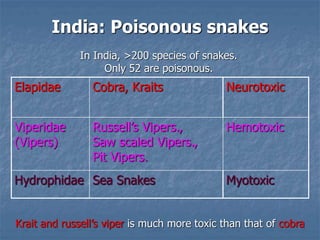
India: Poisonous snakes
Elapidae Cobra, Kraits Neurotoxic
Viperidae
(Vipers)
Russell’s Vipers.,
Saw scaled Vipers.,
Pit Vipers.
Hemotoxic
Hydrophidae Sea Snakes Myotoxic
In India, >200 species of snakes.
Only 52 are poisonous.
Krait and russell’s viper is much more toxic than that of cobra
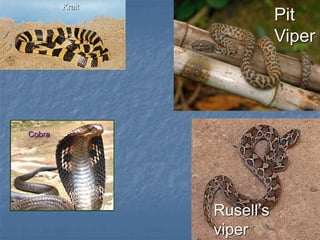
Krait
Cobra
Pit
Viper
Rusell’s
viper
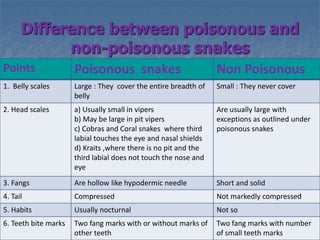
Difference between poisonous and
non-poisonous snakes
Points Poisonous snakes Non Poisonous
1. Belly scales Large : They cover the entire breadth of
belly
Small : They never cover
2. Head scales a) Usually small in vipers
b) May be large in pit vipers
c) Cobras and Coral snakes where third
labial touches the eye and nasal shields
d) Kraits ,where there is no pit and the
third labial does not touch the nose and
eye
Are usually large with
exceptions as outlined under
poisonous snakes
3. Fangs Are hollow like hypodermic needle Short and solid
4. Tail Compressed Not markedly compressed
5. Habits Usually nocturnal Not so
6. Teeth bite marks Two fang marks with or without marks of
other teeth
Two fang marks with number
of small teeth marks
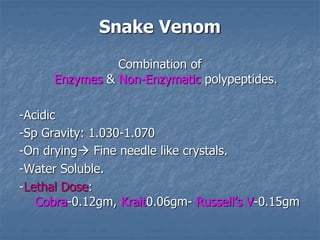
Snake Venom
Combination of
Enzymes & Non-Enzymatic polypeptides.
-Acidic
-Sp Gravity: 1.030-1.070
-On drying Fine needle like crystals.
-Water Soluble.
-Lethal Dose:
Cobra-0.12gm, Krait0.06gm- Russell’s V-0.15gm
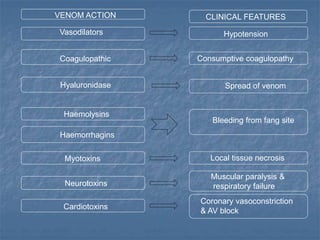
Vasodilators Hypotension
Coagulopathic Consumptive coagulopathy
Hyaluronidase Spread of venom
Haemolysins
Haemorrhagins
Bleeding from fang site
Myotoxins Local tissue necrosis
Neurotoxins
Muscular paralysis &
respiratory failure
Cardiotoxins
Coronary vasoconstriction
& AV block
VENOM ACTION CLINICAL FEATURES
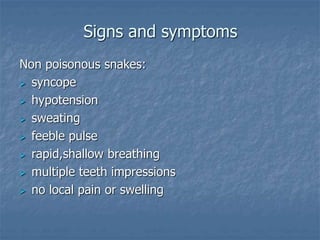
Signs and symptoms
Non poisonous snakes:
 syncope
 hypotension
 sweating
 feeble pulse
 rapid,shallow breathing
 multiple teeth impressions
 no local pain or swelling
 A. Elapid Bite:
Local Features :
Fang marks
Burning pain
Swelling and discoloration
Serosanguinous discharge
Local symptoms are milder in comparison
to that in Viperine bite.
Systemic features
 Preparalytic stage:
 Vomiting
 Headache
 Giddiness
 Weakness and lethargy
 Paralytic stage:
 Ptosis.
 Ophthalmoplegia
Drowsiness
 Convulsion
 Bulbar paralysis
 Respiratory failure
 death
Cardiac Depression
 Cardiogenic/ Vasogenic Shock
 Systolic cardiac arrest.
COBRA envenomation
Cardiotoxicity
 B. Viperid bite :
 Local features : Rapid swelling at bite site
Discoloration
Blister formation
Bleeding from bite site
Pain
 Systemic features:
.Generalized bleeding : Epistaxis ,hemoptysis ,
hematemesis ,bleeding gums ,hematuria ,
malena , hemorrhagic areas over skin and
mucosa
.Shock
.Renal failure
HYDROPHID BITE (sea snake)
Myotoxic
 Local features: minimal swelling and pain
 Systemic features:
Myalgia,
Muscle stiffness,
Myoglobinuria , renal tubular necrosis.
DIAGNOSIS OF SNAKE BITE
 FANG MARKS: classically, two puncture
wounds seperated by a distance varying from
8mm to 4cm, depending on the species
involved.
 However a side swipe may produce only a single
puncture,while multiple bites could result in
numerous fang marks.
Lab investigations
20 WBCT-Test positive for viperine bite
ELISA Test
Non Specific- Hemogram, S.Creatinine, S.Amylase,
CPK, Creatine Phosphokinase,
 PT , FDP & Fibrinogen level in viper bite
interfer with clotting mechanism.
 ABG, Electrolyte-for systemic manifestion.
 Urine Examination for Proteinuria ,
Myoglobinuria
Metabolic changes
• Hyperkalemia in metabolic acidosis
• urine- hematuria, proteinuria, myoglobinuria
• Kidney- acute renal failure
• Chest X-ray- pulmonary edema, pleural effusion
ECG CHANGES IN ENVENOMATION
 Sinus tachycardia
 Sinus bradycardia
 Sinus arrhythmia
 ST depression withT wave inversion in inferior &
anterior limb
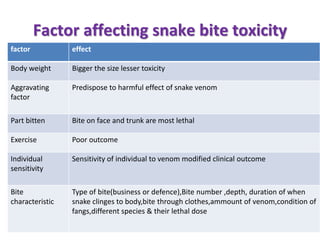
Factor affecting snake bite toxicity
factor effect
Body weight Bigger the size lesser toxicity
Aggravating
factor
Predispose to harmful effect of snake venom
Part bitten Bite on face and trunk are most lethal
Exercise Poor outcome
Individual
sensitivity
Sensitivity of individual to venom modified clinical outcome
Bite
characteristic
Type of bite(business or defence),Bite number ,depth, duration of when
snake clinges to body,bite through clothes,ammount of venom,condition of
fangs,different species & their lethal dose
MANAGEMENT
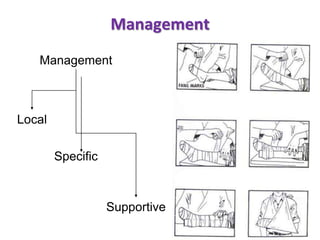
Management
Management
Local
Specific
Supportive
Management
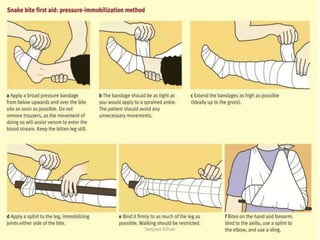
• The first aid being currently recommended is based around the
mnemonic: “Do it R.I.G.H.T.”
R =Reassure the patient.
I = Immobilise in the same way as a fractured limb.
G.H. = Get to Hospital Immediately.
T = Tell the doctor of any systemic symptoms such as ptosis that
manifest on the way to hospital.
First Aids
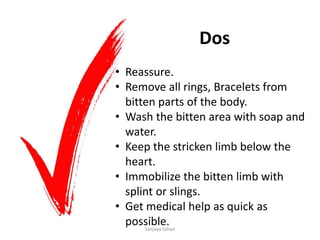
Dos
• Reassure.
• Remove all rings, Bracelets from
bitten parts of the body.
• Wash the bitten area with soap and
water.
• Keep the stricken limb below the
heart.
• Immobilize the bitten limb with
splint or slings.
• Get medical help as quick as
possible.Sanjaya Gihan
Sanjaya Gihan
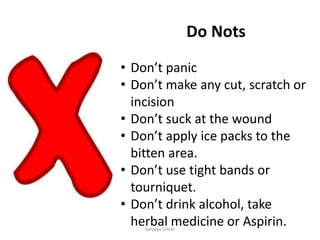
Do Nots
• Don’t panic
• Don’t make any cut, scratch or
incision
• Don’t suck at the wound
• Don’t apply ice packs to the
bitten area.
• Don’t use tight bands or
tourniquet.
• Don’t drink alcohol, take
herbal medicine or Aspirin.Sanjaya Gihan
Management: local reactions
 BULLAE - LEFT INTACT
 NECROSIS - DEBRIDEMENT
 COMPARTMENT SYNDROME - FASCIOTOMY
Specific treatment
Anti snake Venom
Indication for ASV
• Spontaneous systemic Bleeding
• WBCT > 20 min
• Thrombocytopenia (platelet < 1 lac)
• Shock, paralysis, ARF, Rhabdomyolysis,
Hyperkalemia.
• Local swelling involving > ½ of bitten limb
• Rapid extension of swelling
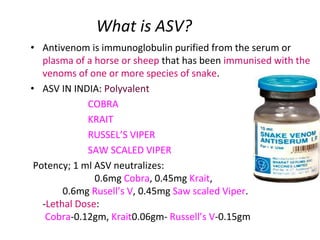
What is ASV?
• Antivenom is immunoglobulin purified from the serum or
plasma of a horse or sheep that has been immunised with the
venoms of one or more species of snake.
• ASV IN INDIA: Polyvalent
COBRA
KRAIT
RUSSEL’S VIPER
SAW SCALED VIPER
Potency; 1 ml ASV neutralizes:
0.6mg Cobra, 0.45mg Krait,
0.6mg Rusell’s V, 0.45mg Saw scaled Viper.
-Lethal Dose:
Cobra-0.12gm, Krait0.06gm- Russell’s V-0.15gm
ASV Indication:
Systemic manifestaiton
 NEUROTOXICITY
 HAEMOTOXICITY
 NEPHROTOXICITY
 CARDIOTOXICITY
 RHABDOMYOLYSIS
 REPEATED VOMITING
 Others:
-Local swelling involving more than half of the bitten
limb.
-Rapid extension of swelling.
-Development of an enlarged tender lymph node
draining the bitten limb
Timing of ASV
 Best effects are observed within four hours of
bite .
 Effective in symptomatic patients even 48 hours
after bite.
 Efficacious even 6-7 days after the bite from
vipers.
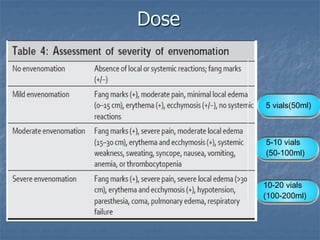
Dose
5 vials(50ml)
5-10 vials
(50-100ml)
10-20 vials
(100-200ml)
Repeat dose
Criteria for repeating the initial dose of
antivenom
 Persistence or recurrence of blood incoagulability
after 1-2 hr
 Deteriorating neurotoxic or cardiovascular signs
after 1-2 hr
 Continuing absorption- due to improved blood
supply following correction of shock, hypovolaemia
etc A redistribution of venom from the tissues
into the vascular space.
Disadvantage of ASV
• Pain at injection site
• Hematoma formation
• Increase intra compartmental pressure
Antivenom reactions
20% of patients, usually develop a reaction
Types:
1. Early anaphylactic reactions- within 10-180 min
2. Pyrogenic (endotoxin) reactions- develop 1-2
hours
3. Late (serum sickness type) reactions- develop 1-
12 (mean 7) days.
Fatal reactions have probably been under-
reported, as death after snake bite is usually
attributed to the venom.
Treatment Of Early ASV reaction
• Adrenaline -1:1000 i.m.
0.5 mg in adult
0.01 mg/kg in children
can be repeated every 5 min if necessary
H1 antihistaminic-i.v. 1 mg of CPM
I.V. Hydrocortisone
Treatment Of Late ASV reaction
• 5 days course of oral anti histaminic CPM
2mg/6hour-adult
0.25 mg/kg/day in divided dose
Patient who fail to response with in 24 hr
Predinisolone-
5mg/6h in adult
0.7 mg/kg/day in divided dose in children
ASV and children
Dose of antivenom
 Snakes inject the same dose of venom into
children and adults.
 Children must therefore be given exactly the
same dose of antivenom as adults.
Supportive therapy
• For Coagulopathy - if not reverse after ASV therapy
Fresh frozen plasma
Cryoprecipitate (fibrinogen, Factor VIII),
Fresh whole blood,
Platelet concentrate.
For Bulbar Paralysis & Resp. Failure-
• ASV alone not sufficient
• Tracheotomy, Endotrachial intubation,& mechanical
ventilation
• Inj. of neostigmine-50 to 100 microgram/kg/4hrs as
a continuous infusion
• Glycopyrrolate-0.25 mg can be given before
neostigmine in place of atropine
don’t cross blood brain barrier
• Care of bitten part-
Antibiotic prophylaxis & ATS injection
snake bite and management

snake bite and management

  • 1.
  • 2.
    Classification of snakes Snakescan be classified into poisonous and non- poisonous. Poisonous snakes belong to three Families on the basis of poison secreted : • 1. Elapidae : Neurotoxic • 2. Viperidae : Haemotoxic • 3. Hydrophidae : Myotoxic
  • 3.
    India: Poisonous snakes ElapidaeCobra, Kraits Neurotoxic Viperidae (Vipers) Russell’s Vipers., Saw scaled Vipers., Pit Vipers. Hemotoxic Hydrophidae Sea Snakes Myotoxic In India, >200 species of snakes. Only 52 are poisonous. Krait and russell’s viper is much more toxic than that of cobra
  • 4.
  • 5.
    Difference between poisonousand non-poisonous snakes Points Poisonous snakes Non Poisonous 1. Belly scales Large : They cover the entire breadth of belly Small : They never cover 2. Head scales a) Usually small in vipers b) May be large in pit vipers c) Cobras and Coral snakes where third labial touches the eye and nasal shields d) Kraits ,where there is no pit and the third labial does not touch the nose and eye Are usually large with exceptions as outlined under poisonous snakes 3. Fangs Are hollow like hypodermic needle Short and solid 4. Tail Compressed Not markedly compressed 5. Habits Usually nocturnal Not so 6. Teeth bite marks Two fang marks with or without marks of other teeth Two fang marks with number of small teeth marks
  • 6.
    Snake Venom Combination of Enzymes& Non-Enzymatic polypeptides. -Acidic -Sp Gravity: 1.030-1.070 -On drying Fine needle like crystals. -Water Soluble. -Lethal Dose: Cobra-0.12gm, Krait0.06gm- Russell’s V-0.15gm
  • 7.
    Vasodilators Hypotension Coagulopathic Consumptivecoagulopathy Hyaluronidase Spread of venom Haemolysins Haemorrhagins Bleeding from fang site Myotoxins Local tissue necrosis Neurotoxins Muscular paralysis & respiratory failure Cardiotoxins Coronary vasoconstriction & AV block VENOM ACTION CLINICAL FEATURES
  • 8.
    Signs and symptoms Nonpoisonous snakes:  syncope  hypotension  sweating  feeble pulse  rapid,shallow breathing  multiple teeth impressions  no local pain or swelling
  • 9.
     A. ElapidBite: Local Features : Fang marks Burning pain Swelling and discoloration Serosanguinous discharge Local symptoms are milder in comparison to that in Viperine bite.
  • 10.
    Systemic features  Preparalyticstage:  Vomiting  Headache  Giddiness  Weakness and lethargy  Paralytic stage:  Ptosis.  Ophthalmoplegia Drowsiness  Convulsion  Bulbar paralysis  Respiratory failure  death
  • 11.
    Cardiac Depression  Cardiogenic/Vasogenic Shock  Systolic cardiac arrest. COBRA envenomation Cardiotoxicity
  • 12.
     B. Viperidbite :  Local features : Rapid swelling at bite site Discoloration Blister formation Bleeding from bite site Pain
  • 13.
     Systemic features: .Generalizedbleeding : Epistaxis ,hemoptysis , hematemesis ,bleeding gums ,hematuria , malena , hemorrhagic areas over skin and mucosa .Shock .Renal failure
  • 14.
    HYDROPHID BITE (seasnake) Myotoxic  Local features: minimal swelling and pain  Systemic features: Myalgia, Muscle stiffness, Myoglobinuria , renal tubular necrosis.
  • 16.
    DIAGNOSIS OF SNAKEBITE  FANG MARKS: classically, two puncture wounds seperated by a distance varying from 8mm to 4cm, depending on the species involved.  However a side swipe may produce only a single puncture,while multiple bites could result in numerous fang marks.
  • 17.
    Lab investigations 20 WBCT-Testpositive for viperine bite ELISA Test Non Specific- Hemogram, S.Creatinine, S.Amylase, CPK, Creatine Phosphokinase,  PT , FDP & Fibrinogen level in viper bite interfer with clotting mechanism.  ABG, Electrolyte-for systemic manifestion.  Urine Examination for Proteinuria , Myoglobinuria
  • 18.
    Metabolic changes • Hyperkalemiain metabolic acidosis • urine- hematuria, proteinuria, myoglobinuria • Kidney- acute renal failure • Chest X-ray- pulmonary edema, pleural effusion
  • 19.
    ECG CHANGES INENVENOMATION  Sinus tachycardia  Sinus bradycardia  Sinus arrhythmia  ST depression withT wave inversion in inferior & anterior limb
  • 20.
    Factor affecting snakebite toxicity factor effect Body weight Bigger the size lesser toxicity Aggravating factor Predispose to harmful effect of snake venom Part bitten Bite on face and trunk are most lethal Exercise Poor outcome Individual sensitivity Sensitivity of individual to venom modified clinical outcome Bite characteristic Type of bite(business or defence),Bite number ,depth, duration of when snake clinges to body,bite through clothes,ammount of venom,condition of fangs,different species & their lethal dose
  • 21.
  • 22.
  • 23.
    Management • The firstaid being currently recommended is based around the mnemonic: “Do it R.I.G.H.T.” R =Reassure the patient. I = Immobilise in the same way as a fractured limb. G.H. = Get to Hospital Immediately. T = Tell the doctor of any systemic symptoms such as ptosis that manifest on the way to hospital.
  • 24.
  • 25.
    Dos • Reassure. • Removeall rings, Bracelets from bitten parts of the body. • Wash the bitten area with soap and water. • Keep the stricken limb below the heart. • Immobilize the bitten limb with splint or slings. • Get medical help as quick as possible.Sanjaya Gihan
  • 26.
  • 27.
    Do Nots • Don’tpanic • Don’t make any cut, scratch or incision • Don’t suck at the wound • Don’t apply ice packs to the bitten area. • Don’t use tight bands or tourniquet. • Don’t drink alcohol, take herbal medicine or Aspirin.Sanjaya Gihan
  • 28.
    Management: local reactions BULLAE - LEFT INTACT  NECROSIS - DEBRIDEMENT  COMPARTMENT SYNDROME - FASCIOTOMY
  • 29.
    Specific treatment Anti snakeVenom Indication for ASV • Spontaneous systemic Bleeding • WBCT > 20 min • Thrombocytopenia (platelet < 1 lac) • Shock, paralysis, ARF, Rhabdomyolysis, Hyperkalemia. • Local swelling involving > ½ of bitten limb • Rapid extension of swelling
  • 30.
    What is ASV? •Antivenom is immunoglobulin purified from the serum or plasma of a horse or sheep that has been immunised with the venoms of one or more species of snake. • ASV IN INDIA: Polyvalent COBRA KRAIT RUSSEL’S VIPER SAW SCALED VIPER Potency; 1 ml ASV neutralizes: 0.6mg Cobra, 0.45mg Krait, 0.6mg Rusell’s V, 0.45mg Saw scaled Viper. -Lethal Dose: Cobra-0.12gm, Krait0.06gm- Russell’s V-0.15gm
  • 31.
    ASV Indication: Systemic manifestaiton NEUROTOXICITY  HAEMOTOXICITY  NEPHROTOXICITY  CARDIOTOXICITY  RHABDOMYOLYSIS  REPEATED VOMITING  Others: -Local swelling involving more than half of the bitten limb. -Rapid extension of swelling. -Development of an enlarged tender lymph node draining the bitten limb
  • 32.
    Timing of ASV Best effects are observed within four hours of bite .  Effective in symptomatic patients even 48 hours after bite.  Efficacious even 6-7 days after the bite from vipers.
  • 33.
  • 34.
    Repeat dose Criteria forrepeating the initial dose of antivenom  Persistence or recurrence of blood incoagulability after 1-2 hr  Deteriorating neurotoxic or cardiovascular signs after 1-2 hr  Continuing absorption- due to improved blood supply following correction of shock, hypovolaemia etc A redistribution of venom from the tissues into the vascular space.
  • 35.
    Disadvantage of ASV •Pain at injection site • Hematoma formation • Increase intra compartmental pressure
  • 36.
    Antivenom reactions 20% ofpatients, usually develop a reaction Types: 1. Early anaphylactic reactions- within 10-180 min 2. Pyrogenic (endotoxin) reactions- develop 1-2 hours 3. Late (serum sickness type) reactions- develop 1- 12 (mean 7) days. Fatal reactions have probably been under- reported, as death after snake bite is usually attributed to the venom.
  • 37.
    Treatment Of EarlyASV reaction • Adrenaline -1:1000 i.m. 0.5 mg in adult 0.01 mg/kg in children can be repeated every 5 min if necessary H1 antihistaminic-i.v. 1 mg of CPM I.V. Hydrocortisone
  • 38.
    Treatment Of LateASV reaction • 5 days course of oral anti histaminic CPM 2mg/6hour-adult 0.25 mg/kg/day in divided dose Patient who fail to response with in 24 hr Predinisolone- 5mg/6h in adult 0.7 mg/kg/day in divided dose in children
  • 39.
    ASV and children Doseof antivenom  Snakes inject the same dose of venom into children and adults.  Children must therefore be given exactly the same dose of antivenom as adults.
  • 40.
    Supportive therapy • ForCoagulopathy - if not reverse after ASV therapy Fresh frozen plasma Cryoprecipitate (fibrinogen, Factor VIII), Fresh whole blood, Platelet concentrate.
  • 41.
    For Bulbar Paralysis& Resp. Failure- • ASV alone not sufficient • Tracheotomy, Endotrachial intubation,& mechanical ventilation • Inj. of neostigmine-50 to 100 microgram/kg/4hrs as a continuous infusion • Glycopyrrolate-0.25 mg can be given before neostigmine in place of atropine don’t cross blood brain barrier • Care of bitten part- Antibiotic prophylaxis & ATS injection