1 
9000 Virginia Manor Rd Ste 290, Beltsville MD 20705 | 301-474-0607 | www.dfrsolutions.com 
SMTA Capital Area Design for Manufacturing: Challenges & Opportunities 
Cheryl Tulkoff, ASQ CRE 
Senior Member of the Technical Staff 
ctulkoff@dfrsolutions.com 
May 16, 2013
2 
9000 Virginia Manor Rd Ste 290, Beltsville MD 20705 | 301-474-0607 | www.dfrsolutions.com 
DfM Abstract 
oIn the electronics industry. the quality and reliability of any product is highly dependent upon the capability of the manufacturing supplier, regardless of whether it is a contractor or a captured shop. Manufacturing issues are one of the top reasons that companies fail to meet warranty expectations, which can result in severe financial pain and eventual loss of market share. What a surprising number of engineers and managers fail to realize is that focusing on processes addresses only part of the issue. Design plays a critical role in the success or failure of manufacturing and assembly. 
oDesigning printed boards today is more difficult than ever before because of the increased lead free process temperature requirements and associated changes required in manufacturing. Not only has the density of the electronic assembly increased, but many changes are taking place throughout the entire supply chain regarding the use of hazardous materials and the requirements for recycling. Much of the change is due to the European Union (EU) Directives regarding these issues. The RoHS and REACH directives have caused many suppliers to the industry to rethink their materials and processes. Thus, everyone designing or producing electronics has been or will be affected. 
oThis course provides a comprehensive insight into the areas where design plays an important role in the manufacturing process. This workshop addresses the increasingly sophisticated PCB fabrication technologies and processes.
3 
9000 Virginia Manor Rd Ste 290, Beltsville MD 20705 | 301-474-0607 | www.dfrsolutions.com 
Presentation Outline 
MODULE 1: INTRODUCTIONS 
oIntro to Design for Manufacturing 
oKey Global DfM Guidelines 
MODULE 2: INDUSTRY STANDARD DESIGN RULES (Reference) 
oQuick View of Industry Standards 
MODULE 3: OVERVIEW OF DFM TASKS 
oTypes of Review Processes 
oRoot Cause Problem Solving 
oFailure Analysis (Reference) 
MODULE 4: DfM - COMPONENT 
Component Robustness 
Temperature Sensitivity Level 
Moisture Sensitivity Level 
Pb-free Issues 
MODULE 6: DfM - SOLDER 
•General Soldering 
•Lead Free Solder Alloy Update 
•Hand Soldering 
•Copper Dissolution 
•Mixed Assembly
4 
9000 Virginia Manor Rd Ste 290, Beltsville MD 20705 | 301-474-0607 | www.dfrsolutions.com 
Module 1: Introduction 
Introduction to Design for Manufacturing (DfM)
5 
9000 Virginia Manor Rd Ste 290, Beltsville MD 20705 | 301-474-0607 | www.dfrsolutions.com 
Design for Manufacturing (DfM) 
oDefinition 
oThe process of ensuring a design can be consistently manufactured by the designated supply chain with a minimum number of defects 
oRequirements 
oAn understanding of best practices (what fails during manufacturing?) 
oAn understanding of the limitations of the supply chain
6 
9000 Virginia Manor Rd Ste 290, Beltsville MD 20705 | 301-474-0607 | www.dfrsolutions.com 
DfM Failures 
oDfM is often overlooked in the design process for some of the following reasons: 
oDesign team often has poor insight into supply chain 
oOriginal Equipment Manufacturer (OEM) requests no feedback on DfM from supply chain 
oDfM feedback consists of standard rule checks (no insight) 
oDfM activities at the OEM are not standardized or distributed
7 
9000 Virginia Manor Rd Ste 290, Beltsville MD 20705 | 301-474-0607 | www.dfrsolutions.com 
Introduction to Design for Manufacturing (DfM) 
oDfM is the process of proactively designing products to: 
oOptimize all of the manufacturing functions: supplier selection and management, procurement, receiving, fabrication, assembly, quality control, operator training, shipping, delivery, service, and repair. 
oAssure that critical objectives of cost, quality, reliability, regulatory compliance, safety, time-to- market, and customer satisfaction are known, balanced, monitored, and achieved.
8 
9000 Virginia Manor Rd Ste 290, Beltsville MD 20705 | 301-474-0607 | www.dfrsolutions.com 
Introduction to Design for Manufacturing (DfM) 
oSuccessful DFM efforts require the integration of product design and process planning 
oIf existing processes are used, new products must be designed to the parameters and limitations of these processes regardless of whether the product is build internally or externally. 
oIf new processes are used, then the product and process need to be developed carefully considering the risks associated with “new”
9 
9000 Virginia Manor Rd Ste 290, Beltsville MD 20705 | 301-474-0607 | www.dfrsolutions.com 
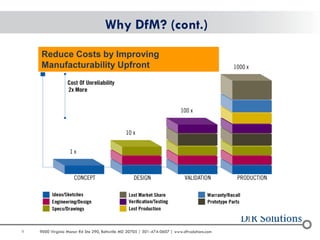
Why DfM? (cont.) 
Reduce Costs by Improving Manufacturability Upfront
26 
9000 Virginia Manor Rd Ste 290, Beltsville MD 20705 | 301-474-0607 | www.dfrsolutions.com 
Module 2: Industry Standard Design Rules (Reference)
27 
9000 Virginia Manor Rd Ste 290, Beltsville MD 20705 | 301-474-0607 | www.dfrsolutions.com 
Industry Standards – IPC, JEDEC, ISO… 
oStart with industry standards where possible 
oTried and true 
oBut, represent only minimum acceptable requirements or concerns 
oModify and extend as needed to customize for your product and environments! 
oForums provide opportunities for free advice and feedback
28 
9000 Virginia Manor Rd Ste 290, Beltsville MD 20705 | 301-474-0607 | www.dfrsolutions.com 
IPC Design Requirement/Guideline References 
oIPC-2221- Generic Standard on Printed Board Design 
oIPC-2221A is the foundation design standard for all documents in the IPC- 2220 series. It establishes the generic requirements for the design of printed boards and other forms of component mounting or interconnecting structures, whether single-sided, double-sided or multilayer. 
o3 Performance Classes 
oClass 1 General Electronic Products - consumer products, 
oClass 2 Dedicated Service Electronic Products 
oCommunications equipment, sophisticated business machine, instruments and military equipment where high performance, extended life and uninterrupted service is desired but is not critical. 
oClass 3 High Reliability Electronic Products 
oCommercial, industrial and military products where continued performance or performance on demand is critical and where high levels of assurance are required...
29 
9000 Virginia Manor Rd Ste 290, Beltsville MD 20705 | 301-474-0607 | www.dfrsolutions.com 
oGood quality is necessary but not SUFFICIENT to guarantee high reliability. 
oClass 3 by itself does not guarantee high reliability 
oA PCB or PCBA can be perfectly built to IPC Class 3 standards and still be totally unreliable in its final application. 
oConsider two different PCB laminates both built to IPC Class 3 standards. 
oBoth laminates are identical in all properties EXCEPT one laminate has a CTEz of 40 and the other has a CTEz of 60. 
oThe vias in the laminate with the lower CTEz will be MORE reliable in a long term, aggressive thermal cycling environment than the CTEz 60 laminate. 
oA CTEz 40 laminate built to IPC class 2 could be MORE reliable than the CTEz 60 laminate built to Class 3. 
oAppropriate materials selection for the environment is key! 
A Word on Quality, Reliability & Class 2 versus Class 3
30 
9000 Virginia Manor Rd Ste 290, Beltsville MD 20705 | 301-474-0607 | www.dfrsolutions.com 
JEDEC/IPC Joint Standards 
oJEDEC is the leading developer of standards for the solid-state industry. All JEDEC standards are available online, at no charge. www.jedec.org 
oSome commonly referenced JEDEC/IPC Joint Standards standards: 
oJ-STD-020D.01: JOINT IPC/JEDEC STANDARD FOR MOISTURE/REFLOW SENSITIVITY CLASSIFICATION FOR NONHERMETIC SOLID STATE SURFACE- MOUNT DEVICES: 
oThis document identifies the classification level of nonhermetic solid-state surface mount devices (SMDs) that are sensitive to moisture-induced stress. It is used to determine what classification level should be used for initial reliability qualification. This revision now covers components to be processed at higher temperatures for lead-free assembly. 
oJS9704 : IPC/JEDEC-9704: Printed Wiring Board (PWB) Strain Gage Test Guideline 
oThis document describes specific guidelines for strain gage testing for Printed Wiring Board (PWB)assemblies. The suggested procedures enables board manufacturers to conduct required strain gage testing independently, and provides a quantitative method for measuring board flexure, and assessing risk levels. The topics covered include: Test setup and equipment; requirements; Strain measurement; Report format
31 
9000 Virginia Manor Rd Ste 290, Beltsville MD 20705 | 301-474-0607 | www.dfrsolutions.com 
Module 3: Overview of DfM Tasks
32 
9000 Virginia Manor Rd Ste 290, Beltsville MD 20705 | 301-474-0607 | www.dfrsolutions.com 
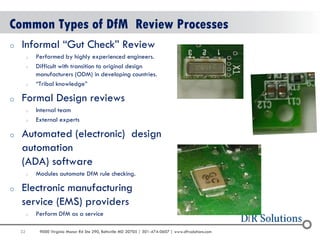
Common Types of DfM Review Processes 
oInformal “Gut Check” Review 
oPerformed by highly experienced engineers. 
oDifficult with transition to original design manufacturers (ODM) in developing countries. 
o“Tribal knowledge” 
oFormal Design reviews 
oInternal team 
oExternal experts 
oAutomated (electronic) design automation (ADA) software 
oModules automate DfM rule checking. 
oElectronic manufacturing service (EMS) providers 
oPerform DfM as a service
33 
9000 Virginia Manor Rd Ste 290, Beltsville MD 20705 | 301-474-0607 | www.dfrsolutions.com 
Design for Manufacturing (DfM) 
oFormal DfM Reviews and Tools Sometimes Overlooked 
oOrganization may lack specialized expertise. 
oMore design organizations completely removed from manufacturing. 
oDfM Reviews Needs to be Performed for: 
oBare Board 
oCircuit Board Assemblies 
oChassis/Housing Integration Packaging 
oSystem Assembly 
oDfM Needs to be conducted in conjunction with the actual electronic assembly source. 
oWhat is good DfM for one supplier and one set of assembly equipment may not be good for another.
34 
9000 Virginia Manor Rd Ste 290, Beltsville MD 20705 | 301-474-0607 | www.dfrsolutions.com 
Use a Root Cause Problem Solving Methodology 
oCritical that your organization has a formal root cause problem solving methodology used both internally and externally. 
oThis is the best way to incorporate relevant material into your customized Design for Manufacturing and Sourcing guidelines. 
oThis ties in closely with DfM Guideline #1: Know Your History!
35 
9000 Virginia Manor Rd Ste 290, Beltsville MD 20705 | 301-474-0607 | www.dfrsolutions.com 
8D Problem Solving Methodology 
oProblem Statement: 
oSimply fixing the symptoms of a problem, more often than not, leads to band-aid solutions 
oEnd up solving the same problem several times 
oOther areas experience similar problems 
oSolution: 
oDo root cause analysis and follow through with permanent corrective actions on significant problems 
oBreak the endless loop 
oDrive Continuous Improvement 
oSave money & efficiencies 
oReap benefits beyond the discrete issue
36 
9000 Virginia Manor Rd Ste 290, Beltsville MD 20705 | 301-474-0607 | www.dfrsolutions.com 
The 8 Disciplines (8D) 
1.Create the Team 
2.Problem Description and Data Analysis 
3.Containment Actions 
4.Perform Root Cause Analysis 
5.Choose and Verify Corrective Action 
6.Implement Corrective Action 
7.Apply Lessons Learned 
8.Celebrate Success / Close the Issue 
(8D forms can also be used by suppliers. )
37 
9000 Virginia Manor Rd Ste 290, Beltsville MD 20705 | 301-474-0607 | www.dfrsolutions.com 
Why is Failure Analysis Knowledge Important? 
oThere are always more problems than resources! 
oIf you don’t analyze, learn from, and prevent problems, you simply repeat them. Your list never gets smaller.
38 
9000 Virginia Manor Rd Ste 290, Beltsville MD 20705 | 301-474-0607 | www.dfrsolutions.com 
General Words of Wisdom on Failure Analysis 
oBefore spending time and money on Failure Analysis (FA), consider the following: 
oConsider “order” carefully. Some actions will limit or eliminate the ability to perform additional tests. 
oUnderstand the limitations and output of the tests selected. 
oUse labs who can help you select and interpret tests for capabilities you don’t have. 
oAvoid requesting a specific test. Describe the problem and define the data and output you need first. 
oPursue multiple courses of action. There is rarely one test or one root cause that will solve your problem. 
oConsider how the data will help solve the problem 
oSome FA is just not worth doing!
39 
9000 Virginia Manor Rd Ste 290, Beltsville MD 20705 | 301-474-0607 | www.dfrsolutions.com 
39 
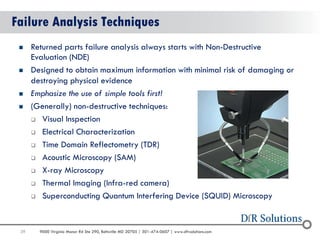
Failure Analysis Techniques 
Returned parts failure analysis always starts with Non-Destructive Evaluation (NDE) 
Designed to obtain maximum information with minimal risk of damaging or destroying physical evidence 
Emphasize the use of simple tools first! 
(Generally) non-destructive techniques: 
Visual Inspection 
Electrical Characterization 
Time Domain Reflectometry (TDR) 
Acoustic Microscopy (SAM) 
X-ray Microscopy 
Thermal Imaging (Infra-red camera) 
Superconducting Quantum Interfering Device (SQUID) Microscopy
40 
9000 Virginia Manor Rd Ste 290, Beltsville MD 20705 | 301-474-0607 | www.dfrsolutions.com 
40 
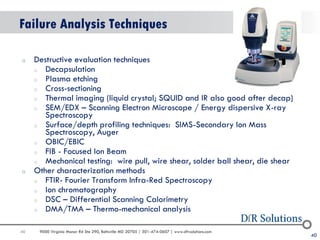
Failure Analysis Techniques 
oDestructive evaluation techniques 
oDecapsulation 
oPlasma etching 
oCross-sectioning 
oThermal imaging (liquid crystal; SQUID and IR also good after decap) 
oSEM/EDX – Scanning Electron Microscope / Energy dispersive X-ray Spectroscopy 
oSurface/depth profiling techniques: SIMS-Secondary Ion Mass Spectroscopy, Auger 
oOBIC/EBIC 
oFIB - Focused Ion Beam 
oMechanical testing: wire pull, wire shear, solder ball shear, die shear 
oOther characterization methods 
oFTIR- Fourier Transform Infra-Red Spectroscopy 
oIon chromatography 
oDSC – Differential Scanning Calorimetry 
oDMA/TMA – Thermo-mechanical analysis
41 
9000 Virginia Manor Rd Ste 290, Beltsville MD 20705 | 301-474-0607 | www.dfrsolutions.com 
oMost critical step in the failure analysis process 
oCan the reported failure mode be replicated? 
oPersistent or intermittent? 
oIntermittent failures often incorrectly diagnosed as no trouble found (NTF) 
oLeast utilized to its fullest extent 
oApproach dependent upon the product 
oComponent 
oBare substrate 
oPCB assembly 
oSometimes performed in combination with environmental exposure 
oCharacterization over specified/expected temperature range 
oCharacterization over specified / expected radiation range 
oHumidity environment (re-introduction of moisture) 
oNot intended to induce damage! 
Electrical Characterization
42 
9000 Virginia Manor Rd Ste 290, Beltsville MD 20705 | 301-474-0607 | www.dfrsolutions.com 
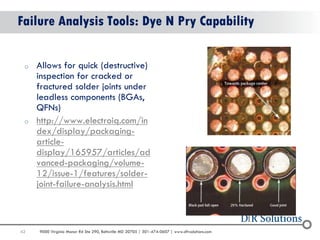
Failure Analysis Tools: Dye N Pry Capability 
oAllows for quick (destructive) inspection for cracked or fractured solder joints under leadless components (BGAs, QFNs) 
ohttp://www.electroiq.com/index/display/packaging- article- display/165957/articles/advanced-packaging/volume- 12/issue-1/features/solder- joint-failure-analysis.html
43 
9000 Virginia Manor Rd Ste 290, Beltsville MD 20705 | 301-474-0607 | www.dfrsolutions.com 
Failure Analysis Dremel Tool – Induce Vibrations 
oA Dremel tool can be used to induce local vibration during debugging 
ohttp://www.dremel.com
44 
9000 Virginia Manor Rd Ste 290, Beltsville MD 20705 | 301-474-0607 | www.dfrsolutions.com 
Module 4: Components 
Component Robustness
45 
9000 Virginia Manor Rd Ste 290, Beltsville MD 20705 | 301-474-0607 | www.dfrsolutions.com 
Robustness - Components 
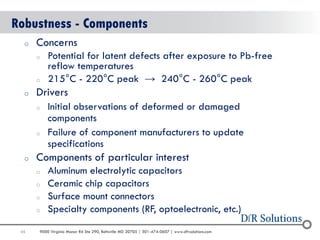
oConcerns 
oPotential for latent defects after exposure to Pb-free reflow temperatures 
o215°C - 220°C peak → 240°C - 260°C peak 
oDrivers 
oInitial observations of deformed or damaged components 
oFailure of component manufacturers to update specifications 
oComponents of particular interest 
oAluminum electrolytic capacitors 
oCeramic chip capacitors 
oSurface mount connectors 
oSpecialty components (RF, optoelectronic, etc.)
46 
9000 Virginia Manor Rd Ste 290, Beltsville MD 20705 | 301-474-0607 | www.dfrsolutions.com 
Ceramic Capacitors (Thermal Shock Cracks) 
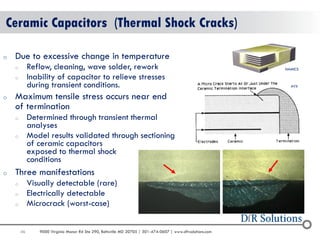
oDue to excessive change in temperature 
oReflow, cleaning, wave solder, rework 
oInability of capacitor to relieve stresses during transient conditions. 
oMaximum tensile stress occurs near end of termination 
oDetermined through transient thermal analyses 
oModel results validated through sectioning of ceramic capacitors exposed to thermal shock conditions 
oThree manifestations 
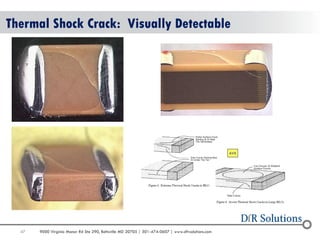
oVisually detectable (rare) 
oElectrically detectable 
oMicrocrack (worst-case) 
NAMICS 
AVX
47 9000 Virginia Manor Rd Ste 290, Beltsville MD 20705 | 301-474-0607 | www.dfrsolutions.com 
Thermal Shock Crack: Visually Detectable 
AVX
48 
9000 Virginia Manor Rd Ste 290, Beltsville MD 20705 | 301-474-0607 | www.dfrsolutions.com 
48 
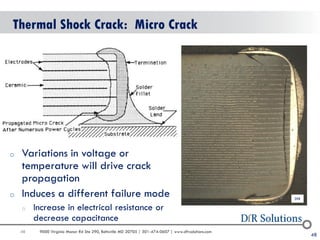
Thermal Shock Crack: Micro Crack 
oVariations in voltage or temperature will drive crack propagation 
oInduces a different failure mode 
oIncrease in electrical resistance or decrease capacitance 
DfR
49 
9000 Virginia Manor Rd Ste 290, Beltsville MD 20705 | 301-474-0607 | www.dfrsolutions.com 
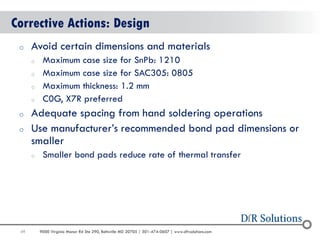
Corrective Actions: Design 
oAvoid certain dimensions and materials 
oMaximum case size for SnPb: 1210 
oMaximum case size for SAC305: 0805 
oMaximum thickness: 1.2 mm 
oC0G, X7R preferred 
oAdequate spacing from hand soldering operations 
oUse manufacturer’s recommended bond pad dimensions or smaller 
oSmaller bond pads reduce rate of thermal transfer
50 
9000 Virginia Manor Rd Ste 290, Beltsville MD 20705 | 301-474-0607 | www.dfrsolutions.com 
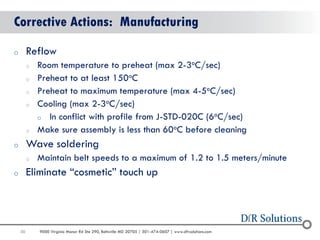
Corrective Actions: Manufacturing 
oReflow 
oRoom temperature to preheat (max 2-3oC/sec) 
oPreheat to at least 150oC 
oPreheat to maximum temperature (max 4-5oC/sec) 
oCooling (max 2-3oC/sec) 
oIn conflict with profile from J-STD-020C (6oC/sec) 
oMake sure assembly is less than 60oC before cleaning 
oWave soldering 
oMaintain belt speeds to a maximum of 1.2 to 1.5 meters/minute 
oEliminate “cosmetic” touch up
51 9000 Virginia Manor Rd Ste 290, Beltsville MD 20705 | 301-474-0607 | www.dfrsolutions.com 
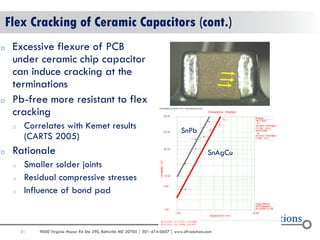
Flex Cracking of Ceramic Capacitors (cont.) 
o Excessive flexure of PCB 
under ceramic chip capacitor 
can induce cracking at the 
terminations 
o Pb-free more resistant to flex 
cracking 
o Correlates with Kemet results 
(CARTS 2005) 
o Rationale 
o Smaller solder joints 
o Residual compressive stresses 
o Influence of bond pad 
1.00 10.00 
1.00 
5.00 
10.00 
50.00 
90.00 
99.90 
ReliaSoft's Weibull++ 6.0 - www.Weibull.c om 
Probability - Weibull 
Displacement (mm) 
Unreliability, F(t) 
6/13/2005 21:56 
DfR Solut ions 
Craig Hillman 
Weibull 
1812 SAC 
W2 RRX - RRM MED 
F=162 / S=0 
         
1812 SnPb 
W2 RRX - RRM MED 
F=90 / S=0 
         
SnPb 
SnAgCu
52 
9000 Virginia Manor Rd Ste 290, Beltsville MD 20705 | 301-474-0607 | www.dfrsolutions.com 
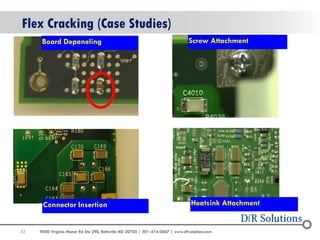
Flex Cracking (Case Studies) 
Screw Attachment 
Board Depaneling 
Connector Insertion 
Heatsink Attachment
53 
9000 Virginia Manor Rd Ste 290, Beltsville MD 20705 | 301-474-0607 | www.dfrsolutions.com 
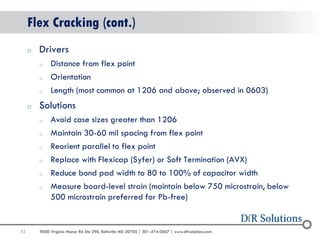
Flex Cracking (cont.) 
oDrivers 
oDistance from flex point 
oOrientation 
oLength (most common at 1206 and above; observed in 0603) 
oSolutions 
oAvoid case sizes greater than 1206 
oMaintain 30-60 mil spacing from flex point 
oReorient parallel to flex point 
oReplace with Flexicap (Syfer) or Soft Termination (AVX) 
oReduce bond pad width to 80 to 100% of capacitor width 
oMeasure board-level strain (maintain below 750 microstrain, below 500 microstrain preferred for Pb-free)
54 
9000 Virginia Manor Rd Ste 290, Beltsville MD 20705 | 301-474-0607 | www.dfrsolutions.com 
Module 6: Solders General Soldering
55 
9000 Virginia Manor Rd Ste 290, Beltsville MD 20705 | 301-474-0607 | www.dfrsolutions.com 
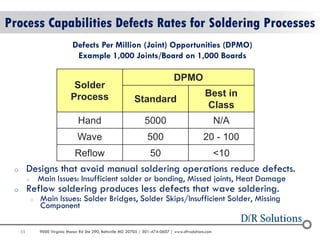
Process Capabilities Defects Rates for Soldering Processes 
oDesigns that avoid manual soldering operations reduce defects. 
oMain Issues: Insufficient solder or bonding, Missed joints, Heat Damage 
oReflow soldering produces less defects that wave soldering. 
oMain Issues: Solder Bridges, Solder Skips/Insufficient Solder, Missing Component 
Defects Per Million (Joint) Opportunities (DPMO) Example 1,000 Joints/Board on 1,000 Boards 
Solder Process 
DPMO 
Standard 
Best in Class 
Hand 
5000 
N/A 
Wave 
500 
20 - 100 
Reflow 
50 
<10
56 
9000 Virginia Manor Rd Ste 290, Beltsville MD 20705 | 301-474-0607 | www.dfrsolutions.com 
Reflow Profile Optimization 
oStart with paste manufacturer’s recommendations! 
oPreheating Phase - Ramp & Soak vs. Straight Ramp preheating profiles 
oRamp & Soak (soak period just below liquidus), more common, more forgiving. 
oAllow flux solvents to fully evaporate and activate to deoxidize the surfaces to be soldered. 
oAllows temperature equalization across the entire assembly. 
oConsistent soldering and reduces tomb stoning. 
oIf too long, flux may be consumed resulting in excessive oxidation. 
oFlux may become volatile - producing solder balls or voiding defects. 
oStraight Line is faster and causes less thermal damage to materials 
oBut more susceptible to defect and quality variation, does not work as well on complex, dense assemblies.
57 
9000 Virginia Manor Rd Ste 290, Beltsville MD 20705 | 301-474-0607 | www.dfrsolutions.com 
Reflow Profile Optimization 
oPeak Temperature and Time at (above) Liquidus (TAL) 
oA balance between being hot enough for long enough to achieve good consistent solder wetting and bonding for proper joint formation, across the entire assembly. 
oYet as quickly as possible to prevent thermal damage to the components and board and to prevent excessive copper dissolution and excessive intermetallic growth. 
oCooling Rate of SnAgCu effects the Microstructure & Bulk Intermetallics 
oFaster cooling rates produce a finer, stronger microstructure and limits intermetallics. 
oOverall Time (Costs & Efficiency) 
oOverall throughput is determined the board size/complexity and the oven's heat transfer capabilities. 
oRule of Thumb: 2-3 C/second ramp up and down rate
58 
9000 Virginia Manor Rd Ste 290, Beltsville MD 20705 | 301-474-0607 | www.dfrsolutions.com 
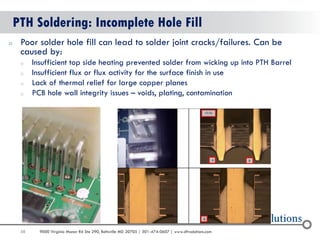
PTH Soldering: Incomplete Hole Fill 
oPoor solder hole fill can lead to solder joint cracks/failures. Can be caused by: 
oInsufficient top side heating prevented solder from wicking up into PTH Barrel 
oInsufficient flux or flux activity for the surface finish in use 
oLack of thermal relief for large copper planes 
oPCB hole wall integrity issues – voids, plating, contamination
59 
9000 Virginia Manor Rd Ste 290, Beltsville MD 20705 | 301-474-0607 | www.dfrsolutions.com 
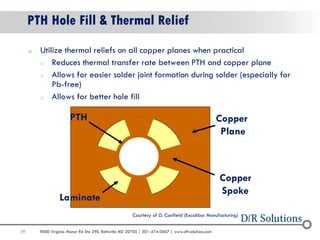
PTH Hole Fill & Thermal Relief 
oUtilize thermal reliefs on all copper planes when practical 
oReduces thermal transfer rate between PTH and copper plane 
oAllows for easier solder joint formation during solder (especially for Pb-free) 
oAllows for better hole fill 
Copper 
Plane 
PTH 
Laminate 
Copper Spoke 
Courtesy of D. Canfield (Excalibur Manufacturing)
60 
9000 Virginia Manor Rd Ste 290, Beltsville MD 20705 | 301-474-0607 | www.dfrsolutions.com 
Module 6: Solders 
Discussion of 2nd generation Pb-free alloys (e.g., SN100C)
61 
9000 Virginia Manor Rd Ste 290, Beltsville MD 20705 | 301-474-0607 | www.dfrsolutions.com 
The Current State of Lead-Free 
oComponent suppliers 
oSAC305 still dominant, but with increasing introduction of low silver alloys (SAC205, SAC105, SAC0507) 
oSolder Paste 
oSAC305 still dominant 
oWave and Rework 
oSn07Cu+Ni (SN100C) 
oSn07Cu+Co (SN100e) 
oSn07Cu+Ni+Bi (K100LD) 
oHASL PCB Coating 
oSn07Cu+Ni (SN100C)
62 
9000 Virginia Manor Rd Ste 290, Beltsville MD 20705 | 301-474-0607 | www.dfrsolutions.com 
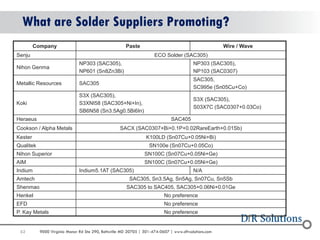
What are Solder Suppliers Promoting? 
Company 
Paste 
Wire / Wave 
Senju 
ECO Solder (SAC305) 
Nihon Genma 
NP303 (SAC305), 
NP601 (Sn8Zn3Bi) 
NP303 (SAC305), 
NP103 (SAC0307) 
Metallic Resources 
SAC305 
SAC305, 
SC995e (Sn05Cu+Co) 
Koki 
S3X (SAC305), 
S3XNI58 (SAC305+Ni+In), 
SB6N58 (Sn3.5Ag0.5Bi6In) 
S3X (SAC305), 
S03X7C (SAC0307+0.03Co) 
Heraeus 
SAC405 
Cookson / Alpha Metals 
SACX (SAC0307+Bi+0.1P+0.02RareEarth+0.01Sb) 
Kester 
K100LD (Sn07Cu+0.05Ni+Bi) 
Qualitek 
SN100e (Sn07Cu+0.05Co) 
Nihon Superior 
SN100C (Sn07Cu+0.05Ni+Ge) 
AIM 
SN100C (Sn07Cu+0.05Ni+Ge) 
Indium 
Indium5.1AT (SAC305) 
N/A 
Amtech 
SAC305, Sn3.5Ag, Sn5Ag, Sn07Cu, Sn5Sb 
Shenmao 
SAC305 to SAC405, SAC305+0.06Ni+0.01Ge 
Henkel 
No preference 
EFD 
No preference 
P. Kay Metals 
No preference
63 
9000 Virginia Manor Rd Ste 290, Beltsville MD 20705 | 301-474-0607 | www.dfrsolutions.com 
2nd Generation Pb-Free Solder (Thoughts) 
oNi-modified SnCu and low silver SAC are the primary front runners 
oBoth seem to display reliability behaviors between SAC305 and SnPb 
oProliferation of custom alloys is unhealthy for the electronics industry 
oToo much time spent on material identification, characterization, and risk assessment 
oOne customer had SAC405, SAC387, SAC305, SAC105, SAC0307, and SAC125Ni on one board! 
oAlmost no component manufacturers assess these new alloys from a physics of failure 
oTest to spec mentality 
oHuge risk for escapes
64 
9000 Virginia Manor Rd Ste 290, Beltsville MD 20705 | 301-474-0607 | www.dfrsolutions.com 
Module 6: Solders 
Hand Soldering Copper Dissolution Mixed Assembly
65 
9000 Virginia Manor Rd Ste 290, Beltsville MD 20705 | 301-474-0607 | www.dfrsolutions.com 
oDesigned for hand soldering 
oSIR data 
oHalogen / halide free: Watch for definitions! 
oSupplier – relationships, proximity 
oLead finish 
oSubstrate finish 
oAcid number 
oLead free or SnPb soldering? 
oCompatibility with adjacent materials 
oAdhesives, conformal coatings, etc. 
Basic Hand Soldering Materials Selection Criteria
66 
9000 Virginia Manor Rd Ste 290, Beltsville MD 20705 | 301-474-0607 | www.dfrsolutions.com 
oSize /type / pitch / plating of leads 
oSubstrate finish / type – rigid, flex, ENIG, etc 
oSpace between hand soldered leads and adjacent components and circuitry 
oSize, shape, heat sinking of module at time of hand soldering 
oCan unit and component be preheated? 
Design Considerations
67 
9000 Virginia Manor Rd Ste 290, Beltsville MD 20705 | 301-474-0607 | www.dfrsolutions.com 
oOperator variation is the norm. Training is critical! 
oGeneral hand soldering tips: 
oUse soldering irons with great thermal recovery - the lower the soldering temperature and the larger the tip, the less heat loss 
oUse a high power soldering iron 
oUse the largest tip commensurate with the size of the joint being soldered and available space 
oCustom tips can be designed if needed. 
oUse the largest cored solder wire diameter appropriate for the size of the joint and available space. 
oAvoid the use of liquid fluxes 
oTypical tip temperatures for Pb-free solder are ~700F with 2-5 seconds of contact time. Higher temps can damage boards and components. 
Hand Soldering Process
68 9000 Virginia Manor Rd Ste 290, Beltsville MD 20705 | 301-474-0607 | www.dfrsolutions.com 
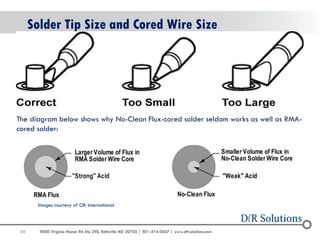
Solder Tip Size and Cored Wire Size 
Images courtesy of OK International 
The diagram below shows why No-Clean Flux-cored solder seldom works as well as RMA-cored 
solder:
69 
9000 Virginia Manor Rd Ste 290, Beltsville MD 20705 | 301-474-0607 | www.dfrsolutions.com 
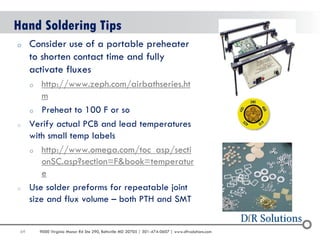
oConsider use of a portable preheater to shorten contact time and fully activate fluxes 
ohttp://www.zeph.com/airbathseries.htm 
oPreheat to 100 F or so 
oVerify actual PCB and lead temperatures with small temp labels 
ohttp://www.omega.com/toc_asp/sectionSC.asp?section=F&book=temperature 
oUse solder preforms for repeatable joint size and flux volume – both PTH and SMT 
Hand Soldering Tips
70 
9000 Virginia Manor Rd Ste 290, Beltsville MD 20705 | 301-474-0607 | www.dfrsolutions.com 
oAlways avoid liquid flux if possible 
oIf it’s truly needed: 
oLook for methods to ensure precise delivery 
oFlux pens are one method 
oThe needle tip dispense bottles are not recommended. 
oAvoid letting flux run under and around adjacent components. 
oProvide some form of uniform heating to volatalize as much of the liquid as possible. 
oSelect a flux designed and validated for hand soldering processes 
oThis is probably NOT be the same material as your wave solder flux. Wave solder fluxes are designed to hold up through preheat and dual wave contact. 
oReview surface insulation resistance (SIR) data 
Use of Liquid Flux
71 
9000 Virginia Manor Rd Ste 290, Beltsville MD 20705 | 301-474-0607 | www.dfrsolutions.com 
oTypical manual cleaning process: 
oSome type of solvent spray is used to loosen flux residues and followed by hand cleaning using IPA and a soft bristle brush. 
oThis type of manual cleaning process represents a reliability risk. 
oSeveral studies have shown that SIR (surface insulation resistance) actually INCREASES when IPA and brushes are used in manual cleaning. 
oBrushes are not routinely cleaned or maintained and become contamination transfer mechanisms. 
oPoorly removed residues are more likely to experience corrosion failures than no clean flux residues left intact. 
oIn rework and repair, if you can’t rinse, you can’t clean. 
Manual Removal of Flux Residues: Not Recommended!
72 9000 Virginia Manor Rd Ste 290, Beltsville MD 20705 | 301-474-0607 | www.dfrsolutions.com 
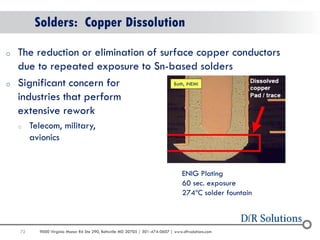
Solders: Copper Dissolution 
o The reduction or elimination of surface copper conductors 
due to repeated exposure to Sn-based solders 
o Significant concern for 
industries that perform 
extensive rework 
o Telecom, military, 
avionics 
Bath, iNEMI 
ENIG Plating 
60 sec. exposure 
274ºC solder fountain
73 9000 Virginia Manor Rd Ste 290, Beltsville MD 20705 | 301-474-0607 | www.dfrsolutions.com 
Solders: Copper Dissolution (cont.) 
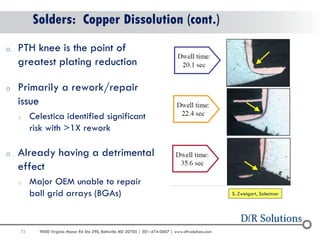
o PTH knee is the point of 
greatest plating reduction 
o Primarily a rework/repair 
issue 
o Celestica identified significant 
risk with >1X rework 
o Already having a detrimental 
effect 
o Major OEM unable to repair 
ball grid arrays (BGAs) S. Zweigart, Solectron
74 
9000 Virginia Manor Rd Ste 290, Beltsville MD 20705 | 301-474-0607 | www.dfrsolutions.com 
Copper Dissolution (Contact Time) 
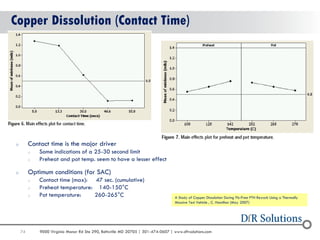
oContact time is the major driver 
oSome indications of a 25-30 second limit 
oPreheat and pot temp. seem to have a lesser effect 
oOptimum conditions (for SAC) 
oContact time (max): 47 sec. (cumulative) 
oPreheat temperature: 140-150°C 
oPot temperature: 260-265°C 
A Study of Copper Dissolution During Pb-Free PTH Rework Using a Thermally Massive Test Vehicle , C. Hamilton (May 2007)
75 
9000 Virginia Manor Rd Ste 290, Beltsville MD 20705 | 301-474-0607 | www.dfrsolutions.com 
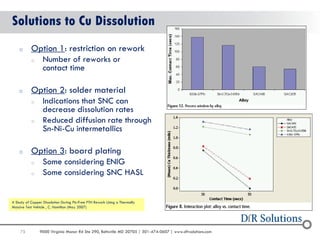
Solutions to Cu Dissolution 
oOption 1: restriction on rework 
oNumber of reworks or contact time 
oOption 2: solder material 
oIndications that SNC can decrease dissolution rates 
oReduced diffusion rate through Sn-Ni-Cu intermetallics 
oOption 3: board plating 
oSome considering ENIG 
oSome considering SNC HASL 
A Study of Copper Dissolution During Pb-Free PTH Rework Using a Thermally Massive Test Vehicle , C. Hamilton (May 2007)
76 
9000 Virginia Manor Rd Ste 290, Beltsville MD 20705 | 301-474-0607 | www.dfrsolutions.com 
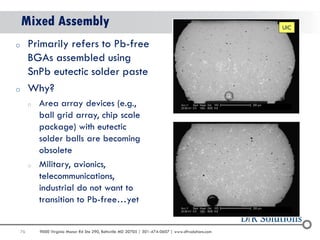
Mixed Assembly 
oPrimarily refers to Pb-free BGAs assembled using SnPb eutectic solder paste 
oWhy? 
oArea array devices (e.g., ball grid array, chip scale package) with eutectic solder balls are becoming obsolete 
oMilitary, avionics, telecommunications, industrial do not want to transition to Pb-free…yet 
UIC
77 
9000 Virginia Manor Rd Ste 290, Beltsville MD 20705 | 301-474-0607 | www.dfrsolutions.com 
Mixed Assembly: Reflow 
•Initial studies focused on peak temperature 
•Identified melt temperature of solder ball as critical parameter 
•217°C for SAC305 
•Ensured ball collapse and intermixing 
•Recommendations 
•Minimum peak reflow temperature of 220°C 
•Reflow temperatures below 220°C may result in poor assembly yields and/or inadequate interconnect reliability 
•For increased margin, >225 to 245°C peak
78 
9000 Virginia Manor Rd Ste 290, Beltsville MD 20705 | 301-474-0607 | www.dfrsolutions.com 
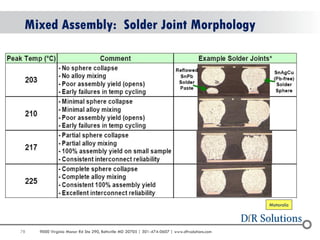
Mixed Assembly: Solder Joint Morphology 
Motorola
79 9000 Virginia Manor Rd Ste 290, Beltsville MD 20705 | 301-474-0607 | www.dfrsolutions.com 
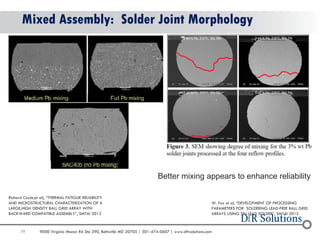
Mixed Assembly: Solder Joint Morphology 
Richard Coyle,et al), “THERMAL FATIGUE RELIABILITY 
AND MICROSTRUCTURAL CHARACTERIZATION OF A 
LARGE,HIGH DENSITY BALL GRID ARRAY WITH 
BACKWARD COMPATIBLE ASSEMBLY”, SMTAI 2012 
W. Fox et al, “DEVELOPMENT OF PROCESSING 
PARAMETERS FOR SOLDERING LEAD-FREE BALL GRID 
ARRAYS USING TIN-LEAD SOLDER”, SMTAI 2012 
Better mixing appears to enhance reliability
80 9000 Virginia Manor Rd Ste 290, Beltsville MD 20705 | 301-474-0607 | www.dfrsolutions.com 
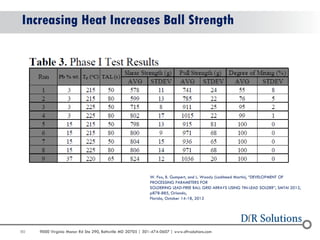
Increasing Heat Increases Ball Strength 
W. Fox, B. Gumpert, and L. Woody (Lockheed Martin), “DEVELOPMENT OF 
PROCESSING PARAMETERS FOR 
SOLDERING LEAD-FREE BALL GRID ARRAYS USING TIN-LEAD SOLDER”, SMTAI 2012, 
p878-885, Orlando, 
Florida, October 14-18, 2012
81 
9000 Virginia Manor Rd Ste 290, Beltsville MD 20705 | 301-474-0607 | www.dfrsolutions.com 
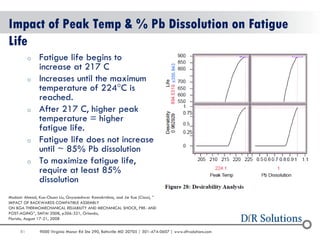
Impact of Peak Temp & % Pb Dissolution on Fatigue Life 
oFatigue life begins to increase at 217 C 
oIncreases until the maximum temperature of 224°C is reached. 
oAfter 217 C, higher peak temperature = higher fatigue life. 
oFatigue life does not increase until ~ 85% Pb dissolution 
oTo maximize fatigue life, require at least 85% dissolution 
Mudasir Ahmad, Kuo-Chuan Liu, Gnyaneshwar Ramakrishna, and Jie Xue (Cisco), ” IMPACT OF BACKWARDS COMPATIBLE ASSEMBLY ON BGA THERMOMECHANICAL RELIABILITY AND MECHANICAL SHOCK, PRE- AND POST-AGING”, SMTAI 2008, p306-321, Orlando, Florida, August 17-21, 2008
85 9000 Virginia Manor Rd Ste 290, Beltsville MD 20705 | 301-474-0607 | www.dfrsolutions.com 
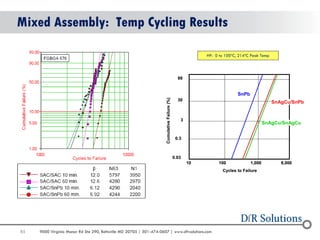
Mixed Assembly: Temp Cycling Results 
10 100 1,000 8,000 
0.03 
0.3 
3 
30 
99 
SnAgCu/SnPb 
SnAgCu/SnAgCu 
SnPb 
Cycles to Failure 
Cumulative Failure (%) 
HP: 0 to 100ºC, 214ºC Peak Temp
86 
9000 Virginia Manor Rd Ste 290, Beltsville MD 20705 | 301-474-0607 | www.dfrsolutions.com 
Mixed Assembly & Voiding 
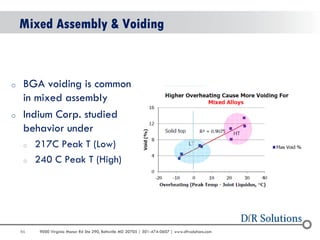
oBGA voiding is common in mixed assembly 
oIndium Corp. studied behavior under 
o217C Peak T (Low) 
o240 C Peak T (High)
87 
9000 Virginia Manor Rd Ste 290, Beltsville MD 20705 | 301-474-0607 | www.dfrsolutions.com 
Indium Corp Study Conclusions 
oMixed systems have less voiding at low temp 
oMixed systems had higher voiding than lead-free systems when reflowed at high temp 
oSome ways to reduce voiding 
oSolder paste formulation less prone to have voiding 
oMechanical shielding fixture (temperature) 
oLonger soaking profile 
oNitrogen reflow atmosphere
88 
9000 Virginia Manor Rd Ste 290, Beltsville MD 20705 | 301-474-0607 | www.dfrsolutions.com 
Mixed Assembly: Conclusions 
oA potentially lower risk than complete transition to Pb-free 
oImportant note: more studies on vibration and shock performance should be performed 
oThe preferred approach for some high reliability manufacturers (military, telecom): 
oAcceptance of mixed assembly could be driven by GEIA- STD-0005-1
89 
9000 Virginia Manor Rd Ste 290, Beltsville MD 20705 | 301-474-0607 | www.dfrsolutions.com 
Mixed Assembly: Alternatives 
oOther options on dealing with Pb-free BGAs other than mixing with SnPb 
oPlacement post-reflow 
oReballing 
oTwo flux options 
oApplication of Pb-free solder paste 
oApplication of flux preform 
oTwo soldering options 
oHot air (manual) 
oLaser soldering (automatic)
90 
9000 Virginia Manor Rd Ste 290, Beltsville MD 20705 | 301-474-0607 | www.dfrsolutions.com 
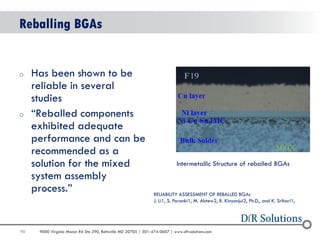
Reballing BGAs 
oHas been shown to be reliable in several studies 
o“Reballed components exhibited adequate performance and can be recommended as a solution for the mixed system assembly process.” 
Intermetallic Structure of reballed BGAs 
RELIABILITY ASSESSMENT OF REBALLED BGAs J. Li1, S. Poranki1, M. Abtew2, R. Kinyanjui2, Ph.D., and K. Srihari1,
110 
9000 Virginia Manor Rd Ste 290, Beltsville MD 20705 | 301-474-0607 | www.dfrsolutions.com 
Ongoing DfM Learning Opportunities 
oSome ideas for low cost continuing education inside and outside of your company 
oE-Learning at dfrsolutions.com 
oOrganize “Your Company Days”, Poster Sessions, Demos 
oUse internal electronic bulletin boards an resources 
oBrown Bags &” Lunch and Learns” from your internal gurus and from your suppliers 
oPCB 
oContract Manufacturers 
oElectronics Materials - paste, fluxes, cleaners
111 
9000 Virginia Manor Rd Ste 290, Beltsville MD 20705 | 301-474-0607 | www.dfrsolutions.com 
Summary 
oDfM is a proven, cost-effective strategic methodology. 
oEarly effective cross functional involvement: 
oReduces overall product development time (less changes, spins, problem solving) 
oResults in a smoother production launch. 
oSpeeds time to market. 
oReduces overall costs. 
oDesigned right the first time. 
oBuild right the first time = less rework, scrap, and warranty costs. 
oImproved quality and reliability results in: 
oHigher customer satisfaction. 
oReduced warranty costs.
112 
9000 Virginia Manor Rd Ste 290, Beltsville MD 20705 | 301-474-0607 | www.dfrsolutions.com 
Instructor Biography 
Cheryl Tulkoff has over 22 years of experience in electronics manufacturing with an emphasis on failure analysis and reliability. She has worked throughout the electronics manufacturing life cycle beginning with semiconductor fabrication processes, into printed circuit board fabrication and assembly, through functional and reliability testing, and culminating in the analysis and evaluation of field returns. She has also managed no clean and RoHS-compliant conversion programs and has developed and managed comprehensive reliability programs. 
Cheryl earned her Bachelor of Mechanical Engineering degree from Georgia Tech. She is a published author, experienced public speaker and trainer and a Senior member of both ASQ and IEEE. She has held leadership positions in the IEEE Central Texas Chapter, IEEE WIE (Women In Engineering), and IEEE ASTR (Accelerated Stress Testing and Reliability) sections. She chaired the annual IEEE ASTR workshop for four years, is an ASQ Certified Reliability Engineer and a member of SMTA and iMAPS. 
She has a strong passion for pre-college STEM (Science, Technology, Engineering, and Math) outreach and volunteers with several organizations that specialize in encouraging pre-college students to pursue careers in these fields.
113 
9000 Virginia Manor Rd Ste 290, Beltsville MD 20705 | 301-474-0607 | www.dfrsolutions.com 
Contact Information 
•Questions? 
•Contact Cheryl Tulkoff, ctulkoff@dfrsolutions.com, 512-913-8624 
•askdfr@dfrsolutions.com 
•www.dfrsolutions.com 
•Connect with me in LinkedIn as well!

Design for Manufacturing: Challenges & Opportunities

  • 1.
    1 9000 VirginiaManor Rd Ste 290, Beltsville MD 20705 | 301-474-0607 | www.dfrsolutions.com SMTA Capital Area Design for Manufacturing: Challenges & Opportunities Cheryl Tulkoff, ASQ CRE Senior Member of the Technical Staff ctulkoff@dfrsolutions.com May 16, 2013
  • 2.
    2 9000 VirginiaManor Rd Ste 290, Beltsville MD 20705 | 301-474-0607 | www.dfrsolutions.com DfM Abstract oIn the electronics industry. the quality and reliability of any product is highly dependent upon the capability of the manufacturing supplier, regardless of whether it is a contractor or a captured shop. Manufacturing issues are one of the top reasons that companies fail to meet warranty expectations, which can result in severe financial pain and eventual loss of market share. What a surprising number of engineers and managers fail to realize is that focusing on processes addresses only part of the issue. Design plays a critical role in the success or failure of manufacturing and assembly. oDesigning printed boards today is more difficult than ever before because of the increased lead free process temperature requirements and associated changes required in manufacturing. Not only has the density of the electronic assembly increased, but many changes are taking place throughout the entire supply chain regarding the use of hazardous materials and the requirements for recycling. Much of the change is due to the European Union (EU) Directives regarding these issues. The RoHS and REACH directives have caused many suppliers to the industry to rethink their materials and processes. Thus, everyone designing or producing electronics has been or will be affected. oThis course provides a comprehensive insight into the areas where design plays an important role in the manufacturing process. This workshop addresses the increasingly sophisticated PCB fabrication technologies and processes.
  • 3.
    3 9000 VirginiaManor Rd Ste 290, Beltsville MD 20705 | 301-474-0607 | www.dfrsolutions.com Presentation Outline MODULE 1: INTRODUCTIONS oIntro to Design for Manufacturing oKey Global DfM Guidelines MODULE 2: INDUSTRY STANDARD DESIGN RULES (Reference) oQuick View of Industry Standards MODULE 3: OVERVIEW OF DFM TASKS oTypes of Review Processes oRoot Cause Problem Solving oFailure Analysis (Reference) MODULE 4: DfM - COMPONENT Component Robustness Temperature Sensitivity Level Moisture Sensitivity Level Pb-free Issues MODULE 6: DfM - SOLDER •General Soldering •Lead Free Solder Alloy Update •Hand Soldering •Copper Dissolution •Mixed Assembly
  • 4.
    4 9000 VirginiaManor Rd Ste 290, Beltsville MD 20705 | 301-474-0607 | www.dfrsolutions.com Module 1: Introduction Introduction to Design for Manufacturing (DfM)
  • 5.
    5 9000 VirginiaManor Rd Ste 290, Beltsville MD 20705 | 301-474-0607 | www.dfrsolutions.com Design for Manufacturing (DfM) oDefinition oThe process of ensuring a design can be consistently manufactured by the designated supply chain with a minimum number of defects oRequirements oAn understanding of best practices (what fails during manufacturing?) oAn understanding of the limitations of the supply chain
  • 6.
    6 9000 VirginiaManor Rd Ste 290, Beltsville MD 20705 | 301-474-0607 | www.dfrsolutions.com DfM Failures oDfM is often overlooked in the design process for some of the following reasons: oDesign team often has poor insight into supply chain oOriginal Equipment Manufacturer (OEM) requests no feedback on DfM from supply chain oDfM feedback consists of standard rule checks (no insight) oDfM activities at the OEM are not standardized or distributed
  • 7.
    7 9000 VirginiaManor Rd Ste 290, Beltsville MD 20705 | 301-474-0607 | www.dfrsolutions.com Introduction to Design for Manufacturing (DfM) oDfM is the process of proactively designing products to: oOptimize all of the manufacturing functions: supplier selection and management, procurement, receiving, fabrication, assembly, quality control, operator training, shipping, delivery, service, and repair. oAssure that critical objectives of cost, quality, reliability, regulatory compliance, safety, time-to- market, and customer satisfaction are known, balanced, monitored, and achieved.
  • 8.
    8 9000 VirginiaManor Rd Ste 290, Beltsville MD 20705 | 301-474-0607 | www.dfrsolutions.com Introduction to Design for Manufacturing (DfM) oSuccessful DFM efforts require the integration of product design and process planning oIf existing processes are used, new products must be designed to the parameters and limitations of these processes regardless of whether the product is build internally or externally. oIf new processes are used, then the product and process need to be developed carefully considering the risks associated with “new”
  • 9.
    9 9000 VirginiaManor Rd Ste 290, Beltsville MD 20705 | 301-474-0607 | www.dfrsolutions.com Why DfM? (cont.) Reduce Costs by Improving Manufacturability Upfront
  • 10.
    26 9000 VirginiaManor Rd Ste 290, Beltsville MD 20705 | 301-474-0607 | www.dfrsolutions.com Module 2: Industry Standard Design Rules (Reference)
  • 11.
    27 9000 VirginiaManor Rd Ste 290, Beltsville MD 20705 | 301-474-0607 | www.dfrsolutions.com Industry Standards – IPC, JEDEC, ISO… oStart with industry standards where possible oTried and true oBut, represent only minimum acceptable requirements or concerns oModify and extend as needed to customize for your product and environments! oForums provide opportunities for free advice and feedback
  • 12.
    28 9000 VirginiaManor Rd Ste 290, Beltsville MD 20705 | 301-474-0607 | www.dfrsolutions.com IPC Design Requirement/Guideline References oIPC-2221- Generic Standard on Printed Board Design oIPC-2221A is the foundation design standard for all documents in the IPC- 2220 series. It establishes the generic requirements for the design of printed boards and other forms of component mounting or interconnecting structures, whether single-sided, double-sided or multilayer. o3 Performance Classes oClass 1 General Electronic Products - consumer products, oClass 2 Dedicated Service Electronic Products oCommunications equipment, sophisticated business machine, instruments and military equipment where high performance, extended life and uninterrupted service is desired but is not critical. oClass 3 High Reliability Electronic Products oCommercial, industrial and military products where continued performance or performance on demand is critical and where high levels of assurance are required...
  • 13.
    29 9000 VirginiaManor Rd Ste 290, Beltsville MD 20705 | 301-474-0607 | www.dfrsolutions.com oGood quality is necessary but not SUFFICIENT to guarantee high reliability. oClass 3 by itself does not guarantee high reliability oA PCB or PCBA can be perfectly built to IPC Class 3 standards and still be totally unreliable in its final application. oConsider two different PCB laminates both built to IPC Class 3 standards. oBoth laminates are identical in all properties EXCEPT one laminate has a CTEz of 40 and the other has a CTEz of 60. oThe vias in the laminate with the lower CTEz will be MORE reliable in a long term, aggressive thermal cycling environment than the CTEz 60 laminate. oA CTEz 40 laminate built to IPC class 2 could be MORE reliable than the CTEz 60 laminate built to Class 3. oAppropriate materials selection for the environment is key! A Word on Quality, Reliability & Class 2 versus Class 3
  • 14.
    30 9000 VirginiaManor Rd Ste 290, Beltsville MD 20705 | 301-474-0607 | www.dfrsolutions.com JEDEC/IPC Joint Standards oJEDEC is the leading developer of standards for the solid-state industry. All JEDEC standards are available online, at no charge. www.jedec.org oSome commonly referenced JEDEC/IPC Joint Standards standards: oJ-STD-020D.01: JOINT IPC/JEDEC STANDARD FOR MOISTURE/REFLOW SENSITIVITY CLASSIFICATION FOR NONHERMETIC SOLID STATE SURFACE- MOUNT DEVICES: oThis document identifies the classification level of nonhermetic solid-state surface mount devices (SMDs) that are sensitive to moisture-induced stress. It is used to determine what classification level should be used for initial reliability qualification. This revision now covers components to be processed at higher temperatures for lead-free assembly. oJS9704 : IPC/JEDEC-9704: Printed Wiring Board (PWB) Strain Gage Test Guideline oThis document describes specific guidelines for strain gage testing for Printed Wiring Board (PWB)assemblies. The suggested procedures enables board manufacturers to conduct required strain gage testing independently, and provides a quantitative method for measuring board flexure, and assessing risk levels. The topics covered include: Test setup and equipment; requirements; Strain measurement; Report format
  • 15.
    31 9000 VirginiaManor Rd Ste 290, Beltsville MD 20705 | 301-474-0607 | www.dfrsolutions.com Module 3: Overview of DfM Tasks
  • 16.
    32 9000 VirginiaManor Rd Ste 290, Beltsville MD 20705 | 301-474-0607 | www.dfrsolutions.com Common Types of DfM Review Processes oInformal “Gut Check” Review oPerformed by highly experienced engineers. oDifficult with transition to original design manufacturers (ODM) in developing countries. o“Tribal knowledge” oFormal Design reviews oInternal team oExternal experts oAutomated (electronic) design automation (ADA) software oModules automate DfM rule checking. oElectronic manufacturing service (EMS) providers oPerform DfM as a service
  • 17.
    33 9000 VirginiaManor Rd Ste 290, Beltsville MD 20705 | 301-474-0607 | www.dfrsolutions.com Design for Manufacturing (DfM) oFormal DfM Reviews and Tools Sometimes Overlooked oOrganization may lack specialized expertise. oMore design organizations completely removed from manufacturing. oDfM Reviews Needs to be Performed for: oBare Board oCircuit Board Assemblies oChassis/Housing Integration Packaging oSystem Assembly oDfM Needs to be conducted in conjunction with the actual electronic assembly source. oWhat is good DfM for one supplier and one set of assembly equipment may not be good for another.
  • 18.
    34 9000 VirginiaManor Rd Ste 290, Beltsville MD 20705 | 301-474-0607 | www.dfrsolutions.com Use a Root Cause Problem Solving Methodology oCritical that your organization has a formal root cause problem solving methodology used both internally and externally. oThis is the best way to incorporate relevant material into your customized Design for Manufacturing and Sourcing guidelines. oThis ties in closely with DfM Guideline #1: Know Your History!
  • 19.
    35 9000 VirginiaManor Rd Ste 290, Beltsville MD 20705 | 301-474-0607 | www.dfrsolutions.com 8D Problem Solving Methodology oProblem Statement: oSimply fixing the symptoms of a problem, more often than not, leads to band-aid solutions oEnd up solving the same problem several times oOther areas experience similar problems oSolution: oDo root cause analysis and follow through with permanent corrective actions on significant problems oBreak the endless loop oDrive Continuous Improvement oSave money & efficiencies oReap benefits beyond the discrete issue
  • 20.
    36 9000 VirginiaManor Rd Ste 290, Beltsville MD 20705 | 301-474-0607 | www.dfrsolutions.com The 8 Disciplines (8D) 1.Create the Team 2.Problem Description and Data Analysis 3.Containment Actions 4.Perform Root Cause Analysis 5.Choose and Verify Corrective Action 6.Implement Corrective Action 7.Apply Lessons Learned 8.Celebrate Success / Close the Issue (8D forms can also be used by suppliers. )
  • 21.
    37 9000 VirginiaManor Rd Ste 290, Beltsville MD 20705 | 301-474-0607 | www.dfrsolutions.com Why is Failure Analysis Knowledge Important? oThere are always more problems than resources! oIf you don’t analyze, learn from, and prevent problems, you simply repeat them. Your list never gets smaller.
  • 22.
    38 9000 VirginiaManor Rd Ste 290, Beltsville MD 20705 | 301-474-0607 | www.dfrsolutions.com General Words of Wisdom on Failure Analysis oBefore spending time and money on Failure Analysis (FA), consider the following: oConsider “order” carefully. Some actions will limit or eliminate the ability to perform additional tests. oUnderstand the limitations and output of the tests selected. oUse labs who can help you select and interpret tests for capabilities you don’t have. oAvoid requesting a specific test. Describe the problem and define the data and output you need first. oPursue multiple courses of action. There is rarely one test or one root cause that will solve your problem. oConsider how the data will help solve the problem oSome FA is just not worth doing!
  • 23.
    39 9000 VirginiaManor Rd Ste 290, Beltsville MD 20705 | 301-474-0607 | www.dfrsolutions.com 39 Failure Analysis Techniques Returned parts failure analysis always starts with Non-Destructive Evaluation (NDE) Designed to obtain maximum information with minimal risk of damaging or destroying physical evidence Emphasize the use of simple tools first! (Generally) non-destructive techniques: Visual Inspection Electrical Characterization Time Domain Reflectometry (TDR) Acoustic Microscopy (SAM) X-ray Microscopy Thermal Imaging (Infra-red camera) Superconducting Quantum Interfering Device (SQUID) Microscopy
  • 24.
    40 9000 VirginiaManor Rd Ste 290, Beltsville MD 20705 | 301-474-0607 | www.dfrsolutions.com 40 Failure Analysis Techniques oDestructive evaluation techniques oDecapsulation oPlasma etching oCross-sectioning oThermal imaging (liquid crystal; SQUID and IR also good after decap) oSEM/EDX – Scanning Electron Microscope / Energy dispersive X-ray Spectroscopy oSurface/depth profiling techniques: SIMS-Secondary Ion Mass Spectroscopy, Auger oOBIC/EBIC oFIB - Focused Ion Beam oMechanical testing: wire pull, wire shear, solder ball shear, die shear oOther characterization methods oFTIR- Fourier Transform Infra-Red Spectroscopy oIon chromatography oDSC – Differential Scanning Calorimetry oDMA/TMA – Thermo-mechanical analysis
  • 25.
    41 9000 VirginiaManor Rd Ste 290, Beltsville MD 20705 | 301-474-0607 | www.dfrsolutions.com oMost critical step in the failure analysis process oCan the reported failure mode be replicated? oPersistent or intermittent? oIntermittent failures often incorrectly diagnosed as no trouble found (NTF) oLeast utilized to its fullest extent oApproach dependent upon the product oComponent oBare substrate oPCB assembly oSometimes performed in combination with environmental exposure oCharacterization over specified/expected temperature range oCharacterization over specified / expected radiation range oHumidity environment (re-introduction of moisture) oNot intended to induce damage! Electrical Characterization
  • 26.
    42 9000 VirginiaManor Rd Ste 290, Beltsville MD 20705 | 301-474-0607 | www.dfrsolutions.com Failure Analysis Tools: Dye N Pry Capability oAllows for quick (destructive) inspection for cracked or fractured solder joints under leadless components (BGAs, QFNs) ohttp://www.electroiq.com/index/display/packaging- article- display/165957/articles/advanced-packaging/volume- 12/issue-1/features/solder- joint-failure-analysis.html
  • 27.
    43 9000 VirginiaManor Rd Ste 290, Beltsville MD 20705 | 301-474-0607 | www.dfrsolutions.com Failure Analysis Dremel Tool – Induce Vibrations oA Dremel tool can be used to induce local vibration during debugging ohttp://www.dremel.com
  • 28.
    44 9000 VirginiaManor Rd Ste 290, Beltsville MD 20705 | 301-474-0607 | www.dfrsolutions.com Module 4: Components Component Robustness
  • 29.
    45 9000 VirginiaManor Rd Ste 290, Beltsville MD 20705 | 301-474-0607 | www.dfrsolutions.com Robustness - Components oConcerns oPotential for latent defects after exposure to Pb-free reflow temperatures o215°C - 220°C peak → 240°C - 260°C peak oDrivers oInitial observations of deformed or damaged components oFailure of component manufacturers to update specifications oComponents of particular interest oAluminum electrolytic capacitors oCeramic chip capacitors oSurface mount connectors oSpecialty components (RF, optoelectronic, etc.)
  • 30.
    46 9000 VirginiaManor Rd Ste 290, Beltsville MD 20705 | 301-474-0607 | www.dfrsolutions.com Ceramic Capacitors (Thermal Shock Cracks) oDue to excessive change in temperature oReflow, cleaning, wave solder, rework oInability of capacitor to relieve stresses during transient conditions. oMaximum tensile stress occurs near end of termination oDetermined through transient thermal analyses oModel results validated through sectioning of ceramic capacitors exposed to thermal shock conditions oThree manifestations oVisually detectable (rare) oElectrically detectable oMicrocrack (worst-case) NAMICS AVX
  • 31.
    47 9000 VirginiaManor Rd Ste 290, Beltsville MD 20705 | 301-474-0607 | www.dfrsolutions.com Thermal Shock Crack: Visually Detectable AVX
  • 32.
    48 9000 VirginiaManor Rd Ste 290, Beltsville MD 20705 | 301-474-0607 | www.dfrsolutions.com 48 Thermal Shock Crack: Micro Crack oVariations in voltage or temperature will drive crack propagation oInduces a different failure mode oIncrease in electrical resistance or decrease capacitance DfR
  • 33.
    49 9000 VirginiaManor Rd Ste 290, Beltsville MD 20705 | 301-474-0607 | www.dfrsolutions.com Corrective Actions: Design oAvoid certain dimensions and materials oMaximum case size for SnPb: 1210 oMaximum case size for SAC305: 0805 oMaximum thickness: 1.2 mm oC0G, X7R preferred oAdequate spacing from hand soldering operations oUse manufacturer’s recommended bond pad dimensions or smaller oSmaller bond pads reduce rate of thermal transfer
  • 34.
    50 9000 VirginiaManor Rd Ste 290, Beltsville MD 20705 | 301-474-0607 | www.dfrsolutions.com Corrective Actions: Manufacturing oReflow oRoom temperature to preheat (max 2-3oC/sec) oPreheat to at least 150oC oPreheat to maximum temperature (max 4-5oC/sec) oCooling (max 2-3oC/sec) oIn conflict with profile from J-STD-020C (6oC/sec) oMake sure assembly is less than 60oC before cleaning oWave soldering oMaintain belt speeds to a maximum of 1.2 to 1.5 meters/minute oEliminate “cosmetic” touch up
  • 35.
    51 9000 VirginiaManor Rd Ste 290, Beltsville MD 20705 | 301-474-0607 | www.dfrsolutions.com Flex Cracking of Ceramic Capacitors (cont.) o Excessive flexure of PCB under ceramic chip capacitor can induce cracking at the terminations o Pb-free more resistant to flex cracking o Correlates with Kemet results (CARTS 2005) o Rationale o Smaller solder joints o Residual compressive stresses o Influence of bond pad 1.00 10.00 1.00 5.00 10.00 50.00 90.00 99.90 ReliaSoft's Weibull++ 6.0 - www.Weibull.c om Probability - Weibull Displacement (mm) Unreliability, F(t) 6/13/2005 21:56 DfR Solut ions Craig Hillman Weibull 1812 SAC W2 RRX - RRM MED F=162 / S=0          1812 SnPb W2 RRX - RRM MED F=90 / S=0          SnPb SnAgCu
  • 36.
    52 9000 VirginiaManor Rd Ste 290, Beltsville MD 20705 | 301-474-0607 | www.dfrsolutions.com Flex Cracking (Case Studies) Screw Attachment Board Depaneling Connector Insertion Heatsink Attachment
  • 37.
    53 9000 VirginiaManor Rd Ste 290, Beltsville MD 20705 | 301-474-0607 | www.dfrsolutions.com Flex Cracking (cont.) oDrivers oDistance from flex point oOrientation oLength (most common at 1206 and above; observed in 0603) oSolutions oAvoid case sizes greater than 1206 oMaintain 30-60 mil spacing from flex point oReorient parallel to flex point oReplace with Flexicap (Syfer) or Soft Termination (AVX) oReduce bond pad width to 80 to 100% of capacitor width oMeasure board-level strain (maintain below 750 microstrain, below 500 microstrain preferred for Pb-free)
  • 38.
    54 9000 VirginiaManor Rd Ste 290, Beltsville MD 20705 | 301-474-0607 | www.dfrsolutions.com Module 6: Solders General Soldering
  • 39.
    55 9000 VirginiaManor Rd Ste 290, Beltsville MD 20705 | 301-474-0607 | www.dfrsolutions.com Process Capabilities Defects Rates for Soldering Processes oDesigns that avoid manual soldering operations reduce defects. oMain Issues: Insufficient solder or bonding, Missed joints, Heat Damage oReflow soldering produces less defects that wave soldering. oMain Issues: Solder Bridges, Solder Skips/Insufficient Solder, Missing Component Defects Per Million (Joint) Opportunities (DPMO) Example 1,000 Joints/Board on 1,000 Boards Solder Process DPMO Standard Best in Class Hand 5000 N/A Wave 500 20 - 100 Reflow 50 <10
  • 40.
    56 9000 VirginiaManor Rd Ste 290, Beltsville MD 20705 | 301-474-0607 | www.dfrsolutions.com Reflow Profile Optimization oStart with paste manufacturer’s recommendations! oPreheating Phase - Ramp & Soak vs. Straight Ramp preheating profiles oRamp & Soak (soak period just below liquidus), more common, more forgiving. oAllow flux solvents to fully evaporate and activate to deoxidize the surfaces to be soldered. oAllows temperature equalization across the entire assembly. oConsistent soldering and reduces tomb stoning. oIf too long, flux may be consumed resulting in excessive oxidation. oFlux may become volatile - producing solder balls or voiding defects. oStraight Line is faster and causes less thermal damage to materials oBut more susceptible to defect and quality variation, does not work as well on complex, dense assemblies.
  • 41.
    57 9000 VirginiaManor Rd Ste 290, Beltsville MD 20705 | 301-474-0607 | www.dfrsolutions.com Reflow Profile Optimization oPeak Temperature and Time at (above) Liquidus (TAL) oA balance between being hot enough for long enough to achieve good consistent solder wetting and bonding for proper joint formation, across the entire assembly. oYet as quickly as possible to prevent thermal damage to the components and board and to prevent excessive copper dissolution and excessive intermetallic growth. oCooling Rate of SnAgCu effects the Microstructure & Bulk Intermetallics oFaster cooling rates produce a finer, stronger microstructure and limits intermetallics. oOverall Time (Costs & Efficiency) oOverall throughput is determined the board size/complexity and the oven's heat transfer capabilities. oRule of Thumb: 2-3 C/second ramp up and down rate
  • 42.
    58 9000 VirginiaManor Rd Ste 290, Beltsville MD 20705 | 301-474-0607 | www.dfrsolutions.com PTH Soldering: Incomplete Hole Fill oPoor solder hole fill can lead to solder joint cracks/failures. Can be caused by: oInsufficient top side heating prevented solder from wicking up into PTH Barrel oInsufficient flux or flux activity for the surface finish in use oLack of thermal relief for large copper planes oPCB hole wall integrity issues – voids, plating, contamination
  • 43.
    59 9000 VirginiaManor Rd Ste 290, Beltsville MD 20705 | 301-474-0607 | www.dfrsolutions.com PTH Hole Fill & Thermal Relief oUtilize thermal reliefs on all copper planes when practical oReduces thermal transfer rate between PTH and copper plane oAllows for easier solder joint formation during solder (especially for Pb-free) oAllows for better hole fill Copper Plane PTH Laminate Copper Spoke Courtesy of D. Canfield (Excalibur Manufacturing)
  • 44.
    60 9000 VirginiaManor Rd Ste 290, Beltsville MD 20705 | 301-474-0607 | www.dfrsolutions.com Module 6: Solders Discussion of 2nd generation Pb-free alloys (e.g., SN100C)
  • 45.
    61 9000 VirginiaManor Rd Ste 290, Beltsville MD 20705 | 301-474-0607 | www.dfrsolutions.com The Current State of Lead-Free oComponent suppliers oSAC305 still dominant, but with increasing introduction of low silver alloys (SAC205, SAC105, SAC0507) oSolder Paste oSAC305 still dominant oWave and Rework oSn07Cu+Ni (SN100C) oSn07Cu+Co (SN100e) oSn07Cu+Ni+Bi (K100LD) oHASL PCB Coating oSn07Cu+Ni (SN100C)
  • 46.
    62 9000 VirginiaManor Rd Ste 290, Beltsville MD 20705 | 301-474-0607 | www.dfrsolutions.com What are Solder Suppliers Promoting? Company Paste Wire / Wave Senju ECO Solder (SAC305) Nihon Genma NP303 (SAC305), NP601 (Sn8Zn3Bi) NP303 (SAC305), NP103 (SAC0307) Metallic Resources SAC305 SAC305, SC995e (Sn05Cu+Co) Koki S3X (SAC305), S3XNI58 (SAC305+Ni+In), SB6N58 (Sn3.5Ag0.5Bi6In) S3X (SAC305), S03X7C (SAC0307+0.03Co) Heraeus SAC405 Cookson / Alpha Metals SACX (SAC0307+Bi+0.1P+0.02RareEarth+0.01Sb) Kester K100LD (Sn07Cu+0.05Ni+Bi) Qualitek SN100e (Sn07Cu+0.05Co) Nihon Superior SN100C (Sn07Cu+0.05Ni+Ge) AIM SN100C (Sn07Cu+0.05Ni+Ge) Indium Indium5.1AT (SAC305) N/A Amtech SAC305, Sn3.5Ag, Sn5Ag, Sn07Cu, Sn5Sb Shenmao SAC305 to SAC405, SAC305+0.06Ni+0.01Ge Henkel No preference EFD No preference P. Kay Metals No preference
  • 47.
    63 9000 VirginiaManor Rd Ste 290, Beltsville MD 20705 | 301-474-0607 | www.dfrsolutions.com 2nd Generation Pb-Free Solder (Thoughts) oNi-modified SnCu and low silver SAC are the primary front runners oBoth seem to display reliability behaviors between SAC305 and SnPb oProliferation of custom alloys is unhealthy for the electronics industry oToo much time spent on material identification, characterization, and risk assessment oOne customer had SAC405, SAC387, SAC305, SAC105, SAC0307, and SAC125Ni on one board! oAlmost no component manufacturers assess these new alloys from a physics of failure oTest to spec mentality oHuge risk for escapes
  • 48.
    64 9000 VirginiaManor Rd Ste 290, Beltsville MD 20705 | 301-474-0607 | www.dfrsolutions.com Module 6: Solders Hand Soldering Copper Dissolution Mixed Assembly
  • 49.
    65 9000 VirginiaManor Rd Ste 290, Beltsville MD 20705 | 301-474-0607 | www.dfrsolutions.com oDesigned for hand soldering oSIR data oHalogen / halide free: Watch for definitions! oSupplier – relationships, proximity oLead finish oSubstrate finish oAcid number oLead free or SnPb soldering? oCompatibility with adjacent materials oAdhesives, conformal coatings, etc. Basic Hand Soldering Materials Selection Criteria
  • 50.
    66 9000 VirginiaManor Rd Ste 290, Beltsville MD 20705 | 301-474-0607 | www.dfrsolutions.com oSize /type / pitch / plating of leads oSubstrate finish / type – rigid, flex, ENIG, etc oSpace between hand soldered leads and adjacent components and circuitry oSize, shape, heat sinking of module at time of hand soldering oCan unit and component be preheated? Design Considerations
  • 51.
    67 9000 VirginiaManor Rd Ste 290, Beltsville MD 20705 | 301-474-0607 | www.dfrsolutions.com oOperator variation is the norm. Training is critical! oGeneral hand soldering tips: oUse soldering irons with great thermal recovery - the lower the soldering temperature and the larger the tip, the less heat loss oUse a high power soldering iron oUse the largest tip commensurate with the size of the joint being soldered and available space oCustom tips can be designed if needed. oUse the largest cored solder wire diameter appropriate for the size of the joint and available space. oAvoid the use of liquid fluxes oTypical tip temperatures for Pb-free solder are ~700F with 2-5 seconds of contact time. Higher temps can damage boards and components. Hand Soldering Process
  • 52.
    68 9000 VirginiaManor Rd Ste 290, Beltsville MD 20705 | 301-474-0607 | www.dfrsolutions.com Solder Tip Size and Cored Wire Size Images courtesy of OK International The diagram below shows why No-Clean Flux-cored solder seldom works as well as RMA-cored solder:
  • 53.
    69 9000 VirginiaManor Rd Ste 290, Beltsville MD 20705 | 301-474-0607 | www.dfrsolutions.com oConsider use of a portable preheater to shorten contact time and fully activate fluxes ohttp://www.zeph.com/airbathseries.htm oPreheat to 100 F or so oVerify actual PCB and lead temperatures with small temp labels ohttp://www.omega.com/toc_asp/sectionSC.asp?section=F&book=temperature oUse solder preforms for repeatable joint size and flux volume – both PTH and SMT Hand Soldering Tips
  • 54.
    70 9000 VirginiaManor Rd Ste 290, Beltsville MD 20705 | 301-474-0607 | www.dfrsolutions.com oAlways avoid liquid flux if possible oIf it’s truly needed: oLook for methods to ensure precise delivery oFlux pens are one method oThe needle tip dispense bottles are not recommended. oAvoid letting flux run under and around adjacent components. oProvide some form of uniform heating to volatalize as much of the liquid as possible. oSelect a flux designed and validated for hand soldering processes oThis is probably NOT be the same material as your wave solder flux. Wave solder fluxes are designed to hold up through preheat and dual wave contact. oReview surface insulation resistance (SIR) data Use of Liquid Flux
  • 55.
    71 9000 VirginiaManor Rd Ste 290, Beltsville MD 20705 | 301-474-0607 | www.dfrsolutions.com oTypical manual cleaning process: oSome type of solvent spray is used to loosen flux residues and followed by hand cleaning using IPA and a soft bristle brush. oThis type of manual cleaning process represents a reliability risk. oSeveral studies have shown that SIR (surface insulation resistance) actually INCREASES when IPA and brushes are used in manual cleaning. oBrushes are not routinely cleaned or maintained and become contamination transfer mechanisms. oPoorly removed residues are more likely to experience corrosion failures than no clean flux residues left intact. oIn rework and repair, if you can’t rinse, you can’t clean. Manual Removal of Flux Residues: Not Recommended!
  • 56.
    72 9000 VirginiaManor Rd Ste 290, Beltsville MD 20705 | 301-474-0607 | www.dfrsolutions.com Solders: Copper Dissolution o The reduction or elimination of surface copper conductors due to repeated exposure to Sn-based solders o Significant concern for industries that perform extensive rework o Telecom, military, avionics Bath, iNEMI ENIG Plating 60 sec. exposure 274ºC solder fountain
  • 57.
    73 9000 VirginiaManor Rd Ste 290, Beltsville MD 20705 | 301-474-0607 | www.dfrsolutions.com Solders: Copper Dissolution (cont.) o PTH knee is the point of greatest plating reduction o Primarily a rework/repair issue o Celestica identified significant risk with >1X rework o Already having a detrimental effect o Major OEM unable to repair ball grid arrays (BGAs) S. Zweigart, Solectron
  • 58.
    74 9000 VirginiaManor Rd Ste 290, Beltsville MD 20705 | 301-474-0607 | www.dfrsolutions.com Copper Dissolution (Contact Time) oContact time is the major driver oSome indications of a 25-30 second limit oPreheat and pot temp. seem to have a lesser effect oOptimum conditions (for SAC) oContact time (max): 47 sec. (cumulative) oPreheat temperature: 140-150°C oPot temperature: 260-265°C A Study of Copper Dissolution During Pb-Free PTH Rework Using a Thermally Massive Test Vehicle , C. Hamilton (May 2007)
  • 59.
    75 9000 VirginiaManor Rd Ste 290, Beltsville MD 20705 | 301-474-0607 | www.dfrsolutions.com Solutions to Cu Dissolution oOption 1: restriction on rework oNumber of reworks or contact time oOption 2: solder material oIndications that SNC can decrease dissolution rates oReduced diffusion rate through Sn-Ni-Cu intermetallics oOption 3: board plating oSome considering ENIG oSome considering SNC HASL A Study of Copper Dissolution During Pb-Free PTH Rework Using a Thermally Massive Test Vehicle , C. Hamilton (May 2007)
  • 60.
    76 9000 VirginiaManor Rd Ste 290, Beltsville MD 20705 | 301-474-0607 | www.dfrsolutions.com Mixed Assembly oPrimarily refers to Pb-free BGAs assembled using SnPb eutectic solder paste oWhy? oArea array devices (e.g., ball grid array, chip scale package) with eutectic solder balls are becoming obsolete oMilitary, avionics, telecommunications, industrial do not want to transition to Pb-free…yet UIC
  • 61.
    77 9000 VirginiaManor Rd Ste 290, Beltsville MD 20705 | 301-474-0607 | www.dfrsolutions.com Mixed Assembly: Reflow •Initial studies focused on peak temperature •Identified melt temperature of solder ball as critical parameter •217°C for SAC305 •Ensured ball collapse and intermixing •Recommendations •Minimum peak reflow temperature of 220°C •Reflow temperatures below 220°C may result in poor assembly yields and/or inadequate interconnect reliability •For increased margin, >225 to 245°C peak
  • 62.
    78 9000 VirginiaManor Rd Ste 290, Beltsville MD 20705 | 301-474-0607 | www.dfrsolutions.com Mixed Assembly: Solder Joint Morphology Motorola
  • 63.
    79 9000 VirginiaManor Rd Ste 290, Beltsville MD 20705 | 301-474-0607 | www.dfrsolutions.com Mixed Assembly: Solder Joint Morphology Richard Coyle,et al), “THERMAL FATIGUE RELIABILITY AND MICROSTRUCTURAL CHARACTERIZATION OF A LARGE,HIGH DENSITY BALL GRID ARRAY WITH BACKWARD COMPATIBLE ASSEMBLY”, SMTAI 2012 W. Fox et al, “DEVELOPMENT OF PROCESSING PARAMETERS FOR SOLDERING LEAD-FREE BALL GRID ARRAYS USING TIN-LEAD SOLDER”, SMTAI 2012 Better mixing appears to enhance reliability
  • 64.
    80 9000 VirginiaManor Rd Ste 290, Beltsville MD 20705 | 301-474-0607 | www.dfrsolutions.com Increasing Heat Increases Ball Strength W. Fox, B. Gumpert, and L. Woody (Lockheed Martin), “DEVELOPMENT OF PROCESSING PARAMETERS FOR SOLDERING LEAD-FREE BALL GRID ARRAYS USING TIN-LEAD SOLDER”, SMTAI 2012, p878-885, Orlando, Florida, October 14-18, 2012
  • 65.
    81 9000 VirginiaManor Rd Ste 290, Beltsville MD 20705 | 301-474-0607 | www.dfrsolutions.com Impact of Peak Temp & % Pb Dissolution on Fatigue Life oFatigue life begins to increase at 217 C oIncreases until the maximum temperature of 224°C is reached. oAfter 217 C, higher peak temperature = higher fatigue life. oFatigue life does not increase until ~ 85% Pb dissolution oTo maximize fatigue life, require at least 85% dissolution Mudasir Ahmad, Kuo-Chuan Liu, Gnyaneshwar Ramakrishna, and Jie Xue (Cisco), ” IMPACT OF BACKWARDS COMPATIBLE ASSEMBLY ON BGA THERMOMECHANICAL RELIABILITY AND MECHANICAL SHOCK, PRE- AND POST-AGING”, SMTAI 2008, p306-321, Orlando, Florida, August 17-21, 2008
  • 66.
    85 9000 VirginiaManor Rd Ste 290, Beltsville MD 20705 | 301-474-0607 | www.dfrsolutions.com Mixed Assembly: Temp Cycling Results 10 100 1,000 8,000 0.03 0.3 3 30 99 SnAgCu/SnPb SnAgCu/SnAgCu SnPb Cycles to Failure Cumulative Failure (%) HP: 0 to 100ºC, 214ºC Peak Temp
  • 67.
    86 9000 VirginiaManor Rd Ste 290, Beltsville MD 20705 | 301-474-0607 | www.dfrsolutions.com Mixed Assembly & Voiding oBGA voiding is common in mixed assembly oIndium Corp. studied behavior under o217C Peak T (Low) o240 C Peak T (High)
  • 68.
    87 9000 VirginiaManor Rd Ste 290, Beltsville MD 20705 | 301-474-0607 | www.dfrsolutions.com Indium Corp Study Conclusions oMixed systems have less voiding at low temp oMixed systems had higher voiding than lead-free systems when reflowed at high temp oSome ways to reduce voiding oSolder paste formulation less prone to have voiding oMechanical shielding fixture (temperature) oLonger soaking profile oNitrogen reflow atmosphere
  • 69.
    88 9000 VirginiaManor Rd Ste 290, Beltsville MD 20705 | 301-474-0607 | www.dfrsolutions.com Mixed Assembly: Conclusions oA potentially lower risk than complete transition to Pb-free oImportant note: more studies on vibration and shock performance should be performed oThe preferred approach for some high reliability manufacturers (military, telecom): oAcceptance of mixed assembly could be driven by GEIA- STD-0005-1
  • 70.
    89 9000 VirginiaManor Rd Ste 290, Beltsville MD 20705 | 301-474-0607 | www.dfrsolutions.com Mixed Assembly: Alternatives oOther options on dealing with Pb-free BGAs other than mixing with SnPb oPlacement post-reflow oReballing oTwo flux options oApplication of Pb-free solder paste oApplication of flux preform oTwo soldering options oHot air (manual) oLaser soldering (automatic)
  • 71.
    90 9000 VirginiaManor Rd Ste 290, Beltsville MD 20705 | 301-474-0607 | www.dfrsolutions.com Reballing BGAs oHas been shown to be reliable in several studies o“Reballed components exhibited adequate performance and can be recommended as a solution for the mixed system assembly process.” Intermetallic Structure of reballed BGAs RELIABILITY ASSESSMENT OF REBALLED BGAs J. Li1, S. Poranki1, M. Abtew2, R. Kinyanjui2, Ph.D., and K. Srihari1,
  • 72.
    110 9000 VirginiaManor Rd Ste 290, Beltsville MD 20705 | 301-474-0607 | www.dfrsolutions.com Ongoing DfM Learning Opportunities oSome ideas for low cost continuing education inside and outside of your company oE-Learning at dfrsolutions.com oOrganize “Your Company Days”, Poster Sessions, Demos oUse internal electronic bulletin boards an resources oBrown Bags &” Lunch and Learns” from your internal gurus and from your suppliers oPCB oContract Manufacturers oElectronics Materials - paste, fluxes, cleaners
  • 73.
    111 9000 VirginiaManor Rd Ste 290, Beltsville MD 20705 | 301-474-0607 | www.dfrsolutions.com Summary oDfM is a proven, cost-effective strategic methodology. oEarly effective cross functional involvement: oReduces overall product development time (less changes, spins, problem solving) oResults in a smoother production launch. oSpeeds time to market. oReduces overall costs. oDesigned right the first time. oBuild right the first time = less rework, scrap, and warranty costs. oImproved quality and reliability results in: oHigher customer satisfaction. oReduced warranty costs.
  • 74.
    112 9000 VirginiaManor Rd Ste 290, Beltsville MD 20705 | 301-474-0607 | www.dfrsolutions.com Instructor Biography Cheryl Tulkoff has over 22 years of experience in electronics manufacturing with an emphasis on failure analysis and reliability. She has worked throughout the electronics manufacturing life cycle beginning with semiconductor fabrication processes, into printed circuit board fabrication and assembly, through functional and reliability testing, and culminating in the analysis and evaluation of field returns. She has also managed no clean and RoHS-compliant conversion programs and has developed and managed comprehensive reliability programs. Cheryl earned her Bachelor of Mechanical Engineering degree from Georgia Tech. She is a published author, experienced public speaker and trainer and a Senior member of both ASQ and IEEE. She has held leadership positions in the IEEE Central Texas Chapter, IEEE WIE (Women In Engineering), and IEEE ASTR (Accelerated Stress Testing and Reliability) sections. She chaired the annual IEEE ASTR workshop for four years, is an ASQ Certified Reliability Engineer and a member of SMTA and iMAPS. She has a strong passion for pre-college STEM (Science, Technology, Engineering, and Math) outreach and volunteers with several organizations that specialize in encouraging pre-college students to pursue careers in these fields.
  • 75.
    113 9000 VirginiaManor Rd Ste 290, Beltsville MD 20705 | 301-474-0607 | www.dfrsolutions.com Contact Information •Questions? •Contact Cheryl Tulkoff, ctulkoff@dfrsolutions.com, 512-913-8624 •askdfr@dfrsolutions.com •www.dfrsolutions.com •Connect with me in LinkedIn as well!