Best Practices for Improving the PCB Supply Chain: Part II 
Cheryl Tulkoff 
Senior Member of the Technical Staff 
ctulkoff@dfrsolutions.com 
1
PCB SUPPLY CHAIN BEST PRACTICES – PART I RECAP 
2
PCBs should always be considered critical components 
Custom design 
Product Foundation 
Long term PCB quality and reliability is simply not achievable without stringent controls in place for: 
Supplier selection 
Qualification 
Management 
PCBs as Critical Components 
3
Create a PCB Commodity Team with at least one representative from each of the following areas: 
Design 
Manufacturing 
Purchasing 
Quality/Reliability 
Team should meet on a routine basis 
Discuss new products and technology requirements in the development pipeline. 
Pricing, delivery, and quality performance issues with approved PCB suppliers should also be reviewed. 
Team is also tasked with identifying new suppliers and creating supplier selection and monitoring criteria 
PCB Commodity Team 
4
Established PCB supplier selection criteria in place. 
Criteria should be custom to your business 
Commonly used criteria are: 
Time in business 
Revenue 
Growth 
Employee Turnover 
Training Program 
Certified to the standards you require (IPC, MIL-SPEC, ISO, etc.) 
Capable of producing the technology you need as part of their mainstream capabilities 
Don’t exist in PCB process “niches” where suppliers claim capability but have less than ~ 15% of their volume built there 
Have quality and problem solving methodologies in place 
Have a technology roadmap 
Have a continuous improvement program in place 
Supplier Selection Criteria 
5
Rigorous qualification criteria which includes: 
On site visit by to the facility which will produce your PCBs by someone knowledgeable in PCB fabrication techniques. 
Review process controls, quality monitoring and analytical techniques, storage and handling practices and conformance to generally acceptable manufacturing practices. 
Best way to meet and establish relationships with the people responsible for manufacturing your product. 
Sample builds of an actual part you will produce which are evaluated by the PCB supplier 
Also independently evaluated by you or a representative to the standards that you require. 
PCB Qualification Criteria 
6
Use of supplier tiering 
 Low, Middle, High strategies if you have a diverse product line with products that range from simpler to complex. 
Allows for strategic tailoring to save cost and to maximize supplier quality to your product design. 
Match supplier qualifications to the complexity of your product. 
Typical criteria for tiering suppliers include: 
Finest line width 
Finest conductor spacing, 
Smallest drilled hole and via size 
Impedance control requirement 
Specialty laminate needed (Rogers, flex, mixed) 
Use of HDI, micro vias, blind or buried vias. 
Minimize use of suppliers who have to outsource critical areas of construction. 
Again, do not exist in the margins of process capabilities! 
PCB Supplier Tiering 
7
Partner with your PCB suppliers for success. 
Critical for low volumes, low spend, or high technology and reliability requirements 
Some good practices include: 
Monthly calls with PCB commodity team and each PCB supplier 
 PCB supplier team should members equivalent to your team members 
QBRs (quarterly business reviews) 
Review spend, quality, and performance metrics, and “state of the business “, business growth, new product and quoting opportunities… 
Address any upcoming changes 
 Factory expansion, move, or relocation, critical staffing changes, new equipment/capability installation etc. 
Twice per year, QBRs should be joint onsite meetings which alternate between your site and the supplier factory site. 
Factory supplier site QBR visit can double as the annual on site visit and audit that you perform. 
PCB Relationship Management 
8
Use Supplier Scorecards 
Perform quarterly and yearly on a rolling basis 
Typical metrics include: 
On Time Delivery 
PPM Defect Rates 
Communication – speed, accuracy, channels, responsiveness to quotes 
Quality Excursions / Root Cause Corrective Action Process Resolution 
Supplier Corrective Action Requests 
Discuss recalls, notifications, or scrap events exceeding a certain dollar amount 
PCB Supplier Scorecards 
9
Review the following: 
Top 3 PCB factory defects: monitoring and reporting 
Process control and improvement plans for the top 3 defects 
Product Yield and scrap reports 
Feedback on issues facing the industry 
Reliability testing performed (HATS, IST, solder float, etc.) 
Review IPC-9151B, Printed Board Process Capability, Quality, and Relative Reliability (PCQR2) Benchmark Test Standard and Database at: 
http://www.ipc.org/html/IPC-9151B.pdf 
PCB suppliers may be part of this activity already. 
Ask if they participate and if you can get a copy of their results. 
PCB Continuous Quality Monitoring 
10
Ideally, all PCBs should come from the same factory from start to finish 
Prototype (feasibility), pre-release production (testability & reliability), to released production (manufacturability). 
Any factory move introduces an element of risk 
Product must go through setup and optimization specific to each factory and equipment contained there. 
While not always possible, all PCBs intended for quality and reliability testing should come from the actual PCB production facility. 
PCB Prototype Development 
11
PART II: PERFORMING THE PCB PROCESS AUDIT 
Everything looks great on paper or on the web…… 
12
Why Perform an Onsite Audit? 
No industry standard methodology for qualifying PCB suppliers 
Standards do exist for lot-based PCB testing and acceptance within the IPC 6010 series 
 Sourcing follows the “as agreed upon between user and supplier” (AABUS) approach 
 IPC began discussing this gap in 2008 with a Blue Ribbon Committee 
IPC has recently launched a Validation Business Unit with plans to eventually move towards an IPC Qualified Manufacturers List (QML) for suppliers, including PCBs [3]. I 
In the meantime, however, onsite audits remain the best approach 
13
PCB Fabrication Processes 
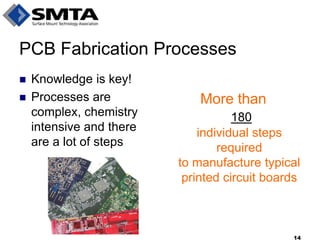
More than 180 individual steps required to manufacture typical printed circuit boards 
Knowledge is key! 
Processes are complex, chemistry intensive and there are a lot of steps 
14
Audit Focus 
All steps are obviously important but this presentation will focus on: 
Requirements 
Surface Finish Highlight 
Process Control & Analysis 
Cleanliness 
Recognizing Common Defects 
Test & Final Inspection 
Material Handling 
15
Communicate Requirements 
Define the standards needed 
Communicate both quality & reliability objectives! 
Help your supplier help you 
Create a PCB Fabrication specification 
Outlines requirements and communication required for modifications to drawings 
16
Laminate selection is frequently under specified! Some common issues: 
PCB supplier frequently allowed to select laminate material 
No restrictions on laminate changes 
Generic IPC slash sheet requirements used 
Laminates called out by Tg only and with no measurement method specified (there is more than one) 
No cleanliness requirements specified 
Failure to specify stackup 
Not all laminates are created equal 
Failure to put some controls in places opens the door to failure 
PCB Materials Selection
Good quality is necessary but not SUFFICIENT to guarantee high reliability. 
IPC Class 3 by itself does not guarantee high reliability 
A PCB or PCBA can be perfectly built to IPC Class 3 standards and still be totally unreliable in its final application. 
Consider two different PCB laminates both built to IPC Class 3 standards. 
Both laminates are identical in all properties EXCEPT one laminate has a CTEz of 40 and the other has a CTEz of 60. 
The vias in the laminate with the lower CTEz will be MORE reliable in a long term, aggressive thermal cycling environment than the CTEz 60 laminate. 
A CTEz 40 laminate built to IPC class 2 could be MORE reliable than the CTEz 60 laminate built to Class 3. 
Appropriate materials selection for the environment is key! 
Quality, Reliability & IPC Class 2 versus Class 3 
18
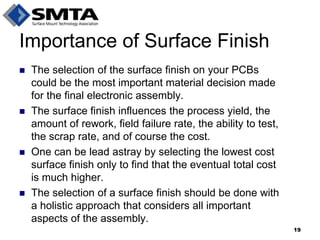
Importance of Surface Finish 
The selection of the surface finish on your PCBs could be the most important material decision made for the final electronic assembly. 
The surface finish influences the process yield, the amount of rework, field failure rate, the ability to test, the scrap rate, and of course the cost. 
One can be lead astray by selecting the lowest cost surface finish only to find that the eventual total cost is much higher. 
The selection of a surface finish should be done with a holistic approach that considers all important aspects of the assembly. 
19
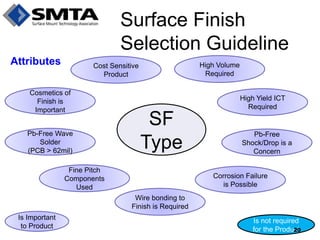
Surface Finish Selection Guideline 
Cost Sensitive Product 
High Volume Required 
Pb-Free Shock/Drop is a Concern 
Cosmetics of Finish is Important 
Corrosion Failure is Possible 
Fine Pitch Components Used 
Pb-Free Wave Solder 
(PCB > 62mil) 
High Yield ICT Required 
Is Important to Product 
Is not required for the Product 
Attributes 
Wire bonding to Finish is Required 
SF Type 
20
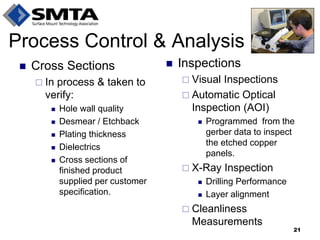
Process Control & Analysis 
Cross Sections 
In process & taken to verify: 
Hole wall quality 
Desmear / Etchback 
Plating thickness 
Dielectrics 
Cross sections of finished product supplied per customer specification. 
Inspections 
Visual Inspections 
Automatic Optical Inspection (AOI) 
Programmed from the gerber data to inspect the etched copper panels. 
X-Ray Inspection 
Drilling Performance 
Layer alignment 
Cleanliness Measurements 
21
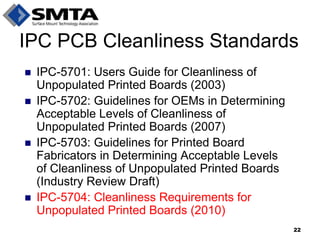
IPC-5701: Users Guide for Cleanliness of Unpopulated Printed Boards (2003) 
IPC-5702: Guidelines for OEMs in Determining Acceptable Levels of Cleanliness of Unpopulated Printed Boards (2007) 
IPC-5703: Guidelines for Printed Board Fabricators in Determining Acceptable Levels of Cleanliness of Unpopulated Printed Boards (Industry Review Draft) 
IPC-5704: Cleanliness Requirements for Unpopulated Printed Boards (2010) 
IPC PCB Cleanliness Standards 
22
Resistivity of Solvent Extract (ROSE) Test Method IPC-TM-650 2.3.25 
The ROSE test method is used as a process control tool to detect the presence of bulk ionics. The IPC upper limit is set at 10.0 mg/NaCl/in2. This test is performed using a Zero-Ion or similar style ionic testing unit that detects total ionic contamination, but does not identify specific ions present. This process draws the ions present on the PCB into the solvent solution. The results are reported as bulk ions present on the PCB per square inch. 
Modified Resistivity of Solvent Extract (Modified ROSE) Test Method TM 2.3.25.1 
The modified ROSE test method involves a thermal extraction. The PCB is exposed in a solvent solution at an elevated temperature for a specified time period. This process draws the ions present on the PCB into the solvent solution. The solution is tested using an Ionograph-style test unit. The results are reported as bulk ions present on the PCB per square inch. 
Ion Chromatography IPC-TM-650 2.3.28.2 
IPC Ionic Contamination Test Standards 
23
Test Procedures: Best Practice 
Ion Chromatography (IC) is the ‘gold standard’ 
Some, but very few, PCB manufacturers qualify lots based on IC results 
Larger group uses IC to baseline ROSE / Omegameter / Ionograph (R/O/I) results 
Perform lot qualification with R/O/I 
Periodically recalibrate with IC (every week, month, or quarter) 
24
Common PCB Defects 
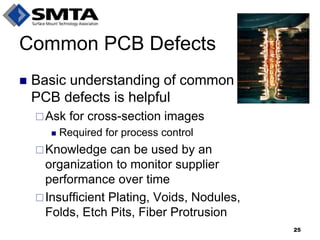
Basic understanding of common PCB defects is helpful 
Ask for cross-section images 
Required for process control 
Knowledge can be used by an organization to monitor supplier performance over time 
Insufficient Plating, Voids, Nodules, Folds, Etch Pits, Fiber Protrusion 
25
Insufficient Plating Thickness 
ANSI/IPC-A-600 requires an average plating thickness of 20 um, with isolated areas allowed to reach 15 um. 
Insufficient plating thickness is caused by either insufficient current/time in the copper plating bath or poor throwing power. 
When insufficient plating thickness is observed throughout the PTH, instead of just at the center, the root-cause is more likely insufficient current/time in the plating bath. 
26
Glass Fiber Protrusion 
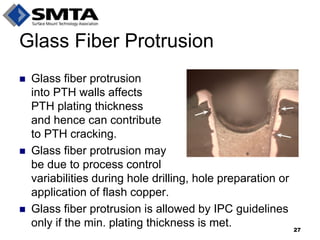
Glass fiber protrusion into PTH walls affects PTH plating thickness and hence can contribute to PTH cracking. 
Glass fiber protrusion may be due to process control variabilities during hole drilling, hole preparation or application of flash copper. 
Glass fiber protrusion is allowed by IPC guidelines only if the min. plating thickness is met. 
27
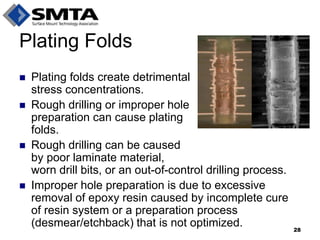
Plating Folds 
Plating folds create detrimental stress concentrations. 
Rough drilling or improper hole preparation can cause plating folds. 
Rough drilling can be caused by poor laminate material, worn drill bits, or an out-of-control drilling process. 
Improper hole preparation is due to excessive removal of epoxy resin caused by incomplete cure of resin system or a preparation process (desmear/etchback) that is not optimized. 
28
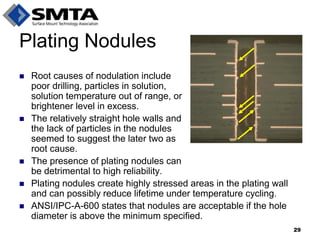
Plating Nodules 
Root causes of nodulation include poor drilling, particles in solution, solution temperature out of range, or brightener level in excess. 
The relatively straight hole walls and the lack of particles in the nodules seemed to suggest the later two as root cause. 
The presence of plating nodules can be detrimental to high reliability. 
Plating nodules create highly stressed areas in the plating wall and can possibly reduce lifetime under temperature cycling. 
ANSI/IPC-A-600 states that nodules are acceptable if the hole diameter is above the minimum specified. 
29
Plating void is a generic term to describe voids present in and around the PTH wall. 
Can cause large stress concentrations, resulting in crack initiation. 
The location of the voids can provide crucial information in identifying the defective process. 
Around the glass bundles 
In the area of the resin 
At the inner layer interconnects (aka, wedge voids) 
Center or edges of the PTH 
Plating Voids 
30
Test & Final Inspection 
Electrical Test 
IPC-D-356 netlist is uploaded into the tester. 
Each PCB is manually placed on fixture and tested for continuity and resistance 
Verify handling for segregating passes & fails 
Final Inspection 
Visually inspect 100% of the finished product 
Review of: 
Fabrication drawing requirements 
Dimensional properties 
Board size 
Finished hole sizes 
Customer specification 
31
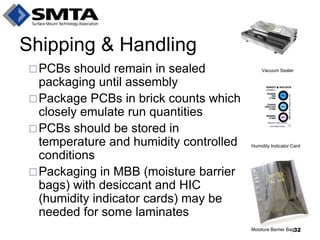
PCBs should remain in sealed packaging until assembly 
Package PCBs in brick counts which closely emulate run quantities 
PCBs should be stored in temperature and humidity controlled conditions 
Packaging in MBB (moisture barrier bags) with desiccant and HIC (humidity indicator cards) may be needed for some laminates 
Shipping & Handling 
Vacuum Sealer 
Humidity Indicator Card 
Moisture Barrier Bag 
32
Conclusions 
Foundation of a reliable product is a reliable PCB 
PCBs are always custom, critical components 
 Have a comprehensive strategy for selecting and qualifying PCB suppliers 
 Ensures that the foundation is strong 
Performing effective on site audits is a critical component of that strategy. 
33
Speaker Biography 
Cheryl Tulkoff has over 22 years of experience in electronics manufacturing with an emphasis on failure analysis and reliability. She has worked throughout the electronics manufacturing life cycle beginning with semiconductor fabrication processes, into printed circuit board fabrication and assembly, through functional and reliability testing, and culminating in the analysis and evaluation of field returns. She has also managed no clean and RoHS-compliant conversion programs and has developed and managed comprehensive reliability programs. 
Cheryl earned her Bachelor of Mechanical Engineering degree from Georgia Tech. She is a published author, experienced public speaker and trainer and a Senior member of both ASQ and IEEE. She has held leadership positions in the IEEE Central Texas Chapter, IEEE WIE (Women In Engineering), and IEEE ASTR (Accelerated Stress Testing and Reliability) sections. She chaired the annual IEEE ASTR workshop for four years, is an ASQ Certified Reliability Engineer and a member of SMTA and iMAPS. 
She has a strong passion for pre-college STEM (Science, Technology, Engineering, and Math) outreach and volunteers with several organizations that specialize in encouraging pre-college students to pursue careers in these fields. 
34
Contact Information 
•Questions? 
•Contact Cheryl Tulkoff, ctulkoff@dfrsolutions.com, 512-913-8624 
•www.dfrsolutions.com 
•Connect with me in LinkedIn as well! 
35

Best Practices for Improving the PCB Supply Chain: Part II

  • 1.
    Best Practices forImproving the PCB Supply Chain: Part II Cheryl Tulkoff Senior Member of the Technical Staff ctulkoff@dfrsolutions.com 1
  • 2.
    PCB SUPPLY CHAINBEST PRACTICES – PART I RECAP 2
  • 3.
    PCBs should alwaysbe considered critical components Custom design Product Foundation Long term PCB quality and reliability is simply not achievable without stringent controls in place for: Supplier selection Qualification Management PCBs as Critical Components 3
  • 4.
    Create a PCBCommodity Team with at least one representative from each of the following areas: Design Manufacturing Purchasing Quality/Reliability Team should meet on a routine basis Discuss new products and technology requirements in the development pipeline. Pricing, delivery, and quality performance issues with approved PCB suppliers should also be reviewed. Team is also tasked with identifying new suppliers and creating supplier selection and monitoring criteria PCB Commodity Team 4
  • 5.
    Established PCB supplierselection criteria in place. Criteria should be custom to your business Commonly used criteria are: Time in business Revenue Growth Employee Turnover Training Program Certified to the standards you require (IPC, MIL-SPEC, ISO, etc.) Capable of producing the technology you need as part of their mainstream capabilities Don’t exist in PCB process “niches” where suppliers claim capability but have less than ~ 15% of their volume built there Have quality and problem solving methodologies in place Have a technology roadmap Have a continuous improvement program in place Supplier Selection Criteria 5
  • 6.
    Rigorous qualification criteriawhich includes: On site visit by to the facility which will produce your PCBs by someone knowledgeable in PCB fabrication techniques. Review process controls, quality monitoring and analytical techniques, storage and handling practices and conformance to generally acceptable manufacturing practices. Best way to meet and establish relationships with the people responsible for manufacturing your product. Sample builds of an actual part you will produce which are evaluated by the PCB supplier Also independently evaluated by you or a representative to the standards that you require. PCB Qualification Criteria 6
  • 7.
    Use of suppliertiering  Low, Middle, High strategies if you have a diverse product line with products that range from simpler to complex. Allows for strategic tailoring to save cost and to maximize supplier quality to your product design. Match supplier qualifications to the complexity of your product. Typical criteria for tiering suppliers include: Finest line width Finest conductor spacing, Smallest drilled hole and via size Impedance control requirement Specialty laminate needed (Rogers, flex, mixed) Use of HDI, micro vias, blind or buried vias. Minimize use of suppliers who have to outsource critical areas of construction. Again, do not exist in the margins of process capabilities! PCB Supplier Tiering 7
  • 8.
    Partner with yourPCB suppliers for success. Critical for low volumes, low spend, or high technology and reliability requirements Some good practices include: Monthly calls with PCB commodity team and each PCB supplier  PCB supplier team should members equivalent to your team members QBRs (quarterly business reviews) Review spend, quality, and performance metrics, and “state of the business “, business growth, new product and quoting opportunities… Address any upcoming changes  Factory expansion, move, or relocation, critical staffing changes, new equipment/capability installation etc. Twice per year, QBRs should be joint onsite meetings which alternate between your site and the supplier factory site. Factory supplier site QBR visit can double as the annual on site visit and audit that you perform. PCB Relationship Management 8
  • 9.
    Use Supplier Scorecards Perform quarterly and yearly on a rolling basis Typical metrics include: On Time Delivery PPM Defect Rates Communication – speed, accuracy, channels, responsiveness to quotes Quality Excursions / Root Cause Corrective Action Process Resolution Supplier Corrective Action Requests Discuss recalls, notifications, or scrap events exceeding a certain dollar amount PCB Supplier Scorecards 9
  • 10.
    Review the following: Top 3 PCB factory defects: monitoring and reporting Process control and improvement plans for the top 3 defects Product Yield and scrap reports Feedback on issues facing the industry Reliability testing performed (HATS, IST, solder float, etc.) Review IPC-9151B, Printed Board Process Capability, Quality, and Relative Reliability (PCQR2) Benchmark Test Standard and Database at: http://www.ipc.org/html/IPC-9151B.pdf PCB suppliers may be part of this activity already. Ask if they participate and if you can get a copy of their results. PCB Continuous Quality Monitoring 10
  • 11.
    Ideally, all PCBsshould come from the same factory from start to finish Prototype (feasibility), pre-release production (testability & reliability), to released production (manufacturability). Any factory move introduces an element of risk Product must go through setup and optimization specific to each factory and equipment contained there. While not always possible, all PCBs intended for quality and reliability testing should come from the actual PCB production facility. PCB Prototype Development 11
  • 12.
    PART II: PERFORMINGTHE PCB PROCESS AUDIT Everything looks great on paper or on the web…… 12
  • 13.
    Why Perform anOnsite Audit? No industry standard methodology for qualifying PCB suppliers Standards do exist for lot-based PCB testing and acceptance within the IPC 6010 series  Sourcing follows the “as agreed upon between user and supplier” (AABUS) approach  IPC began discussing this gap in 2008 with a Blue Ribbon Committee IPC has recently launched a Validation Business Unit with plans to eventually move towards an IPC Qualified Manufacturers List (QML) for suppliers, including PCBs [3]. I In the meantime, however, onsite audits remain the best approach 13
  • 14.
    PCB Fabrication Processes More than 180 individual steps required to manufacture typical printed circuit boards Knowledge is key! Processes are complex, chemistry intensive and there are a lot of steps 14
  • 15.
    Audit Focus Allsteps are obviously important but this presentation will focus on: Requirements Surface Finish Highlight Process Control & Analysis Cleanliness Recognizing Common Defects Test & Final Inspection Material Handling 15
  • 16.
    Communicate Requirements Definethe standards needed Communicate both quality & reliability objectives! Help your supplier help you Create a PCB Fabrication specification Outlines requirements and communication required for modifications to drawings 16
  • 17.
    Laminate selection isfrequently under specified! Some common issues: PCB supplier frequently allowed to select laminate material No restrictions on laminate changes Generic IPC slash sheet requirements used Laminates called out by Tg only and with no measurement method specified (there is more than one) No cleanliness requirements specified Failure to specify stackup Not all laminates are created equal Failure to put some controls in places opens the door to failure PCB Materials Selection
  • 18.
    Good quality isnecessary but not SUFFICIENT to guarantee high reliability. IPC Class 3 by itself does not guarantee high reliability A PCB or PCBA can be perfectly built to IPC Class 3 standards and still be totally unreliable in its final application. Consider two different PCB laminates both built to IPC Class 3 standards. Both laminates are identical in all properties EXCEPT one laminate has a CTEz of 40 and the other has a CTEz of 60. The vias in the laminate with the lower CTEz will be MORE reliable in a long term, aggressive thermal cycling environment than the CTEz 60 laminate. A CTEz 40 laminate built to IPC class 2 could be MORE reliable than the CTEz 60 laminate built to Class 3. Appropriate materials selection for the environment is key! Quality, Reliability & IPC Class 2 versus Class 3 18
  • 19.
    Importance of SurfaceFinish The selection of the surface finish on your PCBs could be the most important material decision made for the final electronic assembly. The surface finish influences the process yield, the amount of rework, field failure rate, the ability to test, the scrap rate, and of course the cost. One can be lead astray by selecting the lowest cost surface finish only to find that the eventual total cost is much higher. The selection of a surface finish should be done with a holistic approach that considers all important aspects of the assembly. 19
  • 20.
    Surface Finish SelectionGuideline Cost Sensitive Product High Volume Required Pb-Free Shock/Drop is a Concern Cosmetics of Finish is Important Corrosion Failure is Possible Fine Pitch Components Used Pb-Free Wave Solder (PCB > 62mil) High Yield ICT Required Is Important to Product Is not required for the Product Attributes Wire bonding to Finish is Required SF Type 20
  • 21.
    Process Control &Analysis Cross Sections In process & taken to verify: Hole wall quality Desmear / Etchback Plating thickness Dielectrics Cross sections of finished product supplied per customer specification. Inspections Visual Inspections Automatic Optical Inspection (AOI) Programmed from the gerber data to inspect the etched copper panels. X-Ray Inspection Drilling Performance Layer alignment Cleanliness Measurements 21
  • 22.
    IPC-5701: Users Guidefor Cleanliness of Unpopulated Printed Boards (2003) IPC-5702: Guidelines for OEMs in Determining Acceptable Levels of Cleanliness of Unpopulated Printed Boards (2007) IPC-5703: Guidelines for Printed Board Fabricators in Determining Acceptable Levels of Cleanliness of Unpopulated Printed Boards (Industry Review Draft) IPC-5704: Cleanliness Requirements for Unpopulated Printed Boards (2010) IPC PCB Cleanliness Standards 22
  • 23.
    Resistivity of SolventExtract (ROSE) Test Method IPC-TM-650 2.3.25 The ROSE test method is used as a process control tool to detect the presence of bulk ionics. The IPC upper limit is set at 10.0 mg/NaCl/in2. This test is performed using a Zero-Ion or similar style ionic testing unit that detects total ionic contamination, but does not identify specific ions present. This process draws the ions present on the PCB into the solvent solution. The results are reported as bulk ions present on the PCB per square inch. Modified Resistivity of Solvent Extract (Modified ROSE) Test Method TM 2.3.25.1 The modified ROSE test method involves a thermal extraction. The PCB is exposed in a solvent solution at an elevated temperature for a specified time period. This process draws the ions present on the PCB into the solvent solution. The solution is tested using an Ionograph-style test unit. The results are reported as bulk ions present on the PCB per square inch. Ion Chromatography IPC-TM-650 2.3.28.2 IPC Ionic Contamination Test Standards 23
  • 24.
    Test Procedures: BestPractice Ion Chromatography (IC) is the ‘gold standard’ Some, but very few, PCB manufacturers qualify lots based on IC results Larger group uses IC to baseline ROSE / Omegameter / Ionograph (R/O/I) results Perform lot qualification with R/O/I Periodically recalibrate with IC (every week, month, or quarter) 24
  • 25.
    Common PCB Defects Basic understanding of common PCB defects is helpful Ask for cross-section images Required for process control Knowledge can be used by an organization to monitor supplier performance over time Insufficient Plating, Voids, Nodules, Folds, Etch Pits, Fiber Protrusion 25
  • 26.
    Insufficient Plating Thickness ANSI/IPC-A-600 requires an average plating thickness of 20 um, with isolated areas allowed to reach 15 um. Insufficient plating thickness is caused by either insufficient current/time in the copper plating bath or poor throwing power. When insufficient plating thickness is observed throughout the PTH, instead of just at the center, the root-cause is more likely insufficient current/time in the plating bath. 26
  • 27.
    Glass Fiber Protrusion Glass fiber protrusion into PTH walls affects PTH plating thickness and hence can contribute to PTH cracking. Glass fiber protrusion may be due to process control variabilities during hole drilling, hole preparation or application of flash copper. Glass fiber protrusion is allowed by IPC guidelines only if the min. plating thickness is met. 27
  • 28.
    Plating Folds Platingfolds create detrimental stress concentrations. Rough drilling or improper hole preparation can cause plating folds. Rough drilling can be caused by poor laminate material, worn drill bits, or an out-of-control drilling process. Improper hole preparation is due to excessive removal of epoxy resin caused by incomplete cure of resin system or a preparation process (desmear/etchback) that is not optimized. 28
  • 29.
    Plating Nodules Rootcauses of nodulation include poor drilling, particles in solution, solution temperature out of range, or brightener level in excess. The relatively straight hole walls and the lack of particles in the nodules seemed to suggest the later two as root cause. The presence of plating nodules can be detrimental to high reliability. Plating nodules create highly stressed areas in the plating wall and can possibly reduce lifetime under temperature cycling. ANSI/IPC-A-600 states that nodules are acceptable if the hole diameter is above the minimum specified. 29
  • 30.
    Plating void isa generic term to describe voids present in and around the PTH wall. Can cause large stress concentrations, resulting in crack initiation. The location of the voids can provide crucial information in identifying the defective process. Around the glass bundles In the area of the resin At the inner layer interconnects (aka, wedge voids) Center or edges of the PTH Plating Voids 30
  • 31.
    Test & FinalInspection Electrical Test IPC-D-356 netlist is uploaded into the tester. Each PCB is manually placed on fixture and tested for continuity and resistance Verify handling for segregating passes & fails Final Inspection Visually inspect 100% of the finished product Review of: Fabrication drawing requirements Dimensional properties Board size Finished hole sizes Customer specification 31
  • 32.
    PCBs should remainin sealed packaging until assembly Package PCBs in brick counts which closely emulate run quantities PCBs should be stored in temperature and humidity controlled conditions Packaging in MBB (moisture barrier bags) with desiccant and HIC (humidity indicator cards) may be needed for some laminates Shipping & Handling Vacuum Sealer Humidity Indicator Card Moisture Barrier Bag 32
  • 33.
    Conclusions Foundation ofa reliable product is a reliable PCB PCBs are always custom, critical components  Have a comprehensive strategy for selecting and qualifying PCB suppliers  Ensures that the foundation is strong Performing effective on site audits is a critical component of that strategy. 33
  • 34.
    Speaker Biography CherylTulkoff has over 22 years of experience in electronics manufacturing with an emphasis on failure analysis and reliability. She has worked throughout the electronics manufacturing life cycle beginning with semiconductor fabrication processes, into printed circuit board fabrication and assembly, through functional and reliability testing, and culminating in the analysis and evaluation of field returns. She has also managed no clean and RoHS-compliant conversion programs and has developed and managed comprehensive reliability programs. Cheryl earned her Bachelor of Mechanical Engineering degree from Georgia Tech. She is a published author, experienced public speaker and trainer and a Senior member of both ASQ and IEEE. She has held leadership positions in the IEEE Central Texas Chapter, IEEE WIE (Women In Engineering), and IEEE ASTR (Accelerated Stress Testing and Reliability) sections. She chaired the annual IEEE ASTR workshop for four years, is an ASQ Certified Reliability Engineer and a member of SMTA and iMAPS. She has a strong passion for pre-college STEM (Science, Technology, Engineering, and Math) outreach and volunteers with several organizations that specialize in encouraging pre-college students to pursue careers in these fields. 34
  • 35.
    Contact Information •Questions? •Contact Cheryl Tulkoff, ctulkoff@dfrsolutions.com, 512-913-8624 •www.dfrsolutions.com •Connect with me in LinkedIn as well! 35