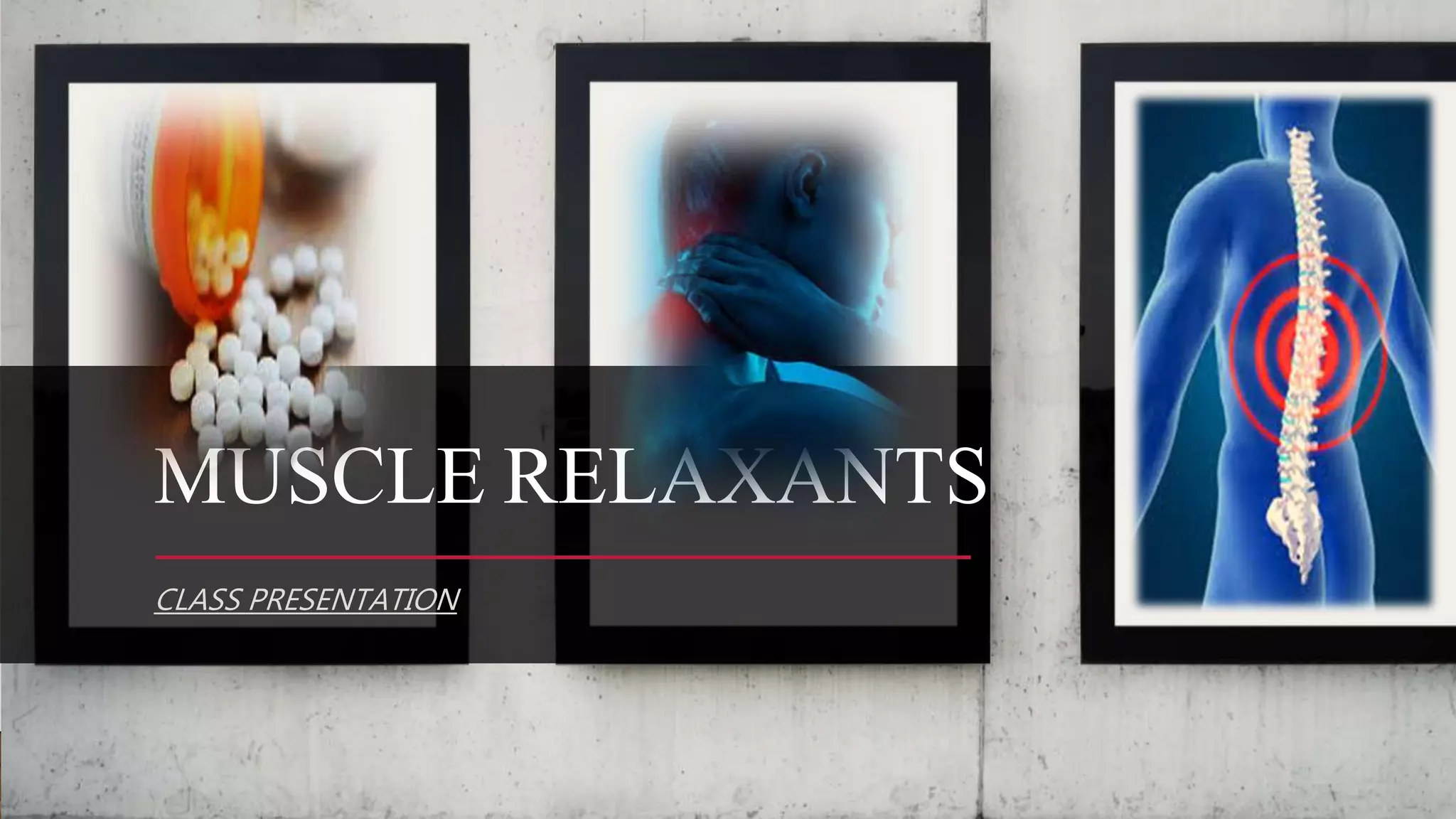
MUSCLE RELAXANTS
CLASS PRESENTATION
INTRODUCTION
• Skeletal muscle relaxant are drugs that reduce muscle tone either by
acting peripherally at the neuromuscular junction or centrally at
cerebrospinal axis or directly on the contractile mechanisms.
• The term muscle relaxant is used to refer to two major therapeutic
groups which are neuromuscular blockers and spasmolytic.
CLASSIFICATION
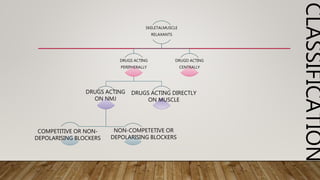
CLASSIFICATION
SKELETALMUSCLE
RELAXANTS
DRUGD ACTING
CENTRALLY
DRUGS ACTING
PERIPHERALLY
DRUGS ACTING
ON NMJ
DRUGS ACTING DIRECTLY
ON MUSCLE
COMPETITIVE OR NON-
DEPOLARISING BLOCKERS
NON-COMPETETIVE OR
DEPOLARISING BLOCKERS
PERIPEHERALLY ACTING MUSCLE RELAXANT
• It acts peripherally at neuromuscular junction or at muscle
fiber itself.
COMPETETIVE OR NON-DEPOLARISING
BLOCKERS
ISOQUINOLINE DERIVATIVES
• Tubocurarine
• Gallamine
• Atracurium
• Alcurium
• Doxacurium
• Mivrcurium
STEROID DERIVATIVES
• Pancuronium
• Vecuronium
• Rapacuronium
• Pipecuronium
• Rocuronium
MECHANISM OF ACTION
• Bind to nicotinic receptors on the motor end plate and block
action of acetylcholine by competitive blockade.
• These compounds slowly dissociate from receptors and
transmission is gradually restored.
PHARMACOLOGICAL ACTIONS
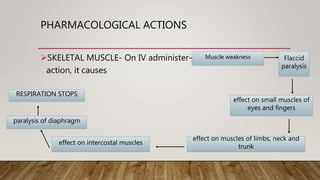
SKELETAL MUSCLE- On IV administer-
action, it causes
Flaccid
paralysis
effect on small muscles of
eyes and fingers
effect on muscles of limbs, neck and
trunk
effect on intercostal muscles
paralysis of diaphragm
RESPIRATION STOPS
Muscle weakness
CONT.…
• Recovery occurs in reverse order i.e., the diaphragm is
first to recover.
• Its effect last for 30-60minutes.
AUTONOMIC GANGLIA- in high doses it can block
autonomic ganglia and adrenal medulla and causes
hypotension.
CONT…
• HISTAMINE RELEASE- it causes histamine release from mast
cells leading to bronchospasm, increased tracheobronchial and
gastric secretions. It also results in hypotension.
GASTROINTESTINAL TRACT- it may enhance post-operative
paralytic ileus after abdominal operations.
CONT.…
CARDIOVASCULAR SYSTEM- it causes significant fall in B.P.
due to
• Ganglionic blockade
• Histamine release
• Reduced venous return
PHARMACOKINETICS
• It is quaternary ammonium compound, hence not absorbed
orally.
• It is given IV and IM only.
ADVERSE EFFECTS
• Respiratory paralysis
• Prolonged apnea
• Hypotension
• Flushing
• bronchospasm
TREATMENT OF TOXICITY
• NEOSTIGRNINE may be used to reverse the skeletal muscle
paralysis and it is the antidote in curare poisoning.
• ANTIHISTAMINE should be given to counter the effect of
histamine.
• SUGAMMADEX is an antidote for overdosage of rocuronium
and vecuoronium.
IMPORTANT FACTS
Pancuronium, atracurium, vecuronium, gallimine, doxacurium,
mivacurium, pipecuronium, rapacuronium, rocuronium are synthetic
neuromuscular blockers, whereas tubocuranine is natural
neuromuscular blocker(NMB).
Use of synthetic NMBs is preferred over natural NMBs due to
following reasons:
• Less or no histamine release
• Do not block autonomic ganglia hence cause less hypotension.
CONT…
• More potency.
• Agents like rapacuronium and rocuronium have rapid onset of
action
• Atracurium can be safely used in patients with renal
impairment because it is degraded by plasma esterases.
DEPOLARISING OR NON-COMPETIVE BLOCKERS
• Succinylcholine
• Decanethonium
MECHANISM OF ACTION
• It stimulates nicotine receptors and depolarize skeletal muscle
membrane.
• Persistent depolarization causes flaccid paralysis.
• Its mechanism is not clearly known.
PHARMACOLOGICAL ACTIONS
SKELETAL MUSCLE- on IV administration onset of action is very
rapid i.e., within 1minute.
• Its initial action is muscular fasciculations and twitchings, mostly
in chest and abdominal regions are followed by skeletal muscle
paralysis.
CARDIOVASCULAR SYSTEM- initially hypotension and
bradycardia may results from stimulation of vagal ganglia. It is
followed by hypertension and tachycardia due to stimulation of
CONT…
• Higher doses can cause cardiac arrhythmias.
• It can also cause release of histamine if injected rapidly
PHARMACOKINETICS
• It is rapidly hydrolyzed by PSEUCDOCHOLINESTERASE enzyme
hence it is short acting about 5minutes.
• Some people might have abnormal synthesis of this enzyme
which is du to hereditary condition.
• In such people it doesn’t get hydrolyzed at last for several
hours resulting in apnea and paralysis.
ADVERSE ACTIONS
• Postoperative muscle pain (due to damage to muscle fiber)
• Hyperkalemia
• Cardiac arrhythmias
• Apnea (due to pseuducholinesterase)
USES OF PERIPHERALLY ACTING SKELETAL MUSCLE
RELAXANT
as have short acting property
• ET intubation
• Laryngoscopy
• Bronchoscopy
• Esophagoscopy
Orthopedic procedure like reduction of fractures
CONT.…
In electroconvulsive therapy (as it protects pt. from
convulsions and trauma)
To overcome spasm of tetanus, athetosis and status
epilepticus
DIRECTLY ACTING MUSCLE RELAXANT
They directly affect skeletal muscle contractile mechanism.
E.g. DANTROLENE
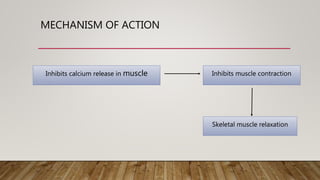
MECHANISM OF ACTION
Inhibits calcium release in muscle Inhibits muscle contraction
Skeletal muscle relaxation
PHARMACOLOGICAL USES
• It is used in spastic disorders like hemiplegia, paraplegia, spinal
injuries, multiple sclerosis and cerebral palsy.
• Drug of choice in malignant hyperthermia is dantrolene.
• Quinine is used as antimalarial drug.
• Quinine is also used in myotonia congenital and nocturnal
muscle cramps.
ADVERSE EFFECTS
• Drowsiness
• Dizziness
• Fatigue
• Diarrhea
• Muscle weakness
• Hepatoxicity (rare)
CENTRALLY ACTING MUSCLE RELXANT
• These drugs act on higher centres and cause muscle
relaxation without loss of consciousness.
• They also have seductive properties.
CONT.…
BENZODIAZEPINES
• Diazepam
• Chlorodiazepoxide
• Clonazepam
• nitrazepam
CONT.…
GABA ANALOGUES
• Baclofenac
• Progabide
ALPHA 2-AGONIST
• trizanidine
CONT.…
OTHERS
• Glycine
• Meprobamate
• Mephenesen
• Idrocilamide
• Riluzole
• Botulinium toxin
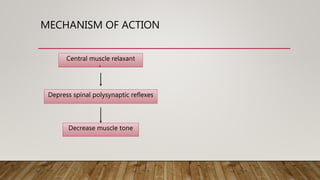
MECHANISM OF ACTION
Central muscle relaxant
Depress spinal polysynaptic reflexes
Decrease muscle tone
PHARMACOLOGICAL USES
Can be used as analgesics in cases of
• Muscle strains
• Sprains
• Myalgia
• Cervical root syndromes
• Low backache
CONT.…
• Arthritis
• Fibrosis
• bursitis
In spastic neurological disorders like ( with use of baclofen and
diazepam)
• Cerebral palsy
• Multiple sclerosis
CONT.…
• Poliomyelitis
• Hemiplegia
• Quadriplegia
Tetanus (IV diazepam)
Orthopedic like fracture reduction
CONT…
Botulinum toxin is useful in:
• Dystonia's
• Sports or writers cramps
• Muscle spasm
• Tremors
• Cosmetic therapy
• Drowsiness
• Mental confusion
• Weakness
• Ataxia
• Hallucinations
ADVERSE EFFECTS
CONT…
• Tachycardia
• Seizures
• Night time insomnia
NURSING IMPLICATIONS
• Respiration should be monitored while on SMRs.
• SMRs should not be withdrawn suddenly after long use
(as may cause hallucination, seizures).
• Patients should avoid driving after having SMRs due to
drowsiness and hallucinations.
• Patient vitals should be monitored every half hourly.
CONT…
• In patient with liver disease lower dose is given first
followed by gradual increase in further dose. It is
contraindicated in chronic liver disease patient or patient
with hepatotoxicity.
• Restriction in amount of dose in case patient has
developed psychological or physical dependence.
YOUR TURN!!!!!!
• How many types of muscle relaxants do we have?
2 i.e., peripheral acting and centrally acting
• Which type of muscle relaxant is better natural or synthetic?
And why?
Synthetic is better.
Because it has less side effects like less hypotension, fast acting,
no or less histamine release, etc.
THANK YOU!
BY AAYUSHI SAJWAN (EN NO 25)

Muscle relaxants

  • 1.
  • 2.
    INTRODUCTION • Skeletal musclerelaxant are drugs that reduce muscle tone either by acting peripherally at the neuromuscular junction or centrally at cerebrospinal axis or directly on the contractile mechanisms. • The term muscle relaxant is used to refer to two major therapeutic groups which are neuromuscular blockers and spasmolytic.
  • 3.
  • 4.
    CLASSIFICATION SKELETALMUSCLE RELAXANTS DRUGD ACTING CENTRALLY DRUGS ACTING PERIPHERALLY DRUGSACTING ON NMJ DRUGS ACTING DIRECTLY ON MUSCLE COMPETITIVE OR NON- DEPOLARISING BLOCKERS NON-COMPETETIVE OR DEPOLARISING BLOCKERS
  • 5.
    PERIPEHERALLY ACTING MUSCLERELAXANT • It acts peripherally at neuromuscular junction or at muscle fiber itself.
  • 6.
    COMPETETIVE OR NON-DEPOLARISING BLOCKERS ISOQUINOLINEDERIVATIVES • Tubocurarine • Gallamine • Atracurium • Alcurium • Doxacurium • Mivrcurium
  • 7.
    STEROID DERIVATIVES • Pancuronium •Vecuronium • Rapacuronium • Pipecuronium • Rocuronium
  • 8.
    MECHANISM OF ACTION •Bind to nicotinic receptors on the motor end plate and block action of acetylcholine by competitive blockade. • These compounds slowly dissociate from receptors and transmission is gradually restored.
  • 9.
    PHARMACOLOGICAL ACTIONS SKELETAL MUSCLE-On IV administer- action, it causes Flaccid paralysis effect on small muscles of eyes and fingers effect on muscles of limbs, neck and trunk effect on intercostal muscles paralysis of diaphragm RESPIRATION STOPS Muscle weakness
  • 10.
    CONT.… • Recovery occursin reverse order i.e., the diaphragm is first to recover. • Its effect last for 30-60minutes. AUTONOMIC GANGLIA- in high doses it can block autonomic ganglia and adrenal medulla and causes hypotension.
  • 11.
    CONT… • HISTAMINE RELEASE-it causes histamine release from mast cells leading to bronchospasm, increased tracheobronchial and gastric secretions. It also results in hypotension. GASTROINTESTINAL TRACT- it may enhance post-operative paralytic ileus after abdominal operations.
  • 12.
    CONT.… CARDIOVASCULAR SYSTEM- itcauses significant fall in B.P. due to • Ganglionic blockade • Histamine release • Reduced venous return
  • 13.
    PHARMACOKINETICS • It isquaternary ammonium compound, hence not absorbed orally. • It is given IV and IM only.
  • 14.
    ADVERSE EFFECTS • Respiratoryparalysis • Prolonged apnea • Hypotension • Flushing • bronchospasm
  • 15.
    TREATMENT OF TOXICITY •NEOSTIGRNINE may be used to reverse the skeletal muscle paralysis and it is the antidote in curare poisoning. • ANTIHISTAMINE should be given to counter the effect of histamine. • SUGAMMADEX is an antidote for overdosage of rocuronium and vecuoronium.
  • 16.
    IMPORTANT FACTS Pancuronium, atracurium,vecuronium, gallimine, doxacurium, mivacurium, pipecuronium, rapacuronium, rocuronium are synthetic neuromuscular blockers, whereas tubocuranine is natural neuromuscular blocker(NMB). Use of synthetic NMBs is preferred over natural NMBs due to following reasons: • Less or no histamine release • Do not block autonomic ganglia hence cause less hypotension.
  • 17.
    CONT… • More potency. •Agents like rapacuronium and rocuronium have rapid onset of action • Atracurium can be safely used in patients with renal impairment because it is degraded by plasma esterases.
  • 18.
    DEPOLARISING OR NON-COMPETIVEBLOCKERS • Succinylcholine • Decanethonium
  • 19.
    MECHANISM OF ACTION •It stimulates nicotine receptors and depolarize skeletal muscle membrane. • Persistent depolarization causes flaccid paralysis. • Its mechanism is not clearly known.
  • 20.
    PHARMACOLOGICAL ACTIONS SKELETAL MUSCLE-on IV administration onset of action is very rapid i.e., within 1minute. • Its initial action is muscular fasciculations and twitchings, mostly in chest and abdominal regions are followed by skeletal muscle paralysis. CARDIOVASCULAR SYSTEM- initially hypotension and bradycardia may results from stimulation of vagal ganglia. It is followed by hypertension and tachycardia due to stimulation of
  • 21.
    CONT… • Higher dosescan cause cardiac arrhythmias. • It can also cause release of histamine if injected rapidly
  • 22.
    PHARMACOKINETICS • It israpidly hydrolyzed by PSEUCDOCHOLINESTERASE enzyme hence it is short acting about 5minutes. • Some people might have abnormal synthesis of this enzyme which is du to hereditary condition. • In such people it doesn’t get hydrolyzed at last for several hours resulting in apnea and paralysis.
  • 23.
    ADVERSE ACTIONS • Postoperativemuscle pain (due to damage to muscle fiber) • Hyperkalemia • Cardiac arrhythmias • Apnea (due to pseuducholinesterase)
  • 24.
    USES OF PERIPHERALLYACTING SKELETAL MUSCLE RELAXANT as have short acting property • ET intubation • Laryngoscopy • Bronchoscopy • Esophagoscopy Orthopedic procedure like reduction of fractures
  • 25.
    CONT.… In electroconvulsive therapy(as it protects pt. from convulsions and trauma) To overcome spasm of tetanus, athetosis and status epilepticus
  • 26.
    DIRECTLY ACTING MUSCLERELAXANT They directly affect skeletal muscle contractile mechanism. E.g. DANTROLENE
  • 27.
    MECHANISM OF ACTION Inhibitscalcium release in muscle Inhibits muscle contraction Skeletal muscle relaxation
  • 28.
    PHARMACOLOGICAL USES • Itis used in spastic disorders like hemiplegia, paraplegia, spinal injuries, multiple sclerosis and cerebral palsy. • Drug of choice in malignant hyperthermia is dantrolene. • Quinine is used as antimalarial drug. • Quinine is also used in myotonia congenital and nocturnal muscle cramps.
  • 29.
    ADVERSE EFFECTS • Drowsiness •Dizziness • Fatigue • Diarrhea • Muscle weakness • Hepatoxicity (rare)
  • 30.
    CENTRALLY ACTING MUSCLERELXANT • These drugs act on higher centres and cause muscle relaxation without loss of consciousness. • They also have seductive properties.
  • 31.
  • 32.
    CONT.… GABA ANALOGUES • Baclofenac •Progabide ALPHA 2-AGONIST • trizanidine
  • 33.
    CONT.… OTHERS • Glycine • Meprobamate •Mephenesen • Idrocilamide • Riluzole • Botulinium toxin
  • 34.
    MECHANISM OF ACTION Centralmuscle relaxant Depress spinal polysynaptic reflexes Decrease muscle tone
  • 35.
    PHARMACOLOGICAL USES Can beused as analgesics in cases of • Muscle strains • Sprains • Myalgia • Cervical root syndromes • Low backache
  • 36.
    CONT.… • Arthritis • Fibrosis •bursitis In spastic neurological disorders like ( with use of baclofen and diazepam) • Cerebral palsy • Multiple sclerosis
  • 37.
    CONT.… • Poliomyelitis • Hemiplegia •Quadriplegia Tetanus (IV diazepam) Orthopedic like fracture reduction
  • 38.
    CONT… Botulinum toxin isuseful in: • Dystonia's • Sports or writers cramps • Muscle spasm • Tremors • Cosmetic therapy
  • 39.
    • Drowsiness • Mentalconfusion • Weakness • Ataxia • Hallucinations ADVERSE EFFECTS
  • 40.
  • 41.
    NURSING IMPLICATIONS • Respirationshould be monitored while on SMRs. • SMRs should not be withdrawn suddenly after long use (as may cause hallucination, seizures). • Patients should avoid driving after having SMRs due to drowsiness and hallucinations. • Patient vitals should be monitored every half hourly.
  • 42.
    CONT… • In patientwith liver disease lower dose is given first followed by gradual increase in further dose. It is contraindicated in chronic liver disease patient or patient with hepatotoxicity. • Restriction in amount of dose in case patient has developed psychological or physical dependence.
  • 43.
    YOUR TURN!!!!!! • Howmany types of muscle relaxants do we have? 2 i.e., peripheral acting and centrally acting • Which type of muscle relaxant is better natural or synthetic? And why? Synthetic is better. Because it has less side effects like less hypotension, fast acting, no or less histamine release, etc.
  • 44.
    THANK YOU! BY AAYUSHISAJWAN (EN NO 25)