INQUIRY-BASED LEARNING AND 
RESEARCH-BASED TEACHING WITH 
(SOCIAL) MEDIA 
Dr. Sandra Hofhues (Zeppelin University, Friedrichshafen, Germany) 
Prof. Dr. Ulrike Lucke (University of Potsdam, Germany) 
Prof. Dr. Gabi Reinmann (Zeppelin University, Friedrichshafen, Germany) 
Ass.-Prof. Dr. Mandy Schiefner-Rohs (TU Kaiserslautern, Germany)
SPOTLIGHT: OVERWHELMING MEDIA 
Source: https://www.flickr.com/photos/thomcochrane/4972619950/sizes/l 
Hofhues | Lucke | Reinmann | Schiefner-Rohs | SMART 2014 | Keynote Lecture | 2
OVERVIEW 
1 Inquiry-based learning: What are core ideas of this approach? 
2 The approach and the use of media: How do they fit? 
| Digital research practices: Do they really change? 
| Digital research environments: How personal could they be? 
3 Outlook: The need of (more) interdisciplinary research 
Hofhues | Lucke | Reinmann | Schiefner-Rohs | SMART 2014 | Keynote Lecture | 3
1 INQUIRY-BASED LEARNING: 
WHAT ARE CORE IDEAS OF THIS APPROACH? 
Hofhues | Lucke | Reinmann | Schiefner-Rohs | SMART 2014 | Keynote Lecture | 4
INQUIRY-BASED LEARNING: CORE IDEAS 
LEARNER‘S PRACTICES 
AND PREFERENCES 
Ask! 
Criticize! 
& 
Looking behind! 
Investigate! 
Analyze! 
IN RESEARCH AND TEACHING 
Create ! 
Evaluate!Interpret! 
Criticize! 
Re-Interpret! 
Discuss! 
Present! 
COMMON PRACTICES 
Share! 
Ask! 
Looking behind! 
Investigate! 
Discuss! 
Goal: Undertaking research and inquiry within formal learning scenarios. 
Hofhues | Lucke | Reinmann | Schiefner-Rohs | SMART 2014 | Keynote Lecture | 5
INQUIRY-BASED LEARNING OR 
RESEARCH-BASED TEACHING? 
INQUIRY BASED LEARNING: 
THE LEARNER‘S POINT OF VIEW 
RESEARCH-BASED TEACHING: 
THE INSTRUCTOR’S POINT OF VIEW 
Source: http://curriculum.leeds.ac.uk/wp-content/uploads/healeymatrix.jpg 
Source: http://mlab.uiah.fi/fle/research/image1.jpg 
Hofhues | Lucke | Reinmann | Schiefner-Rohs | SMART 2014 | Keynote Lecture | 6
INQUIRY-BASED LEARNING: 
(INTER-) DISCIPLINARY APPROACHES 
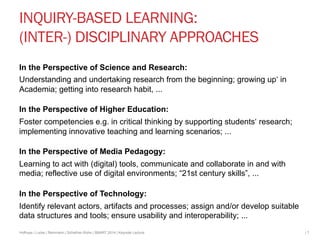
In the Perspective of Science and Research: 
Understanding and undertaking research from the beginning; growing up‘ in 
Academia; getting into research habit, ... 
In the Perspective of Higher Education: 
Foster competencies e.g. in critical thinking by supporting students‘ research; 
implementing innovative teaching and learning scenarios; ... 
In the Perspective of Media Pedagogy: 
Learning to act with (digital) tools, communicate and collaborate in and with 
media; reflective use of digital environments; “21st century skills”, ... 
In the Perspective of Technology: 
Identify relevant actors, artifacts and processes; assign and/or develop suitable 
data structures and tools; ensure usability and interoperability; ... 
Hofhues | Lucke | Reinmann | Schiefner-Rohs | SMART 2014 | Keynote Lecture | 7
INQUIRY-BASED LEARNING: 
TYPICAL CHALLENGES 
& 
Sources: https://www.flickr.com/photos/audiolucistore/14160279212/sizes/l; https://www.flickr.com/photos/83633410@N07/7658284016/sizes/m/ 
Dilemma of instruction 
Openness and overload 
Emotions and motivation 
Continuous tool chain 
… 
Activate students do learn 
Self-directed learning processes 
Various problems 
Critical and reflective habitus 
... 
Hofhues | Lucke | Reinmann | Schiefner-Rohs | SMART 2014 | Keynote Lecture | 8
2 THE APPROACH AND THE USE OF 
MEDIA: HOW DO THEY FIT? 
Hofhues | Lucke | Reinmann | Schiefner-Rohs | SMART 2014 | Keynote Lecture | 9
DIGITAL MEDIA IN ACADEMIA 
Is media changing Academia? 
| The use of digital resources and tools is essential to do research (mailing, 
searching, collaborating by skype, ....) 
| New fields like e-science or digital humanities 
Source: https://www.flickr.com/photos/ivyfield/4532962327/sizes/l 
Hofhues | Lucke | Reinmann | Schiefner-Rohs | SMART 2014 | Keynote Lecture | 10
DIGITAL (MEDIA) SPACES IN ACADEMIA 
Digital media to change 
communication, publication 
processes and access to 
information 
(“digitised science”) 
Digital media to generate 
questions, insights, knowledge 
and theory 
(“digital science”) 
Source: https://www.Source: https://www.flickr.com/photos/ivyfield/4532962327/sizes/l flickr.com/photos/globalx/3654834786/sizes/m/ 
(compare Donk, 2012) 
Hofhues | Lucke | Reinmann | Schiefner-Rohs | SMART 2014 | Keynote Lecture | 11
DIGITAL RESEARCH PRACTICES AND 
ENVIRONMENTS 
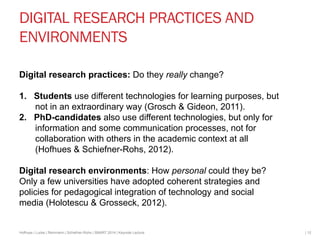
Digital research practices: Do they really change? 
1. Students use different technologies for learning purposes, but 
not in an extraordinary way (Grosch & Gideon, 2011). 
2. PhD-candidates also use different technologies, but only for 
information and some communication processes, not for 
collaboration with others in the academic context at all 
(Hofhues & Schiefner-Rohs, 2012). 
Digital research environments: How personal could they be? 
Only a few universities have adopted coherent strategies and 
policies for pedagogical integration of technology and social 
media (Holotescu & Grosseck, 2012). 
Hofhues | Lucke | Reinmann | Schiefner-Rohs | SMART 2014 | Keynote Lecture | 12
DIGITAL RESEARCH: POSSIBILITIES FOR THE 
USE OF TECHNOLOGY 
INQUIRY BASED LEARNING: 
THE LEARNER‘S POINT OF VIEW 
RESEARCH-BASED TEACHING: 
THE INSTRUCTOR’S POINT OF VIEW 
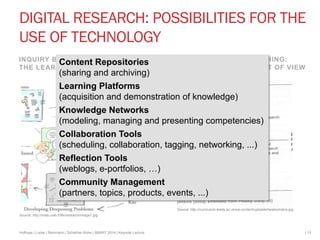
Content Repositories 
(sharing and archiving) 
Learning Platforms 
(acquisition and demonstration of knowledge) 
Knowledge Networks 
(modeling, managing and presenting competencies) 
Collaboration Tools 
(scheduling, collaboration, tagging, networking, ...) 
Reflection Tools 
(weblogs, e-portfolios, …) 
Community Management 
(partners, topics, products, events, ...) 
Source: http://curriculum.leeds.ac.uk/wp-content/uploads/healeymatrix.jpg 
Source: http://mlab.uiah.fi/fle/research/image1.jpg 
Hofhues | Lucke | Reinmann | Schiefner-Rohs | SMART 2014 | Keynote Lecture | 13
DIGITAL RESEARCH: 
PERSONAL RESEARCH ENVIRONMENTS? 
Hofhues | Lucke | Reinmann | Schiefner-Rohs | SMART 2014 | Keynote Lecture | 14 
Source: http://profbailey.com/images/island.jpg
“PERSONAL” DIGITAL RESEARCH 
Academic 
tribes and 
cultures 
Challenges 
and 
opportunities 
Cross-institutional 
scenarios 
Missing 
interoperability 
of tools 
Various media 
formats 
Individual use 
cases 
... 
Restrictions 
by law 
Non-users 
Hofhues | Lucke | Reinmann | Schiefner-Rohs | SMART 2014 | Keynote Lecture | 15
3 OUTLOOK: THE NEED OF (MORE) 
INTERDISCIPLINARY RESEARCH 
Hofhues | Lucke | Reinmann | Schiefner-Rohs | SMART 2014 | Keynote Lecture | 16
OUTLOOK 
Research practices in 
and with digital media 
often go back to the 
understanding of 
university as 
institutionalized place of 
knowledge production. 
What we actually see 
and maybe need is a 
reframing of university 
in a mediatized society. 
Research to be 
continued… 
Hofhues | Lucke | Reinmann | Schiefner-Rohs | SMART 2014 | Keynote Lecture | 17
THE NEED OF (MORE) INTERDISCIPLINARY 
RESEARCH: IDEAS AND QUESTIONS 
In the Perspective of 
Science and Research 
| Understanding of research? 
| Influences of the disciplines? 
In the Perspective of 
Media Pedagogy 
| Mediatized Academia? 
| Media ecologies? 
Source: https://www.flickr.com/photos/marfis75/4386981374/sizes/l 
In the Perspective of 
Higher Education 
| Heterogenious students? 
| Interests and motivation? 
In the Perspective of 
Technology 
| Modelling of processes? 
| Tools and environments? 
Hofhues | Lucke | Reinmann | Schiefner-Rohs | SMART 2014 | Keynote Lecture | 18
THANK YOU FOR YOUR INTEREST. 
Dr. Sandra Hofhues, sandra.hofhues@zu.de 
Prof. Dr. Ulrike Lucke, ulrike.lucke@uni-potsdam.de 
Prof. Dr. Gabi Reinmann, gabi.reinmann@zu.de 
Ass.-Prof. Dr. Mandy Schiefner-Rohs, mandy.rohs@sowi.uni-kl.de 
Hofhues | Lucke | Reinmann | Schiefner-Rohs | SMART 2014 | Keynote Lecture | 19
REFERENCES 
Donk, A. (2012). The Global Science Village? Wissenschaftler in der digitalen Welt. medien + 
erziehung (merz) Wissenschaft. 6, 103–113. 
Grosch, M. & Gideon, G. (2011) Mediennutzungsgewohnheiten im Wandel. Ergebnisse einer 
Befragung zur studiumsbezogenen Mediennutzung. Karlsruhe: KIT Scientific Publishing. 
Hofhues, S. & Schiefner-Rohs, M. (2012). Doktorandenausbildung zwischen 
Selbstorganisation und Vernetzung: zur Bedeutung digitaler sozialer Medien. In G. Csanyi, 
F. Reichl, A. Steiner (Hrsg.), Digitale Medien – Werkzeuge für exzellente Forschung und 
Lehre (S. 313–323). Reihe Medien in der Wissenschaft (Band 61). Münster: Waxmann. 
Hofhues, S. (2014). Personal Learning Environments aus hochschul- und mediendidaktischer 
Sicht. (Eingeladener) Impulsvortrag im Workshop “Persönliche Lernumgebungen im 
Hochschulkontext”. 20.1.2014 (Potsdam). 
Holotescu, C. & Grosseck, G. (2012). An empirical analysis of the educational effects of social 
media in universities and colleges. The 8th International Scientific Conference eLearning 
and software for Education Bucharest, April 26-27, 2012, 167-174. 
Hofhues | Lucke | Reinmann | Schiefner-Rohs | SMART 2014 | Keynote Lecture | 20

Inquiry-based learning and research-based teaching with (social) media

  • 1.
    INQUIRY-BASED LEARNING AND RESEARCH-BASED TEACHING WITH (SOCIAL) MEDIA Dr. Sandra Hofhues (Zeppelin University, Friedrichshafen, Germany) Prof. Dr. Ulrike Lucke (University of Potsdam, Germany) Prof. Dr. Gabi Reinmann (Zeppelin University, Friedrichshafen, Germany) Ass.-Prof. Dr. Mandy Schiefner-Rohs (TU Kaiserslautern, Germany)
  • 2.
    SPOTLIGHT: OVERWHELMING MEDIA Source: https://www.flickr.com/photos/thomcochrane/4972619950/sizes/l Hofhues | Lucke | Reinmann | Schiefner-Rohs | SMART 2014 | Keynote Lecture | 2
  • 3.
    OVERVIEW 1 Inquiry-basedlearning: What are core ideas of this approach? 2 The approach and the use of media: How do they fit? | Digital research practices: Do they really change? | Digital research environments: How personal could they be? 3 Outlook: The need of (more) interdisciplinary research Hofhues | Lucke | Reinmann | Schiefner-Rohs | SMART 2014 | Keynote Lecture | 3
  • 4.
    1 INQUIRY-BASED LEARNING: WHAT ARE CORE IDEAS OF THIS APPROACH? Hofhues | Lucke | Reinmann | Schiefner-Rohs | SMART 2014 | Keynote Lecture | 4
  • 5.
    INQUIRY-BASED LEARNING: COREIDEAS LEARNER‘S PRACTICES AND PREFERENCES Ask! Criticize! & Looking behind! Investigate! Analyze! IN RESEARCH AND TEACHING Create ! Evaluate!Interpret! Criticize! Re-Interpret! Discuss! Present! COMMON PRACTICES Share! Ask! Looking behind! Investigate! Discuss! Goal: Undertaking research and inquiry within formal learning scenarios. Hofhues | Lucke | Reinmann | Schiefner-Rohs | SMART 2014 | Keynote Lecture | 5
  • 6.
    INQUIRY-BASED LEARNING OR RESEARCH-BASED TEACHING? INQUIRY BASED LEARNING: THE LEARNER‘S POINT OF VIEW RESEARCH-BASED TEACHING: THE INSTRUCTOR’S POINT OF VIEW Source: http://curriculum.leeds.ac.uk/wp-content/uploads/healeymatrix.jpg Source: http://mlab.uiah.fi/fle/research/image1.jpg Hofhues | Lucke | Reinmann | Schiefner-Rohs | SMART 2014 | Keynote Lecture | 6
  • 7.
    INQUIRY-BASED LEARNING: (INTER-)DISCIPLINARY APPROACHES In the Perspective of Science and Research: Understanding and undertaking research from the beginning; growing up‘ in Academia; getting into research habit, ... In the Perspective of Higher Education: Foster competencies e.g. in critical thinking by supporting students‘ research; implementing innovative teaching and learning scenarios; ... In the Perspective of Media Pedagogy: Learning to act with (digital) tools, communicate and collaborate in and with media; reflective use of digital environments; “21st century skills”, ... In the Perspective of Technology: Identify relevant actors, artifacts and processes; assign and/or develop suitable data structures and tools; ensure usability and interoperability; ... Hofhues | Lucke | Reinmann | Schiefner-Rohs | SMART 2014 | Keynote Lecture | 7
  • 8.
    INQUIRY-BASED LEARNING: TYPICALCHALLENGES & Sources: https://www.flickr.com/photos/audiolucistore/14160279212/sizes/l; https://www.flickr.com/photos/83633410@N07/7658284016/sizes/m/ Dilemma of instruction Openness and overload Emotions and motivation Continuous tool chain … Activate students do learn Self-directed learning processes Various problems Critical and reflective habitus ... Hofhues | Lucke | Reinmann | Schiefner-Rohs | SMART 2014 | Keynote Lecture | 8
  • 9.
    2 THE APPROACHAND THE USE OF MEDIA: HOW DO THEY FIT? Hofhues | Lucke | Reinmann | Schiefner-Rohs | SMART 2014 | Keynote Lecture | 9
  • 10.
    DIGITAL MEDIA INACADEMIA Is media changing Academia? | The use of digital resources and tools is essential to do research (mailing, searching, collaborating by skype, ....) | New fields like e-science or digital humanities Source: https://www.flickr.com/photos/ivyfield/4532962327/sizes/l Hofhues | Lucke | Reinmann | Schiefner-Rohs | SMART 2014 | Keynote Lecture | 10
  • 11.
    DIGITAL (MEDIA) SPACESIN ACADEMIA Digital media to change communication, publication processes and access to information (“digitised science”) Digital media to generate questions, insights, knowledge and theory (“digital science”) Source: https://www.Source: https://www.flickr.com/photos/ivyfield/4532962327/sizes/l flickr.com/photos/globalx/3654834786/sizes/m/ (compare Donk, 2012) Hofhues | Lucke | Reinmann | Schiefner-Rohs | SMART 2014 | Keynote Lecture | 11
  • 12.
    DIGITAL RESEARCH PRACTICESAND ENVIRONMENTS Digital research practices: Do they really change? 1. Students use different technologies for learning purposes, but not in an extraordinary way (Grosch & Gideon, 2011). 2. PhD-candidates also use different technologies, but only for information and some communication processes, not for collaboration with others in the academic context at all (Hofhues & Schiefner-Rohs, 2012). Digital research environments: How personal could they be? Only a few universities have adopted coherent strategies and policies for pedagogical integration of technology and social media (Holotescu & Grosseck, 2012). Hofhues | Lucke | Reinmann | Schiefner-Rohs | SMART 2014 | Keynote Lecture | 12
  • 13.
    DIGITAL RESEARCH: POSSIBILITIESFOR THE USE OF TECHNOLOGY INQUIRY BASED LEARNING: THE LEARNER‘S POINT OF VIEW RESEARCH-BASED TEACHING: THE INSTRUCTOR’S POINT OF VIEW Content Repositories (sharing and archiving) Learning Platforms (acquisition and demonstration of knowledge) Knowledge Networks (modeling, managing and presenting competencies) Collaboration Tools (scheduling, collaboration, tagging, networking, ...) Reflection Tools (weblogs, e-portfolios, …) Community Management (partners, topics, products, events, ...) Source: http://curriculum.leeds.ac.uk/wp-content/uploads/healeymatrix.jpg Source: http://mlab.uiah.fi/fle/research/image1.jpg Hofhues | Lucke | Reinmann | Schiefner-Rohs | SMART 2014 | Keynote Lecture | 13
  • 14.
    DIGITAL RESEARCH: PERSONALRESEARCH ENVIRONMENTS? Hofhues | Lucke | Reinmann | Schiefner-Rohs | SMART 2014 | Keynote Lecture | 14 Source: http://profbailey.com/images/island.jpg
  • 15.
    “PERSONAL” DIGITAL RESEARCH Academic tribes and cultures Challenges and opportunities Cross-institutional scenarios Missing interoperability of tools Various media formats Individual use cases ... Restrictions by law Non-users Hofhues | Lucke | Reinmann | Schiefner-Rohs | SMART 2014 | Keynote Lecture | 15
  • 16.
    3 OUTLOOK: THENEED OF (MORE) INTERDISCIPLINARY RESEARCH Hofhues | Lucke | Reinmann | Schiefner-Rohs | SMART 2014 | Keynote Lecture | 16
  • 17.
    OUTLOOK Research practicesin and with digital media often go back to the understanding of university as institutionalized place of knowledge production. What we actually see and maybe need is a reframing of university in a mediatized society. Research to be continued… Hofhues | Lucke | Reinmann | Schiefner-Rohs | SMART 2014 | Keynote Lecture | 17
  • 18.
    THE NEED OF(MORE) INTERDISCIPLINARY RESEARCH: IDEAS AND QUESTIONS In the Perspective of Science and Research | Understanding of research? | Influences of the disciplines? In the Perspective of Media Pedagogy | Mediatized Academia? | Media ecologies? Source: https://www.flickr.com/photos/marfis75/4386981374/sizes/l In the Perspective of Higher Education | Heterogenious students? | Interests and motivation? In the Perspective of Technology | Modelling of processes? | Tools and environments? Hofhues | Lucke | Reinmann | Schiefner-Rohs | SMART 2014 | Keynote Lecture | 18
  • 19.
    THANK YOU FORYOUR INTEREST. Dr. Sandra Hofhues, sandra.hofhues@zu.de Prof. Dr. Ulrike Lucke, ulrike.lucke@uni-potsdam.de Prof. Dr. Gabi Reinmann, gabi.reinmann@zu.de Ass.-Prof. Dr. Mandy Schiefner-Rohs, mandy.rohs@sowi.uni-kl.de Hofhues | Lucke | Reinmann | Schiefner-Rohs | SMART 2014 | Keynote Lecture | 19
  • 20.
    REFERENCES Donk, A.(2012). The Global Science Village? Wissenschaftler in der digitalen Welt. medien + erziehung (merz) Wissenschaft. 6, 103–113. Grosch, M. & Gideon, G. (2011) Mediennutzungsgewohnheiten im Wandel. Ergebnisse einer Befragung zur studiumsbezogenen Mediennutzung. Karlsruhe: KIT Scientific Publishing. Hofhues, S. & Schiefner-Rohs, M. (2012). Doktorandenausbildung zwischen Selbstorganisation und Vernetzung: zur Bedeutung digitaler sozialer Medien. In G. Csanyi, F. Reichl, A. Steiner (Hrsg.), Digitale Medien – Werkzeuge für exzellente Forschung und Lehre (S. 313–323). Reihe Medien in der Wissenschaft (Band 61). Münster: Waxmann. Hofhues, S. (2014). Personal Learning Environments aus hochschul- und mediendidaktischer Sicht. (Eingeladener) Impulsvortrag im Workshop “Persönliche Lernumgebungen im Hochschulkontext”. 20.1.2014 (Potsdam). Holotescu, C. & Grosseck, G. (2012). An empirical analysis of the educational effects of social media in universities and colleges. The 8th International Scientific Conference eLearning and software for Education Bucharest, April 26-27, 2012, 167-174. Hofhues | Lucke | Reinmann | Schiefner-Rohs | SMART 2014 | Keynote Lecture | 20