International Journal of Trend in Scientific Research and Development (IJTSRD)
Volume: 3 | Issue: 3 | Mar-Apr 2019 Available Online: www.ijtsrd.com e-ISSN: 2456 - 6470
@ IJTSRD | Unique Paper ID – IJTSRD23482 | Volume – 3 | Issue – 3 | Mar-Apr 2019 Page: 1725
Smart Waste Management System
Somy P Mathew1, Lisha Tomy2, Parvathi S2, Reshmi Nath2
1Assistant Professor, 2UG Student
1,2Deptrment of ECE, Viswajyothi College of Engineering and Technology, Vazhakulam, Kerala, India
How to cite this paper: Somy P Mathew
| Lisha Tomy | Parvathi S | Reshmi Nath
"Smart Waste Management System"
Published in International Journal of
Trend in Scientific Research and
Development
(ijtsrd), ISSN: 2456-
6470, Volume-3 |
Issue-3, April 2019,
pp.1725-1727, URL:
https://www.ijtsrd.c
om/papers/ijtsrd23
482.pdf
Copyright © 2019 by author(s) and
International Journal of Trend in
Scientific Research and Development
Journal. This is an Open Access article
distributed under
the terms of the
CreativeCommons
Attribution License (CC BY 4.0)
(http://creativecommons.org/licenses/
by/4.0)
ABSTRACT
In this paper, we present a cost-effective and efficient smart wastemanagement
system that acts as an easy link between the user and the authoritybyproviding
a mobile application to monitor the bin interfaced with appropriate sensors.
KEYWORDS: Smart waste management system,nodeMCU, UltrasonicSensor, Servo
Motor, Mobile application.
I. INTRODUCTION
Waste management is one of themainproblemsfaced by our
nation. It includes the collection of waste, transportation,
treatment and disposal of waste. Here in this project, we are
implementing a smart waste management system. Cities are
becoming smarter so has to be our waste management. This
is more overachieved by deploying dedicated municipal
access networks to support city management and
maintenance services through a data connection. This
project practically demonstrates a solution for many of the
problems related to the waste management system in our
country. Here we presentasmartwastemanagementsystem
using appropriate sensors, that detects the waste level,
collects the data and send them over a data network to a
mobile application hence allowing user and authority to
monitor the bin. This data is then put into a server and the
information is collected by the user with the helpof amobile
application.
II. LITERATURE SURVEY
Improper waste management can easily result in air
pollution, soil contamination and other relatedhealthissues.
They will adversely affect human health. [1].According to
recent research conducted in South Delhi, it was found that
12.16 percent of the waste produced was plastic. In Delhi,
the quantity of plastic waste was 10.14 percent of the city's
total waste by the Central Pollution Control Board in 2015.
Delhi produces 10,000 metric tonnes of garbage every day
and also the area to dump this garbage could be a major
problem.[2].In this paper, waste management involves
various waste bins that exhibit significant filling variations.
The detection of the waste level of the urban solid-waste-
bins introduces many problems due to the irregular shape
and the variety of the included materials [3]. Issues
connected to waste collection are: (i) when the bin will be
filled and (ii) devoid the bin before it gets overflowed [4].
The main theme of the work was to create asmartintelligent
garbage alert system for waste management. This paper
proposes an alert system for waste collection by giving an
alert signal to the municipal net server for immediate
cleaning of a dustbin with proper verification according to
the level of garbage filling. This process is done by the
ultrasonic sensor which is interfaced with Node MCU to
check the level of garbage filled in the dustbin and sends the
data to a mobile application handled by the user or the
authority [5].
III. EXISTING SYSTEM
In existing systems garbage is collectedbythemunicipalities
weekly once or twice a week. Through this, the waste gets
accumulated and overflows the waste bin and spread over
the roads and thus it will pollute the environment. Thesmell
produced from this will be heavy and it contaminates the air
and the surroundings and causes many diseases. The stray
dogs and animals eat the waste food and the waste spreads
over the area and creates a dirty environment. In order to
IJTSRD23482
International Journal of Trend in Scientific Research and Development (IJTSRD) @ www.ijtsrd.com eISSN: 2456-6470
@ IJTSRD | Unique Paper ID - IJTSRD23482 | Volume – 3 | Issue – 3 | Mar-Apr 2019 Page: 1726
avoid such a situation, we are designing smart waste
management system for smart cities.
Plastic pollution causes immense damage to humans,
wildlife, and aquatic creatures. The widespread use of such
waste is harmful as it is non-biodegradable. This interferes
with the food chain and causes indigestion to wildlife and
marine creatures sometimes resulting in fatal situations.
Disadvantages of the existing system
Consumes time and less effective: trucks go and empty
containers even if they are filled or not.
High implementation costs.
Unhygienic bins will affect the look of the city.
Foul smell and toxic chemicals cause adverse effects on
living beings.
Waste collection vehiclesare nuisancecausingnoiseand
traffic.
Plastic waste is not being managed properly
Fig:- Current situation in cities. PROPOSED WORK
IV. PROPOSED WORK
There are effective waste management systems that consist
of smart alert system for waste clearance by giving an alert
to the municipality for fast removal of garbage in waste bin
based on the information about the level of garbage filling.
Here we propose a project that makes use of sensors and
controllers that manage the waste in a locality and also
segregate the waste by the user with the help of a mobile
application.
Hardware
A. NodeMCU
NodeMCU includes firmware thatrunsontheESP8266Wi-Fi
SoC, which is an open source IoT platform and hardware
which is based on the ESP-12 module. The waste level is
detected and this level is transferred to the mobile
application by using this controller.
B. Ultrasonic Sensor
The ultrasonic sensor transmitssoundwavesand if anobject
is present this wave is reflected back as echo which is
received by the sensor present in the module, the distance
can be calculated by measuring thetraveltimeandthespeed
of sound. With all the received information the ultrasonic
sensor detects the waste level tocheck whether thebin isfull
or not.
C. Servo Motor
The servo can rotate 90 degrees in each direction and
therefore it can rotate 180 degrees in total. We can use any
servo code, hardware or library to control the servos. When
the user selects which type of waste he is dumping then the
corresponding bin will automatically open up withtheaid of
a servo motor.
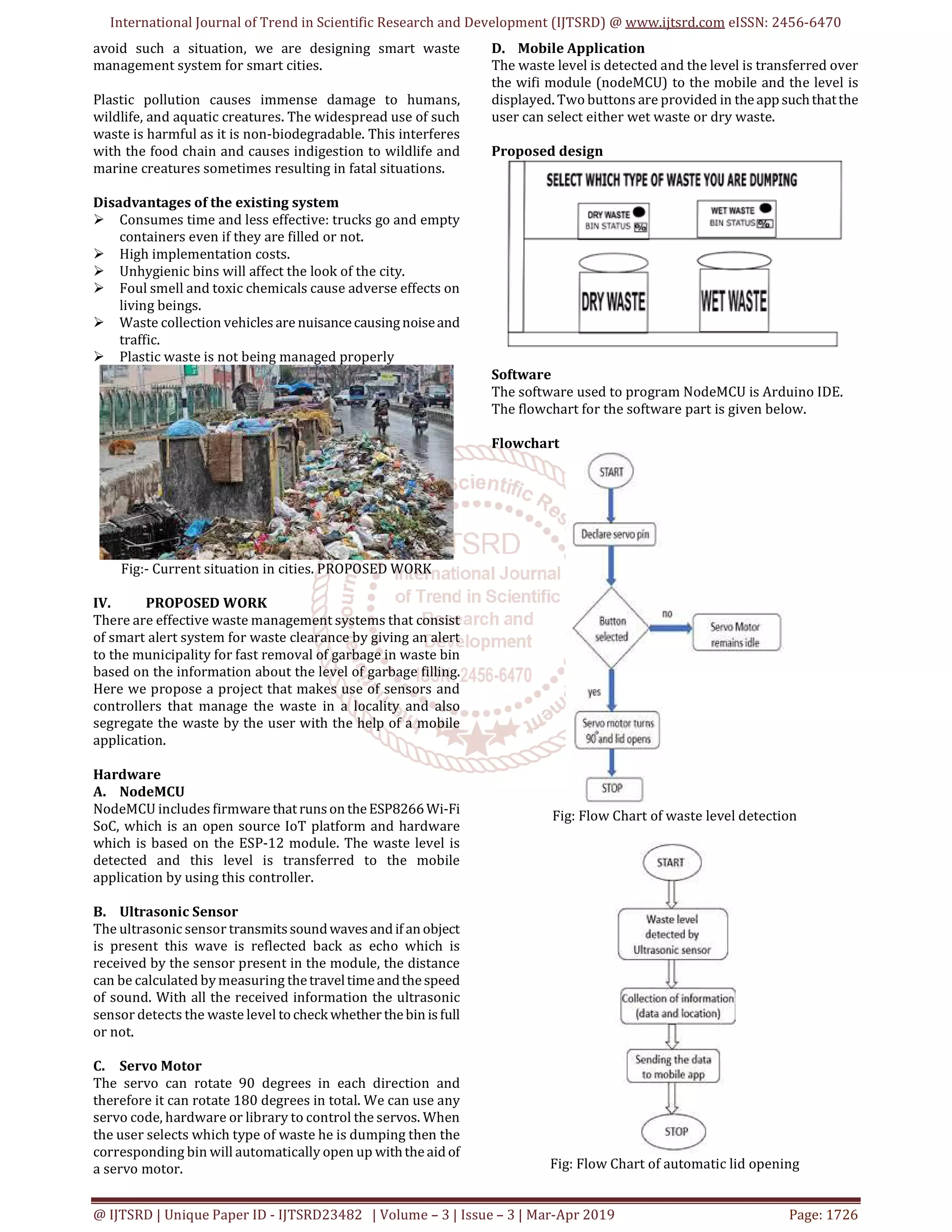
D. Mobile Application
The waste level is detected and the level is transferred over
the wifi module (nodeMCU) to the mobile and the level is
displayed. Two buttons are provided in theappsuchthatthe
user can select either wet waste or dry waste.
Proposed design
Software
The software used to program NodeMCU is Arduino IDE.
The flowchart for the software part is given below.
Flowchart
Fig: Flow Chart of waste level detection
Fig: Flow Chart of automatic lid opening
International Journal of Trend in Scientific Research and Development (IJTSRD) @ www.ijtsrd.com eISSN: 2456-6470
@ IJTSRD | Unique Paper ID - IJTSRD23482 | Volume – 3 | Issue – 3 | Mar-Apr 2019 Page: 1727
Advantages
Easy to implement.
Maintains hygiene.
Unwanted trips can be avoided.
Reduces waste overflow.
The waste level can be monitored by the user as well as
the authority.
Low cost.
V. RESULTS
In this project, smart waste management can be done by
monitoring the waste level with the help of the ultrasonic
sensor. The waste level information is transferred to the
mobile app with the help of NodeMCU.The user, as well as
the authority, can view the level of waste in his/her mobile
phone and act accordingly. Also, the user can select which
type of waste he is dumping (dry or wet waste)withthehelp
of the app. The lid opens automatically as soon as the user
selects the button and hence this will provide hygiene to the
user without interferingwiththewastebin.Manualswitches
are also provided in the control panel even if the user
doesn’t take his phone. Led lightsarealsointerfaced whichis
used to indicate whether the bin is filled or not.
VI. FUTURE SCOPE
Automatic waste segregation can be incorporated to
separate dry and wet waste.
On spot, decomposition can be implemented sothatwet
waste can be converted into biowaste.
Compactors can be provided.
Solar panels help to provide the power supply.
Location mapping can be incorporated.
Common remote application can be implemented to
control bins in different localities.
VII. CONCLUSION
Smart waste management system involves sensor and
mobile application to monitor the waste overflow. Waste
overflow is eliminated with the help of two methods of
automatic lid openingand waste leveldetection.Servomotor
is used to open the lid so as to provide the users with
hygienic bins hence avoiding direct contact with bin. It also
allows the user to be informed about the waste level before
leaving their home to dump the waste. This information is
collected with the help of a mobile application which is
interfaced with Node MCU and ultrasonic sensor. This
system is efficient as it helps to keep the environment clean
by allowing timely collection of waste from bins.
REFERENCES
[1] L. Gogoi: “Solid Waste Disposal and its Health
Implications in Guwahati City: A Study in Medical
Geography", ISBN 978-3-8454-0149-2.
[2] www.downtoearth.org.in
[3] D. K. J. G. A. G. V. A. Papalambrou, "A Versatile Scalable
Smart Wastebin System based on Resource-limited
Embedded Devices," in Emerging Technologies &
Factory.
[4] Lingling H., Haifeng L., Xu X., Jian L., "An Intelligent
Vehicle Monitoring System, Based on Internet of
Things", IEEE 7th International Conference on
Computational Intelligence and Security (CIS), pp. 231-
233, Hainan, December 2011.
[5] Dr. N. Sathish Kumar, B. Vijayalaksmi, R. Jenifer
Prarthana, A. Shankar, "IOT Based Smart Garbage alert

Smart Waste Management System

  • 1.
    International Journal ofTrend in Scientific Research and Development (IJTSRD) Volume: 3 | Issue: 3 | Mar-Apr 2019 Available Online: www.ijtsrd.com e-ISSN: 2456 - 6470 @ IJTSRD | Unique Paper ID – IJTSRD23482 | Volume – 3 | Issue – 3 | Mar-Apr 2019 Page: 1725 Smart Waste Management System Somy P Mathew1, Lisha Tomy2, Parvathi S2, Reshmi Nath2 1Assistant Professor, 2UG Student 1,2Deptrment of ECE, Viswajyothi College of Engineering and Technology, Vazhakulam, Kerala, India How to cite this paper: Somy P Mathew | Lisha Tomy | Parvathi S | Reshmi Nath "Smart Waste Management System" Published in International Journal of Trend in Scientific Research and Development (ijtsrd), ISSN: 2456- 6470, Volume-3 | Issue-3, April 2019, pp.1725-1727, URL: https://www.ijtsrd.c om/papers/ijtsrd23 482.pdf Copyright © 2019 by author(s) and International Journal of Trend in Scientific Research and Development Journal. This is an Open Access article distributed under the terms of the CreativeCommons Attribution License (CC BY 4.0) (http://creativecommons.org/licenses/ by/4.0) ABSTRACT In this paper, we present a cost-effective and efficient smart wastemanagement system that acts as an easy link between the user and the authoritybyproviding a mobile application to monitor the bin interfaced with appropriate sensors. KEYWORDS: Smart waste management system,nodeMCU, UltrasonicSensor, Servo Motor, Mobile application. I. INTRODUCTION Waste management is one of themainproblemsfaced by our nation. It includes the collection of waste, transportation, treatment and disposal of waste. Here in this project, we are implementing a smart waste management system. Cities are becoming smarter so has to be our waste management. This is more overachieved by deploying dedicated municipal access networks to support city management and maintenance services through a data connection. This project practically demonstrates a solution for many of the problems related to the waste management system in our country. Here we presentasmartwastemanagementsystem using appropriate sensors, that detects the waste level, collects the data and send them over a data network to a mobile application hence allowing user and authority to monitor the bin. This data is then put into a server and the information is collected by the user with the helpof amobile application. II. LITERATURE SURVEY Improper waste management can easily result in air pollution, soil contamination and other relatedhealthissues. They will adversely affect human health. [1].According to recent research conducted in South Delhi, it was found that 12.16 percent of the waste produced was plastic. In Delhi, the quantity of plastic waste was 10.14 percent of the city's total waste by the Central Pollution Control Board in 2015. Delhi produces 10,000 metric tonnes of garbage every day and also the area to dump this garbage could be a major problem.[2].In this paper, waste management involves various waste bins that exhibit significant filling variations. The detection of the waste level of the urban solid-waste- bins introduces many problems due to the irregular shape and the variety of the included materials [3]. Issues connected to waste collection are: (i) when the bin will be filled and (ii) devoid the bin before it gets overflowed [4]. The main theme of the work was to create asmartintelligent garbage alert system for waste management. This paper proposes an alert system for waste collection by giving an alert signal to the municipal net server for immediate cleaning of a dustbin with proper verification according to the level of garbage filling. This process is done by the ultrasonic sensor which is interfaced with Node MCU to check the level of garbage filled in the dustbin and sends the data to a mobile application handled by the user or the authority [5]. III. EXISTING SYSTEM In existing systems garbage is collectedbythemunicipalities weekly once or twice a week. Through this, the waste gets accumulated and overflows the waste bin and spread over the roads and thus it will pollute the environment. Thesmell produced from this will be heavy and it contaminates the air and the surroundings and causes many diseases. The stray dogs and animals eat the waste food and the waste spreads over the area and creates a dirty environment. In order to IJTSRD23482
  • 2.
    International Journal ofTrend in Scientific Research and Development (IJTSRD) @ www.ijtsrd.com eISSN: 2456-6470 @ IJTSRD | Unique Paper ID - IJTSRD23482 | Volume – 3 | Issue – 3 | Mar-Apr 2019 Page: 1726 avoid such a situation, we are designing smart waste management system for smart cities. Plastic pollution causes immense damage to humans, wildlife, and aquatic creatures. The widespread use of such waste is harmful as it is non-biodegradable. This interferes with the food chain and causes indigestion to wildlife and marine creatures sometimes resulting in fatal situations. Disadvantages of the existing system Consumes time and less effective: trucks go and empty containers even if they are filled or not. High implementation costs. Unhygienic bins will affect the look of the city. Foul smell and toxic chemicals cause adverse effects on living beings. Waste collection vehiclesare nuisancecausingnoiseand traffic. Plastic waste is not being managed properly Fig:- Current situation in cities. PROPOSED WORK IV. PROPOSED WORK There are effective waste management systems that consist of smart alert system for waste clearance by giving an alert to the municipality for fast removal of garbage in waste bin based on the information about the level of garbage filling. Here we propose a project that makes use of sensors and controllers that manage the waste in a locality and also segregate the waste by the user with the help of a mobile application. Hardware A. NodeMCU NodeMCU includes firmware thatrunsontheESP8266Wi-Fi SoC, which is an open source IoT platform and hardware which is based on the ESP-12 module. The waste level is detected and this level is transferred to the mobile application by using this controller. B. Ultrasonic Sensor The ultrasonic sensor transmitssoundwavesand if anobject is present this wave is reflected back as echo which is received by the sensor present in the module, the distance can be calculated by measuring thetraveltimeandthespeed of sound. With all the received information the ultrasonic sensor detects the waste level tocheck whether thebin isfull or not. C. Servo Motor The servo can rotate 90 degrees in each direction and therefore it can rotate 180 degrees in total. We can use any servo code, hardware or library to control the servos. When the user selects which type of waste he is dumping then the corresponding bin will automatically open up withtheaid of a servo motor. D. Mobile Application The waste level is detected and the level is transferred over the wifi module (nodeMCU) to the mobile and the level is displayed. Two buttons are provided in theappsuchthatthe user can select either wet waste or dry waste. Proposed design Software The software used to program NodeMCU is Arduino IDE. The flowchart for the software part is given below. Flowchart Fig: Flow Chart of waste level detection Fig: Flow Chart of automatic lid opening
  • 3.
    International Journal ofTrend in Scientific Research and Development (IJTSRD) @ www.ijtsrd.com eISSN: 2456-6470 @ IJTSRD | Unique Paper ID - IJTSRD23482 | Volume – 3 | Issue – 3 | Mar-Apr 2019 Page: 1727 Advantages Easy to implement. Maintains hygiene. Unwanted trips can be avoided. Reduces waste overflow. The waste level can be monitored by the user as well as the authority. Low cost. V. RESULTS In this project, smart waste management can be done by monitoring the waste level with the help of the ultrasonic sensor. The waste level information is transferred to the mobile app with the help of NodeMCU.The user, as well as the authority, can view the level of waste in his/her mobile phone and act accordingly. Also, the user can select which type of waste he is dumping (dry or wet waste)withthehelp of the app. The lid opens automatically as soon as the user selects the button and hence this will provide hygiene to the user without interferingwiththewastebin.Manualswitches are also provided in the control panel even if the user doesn’t take his phone. Led lightsarealsointerfaced whichis used to indicate whether the bin is filled or not. VI. FUTURE SCOPE Automatic waste segregation can be incorporated to separate dry and wet waste. On spot, decomposition can be implemented sothatwet waste can be converted into biowaste. Compactors can be provided. Solar panels help to provide the power supply. Location mapping can be incorporated. Common remote application can be implemented to control bins in different localities. VII. CONCLUSION Smart waste management system involves sensor and mobile application to monitor the waste overflow. Waste overflow is eliminated with the help of two methods of automatic lid openingand waste leveldetection.Servomotor is used to open the lid so as to provide the users with hygienic bins hence avoiding direct contact with bin. It also allows the user to be informed about the waste level before leaving their home to dump the waste. This information is collected with the help of a mobile application which is interfaced with Node MCU and ultrasonic sensor. This system is efficient as it helps to keep the environment clean by allowing timely collection of waste from bins. REFERENCES [1] L. Gogoi: “Solid Waste Disposal and its Health Implications in Guwahati City: A Study in Medical Geography", ISBN 978-3-8454-0149-2. [2] www.downtoearth.org.in [3] D. K. J. G. A. G. V. A. Papalambrou, "A Versatile Scalable Smart Wastebin System based on Resource-limited Embedded Devices," in Emerging Technologies & Factory. [4] Lingling H., Haifeng L., Xu X., Jian L., "An Intelligent Vehicle Monitoring System, Based on Internet of Things", IEEE 7th International Conference on Computational Intelligence and Security (CIS), pp. 231- 233, Hainan, December 2011. [5] Dr. N. Sathish Kumar, B. Vijayalaksmi, R. Jenifer Prarthana, A. Shankar, "IOT Based Smart Garbage alert