International Journal of Trend in Scientific Research and Development (IJTSRD)
Volume 8 Issue 2, March-April 2024 Available Online: www.ijtsrd.com e-ISSN: 2456 – 6470
@ IJTSRD | Unique Paper ID – IJTSRD64650 | Volume – 8 | Issue – 2 | Mar-Apr 2024 Page 357
A Study on Seismic Analysis of High Rise Building with Mass
Irregularities, Torsional Irregularities and Floating Column
Magal Banskar1, Prof. Pawan Dubey2, Prof. Rakesh Sakale3, Prof. Hirendra Pratap Singh4
1
PG Student, 2,4
Assistant Professor, 3
Associate Professor,
1, 2, 3, 4
School of Research and Technology, Bhopal, Madhya Pradesh, India
ABSTRACT
In a many techniques of S.A. of structure. Analysis of the structure is
critical techniques for structural S.A. in general evaluate structural
reaction is non-linear in nature. This type of analysis, a representative
earthquake time history is required. In this case study S.A. of RCC
buildings with mass irregularity at different floor level are carrying.
Seismic forces can origin major structural damage or demolition. In
multi story RC building have been subjected to the heavy earth
quakes, the existence of irregularity in RC construction was vertical
irregularity of the building stap-0nds it apart from other structures.
In this study is to design and analysis of the structural elements like
Slabs, Beams and Columns etc. All loads like dead load, live load,
wind load etc. are consider according to standards and by considering
seismic and wind force to ensure the safety and careful balance b/w
financial system and safety. As a final point the analysis parameters
like shear force, bending moment and displacements are
comparatively presented.
KEYWORDS: SA- Seismic analysis, Time history, Storey Shear, Story
How to cite this paper: Magal Banskar |
Prof. Pawan Dubey | Prof. Rakesh
Sakale | Prof. Hirendra Pratap Singh "A
Study on Seismic Analysis of High Rise
Building with Mass Irregularities,
Torsional Irregularities and Floating
Column" Published
in International
Journal of Trend in
Scientific Research
and Development
(ijtsrd), ISSN: 2456-
6470, Volume-8 |
Issue-2, April 2024,
pp.357-360, URL:
www.ijtsrd.com/papers/ijtsrd64650.pdf
Copyright © 2024 by author (s) and
International Journal of Trend in
Scientific Research and Development
Journal. This is an
Open Access article
distributed under the
terms of the Creative Commons
Attribution License (CC BY 4.0)
(http://creativecommons.org/licenses/by/4.0)
I. INTRODUCTION
In the past studies weakness is due to geometry, the
mass discontinuity and stiffness of structure. The
structures having this discontinuity are termed as
Irregular structures. These types of structures have a
large portion of urban infrastructure. Therefore
structures fail during earthquakes due to vertical
irregularity. These structures are referred to as
irregular structure since they have this discontinuity.
In urban infrastructure is partially or completely
irregular structure. Irregularities in a structure are key
variables that decrease the seismic performance of
any structure as earthquake .
In a frame structure be utilize to model the first and
second storey of building G1, and a frame-shear wall
structure was utilized to model the remaining storey
of the building. Study of the two different types of
building structure, the second storey was treated as
the transfer storey by using several strength end frame
beams to distribute the wall loading of the upper
storey to the frame columns in the lower storey. In a
plan views of the first and second storey of building
G1, as well as the standard plan view of the other
twelve storeys, are illustrated. The usual geometric
dimensions and concrete material grades of the frame
structure and frame-shear wall structure.
II. METHODOLOGY
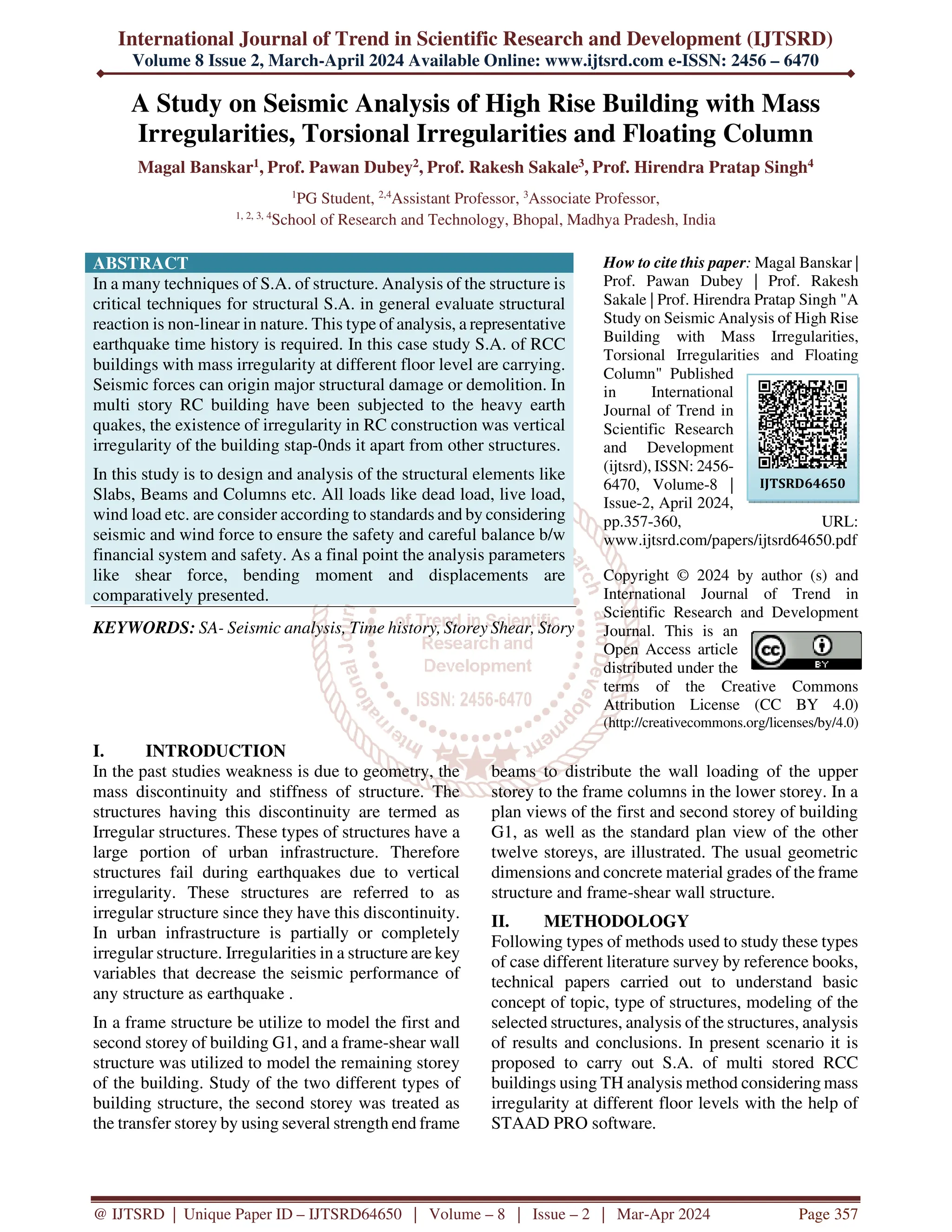
Following types of methods used to study these types
of case different literature survey by reference books,
technical papers carried out to understand basic
concept of topic, type of structures, modeling of the
selected structures, analysis of the structures, analysis
of results and conclusions. In present scenario it is
proposed to carry out S.A. of multi stored RCC
buildings using TH analysis method considering mass
irregularity at different floor levels with the help of
STAAD PRO software.
IJTSRD64650
International Journal of Trend in Scientific Research and Development @ www.ijtsrd.com eISSN: 2456-6470
@ IJTSRD | Unique Paper ID – IJTSRD64650 | Volume – 8 | Issue – 2 | Mar-Apr 2024 Page 358
The following changes to be made to the parameters
for vertical irregularity:
Table no.1
Types of
irregularity
Changes Parameter
Stiffness
irregularity
Height of
that floor
3.1 m.
Mass
irregularity
SDL of
that floor
20.9 KN/m2
Vertical
geometric
irregularity
Setback in
building
After every
3 story
There is following three types of irregular buildings
were considered, regular structure, mass irregular
structure, and vertically geometric irregular building.
All three structures are of fifteen storey’s.
Dead load: All permanent constructions of the
structure form the dead loads. The dead load
comprises of the self-weight, weight of walls,
partitions floor finishes and the other permanent
constructions in the buildings.
The loads considered in this project are as per IS 456
2000.
Weight of concrete = 7.178KN/m2
4½ inches thick wall weight = 2.389 KN/m2
9 inches thick wall weight = 4.778 KN/m2
Weight of glass area = 0.469KN/m2
Weight of elevator = 2.11tons
Weight of ceiling and finishing = 1.211KN/m2
Imposed loads do not include loads due to wind,
seismic activity, snow, and loads imposed due to
temperature changes to which the structure will be
subjected to, creep and shrinkage of the structure,
Live load on lobbing = 4.778 KN/m2
Live load on corridors = 4.778 KN/m2
Live load on stairs = 4.778 KN/m2
Live load on restaurants = 4.778 KN/m2
Live load on assembly hall = 4.778 KN/m2
Live load on bedroom =1.899KN/m2
Live load on roof =0.944KN/m2
III. RESULTS AND DISCUSSION
0
5
10
15
20
25
30
35
40
45
1 2 3 4 5 6 7 8 9 10 11 12 13 14 15 16
Storey displacement
Storey
Storey Displacement
In the above graph the X-axis represents the storey of
the building and Y-axis represents the displacement
in mm. It is mini. at the base level and gradually
increases with respect to storey. The maximum
displacement is at the top storey.
In the above graph the X-axis represents the storey of
the building and Y-axis represents the shear force.
The shear force is maximum at the first storey and it
decreases with respect to the storey height.
International Journal of Trend in Scientific Research and Development @ www.ijtsrd.com eISSN: 2456-6470
@ IJTSRD | Unique Paper ID – IJTSRD64650 | Volume – 8 | Issue – 2 | Mar-Apr 2024 Page 359
Storey Drift
In the above graph the storey drift is maximum at the
fifth storey and it is minimum at base plinth level.
Storey Overturning Moment: It is the sum of the
moments on the column and any shear on the column
multiplied by the distance from the base of the
column to the base of the footing.
0
5
10
15
Overturning moment
Storeys
The X- direction represents the storey of the building
and y- direction represents the overturning moment in
KN. The overturning moment is maxm
at the base
level and gradually decreases with respect to height of
the storey.
Table No 2 Design Parameters
Sr.
No.
Design
Parameter
Result
1
Storey
displacement
43mm
2 Storey shear
1st
storey - 4167.3KN
5th
storey - 3293.6KN
10th
storey-2351.6KN
15th
storey- 632.29KN
3 Storey drift 4.311mm
4
Storey overturning
moment
118000KN
The structural model formed in the software has been
studied to consider torsion irregularity following the
provisions of IS for Earthquake Resistant design. In
the III floor of the building has been measured to
check the corner displacements. Min & max obtained
in this floor are 5.99 mm and 10.99 mm respectively.
IV. CONCLUSION
 In this study analysis of vertically irregular
structure, the behavior of the structure has been
studied under dynamic loading.
 The performance of the vertically irregular
structure under plane ground conditions has been
analyzed through the Response Spectrum Method.
 Developed 3D-model for the building using
STAAD PRO software.
 It is suggested that irregular buildings are safer
than regular buildings under seismic situation and
should be chosen for regular buildings.
 Seismic performances of a high-rise building with
structural irregularities and transfer floors under
frequent, moderate and rare earthquakes were
evaluated.
REFERENCES
[1] Akiyama, H. Earthquake Resistant Limit State
Design for Buildings; University of Tokyo
Press: Tokyo, Japan, 1985.
[2] Ali Akbar Firoozi, Ali Asghar Firoozi, Mojtaba
Shojaei Baghini.-Fundamentals of soil
stabilization, International Journal of Geo-
engineering, volume 8, Article number: 26
(2017), published in 2017.
[3] D’Angela, D.; Magliulo, G.; Cosenza, E.
Seismic damage assessment of unanchored non
structural components taking into account the
building response. Struct. Saf. 2021, 93,
102126.
[4] Georgantzia, E.; Nikolaidis, T.; Katakalos, K.;
Tsikaloudaki, K.; Iliadis, T. Dynamic
Performance Analysis by Laboratory Tests of a
Sustainable Prefabricated Composite Structural.
[5] Jankowski, R. Pounding force responses
pectrum under earthquake excitation.
Eng.Struct.2006, 28, 1149–1161.
[6] Jiang, J. Comparative study on performance-
based seismic design method and capacity-
based seismic design method. Struct.Eng.2008,
24, 25–52.
[7] Jiang, X.; Liu, W.; Yang, H.; Zhang, J.; Yu, L.
Study on dynamic response characteristics of
slope with double-arch tunnel under seismic
action. Geotech. Geol. Eng. 2021, 39,1349–
1363.
[8] Kim, T.-H.; Lee, H.-M.; Kim, Y.-J.; Shin, H.
Performance assessment of precast concrete
segmental bridge columns with a shear resistant
connecting structure. Eng. Struct.2010, 32,
International Journal of Trend in Scientific Research and Development @ www.ijtsrd.com eISSN: 2456-6470
@ IJTSRD | Unique Paper ID – IJTSRD64650 | Volume – 8 | Issue – 2 | Mar-Apr 2024 Page 360
1292–1303.
[9] Jeong, S. H.; Mwafy, A. M.; Elnashai, A. S.
Probabilistic seismic performance assessment
of code-compliant multi-story RC buildings.
Eng. Struct. 2012, 34, 527–537.
[10] Lee, D. -G.; Choi, W.-H.; Cheong, M.-C.; Kim,
D.-K. Evaluation of seismic performance of
multistory building structures based on the
equivalent responses.Eng.Struct.2006, 28, 837–
856.
[11] Scislo, L. High activity earthquake swarm
event monitoring and impact analysis on
underground high energy physics research
facilities. Energies 2022, 15, 3705.
[12] Samreen bano, Anand kumar, Sahib ahmed-
Feasibility of Artificial Neural Network in Civil
Engineering, published in 2019.
[13] Taslimi, A.; Tehranizadeh, M.; Shamlu, M.
Seismic fragility analysis of RC frame-core
wall buildings under the combined vertical and
horizontal ground motions. Earthq.Struct.2021,
20, 175–185.
[14] Zhang, S.; Zhou, J.; Hao, Y. Seismic
vulnerability analysis of high-rise composite
frame concrete tube composite structure. IOP
Conf. Ser. Earth Environ. Sci.

A Study on Seismic Analysis of High Rise Building with Mass Irregularities, Torsional Irregularities and Floating Column

  • 1.
    International Journal ofTrend in Scientific Research and Development (IJTSRD) Volume 8 Issue 2, March-April 2024 Available Online: www.ijtsrd.com e-ISSN: 2456 – 6470 @ IJTSRD | Unique Paper ID – IJTSRD64650 | Volume – 8 | Issue – 2 | Mar-Apr 2024 Page 357 A Study on Seismic Analysis of High Rise Building with Mass Irregularities, Torsional Irregularities and Floating Column Magal Banskar1, Prof. Pawan Dubey2, Prof. Rakesh Sakale3, Prof. Hirendra Pratap Singh4 1 PG Student, 2,4 Assistant Professor, 3 Associate Professor, 1, 2, 3, 4 School of Research and Technology, Bhopal, Madhya Pradesh, India ABSTRACT In a many techniques of S.A. of structure. Analysis of the structure is critical techniques for structural S.A. in general evaluate structural reaction is non-linear in nature. This type of analysis, a representative earthquake time history is required. In this case study S.A. of RCC buildings with mass irregularity at different floor level are carrying. Seismic forces can origin major structural damage or demolition. In multi story RC building have been subjected to the heavy earth quakes, the existence of irregularity in RC construction was vertical irregularity of the building stap-0nds it apart from other structures. In this study is to design and analysis of the structural elements like Slabs, Beams and Columns etc. All loads like dead load, live load, wind load etc. are consider according to standards and by considering seismic and wind force to ensure the safety and careful balance b/w financial system and safety. As a final point the analysis parameters like shear force, bending moment and displacements are comparatively presented. KEYWORDS: SA- Seismic analysis, Time history, Storey Shear, Story How to cite this paper: Magal Banskar | Prof. Pawan Dubey | Prof. Rakesh Sakale | Prof. Hirendra Pratap Singh "A Study on Seismic Analysis of High Rise Building with Mass Irregularities, Torsional Irregularities and Floating Column" Published in International Journal of Trend in Scientific Research and Development (ijtsrd), ISSN: 2456- 6470, Volume-8 | Issue-2, April 2024, pp.357-360, URL: www.ijtsrd.com/papers/ijtsrd64650.pdf Copyright © 2024 by author (s) and International Journal of Trend in Scientific Research and Development Journal. This is an Open Access article distributed under the terms of the Creative Commons Attribution License (CC BY 4.0) (http://creativecommons.org/licenses/by/4.0) I. INTRODUCTION In the past studies weakness is due to geometry, the mass discontinuity and stiffness of structure. The structures having this discontinuity are termed as Irregular structures. These types of structures have a large portion of urban infrastructure. Therefore structures fail during earthquakes due to vertical irregularity. These structures are referred to as irregular structure since they have this discontinuity. In urban infrastructure is partially or completely irregular structure. Irregularities in a structure are key variables that decrease the seismic performance of any structure as earthquake . In a frame structure be utilize to model the first and second storey of building G1, and a frame-shear wall structure was utilized to model the remaining storey of the building. Study of the two different types of building structure, the second storey was treated as the transfer storey by using several strength end frame beams to distribute the wall loading of the upper storey to the frame columns in the lower storey. In a plan views of the first and second storey of building G1, as well as the standard plan view of the other twelve storeys, are illustrated. The usual geometric dimensions and concrete material grades of the frame structure and frame-shear wall structure. II. METHODOLOGY Following types of methods used to study these types of case different literature survey by reference books, technical papers carried out to understand basic concept of topic, type of structures, modeling of the selected structures, analysis of the structures, analysis of results and conclusions. In present scenario it is proposed to carry out S.A. of multi stored RCC buildings using TH analysis method considering mass irregularity at different floor levels with the help of STAAD PRO software. IJTSRD64650
  • 2.
    International Journal ofTrend in Scientific Research and Development @ www.ijtsrd.com eISSN: 2456-6470 @ IJTSRD | Unique Paper ID – IJTSRD64650 | Volume – 8 | Issue – 2 | Mar-Apr 2024 Page 358 The following changes to be made to the parameters for vertical irregularity: Table no.1 Types of irregularity Changes Parameter Stiffness irregularity Height of that floor 3.1 m. Mass irregularity SDL of that floor 20.9 KN/m2 Vertical geometric irregularity Setback in building After every 3 story There is following three types of irregular buildings were considered, regular structure, mass irregular structure, and vertically geometric irregular building. All three structures are of fifteen storey’s. Dead load: All permanent constructions of the structure form the dead loads. The dead load comprises of the self-weight, weight of walls, partitions floor finishes and the other permanent constructions in the buildings. The loads considered in this project are as per IS 456 2000. Weight of concrete = 7.178KN/m2 4½ inches thick wall weight = 2.389 KN/m2 9 inches thick wall weight = 4.778 KN/m2 Weight of glass area = 0.469KN/m2 Weight of elevator = 2.11tons Weight of ceiling and finishing = 1.211KN/m2 Imposed loads do not include loads due to wind, seismic activity, snow, and loads imposed due to temperature changes to which the structure will be subjected to, creep and shrinkage of the structure, Live load on lobbing = 4.778 KN/m2 Live load on corridors = 4.778 KN/m2 Live load on stairs = 4.778 KN/m2 Live load on restaurants = 4.778 KN/m2 Live load on assembly hall = 4.778 KN/m2 Live load on bedroom =1.899KN/m2 Live load on roof =0.944KN/m2 III. RESULTS AND DISCUSSION 0 5 10 15 20 25 30 35 40 45 1 2 3 4 5 6 7 8 9 10 11 12 13 14 15 16 Storey displacement Storey Storey Displacement In the above graph the X-axis represents the storey of the building and Y-axis represents the displacement in mm. It is mini. at the base level and gradually increases with respect to storey. The maximum displacement is at the top storey. In the above graph the X-axis represents the storey of the building and Y-axis represents the shear force. The shear force is maximum at the first storey and it decreases with respect to the storey height.
  • 3.
    International Journal ofTrend in Scientific Research and Development @ www.ijtsrd.com eISSN: 2456-6470 @ IJTSRD | Unique Paper ID – IJTSRD64650 | Volume – 8 | Issue – 2 | Mar-Apr 2024 Page 359 Storey Drift In the above graph the storey drift is maximum at the fifth storey and it is minimum at base plinth level. Storey Overturning Moment: It is the sum of the moments on the column and any shear on the column multiplied by the distance from the base of the column to the base of the footing. 0 5 10 15 Overturning moment Storeys The X- direction represents the storey of the building and y- direction represents the overturning moment in KN. The overturning moment is maxm at the base level and gradually decreases with respect to height of the storey. Table No 2 Design Parameters Sr. No. Design Parameter Result 1 Storey displacement 43mm 2 Storey shear 1st storey - 4167.3KN 5th storey - 3293.6KN 10th storey-2351.6KN 15th storey- 632.29KN 3 Storey drift 4.311mm 4 Storey overturning moment 118000KN The structural model formed in the software has been studied to consider torsion irregularity following the provisions of IS for Earthquake Resistant design. In the III floor of the building has been measured to check the corner displacements. Min & max obtained in this floor are 5.99 mm and 10.99 mm respectively. IV. CONCLUSION  In this study analysis of vertically irregular structure, the behavior of the structure has been studied under dynamic loading.  The performance of the vertically irregular structure under plane ground conditions has been analyzed through the Response Spectrum Method.  Developed 3D-model for the building using STAAD PRO software.  It is suggested that irregular buildings are safer than regular buildings under seismic situation and should be chosen for regular buildings.  Seismic performances of a high-rise building with structural irregularities and transfer floors under frequent, moderate and rare earthquakes were evaluated. REFERENCES [1] Akiyama, H. Earthquake Resistant Limit State Design for Buildings; University of Tokyo Press: Tokyo, Japan, 1985. [2] Ali Akbar Firoozi, Ali Asghar Firoozi, Mojtaba Shojaei Baghini.-Fundamentals of soil stabilization, International Journal of Geo- engineering, volume 8, Article number: 26 (2017), published in 2017. [3] D’Angela, D.; Magliulo, G.; Cosenza, E. Seismic damage assessment of unanchored non structural components taking into account the building response. Struct. Saf. 2021, 93, 102126. [4] Georgantzia, E.; Nikolaidis, T.; Katakalos, K.; Tsikaloudaki, K.; Iliadis, T. Dynamic Performance Analysis by Laboratory Tests of a Sustainable Prefabricated Composite Structural. [5] Jankowski, R. Pounding force responses pectrum under earthquake excitation. Eng.Struct.2006, 28, 1149–1161. [6] Jiang, J. Comparative study on performance- based seismic design method and capacity- based seismic design method. Struct.Eng.2008, 24, 25–52. [7] Jiang, X.; Liu, W.; Yang, H.; Zhang, J.; Yu, L. Study on dynamic response characteristics of slope with double-arch tunnel under seismic action. Geotech. Geol. Eng. 2021, 39,1349– 1363. [8] Kim, T.-H.; Lee, H.-M.; Kim, Y.-J.; Shin, H. Performance assessment of precast concrete segmental bridge columns with a shear resistant connecting structure. Eng. Struct.2010, 32,
  • 4.
    International Journal ofTrend in Scientific Research and Development @ www.ijtsrd.com eISSN: 2456-6470 @ IJTSRD | Unique Paper ID – IJTSRD64650 | Volume – 8 | Issue – 2 | Mar-Apr 2024 Page 360 1292–1303. [9] Jeong, S. H.; Mwafy, A. M.; Elnashai, A. S. Probabilistic seismic performance assessment of code-compliant multi-story RC buildings. Eng. Struct. 2012, 34, 527–537. [10] Lee, D. -G.; Choi, W.-H.; Cheong, M.-C.; Kim, D.-K. Evaluation of seismic performance of multistory building structures based on the equivalent responses.Eng.Struct.2006, 28, 837– 856. [11] Scislo, L. High activity earthquake swarm event monitoring and impact analysis on underground high energy physics research facilities. Energies 2022, 15, 3705. [12] Samreen bano, Anand kumar, Sahib ahmed- Feasibility of Artificial Neural Network in Civil Engineering, published in 2019. [13] Taslimi, A.; Tehranizadeh, M.; Shamlu, M. Seismic fragility analysis of RC frame-core wall buildings under the combined vertical and horizontal ground motions. Earthq.Struct.2021, 20, 175–185. [14] Zhang, S.; Zhou, J.; Hao, Y. Seismic vulnerability analysis of high-rise composite frame concrete tube composite structure. IOP Conf. Ser. Earth Environ. Sci.