Project on:
SMART SOLID WASTE
MANAGEMENT
Presented By Project Guide
Shubham Thakur Prof. Y.D.Borole
Utkarsh Bingewar Prof. A.M.Bongale
Aniruddha Aru
CONTENTS
INTRODUCTION
LITERATURE SURVEY
PROBLEM OVERVIEW
OBJECTIVE
BLOCK DIAGRAM
BLOCK DIAGRAM DESCRIPTION
HARDWARE
ADVANTAGES
CONCLUSION
REFERENCES
INTRODUCTION:
Generally, the solid waste is defined from households refusal and non-
hazardous solid waste is from industrial, commercial and institutional
establishments such as hospitals, market waste, yard waste and street sweepings.
Today, Solid waste management has changed a long way from the old days when
garbage was collected by horse and disposed outside of town. Today, it is almost
hard to manage waste collection process and management without high technology
to pinpoint the locations of vehicles and recycling bins. In the developing
countries, waste management is becoming an acute problem as urbanization and
economic development increase leading to larger quantities of waste materials.
LITERATURE SURVEY
Name of Author Method Advantages Disadvantages
Shubham Thakker and
R.Narayanamoorthi
[2009]
GSM System Server whenever a bin is
full
Assigning GSM modules and SIM
cards to each garbage bin is not
possible.
Mohd Helmy Abd Wahab
et al [2013]
RFID tags Detect the identity of the
person throwing the
garbage.
Every individual will be not able to
carrying his RFID card at all times
whenever he has to dispose some form
of waste into a garbage bin.
C.K.M. Lee and Trevor
wu [2015]
GPRS System Send the sensor data to a
mobile app over the
cloud.
This is again not feasible as fitting
GSM modules to all the dustbins of a
city and ensuring that GPRS data is
available to each of the bins is
impractical.
PROBLEM OVERVIEW:
 The main problems of the existing solid waste collection process and
management system are as follows.
 Lack of the information about the collecting time and area.
Lack of the proper system for monitoring, tracking the trucks and trash bins that have
been collected in real time.
 Loss of productivity due to inefficient utilization and unauthorized use of vehicles.
 There is no quick response to urgent cases like truck accident, breakdown, longtime
idling.
 There is no quick way to response to client's complaints about uncollected waste.
PROBLEM
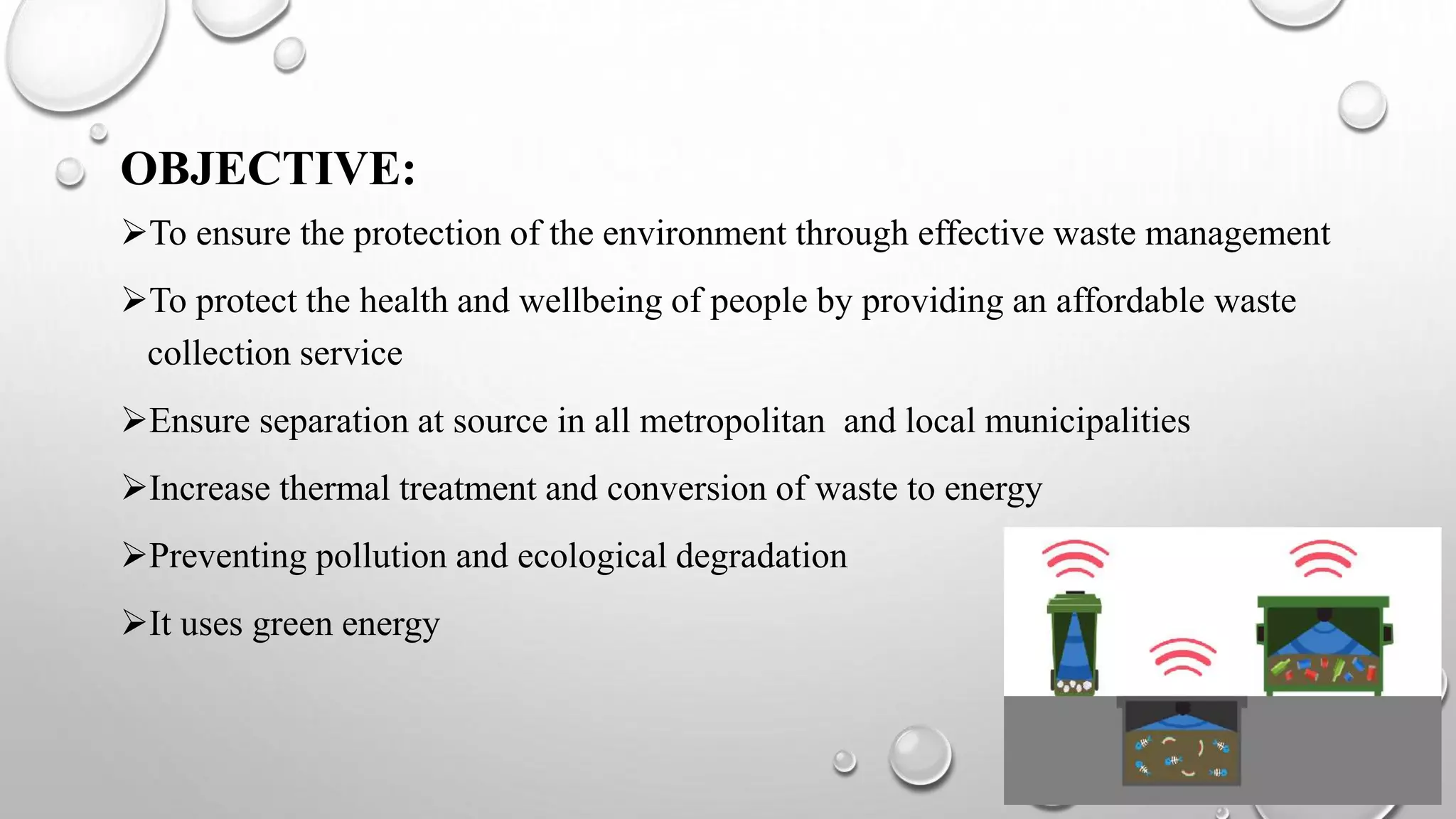
OBJECTIVE:
To ensure the protection of the environment through effective waste management
To protect the health and wellbeing of people by providing an affordable waste
collection service
Ensure separation at source in all metropolitan and local municipalities
Increase thermal treatment and conversion of waste to energy
Preventing pollution and ecological degradation
It uses green energy
 BLOCK DIAGRAM:
DESCRIPATION OF EACH BLOCK:
 COLLECTION:
COMBUSTION:
HARDWARE
ULTRASONIC SENSOR
As shown above the HC-SR04 ultrasonic (US) sensor is a 4 pin
module, whose pin names are vcc, trigger, echo and ground
respectively. This sensor is a very popular sensor used in many
applications where measuring distance or sensing objects are
required. The module has two eyes like projects in the front which
forms the ultrasonic transmitter and receiver. The sensor works
with the simple high school formula that
DISTANCE = SPEED × TIME
The ultrasonic transmitter transmits an ultrasonic wave, this wave
travels in air and when it gets objected by any material it gets
reflected back toward the sensor
TEMPERATURE SENSOR
THE DHT11 IS A BASIC, ULTRA LOW-COST DIGITAL
TEMPERATURE AND HUMIDITY SENSOR. IT USES
A CAPACITIVE HUMIDITY SENSOR AND A
THERMISTOR TO MEASURE THE SURROUNDING
AIR, AND SPITS OUT A DIGITAL SIGNAL ON THE
DATA PIN (NO ANALOG INPUT PINS NEEDED). ITS
FAIRLY SIMPLE TO USE, BUT REQUIRES CAREFUL
TIMING TO GRAB DATA. THE ONLY REAL
DOWNSIDE OF THIS SENSOR IS YOU CAN ONLY
GET NEW DATA FROM IT ONCE EVERY 2
SECONDS, SO WHEN USING OUR LIBRARY,
SENSOR READINGS CAN BE UP TO 2 SECONDS
OLD.
GPS MODULE
Global positioning system (GPS) makes
use of signals sent by satellites in space and
ground stations on earth to accurately
determine their position on earth.
Radio frequency signals sent from satellites
and ground stations are received by the gps.
GPS makes use of these signals to determine
its exact position.
The gps itself does not need to transmit any
information.
The signals received from the satellites and
ground stations contain time stamps of the
time when the signals were transmitted. By
calculating the difference between the time
when the signal was transmitted and the time
when the signal was received. Using the
speed of the signal, the distance between the
satellites and the GPS receiver can be
determined using a simple formula for
distance using speed and time.
ESP 8266
• THE ESP8266 SERIAL WIFI WIRELESS
TRANSCEIVER MODULE IS A SELF-
CONTAINED SOC
• EACH ESP8266 MODULE COMES PRE-
PROGRAMMED WITH AN AT
COMMAND
• THE ESP8266 MODULE IS AN
EXTREMELY COST-EFFECTIVE
• ITS HIGH DEGREE OF ON-CHIP
INTEGRATION ALLOWS FOR
MINIMAL EXTERNAL CIRCUITRY
ARDUINOUNO
(ATMEGA328P)
ARDUINO/GENUINO UNO IS A
MICROCONTROLLER BOARD BASED ON THE
ATMEGA328P. IT HAS 14 DIGITAL
INPUT/OUTPUT PINS (OF WHICH 6 CAN BE
USED AS PWM OUTPUTS), 6 ANALOG
INPUTS, A 16 MHZ QUARTZ CRYSTAL, A USB
CONNECTION, A POWER JACK, AN ICSP
HEADER AND A RESET BUTTON. IT
CONTAINS EVERYTHING NEEDED TO
SUPPORT THE MICROCONTROLLER; SIMPLY
CONNECT IT TO A COMPUTER WITH A USB
CABLE OR POWER IT WITH A AC-TO-DC
ADAPTER OR BATTERY TO GET STARTED.
YOU CAN TINKER WITH YOUR UNO
WITHOUT WORRING TOO MUCH ABOUT
DOING SOMETHING WRONG, WORST CASE
SCENARIO YOU CAN REPLACE THE CHIP
FOR A FEW DOLLARS AND START OVER
AGAIN.
EXPERIMENTAL
SETUP
ADVANTAGES:
• IT WILL STOP OVERFLOWING OF DUSTBINS ALONG ROADSIDES AND LOCALITIES AS SMART BINS ARE
MANAGED AT REAL TIME.
• IT ALSO AIMS AT CREATING A CLEAN AS WELL AS GREEN ENVIRONMENT.
• BY USING THE ROUTE ALGORITHM IT WILL SMARTLY FIND THE SHORTEST ROUTE THUS IT WILL
REDUCE THE NUMBER OF VEHICLES USED FOR GARBAGE COLLECTION.
• SEND OPTIMIZED ROUTES DIRECTLY TO DRIVERS.
• IT WILL REDUCE FUEL CONSUMPTION.
• LESS AMOUNT OF FUEL CONSUMED BY VEHICLES THUS CAN SAVE A LARGE AMOUNT OF MONEY AS
WELL.
CONCLUSION
We have implemented real time waste management system by using smart dustbin to check the fill level of
smart dustbin whether the dustbins are full of not. In this system the information of all smart dustbins can be
accessed from anywhere and anytime by the Concern person and he can take decision accordingly. By
implementing this proposed system the cost reduction, resource Optimization effective use of Smart
dustbins can be done.
REFERENCES
C. K. M. LEE AND T. WU, "DESIGN AND DEVELOPMENT WASTE
MANAGEMENT SYSTEM IN HONG KONG," 2014 IEEE INTERNATIONAL
CONFERENCE ON INDUSTRIAL ENGINEERING AND ENGINEERING
MANAGEMENT, BANDAR SUNWAY, 2014, PP. 798-802. DOI:
10.1109/IEEM.2014.7058748
M. H. A. WAHAB, ET.AL., "SMART RECYCLE BIN: A CONCEPTUAL APPROACH
OF SMART WASTE MANAGEMENT WITH INTEGRATED WEB BASED
SYSTEM," INTERNATIONAL CONFERENCE ON IT CONVERGENCE AND
SECURITY (ICITCS), 2014, BEIJING, 2014, PP. 1-4. DOI:
10.1109/ICITCS.2014.7021812
S. THAKKER AND R. NARAYANAMOORTHI, "SMART AND WIRELESS WASTE
MANAGEMENT," INTERNATIONAL CONFERENCE ON INNOVATIONS IN
INFORMATION, EMBEDDED AND COMMUNICATION SYSTEMS (ICIIECS),
2015, COIMBATORE, 2015, PP. 1-4. DOI: 10.1109/ICIIECS.2015.7193141
“TATA COMMUNICATIONS DEBUTS ULTRA-LOW POWER CONNECTIVITY
SOLUTION TO PAVE THE WAY FOR THE INTERNET OF THINGS IN INDIA” 2015.
[ONLINE]. AVAILABLE:
HTTP://WWW.TATACOMMUNICATIONS.COM/ARTICLE/TATACOMMUNICATIONS-
DEBUTS-ULTRA-LOW-POWER-CONNECTIVITY-SOLUTION-PAVEWAY-INTERNET-
THINGS [ACCESSED: AUG. 1, 2016].
HTTPS://WWW.GPSINTEGRATED.COM/SMART-BINS-FOR-SMART-CITY
Smart waste management system

Smart waste management system

  • 1.
    Project on: SMART SOLIDWASTE MANAGEMENT Presented By Project Guide Shubham Thakur Prof. Y.D.Borole Utkarsh Bingewar Prof. A.M.Bongale Aniruddha Aru
  • 2.
    CONTENTS INTRODUCTION LITERATURE SURVEY PROBLEM OVERVIEW OBJECTIVE BLOCKDIAGRAM BLOCK DIAGRAM DESCRIPTION HARDWARE ADVANTAGES CONCLUSION REFERENCES
  • 3.
    INTRODUCTION: Generally, the solidwaste is defined from households refusal and non- hazardous solid waste is from industrial, commercial and institutional establishments such as hospitals, market waste, yard waste and street sweepings. Today, Solid waste management has changed a long way from the old days when garbage was collected by horse and disposed outside of town. Today, it is almost hard to manage waste collection process and management without high technology to pinpoint the locations of vehicles and recycling bins. In the developing countries, waste management is becoming an acute problem as urbanization and economic development increase leading to larger quantities of waste materials.
  • 4.
    LITERATURE SURVEY Name ofAuthor Method Advantages Disadvantages Shubham Thakker and R.Narayanamoorthi [2009] GSM System Server whenever a bin is full Assigning GSM modules and SIM cards to each garbage bin is not possible. Mohd Helmy Abd Wahab et al [2013] RFID tags Detect the identity of the person throwing the garbage. Every individual will be not able to carrying his RFID card at all times whenever he has to dispose some form of waste into a garbage bin. C.K.M. Lee and Trevor wu [2015] GPRS System Send the sensor data to a mobile app over the cloud. This is again not feasible as fitting GSM modules to all the dustbins of a city and ensuring that GPRS data is available to each of the bins is impractical.
  • 5.
    PROBLEM OVERVIEW:  Themain problems of the existing solid waste collection process and management system are as follows.  Lack of the information about the collecting time and area. Lack of the proper system for monitoring, tracking the trucks and trash bins that have been collected in real time.  Loss of productivity due to inefficient utilization and unauthorized use of vehicles.  There is no quick response to urgent cases like truck accident, breakdown, longtime idling.  There is no quick way to response to client's complaints about uncollected waste.
  • 6.
  • 7.
    OBJECTIVE: To ensure theprotection of the environment through effective waste management To protect the health and wellbeing of people by providing an affordable waste collection service Ensure separation at source in all metropolitan and local municipalities Increase thermal treatment and conversion of waste to energy Preventing pollution and ecological degradation It uses green energy
  • 8.
  • 9.
    DESCRIPATION OF EACHBLOCK:  COLLECTION:
  • 10.
  • 11.
    HARDWARE ULTRASONIC SENSOR As shownabove the HC-SR04 ultrasonic (US) sensor is a 4 pin module, whose pin names are vcc, trigger, echo and ground respectively. This sensor is a very popular sensor used in many applications where measuring distance or sensing objects are required. The module has two eyes like projects in the front which forms the ultrasonic transmitter and receiver. The sensor works with the simple high school formula that DISTANCE = SPEED × TIME The ultrasonic transmitter transmits an ultrasonic wave, this wave travels in air and when it gets objected by any material it gets reflected back toward the sensor
  • 12.
    TEMPERATURE SENSOR THE DHT11IS A BASIC, ULTRA LOW-COST DIGITAL TEMPERATURE AND HUMIDITY SENSOR. IT USES A CAPACITIVE HUMIDITY SENSOR AND A THERMISTOR TO MEASURE THE SURROUNDING AIR, AND SPITS OUT A DIGITAL SIGNAL ON THE DATA PIN (NO ANALOG INPUT PINS NEEDED). ITS FAIRLY SIMPLE TO USE, BUT REQUIRES CAREFUL TIMING TO GRAB DATA. THE ONLY REAL DOWNSIDE OF THIS SENSOR IS YOU CAN ONLY GET NEW DATA FROM IT ONCE EVERY 2 SECONDS, SO WHEN USING OUR LIBRARY, SENSOR READINGS CAN BE UP TO 2 SECONDS OLD.
  • 13.
    GPS MODULE Global positioningsystem (GPS) makes use of signals sent by satellites in space and ground stations on earth to accurately determine their position on earth. Radio frequency signals sent from satellites and ground stations are received by the gps. GPS makes use of these signals to determine its exact position. The gps itself does not need to transmit any information. The signals received from the satellites and ground stations contain time stamps of the time when the signals were transmitted. By calculating the difference between the time when the signal was transmitted and the time when the signal was received. Using the speed of the signal, the distance between the satellites and the GPS receiver can be determined using a simple formula for distance using speed and time.
  • 14.
    ESP 8266 • THEESP8266 SERIAL WIFI WIRELESS TRANSCEIVER MODULE IS A SELF- CONTAINED SOC • EACH ESP8266 MODULE COMES PRE- PROGRAMMED WITH AN AT COMMAND • THE ESP8266 MODULE IS AN EXTREMELY COST-EFFECTIVE • ITS HIGH DEGREE OF ON-CHIP INTEGRATION ALLOWS FOR MINIMAL EXTERNAL CIRCUITRY
  • 15.
    ARDUINOUNO (ATMEGA328P) ARDUINO/GENUINO UNO ISA MICROCONTROLLER BOARD BASED ON THE ATMEGA328P. IT HAS 14 DIGITAL INPUT/OUTPUT PINS (OF WHICH 6 CAN BE USED AS PWM OUTPUTS), 6 ANALOG INPUTS, A 16 MHZ QUARTZ CRYSTAL, A USB CONNECTION, A POWER JACK, AN ICSP HEADER AND A RESET BUTTON. IT CONTAINS EVERYTHING NEEDED TO SUPPORT THE MICROCONTROLLER; SIMPLY CONNECT IT TO A COMPUTER WITH A USB CABLE OR POWER IT WITH A AC-TO-DC ADAPTER OR BATTERY TO GET STARTED. YOU CAN TINKER WITH YOUR UNO WITHOUT WORRING TOO MUCH ABOUT DOING SOMETHING WRONG, WORST CASE SCENARIO YOU CAN REPLACE THE CHIP FOR A FEW DOLLARS AND START OVER AGAIN.
  • 16.
  • 17.
    ADVANTAGES: • IT WILLSTOP OVERFLOWING OF DUSTBINS ALONG ROADSIDES AND LOCALITIES AS SMART BINS ARE MANAGED AT REAL TIME. • IT ALSO AIMS AT CREATING A CLEAN AS WELL AS GREEN ENVIRONMENT. • BY USING THE ROUTE ALGORITHM IT WILL SMARTLY FIND THE SHORTEST ROUTE THUS IT WILL REDUCE THE NUMBER OF VEHICLES USED FOR GARBAGE COLLECTION. • SEND OPTIMIZED ROUTES DIRECTLY TO DRIVERS. • IT WILL REDUCE FUEL CONSUMPTION. • LESS AMOUNT OF FUEL CONSUMED BY VEHICLES THUS CAN SAVE A LARGE AMOUNT OF MONEY AS WELL.
  • 18.
    CONCLUSION We have implementedreal time waste management system by using smart dustbin to check the fill level of smart dustbin whether the dustbins are full of not. In this system the information of all smart dustbins can be accessed from anywhere and anytime by the Concern person and he can take decision accordingly. By implementing this proposed system the cost reduction, resource Optimization effective use of Smart dustbins can be done.
  • 19.
    REFERENCES C. K. M.LEE AND T. WU, "DESIGN AND DEVELOPMENT WASTE MANAGEMENT SYSTEM IN HONG KONG," 2014 IEEE INTERNATIONAL CONFERENCE ON INDUSTRIAL ENGINEERING AND ENGINEERING MANAGEMENT, BANDAR SUNWAY, 2014, PP. 798-802. DOI: 10.1109/IEEM.2014.7058748 M. H. A. WAHAB, ET.AL., "SMART RECYCLE BIN: A CONCEPTUAL APPROACH OF SMART WASTE MANAGEMENT WITH INTEGRATED WEB BASED SYSTEM," INTERNATIONAL CONFERENCE ON IT CONVERGENCE AND SECURITY (ICITCS), 2014, BEIJING, 2014, PP. 1-4. DOI: 10.1109/ICITCS.2014.7021812 S. THAKKER AND R. NARAYANAMOORTHI, "SMART AND WIRELESS WASTE MANAGEMENT," INTERNATIONAL CONFERENCE ON INNOVATIONS IN INFORMATION, EMBEDDED AND COMMUNICATION SYSTEMS (ICIIECS), 2015, COIMBATORE, 2015, PP. 1-4. DOI: 10.1109/ICIIECS.2015.7193141
  • 20.
    “TATA COMMUNICATIONS DEBUTSULTRA-LOW POWER CONNECTIVITY SOLUTION TO PAVE THE WAY FOR THE INTERNET OF THINGS IN INDIA” 2015. [ONLINE]. AVAILABLE: HTTP://WWW.TATACOMMUNICATIONS.COM/ARTICLE/TATACOMMUNICATIONS- DEBUTS-ULTRA-LOW-POWER-CONNECTIVITY-SOLUTION-PAVEWAY-INTERNET- THINGS [ACCESSED: AUG. 1, 2016]. HTTPS://WWW.GPSINTEGRATED.COM/SMART-BINS-FOR-SMART-CITY