Decision Making
Definitionstandardsthe levels of acceptability we live withwhat we feel is ok, and what we feel is notWhat are your standards for cleanliness in your room?What are your standards for intelligence in a boyfriend / girlfriend?
The Decision Making ProcessIdentify the problem.Consider results for success.Identify alternative  action plans.Predict consequences.Estimate the probability of consequences.Choose the best action plan.Finish your plan and DO IT!Evaluate Results
1. Identify the ProblemWhy must we make a decision?Make the problem clear.Try to state the problem as a goal.(leads to step 2)
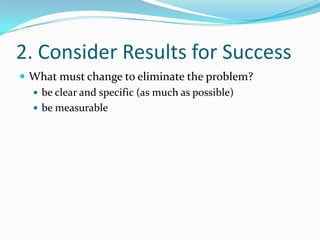
2. Consider Results for SuccessWhat must change to eliminate the problem?be clear and specific (as much as possible)be measurable
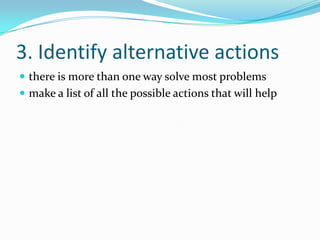
3. Identify alternative actionsthere is more than one way solve most problemsmake a list of all the possible actions that will help
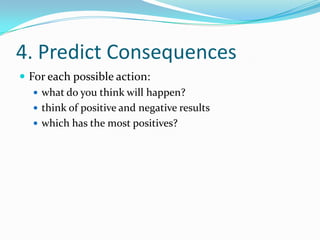
4. Predict ConsequencesFor each possible action:what do you think will happen?think of positive and negative resultswhich has the most positives?
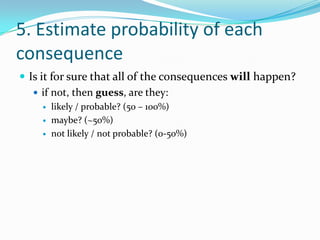
5. Estimate probability of each consequenceIs it for sure that all of the consequences will happen?if not, then guess, are they:likely / probable? (50 – 100%)maybe? (~50%)not likely / not probable? (0-50%)
6.  Choose the best plan of actionThink about:consequences / possibilities (positive and negative)your valuesyour goalsyour standardsChoose the plan that agrees with you most when thinking about all these thingsSometimes we must choose difficult options
7. Finish your plan and… DO IT!!Before acting, imagine each action you will takethink of any obstacles you might havethink of actions to avoid or manage the obstaclesDO IT!!do all the actions in your plan with the goal of eliminating the problem
8. Evaluate ResultsDid you eliminate the problem?Is everything perfect now? ORDid you think it would be different?Could you have done better?Do you think your guesses (estimates, assumptions) were:Correct?Incorrect?“I know now that…. so, next time I will….”
ApplicationRead Page 56 “CASE STUDY”Answer question 1-4 with partner.

March 03 decision making

  • 1.
  • 2.
    Definitionstandardsthe levels ofacceptability we live withwhat we feel is ok, and what we feel is notWhat are your standards for cleanliness in your room?What are your standards for intelligence in a boyfriend / girlfriend?
  • 3.
    The Decision MakingProcessIdentify the problem.Consider results for success.Identify alternative action plans.Predict consequences.Estimate the probability of consequences.Choose the best action plan.Finish your plan and DO IT!Evaluate Results
  • 4.
    1. Identify theProblemWhy must we make a decision?Make the problem clear.Try to state the problem as a goal.(leads to step 2)
  • 5.
    2. Consider Resultsfor SuccessWhat must change to eliminate the problem?be clear and specific (as much as possible)be measurable
  • 6.
    3. Identify alternativeactionsthere is more than one way solve most problemsmake a list of all the possible actions that will help
  • 7.
    4. Predict ConsequencesForeach possible action:what do you think will happen?think of positive and negative resultswhich has the most positives?
  • 8.
    5. Estimate probabilityof each consequenceIs it for sure that all of the consequences will happen?if not, then guess, are they:likely / probable? (50 – 100%)maybe? (~50%)not likely / not probable? (0-50%)
  • 9.
    6. Choosethe best plan of actionThink about:consequences / possibilities (positive and negative)your valuesyour goalsyour standardsChoose the plan that agrees with you most when thinking about all these thingsSometimes we must choose difficult options
  • 10.
    7. Finish yourplan and… DO IT!!Before acting, imagine each action you will takethink of any obstacles you might havethink of actions to avoid or manage the obstaclesDO IT!!do all the actions in your plan with the goal of eliminating the problem
  • 11.
    8. Evaluate ResultsDidyou eliminate the problem?Is everything perfect now? ORDid you think it would be different?Could you have done better?Do you think your guesses (estimates, assumptions) were:Correct?Incorrect?“I know now that…. so, next time I will….”
  • 12.
    ApplicationRead Page 56“CASE STUDY”Answer question 1-4 with partner.