Creating S.M.A.R.TCreating S.M.A.R.T
GoalsGoals
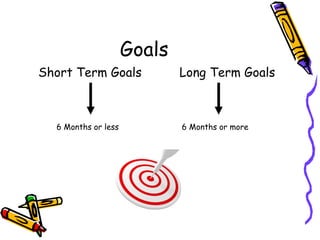
Goals
Short Term Goals Long Term Goals
6 Months or less 6 Months or more
S.M.A.R.T.
• Specific
• Measureable
• Attainable
• Realistic
• Timely
Specific
• A specific goal has a much greater chance
of being accomplished than a general goal.
• Goals should be straightforward and
emphasize what you want to happen.
Specifics help us to focus our efforts and
clearly define what we are going to do.
To set a specific goal you must
answer the six "W" questions:
*Who:      Who is involved?
*What:     What do I want to accomplish?
*Where:    Identify a location.
*When:     Establish a time frame.
*Which:    Identify requirements and
constraints.
*Why:      Specific reasons, purpose or
benefits of accomplishing the goal.
Measurable
• Establish concrete criteria for measuring
progress toward the attainment of each
goal you set.
• When you measure your progress, you stay
on track, reach your target dates, and
experience the achievement that
encourages you on to continued efforts
required to reach your goals.
Attainable
• When you identify goals that are most
important to you, you begin to figure out
ways you can make them come true.
• You develop the attitudes, abilities, skills,
and financial capacity to reach them.
• You begin seeing previously overlooked
opportunities to bring yourself closer to
the achievement of your goals.
Realistic
• To be realistic, a goal must represent an
objective toward which you are both
willing and able to work.
• Realistic, in this case, means "do-able."
• Devise a plan or a way of getting there
which makes the goal realistic.
Timely
• A goal should be grounded within a time
frame. With no time frame tied to it
there's no sense of urgency.
• Putting an end point on your goal gives you
a clear target to work towards.
• Remember: Time must be measurable,
attainable and realistic.
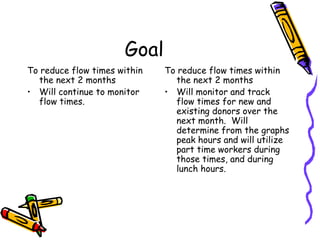
Goal
To reduce flow times within
the next 2 months
• Will continue to monitor
flow times.
To reduce flow times within
the next 2 months
• Will monitor and track
flow times for new and
existing donors over the
next month. Will
determine from the graphs
peak hours and will utilize
part time workers during
those times, and during
lunch hours.
Lab
• Pick one area in your last CMR that
you have as an action item and create
a SMART goal for it.
QuestionsQuestions
Thank you for your timeThank you for your time

Creating Smart Goals Presentation

  • 1.
  • 2.
    Goals Short Term GoalsLong Term Goals 6 Months or less 6 Months or more
  • 3.
    S.M.A.R.T. • Specific • Measureable •Attainable • Realistic • Timely
  • 4.
    Specific • A specificgoal has a much greater chance of being accomplished than a general goal. • Goals should be straightforward and emphasize what you want to happen. Specifics help us to focus our efforts and clearly define what we are going to do.
  • 5.
    To set aspecific goal you must answer the six "W" questions: *Who:      Who is involved? *What:     What do I want to accomplish? *Where:    Identify a location. *When:     Establish a time frame. *Which:    Identify requirements and constraints. *Why:      Specific reasons, purpose or benefits of accomplishing the goal.
  • 6.
    Measurable • Establish concretecriteria for measuring progress toward the attainment of each goal you set. • When you measure your progress, you stay on track, reach your target dates, and experience the achievement that encourages you on to continued efforts required to reach your goals.
  • 7.
    Attainable • When youidentify goals that are most important to you, you begin to figure out ways you can make them come true. • You develop the attitudes, abilities, skills, and financial capacity to reach them. • You begin seeing previously overlooked opportunities to bring yourself closer to the achievement of your goals.
  • 8.
    Realistic • To berealistic, a goal must represent an objective toward which you are both willing and able to work. • Realistic, in this case, means "do-able." • Devise a plan or a way of getting there which makes the goal realistic.
  • 9.
    Timely • A goalshould be grounded within a time frame. With no time frame tied to it there's no sense of urgency. • Putting an end point on your goal gives you a clear target to work towards. • Remember: Time must be measurable, attainable and realistic.
  • 10.
    Goal To reduce flowtimes within the next 2 months • Will continue to monitor flow times. To reduce flow times within the next 2 months • Will monitor and track flow times for new and existing donors over the next month. Will determine from the graphs peak hours and will utilize part time workers during those times, and during lunch hours.
  • 11.
    Lab • Pick onearea in your last CMR that you have as an action item and create a SMART goal for it.
  • 12.
    QuestionsQuestions Thank you foryour timeThank you for your time

Editor's Notes

  • #3 Goals should be made when you are making plans, improvements, or working as a group to get something accomplished. Some goals will be short term, and others may be long term. Goals help us in identifying ways to make improvements and devising a plan to do it.
  • #4 A well designed goal should include 5 elements. Goals should be specific, measurable, attainable, realistic and timely.
  • #5 Specific goals allow you to understand exactly what you want to accomplish.
  • #6 EXAMPLE:    A general goal would be, "Get in shape." But a specific goal would say, “I will join a health club and workout 3 days a week to lose 15 pounds by August so that I will be n better shape." I To lose 15 pounds The health club August Work out 3 days a week To get into better shape
  • #7 If you can't measure it, you can't manage it. To determine if your goal is measurable, ask questions such as......How much? How many? How will I know when it is accomplished? Goals can be tracked using charts, and graphs.
  • #8   A goal needs to be relevant to your situation and allows you to have something to reach towards. For instance, if you aim to lose 20lbs in one week, we all know that isn't achievable. But setting a goal to loose 1lb and when you've achieved that, aiming to lose a further 1lb, will keep it achievable for you.
  • #10  If you don't set timelines, the commitment is probably too vague. It tends not to happen because you feel you can start at any time. Without a time limit, there's no urgency to start taking action now.
  • #11 The goal on the Right represents a SMART goal