Structured Approach
to Problem Solving
Content
DISCUSSION TOPICS
Five reasons why we go through this process
Six-step problem solving process
Prepare a Problem Statement
What is Root Cause Analysis (RCA)?
Understanding Root Causes
RCA Tools: #1 Five Whys and #2 Fishbone Diagram
Start Practising
Mistakes are the stepping stones to
wisdom. We learn from trial and
error; we become wise by
understanding problems.
L e o n B r o w n
01
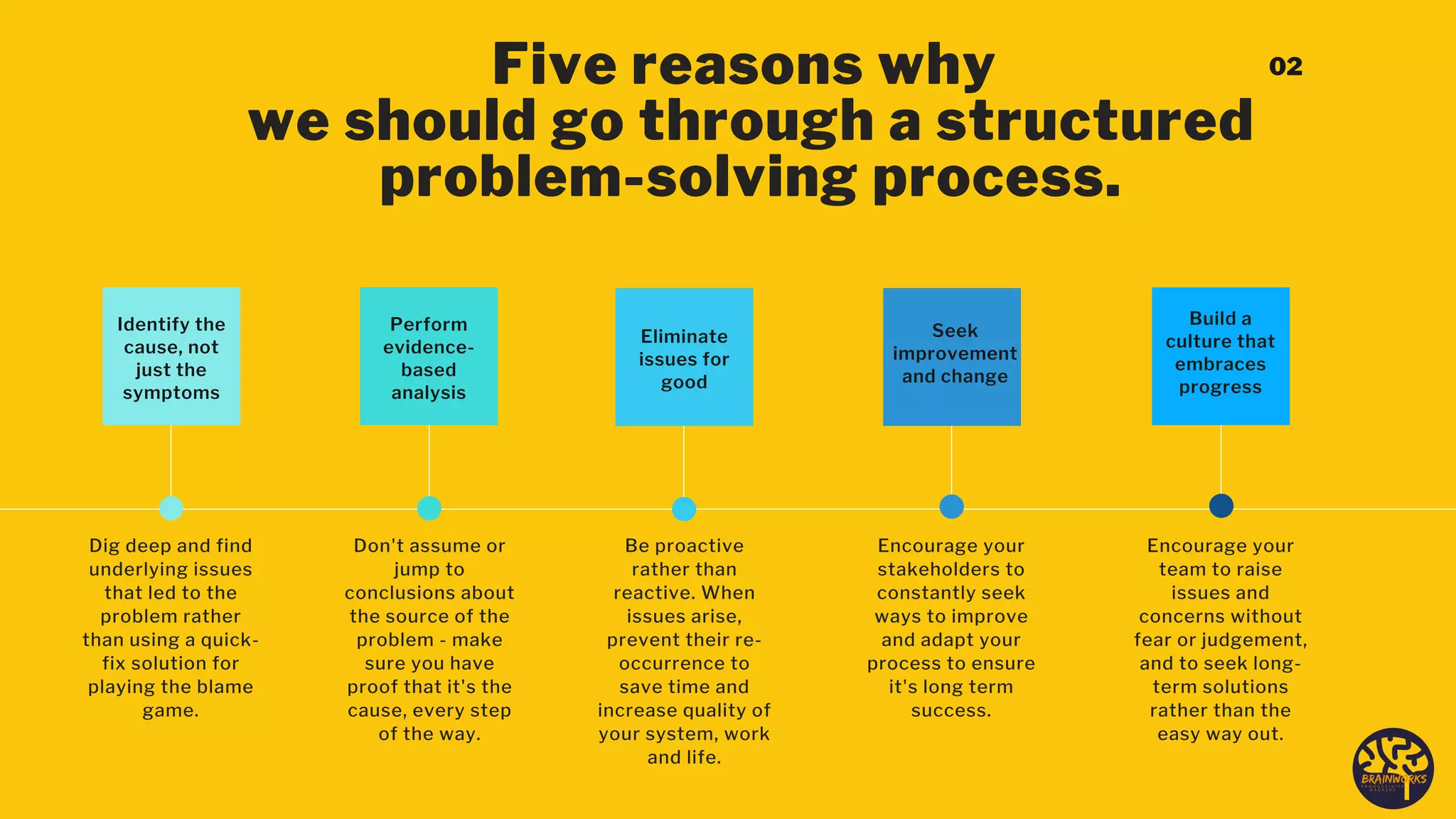
Dig deep and find
underlying issues
that led to the
problem rather
than using a quick-
fix solution for
playing the blame
game.
Identify the
cause, not
just the
symptoms
Five reasons why
we should go through a structured
problem-solving process.
Perform
evidence-
based
analysis
Eliminate
issues for
good
Seek
improvement
and change
Build a
culture that
embraces
progress
Don't assume or
jump to
conclusions about
the source of the
problem - make
sure you have
proof that it's the
cause, every step
of the way.
Be proactive
rather than
reactive. When
issues arise,
prevent their re-
occurrence to
save time and
increase quality of
your system, work
and life.
Encourage your
stakeholders to
constantly seek
ways to improve
and adapt your
process to ensure
it's long term
success.
Encourage your
team to raise
issues and
concerns without
fear or judgement,
and to seek long-
term solutions
rather than the
easy way out.
02
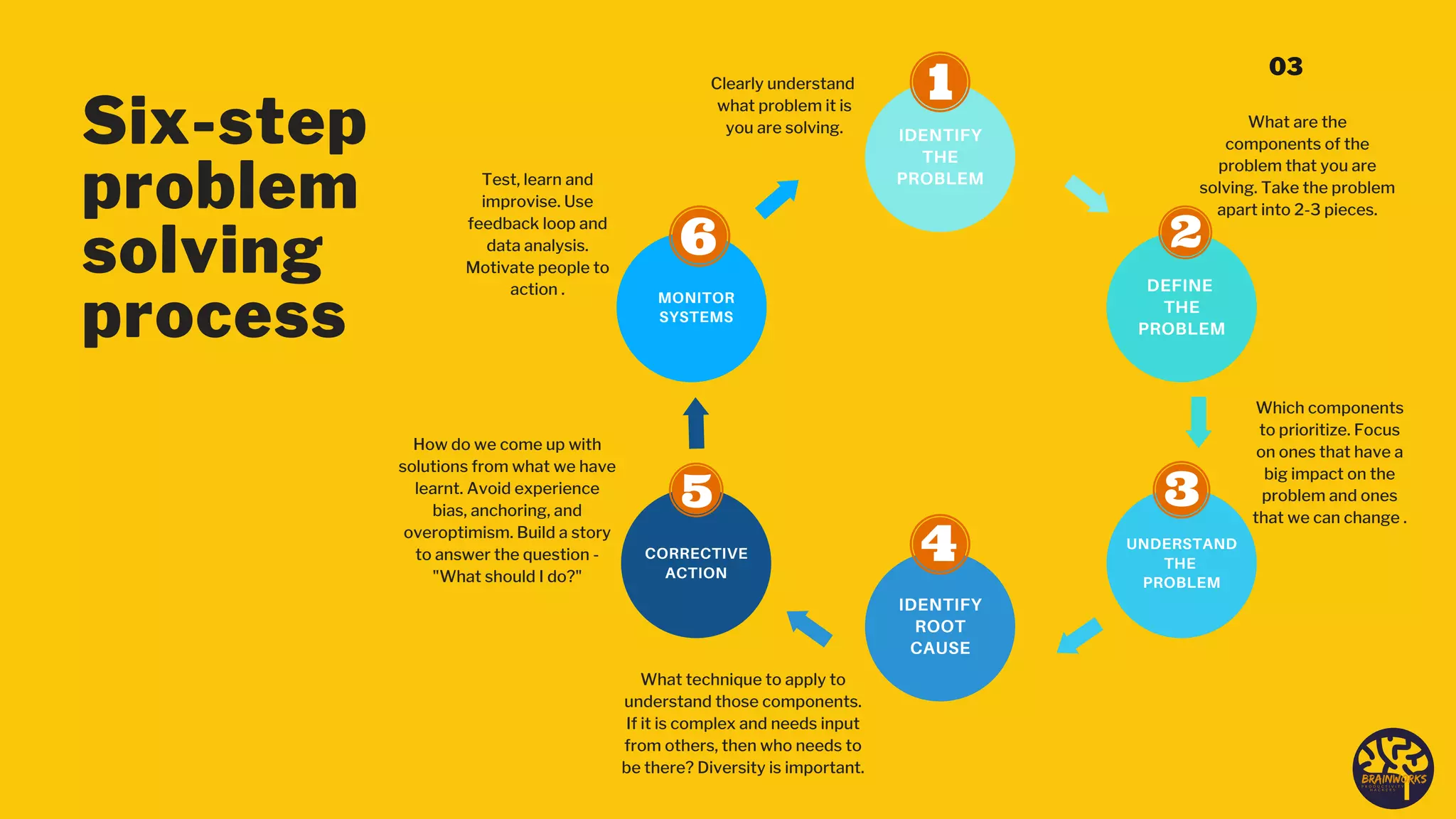
Six-step
problem
solving
process
IDENTIFY
THE
PROBLEM
DEFINE
THE
PROBLEM
CORRECTIVE
ACTION
UNDERSTAND
THE
PROBLEM
IDENTIFY
ROOT
CAUSE
MONITOR
SYSTEMS
Clearly understand
what problem it is
you are solving. What are the
components of the
problem that you are
solving. Take the problem
apart into 2-3 pieces.
Which components
to prioritize. Focus
on ones that have a
big impact on the
problem and ones
that we can change .
What technique to apply to
understand those components.
If it is complex and needs input
from others, then who needs to
be there? Diversity is important.
How do we come up with
solutions from what we have
learnt. Avoid experience
bias, anchoring, and
overoptimism. Build a story
to answer the question -
"What should I do?"
Test, learn and
improvise. Use
feedback loop and
data analysis.
Motivate people to
action .
03
1
2
3
4
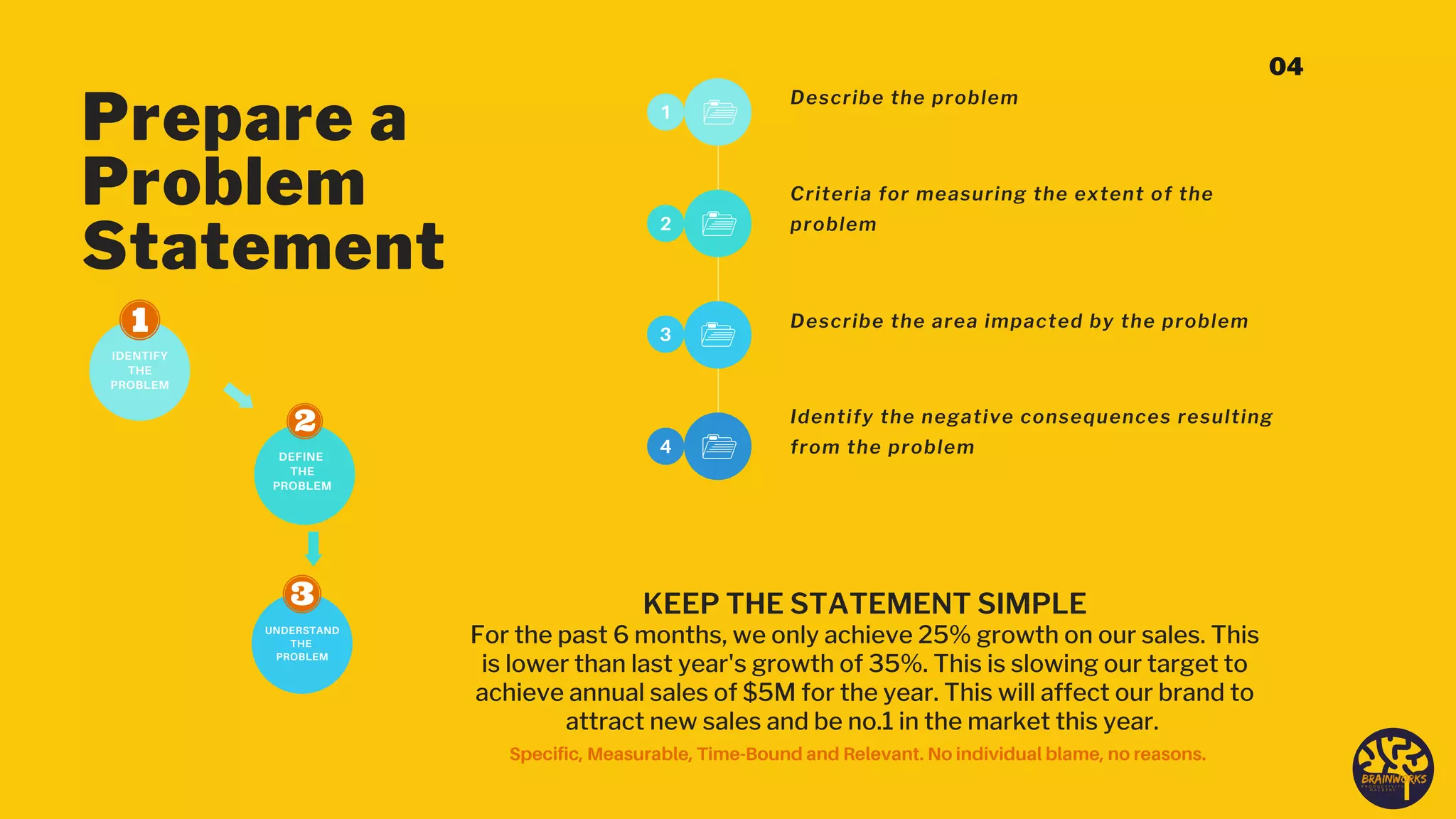
Describe the problem
Criteria for measuring the extent of the
problem
Describe the area impacted by the problem
Identify the negative consequences resulting
from the problem
Prepare a
Problem
Statement
KEEP THE STATEMENT SIMPLE
For the past 6 months, we only achieve 25% growth on our sales. This
is lower than last year's growth of 35%. This is slowing our target to
achieve annual sales of $5M for the year. This will affect our brand to
attract new sales and be no.1 in the market this year.
Specific, Measurable, Time-Bound and Relevant. No individual blame, no reasons.
IDENTIFY
THE
PROBLEM
DEFINE
THE
PROBLEM
UNDERSTAND
THE
PROBLEM
04
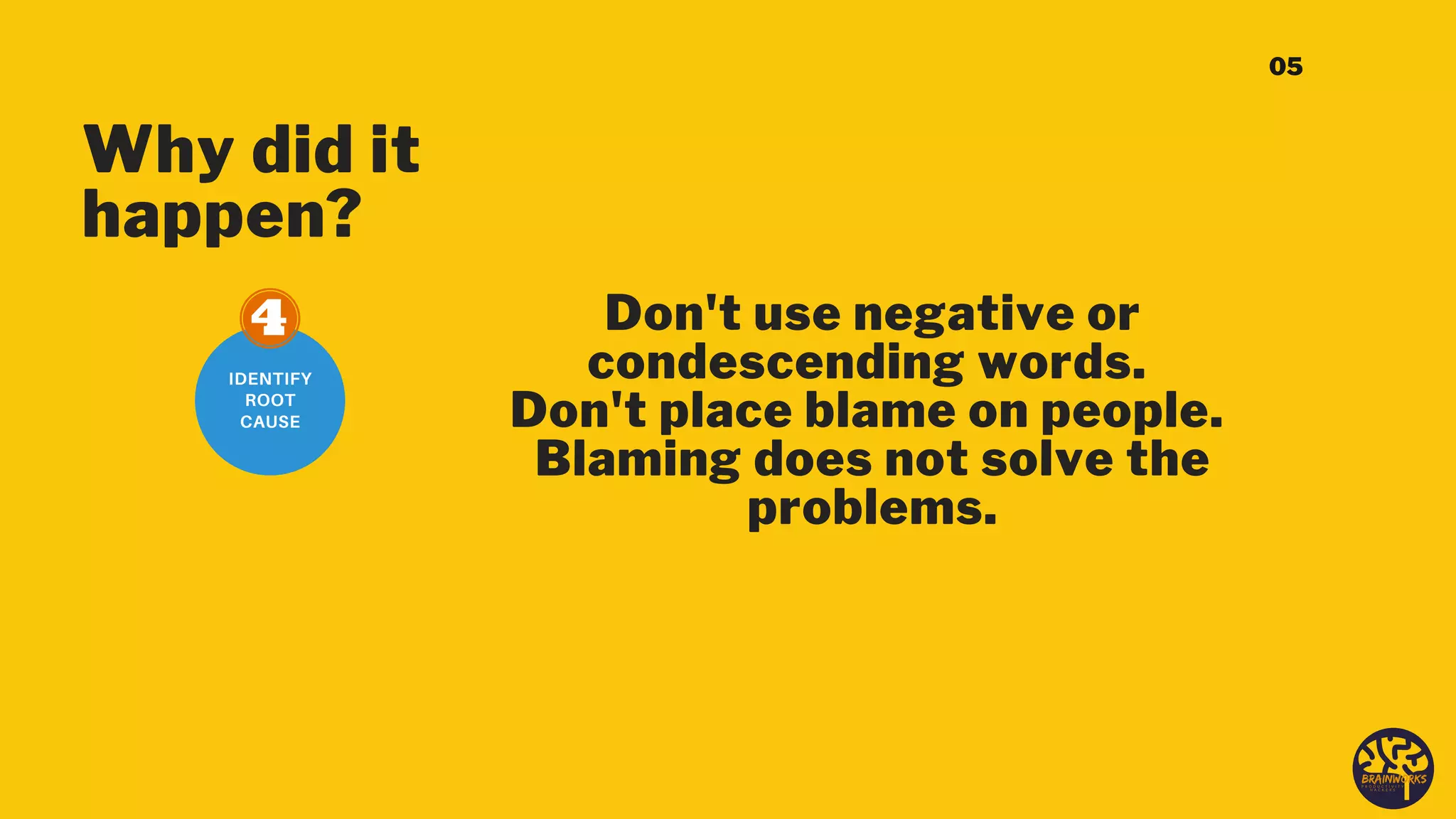
Don't use negative or
condescending words.
Don't place blame on people.
Blaming does not solve the
problems.
IDENTIFY
ROOT
CAUSE
Why did it
happen?
05
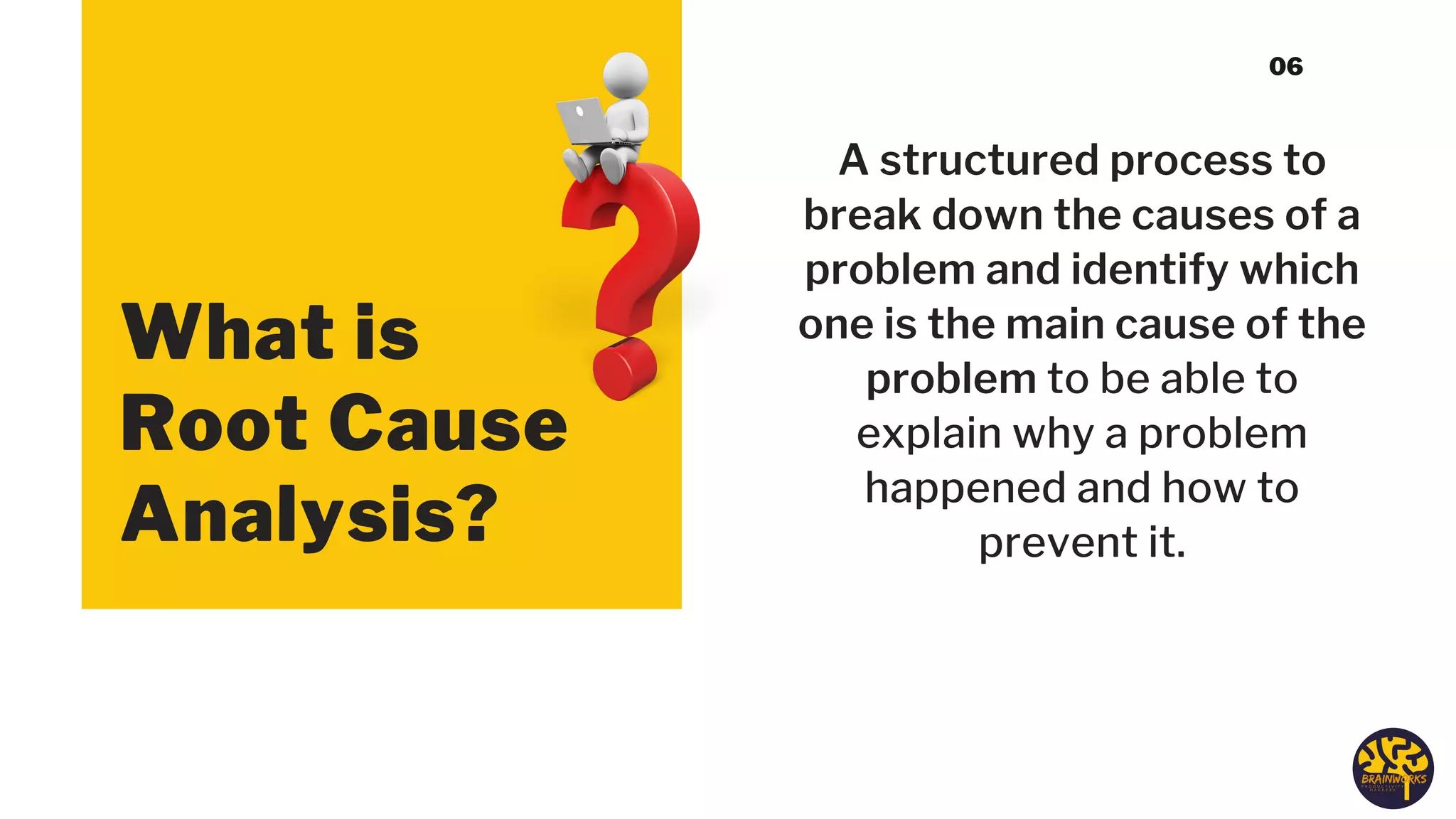
What is
Root Cause
Analysis?
A structured process to
break down the causes of a
problem and identify which
one is the main cause of the
problem to be able to
explain why a problem
happened and how to
prevent it.
06
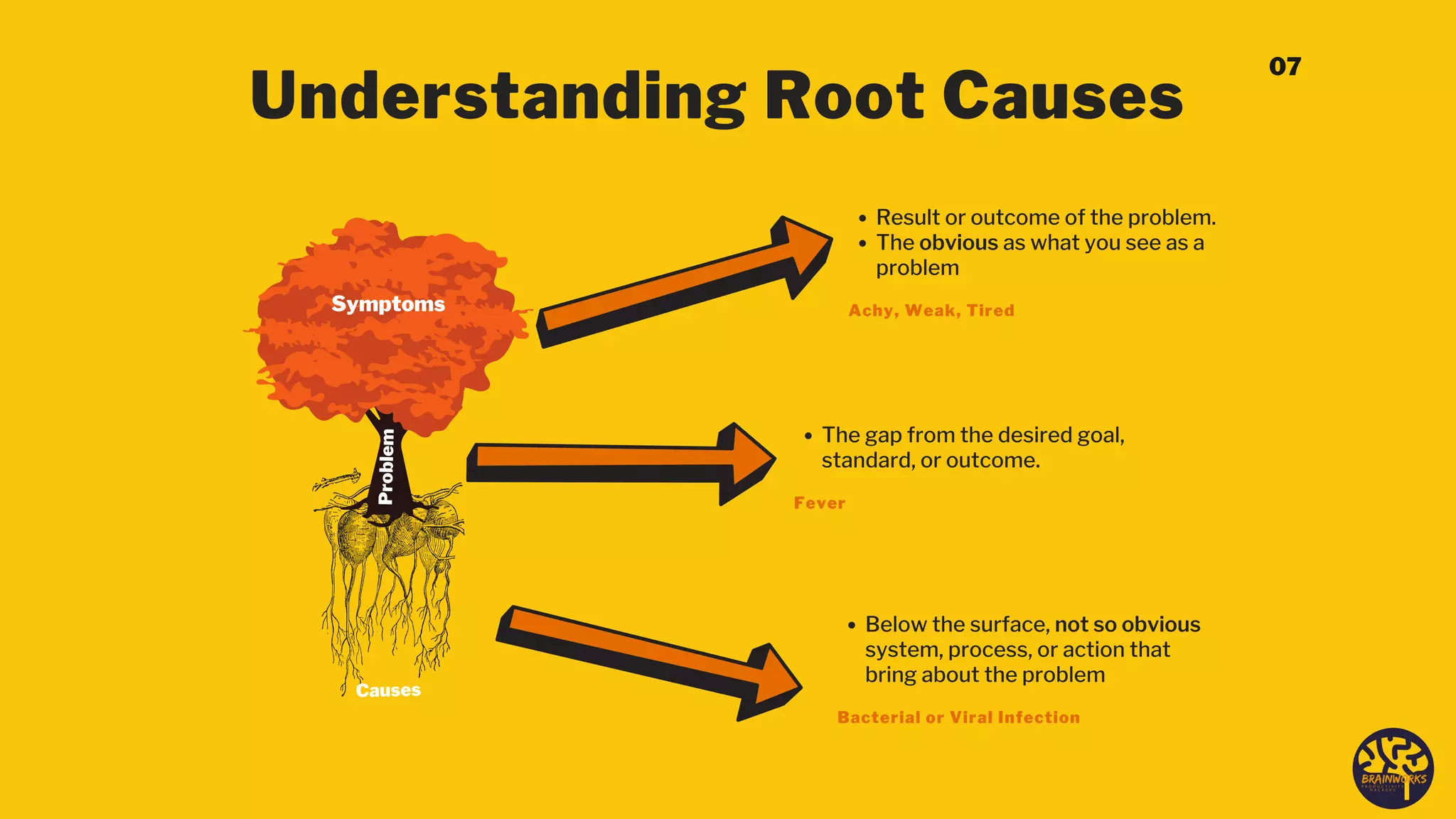
Understanding Root Causes
Result or outcome of the problem.
The obvious as what you see as a
problem
Achy, Weak, Tired
Below the surface, not so obvious
system, process, or action that
bring about the problem
Bacterial or Viral Infection
The gap from the desired goal,
standard, or outcome.
Fever
Symptoms
Problem
Causes
07
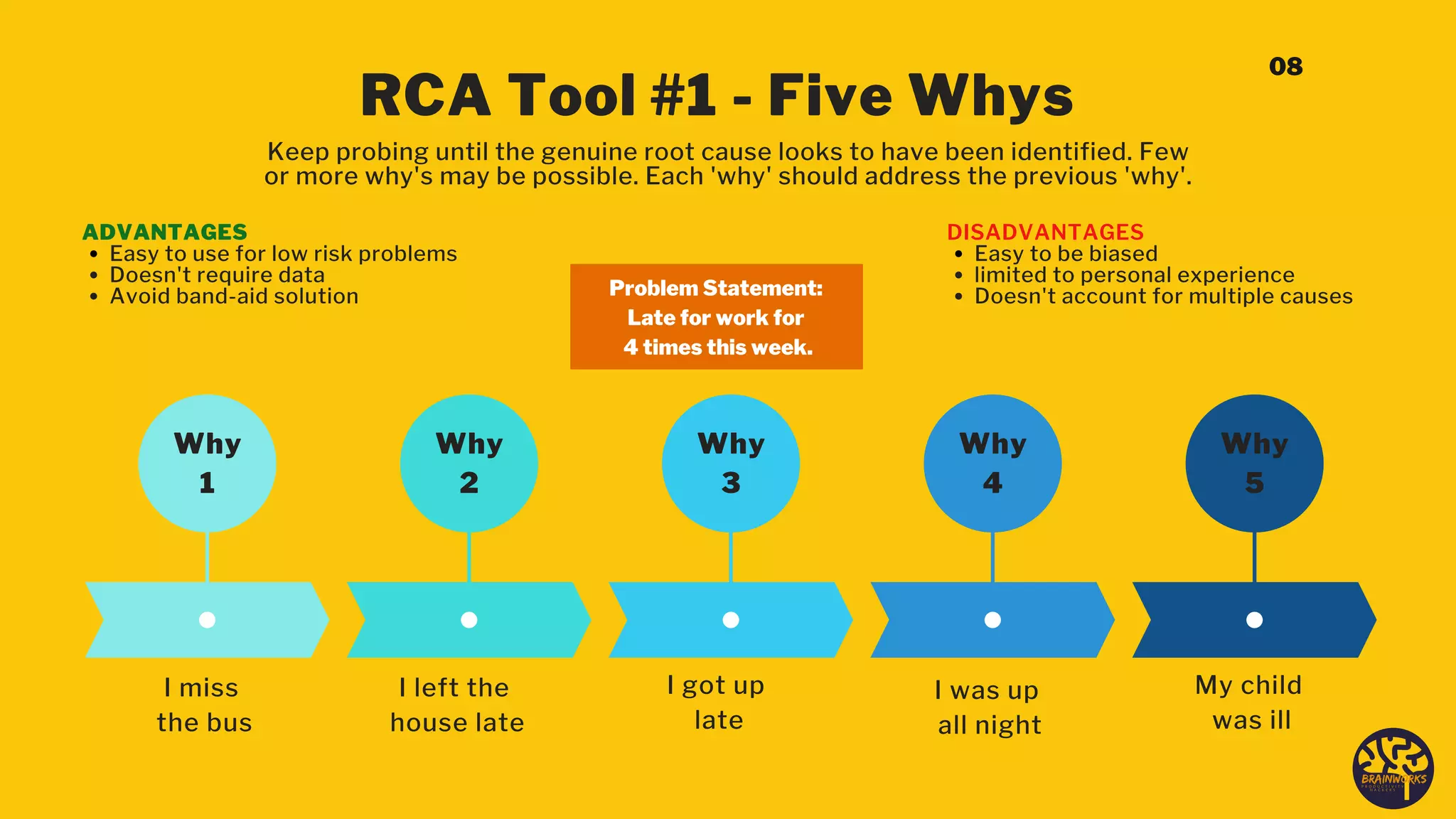
I miss
the bus
Why
1
Why
2
Why
3
Why
4
Why
5
I left the
house late
I got up
late
I was up
all night
My child
was ill
RCA Tool #1 - Five Whys
Keep probing until the genuine root cause looks to have been identified. Few
or more why's may be possible. Each 'why' should address the previous 'why'.
Problem Statement:
Late for work for
4 times this week.
Easy to use for low risk problems
Doesn't require data
Avoid band-aid solution
ADVANTAGES
Easy to be biased
limited to personal experience
Doesn't account for multiple causes
DISADVANTAGES
08
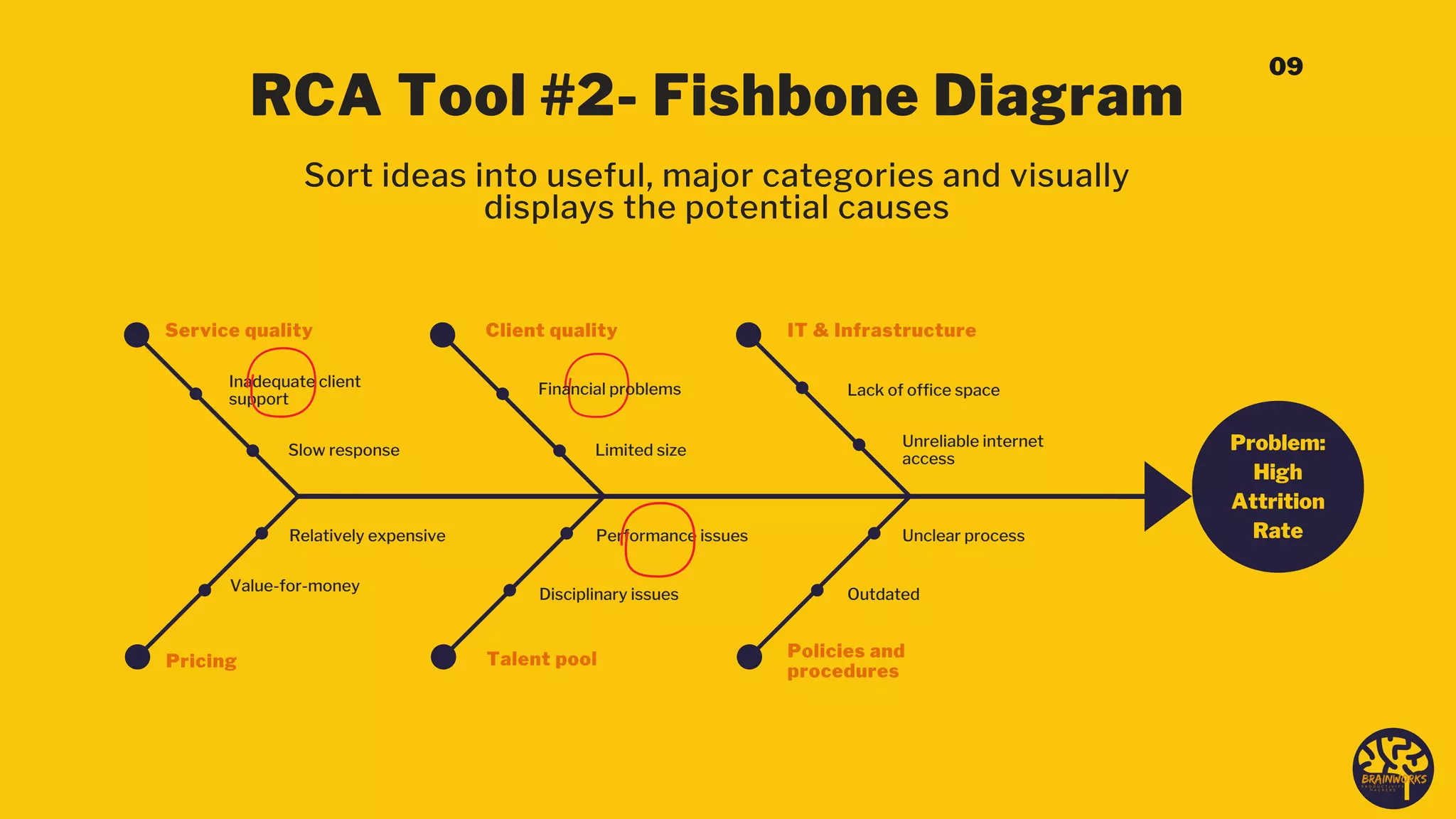
Relatively expensive Performance issues Unclear process
Inadequate client
support
Service quality
Slow response
Value-for-money
Pricing
Financial problems
Client quality
Limited size
Disciplinary issues
Talent pool
Lack of office space
IT & Infrastructure
Unreliable internet
access
Outdated
Policies and
procedures
RCA Tool #2- Fishbone Diagram
Sort ideas into useful, major categories and visually
displays the potential causes
Problem:
High
Attrition
Rate
09
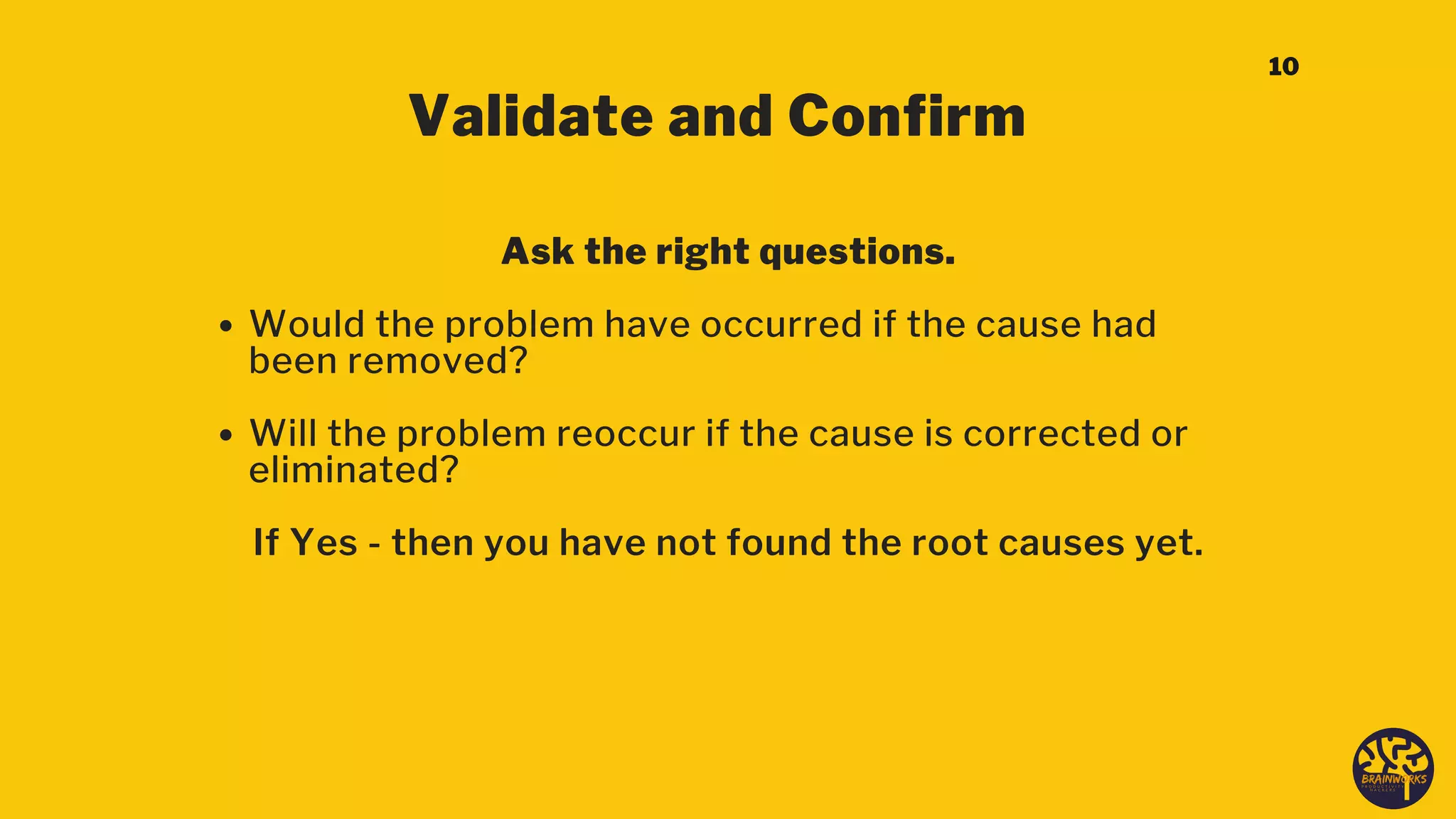
Validate and Confirm
Would the problem have occurred if the cause had
been removed?
Will the problem reoccur if the cause is corrected or
eliminated?
Ask the right questions.
If Yes - then you have not found the root causes yet.
10
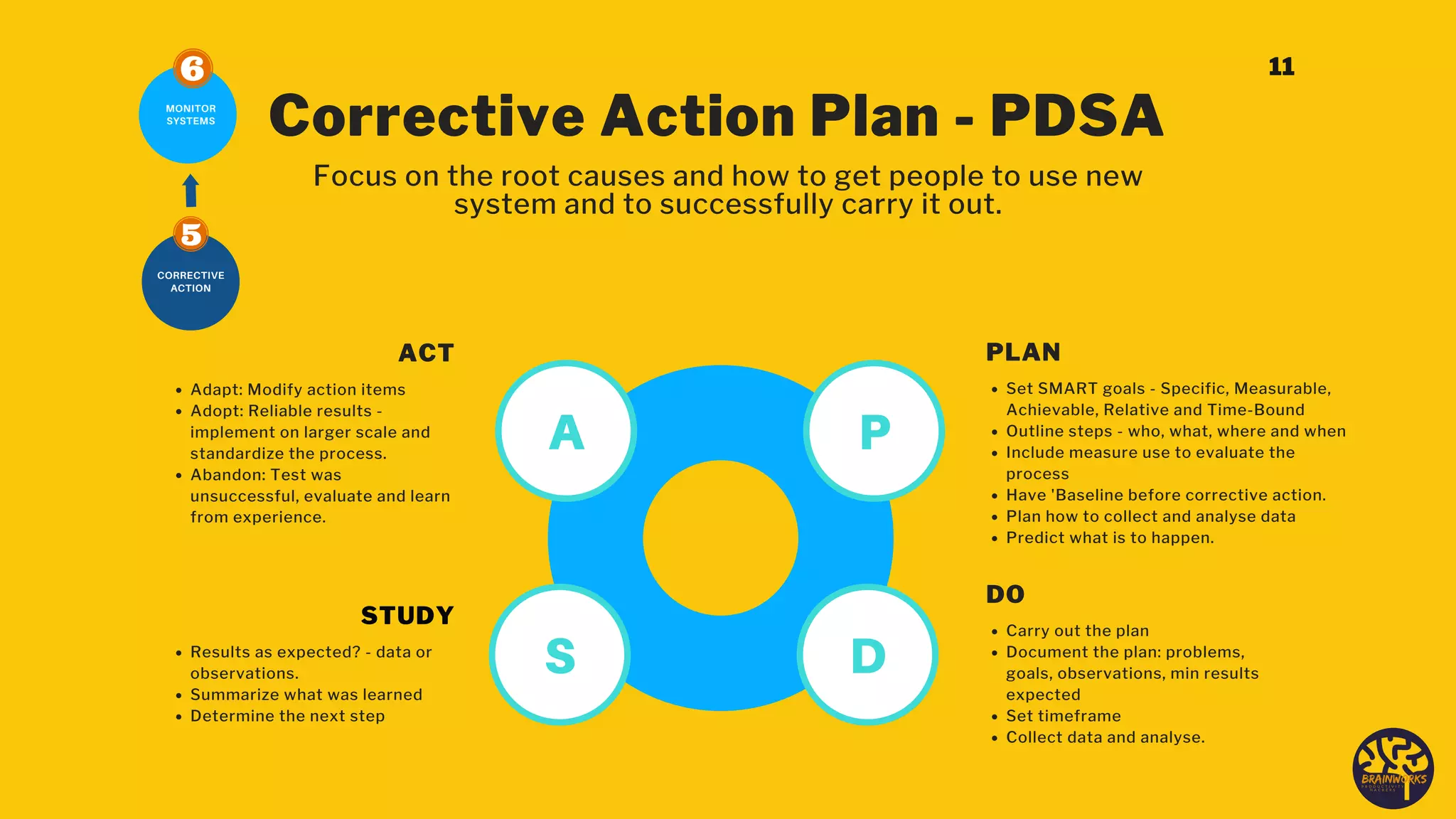
ACT
Adapt: Modify action items
Adopt: Reliable results -
implement on larger scale and
standardize the process.
Abandon: Test was
unsuccessful, evaluate and learn
from experience.
PLAN
Set SMART goals - Specific, Measurable,
Achievable, Relative and Time-Bound
Outline steps - who, what, where and when
Include measure use to evaluate the
process
Have 'Baseline before corrective action.
Plan how to collect and analyse data
Predict what is to happen.
STUDY
Results as expected? - data or
observations.
Summarize what was learned
Determine the next step
DO
Carry out the plan
Document the plan: problems,
goals, observations, min results
expected
Set timeframe
Collect data and analyse.
P
D
A
S
Corrective Action Plan - PDSA
Focus on the root causes and how to get people to use new
system and to successfully carry it out.
CORRECTIVE
ACTION
MONITOR
SYSTEMS
11
Learning Practice
FROM THEORY TO APPLICATION
12
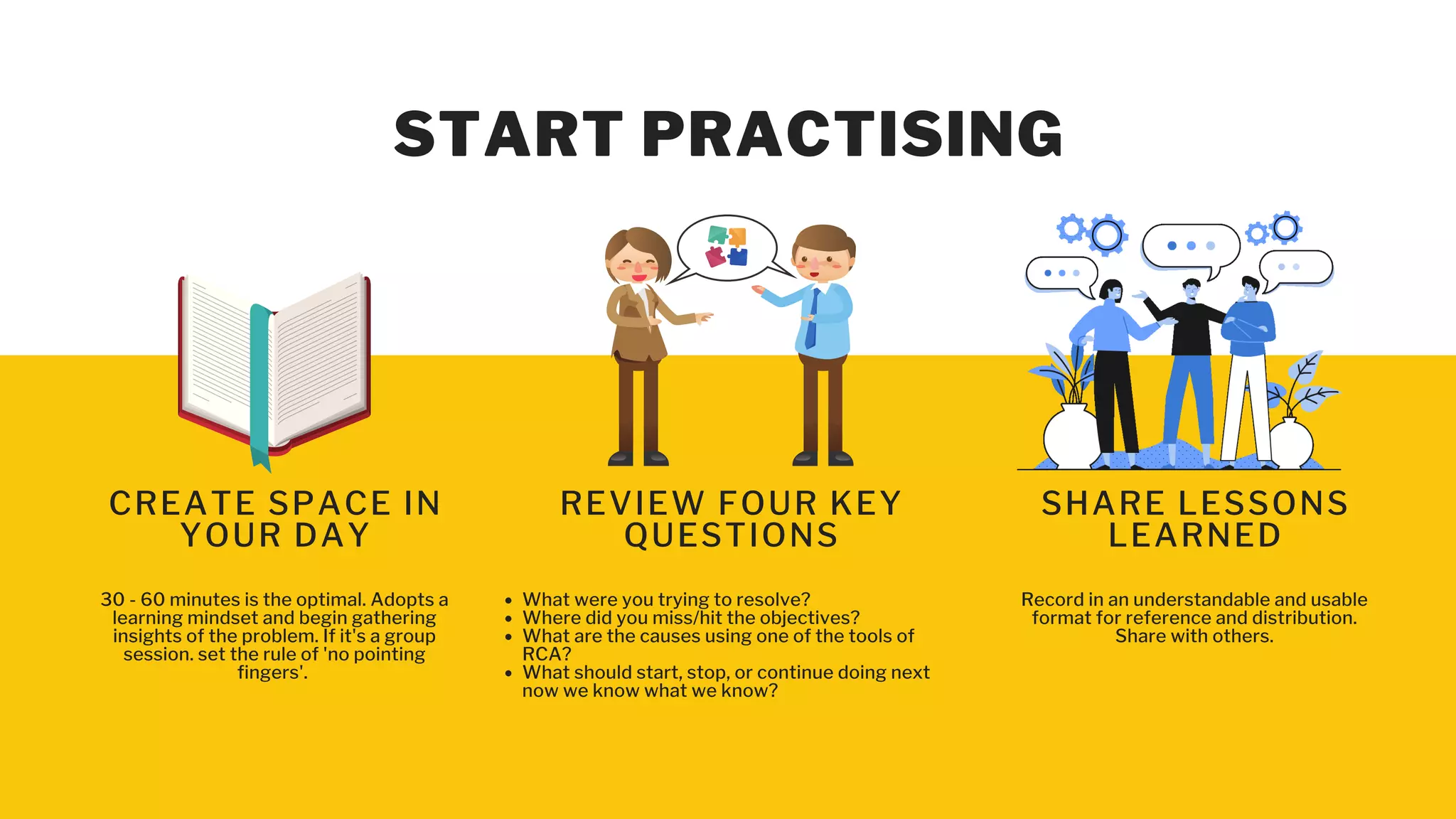
START PRACTISING
CREATE SPACE IN
YOUR DAY
30 - 60 minutes is the optimal. Adopts a
learning mindset and begin gathering
insights of the problem. If it's a group
session. set the rule of 'no pointing
fingers'. 
REVIEW FOUR KEY
QUESTIONS
What were you trying to resolve?
Where did you miss/hit the objectives?
What are the causes using one of the tools of
RCA?
What should start, stop, or continue doing next
now we know what we know?
SHARE LESSONS
LEARNED
Record in an understandable and usable
format for reference and distribution.
Share with others.

Leadership Series #2 - Structured Approach to Problem Solving

  • 1.
  • 2.
    Content DISCUSSION TOPICS Five reasonswhy we go through this process Six-step problem solving process Prepare a Problem Statement What is Root Cause Analysis (RCA)? Understanding Root Causes RCA Tools: #1 Five Whys and #2 Fishbone Diagram Start Practising
  • 3.
    Mistakes are thestepping stones to wisdom. We learn from trial and error; we become wise by understanding problems. L e o n B r o w n 01
  • 4.
    Dig deep andfind underlying issues that led to the problem rather than using a quick- fix solution for playing the blame game. Identify the cause, not just the symptoms Five reasons why we should go through a structured problem-solving process. Perform evidence- based analysis Eliminate issues for good Seek improvement and change Build a culture that embraces progress Don't assume or jump to conclusions about the source of the problem - make sure you have proof that it's the cause, every step of the way. Be proactive rather than reactive. When issues arise, prevent their re- occurrence to save time and increase quality of your system, work and life. Encourage your stakeholders to constantly seek ways to improve and adapt your process to ensure it's long term success. Encourage your team to raise issues and concerns without fear or judgement, and to seek long- term solutions rather than the easy way out. 02
  • 5.
    Six-step problem solving process IDENTIFY THE PROBLEM DEFINE THE PROBLEM CORRECTIVE ACTION UNDERSTAND THE PROBLEM IDENTIFY ROOT CAUSE MONITOR SYSTEMS Clearly understand what problemit is you are solving. What are the components of the problem that you are solving. Take the problem apart into 2-3 pieces. Which components to prioritize. Focus on ones that have a big impact on the problem and ones that we can change . What technique to apply to understand those components. If it is complex and needs input from others, then who needs to be there? Diversity is important. How do we come up with solutions from what we have learnt. Avoid experience bias, anchoring, and overoptimism. Build a story to answer the question - "What should I do?" Test, learn and improvise. Use feedback loop and data analysis. Motivate people to action . 03
  • 6.
    1 2 3 4 Describe the problem Criteriafor measuring the extent of the problem Describe the area impacted by the problem Identify the negative consequences resulting from the problem Prepare a Problem Statement KEEP THE STATEMENT SIMPLE For the past 6 months, we only achieve 25% growth on our sales. This is lower than last year's growth of 35%. This is slowing our target to achieve annual sales of $5M for the year. This will affect our brand to attract new sales and be no.1 in the market this year. Specific, Measurable, Time-Bound and Relevant. No individual blame, no reasons. IDENTIFY THE PROBLEM DEFINE THE PROBLEM UNDERSTAND THE PROBLEM 04
  • 7.
    Don't use negativeor condescending words. Don't place blame on people. Blaming does not solve the problems. IDENTIFY ROOT CAUSE Why did it happen? 05
  • 8.
    What is Root Cause Analysis? A structuredprocess to break down the causes of a problem and identify which one is the main cause of the problem to be able to explain why a problem happened and how to prevent it. 06
  • 9.
    Understanding Root Causes Resultor outcome of the problem. The obvious as what you see as a problem Achy, Weak, Tired Below the surface, not so obvious system, process, or action that bring about the problem Bacterial or Viral Infection The gap from the desired goal, standard, or outcome. Fever Symptoms Problem Causes 07
  • 10.
    I miss the bus Why 1 Why 2 Why 3 Why 4 Why 5 Ileft the house late I got up late I was up all night My child was ill RCA Tool #1 - Five Whys Keep probing until the genuine root cause looks to have been identified. Few or more why's may be possible. Each 'why' should address the previous 'why'. Problem Statement: Late for work for 4 times this week. Easy to use for low risk problems Doesn't require data Avoid band-aid solution ADVANTAGES Easy to be biased limited to personal experience Doesn't account for multiple causes DISADVANTAGES 08
  • 11.
    Relatively expensive Performanceissues Unclear process Inadequate client support Service quality Slow response Value-for-money Pricing Financial problems Client quality Limited size Disciplinary issues Talent pool Lack of office space IT & Infrastructure Unreliable internet access Outdated Policies and procedures RCA Tool #2- Fishbone Diagram Sort ideas into useful, major categories and visually displays the potential causes Problem: High Attrition Rate 09
  • 12.
    Validate and Confirm Wouldthe problem have occurred if the cause had been removed? Will the problem reoccur if the cause is corrected or eliminated? Ask the right questions. If Yes - then you have not found the root causes yet. 10
  • 13.
    ACT Adapt: Modify actionitems Adopt: Reliable results - implement on larger scale and standardize the process. Abandon: Test was unsuccessful, evaluate and learn from experience. PLAN Set SMART goals - Specific, Measurable, Achievable, Relative and Time-Bound Outline steps - who, what, where and when Include measure use to evaluate the process Have 'Baseline before corrective action. Plan how to collect and analyse data Predict what is to happen. STUDY Results as expected? - data or observations. Summarize what was learned Determine the next step DO Carry out the plan Document the plan: problems, goals, observations, min results expected Set timeframe Collect data and analyse. P D A S Corrective Action Plan - PDSA Focus on the root causes and how to get people to use new system and to successfully carry it out. CORRECTIVE ACTION MONITOR SYSTEMS 11
  • 14.
  • 15.
    START PRACTISING CREATE SPACEIN YOUR DAY 30 - 60 minutes is the optimal. Adopts a learning mindset and begin gathering insights of the problem. If it's a group session. set the rule of 'no pointing fingers'.  REVIEW FOUR KEY QUESTIONS What were you trying to resolve? Where did you miss/hit the objectives? What are the causes using one of the tools of RCA? What should start, stop, or continue doing next now we know what we know? SHARE LESSONS LEARNED Record in an understandable and usable format for reference and distribution. Share with others.