•
    –
•
    –
•
    –
    –
•
•
Starter Circulator A
Short term


Length: 3 mile one-way
circulator
Cost:   $15-35 million


Benefits:
• Links downtown to Baylor
• 3 blocks from existing transit
center
Challenges:
• At-grade cross of rail line can
be minimized if we go over near
the river
• Somewhat limited
redevelopment opportunities
East Waco Circulator A
Short term
Length: 3.25 mile one-way
circulator
Costs:
•streetcar is roughly $30 million
• BRT would be 50% of the cost
of streetcar
Benefits:
• Links downtown to Quinn
Campus
• Bus Rapid Transit option could
be employed quickly to
establish corridor
• Significant reinvestment
opportunity along Elm and in
surrounding neighborhoods
Challenges:
• Washington bridge is weight
restricted- but Franklin can be
used
4th and 5th Circulator
Medium term


Length: 3 mile one-way
circulator
Cost: $15- $30 million


Benefits:
•Links downtown to zoo, and
residential areas in between
•Works well as one-way
circulator, since stations would
be only one block apart and
0.25 miles between each
•Expand reinvestment
opportunities into northwest
neighborhoods and along
riverfront extending north
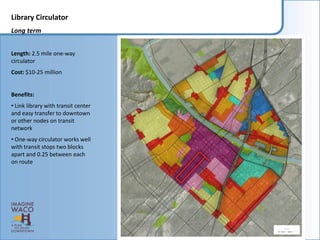
Library Circulator
Long term


Length: 2.5 mile one-way
circulator
Cost: $10-25 million


Benefits:
• Link library with transit center
and easy transfer to downtown
or other nodes on transit
network
• One-way circulator works well
with transit stops two blocks
apart and 0.25 between each
on route
Outer Corridor
Long term


Length: 8 mile two-way
circulator
Cost: $10 million per mile
Benefits:
• Connects major activity
centers around downtown
including; Downtown, Baylor,
Zoo, Waterfront
• Possibility of linking to Transit
Center along Franklin and
Webster
Full System

Characteristics:
• Integrated system with
downtown as central hub
• Take advantage of one-way
couplets for one-way circulator
options
• Radiates investment
opportunity around downtown


Functional Considerations:
• Could operate as streetcar or bus
rapid transit
• BRT could be used in immediate
term to establish corridors and
build ridership
• BRT is about 50% of capital cost
of streetcar
• Streetcar has lower long term
maintenance costs however
•Consider the future option to
connect to high speed rail system
Pearl District

1. Brownfield cleanup: 35
   acres reclaimed from rail
   yards
2. Demolition of the Lovejoy
   bridge ramp
3. Housing Variety – live/work,
   condominium, apartment,
   affordable, townhouses,
   senior affordable
4. Green Spaces - the heart
   of the neighborhood
5. Streetcar – linking central
   business district to Pearl
   District and NW 23rd
Lovejoy Ramp Demolition
Twenty Year
                         2002         2005         Target
Low / Extremely Low
(0 - 50% MFI)           740 (21%)    812 (16%)     20%
Moderate Income
(51 - 80% MFI)          748 (21%)    920 (19%)      25%
Middle / Upper
(Over 80% MFI)         2,036 (58%)   3,210 (67%)    55%
    Total              3,524 units   4,942 units   100%
* Completed or Under Construction
                                                            35
Portland Streetcar, Inc.
•7,248 housing units

•4.6 million sq. feet commercial

•$2.28 Billion in private investment

•35:1 leverage


•2,500 riders expected, 11,500 daily
•
•

•
•
•

•

•
THE QUESTION:
What should the City of Waco be doing to spur
redevelopment over the next ten years?
THE APPROACH                    THE DEVELOPMENT

 Facilitate partnerships for    Start small and concentrate
  implementation                  development
 Engage Baylor University       Create 18-hour
 Land control is critical        environment with residential
                                  uses
 Create a public
  development entity             Use programmed events to
                                  activate the downtown area
 Know the market
                                 Improve connectivity to the
 Anticipate market changes       waterfront
                                 Create development
                                  guidelines
                                 Educate land owners and
                                  developers on opportunities
1) Facilitate partnerships for implementation
  •   Partnership between City, Baylor, and
      relevant development organizations
  •   Work to identify key development partners
      and landowners for “catalytic developments”
2) Engage Baylor University
  •   Baylor must be a partner in any successful
      Downtown redevelopment
  •   Baylor students are a primary market
      audience for retail and residential
  •   Bus connectivity to Baylor is a strong start.
3) Land control is critical
  •   City or development entity must control key
      land assemblages early on in the process
  •   Opportunistic investors can hamper
      redevelopment plans
4) Create a public development entity
  •   Important to create a team with proper
      expertise, mission, and job description
  •   Successful models in other cities
5) Know the market
  •   Need to understand market audiences
      and opportunities (RCLCO)
6) Anticipate market changes
  •   Allow flexibility in planning. For
      example, some residential and office
      could be rental or for-sale
  •   Plan for who is coming as well as who
      is here today
1) Start small and concentrate development
  •   Waco already has a good start with Heritage
      Square. The next major development should be in
      close proximity and build off this energy
2) Create an 18-hour environment with residential
   uses
  •   Should continue adding as much residential as
      the market will bear
  •   Residential uses increase the perception of safety
      and drive demand for retail and entertainment
3) Use programmed events to activate the downtown
   area
  •   Should have a regular schedule of monthly and
      seasonal events to promote activity downtown
  •   In addition to tailgates and movie nights, City
      could add a live concert series, restaurant week,
      and an arts fair.
4) Improve connectivity to the waterfront
  •   Think about extending trail system from the
      Waterfront through the Downtown
  •   Future development should draw activity toward
      the Riverfront.
5) Create development guidelines for the downtown
   core
  •   Typically a visual document covering
      recommended building materials and
      appearance, as well as the treatment of the
      streetscape
  •   Guidelines helps to enhance the aesthetic quality
      and unity of a downtown area
6) Educate landowners and developers on potential
   opportunities
  •   Public and private sector communication is key
WHAT
 Six city blocks of new mixed-use development
  in Downtown Austin
 New development oriented to the waterfront and
  integrated within existing downtown street
  pattern
 Consists of 26 boutiques, 18 restaurants, 450
  residential units (rental) and a W hotel on
  approximately 18-acres.
                LESSONS LEARNED
 The City controlled the land and was able to
  lease it to the developer under favorable
  conditions in order to make the project feasible.
 Development is anchored by a new City Hall.
  This civic component drives visitation and
  increases the sense of public „ownership‟ of the
  development.
 Hotel and retail uses are synergistic, as hotel
  guests drive retail and restaurant sales and
  retail increases attractiveness and convenience
  of the hotel location.
 New development differentiates itself from
  existing Downtown area via design, creative
  tenanting, and mixing of uses.
WHAT
 Four city blocks (10-acres) of new mixed-use
  development in Midtown, Atlanta
 A public-private partnership development that
  extended Georgia Tech‟s historically insular
  campus across the I-75/85 connector
 Was a major catalyst that spurred redevelopment
  of the Midtown district which was crime infested
  and had mostly empty parking lots
 Consists of street level retail including (Barnes
  and Noble, Starbucks, and 10 other boutiques &
  restaurants). Also houses a new School of
  Management, a Georgia Tech Hotel &
  Conference Center, as well as a private mid-rise
  office building.
                 LESSONS LEARNED
 Free electric trolley systems links to campus
 Retail is targeted to both students and
  professionals
 High quality streetscape is a critical component
 Privately developed office is integrated through
  design and retail tenanting
 Designed at a human scale
Austin‟s 2nd Street
                                            Heritage Square   Development overlaid
                                                              on downtown Waco,
                                                              shows how little land
                                                              area is needed to
                                                              create a high impact
                                                              mixed-use
                                                              development
                                              Hilton


= Size of Austin‟s 2nd Street Development
Waco, TX                                              Austin, TX


Because Waco‟s Land area is so large, the City must focus its initial efforts on a several key
redevelopment nodes or places
THE QUESTION:
How does the Economic Development Strategy
relate to WHERE development should be focused
in Greater Downtown given its large size?
84
1Entrepreneurial
               retailers/ restaurateurs can have a particularly strong impact on improving character and quality of Greater Downtown
2SupplyChain-related employment facilities can be fiscal winners to the City, providing income to subsidize the high-quality
development wanted near the river.b                                                                                            85
86
THE QUESTION:
Broadly, how might the City organize itself to help
implement and incentivize place-based
development?
88
•   Mixed-Use Res Low-Rise
•   Mixed-Use Office Low-Rise
•   Warehouse Rehab
•   Rehab for Restaurant/Theater
•   Main Street Retail
•   Traditional Single Family
•   Small Lot Single Family (3-5K)
•   Duplex
•   Townhome
•   Industrial
•   Arterial Retail
•   Hotel
•   Office Low-Rise (2 to 4)
•   Office Mid-Rise
•   Garden Apartments
•   Live/Work
•   Apt/Condo Mid-Rise (over 5)
•   Mixed-Use Res Mid-Rise
•   Mixed-Use Res High-Rise
•   Mixed-Use Office Mid-Rise
•   Mixed-Use Office High-Rise
Legend

   Mixed-Use Res High-Rise
   Mixed-Use Res Mid-Rise
   Mixed-Use Res Low-Rise
   Mixed-Use Office High-Rise
   Mixed-Use Office Mid-Rise
   Mixed-Use Office Low-Rise
   Live/Work
   Apt/Condo Mid-Rise
   Garden Apartments
   Warehouse Rehab
   Duplex
   Townhome
   Small Lot Single Family (3-5K)
   Traditional Single Family (5-8K)
   Office Mid-Rise
   Office Low-Rise
   Main Street Retail (University focused)
   Rehab for Restaurant/Theater
   Industrial
   Arterial Retail
   Hotel
   K-12 Education
   College or University
   Park


Legend
    Agricultural
    Cemeteries
    Church
    Commercial
    Educational
    Forest
    Government / Social Services
    Industrial
    Medical
    Multi-Family Residential
    Office
    Parks / Recreational Areas
    Single Family Residential
    Transportation
    Utilities
    Vacant
    Water
Legend

   Mixed-Use Res High-Rise
   Mixed-Use Res Mid-Rise
   Mixed-Use Res Low-Rise
   Mixed-Use Office High-Rise
   Mixed-Use Office Mid-Rise
   Mixed-Use Office Low-Rise
   Live/Work
   Apt/Condo Mid-Rise
   Garden Apartments
   Warehouse Rehab
   Duplex
   Townhome
   Small Lot Single Family (3-5K)
   Traditional Single Family (5-8K)
   Office Mid-Rise
   Office Low-Rise
   Main Street Retail (University focused)
   Rehab for Restaurant/Theater
   Industrial
   Arterial Retail
   Hotel
   K-12 Education
   College or University
   Park


Legend
    Agricultural
    Cemeteries
    Church
    Commercial
    Educational
    Forest
    Government / Social Services
    Industrial
    Medical
    Multi-Family Residential
    Office
    Parks / Recreational Areas
    Single Family Residential
    Transportation
    Utilities
    Vacant
    Water
Legend

   Mixed-Use Res High-Rise
   Mixed-Use Res Mid-Rise
   Mixed-Use Res Low-Rise
   Mixed-Use Office High-Rise
   Mixed-Use Office Mid-Rise
   Mixed-Use Office Low-Rise
   Live/Work
   Apt/Condo Mid-Rise
   Garden Apartments
   Warehouse Rehab
   Duplex
   Townhome
   Small Lot Single Family (3-5K)
   Traditional Single Family (5-8K)
   Office Mid-Rise
   Office Low-Rise
   Main Street Retail (University focused)
   Rehab for Restaurant/Theater
   Industrial
   Arterial Retail
   Hotel
   K-12 Education
   College or University
   Park


Legend
    Agricultural
    Cemeteries
    Church
    Commercial
    Educational
    Forest
    Government / Social Services
    Industrial
    Medical
    Multi-Family Residential
    Office
    Parks / Recreational Areas
    Single Family Residential
    Transportation
    Utilities
    Vacant
    Water
Building and Intensity
Building Height and Intensity
Waco Plan Draft Presentation022410

Waco Plan Draft Presentation022410

  • 18.
    – • – • – – • •
  • 19.
    Starter Circulator A Shortterm Length: 3 mile one-way circulator Cost: $15-35 million Benefits: • Links downtown to Baylor • 3 blocks from existing transit center Challenges: • At-grade cross of rail line can be minimized if we go over near the river • Somewhat limited redevelopment opportunities
  • 20.
    East Waco CirculatorA Short term Length: 3.25 mile one-way circulator Costs: •streetcar is roughly $30 million • BRT would be 50% of the cost of streetcar Benefits: • Links downtown to Quinn Campus • Bus Rapid Transit option could be employed quickly to establish corridor • Significant reinvestment opportunity along Elm and in surrounding neighborhoods Challenges: • Washington bridge is weight restricted- but Franklin can be used
  • 21.
    4th and 5thCirculator Medium term Length: 3 mile one-way circulator Cost: $15- $30 million Benefits: •Links downtown to zoo, and residential areas in between •Works well as one-way circulator, since stations would be only one block apart and 0.25 miles between each •Expand reinvestment opportunities into northwest neighborhoods and along riverfront extending north
  • 22.
    Library Circulator Long term Length:2.5 mile one-way circulator Cost: $10-25 million Benefits: • Link library with transit center and easy transfer to downtown or other nodes on transit network • One-way circulator works well with transit stops two blocks apart and 0.25 between each on route
  • 23.
    Outer Corridor Long term Length:8 mile two-way circulator Cost: $10 million per mile Benefits: • Connects major activity centers around downtown including; Downtown, Baylor, Zoo, Waterfront • Possibility of linking to Transit Center along Franklin and Webster
  • 24.
    Full System Characteristics: • Integratedsystem with downtown as central hub • Take advantage of one-way couplets for one-way circulator options • Radiates investment opportunity around downtown Functional Considerations: • Could operate as streetcar or bus rapid transit • BRT could be used in immediate term to establish corridors and build ridership • BRT is about 50% of capital cost of streetcar • Streetcar has lower long term maintenance costs however •Consider the future option to connect to high speed rail system
  • 33.
    Pearl District 1. Brownfieldcleanup: 35 acres reclaimed from rail yards 2. Demolition of the Lovejoy bridge ramp 3. Housing Variety – live/work, condominium, apartment, affordable, townhouses, senior affordable 4. Green Spaces - the heart of the neighborhood 5. Streetcar – linking central business district to Pearl District and NW 23rd
  • 34.
  • 35.
    Twenty Year 2002 2005 Target Low / Extremely Low (0 - 50% MFI) 740 (21%) 812 (16%) 20% Moderate Income (51 - 80% MFI) 748 (21%) 920 (19%) 25% Middle / Upper (Over 80% MFI) 2,036 (58%) 3,210 (67%) 55% Total 3,524 units 4,942 units 100% * Completed or Under Construction 35
  • 36.
  • 37.
    •7,248 housing units •4.6million sq. feet commercial •$2.28 Billion in private investment •35:1 leverage •2,500 riders expected, 11,500 daily
  • 61.
  • 73.
    THE QUESTION: What shouldthe City of Waco be doing to spur redevelopment over the next ten years?
  • 74.
    THE APPROACH THE DEVELOPMENT  Facilitate partnerships for  Start small and concentrate implementation development  Engage Baylor University  Create 18-hour  Land control is critical environment with residential uses  Create a public development entity  Use programmed events to activate the downtown area  Know the market  Improve connectivity to the  Anticipate market changes waterfront  Create development guidelines  Educate land owners and developers on opportunities
  • 75.
    1) Facilitate partnershipsfor implementation • Partnership between City, Baylor, and relevant development organizations • Work to identify key development partners and landowners for “catalytic developments” 2) Engage Baylor University • Baylor must be a partner in any successful Downtown redevelopment • Baylor students are a primary market audience for retail and residential • Bus connectivity to Baylor is a strong start. 3) Land control is critical • City or development entity must control key land assemblages early on in the process • Opportunistic investors can hamper redevelopment plans
  • 76.
    4) Create apublic development entity • Important to create a team with proper expertise, mission, and job description • Successful models in other cities 5) Know the market • Need to understand market audiences and opportunities (RCLCO) 6) Anticipate market changes • Allow flexibility in planning. For example, some residential and office could be rental or for-sale • Plan for who is coming as well as who is here today
  • 77.
    1) Start smalland concentrate development • Waco already has a good start with Heritage Square. The next major development should be in close proximity and build off this energy 2) Create an 18-hour environment with residential uses • Should continue adding as much residential as the market will bear • Residential uses increase the perception of safety and drive demand for retail and entertainment 3) Use programmed events to activate the downtown area • Should have a regular schedule of monthly and seasonal events to promote activity downtown • In addition to tailgates and movie nights, City could add a live concert series, restaurant week, and an arts fair.
  • 78.
    4) Improve connectivityto the waterfront • Think about extending trail system from the Waterfront through the Downtown • Future development should draw activity toward the Riverfront. 5) Create development guidelines for the downtown core • Typically a visual document covering recommended building materials and appearance, as well as the treatment of the streetscape • Guidelines helps to enhance the aesthetic quality and unity of a downtown area 6) Educate landowners and developers on potential opportunities • Public and private sector communication is key
  • 79.
    WHAT  Six cityblocks of new mixed-use development in Downtown Austin  New development oriented to the waterfront and integrated within existing downtown street pattern  Consists of 26 boutiques, 18 restaurants, 450 residential units (rental) and a W hotel on approximately 18-acres. LESSONS LEARNED  The City controlled the land and was able to lease it to the developer under favorable conditions in order to make the project feasible.  Development is anchored by a new City Hall. This civic component drives visitation and increases the sense of public „ownership‟ of the development.  Hotel and retail uses are synergistic, as hotel guests drive retail and restaurant sales and retail increases attractiveness and convenience of the hotel location.  New development differentiates itself from existing Downtown area via design, creative tenanting, and mixing of uses.
  • 80.
    WHAT  Four cityblocks (10-acres) of new mixed-use development in Midtown, Atlanta  A public-private partnership development that extended Georgia Tech‟s historically insular campus across the I-75/85 connector  Was a major catalyst that spurred redevelopment of the Midtown district which was crime infested and had mostly empty parking lots  Consists of street level retail including (Barnes and Noble, Starbucks, and 10 other boutiques & restaurants). Also houses a new School of Management, a Georgia Tech Hotel & Conference Center, as well as a private mid-rise office building. LESSONS LEARNED  Free electric trolley systems links to campus  Retail is targeted to both students and professionals  High quality streetscape is a critical component  Privately developed office is integrated through design and retail tenanting  Designed at a human scale
  • 81.
    Austin‟s 2nd Street Heritage Square Development overlaid on downtown Waco, shows how little land area is needed to create a high impact mixed-use development Hilton = Size of Austin‟s 2nd Street Development
  • 82.
    Waco, TX Austin, TX Because Waco‟s Land area is so large, the City must focus its initial efforts on a several key redevelopment nodes or places
  • 83.
    THE QUESTION: How doesthe Economic Development Strategy relate to WHERE development should be focused in Greater Downtown given its large size?
  • 84.
  • 85.
    1Entrepreneurial retailers/ restaurateurs can have a particularly strong impact on improving character and quality of Greater Downtown 2SupplyChain-related employment facilities can be fiscal winners to the City, providing income to subsidize the high-quality development wanted near the river.b 85
  • 86.
  • 87.
    THE QUESTION: Broadly, howmight the City organize itself to help implement and incentivize place-based development?
  • 88.
  • 92.
    Mixed-Use Res Low-Rise • Mixed-Use Office Low-Rise • Warehouse Rehab • Rehab for Restaurant/Theater • Main Street Retail • Traditional Single Family • Small Lot Single Family (3-5K) • Duplex • Townhome • Industrial • Arterial Retail
  • 97.
    Hotel • Office Low-Rise (2 to 4) • Office Mid-Rise • Garden Apartments • Live/Work
  • 99.
    Apt/Condo Mid-Rise (over 5) • Mixed-Use Res Mid-Rise • Mixed-Use Res High-Rise • Mixed-Use Office Mid-Rise • Mixed-Use Office High-Rise
  • 102.
    Legend Mixed-Use Res High-Rise Mixed-Use Res Mid-Rise Mixed-Use Res Low-Rise Mixed-Use Office High-Rise Mixed-Use Office Mid-Rise Mixed-Use Office Low-Rise Live/Work Apt/Condo Mid-Rise Garden Apartments Warehouse Rehab Duplex Townhome Small Lot Single Family (3-5K) Traditional Single Family (5-8K) Office Mid-Rise Office Low-Rise Main Street Retail (University focused) Rehab for Restaurant/Theater Industrial Arterial Retail Hotel K-12 Education College or University Park Legend Agricultural Cemeteries Church Commercial Educational Forest Government / Social Services Industrial Medical Multi-Family Residential Office Parks / Recreational Areas Single Family Residential Transportation Utilities Vacant Water
  • 103.
    Legend Mixed-Use Res High-Rise Mixed-Use Res Mid-Rise Mixed-Use Res Low-Rise Mixed-Use Office High-Rise Mixed-Use Office Mid-Rise Mixed-Use Office Low-Rise Live/Work Apt/Condo Mid-Rise Garden Apartments Warehouse Rehab Duplex Townhome Small Lot Single Family (3-5K) Traditional Single Family (5-8K) Office Mid-Rise Office Low-Rise Main Street Retail (University focused) Rehab for Restaurant/Theater Industrial Arterial Retail Hotel K-12 Education College or University Park Legend Agricultural Cemeteries Church Commercial Educational Forest Government / Social Services Industrial Medical Multi-Family Residential Office Parks / Recreational Areas Single Family Residential Transportation Utilities Vacant Water
  • 104.
    Legend Mixed-Use Res High-Rise Mixed-Use Res Mid-Rise Mixed-Use Res Low-Rise Mixed-Use Office High-Rise Mixed-Use Office Mid-Rise Mixed-Use Office Low-Rise Live/Work Apt/Condo Mid-Rise Garden Apartments Warehouse Rehab Duplex Townhome Small Lot Single Family (3-5K) Traditional Single Family (5-8K) Office Mid-Rise Office Low-Rise Main Street Retail (University focused) Rehab for Restaurant/Theater Industrial Arterial Retail Hotel K-12 Education College or University Park Legend Agricultural Cemeteries Church Commercial Educational Forest Government / Social Services Industrial Medical Multi-Family Residential Office Parks / Recreational Areas Single Family Residential Transportation Utilities Vacant Water
  • 106.
  • 107.
  • 108.