Faculty of Organization and Informatics. Varaždin. (Univ. Zagreb). May 2018
Gamifiying information systems:
How to motivate users with game
elements
Luis de Marcos Ortega
Universidad de Alcalá
luis.demarcos@uah.es
https://goo.gl/sBjvw1
TOC
1. Univ. de Alcalá
2. Games
3. Videogames
4. Gamification
5. Examples
6. Process
7. Criticism
8. Conclusion
9. References
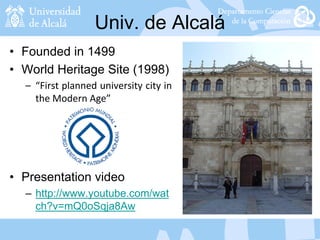
Univ. de Alcalá
• Founded in 1499
• World Heritage Site (1998)
– “First planned university city in
the Modern Age”
• Presentation video
– http://www.youtube.com/wat
ch?v=mQ0oSqja8Aw
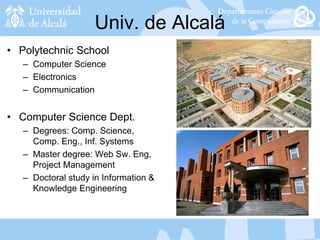
Univ. de Alcalá
• Polytechnic School
– Computer Science
– Electronics
– Communication
• Computer Science Dept.
– Degrees: Comp. Science,
Comp. Eng., Inf. Systems
– Master degree: Web Sw. Eng,
Project Management
– Doctoral study in Information &
Knowledge Engineering
Games
• Definition:
No consensus of what a game is
• deep philosophical question…
Games
• Wittgenstein [on language]
– “For how is the concept of a game
bounded? What still counts as a
game and what no longer does?
Can you give the boundary? No.
You can draw one; for none has
so far been drawn. (But that never
troubled you before when you
used the word ‘game’.)”
Philosophical Investigations,
Aphorism 68
Games
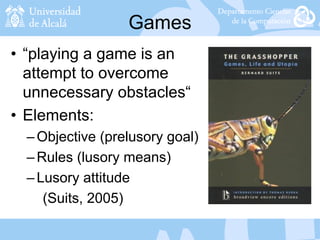
• “playing a game is an
attempt to overcome
unnecessary obstacles“
• Elements:
–Objective (prelusory goal)
–Rules (lusory means)
–Lusory attitude
(Suits, 2005)
Games
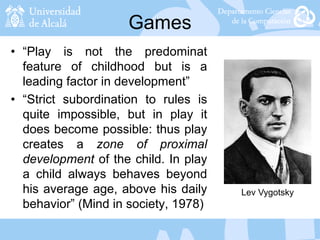
• “Play is not the predominat
feature of childhood but is a
leading factor in development”
• “Strict subordination to rules is
quite impossible, but in play it
does become possible: thus play
creates a zone of proximal
development of the child. In play
a child always behaves beyond
his average age, above his daily
behavior” (Mind in society, 1978)
Lev Vygotsky
9
Games
• "If play is at the heart of learning,
games are the frameworks that help
us understand and better ourselves
as we gather more knowledge of
who we are.“ (Nacke, 2017)
Games
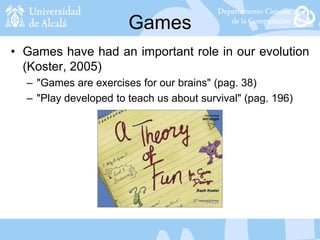
• Games have had an important role in our evolution
(Koster, 2005)
– "Games are exercises for our brains" (pag. 38)
– "Play developed to teach us about survival" (pag. 196)
Games
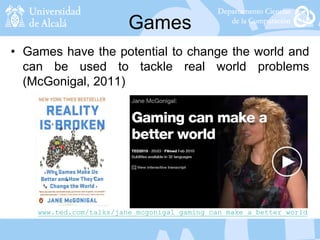
• Games have the potential to change the world and
can be used to tackle real world problems
(McGonigal, 2011)
www.ted.com/talks/jane_mcgonigal_gaming_can_make_a_better_world
Videogames
• Computers provide to games:
–immediate feedback
–multimedia enriched narrative
–connectivity
Videogames
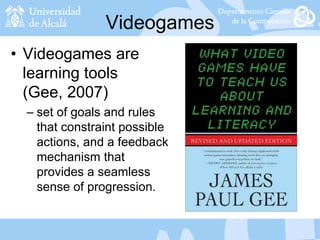
• Videogames are
learning tools
(Gee, 2007)
– set of goals and rules
that constraint possible
actions, and a feedback
mechanism that
provides a seamless
sense of progression.
Gamification
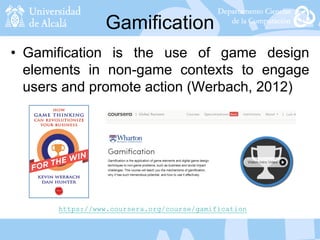
• Gamification is the use of game design
elements in non-game contexts to engage
users and promote action (Werbach, 2012)
https://www.coursera.org/course/gamification
Gamification
• Gamification has a great potential
–Unmotivated users
–Systems not used
–Employees and customers disengaged
• Put fun back!!!
Gamification
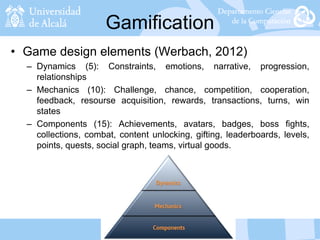
• Game design elements (Werbach, 2012)
– Dynamics (5): Constraints, emotions, narrative, progression,
relationships
– Mechanics (10): Challenge, chance, competition, cooperation,
feedback, resourse acquisition, rewards, transactions, turns, win
states
– Components (15): Achievements, avatars, badges, boss fights,
collections, combat, content unlocking, gifting, leaderboards, levels,
points, quests, social graph, teams, virtual goods.
Gamification
• PBL triad:
–(P)oints
–(B)agdes
–(L)eaderboard
Examples
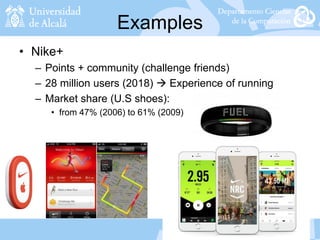
• Nike+
– Points + community (challenge friends)
– 28 million users (2018)  Experience of running
– Market share (U.S shoes):
• from 47% (2006) to 61% (2009)
Examples
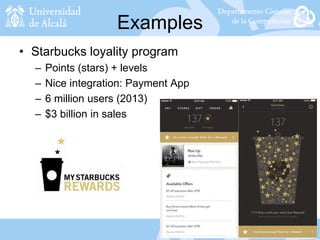
• Starbucks loyality program
– Points (stars) + levels
– Nice integration: Payment App
– 6 million users (2013)
– $3 billion in sales
Examples
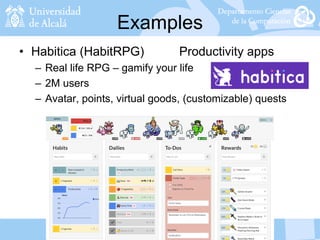
• Habitica (HabitRPG) Productivity apps
– Real life RPG – gamify your life
– 2M users
– Avatar, points, virtual goods, (customizable) quests
More Examples
• Social
– Pain Squad: helps patients combat cancer
– OPower: Energy consumption
– RecycleBank
• Educational
– Khan Academy, Udemy, Codeacademy, Duolingo
• Marketing / eCommerce
– McDonald’s Monopoly, Coca-Cola’s Shake It
• Enterprise gamification
– Nitro for Salesforce, Badgeville
Gamification
• Types of gamification (organizational view)
– Internal gamification
– External gamification
– Behavior-change gamification
• Types of gamification (process view)
– Product gamification
– Marketing gamification
– Workplace gamification
Gamification
• Other flavours of gamification
–Game-based/gameful design
–Motivational software/design
–Serious games
–Playful design
–Ludification / Ludology
–Fun theory
Examples
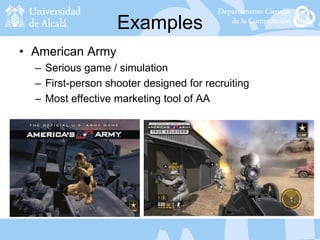
• American Army
– Serious game / simulation
– First-person shooter designed for recruiting
– Most effective marketing tool of AA
Examples
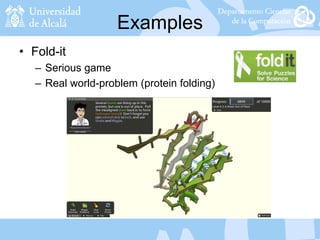
• Fold-it
– Serious game
– Real world-problem (protein folding)
Examples
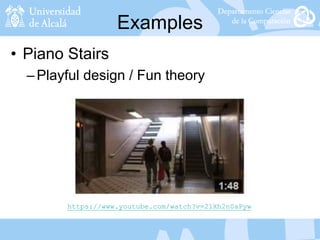
• Piano Stairs
–Playful design / Fun theory
https://www.youtube.com/watch?v=2lXh2n0aPyw
Process
Gamification is not an insignificant
task: game mechanics/elements on
their own result insufficient (Kapp,
2012)
Process
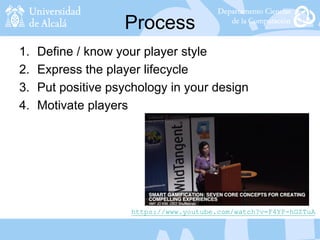
1. Define / know your player style
2. Express the player lifecycle
3. Put positive psychology in your design
4. Motivate players
https://www.youtube.com/watch?v=F4YP-hGZTuA
Process
1. Define / know your player style
– Forget about users…
think in terms of players!!!
– Different players means different…
• Skills
• Needs
• Expectations
• Motivations
– Know your player styles and address them
Process
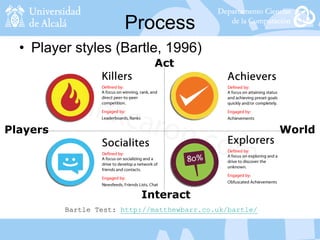
• Player styles (Bartle, 1996)
World
Interact
Players
Act
Bartle Test: http://matthewbarr.co.uk/bartle/
Process
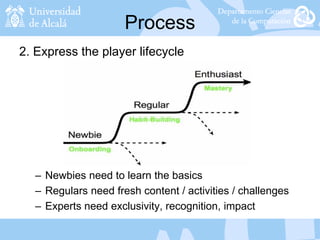
2. Express the player lifecycle
– Newbies need to learn the basics
– Regulars need fresh content / activities / challenges
– Experts need exclusivity, recognition, impact
Process
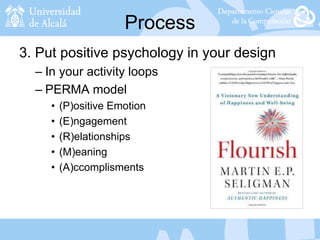
3. Put positive psychology in your design
– In your activity loops
– PERMA model
• (P)ositive Emotion
• (E)ngagement
• (R)elationships
• (M)eaning
• (A)ccomplisments
Process
4. Motivate your players
– Focus on intrinsic rewards
– Provide a sense of autonomy, mastery and
purpose
– Design your flow
• Theoretical background (psychology)
– Self-determination theory (Ryan & Deci, 2000)
– Flow (Csíkszentmihályi, 1990)
Theory
• Motivators:
– Extrinsic motivation – from outside sources,
usually rewards
– Intrinsic motivation – from within an individual,
self-determined
• Beware of extrinsic motivators / rewards
– Reward may become the only reason
– Potentially demotivating effect
Theory
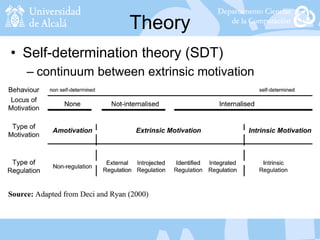
• Self-determination theory (SDT)
– continuum between extrinsic motivation
36
Theory
• "In gamification, the activities we are
designing must not only be goal-
oriented and rule-driven but also be
meaningful for our users” (Nacke, 2017)
 Motivational affordances
Theory
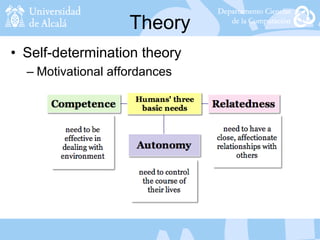
• Self-determination theory
– Motivational affordances
Theory
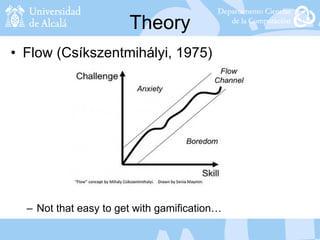
• Flow (Csíkszentmihályi, 1975)
– Not that easy to get with gamification…
39
Exercise
• Gamification in Moodle
– Challenge: Students don’t submit assignments
1. Define your users & their motivations
2. Game elements to use and why (affordances)
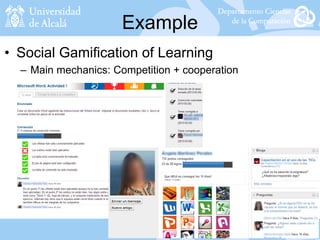
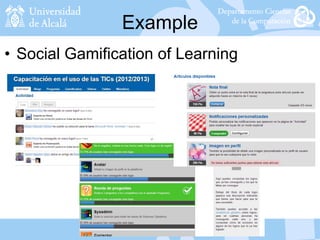
• Social Gamification of Learning
– Main mechanics: Competition + cooperation
Example
40
Example
• Social Gamification of Learning
– Elements
• Achievements (social or task-related)  Autonomy
• Peer-review Competence + Relatedness
• Personal profile  Autonomy (+Relatedness)
• Dashboard + social network Relatedness
• Virtual shop, rewards  Autonomy
– Addressing all player types
– Elgg social networking engine + gamification
features
• Social Gamification of Learning
Example
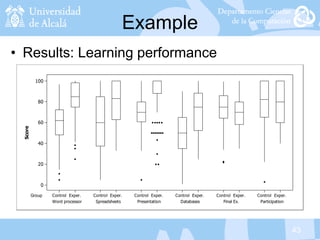
• Results: Learning performance
Example
43
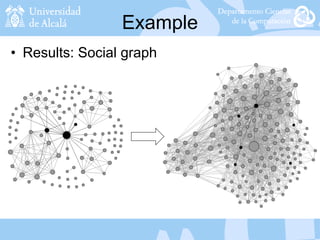
• Results: Social graph
Example
45
Criticism
“However, the rise of gamification also brought the
risk of a hollow and frustrated world, with users made
to do tasks that did not contribute to self-improvement
or personal learning. Points and badges were used
for meaningless progression in a digital system;
leaderboards provided a “digital whip” for employees
not performing at a high level. We saw the dangers of
gamification. In many instances, digital marketing
became synonymous with gamification, leading
designers astray from core concepts of self-
determination” (Nacke, 2017)
Criticism
“Gamification is bullshit. I'm not being flip or
glib or provocative. I'm speaking
philosophically. More specifically, gamification
is marketing bullshit, invented by consultants
as a means to capture the wild, coveted beast
that is videogames and to domesticate it for
use in the grey, hopeless wasteland of big
business, where bullshit already reigns
anyway.” (Ian Bogost)
http://www.bogost.com/blog/gamification_is_bullshit.shtml
Criticism
• Cow clicker
–“deconstructive satire of social games […]
gamification, educational apps, and
alternate reality games” (wikipedia)
–Pointsification…
http://bogost.com/writing/blog/cow_clicker_1/
http://en.wikipedia.org/wiki/Cow_Clicker
Criticism
“Gamification is an inadvertent con. It tricks
people into believing that there’s a simple way
to imbue their thing (bank, gym, job,
government, genital health outreach program,
etc) with the psychological, emotional and
social power of a great game.”
Can’t play, won’t play
Margaret robertson
http://www.hideandseek.net/2010/10/06/cant-play-wont-play/
Caveats
Sight (2012)
– A short futuristic film by Eran May-raz and Daniel Lazo.
http://vimeo.com/46304267
Caveats
“Amusement is the extension of work in
late capitalism. It is sought out by him
who wants to scape the mechanised
process of work only to become fit for it
anew”
Dialectics of Enlightenment
Theodor W. Adorno.
Conclusions
• Engagement can be a differentiator
• Gamification is not an easy task
• and it’s not always appropriate…
• Recommendations:
– Find interesting challenges
• ‘Don’t “sugarcoat” non-fun stuff.’ (Deterding)
– Involve players
– Focus on meaning, autonomy & relatedness
– Play test: test, test, test, & then… test again
– Don’t forget the fun!!!
Conclusions
“at its core gamification is
about finding the fun in the
things that you have to do”
(Werbach, 2012)
References
• CSÍKSZENTMIHÁLYI, M. 1990. Flow: The psychology of optimal experience, New York,
HarperCollins.
• GEE, J. P. 2007. What video games have to teach us about learning and literacy,
New York, Palgrave Macmillan.
• KAPP, K. M. 2012. The Gamification of Learning and Instruction: Game-based Methods
and Strategies for Training and Education, San Francisco, Pfeiffer.
• KOSTER, R. 2005. A Theory of Fun for Game Design, Scottsdale, Arizona, USA,
Paraglyph Press.
• McGONIGAL, J. 2011. Reality Is Broken: Why Games Make Us Better and How They Can
Change the World, New York, Penguin Books.
• NACKE, L. E. 2017. Games user research and gamification in human-computer
interaction. XRDS: Crossroads, The ACM Magazine for Students, 24, 48-51.
• RYAN, R. M. & DECI, E. L. 2000. Intrinsic and Extrinsic Motivations: Classic Definitions
and New Directions. Contemporary Educational Psychology, 25, 54-67.
• SUITS, B. 2005. The Grasshopper: Life, Games & Utopia, Toronto, Broadview Press.
• WERBACH, K. & HUNTER, D. 2012. For the win: How game thinking can revolutionize
your business, Philadelphia, Wharton Digital Press.
Other Resources
• Kevin Werbach course on Gamification
– https://www.coursera.org/course/gamification
• Sebastian Deterding: Meaningful Play: Getting
Gamification Right
– http://www.youtube.com/watch?v=7ZGCPap7GkY
• Amy Jo Kim: Smart Gamification
– https://www.youtube.com/watch?v=F4YP-hGZTuA
Thank you & Questions
Faculty of Organization and Informatics. Varaždin. (Univ. Zagreb). May 2018
Gamifiying information systems:
How to motivate users with game
elements
Luis de Marcos Ortega
Universidad de Alcalá
luis.demarcos@uah.es
https://goo.gl/sBjvw1

Gamifiying information systems: How to motivate users with game elements

  • 1.
    Faculty of Organizationand Informatics. Varaždin. (Univ. Zagreb). May 2018 Gamifiying information systems: How to motivate users with game elements Luis de Marcos Ortega Universidad de Alcalá luis.demarcos@uah.es https://goo.gl/sBjvw1
  • 2.
    TOC 1. Univ. deAlcalá 2. Games 3. Videogames 4. Gamification 5. Examples 6. Process 7. Criticism 8. Conclusion 9. References
  • 3.
    Univ. de Alcalá •Founded in 1499 • World Heritage Site (1998) – “First planned university city in the Modern Age” • Presentation video – http://www.youtube.com/wat ch?v=mQ0oSqja8Aw
  • 4.
    Univ. de Alcalá •Polytechnic School – Computer Science – Electronics – Communication • Computer Science Dept. – Degrees: Comp. Science, Comp. Eng., Inf. Systems – Master degree: Web Sw. Eng, Project Management – Doctoral study in Information & Knowledge Engineering
  • 5.
    Games • Definition: No consensusof what a game is • deep philosophical question…
  • 6.
    Games • Wittgenstein [onlanguage] – “For how is the concept of a game bounded? What still counts as a game and what no longer does? Can you give the boundary? No. You can draw one; for none has so far been drawn. (But that never troubled you before when you used the word ‘game’.)” Philosophical Investigations, Aphorism 68
  • 7.
    Games • “playing agame is an attempt to overcome unnecessary obstacles“ • Elements: –Objective (prelusory goal) –Rules (lusory means) –Lusory attitude (Suits, 2005)
  • 8.
    Games • “Play isnot the predominat feature of childhood but is a leading factor in development” • “Strict subordination to rules is quite impossible, but in play it does become possible: thus play creates a zone of proximal development of the child. In play a child always behaves beyond his average age, above his daily behavior” (Mind in society, 1978) Lev Vygotsky
  • 9.
    9 Games • "If playis at the heart of learning, games are the frameworks that help us understand and better ourselves as we gather more knowledge of who we are.“ (Nacke, 2017)
  • 10.
    Games • Games havehad an important role in our evolution (Koster, 2005) – "Games are exercises for our brains" (pag. 38) – "Play developed to teach us about survival" (pag. 196)
  • 11.
    Games • Games havethe potential to change the world and can be used to tackle real world problems (McGonigal, 2011) www.ted.com/talks/jane_mcgonigal_gaming_can_make_a_better_world
  • 12.
    Videogames • Computers provideto games: –immediate feedback –multimedia enriched narrative –connectivity
  • 13.
    Videogames • Videogames are learningtools (Gee, 2007) – set of goals and rules that constraint possible actions, and a feedback mechanism that provides a seamless sense of progression.
  • 14.
    Gamification • Gamification isthe use of game design elements in non-game contexts to engage users and promote action (Werbach, 2012) https://www.coursera.org/course/gamification
  • 15.
    Gamification • Gamification hasa great potential –Unmotivated users –Systems not used –Employees and customers disengaged • Put fun back!!!
  • 16.
    Gamification • Game designelements (Werbach, 2012) – Dynamics (5): Constraints, emotions, narrative, progression, relationships – Mechanics (10): Challenge, chance, competition, cooperation, feedback, resourse acquisition, rewards, transactions, turns, win states – Components (15): Achievements, avatars, badges, boss fights, collections, combat, content unlocking, gifting, leaderboards, levels, points, quests, social graph, teams, virtual goods.
  • 17.
  • 18.
    Examples • Nike+ – Points+ community (challenge friends) – 28 million users (2018)  Experience of running – Market share (U.S shoes): • from 47% (2006) to 61% (2009)
  • 19.
    Examples • Starbucks loyalityprogram – Points (stars) + levels – Nice integration: Payment App – 6 million users (2013) – $3 billion in sales
  • 20.
    Examples • Habitica (HabitRPG)Productivity apps – Real life RPG – gamify your life – 2M users – Avatar, points, virtual goods, (customizable) quests
  • 21.
    More Examples • Social –Pain Squad: helps patients combat cancer – OPower: Energy consumption – RecycleBank • Educational – Khan Academy, Udemy, Codeacademy, Duolingo • Marketing / eCommerce – McDonald’s Monopoly, Coca-Cola’s Shake It • Enterprise gamification – Nitro for Salesforce, Badgeville
  • 22.
    Gamification • Types ofgamification (organizational view) – Internal gamification – External gamification – Behavior-change gamification • Types of gamification (process view) – Product gamification – Marketing gamification – Workplace gamification
  • 23.
    Gamification • Other flavoursof gamification –Game-based/gameful design –Motivational software/design –Serious games –Playful design –Ludification / Ludology –Fun theory
  • 24.
    Examples • American Army –Serious game / simulation – First-person shooter designed for recruiting – Most effective marketing tool of AA
  • 25.
    Examples • Fold-it – Seriousgame – Real world-problem (protein folding)
  • 26.
    Examples • Piano Stairs –Playfuldesign / Fun theory https://www.youtube.com/watch?v=2lXh2n0aPyw
  • 27.
    Process Gamification is notan insignificant task: game mechanics/elements on their own result insufficient (Kapp, 2012)
  • 28.
    Process 1. Define /know your player style 2. Express the player lifecycle 3. Put positive psychology in your design 4. Motivate players https://www.youtube.com/watch?v=F4YP-hGZTuA
  • 29.
    Process 1. Define /know your player style – Forget about users… think in terms of players!!! – Different players means different… • Skills • Needs • Expectations • Motivations – Know your player styles and address them
  • 30.
    Process • Player styles(Bartle, 1996) World Interact Players Act Bartle Test: http://matthewbarr.co.uk/bartle/
  • 31.
    Process 2. Express theplayer lifecycle – Newbies need to learn the basics – Regulars need fresh content / activities / challenges – Experts need exclusivity, recognition, impact
  • 32.
    Process 3. Put positivepsychology in your design – In your activity loops – PERMA model • (P)ositive Emotion • (E)ngagement • (R)elationships • (M)eaning • (A)ccomplisments
  • 33.
    Process 4. Motivate yourplayers – Focus on intrinsic rewards – Provide a sense of autonomy, mastery and purpose – Design your flow • Theoretical background (psychology) – Self-determination theory (Ryan & Deci, 2000) – Flow (Csíkszentmihályi, 1990)
  • 34.
    Theory • Motivators: – Extrinsicmotivation – from outside sources, usually rewards – Intrinsic motivation – from within an individual, self-determined • Beware of extrinsic motivators / rewards – Reward may become the only reason – Potentially demotivating effect
  • 35.
    Theory • Self-determination theory(SDT) – continuum between extrinsic motivation
  • 36.
    36 Theory • "In gamification,the activities we are designing must not only be goal- oriented and rule-driven but also be meaningful for our users” (Nacke, 2017)  Motivational affordances
  • 37.
  • 38.
    Theory • Flow (Csíkszentmihályi,1975) – Not that easy to get with gamification…
  • 39.
    39 Exercise • Gamification inMoodle – Challenge: Students don’t submit assignments 1. Define your users & their motivations 2. Game elements to use and why (affordances)
  • 40.
    • Social Gamificationof Learning – Main mechanics: Competition + cooperation Example 40
  • 41.
    Example • Social Gamificationof Learning – Elements • Achievements (social or task-related)  Autonomy • Peer-review Competence + Relatedness • Personal profile  Autonomy (+Relatedness) • Dashboard + social network Relatedness • Virtual shop, rewards  Autonomy – Addressing all player types – Elgg social networking engine + gamification features
  • 42.
    • Social Gamificationof Learning Example
  • 43.
    • Results: Learningperformance Example 43
  • 44.
    • Results: Socialgraph Example
  • 45.
    45 Criticism “However, the riseof gamification also brought the risk of a hollow and frustrated world, with users made to do tasks that did not contribute to self-improvement or personal learning. Points and badges were used for meaningless progression in a digital system; leaderboards provided a “digital whip” for employees not performing at a high level. We saw the dangers of gamification. In many instances, digital marketing became synonymous with gamification, leading designers astray from core concepts of self- determination” (Nacke, 2017)
  • 46.
    Criticism “Gamification is bullshit.I'm not being flip or glib or provocative. I'm speaking philosophically. More specifically, gamification is marketing bullshit, invented by consultants as a means to capture the wild, coveted beast that is videogames and to domesticate it for use in the grey, hopeless wasteland of big business, where bullshit already reigns anyway.” (Ian Bogost) http://www.bogost.com/blog/gamification_is_bullshit.shtml
  • 47.
    Criticism • Cow clicker –“deconstructivesatire of social games […] gamification, educational apps, and alternate reality games” (wikipedia) –Pointsification… http://bogost.com/writing/blog/cow_clicker_1/ http://en.wikipedia.org/wiki/Cow_Clicker
  • 48.
    Criticism “Gamification is aninadvertent con. It tricks people into believing that there’s a simple way to imbue their thing (bank, gym, job, government, genital health outreach program, etc) with the psychological, emotional and social power of a great game.” Can’t play, won’t play Margaret robertson http://www.hideandseek.net/2010/10/06/cant-play-wont-play/
  • 49.
    Caveats Sight (2012) – Ashort futuristic film by Eran May-raz and Daniel Lazo. http://vimeo.com/46304267
  • 50.
    Caveats “Amusement is theextension of work in late capitalism. It is sought out by him who wants to scape the mechanised process of work only to become fit for it anew” Dialectics of Enlightenment Theodor W. Adorno.
  • 51.
    Conclusions • Engagement canbe a differentiator • Gamification is not an easy task • and it’s not always appropriate… • Recommendations: – Find interesting challenges • ‘Don’t “sugarcoat” non-fun stuff.’ (Deterding) – Involve players – Focus on meaning, autonomy & relatedness – Play test: test, test, test, & then… test again – Don’t forget the fun!!!
  • 52.
    Conclusions “at its coregamification is about finding the fun in the things that you have to do” (Werbach, 2012)
  • 53.
    References • CSÍKSZENTMIHÁLYI, M.1990. Flow: The psychology of optimal experience, New York, HarperCollins. • GEE, J. P. 2007. What video games have to teach us about learning and literacy, New York, Palgrave Macmillan. • KAPP, K. M. 2012. The Gamification of Learning and Instruction: Game-based Methods and Strategies for Training and Education, San Francisco, Pfeiffer. • KOSTER, R. 2005. A Theory of Fun for Game Design, Scottsdale, Arizona, USA, Paraglyph Press. • McGONIGAL, J. 2011. Reality Is Broken: Why Games Make Us Better and How They Can Change the World, New York, Penguin Books. • NACKE, L. E. 2017. Games user research and gamification in human-computer interaction. XRDS: Crossroads, The ACM Magazine for Students, 24, 48-51. • RYAN, R. M. & DECI, E. L. 2000. Intrinsic and Extrinsic Motivations: Classic Definitions and New Directions. Contemporary Educational Psychology, 25, 54-67. • SUITS, B. 2005. The Grasshopper: Life, Games & Utopia, Toronto, Broadview Press. • WERBACH, K. & HUNTER, D. 2012. For the win: How game thinking can revolutionize your business, Philadelphia, Wharton Digital Press.
  • 54.
    Other Resources • KevinWerbach course on Gamification – https://www.coursera.org/course/gamification • Sebastian Deterding: Meaningful Play: Getting Gamification Right – http://www.youtube.com/watch?v=7ZGCPap7GkY • Amy Jo Kim: Smart Gamification – https://www.youtube.com/watch?v=F4YP-hGZTuA
  • 55.
    Thank you &Questions
  • 56.
    Faculty of Organizationand Informatics. Varaždin. (Univ. Zagreb). May 2018 Gamifiying information systems: How to motivate users with game elements Luis de Marcos Ortega Universidad de Alcalá luis.demarcos@uah.es https://goo.gl/sBjvw1