www.studymafia.org
Submitted By :
Arun V S
Seminar
On
Smart Dust
Content
 Introduction
 What is Smart Dust?
 Smart Dust Mote
 Architecture
 Smart Dust Technology
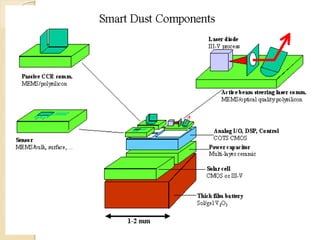
 Smart Dust Components
 Communication with Smart Dust
 Application
 Challenges
 Conclusion
 Reference
Introduction
 Smart dust is a tiny dust size device with extra-
ordinary capabilities.
 Smart dust combines sensing, computing,
wireless communication capabilities and
autonomous power supply within volume of only
few millimeters and that too at low cost.
 These devices are proposed to be so small and
light in weight that they can remain suspended in
the environment like an ordinary dust particle.
What is Smart Dust?
 A tiny dust size device with extra-ordinary
capabilities.
 Often called micro electro-mechanical sensors
 Combines sensing, computing, wireless
communication capabilities and autonomous
power supply within volume of only few
millimeters.
 Useful in monitoring real world phenomenon
without disturbing the original process.
What is Smart Dust? (Cont..)
 so small and light in weight that they can remain
suspended in the environment like an ordinary
dust particle.
 the air currents can also move them in the
direction of flow.
 It is very hard to detect the presence of the
Smart Dust and it is even harder to get rid of
them once deployed.
Smart Dust Mote
Architecture
A single Smart Dust mote has:
 a semiconductor laser diode and MEMS beam
steering mirror for active optical transmission
 a MEMS corner cube retro-reflector for passive
optical transmission
 an optical receiver
 a signal processing and control circuitry
 a power source based on thick-film batteries and
solar cells.
Smart Dust Technology
 MEMS sensors
 MEMS beam steering mirrors for optical
transmission
 MEMS corner cube retroreflector for passive
optical transmission
 An optical receiver
 Signal processing and control circuitory
 A power source based on thick film batteries and
solar cells
Communication with Smart
Dust
 Radio Frequency Transmission
 Optical transmission technique
◦ Passive Laser based Communication
◦ Active Laser based Communication
◦ Fiber Optic Communication
Application
 Environmental protection (identification and
monitoring of pollution).
 Habitat monitoring (observing the behavior of
the animals in there natural habitat).
 Military application (monitoring activities in
inaccessible areas, accompany soldiers and alert
them to any poisons or dangerous biological
substances in the air).
 Indoor/Outdoor Environmental Monitoring.
Application
 Security and Tracking
 Health and Wellness Monitoring (enter human
bodies and check for physiological problems).
 Factory and Process Automation.
 Seismic and Structural Monitoring.
 Monitor traffic and redirecting it.
Challenges
 To incorporate all these functions while
maintaining a low power consumption
 Maximising operating life given the limited
volume of energy storage
 The functionality can be achieved only if the
total power consumption is limited to microwatt
levels.
 An unbroken line of sight of path should be
available for free space optical links.
Conclusion
 There are many ongoing researches on Smart
Dust, the main purpose of these researches is to
make Smart Dust mote as small as possible and
to make it available at as low price as possible.
 Soon we will see Smart Dust being used in
varied application from all spans of life.
References
 www.studymafia.org
 www.wikipedia.com
 www.google.com
Thanks

Smart Dust.pptx

  • 1.
    www.studymafia.org Submitted By : ArunV S Seminar On Smart Dust
  • 2.
    Content  Introduction  Whatis Smart Dust?  Smart Dust Mote  Architecture  Smart Dust Technology  Smart Dust Components  Communication with Smart Dust  Application  Challenges  Conclusion  Reference
  • 3.
    Introduction  Smart dustis a tiny dust size device with extra- ordinary capabilities.  Smart dust combines sensing, computing, wireless communication capabilities and autonomous power supply within volume of only few millimeters and that too at low cost.  These devices are proposed to be so small and light in weight that they can remain suspended in the environment like an ordinary dust particle.
  • 4.
    What is SmartDust?  A tiny dust size device with extra-ordinary capabilities.  Often called micro electro-mechanical sensors  Combines sensing, computing, wireless communication capabilities and autonomous power supply within volume of only few millimeters.  Useful in monitoring real world phenomenon without disturbing the original process.
  • 5.
    What is SmartDust? (Cont..)  so small and light in weight that they can remain suspended in the environment like an ordinary dust particle.  the air currents can also move them in the direction of flow.  It is very hard to detect the presence of the Smart Dust and it is even harder to get rid of them once deployed.
  • 6.
  • 7.
    Architecture A single SmartDust mote has:  a semiconductor laser diode and MEMS beam steering mirror for active optical transmission  a MEMS corner cube retro-reflector for passive optical transmission  an optical receiver  a signal processing and control circuitry  a power source based on thick-film batteries and solar cells.
  • 8.
    Smart Dust Technology MEMS sensors  MEMS beam steering mirrors for optical transmission  MEMS corner cube retroreflector for passive optical transmission  An optical receiver  Signal processing and control circuitory  A power source based on thick film batteries and solar cells
  • 10.
    Communication with Smart Dust Radio Frequency Transmission  Optical transmission technique ◦ Passive Laser based Communication ◦ Active Laser based Communication ◦ Fiber Optic Communication
  • 11.
    Application  Environmental protection(identification and monitoring of pollution).  Habitat monitoring (observing the behavior of the animals in there natural habitat).  Military application (monitoring activities in inaccessible areas, accompany soldiers and alert them to any poisons or dangerous biological substances in the air).  Indoor/Outdoor Environmental Monitoring.
  • 12.
    Application  Security andTracking  Health and Wellness Monitoring (enter human bodies and check for physiological problems).  Factory and Process Automation.  Seismic and Structural Monitoring.  Monitor traffic and redirecting it.
  • 13.
    Challenges  To incorporateall these functions while maintaining a low power consumption  Maximising operating life given the limited volume of energy storage  The functionality can be achieved only if the total power consumption is limited to microwatt levels.  An unbroken line of sight of path should be available for free space optical links.
  • 14.
    Conclusion  There aremany ongoing researches on Smart Dust, the main purpose of these researches is to make Smart Dust mote as small as possible and to make it available at as low price as possible.  Soon we will see Smart Dust being used in varied application from all spans of life.
  • 15.
  • 16.

Editor's Notes