NIET Journal of Engineering & Technology (NIETJET)
Volume 10, Issue summer 2022 ISSN: 2229-5828 (Print)
24 | Page
Publisher: Noida Institute of Engineering & Technology,
19, Knowledge Park-II, Institutional Area, Greater Noida (UP), India.
Abstract : The project’s major goal is to create an intelligent trash can that would aid in maintaining a clean
and environmentally friendly environment. The Swachh Bharat Mission motivates us. Since technology is
becoming increasingly intelligent, we are utilising Arduino nano to develop an intelligent dustbin to help clean
the environment. The ultrasonic sensors on the trashcan are part of the dustbin control and management system,
which happens to be designed with a microcontroller-based platform. In the suggested method, we used an
ARDUINO NANO, an ultrasonic sensor, a Mini servo motor, and jumper wire linked to a charger to construct an
intelligent trash can. The Smart Dustbin application will launch when all hardware and software connections
have been made. Dustbin lid will wait for the person to pass by at a distance of 60 cm.
Keywords - Arduino Nano, Microcontroller, IOT, mini servo.
1. INTRODUCTION
Our country's population is growing quickly, and there is also more than ever garbage, which has led to an increase
in environmental degradation. A dustbin is a trashcan that is used for recyclable, non-recyclable, decomposable,
and recyclable products, as well as waste. They are typically used in homes, offices, universities, and schools,
among other places, but if they're stuffed., nobody is there to clean them up, thus trash spills out. A dustbin's
surroundings might also contribute to an increase in pollution. Dustbin air pollution can result in the development
of germs and viruses that can cause fatal human illnesses. As a result, we created a smart trash can that uses the
ARDUINO NANO, an ultrasonic sensor that can detect an object.
2. METHODOLOGY: SMART DUSTBIN
ARDUINO NANO is a project completely based primarily on IOT. Here we use Arduino Nano to execute the
code to open the lid and waited while using an ultrasonic sensor for sensing. for a while. With its help, it will bear
drastic modifications in terms of cleanliness. Everything comes with smart time to move human beings. As a
result, the use of age facilitates the preservation of the environment. Since this litter box is entirely sensor-based,
it would be simple for people of any age to access and operate. We also want to make it inexpensive so that many
people may take use of it. And everyone should be able to use and benefit from it.
We need some hardware and some software to finish our project.
1. Required Software:
1) ARDUINO IDE
2. Required Hardware:
1)Arduino Nano
2)Ultrasonic sensor
3)Mini-servo motor
4)Dustbin
5)Jumper Wires (male to female and male to male)
SMART DUSTBIN USING ARDUINO
NANO
Shudhanshu Ranjan1
, Shashank Singh1
Dhananjay Singh2
, Anshuman Singh2
, Pavan Kumar Shukla2
, Vinod M. Kapse2
1
Student, Department of Electronics and Communication Engineering, Noida Institute of Engineering and Technology,
Greater Noida
2
Faculty, Department of Electronics and Communication Engineering, Noida Institute of Engineering and Technology,
Greater Noida
NIET Journal of Engineering & Technology (NIETJET)
Volume 10, Issue summer 2022 ISSN: 2229-5828 (Print)
25 | Page
Publisher: Noida Institute of Engineering & Technology,
19, Knowledge Park-II, Institutional Area, Greater Noida (UP), India.
3. PROCEDURE
Setup for the MINI-SERVO Motor Connection:
Let me now walk you through how to set up and construct the Smart Dustbin using Arduino. We'll begin by
discussing the process for opening the lid. We utilized a little servo motor for this, as you may have already
guessed. I used fast glue to attach a little plastic tube to servo horn, horn with one end, to open the lid. The tube
resembled the empty refill of a ballpoint pen. This device has to be situated close to the dustbin's lid in order to
operate. This dustbin arrangement was created and built utilizing an Arduino system. I'll start with the dustbin lid
opening mechanism, which uses a tiny servo motor.
Adding an Ultrasonic Sensor:
After successfully installing the tiny servo motor, the ultrasonic sensor is now installed at the front of the trash
can.
Wire connections to the component:
All of the wires from the small servo motor and ultrasonic sensor components are linked to the corresponding
Arduino Nano pins. The construction of the Smart Dustbin is now complete. The Arduino code has been provided,
and it includes connections for all the hardware and software.
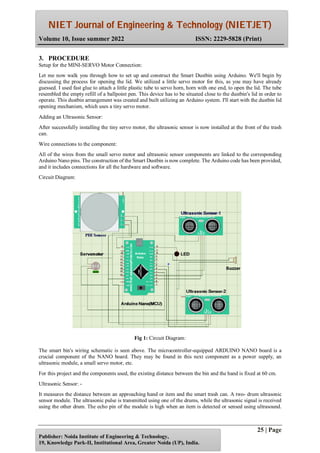
Circuit Diagram:
Fig 1: Circuit Diagram:
The smart bin's wiring schematic is seen above. The microcontroller-equipped ARDUINO NANO board is a
crucial component of the NANO board. They may be found in this next component as a power supply, an
ultrasonic module, a small servo motor, etc.
For this project and the components used, the existing distance between the bin and the hand is fixed at 60 cm.
Ultrasonic Sensor: -
It measures the distance between an approaching hand or item and the smart trash can. A two- drum ultrasonic
sensor module. The ultrasonic pulse is transmitted using one of the drums, while the ultrasonic signal is received
using the other drum. The echo pin of the module is high when an item is detected or sensed using ultrasound.
NIET Journal of Engineering & Technology (NIETJET)
Volume 10, Issue summer 2022 ISSN: 2229-5828 (Print)
26 | Page
Publisher: Noida Institute of Engineering & Technology,
19, Knowledge Park-II, Institutional Area, Greater Noida (UP), India.
The placement of the obstruction has a complete impact on how long the reflected pulse waits. We may use the
formula to determine the distance, once we get the echo signal.
4. WORKING
The next step after setting up the connection is to upload or send the code to the Arduino Nano and power the
circuit.
The Arduino mini continuously monitors everything that comes within 60 cm of the sensor when the device is
switched on.
When an object such as a hand is detected by the ultrasonic sensor, the Arduino will determine its distance. If this
distance is smaller than a certain threshold, a small servomotor is first activated with the help of the extended arm
of the lid.
The lid will open for a certain amount of time before closing on its own.
5. ADVANTAGES
The benefits of employing a Smart dustbin are as follows:
 80 percent fewer garbage collections needed, which would require less labor, emissions, fuel and road
congestion.
 Reducing the required amount of trash.
 Keep the environment clean (i.e. no waste overflow and less unpleasant smell).
 It will contribute to the advancement of clean-tech technologies. It will contribute advancement in the area
of cleanliness.
6. CONCLUSIONS
In this move towards purity, we will change things. When combined with advanced trash compaction and waste
monitoring technology, smart waste bins outperform traditional dustbins by a wide margin. It includes many smart
devices, including Arduino sensors. The bin lid opens automatically when something approaches it and closes
again after a certain period of time. Here we will make an evolutionary change towards purity. Smart bins are
continually superior to conventional bins because they combine smart waste monitoring and garbage compaction
technology. It has smart gadgets like Arduino sensors and other things. When an item approaches the trash can,
the lid automatically opens; it then automatically closes after a certain amount of time.
7. FUTURE SCOPE
Smart trash cans aid in the reduction of pollution. Many times, garbage cans are overflowing, and dogs or rats
frequently access the cans or the area around them. This makes a poor situation. Additionally, several birds are
attempting to remove trash from the trashcan. Since there is no physical contact between the trash can and the
person, we will be protected from germs and illnesses.
REFERENCES
[1] Kumar NS, Vuayalakshmi B, Prarthana RJ, Shankar A. IOT based smart garbage alert system using
Arduino UNO. In2016 IEEE Region 10 Conference (TENCON) 2016 Nov 22 (pp. 1028- 1034). IEEE.
[2] Reddy PS, Naik RN, Kumar AA, Kishor SN. Wireless dust bin monitoring and alert system using
Arduino. In2017 Second International Conference on Electrical, Computer and Communication
Technologies (ICECCT) 2017 Feb 22 (pp. 1-5). IEEE.
[3] Anushri G, Manikandan A, Nivas P, Vignesh K. Garbage Monitoring System Using Arduino.
[4] Hassan SA, Jameel NG, Şekeroğlu B. Smart solid waste monitoring and collection system. International
Journal. 2016 Oct;6(10).

SMART DUSTBIN USING ARDUINO NANO

  • 1.
    NIET Journal ofEngineering & Technology (NIETJET) Volume 10, Issue summer 2022 ISSN: 2229-5828 (Print) 24 | Page Publisher: Noida Institute of Engineering & Technology, 19, Knowledge Park-II, Institutional Area, Greater Noida (UP), India. Abstract : The project’s major goal is to create an intelligent trash can that would aid in maintaining a clean and environmentally friendly environment. The Swachh Bharat Mission motivates us. Since technology is becoming increasingly intelligent, we are utilising Arduino nano to develop an intelligent dustbin to help clean the environment. The ultrasonic sensors on the trashcan are part of the dustbin control and management system, which happens to be designed with a microcontroller-based platform. In the suggested method, we used an ARDUINO NANO, an ultrasonic sensor, a Mini servo motor, and jumper wire linked to a charger to construct an intelligent trash can. The Smart Dustbin application will launch when all hardware and software connections have been made. Dustbin lid will wait for the person to pass by at a distance of 60 cm. Keywords - Arduino Nano, Microcontroller, IOT, mini servo. 1. INTRODUCTION Our country's population is growing quickly, and there is also more than ever garbage, which has led to an increase in environmental degradation. A dustbin is a trashcan that is used for recyclable, non-recyclable, decomposable, and recyclable products, as well as waste. They are typically used in homes, offices, universities, and schools, among other places, but if they're stuffed., nobody is there to clean them up, thus trash spills out. A dustbin's surroundings might also contribute to an increase in pollution. Dustbin air pollution can result in the development of germs and viruses that can cause fatal human illnesses. As a result, we created a smart trash can that uses the ARDUINO NANO, an ultrasonic sensor that can detect an object. 2. METHODOLOGY: SMART DUSTBIN ARDUINO NANO is a project completely based primarily on IOT. Here we use Arduino Nano to execute the code to open the lid and waited while using an ultrasonic sensor for sensing. for a while. With its help, it will bear drastic modifications in terms of cleanliness. Everything comes with smart time to move human beings. As a result, the use of age facilitates the preservation of the environment. Since this litter box is entirely sensor-based, it would be simple for people of any age to access and operate. We also want to make it inexpensive so that many people may take use of it. And everyone should be able to use and benefit from it. We need some hardware and some software to finish our project. 1. Required Software: 1) ARDUINO IDE 2. Required Hardware: 1)Arduino Nano 2)Ultrasonic sensor 3)Mini-servo motor 4)Dustbin 5)Jumper Wires (male to female and male to male) SMART DUSTBIN USING ARDUINO NANO Shudhanshu Ranjan1 , Shashank Singh1 Dhananjay Singh2 , Anshuman Singh2 , Pavan Kumar Shukla2 , Vinod M. Kapse2 1 Student, Department of Electronics and Communication Engineering, Noida Institute of Engineering and Technology, Greater Noida 2 Faculty, Department of Electronics and Communication Engineering, Noida Institute of Engineering and Technology, Greater Noida
  • 2.
    NIET Journal ofEngineering & Technology (NIETJET) Volume 10, Issue summer 2022 ISSN: 2229-5828 (Print) 25 | Page Publisher: Noida Institute of Engineering & Technology, 19, Knowledge Park-II, Institutional Area, Greater Noida (UP), India. 3. PROCEDURE Setup for the MINI-SERVO Motor Connection: Let me now walk you through how to set up and construct the Smart Dustbin using Arduino. We'll begin by discussing the process for opening the lid. We utilized a little servo motor for this, as you may have already guessed. I used fast glue to attach a little plastic tube to servo horn, horn with one end, to open the lid. The tube resembled the empty refill of a ballpoint pen. This device has to be situated close to the dustbin's lid in order to operate. This dustbin arrangement was created and built utilizing an Arduino system. I'll start with the dustbin lid opening mechanism, which uses a tiny servo motor. Adding an Ultrasonic Sensor: After successfully installing the tiny servo motor, the ultrasonic sensor is now installed at the front of the trash can. Wire connections to the component: All of the wires from the small servo motor and ultrasonic sensor components are linked to the corresponding Arduino Nano pins. The construction of the Smart Dustbin is now complete. The Arduino code has been provided, and it includes connections for all the hardware and software. Circuit Diagram: Fig 1: Circuit Diagram: The smart bin's wiring schematic is seen above. The microcontroller-equipped ARDUINO NANO board is a crucial component of the NANO board. They may be found in this next component as a power supply, an ultrasonic module, a small servo motor, etc. For this project and the components used, the existing distance between the bin and the hand is fixed at 60 cm. Ultrasonic Sensor: - It measures the distance between an approaching hand or item and the smart trash can. A two- drum ultrasonic sensor module. The ultrasonic pulse is transmitted using one of the drums, while the ultrasonic signal is received using the other drum. The echo pin of the module is high when an item is detected or sensed using ultrasound.
  • 3.
    NIET Journal ofEngineering & Technology (NIETJET) Volume 10, Issue summer 2022 ISSN: 2229-5828 (Print) 26 | Page Publisher: Noida Institute of Engineering & Technology, 19, Knowledge Park-II, Institutional Area, Greater Noida (UP), India. The placement of the obstruction has a complete impact on how long the reflected pulse waits. We may use the formula to determine the distance, once we get the echo signal. 4. WORKING The next step after setting up the connection is to upload or send the code to the Arduino Nano and power the circuit. The Arduino mini continuously monitors everything that comes within 60 cm of the sensor when the device is switched on. When an object such as a hand is detected by the ultrasonic sensor, the Arduino will determine its distance. If this distance is smaller than a certain threshold, a small servomotor is first activated with the help of the extended arm of the lid. The lid will open for a certain amount of time before closing on its own. 5. ADVANTAGES The benefits of employing a Smart dustbin are as follows:  80 percent fewer garbage collections needed, which would require less labor, emissions, fuel and road congestion.  Reducing the required amount of trash.  Keep the environment clean (i.e. no waste overflow and less unpleasant smell).  It will contribute to the advancement of clean-tech technologies. It will contribute advancement in the area of cleanliness. 6. CONCLUSIONS In this move towards purity, we will change things. When combined with advanced trash compaction and waste monitoring technology, smart waste bins outperform traditional dustbins by a wide margin. It includes many smart devices, including Arduino sensors. The bin lid opens automatically when something approaches it and closes again after a certain period of time. Here we will make an evolutionary change towards purity. Smart bins are continually superior to conventional bins because they combine smart waste monitoring and garbage compaction technology. It has smart gadgets like Arduino sensors and other things. When an item approaches the trash can, the lid automatically opens; it then automatically closes after a certain amount of time. 7. FUTURE SCOPE Smart trash cans aid in the reduction of pollution. Many times, garbage cans are overflowing, and dogs or rats frequently access the cans or the area around them. This makes a poor situation. Additionally, several birds are attempting to remove trash from the trashcan. Since there is no physical contact between the trash can and the person, we will be protected from germs and illnesses. REFERENCES [1] Kumar NS, Vuayalakshmi B, Prarthana RJ, Shankar A. IOT based smart garbage alert system using Arduino UNO. In2016 IEEE Region 10 Conference (TENCON) 2016 Nov 22 (pp. 1028- 1034). IEEE. [2] Reddy PS, Naik RN, Kumar AA, Kishor SN. Wireless dust bin monitoring and alert system using Arduino. In2017 Second International Conference on Electrical, Computer and Communication Technologies (ICECCT) 2017 Feb 22 (pp. 1-5). IEEE. [3] Anushri G, Manikandan A, Nivas P, Vignesh K. Garbage Monitoring System Using Arduino. [4] Hassan SA, Jameel NG, Şekeroğlu B. Smart solid waste monitoring and collection system. International Journal. 2016 Oct;6(10).