OUTLINE:
• What issmart dust?
• Motes
• Architecture
• Communications
• Conservation of Power and Working
• Applications
• Challenges
4.
WHAT IS IT?
•Smart dust consist of tiny microelectromechanical wireless devices that can
sense anything from light to vibration.
• Combines sensing, computing, wireless communication capabilities and
autonomous power supply within volume of only few millimeters.
• Concept was introduced by Kristofer S.J. Pister (University of California) in
2001
• Also referred to as motes.
5.
WHAT IS IT?
•Useful in monitoring real world phenomenon without disturbing the
original process.
• so small and light in weight that they can remain suspended in the
environment like an ordinary dust particle.
• the air currents can also move them in the direction of flow.
• It is very hard to detect the presence of the Smart Dust and it is even harder to
get rid of them once deployed.
6.
MOTES
• The coreof a mote is a small, low−cost, low−power computer.
• The computer monitors one or more sensors.
• Sensors can be for temperature, light, sound, position, acceleration, vibration,
stress, weight, pressure, humidity, etc.
• They connect to the outside world.
• Commonly a mote can transmit at a distance of something like 3 to 61
meters.
• Power consumption, size and cost are the barriers to longer distances.
7.
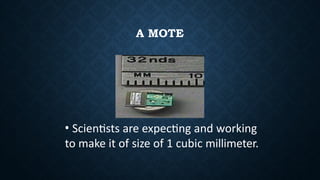
A MOTE
• Scientistsare expecting and working
to make it of size of 1 cubic millimeter.
ACOUSTIC COMMUNICATION
• PowerHungry
• High Background Noise
• Large Size (proportional to harmonics of sound)
• Fast Attenuation Curve
13.
RADIO COMMUNICATION
• Basedon the generation, propagation and detection of electromagnetic waves
with a frequency range from tens of kHz to hundreds of GHz
• New low power techniques
• – Not robust (No fancy Spread Spectrum)
14.
PROBLEMS WITH RADIOCOMM..
• Large size of antenna.
•Radio communication can only be achieved by using time, frequency or code
division.
•TDMA, FDMA, and CDMA have their own complications.
15.
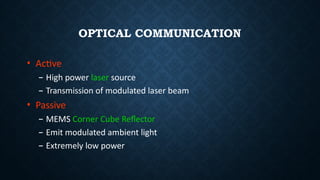
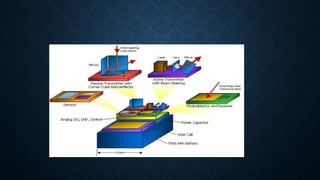
OPTICAL COMMUNICATION
• Active
–High power laser source
– Transmission of modulated laser beam
• Passive
– MEMS Corner Cube Reflector
– Emit modulated ambient light
– Extremely low power
17.
OPERATION OF THEMOTE
• Smart Dust mote is run by the microcontroller. Microcontroller:
• Determines the tasks performed by mote.
•Controls power to various components to conserve energy.
18.
MICROCONTROLLER
• Microcontroller getsreadings from sensors
• Processes the data and stores it in memory
• Occasionally turns on the receiver to see if anyone is trying to communicate
with it
• Sends messages
19.
CONSTRAINTS
• Primary constraintin the design of smart dust mote is volume.
• Volume in turn puts a constraint on energy since there is less space for
batteries or large solar cells
20.
CONSERVATION OF POWERAND
WORKING
• Most of the time a majority of the mote is powered off
• Only a clock and few timers run all the time
• When a timer expires it powers up a part of the mote to carry out a job
• Sensor when powered up takes a sample, converts it to digital word. If the
data is interesting, it may either be stored directly in SRAM or microcontroller
is powered up to perform complex operations
• When the task is complete everything is again powered down
21.
CONSERVATION OF POWERAND
WORKING
• Receiver is also controlled by a timer
• When timer expires ,the receiver powers up and looks for an incoming
packet
• If it does not see a packet , it is powered down again
• If a packet is received microcontroller is powered up and used to
interpret the contents of the message.
22.
CONSERVATION OF POWERAND
WORKING
• In response to a message or to another timer expiring, the microcontroller
will assemble a packet containing sensor data or a message and transmit it
• The packet is transmitted using corner cube retro reflector or the laser diode,
depending on what it has
• Corner cube retro reflector transmits information just by moving a
mirror ,changing the reflection of laser beam
23.
POWER CONSERVATION ANDWORKING
• With a laser diode and beam scanning mirrors, data can be sent in any direction
24.
APPLICATIONS
• To monitorpollution in environment
• To observe the behavior of the animals in their natural habitat
• To monitor activities in inaccessible areas during military operations, to alert
soldiers of any poisonous biological substances
• Home sensor network
• Factory and Process Automation.
• Health and Wellness Monitoring (enter human bodies and check for
physiological problems).
25.
CHALLENGES
• To incorporateall these functions while maintaining a low power consumption
• Maximising operating life given the limited volume of energy storage
• The functionality can be achieved only if the total power consumption is limited
to microwatt levels.
• An unbroken line of sight of path should be available for free space optical links.
26.
CONCLUSION
• The mainpurpose of all ongoing researches is to make small dust motes as
small as possible and to make them available at as low price as possible
• And we will see the small dust motes being used in various spans of our life
#2 "Introducing miniature airborne devices equipped with sensors and communication capabilities. These tiny gadgets revolutionize data collection and transmission, with applications in environmental monitoring and surveillance. The integration of sensors and communication tech signifies impactful advancements in technology."
#4 "Smart dust comprises minuscule microelectromechanical wireless devices with the ability to sense a spectrum ranging from light to vibration. These devices seamlessly integrate sensing, computing, wireless communication capabilities, and autonomous power supply, all within a volume of just a few millimeters. The concept was pioneered by Kristofer S.J. Pister at the University of California in 2001 and is commonly referred to as 'motes.'"
#5 "Invaluable for monitoring real-world phenomena without disrupting the original process, smart dust is so small and lightweight that it can remain suspended in the environment, resembling ordinary dust particles. Being moved by air currents in the direction of flow, the presence of smart dust is challenging to detect. Once deployed, these tiny devices are exceptionally difficult to eliminate."
#6 "At the heart of a mote is a small, cost-effective, and energy-efficient computer. This computer is responsible for monitoring one or more sensors, which can include temperature, light, sound, position, acceleration, vibration, stress, weight, pressure, humidity, among others. These sensors enable the mote to connect to the outside world, and typically, it can transmit data at distances ranging from 3 to 61 meters. Barriers to achieving longer transmission distances include considerations of power consumption, size, and cost."
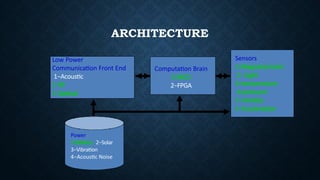
#8 "Operating on low power, the communication front end of the smart dust system incorporates various modalities such as acoustic, RF, and optical. The computation brain, consisting of an MCU (Microcontroller Unit) and FPGA (Field-Programmable Gate Array), orchestrates the functionality. Sensors, including a magnetometer, light sensor, temperature sensor, pressure sensor, humidity sensor, and acceleration sensor, capture diverse environmental data. Power is sourced from batteries, solar energy, vibration, and acoustic noise, illustrating the system's versatility in energy harvesting."
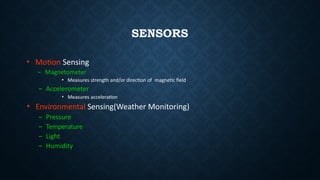
#9 "Motion sensing in the smart dust system is achieved through a magnetometer, measuring the strength and/or direction of the magnetic field, and an accelerometer, which gauges acceleration. Environmental sensing for weather monitoring encompasses sensors for pressure, temperature, light, and humidity, providing a comprehensive data set for real-time environmental analysis."
#10 "Small dust motes utilize ad hoc networking, where each node possesses the capability to autonomously locate and transmit signals to other nodes. This decentralized communication approach enhances the flexibility and adaptability of the network, allowing for dynamic interactions among the smart dust particles."
#11 1. **Acoustic:** Communication using sound waves.
2. **Radio Frequency (RF):** Communication using radio waves.
3. **Optical:** Communication using light.
4. **Passive:** Devices that don't actively transmit signals.
5. **Active:** Devices that actively generate and transmit signals.
#12 Power Hungry: High energy consumption.
High Background Noise: Susceptible to interference from ambient noise.
Large Size (proportional to harmonics of sound): Size increases with harmonic components, potentially limiting practical applications.
Fast Attenuation Curve: Rapid decrease in signal strength over distance, affecting effective range.
#13 Frequency Range: Tens of kHz to hundreds of GHz.
Low Power Techniques: Implementation of new, efficient power-saving methods.
Not Robust (No Spread Spectrum): The approach lacks the use of sophisticated Spread Spectrum techniques, indicating a potential trade-off between robustness and power efficiency.
#14 Large antennas in radio communication require the use of division methods like Time Division Multiple Access (TDMA), Frequency Division Multiple Access (FDMA), or Code Division Multiple Access (CDMA). However, these methods bring their own complications to the communication system.
#15 The system comprises active and passive elements. The active part uses a powerful laser for transmitting a modulated laser beam, requiring a notable power source. Conversely, the passive side employs a MEMS Corner Cube Reflector emitting modulated ambient light but operates at extremely low power, enhancing energy efficiency in the system. This combination achieves a balance between high-power laser transmission and energy-efficient, low-power ambient light emission through MEMS technology.
#17 The Smart Dust mote is powered by a microcontroller, which plays a pivotal role in the system. This microcontroller is responsible for defining and executing tasks performed by the mote. Additionally, it efficiently manages power distribution to different components, strategically controlling power to conserve energy. This highlights the crucial role of the microcontroller in task execution and energy optimization within the Smart Dust mote.
#18 The microcontroller collects sensor readings, processes and stores data in memory. It intermittently checks for incoming communications by activating the receiver, conserving energy. Moreover, the microcontroller handles message transmission, completing its essential functions in the device.
#19 The key limitation in designing a smart dust mote is its volume, which, in turn, impacts the available space for energy sources. The constrained volume poses challenges for incorporating sufficient batteries or large solar cells, directly influencing the energy capacity of the device. This emphasizes the critical interplay between volume and energy considerations in the design of smart dust motes.
#20 The smart dust mote focuses on power efficiency. Most of the time, it stays powered off, with only a clock and a few timers running. When a timer expires, a part of the mote powers up for a specific task, like the sensor taking a sample and converting it to a digital format. If the data is important, it's stored in SRAM, or the microcontroller powers up for more complex tasks. After completion, the entire system is powered down again, effectively conserving energy.
#21 The receiver in the system is efficiently managed by a timer. When the timer reaches its limit, the receiver powers up, actively searching for an incoming packet. If no packet is detected, the receiver is promptly powered down. However, if a packet is successfully received, the microcontroller is activated to interpret and process the contents of the message, ensuring a streamlined and energy-efficient communication process.
#24 Smart dust motes find diverse applications in monitoring and data collection. They are instrumental in tracking environmental pollution levels, observing natural animal behavior, and monitoring activities in remote or inaccessible areas during military operations. In addition, these motes are deployed in home sensor networks for efficient automation, contributing to enhanced safety and convenience. Moreover, they play a crucial role in factory and process automation, optimizing industrial processes. Their utility extends to health and wellness monitoring, where they can be employed to enter human bodies and check for physiological problems. The versatility of smart dust motes makes them valuable tools across various domains, addressing a wide range of monitoring and data collection needs.
#25 Achieving a balance between diverse functions and maintaining low power consumption is crucial for smart dust motes. Maximizing operating life within limited energy storage volume is a priority, necessitating total power consumption to be restricted to microwatt levels. Additionally, for functions like free space optical links, an unbroken line of sight is essential. This delicate interplay between energy efficiency, functionality, and environmental conditions underscores the challenge of designing and optimizing smart dust motes for an array of applications while ensuring sustained, efficient operation.
#26 In summary, smart dust technology offers groundbreaking possibilities for monitoring in various fields. These miniature motes, powered by efficient microcontrollers, have broad applications from environmental monitoring to military operations, home automation, industry, and health tracking. The challenge is to balance functionality with low power consumption within limited energy storage. Navigating this challenge opens doors to a future where smart dust redefines how we collect and utilize data across different domains.