SMART DUST  Magic Dust(Tiny sensor)
 
WHAT WE WILL COVER ! What is smart dust  The smart dust technology  Communication with a smart dust  Listening to a dust field  Major challenges  Applications
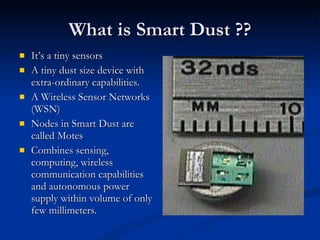
What is Smart Dust ?? It’s a tiny sensors A tiny dust size device with extra-ordinary capabilities . A  Wireless Sensor Networks (WSN)‏ Nodes in Smart Dust are called Motes Combines sensing, computing, wireless communication capabilities and autonomous power supply within volume of only few millimeters.
 
MEMS Technology in Smart Dust  Integration of mechanical elements, sensors, actuators and electronics on a common silicon substrate through micro fabrication. Fabrication  electronics – IC process technique Micromechanical- micromachining process
Components
Smart Dust Technology MEMS sensors  MEMS beam steering mirrors for optical transmission MEMS corner cube retroreflector for passive optical transmission An optical receiver Signal processing and control circuitory  A power source based on thick film batteries and solar cells
Sensors and other devices Micro-controller Processor Tiny operating system 3 KB RAM memory 1 week fully active, 2 yr @1%duty cycle N S E W 2 Axis Magnetic Sensor 2 Axis Accelerometer Light Intensity Sensor Humidity Sensor Pressure Sensor Temperature Sensor
How Smart dust works? Run by microcontroller Determines the task performed by the mote Controls power Primary constraint of smart dust is volume => constraint on energy Most of the time mote if off with only timers running When a timer expires, it powers mote to carry out a job , then powers off.
Communicating with a Smart dust Radio Frequency Transmission  Optical transmission technique  (Laser based Communication)
Radio Frequency Transmission Based on the generation, propagation and detection of electromagnetic waves with a frequency range from tens of kHz to hundreds of GHz . Multiplexing techniques: time, frequency or code-division multiplexing. Their use leads to modulation, bandpass filtering, demodulation circuitry, and additional circuitry, all of which needs to be considered, based on power consumption.
Problems with RF comm.. Large size of antenna. RF communication can only be achieved by using time, frequency or code division . TDMA, FDMA, and CDMA have their own complications.
Disadvantages Relatively high power consumption  . Thus can be used only for a  short duration burst-mode communication. Components like active beam-steering mechanism makes the design of the dust mote more complicated.
OPTICAL COMMUNICATION PASSIVE REFLECTIVE SYSTEMS   ACTIVE-STEERED LASER SYSTEMS  DOES NOT require onboard light source Uses special device called corner cube retro reflectors
Passive reflective Systems For bidirectional communication btw mote & BTS Light enters CCR, bounces off each of three mirrors & is reflected parallel to the direction it  entered CORNER CUBE RETRO REFLECTOR
Limitations of passive communication Unable to communicate with each other, motes rely on central station. Mote can be isolated from n/w if there is no clear line of sight. System’s range cannot extend beyond 1 km
Working of a CCR  CCR requires uninterrupted line of sight . CCR is highly directional => CCR can transmit to BTS only when CCR body diagonal points to BTS. Can be made more omni directional by employing several CCRs oriented in diff direction
 
Active steered laser systems For mote to mote communication Uses onboard light source to send a tight collimated beam towards an intended receiver Uses a semiconductor laser, collimating lens and beam steering micro mirrors. Power consumption trade off btw bandwidth & range
DISADVANTAGE  High power consumption=> use of short duration burst mode communication ADVANTAGE  High power density =>optical wireless communi over enormous long dist
Major Challenges  It is difficult to fit all these devices in a small Smart Dust both size wise and Energy wise. With devices so small, batteries present a massive addition of weight.
Applications !!!! Military Application Environmental protection   identification and monitoring pollution  Habitat Monitoring observing the behavior of animals in their natural habitat Inventory Control smart offices
Health And Wellness Monitoring Enter human bodies and check for physiological problems  VIRTUAL KEYBOARDS  Glue a dust mote to each fingertips. Accelerometers will sense the orientation and motion of each of the fingertip and talk to the computer on your watch  Circulatory Net
Conclusion There are many ongoing researches on Smart Dust, the main purpose will to make mote as small as possible and to make it available at a low price. Soon we will see smart dust being used in varied application from all spans of life!
References 1.Yunbin Song: ”Optical Communication Systems for Smart Dust”. 2. J. M. Kahn, R. H. Katz, K. S. J. Pister: Next Century Challenges: Mobile Networking for “Smart Dust”. 3. An Introduction to Microelectromechancal System Engineering: Nadim Maluf, Kirt William 4. B.A. Warneke, M.D. Scott, B.S. Leibowitz: Distributed Wireless Sensor Network 5. http://www.coe.berkeley.edu/labnotes
Thank You Presented by Rohit Kumar Roll No: 73 C.S. ‘B’ S.O.E., CUSAT
Questions??

Smart Dust

  • 1.
    SMART DUST Magic Dust(Tiny sensor)
  • 2.
  • 3.
    WHAT WE WILLCOVER ! What is smart dust The smart dust technology Communication with a smart dust Listening to a dust field Major challenges Applications
  • 4.
    What is SmartDust ?? It’s a tiny sensors A tiny dust size device with extra-ordinary capabilities . A Wireless Sensor Networks (WSN)‏ Nodes in Smart Dust are called Motes Combines sensing, computing, wireless communication capabilities and autonomous power supply within volume of only few millimeters.
  • 5.
  • 6.
    MEMS Technology inSmart Dust Integration of mechanical elements, sensors, actuators and electronics on a common silicon substrate through micro fabrication. Fabrication electronics – IC process technique Micromechanical- micromachining process
  • 7.
  • 8.
    Smart Dust TechnologyMEMS sensors MEMS beam steering mirrors for optical transmission MEMS corner cube retroreflector for passive optical transmission An optical receiver Signal processing and control circuitory A power source based on thick film batteries and solar cells
  • 9.
    Sensors and otherdevices Micro-controller Processor Tiny operating system 3 KB RAM memory 1 week fully active, 2 yr @1%duty cycle N S E W 2 Axis Magnetic Sensor 2 Axis Accelerometer Light Intensity Sensor Humidity Sensor Pressure Sensor Temperature Sensor
  • 10.
    How Smart dustworks? Run by microcontroller Determines the task performed by the mote Controls power Primary constraint of smart dust is volume => constraint on energy Most of the time mote if off with only timers running When a timer expires, it powers mote to carry out a job , then powers off.
  • 11.
    Communicating with aSmart dust Radio Frequency Transmission Optical transmission technique (Laser based Communication)
  • 12.
    Radio Frequency TransmissionBased on the generation, propagation and detection of electromagnetic waves with a frequency range from tens of kHz to hundreds of GHz . Multiplexing techniques: time, frequency or code-division multiplexing. Their use leads to modulation, bandpass filtering, demodulation circuitry, and additional circuitry, all of which needs to be considered, based on power consumption.
  • 13.
    Problems with RFcomm.. Large size of antenna. RF communication can only be achieved by using time, frequency or code division . TDMA, FDMA, and CDMA have their own complications.
  • 14.
    Disadvantages Relatively highpower consumption . Thus can be used only for a short duration burst-mode communication. Components like active beam-steering mechanism makes the design of the dust mote more complicated.
  • 15.
    OPTICAL COMMUNICATION PASSIVEREFLECTIVE SYSTEMS ACTIVE-STEERED LASER SYSTEMS DOES NOT require onboard light source Uses special device called corner cube retro reflectors
  • 16.
    Passive reflective SystemsFor bidirectional communication btw mote & BTS Light enters CCR, bounces off each of three mirrors & is reflected parallel to the direction it entered CORNER CUBE RETRO REFLECTOR
  • 17.
    Limitations of passivecommunication Unable to communicate with each other, motes rely on central station. Mote can be isolated from n/w if there is no clear line of sight. System’s range cannot extend beyond 1 km
  • 18.
    Working of aCCR CCR requires uninterrupted line of sight . CCR is highly directional => CCR can transmit to BTS only when CCR body diagonal points to BTS. Can be made more omni directional by employing several CCRs oriented in diff direction
  • 19.
  • 20.
    Active steered lasersystems For mote to mote communication Uses onboard light source to send a tight collimated beam towards an intended receiver Uses a semiconductor laser, collimating lens and beam steering micro mirrors. Power consumption trade off btw bandwidth & range
  • 21.
    DISADVANTAGE Highpower consumption=> use of short duration burst mode communication ADVANTAGE High power density =>optical wireless communi over enormous long dist
  • 22.
    Major Challenges It is difficult to fit all these devices in a small Smart Dust both size wise and Energy wise. With devices so small, batteries present a massive addition of weight.
  • 23.
    Applications !!!! MilitaryApplication Environmental protection identification and monitoring pollution Habitat Monitoring observing the behavior of animals in their natural habitat Inventory Control smart offices
  • 24.
    Health And WellnessMonitoring Enter human bodies and check for physiological problems VIRTUAL KEYBOARDS Glue a dust mote to each fingertips. Accelerometers will sense the orientation and motion of each of the fingertip and talk to the computer on your watch Circulatory Net
  • 25.
    Conclusion There aremany ongoing researches on Smart Dust, the main purpose will to make mote as small as possible and to make it available at a low price. Soon we will see smart dust being used in varied application from all spans of life!
  • 26.
    References 1.Yunbin Song:”Optical Communication Systems for Smart Dust”. 2. J. M. Kahn, R. H. Katz, K. S. J. Pister: Next Century Challenges: Mobile Networking for “Smart Dust”. 3. An Introduction to Microelectromechancal System Engineering: Nadim Maluf, Kirt William 4. B.A. Warneke, M.D. Scott, B.S. Leibowitz: Distributed Wireless Sensor Network 5. http://www.coe.berkeley.edu/labnotes
  • 27.
    Thank You Presentedby Rohit Kumar Roll No: 73 C.S. ‘B’ S.O.E., CUSAT
  • 28.