
PREPARED BY WILLARD VAN DE BOGART – BANGKOK UNIVERSITY
FOR 1ST INTERNATIONAL CONFERENCE NSRU: AUGUST 17, 2015
LANGUAGE, COMMUNICATION, AND CULTURE: ENGLISH IN A GLOBALIZED CO NTEXT
Application of a Smart Classroom as a Learning Process Methodology
to Support Thai Students’ Learning
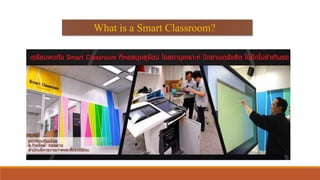
What is a Smart Classroom?
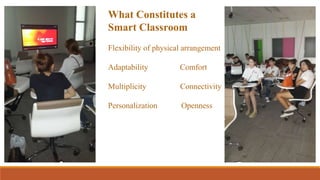
What Constitutes a
Smart Classroom
Flexibility of physical arrangement
Adaptability Comfort
Multiplicity Connectivity
Personalization Openness
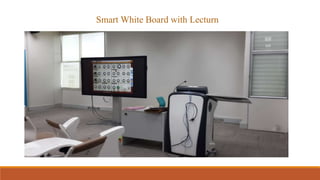
Smart White Board with Lecturn
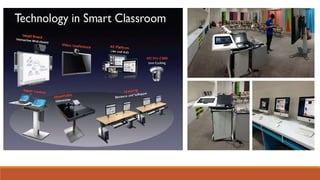
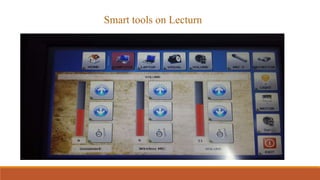
Smart tools on Lecturn
iPAD Charger cabinet
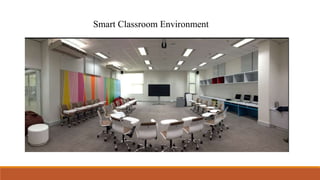
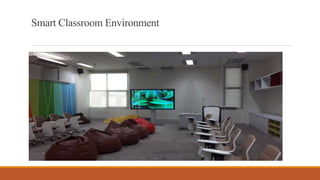
Smart Classroom Environment
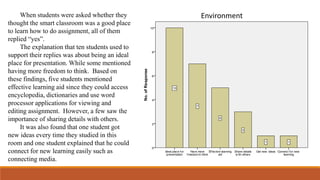
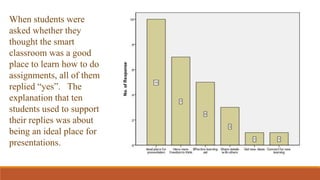
When students were asked whether they
thought the smart classroom was a good place
to learn how to do assignment, all of them
replied “yes”.
The explanation that ten students used to
support their replies was about being an ideal
place for presentation. While some mentioned
having more freedom to think. Based on
these findings, five students mentioned
effective learning aid since they could access
encyclopedia, dictionaries and use word
processor applications for viewing and
editing assignment. However, a few saw the
importance of sharing details with others.
It was also found that one student got
new ideas every time they studied in this
room and one student explained that he could
connect for new learning easily such as
connecting media.
Environment
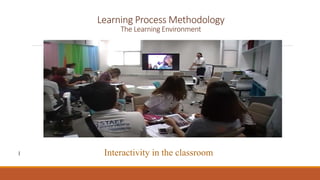
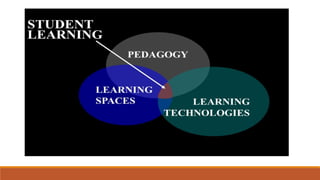
Learning Process Methodology
The Learning Environment
I Interactivity in the classroom
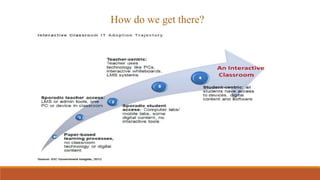
How do we get there?
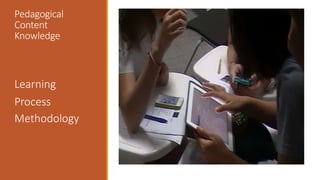
Pedagogical
Content
Knowledge
Learning
Process
Methodology
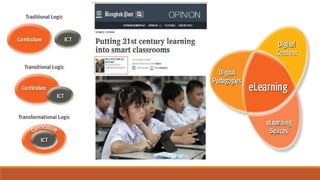
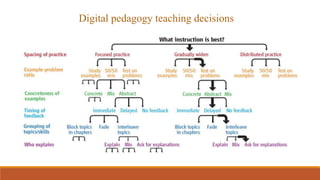
Digital pedagogy teaching decisions
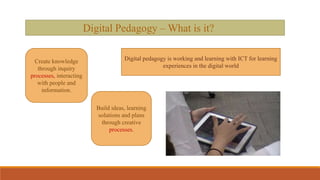
Digital Pedagogy – What is it?
Create knowledge
through inquiry
processes, interacting
with people and
information.
Build ideas, learning
solutions and plans
through creative
processes.
Digital pedagogy is working and learning with ICT for learning
experiences in the digital world
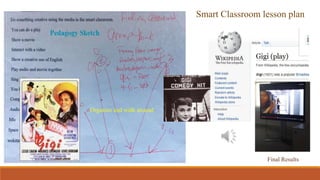
Smart Classroom lesson plan
Organize and walk around
Final Results
When students were
asked whether they
thought the smart
classroom was a good
place to learn how to do
assignments, all of them
replied “yes”. The
explanation that ten
students used to support
their replies was about
being an ideal place for
presentations.
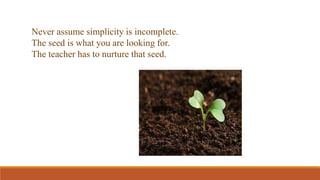
Never assume simplicity is incomplete.
The seed is what you are looking for.
The teacher has to nurture that seed.
Smart Classroom instructional design strategies
Learning is multidimensional.
Learning occurs in various planes simultaneously.
Learning has potentialities which exist infinitely.
Learning environments are like living systems.
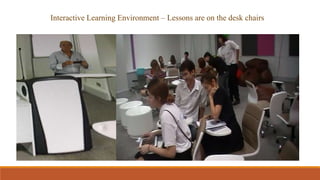
Interactive Learning Environment – Lessons are on the desk chairs
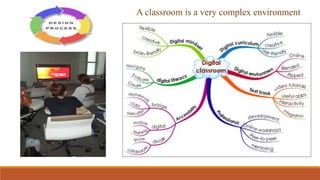
A classroom is a very complex environment
1. Long-term transfer requires a series of learning opportunities that involve varied “cues” for use of the
learning, e.g., in different contexts.
2. Long-term transfer also requires that learning episodes be spaced over time, i.e., the learner must use
“spaced practice.”
3. Varying cues and contexts make learning more challenging; this is essential for improving the probability
that learning will transfer.
4. Using multiple kinds of models and representing knowledge in multiple ways enhances the construction of
knowledge so that it will transfer.
5. Learner assumptions (e.g., that they are innately incapable of certain kinds of learning), experiences (e.g.,
of anxiety or pleasure with certain kinds of learning), and expectancies (e.g., that learning certain subjects is
easy) must be assessed in order to help learners build effective models of knowledge that will transfer.
6. Performance assessment and evaluation must focus on the main learning objectives in order to avoid
learner misperceptions and the forgetting of essential knowledge as a result of attending to the wrong
knowledge for the purpose at hand (e.g., learning to pass a test rather than learning to perform in a real
context).
7. In-depth knowledge is usually needed for effective transfer. The amount of information to be learned at
Bloom’s Levels 1 and 2 must support the goal of transfer.
8. Learning strategies must be validated with empirical evidence that they actually produce desired outcomes
in learner transfer of knowledge.
The critical determinate for learning is continuity of process
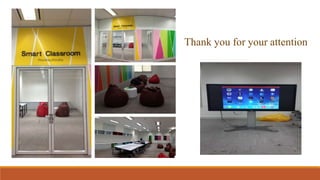
Thank you for your attention

Smart classroom teaching strategies

  • 1.
    PREPARED BY WILLARDVAN DE BOGART – BANGKOK UNIVERSITY FOR 1ST INTERNATIONAL CONFERENCE NSRU: AUGUST 17, 2015 LANGUAGE, COMMUNICATION, AND CULTURE: ENGLISH IN A GLOBALIZED CO NTEXT Application of a Smart Classroom as a Learning Process Methodology to Support Thai Students’ Learning
  • 2.
    What is aSmart Classroom?
  • 3.
    What Constitutes a SmartClassroom Flexibility of physical arrangement Adaptability Comfort Multiplicity Connectivity Personalization Openness
  • 5.
    Smart White Boardwith Lecturn
  • 6.
  • 7.
  • 8.
  • 9.
  • 10.
    When students wereasked whether they thought the smart classroom was a good place to learn how to do assignment, all of them replied “yes”. The explanation that ten students used to support their replies was about being an ideal place for presentation. While some mentioned having more freedom to think. Based on these findings, five students mentioned effective learning aid since they could access encyclopedia, dictionaries and use word processor applications for viewing and editing assignment. However, a few saw the importance of sharing details with others. It was also found that one student got new ideas every time they studied in this room and one student explained that he could connect for new learning easily such as connecting media. Environment
  • 11.
    Learning Process Methodology TheLearning Environment I Interactivity in the classroom
  • 14.
    How do weget there?
  • 15.
  • 16.
  • 17.
    Digital Pedagogy –What is it? Create knowledge through inquiry processes, interacting with people and information. Build ideas, learning solutions and plans through creative processes. Digital pedagogy is working and learning with ICT for learning experiences in the digital world
  • 18.
    Smart Classroom lessonplan Organize and walk around Final Results
  • 19.
    When students were askedwhether they thought the smart classroom was a good place to learn how to do assignments, all of them replied “yes”. The explanation that ten students used to support their replies was about being an ideal place for presentations.
  • 20.
    Never assume simplicityis incomplete. The seed is what you are looking for. The teacher has to nurture that seed.
  • 21.
    Smart Classroom instructionaldesign strategies Learning is multidimensional. Learning occurs in various planes simultaneously. Learning has potentialities which exist infinitely. Learning environments are like living systems.
  • 22.
    Interactive Learning Environment– Lessons are on the desk chairs
  • 23.
    A classroom isa very complex environment
  • 24.
    1. Long-term transferrequires a series of learning opportunities that involve varied “cues” for use of the learning, e.g., in different contexts. 2. Long-term transfer also requires that learning episodes be spaced over time, i.e., the learner must use “spaced practice.” 3. Varying cues and contexts make learning more challenging; this is essential for improving the probability that learning will transfer. 4. Using multiple kinds of models and representing knowledge in multiple ways enhances the construction of knowledge so that it will transfer. 5. Learner assumptions (e.g., that they are innately incapable of certain kinds of learning), experiences (e.g., of anxiety or pleasure with certain kinds of learning), and expectancies (e.g., that learning certain subjects is easy) must be assessed in order to help learners build effective models of knowledge that will transfer. 6. Performance assessment and evaluation must focus on the main learning objectives in order to avoid learner misperceptions and the forgetting of essential knowledge as a result of attending to the wrong knowledge for the purpose at hand (e.g., learning to pass a test rather than learning to perform in a real context). 7. In-depth knowledge is usually needed for effective transfer. The amount of information to be learned at Bloom’s Levels 1 and 2 must support the goal of transfer. 8. Learning strategies must be validated with empirical evidence that they actually produce desired outcomes in learner transfer of knowledge. The critical determinate for learning is continuity of process
  • 25.
    Thank you foryour attention