Ethics in Information
Technology
Chapter 7
Software Development
Objectives
• Why do companies require high-quality software
in business systems, industrial process control
systems, and consumer products?
• What ethical issues do software manufacturers
face in making tradeoffs between project
schedules, project costs, and software quality?
Objectives (continued)
• What are the four most common types of
software product liability claims, and what actions
must plaintiffs and defendants take to be
successful?
• What are the essential components of a software
development methodology, and what are its
benefits?
Objectives (continued)
• How can Capability Maturity Model Integration
improve an organization’s software development
process?
• What is a safety-critical system, and what actions
are required during its development?
Strategies to Engineer Quality
Software
• High-quality software systems
– Operate safely and dependably
– Have a high degree of availability
– Required to support the fields of
• Air traffic control
• Nuclear power
• Automobile safety
• Health care
• Military and defense
• Space exploration
Strategies to Engineer Quality
Software (continued)
• More and more users are demanding high quality
software
• Software defect
– Could cause a system to fail to meet users’ needs
– Impact may be trivial or very serious
– Patches may contain defects
• Software quality
– Degree to which software meets the needs of
users
Strategies to Engineer Quality
Software (continued)
• Quality management
– How to define, measure, and refine the quality of
the development process and products
– Objective
• Help developers deliver high-quality systems that
meet the needs of users
• Deliverables
– Products such as:
• Statements of requirements
• Flowcharts
• User documentation
Strategies to Engineer Quality
Software (continued)
• Primary cause for poor software quality
– Developers do not know how to design quality into
software
– Or do not take the time to do so
• Developers must
– Define and follow a set of rigorous engineering
principles
– Learn from past mistakes
– Understand the environment in which systems
operate
– Design systems relatively immune to human error
Strategies to Engineer Quality
Software (continued)
• Programmers make mistakes in turning design
specifications into code
– About one defect for every 10 lines of code
• Pressure to reduce time-to-market
• First release
– Organizations avoid buying the first release
– Or prohibit its use in critical systems
– Usually has many defects
The Importance of Software
Quality
• Business information systems are a set of
interrelated components
– Including
• Hardware
• Software
• Databases
• Networks
• People
• Procedures
The Importance of Software
Quality (continued)
• Business information system examples
– Order-processing system
– Electronic-funds transfer system
– Airline’s online ticket reservation system
• Decision support system (DSS)
– Used to improve decision making
• Software for industrial use
• Software controls the operation of many
industrial and consumer products
The Importance of Software
Quality (continued)
• Mismanaged software can be fatal to a business
• Ethical questions
– How much effort and money to invest to ensure
high-quality software
– Whether products could cause damage
• Legal exposure if they did
Legal Overview: Software Product
Liability
• Product liability
– Liability of manufacturers, sellers, lessors, and
others for injuries caused by defective products
– There is no federal product liability law
• Mainly state law
• Article 2 of the Uniform Commercial Code
• Strict liability
– Defendant held responsible for the injury
– Regardless of negligence or intent
Legal Overview: Software Product
Liability (continued)
• Strict liability
– Plaintiff must prove only that the software
product is defective or unreasonably dangerous
and that the defect caused the injury
– No requirement to prove that the manufacturer
was careless or negligent
• Or to prove who caused the defect
– All parties in the chain of distribution are liable
Legal Overview: Software Product
Liability (continued)
• Legal defenses used against strict liability
– Doctrine of supervening event
– Government contractor defense
– Expired statute of limitations
• Negligence
– A supplier is not held responsible for every
product defect that causes a customer or third-
party loss
– Responsibility is limited to defects that could
have been detected and corrected through
“reasonable” software development practices
Legal Overview: Software Product
Liability (continued)
• Negligence
– Area of great risk for software manufacturers
– Defense of negligence may include
• Legal justification for the alleged misconduct
• Demonstrate that the plaintiffs’ own actions
contributed to injuries
Legal Overview: Software Product
Liability (continued)
• Warranty
– Assures buyers or lessees that a product meets
certain standards of quality
– Expressly stated
– Implied by law
• Breach of warranty claim
– Plaintiff must have a valid contract that the
supplier did not fulfill
– Can be extremely difficult to prove
• Because the software supplier writes the warranty
Legal Overview: Software Product
Liability (continued)
• Intentional misrepresentation
– Seller or lessor either misrepresents the quality
of a product
– Or conceals a defect in it
– Forms of representation
• Advertising
• Salespersons’ comments
• Invoices
• Shipping labels
Software Development Process
• Large software project roles
– System analysts
– Programmers
– Architects
– Database specialists
– Project managers
– Documentation specialists
– Trainers
– Testers
Software Development Process
(continued)
• Software development methodology
– Work process
– Controlled and orderly progress
– Defines activities and individual and group
responsibilities
– Recommends specific techniques for
accomplishing various activities
– Offers guidelines for managing the quality of
software during various stages of development
Software Development Process
(continued)
• Safer and cheaper to avoid software problems
at the beginning than to attempt to fix damages
after the fact
– Identify and remove errors early in the
development process
• Cost-saving measure
• Most efficient way to improve software quality
Software Development Process
(continued)
• Effective methodology
– Reduces the number of software errors that
might occur
– If an organization follows widely accepted
development methods, negligence on its part is
harder to prove
• Software quality assurance (QA) refers to
methods within the development cycle
– Guarantee reliable operation of product
– Ideally applied at each stage throughout the
development cycle
Software Development Process
(continued)
• Dynamic testing
– Black-box testing
• Tester has no knowledge of code
– White-box testing
• Testing all possible logic paths through the
software unit
• With thorough knowledge of the logic
• Make each program statement execute at least
once
Software Development Process
(continued)
• Static testing
– Static analyzers are run against the new code
– Looks for suspicious patterns in programs that
might indicate a defect
• Integration testing
– After successful unit testing
– Software units are combined into an integrated
subsystem
– Ensures that all linkages among various
subsystems work successfully
Software Development Process
(continued)
• System testing
– After successful integration testing
– Various subsystems are combined
– Tests the entire system as a complete entity
• User acceptance testing
– Independent testing
– Performed by trained end users
– Ensures that the system operates as they expect
Capability Maturity Model
Integration for Software
• Process improvement approach
• Defined by the Software Engineering Institute
– At Carnegie Mellon University in Pittsburgh
• Defines essential elements of effective
processes
• General enough to evaluate and improve almost
any process
• Frequently used to assess software development
practices
Capability Maturity Model
Integration for Software
(continued)
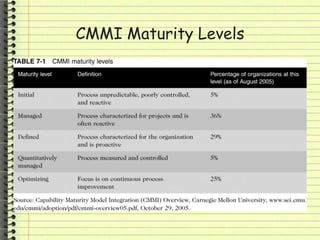
• Defines five levels of software development
maturity
• Identifies issues most critical to software
quality and process improvement
• Organization conducts an assessment of its
software development practices
– Determines where they fit in the capability model
– Identifies areas for improvement
• Action plans are needed to upgrade the
development process
Capability Maturity Model
Integration for Software
(continued)
• Maturity level increases
– Organization improves its ability to deliver good
software on time and on budget
CMMI Maturity Levels
Key Issues in Software Development
• Consequences of software defects in certain
systems can be deadly
– Companies must take special precautions
Development of Safety-Critical
Systems
• Safety-critical system
– Failure may cause injury or death
– Examples
• Automobile’s antilock brakes
• Nuclear power plant reactors
• Airplane navigation
• Roller coasters
• Elevators
• Medical devices
Development of Safety-Critical
Systems (continued)
• Key assumption
– Safety will not automatically result from following
the organization’s standard development
methodology
• Must go through a more rigorous and time-
consuming development process than other kinds
of software
• All tasks require
– Additional steps
– More thorough documentation
– More checking and rechecking
Development of Safety-Critical
Systems (continued)
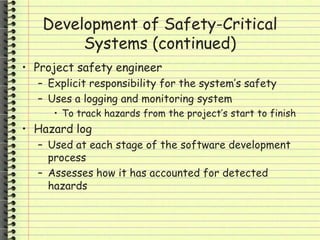
• Project safety engineer
– Explicit responsibility for the system’s safety
– Uses a logging and monitoring system
• To track hazards from the project’s start to finish
• Hazard log
– Used at each stage of the software development
process
– Assesses how it has accounted for detected
hazards
Development of Safety-Critical
Systems (continued)
• Safety reviews
– Held throughout the development process
• Robust configuration management system
– Tracks all safety-related documentation
• Formal documentation required
– Including verification reviews and signatures
• Key issue
– Deciding when QA staff has performed enough
testing
Development of Safety-Critical
Systems (continued)
• Risk
– Probability of an undesirable event occurring
times the magnitude of the event’s consequences
if it does happen
– Consequences include
• Damage to property
• Loss of money
• Injury to people
• Death
Development of Safety-Critical
Systems (continued)
• Redundancy
– Provision of multiple interchangeable components
to perform a single function
– In order to cope with failures and errors
• N-version programming
– Form of redundancy
– Involves the execution of a series of program
instructions simultaneously by two different
systems
– Uses different algorithms to execute instructions
that accomplish the same result
Development of Safety-Critical
Systems (continued)
• N-version programming
– Results from the two systems are compared
– If a difference is found, another algorithm is
executed to determine which system yielded the
correct result
– Instructions for the two systems are:
• Written by programmers from two different
companies
• Run on different hardware devices
– Both systems are highly unlikely to fail at the
same time under the same conditions
Development of Safety-Critical
Systems (continued)
• Decide what level of risk is acceptable
– Controversial
– If the level of risk in a design is judged to be too
great, make system modifications
• Mitigate the consequences of failure
– By devising emergency procedures and evacuation
plans
• Recall product
– When data indicates a problem
Development of Safety-Critical
Systems (continued)
• Reliability
– Probability of a component or system performing
without failure over its product life
• Human interface
– Important and difficult area of safety-critical
system design
– Leave the operator little room for erroneous
judgment
Quality Management Standards
• ISO 9000 standard
– Guide to quality products, services, and
management
– Organization must submit to an examination by an
external assessor
– Requirements:
• Written procedures for everything it does
• Follow those procedures
• Prove to the auditor the organization fulfilled the
first two requirements
Quality Management Standards
(continued)
• Failure mode and effects analysis (FMEA)
– Used to evaluate reliability
– Determine the effect of system and equipment
failures
– Goal:
• Identify potential design and process failures early
in a project
Quality Management Standards
(continued)
• Failure mode and effects analysis (FMEA)
– Failure mode
• Describes how a product or process could fail
– Effect
• Adverse consequence that a customer might
experience
– Seldom is a one-to-one relationship between
cause and effect
Quality Management Standards
• DO-178B/EUROCCAE ED-128
– Evaluation standard for the international aviation
community
– Developed by Radio Technical Commission for
Aeronautics (RTCA)
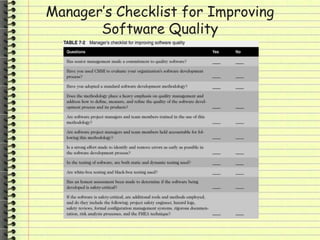
Manager’s Checklist for Improving
Software Quality
Summary
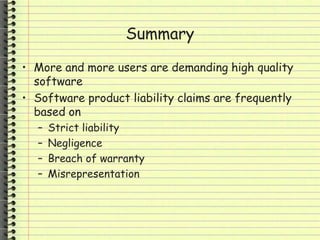
• More and more users are demanding high quality
software
• Software product liability claims are frequently
based on
– Strict liability
– Negligence
– Breach of warranty
– Misrepresentation
Summary (continued)
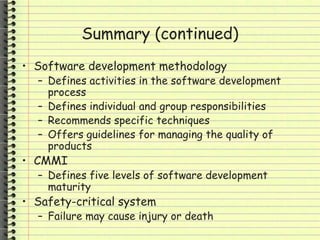
• Software development methodology
– Defines activities in the software development
process
– Defines individual and group responsibilities
– Recommends specific techniques
– Offers guidelines for managing the quality of
products
• CMMI
– Defines five levels of software development
maturity
• Safety-critical system
– Failure may cause injury or death

Software development

  • 1.
  • 2.
    Objectives • Why docompanies require high-quality software in business systems, industrial process control systems, and consumer products? • What ethical issues do software manufacturers face in making tradeoffs between project schedules, project costs, and software quality?
  • 3.
    Objectives (continued) • Whatare the four most common types of software product liability claims, and what actions must plaintiffs and defendants take to be successful? • What are the essential components of a software development methodology, and what are its benefits?
  • 4.
    Objectives (continued) • Howcan Capability Maturity Model Integration improve an organization’s software development process? • What is a safety-critical system, and what actions are required during its development?
  • 5.
    Strategies to EngineerQuality Software • High-quality software systems – Operate safely and dependably – Have a high degree of availability – Required to support the fields of • Air traffic control • Nuclear power • Automobile safety • Health care • Military and defense • Space exploration
  • 6.
    Strategies to EngineerQuality Software (continued) • More and more users are demanding high quality software • Software defect – Could cause a system to fail to meet users’ needs – Impact may be trivial or very serious – Patches may contain defects • Software quality – Degree to which software meets the needs of users
  • 7.
    Strategies to EngineerQuality Software (continued) • Quality management – How to define, measure, and refine the quality of the development process and products – Objective • Help developers deliver high-quality systems that meet the needs of users • Deliverables – Products such as: • Statements of requirements • Flowcharts • User documentation
  • 8.
    Strategies to EngineerQuality Software (continued) • Primary cause for poor software quality – Developers do not know how to design quality into software – Or do not take the time to do so • Developers must – Define and follow a set of rigorous engineering principles – Learn from past mistakes – Understand the environment in which systems operate – Design systems relatively immune to human error
  • 9.
    Strategies to EngineerQuality Software (continued) • Programmers make mistakes in turning design specifications into code – About one defect for every 10 lines of code • Pressure to reduce time-to-market • First release – Organizations avoid buying the first release – Or prohibit its use in critical systems – Usually has many defects
  • 10.
    The Importance ofSoftware Quality • Business information systems are a set of interrelated components – Including • Hardware • Software • Databases • Networks • People • Procedures
  • 11.
    The Importance ofSoftware Quality (continued) • Business information system examples – Order-processing system – Electronic-funds transfer system – Airline’s online ticket reservation system • Decision support system (DSS) – Used to improve decision making • Software for industrial use • Software controls the operation of many industrial and consumer products
  • 12.
    The Importance ofSoftware Quality (continued) • Mismanaged software can be fatal to a business • Ethical questions – How much effort and money to invest to ensure high-quality software – Whether products could cause damage • Legal exposure if they did
  • 13.
    Legal Overview: SoftwareProduct Liability • Product liability – Liability of manufacturers, sellers, lessors, and others for injuries caused by defective products – There is no federal product liability law • Mainly state law • Article 2 of the Uniform Commercial Code • Strict liability – Defendant held responsible for the injury – Regardless of negligence or intent
  • 14.
    Legal Overview: SoftwareProduct Liability (continued) • Strict liability – Plaintiff must prove only that the software product is defective or unreasonably dangerous and that the defect caused the injury – No requirement to prove that the manufacturer was careless or negligent • Or to prove who caused the defect – All parties in the chain of distribution are liable
  • 15.
    Legal Overview: SoftwareProduct Liability (continued) • Legal defenses used against strict liability – Doctrine of supervening event – Government contractor defense – Expired statute of limitations • Negligence – A supplier is not held responsible for every product defect that causes a customer or third- party loss – Responsibility is limited to defects that could have been detected and corrected through “reasonable” software development practices
  • 16.
    Legal Overview: SoftwareProduct Liability (continued) • Negligence – Area of great risk for software manufacturers – Defense of negligence may include • Legal justification for the alleged misconduct • Demonstrate that the plaintiffs’ own actions contributed to injuries
  • 17.
    Legal Overview: SoftwareProduct Liability (continued) • Warranty – Assures buyers or lessees that a product meets certain standards of quality – Expressly stated – Implied by law • Breach of warranty claim – Plaintiff must have a valid contract that the supplier did not fulfill – Can be extremely difficult to prove • Because the software supplier writes the warranty
  • 18.
    Legal Overview: SoftwareProduct Liability (continued) • Intentional misrepresentation – Seller or lessor either misrepresents the quality of a product – Or conceals a defect in it – Forms of representation • Advertising • Salespersons’ comments • Invoices • Shipping labels
  • 19.
    Software Development Process •Large software project roles – System analysts – Programmers – Architects – Database specialists – Project managers – Documentation specialists – Trainers – Testers
  • 20.
    Software Development Process (continued) •Software development methodology – Work process – Controlled and orderly progress – Defines activities and individual and group responsibilities – Recommends specific techniques for accomplishing various activities – Offers guidelines for managing the quality of software during various stages of development
  • 21.
    Software Development Process (continued) •Safer and cheaper to avoid software problems at the beginning than to attempt to fix damages after the fact – Identify and remove errors early in the development process • Cost-saving measure • Most efficient way to improve software quality
  • 22.
    Software Development Process (continued) •Effective methodology – Reduces the number of software errors that might occur – If an organization follows widely accepted development methods, negligence on its part is harder to prove • Software quality assurance (QA) refers to methods within the development cycle – Guarantee reliable operation of product – Ideally applied at each stage throughout the development cycle
  • 23.
    Software Development Process (continued) •Dynamic testing – Black-box testing • Tester has no knowledge of code – White-box testing • Testing all possible logic paths through the software unit • With thorough knowledge of the logic • Make each program statement execute at least once
  • 24.
    Software Development Process (continued) •Static testing – Static analyzers are run against the new code – Looks for suspicious patterns in programs that might indicate a defect • Integration testing – After successful unit testing – Software units are combined into an integrated subsystem – Ensures that all linkages among various subsystems work successfully
  • 25.
    Software Development Process (continued) •System testing – After successful integration testing – Various subsystems are combined – Tests the entire system as a complete entity • User acceptance testing – Independent testing – Performed by trained end users – Ensures that the system operates as they expect
  • 26.
    Capability Maturity Model Integrationfor Software • Process improvement approach • Defined by the Software Engineering Institute – At Carnegie Mellon University in Pittsburgh • Defines essential elements of effective processes • General enough to evaluate and improve almost any process • Frequently used to assess software development practices
  • 27.
    Capability Maturity Model Integrationfor Software (continued) • Defines five levels of software development maturity • Identifies issues most critical to software quality and process improvement • Organization conducts an assessment of its software development practices – Determines where they fit in the capability model – Identifies areas for improvement • Action plans are needed to upgrade the development process
  • 28.
    Capability Maturity Model Integrationfor Software (continued) • Maturity level increases – Organization improves its ability to deliver good software on time and on budget
  • 29.
  • 30.
    Key Issues inSoftware Development • Consequences of software defects in certain systems can be deadly – Companies must take special precautions
  • 31.
    Development of Safety-Critical Systems •Safety-critical system – Failure may cause injury or death – Examples • Automobile’s antilock brakes • Nuclear power plant reactors • Airplane navigation • Roller coasters • Elevators • Medical devices
  • 32.
    Development of Safety-Critical Systems(continued) • Key assumption – Safety will not automatically result from following the organization’s standard development methodology • Must go through a more rigorous and time- consuming development process than other kinds of software • All tasks require – Additional steps – More thorough documentation – More checking and rechecking
  • 33.
    Development of Safety-Critical Systems(continued) • Project safety engineer – Explicit responsibility for the system’s safety – Uses a logging and monitoring system • To track hazards from the project’s start to finish • Hazard log – Used at each stage of the software development process – Assesses how it has accounted for detected hazards
  • 34.
    Development of Safety-Critical Systems(continued) • Safety reviews – Held throughout the development process • Robust configuration management system – Tracks all safety-related documentation • Formal documentation required – Including verification reviews and signatures • Key issue – Deciding when QA staff has performed enough testing
  • 35.
    Development of Safety-Critical Systems(continued) • Risk – Probability of an undesirable event occurring times the magnitude of the event’s consequences if it does happen – Consequences include • Damage to property • Loss of money • Injury to people • Death
  • 36.
    Development of Safety-Critical Systems(continued) • Redundancy – Provision of multiple interchangeable components to perform a single function – In order to cope with failures and errors • N-version programming – Form of redundancy – Involves the execution of a series of program instructions simultaneously by two different systems – Uses different algorithms to execute instructions that accomplish the same result
  • 37.
    Development of Safety-Critical Systems(continued) • N-version programming – Results from the two systems are compared – If a difference is found, another algorithm is executed to determine which system yielded the correct result – Instructions for the two systems are: • Written by programmers from two different companies • Run on different hardware devices – Both systems are highly unlikely to fail at the same time under the same conditions
  • 38.
    Development of Safety-Critical Systems(continued) • Decide what level of risk is acceptable – Controversial – If the level of risk in a design is judged to be too great, make system modifications • Mitigate the consequences of failure – By devising emergency procedures and evacuation plans • Recall product – When data indicates a problem
  • 39.
    Development of Safety-Critical Systems(continued) • Reliability – Probability of a component or system performing without failure over its product life • Human interface – Important and difficult area of safety-critical system design – Leave the operator little room for erroneous judgment
  • 40.
    Quality Management Standards •ISO 9000 standard – Guide to quality products, services, and management – Organization must submit to an examination by an external assessor – Requirements: • Written procedures for everything it does • Follow those procedures • Prove to the auditor the organization fulfilled the first two requirements
  • 41.
    Quality Management Standards (continued) •Failure mode and effects analysis (FMEA) – Used to evaluate reliability – Determine the effect of system and equipment failures – Goal: • Identify potential design and process failures early in a project
  • 42.
    Quality Management Standards (continued) •Failure mode and effects analysis (FMEA) – Failure mode • Describes how a product or process could fail – Effect • Adverse consequence that a customer might experience – Seldom is a one-to-one relationship between cause and effect
  • 43.
    Quality Management Standards •DO-178B/EUROCCAE ED-128 – Evaluation standard for the international aviation community – Developed by Radio Technical Commission for Aeronautics (RTCA)
  • 44.
    Manager’s Checklist forImproving Software Quality
  • 45.
    Summary • More andmore users are demanding high quality software • Software product liability claims are frequently based on – Strict liability – Negligence – Breach of warranty – Misrepresentation
  • 46.
    Summary (continued) • Softwaredevelopment methodology – Defines activities in the software development process – Defines individual and group responsibilities – Recommends specific techniques – Offers guidelines for managing the quality of products • CMMI – Defines five levels of software development maturity • Safety-critical system – Failure may cause injury or death