SUBJECT: EDUCATIONAL TECHNOLOGY
SEMINAR ON: MULTIMEDIA
KLE SOCIETY’S COLLEGE OF EDUCATION
VIDYANAGAR HUBBALLI
Submitted To:
Veeresh A Kalakeri
Submitted By:
Rachana S Joshi
B. Ed 1st Sem
INTRODUCTION
Multimedia is an interactive media and provides multiple
ways to represent information to the user in a powerful
manner. It provides an interaction between users and
digital information. It is a medium of communication. Today
is the age of multimedia. We share a major part of our life
with multimedia or its elements. Multimedia is an useful
combination of two or more media. Media is a medium
through which different form of information is transferred
and can be understood in a constructive way.
WHAT IS MULTIMEDIA?
Multimedia is a combination of text, graphics, sound,
animation and video, that is delivered interactively to the
user by electronically or digitally manipulated means.
Multimedia is a media and content that uses a
combination of different content forms.
CATEGORIES OF MULTIMEDIA
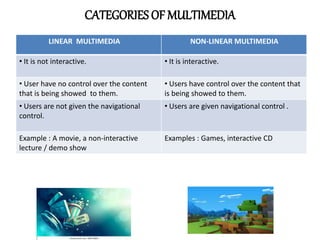
LINEAR MULTIMEDIA NON-LINEAR MULTIMEDIA
• It is not interactive. • It is interactive.
• User have no control over the content
that is being showed to them.
• Users have control over the content that
is being showed to them.
• Users are not given the navigational
control.
• Users are given navigational control .
Example : A movie, a non-interactive
lecture / demo show
Examples : Games, interactive CD
DEFINATION OF MULTIMEDIA
Multimedia is a representation of information in an
attractive and interactive manner with a use of a
combination of text, graphics, animation, audio and video.
In other words we can say that Multimedia is a
computerized method of presenting information combining
textual data, audio, video, graphics and animations. For
example: E-mail, Yahoo Messenger, Video Conferencing,
and Multimedia Message Service (MMS).
Multimedia as name suggests, it is the combination of
Multi and Media. There are many types of media
(hardware / software) used for communication of
information.
SCOPE OF MULTIMEDIA
 The technology of multimedia design utilizes various
features like animation, graphics, audio, video to impress
the users.
 Multimedia technology is used for 3D cinema applications
and mobile environments.
 Animation is also being used in titling films, creating special
effects or in web entertainment programs. Thus scope of
animation is huge in context to market.
 In the field of education multimedia is being used
extensively especially for online courses and trainings.
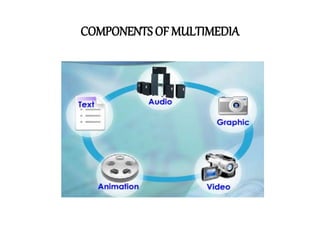
COMPONENTS OF MULTIMEDIA
• Text : All multimedia productions contain some amount of text.
The text can have various types of fonts and sizes that suits the
profession presentation of the multimedia software.
• Graphics: This makes the multimedia application attractive. In
many cases people do not like reading large amount of textual
matter on the screen.
• Audio: A multimedia application may require the use of speech,
music and sound effects. These are called audio or sound
element of multimedia.
• Video: The term video refers to the moving picture,
accompanied with sound such as a picture in television.
• Animation: It is the process of making the static image look
like it is moving. An animation is just a continuous series of
still images that are displayed in a sequence.
ADVANTAGES OF MULTIMEDIA
• Increases the learning effectiveness.
• Can learn the real world skills related to technology.
• Can be easier to understand.
• The importance of research, planning and organization skills.
• The impact and importance of different media.
• The significance of presentation and speaking skills.
DISADVANTAGES OF MULTIMEDIA
• It is time consuming.
• Amount of storage space required.
• It is not always easy to configure.
• Complex to create.
• Very expensive.
• Technological skills, for both the students and teachers.
APPLICATIONS OF MULTIMEDIA
• Multimedia in Business.
• Multimedia in Marketing and Advertising.
• Multimedia in Entertainment.
• Multimedia in Education.
• Multimedia in Bank.
• Multimedia in Hospital.
CONCLUSION
• Multimedia and graphics can be a very effective tool to
communicate, educate, compel and convince the
audiences.
• Multimedia can help to gain and hold attention, make
points clearer, stimulate discussion, and in general,
enhance the learning process, it also includes the
appropriate human elements.
Multimedia seminar (1)

Multimedia seminar (1)

  • 1.
    SUBJECT: EDUCATIONAL TECHNOLOGY SEMINARON: MULTIMEDIA KLE SOCIETY’S COLLEGE OF EDUCATION VIDYANAGAR HUBBALLI Submitted To: Veeresh A Kalakeri Submitted By: Rachana S Joshi B. Ed 1st Sem
  • 2.
    INTRODUCTION Multimedia is aninteractive media and provides multiple ways to represent information to the user in a powerful manner. It provides an interaction between users and digital information. It is a medium of communication. Today is the age of multimedia. We share a major part of our life with multimedia or its elements. Multimedia is an useful combination of two or more media. Media is a medium through which different form of information is transferred and can be understood in a constructive way.
  • 3.
    WHAT IS MULTIMEDIA? Multimediais a combination of text, graphics, sound, animation and video, that is delivered interactively to the user by electronically or digitally manipulated means. Multimedia is a media and content that uses a combination of different content forms.
  • 4.
    CATEGORIES OF MULTIMEDIA LINEARMULTIMEDIA NON-LINEAR MULTIMEDIA • It is not interactive. • It is interactive. • User have no control over the content that is being showed to them. • Users have control over the content that is being showed to them. • Users are not given the navigational control. • Users are given navigational control . Example : A movie, a non-interactive lecture / demo show Examples : Games, interactive CD
  • 5.
    DEFINATION OF MULTIMEDIA Multimediais a representation of information in an attractive and interactive manner with a use of a combination of text, graphics, animation, audio and video. In other words we can say that Multimedia is a computerized method of presenting information combining textual data, audio, video, graphics and animations. For example: E-mail, Yahoo Messenger, Video Conferencing, and Multimedia Message Service (MMS).
  • 6.
    Multimedia as namesuggests, it is the combination of Multi and Media. There are many types of media (hardware / software) used for communication of information.
  • 7.
    SCOPE OF MULTIMEDIA The technology of multimedia design utilizes various features like animation, graphics, audio, video to impress the users.  Multimedia technology is used for 3D cinema applications and mobile environments.  Animation is also being used in titling films, creating special effects or in web entertainment programs. Thus scope of animation is huge in context to market.  In the field of education multimedia is being used extensively especially for online courses and trainings.
  • 8.
  • 9.
    • Text :All multimedia productions contain some amount of text. The text can have various types of fonts and sizes that suits the profession presentation of the multimedia software. • Graphics: This makes the multimedia application attractive. In many cases people do not like reading large amount of textual matter on the screen. • Audio: A multimedia application may require the use of speech, music and sound effects. These are called audio or sound element of multimedia.
  • 10.
    • Video: Theterm video refers to the moving picture, accompanied with sound such as a picture in television. • Animation: It is the process of making the static image look like it is moving. An animation is just a continuous series of still images that are displayed in a sequence.
  • 11.
    ADVANTAGES OF MULTIMEDIA •Increases the learning effectiveness. • Can learn the real world skills related to technology. • Can be easier to understand. • The importance of research, planning and organization skills. • The impact and importance of different media. • The significance of presentation and speaking skills.
  • 12.
    DISADVANTAGES OF MULTIMEDIA •It is time consuming. • Amount of storage space required. • It is not always easy to configure. • Complex to create. • Very expensive. • Technological skills, for both the students and teachers.
  • 13.
    APPLICATIONS OF MULTIMEDIA •Multimedia in Business. • Multimedia in Marketing and Advertising. • Multimedia in Entertainment. • Multimedia in Education. • Multimedia in Bank. • Multimedia in Hospital.
  • 14.
    CONCLUSION • Multimedia andgraphics can be a very effective tool to communicate, educate, compel and convince the audiences. • Multimedia can help to gain and hold attention, make points clearer, stimulate discussion, and in general, enhance the learning process, it also includes the appropriate human elements.