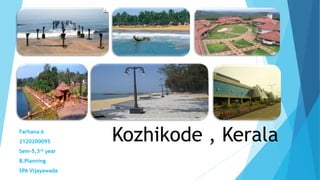
Kozhikode , Kerala Farhana.k 
2120200095 
Sem-5,3rd year 
B.Planning 
SPA Vijayawada
Kozhikode 
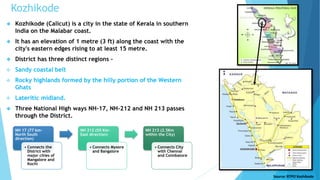
 Kozhikode (Calicut) is a city in the state of Kerala in southern 
India on the Malabar coast. 
 It has an elevation of 1 metre (3 ft) along the coast with the 
city's eastern edges rising to at least 15 metre. 
 District has three distinct regions – 
 Sandy coastal belt 
 Rocky highlands formed by the hilly portion of the Western 
Ghats 
 Lateritic midland. 
 Three National High ways NH-17, NH-212 and NH 213 passes 
through the District. 
Source: RTPO Kozhikode 
NH 17 (77 km- 
North South 
direction) 
• Connects the 
District with 
major cities of 
Mangalore and 
Kochi 
NH 212 (55 Km- 
East direction) 
• Connects Mysore 
and Bangalore 
NH 213 (2.5Km 
within the City) 
• Connects City 
with Chennai 
and Coimbatore
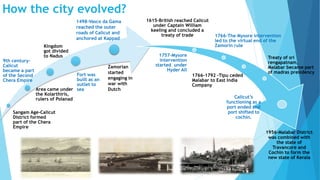
How the city evolved? 
9th century- 
Calicut 
became a part 
of the Second 
Chera Empire 
Kingdom 
got divided 
to Nadus 
Area came under 
the Kolarthiris, 
rulers of Polanad 
Sangam Age-Calicut 
District formed 
part of the Chera 
Empire 
Fort was 
built as an 
outlet to 
sea 
1615-British reached Calicut 
under Captain William 
keeling and concluded a 
treaty of trade 1766-The Mysore intervention 
led to the virtual end of the 
Zamorin rule 
1757-Mysore 
intervention 
started under 
Hyder Ali 
1766-1792 -Tipu ceded 
Malabar to East India 
Company 
Treaty of sri 
rengapatnam, 
Malabar became part 
of madras presidency 
Calicut’s 
functioning as a 
port ended and 
port shifted to 
cochin. 
1956-Malabar District 
was combined with 
the state of 
Travancore and 
Cochin to form the 
new state of Kerala 
1498-Vasco da Gama 
reached the outer 
roads of Calicut and 
anchored at Kappad 
Zamorian 
started 
engaging in 
war with 
Dutch
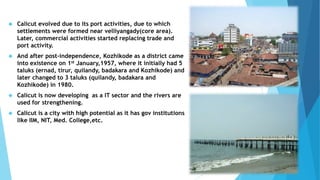
 Calicut evolved due to its port activities, due to which 
settlements were formed near velliyangady(core area). 
Later, commercial activities started replacing trade and 
port activity. 
 And after post-independence, Kozhikode as a district came 
into existence on 1st January,1957, where it initially had 5 
taluks (ernad, tirur, quilandy, badakara and Kozhikode) and 
later changed to 3 taluks (quilandy, badakara and 
Kozhikode) in 1980. 
 Calicut is now developing as a IT sector and the rivers are 
used for strengthening. 
 Calicut is a city with high potential as it has gov institutions 
like IIM, NIT, Med. College,etc.
Population Trends and Urbanization 
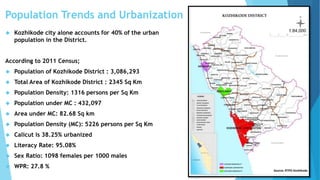
 Kozhikode city alone accounts for 40% of the urban 
population in the District. 
According to 2011 Census; 
 Population of Kozhikode District : 3,086,293 
 Total Area of Kozhikode District : 2345 Sq Km 
 Population Density: 1316 persons per Sq Km 
 Population under MC : 432,097 
 Area under MC: 82.68 Sq km 
 Population Density (MC): 5226 persons per Sq Km 
 Calicut is 38.25% urbanized 
 Literacy Rate: 95.08% 
 Sex Ratio: 1098 females per 1000 males 
 WPR: 27.8 % 
Source: RTPO Kozhikode
Economic Development 
Sectoral Growth 
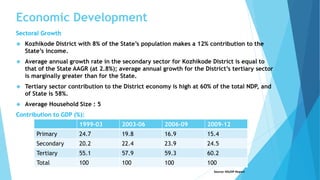
 Kozhikode District with 8% of the State’s population makes a 12% contribution to the 
State’s income. 
 Average annual growth rate in the secondary sector for Kozhikode District is equal to 
that of the State AAGR (at 2.8%); average annual growth for the District’s tertiary sector 
is marginally greater than for the State. 
 Tertiary sector contribution to the District economy is high at 60% of the total NDP, and 
of State is 58%. 
 Average Household Size : 5 
Contribution to GDP (%): 
1999-03 2003-06 2006-09 2009-12 
Primary 24.7 19.8 16.9 15.4 
Secondary 20.2 22.4 23.9 24.5 
Tertiary 55.1 57.9 59.3 60.2 
Total 100 100 100 100 
Source: KSUDP Report
Religion Composition 
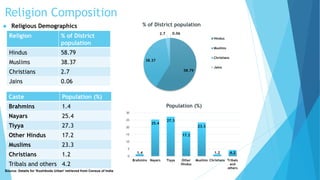
 Religious Demographics 
Religion % of District 
population 
Hindus 58.79 
Muslims 38.37 
Christians 2.7 
Jains 0.06 
Caste Population (%) 
Brahmins 1.4 
Nayars 25.4 
Tiyya 27.3 
Other Hindus 17.2 
Muslims 23.3 
Christians 1.2 
Tribals and others 4.2 
Source: Details for 'Kozhikode Urban' retrieved from Census of India 
% of District population 
1.4 
25.4 
27.3 
58.79 
17.2 
23.3 
1.2 4.2 
30 
25 
20 
15 
10 
5 
0 
Brahmins Nayars Tiyya Other 
Hindus 
Muslims Christians Tribals 
and 
others 
Population (%) 
38.37 
2.7 0.06 
Hindus 
Muslims 
Christians 
Jains
Population Growth and Projections 
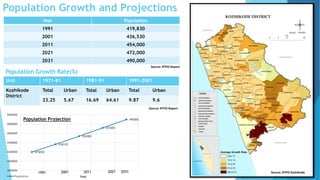
Year Population 
1991 419,830 
2001 436,530 
2011 454,000 
2021 472,000 
2031 490,000 
Population Growth Rate(%) 
Source: RTPO Report 
Unit 1971-81 1981-91 1991-2001 
419830 
436530 
454000 
472000 
490000 
500000 
480000 
460000 
440000 
420000 
400000 
380000 
Population Projection 
Population 
1991 2001 2011 2021 2031 Source: RTPO Kozhikode 
Kozhikode 
District 
Total Urban Total Urban Total Urban 
23.25 5.67 16.69 64.61 9.87 9.6 
Source: RTPO Report 
Year
Housing 
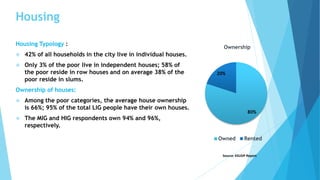
Housing Typology : 
 42% of all households in the city live in individual houses. 
 Only 3% of the poor live in independent houses; 58% of 
the poor reside in row houses and on average 38% of the 
poor reside in slums. 
Ownership of houses: 
 Among the poor categories, the average house ownership 
is 66%; 95% of the total LIG people have their own houses. 
 The MIG and HIG respondents own 94% and 96%, 
respectively. 
Ownership 
80% 
20% 
Owned Rented 
Source: KSUDP Report
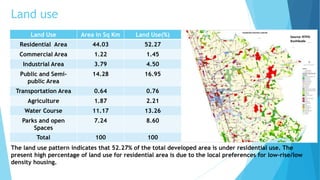
Land use 
Land Use Area in Sq Km Land Use(%) 
Residential Area 44.03 52.27 
Commercial Area 1.22 1.45 
Industrial Area 3.79 4.50 
Public and Semi-public 
Area 
14.28 16.95 
Transportation Area 0.64 0.76 
Agriculture 1.87 2.21 
Water Course 11.17 13.26 
Parks and open 
Spaces 
7.24 8.60 
Total 100 100 
Source: RTPO 
Kozhikode 
The land use pattern indicates that 52.27% of the total developed area is under residential use. The 
present high percentage of land use for residential area is due to the local preferences for low-rise/low 
density housing.
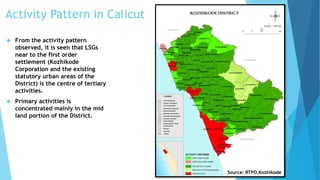
Activity Pattern in Calicut 
 From the activity pattern 
observed, it is seen that LSGs 
near to the first order 
settlement (Kozhikode 
Corporation and the existing 
statutory urban areas of the 
District) is the centre of tertiary 
activities. 
 Primary activities is 
concentrated mainly in the mid 
land portion of the District. 
Source: RTPO,Kozhikode
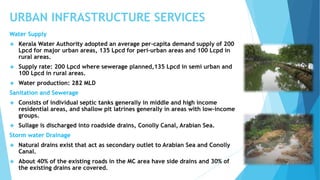
URBAN INFRASTRUCTURE SERVICES 
Water Supply 
 Kerala Water Authority adopted an average per-capita demand supply of 200 
Lpcd for major urban areas, 135 Lpcd for peri-urban areas and 100 Lcpd in 
rural areas. 
 Supply rate: 200 Lpcd where sewerage planned,135 Lpcd in semi urban and 
100 Lpcd in rural areas. 
 Water production: 282 MLD 
Sanitation and Sewerage 
 Consists of individual septic tanks generally in middle and high income 
residential areas, and shallow pit latrines generally in areas with low-income 
groups. 
 Sullage is discharged into roadside drains, Conolly Canal, Arabian Sea. 
Storm water Drainage 
 Natural drains exist that act as secondary outlet to Arabian Sea and Conolly 
Canal. 
 About 40% of the existing roads in the MC area have side drains and 30% of 
the existing drains are covered.
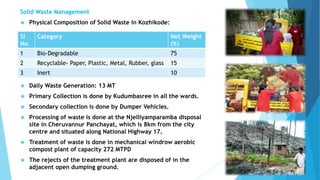
Solid Waste Management 
 Physical Composition of Solid Waste in Kozhikode: 
Sl 
No. 
Category Net Weight 
 Daily Waste Generation: 13 MT 
 Primary Collection is done by Kudumbasree in all the wards. 
 Secondary collection is done by Dumper Vehicles. 
 Processing of waste is done at the Njelliyamparamba disposal 
site in Cheruvannur Panchayat, which is 8km from the city 
centre and situated along National Highway 17. 
 Treatment of waste is done in mechanical windrow aerobic 
compost plant of capacity 272 MTPD 
 The rejects of the treatment plant are disposed of in the 
adjacent open dumping ground. 
(%) 
1 Bio-Degradable 75 
2 Recyclable- Paper, Plastic, Metal, Rubber, glass 15 
3 Inert 10
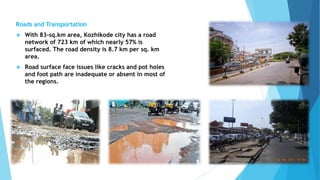
Roads and Transportation 
 With 83-sq.km area, Kozhikode city has a road 
network of 723 km of which nearly 57% is 
surfaced. The road density is 8.7 km per sq. km 
area. 
 Road surface face issues like cracks and pot holes 
and foot path are inadequate or absent in most of 
the regions.
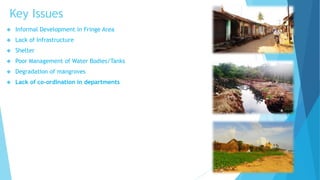
Key Issues 
 Informal Development in Fringe Area 
 Lack of Infrastructure 
 Shelter 
 Poor Management of Water Bodies/Tanks 
 Degradation of mangroves 
 Lack of co-ordination in departments

Calicut city profile

  • 1.
    Kozhikode , KeralaFarhana.k 2120200095 Sem-5,3rd year B.Planning SPA Vijayawada
  • 2.
    Kozhikode  Kozhikode(Calicut) is a city in the state of Kerala in southern India on the Malabar coast.  It has an elevation of 1 metre (3 ft) along the coast with the city's eastern edges rising to at least 15 metre.  District has three distinct regions –  Sandy coastal belt  Rocky highlands formed by the hilly portion of the Western Ghats  Lateritic midland.  Three National High ways NH-17, NH-212 and NH 213 passes through the District. Source: RTPO Kozhikode NH 17 (77 km- North South direction) • Connects the District with major cities of Mangalore and Kochi NH 212 (55 Km- East direction) • Connects Mysore and Bangalore NH 213 (2.5Km within the City) • Connects City with Chennai and Coimbatore
  • 3.
    How the cityevolved? 9th century- Calicut became a part of the Second Chera Empire Kingdom got divided to Nadus Area came under the Kolarthiris, rulers of Polanad Sangam Age-Calicut District formed part of the Chera Empire Fort was built as an outlet to sea 1615-British reached Calicut under Captain William keeling and concluded a treaty of trade 1766-The Mysore intervention led to the virtual end of the Zamorin rule 1757-Mysore intervention started under Hyder Ali 1766-1792 -Tipu ceded Malabar to East India Company Treaty of sri rengapatnam, Malabar became part of madras presidency Calicut’s functioning as a port ended and port shifted to cochin. 1956-Malabar District was combined with the state of Travancore and Cochin to form the new state of Kerala 1498-Vasco da Gama reached the outer roads of Calicut and anchored at Kappad Zamorian started engaging in war with Dutch
  • 4.
     Calicut evolveddue to its port activities, due to which settlements were formed near velliyangady(core area). Later, commercial activities started replacing trade and port activity.  And after post-independence, Kozhikode as a district came into existence on 1st January,1957, where it initially had 5 taluks (ernad, tirur, quilandy, badakara and Kozhikode) and later changed to 3 taluks (quilandy, badakara and Kozhikode) in 1980.  Calicut is now developing as a IT sector and the rivers are used for strengthening.  Calicut is a city with high potential as it has gov institutions like IIM, NIT, Med. College,etc.
  • 5.
    Population Trends andUrbanization  Kozhikode city alone accounts for 40% of the urban population in the District. According to 2011 Census;  Population of Kozhikode District : 3,086,293  Total Area of Kozhikode District : 2345 Sq Km  Population Density: 1316 persons per Sq Km  Population under MC : 432,097  Area under MC: 82.68 Sq km  Population Density (MC): 5226 persons per Sq Km  Calicut is 38.25% urbanized  Literacy Rate: 95.08%  Sex Ratio: 1098 females per 1000 males  WPR: 27.8 % Source: RTPO Kozhikode
  • 6.
    Economic Development SectoralGrowth  Kozhikode District with 8% of the State’s population makes a 12% contribution to the State’s income.  Average annual growth rate in the secondary sector for Kozhikode District is equal to that of the State AAGR (at 2.8%); average annual growth for the District’s tertiary sector is marginally greater than for the State.  Tertiary sector contribution to the District economy is high at 60% of the total NDP, and of State is 58%.  Average Household Size : 5 Contribution to GDP (%): 1999-03 2003-06 2006-09 2009-12 Primary 24.7 19.8 16.9 15.4 Secondary 20.2 22.4 23.9 24.5 Tertiary 55.1 57.9 59.3 60.2 Total 100 100 100 100 Source: KSUDP Report
  • 7.
    Religion Composition Religious Demographics Religion % of District population Hindus 58.79 Muslims 38.37 Christians 2.7 Jains 0.06 Caste Population (%) Brahmins 1.4 Nayars 25.4 Tiyya 27.3 Other Hindus 17.2 Muslims 23.3 Christians 1.2 Tribals and others 4.2 Source: Details for 'Kozhikode Urban' retrieved from Census of India % of District population 1.4 25.4 27.3 58.79 17.2 23.3 1.2 4.2 30 25 20 15 10 5 0 Brahmins Nayars Tiyya Other Hindus Muslims Christians Tribals and others Population (%) 38.37 2.7 0.06 Hindus Muslims Christians Jains
  • 8.
    Population Growth andProjections Year Population 1991 419,830 2001 436,530 2011 454,000 2021 472,000 2031 490,000 Population Growth Rate(%) Source: RTPO Report Unit 1971-81 1981-91 1991-2001 419830 436530 454000 472000 490000 500000 480000 460000 440000 420000 400000 380000 Population Projection Population 1991 2001 2011 2021 2031 Source: RTPO Kozhikode Kozhikode District Total Urban Total Urban Total Urban 23.25 5.67 16.69 64.61 9.87 9.6 Source: RTPO Report Year
  • 9.
    Housing Housing Typology:  42% of all households in the city live in individual houses.  Only 3% of the poor live in independent houses; 58% of the poor reside in row houses and on average 38% of the poor reside in slums. Ownership of houses:  Among the poor categories, the average house ownership is 66%; 95% of the total LIG people have their own houses.  The MIG and HIG respondents own 94% and 96%, respectively. Ownership 80% 20% Owned Rented Source: KSUDP Report
  • 10.
    Land use LandUse Area in Sq Km Land Use(%) Residential Area 44.03 52.27 Commercial Area 1.22 1.45 Industrial Area 3.79 4.50 Public and Semi-public Area 14.28 16.95 Transportation Area 0.64 0.76 Agriculture 1.87 2.21 Water Course 11.17 13.26 Parks and open Spaces 7.24 8.60 Total 100 100 Source: RTPO Kozhikode The land use pattern indicates that 52.27% of the total developed area is under residential use. The present high percentage of land use for residential area is due to the local preferences for low-rise/low density housing.
  • 11.
    Activity Pattern inCalicut  From the activity pattern observed, it is seen that LSGs near to the first order settlement (Kozhikode Corporation and the existing statutory urban areas of the District) is the centre of tertiary activities.  Primary activities is concentrated mainly in the mid land portion of the District. Source: RTPO,Kozhikode
  • 12.
    URBAN INFRASTRUCTURE SERVICES Water Supply  Kerala Water Authority adopted an average per-capita demand supply of 200 Lpcd for major urban areas, 135 Lpcd for peri-urban areas and 100 Lcpd in rural areas.  Supply rate: 200 Lpcd where sewerage planned,135 Lpcd in semi urban and 100 Lpcd in rural areas.  Water production: 282 MLD Sanitation and Sewerage  Consists of individual septic tanks generally in middle and high income residential areas, and shallow pit latrines generally in areas with low-income groups.  Sullage is discharged into roadside drains, Conolly Canal, Arabian Sea. Storm water Drainage  Natural drains exist that act as secondary outlet to Arabian Sea and Conolly Canal.  About 40% of the existing roads in the MC area have side drains and 30% of the existing drains are covered.
  • 13.
    Solid Waste Management  Physical Composition of Solid Waste in Kozhikode: Sl No. Category Net Weight  Daily Waste Generation: 13 MT  Primary Collection is done by Kudumbasree in all the wards.  Secondary collection is done by Dumper Vehicles.  Processing of waste is done at the Njelliyamparamba disposal site in Cheruvannur Panchayat, which is 8km from the city centre and situated along National Highway 17.  Treatment of waste is done in mechanical windrow aerobic compost plant of capacity 272 MTPD  The rejects of the treatment plant are disposed of in the adjacent open dumping ground. (%) 1 Bio-Degradable 75 2 Recyclable- Paper, Plastic, Metal, Rubber, glass 15 3 Inert 10
  • 14.
    Roads and Transportation  With 83-sq.km area, Kozhikode city has a road network of 723 km of which nearly 57% is surfaced. The road density is 8.7 km per sq. km area.  Road surface face issues like cracks and pot holes and foot path are inadequate or absent in most of the regions.
  • 15.
    Key Issues Informal Development in Fringe Area  Lack of Infrastructure  Shelter  Poor Management of Water Bodies/Tanks  Degradation of mangroves  Lack of co-ordination in departments