Blue Brain
Presented By:
Ravisha Sethi
Contents
 Introduction
 Blue Brain
 Virtual Brain
 Function of Natural Brain
 Brain Simulation
 Current Research Work
Introduction
• Human brain, the most
valuable creation of God.
• The intelligence of a person is
lost after his/her death.
• Is there any solution for this ?
Blue Brain
• First virtual Brain.
• Its aim is to upload a
human brain into a
machine.
Virtual Brain
• IBM is developing a
virtual brain.
• A machine that can
function as our Brain.
• An Artificial Brain.
Need Of Virtual Brain
• To upload the contents
of human brain.
• To remember things
without any effort.
• To keep a person’s
intelligence/skill alive
Brain Simulation
Natural Brain vs. Artificial Brain
INPUT
• Through the natural
neurons
INTERPRETATION
• By different states of
the neurons in the brain
INPUT
• Through the silicon chip
or artificial neurons.
INTERPRETATION
• By a set of bits in the
set of register
Cont’d
OUTPUT
• Through the natural
neurons.
PROCESSING
• Through arithmetic and
logical calculations
OUTPUT
• Through the silicon
chip.
PROCESSING
• Through arithmetic and
logical calculation and
artificial intelligence
Cont’d
MEMORY
• Through permanent
states of neurons
MEMORY
• Through Secondary
memory
Uploading Human Brain
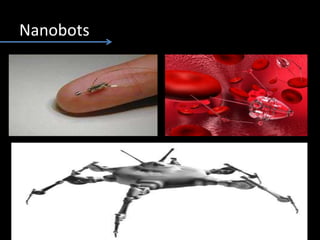
• Use of small robots
known as the Nanobots.
• Robots are small enough
to travel through out our
circulatory system.
• Provide an interface with
computer
Uploading Human Brain
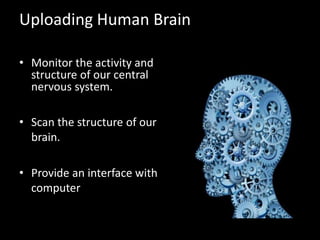
• Monitor the activity and
structure of our central
nervous system.
• Scan the structure of our
brain.
• Provide an interface with
computer
Nanobots
Examples
• Utilization of Blue brain in
the case of “Short Term
Memory”.
• When a person gets
older,then he/she starts
forgetting.
• Great Inventory Brains
can be reused for further
inventions and expansion
of technology.
Current Research Work
• IBM developing the
“Blue brain” .
• Partnership with EPFL
Brain & Mind Institute.
Software & Hardware Requirements
• A Super computer.
• Memory with a very
large storing capacity.
• Processor with a very
high processing
power.
• Very powerful
Nanobots
Advantages
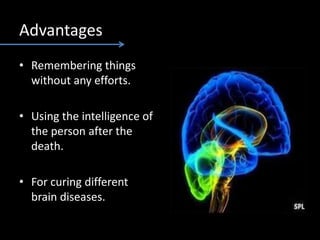
• Remembering things
without any efforts.
• Using the intelligence of
the person after the
death.
• For curing different
brain diseases.
Limitations
• Dependent upon the
computers.
• Very costly procedure of
regaining the memory
back.
• Computer viruses will
pose an increasingly
critical threat.
Conclusion

Blue brain

  • 1.
  • 2.
    Contents  Introduction  BlueBrain  Virtual Brain  Function of Natural Brain  Brain Simulation  Current Research Work
  • 3.
    Introduction • Human brain,the most valuable creation of God. • The intelligence of a person is lost after his/her death. • Is there any solution for this ?
  • 4.
    Blue Brain • Firstvirtual Brain. • Its aim is to upload a human brain into a machine.
  • 5.
    Virtual Brain • IBMis developing a virtual brain. • A machine that can function as our Brain. • An Artificial Brain.
  • 6.
    Need Of VirtualBrain • To upload the contents of human brain. • To remember things without any effort. • To keep a person’s intelligence/skill alive
  • 7.
    Brain Simulation Natural Brainvs. Artificial Brain INPUT • Through the natural neurons INTERPRETATION • By different states of the neurons in the brain INPUT • Through the silicon chip or artificial neurons. INTERPRETATION • By a set of bits in the set of register
  • 8.
    Cont’d OUTPUT • Through thenatural neurons. PROCESSING • Through arithmetic and logical calculations OUTPUT • Through the silicon chip. PROCESSING • Through arithmetic and logical calculation and artificial intelligence
  • 9.
    Cont’d MEMORY • Through permanent statesof neurons MEMORY • Through Secondary memory
  • 10.
    Uploading Human Brain •Use of small robots known as the Nanobots. • Robots are small enough to travel through out our circulatory system. • Provide an interface with computer
  • 11.
    Uploading Human Brain •Monitor the activity and structure of our central nervous system. • Scan the structure of our brain. • Provide an interface with computer
  • 12.
  • 13.
    Examples • Utilization ofBlue brain in the case of “Short Term Memory”. • When a person gets older,then he/she starts forgetting. • Great Inventory Brains can be reused for further inventions and expansion of technology.
  • 14.
    Current Research Work •IBM developing the “Blue brain” . • Partnership with EPFL Brain & Mind Institute.
  • 15.
    Software & HardwareRequirements • A Super computer. • Memory with a very large storing capacity. • Processor with a very high processing power. • Very powerful Nanobots
  • 16.
    Advantages • Remembering things withoutany efforts. • Using the intelligence of the person after the death. • For curing different brain diseases.
  • 17.
    Limitations • Dependent uponthe computers. • Very costly procedure of regaining the memory back. • Computer viruses will pose an increasingly critical threat.
  • 18.

Editor's Notes

  • #6 Possible by using Super ComputersIt can take decision.It can think.It can respond.It can keep things in memory.
  • #11 These robots are small enough totravel through out our circulatory system.Traveling into the spine and brain, they will be able to monitor the activity and structure of our central nervous system.They will be able to provide an interface with computer that is as close as our mind can be while we still reside in our biological form .
  • #12 Nanobots could also carefully scan the structure of our brain, providing a complete readout of the connection.This information, when entered into a computer, could then continue to function as us.Thus the data stored in the entire brain will be uploaded into the computer.
  • #15 IBM, in partnership with scientists at Switzerland’s EcolePolytechniqueFederale De Lausanne’s(EPFL) Brain and Mind Institute will begin simulating the brain’s biological systems
  • #16 Very powerful Nanobots to act as the interface between the natural brain and the computer.A program to convert the electric impulses from the brain to input signal, which is to be received by the computer and vice versa.
  • #17 Allowing the deaf to hear via direct nerve simulation.
  • #18 Another fear is found with respect to human cloning.