International Research Journal of Engineering and Technology (IRJET) e-ISSN: 2395-0056
Volume: 05 Issue: 10 | Oct 2018 www.irjet.net p-ISSN: 2395-0072
© 2018, IRJET | Impact Factor value: 7.211 | ISO 9001:2008 Certified Journal | Page 674
Smart Drip Irrigation System using IOT
Gaikwad Tararani1, Gandule Shital2, Korabu Sofiya3 , Pawar Gouri 4 ,Prof.Vasekar S.R.5
1,2,3,4Student, Department of Computer Science and Engineering, SMSMPITR, Akluj, Maharashtra, India,
5Assistant Professor, Department of Computer science and Engineering, SMSMPITR, Akluj, Maharashtra, India.
---------------------------------------------------------------------***---------------------------------------------------------------------
Abstract: Water is the importantsourceinhumanlife. Around
80 % to 90 % water used in agriculture field. As due to day by
day growth in globalization and population water
consumption is also increases. Today automation is one of the
important roles in agriculture field. Agricultureistheprimary
occupation in our country. India’s major income source is
depending on agriculture therefore the development of
agriculture is important. In today also most of the irrigation
systems are operated manually. The available traditional
techniques are like drip irrigation, sprinkler irrigation etc. By
the use of Drip Irrigation we can save water and fertilizer
provided to the crops. Whenever there is a change in
temperature, humidity and current status of rain of the
surroundings these sensors senses the change in temperature
and humidity and gives an interrupt signal totheraspberrypi.
This paper focuses primarily on reducingthewastageof water
and minimizing the manual laboronfieldforirrigationso that
you can save time, cash and power of the farmer.
Key Words: Raspberry Pi, Sensors, Drip Irrigation,
automation
1. INTRODUCTION
India is the country of village and agriculture plays an
important role for development of country. In our country,
agriculture depends on the monsoons which hasinsufficient
source of water. So the irrigation is used in agriculture field.
In Irrigation system, depending upon the soil type, water is
provided to plant. In agriculture, two things are very
important, first to get informationofaboutthefertilityof soil
and second to measure moisture content in soil. Nowadays,
for irrigation, different techniques are available which are
used to reduce the dependency of rain. And mostly this
technique is driven by electrical power and on/off
scheduling. In this technique, water level indicator placed in
water reservoir and soil moisture sensors are placed root
zone of plant and near the module unit handles the sensor
information and transmit data to the controller which in
turns the control the flow of water through the valves.
2. LIERATURE SURVEY
In[1] October 2017 .V. Vinoth Kumar, R.Ramasamy,
S.Janarthanan, M. VasimBabu anther tells that proposed
Irrigation system IoT is implemented, in this system all the
information that are received from the sensors and the
various parameters are given to the arduinouno
microcontroller as an analog input. A preset value of soil
moisture sensor is fixed in microcontroller and also for
fencing.
In[2] February 2017 ,Srishti Rawal author tells that
Automation of farm activities can transform agricultural
domain from being manual and static to intelligent and
dynamic leading to higher production with lesser human
supervision. This paper proposes an automated irrigation
system which monitors and maintains the desired soil
moisture content via automatic watering. Microcontroller
ATMEGA328P on Arduino platform is usedtoimplement the
control unit. The setup uses soil moisture sensors which
measure the exact moisture level in soil.
In [3] September 2017, Arif Gori, Manglesh author tells
about As water supply is becoming scarce in today’s world
there is an urgency of adopting smart ways of irrigation.The
project describes how irrigation can be handled smartly
using IOT. This project aims at saving time and avoiding
problems like constant vigilance. It also helps in conserving
water by automatically providing water to the plants/field
depending on the water requirements. This system can also
prove to be helpful in agriculture, parks and lawns.
In [4] March 2017, Dr.S.Jothi Muneeswari author tells about
automatic irrigation system using the Arduino
microcontroller with moisture sensor and water flow
management. The humidity sensor unit consists of an
Arduino board, Wi-Fi unit, Humidity sensor and water flow
control mechanism. The data taken from Humidity sensor
will be sending to data monitoringsystem byarduinoboards
over a wireless network using WiFi. At Monitoring system,
the humidity levels are monitored and any decrease in
humidity level below a limit will be reported as requirement
for water and signal is raised to the entire humidity sensor
unit to open the water flow management. Also, Humidity
level in agricultural field can be checked any time through
the web portal.
International Research Journal of Engineering and Technology (IRJET) e-ISSN: 2395-0056
Volume: 05 Issue: 10 | Oct 2018 www.irjet.net p-ISSN: 2395-0072
© 2018, IRJET | Impact Factor value: 7.211 | ISO 9001:2008 Certified Journal | Page 675
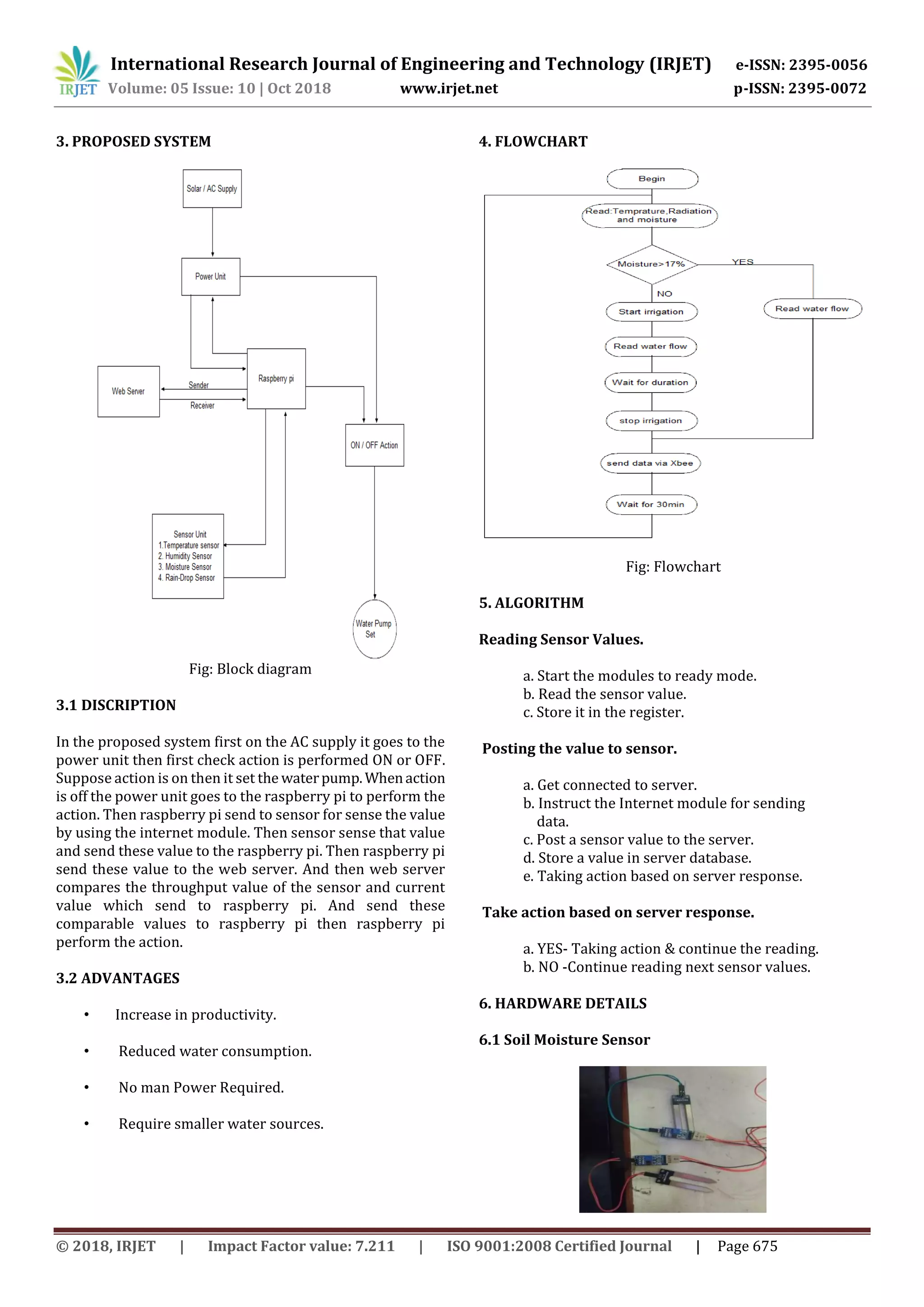
3. PROPOSED SYSTEM
Fig: Block diagram
3.1 DISCRIPTION
In the proposed system first on the AC supply it goes to the
power unit then first check action is performed ON or OFF.
Suppose action is on then it set the waterpump.Whenaction
is off the power unit goes to the raspberry pi to perform the
action. Then raspberry pi send to sensor for sense the value
by using the internet module. Then sensor sense that value
and send these value to the raspberry pi. Then raspberry pi
send these value to the web server. And then web server
compares the throughput value of the sensor and current
value which send to raspberry pi. And send these
comparable values to raspberry pi then raspberry pi
perform the action.
3.2 ADVANTAGES
• Increase in productivity.
• Reduced water consumption.
• No man Power Required.
• Require smaller water sources.
4. FLOWCHART
Fig: Flowchart
5. ALGORITHM
Reading Sensor Values.
a. Start the modules to ready mode.
b. Read the sensor value.
c. Store it in the register.
Posting the value to sensor.
a. Get connected to server.
b. Instruct the Internet module for sending
data.
c. Post a sensor value to the server.
d. Store a value in server database.
e. Taking action based on server response.
Take action based on server response.
a. YES- Taking action & continue the reading.
b. NO -Continue reading next sensor values.
6. HARDWARE DETAILS
6.1 Soil Moisture Sensor
International Research Journal of Engineering and Technology (IRJET) e-ISSN: 2395-0056
Volume: 05 Issue: 10 | Oct 2018 www.irjet.net p-ISSN: 2395-0072
© 2018, IRJET | Impact Factor value: 7.211 | ISO 9001:2008 Certified Journal | Page 676
Soil Moisture Sensor measures the water content in the soil.
In this project the soil moisture sensor is usedtomanagethe
irrigation system more efficiently.
6.2 Temperature sensor
Temperature sensor is used to detect the temperature of
soil as well as atmosphere.
6.3 Humidity sensor
Humidity sensor is used for sense the humidity in climate.
6.4 Rain drop sensor
Rain drop sensor is used for rain detection. It can be used
when raindrop falls. It also measures the rainfall intensity.
6.5 Raspberry pi 3 model B
This is a latest model of raspberry pi. In this model the
internet module is in built. Storage capacity of these models
is more as compare to old model.
6.6 DC motor pump
DC motor pump is used for pumping the water.
7. CONCLUSION
Automated drip irrigationis themost beneficial approachfor
the farmers. This system reduces the extra manpower tothe
farmer for his farm work like supplying water to plants,
safeguard the crop from intruders. The smart irrigation
system is suitable and cost effective for advance water
resources for agricultural production. The system would
provide feedback control system which will monitor and
control all the activities of plant growth and irrigation
system efficiently.
REFERENCES
[1] V. Vinoth Kumar, R.Ramasamy, S.Janarthanan, M.
VasimBabu “IMPLEMENTATION OF IOT IN SMART
IRRIGATION SYSTEM USING ARDUINO PROCESSOR”,
International Journal of Civil Engineering and Technology.
October 2017.
[2] Srishti Rawal “IOT based Smart Irrigation System”
International Journal of Computer applications (0975 –
8887) February 2017.
[3] Arif Gori, Manglesh Smart Irrigation System using IOT”
International Journal of Advanced Research in Computer
and Communication Engineering, September 2017.
[4] Dr.S.Jothi Muneeswari1 “Smart Irrigation System using
Iot approach” International Journal of EngineeringResearch
& Science (IJOER) march 2017.

IRJET- Smart Drip Irrigation System using IoT

  • 1.
    International Research Journalof Engineering and Technology (IRJET) e-ISSN: 2395-0056 Volume: 05 Issue: 10 | Oct 2018 www.irjet.net p-ISSN: 2395-0072 © 2018, IRJET | Impact Factor value: 7.211 | ISO 9001:2008 Certified Journal | Page 674 Smart Drip Irrigation System using IOT Gaikwad Tararani1, Gandule Shital2, Korabu Sofiya3 , Pawar Gouri 4 ,Prof.Vasekar S.R.5 1,2,3,4Student, Department of Computer Science and Engineering, SMSMPITR, Akluj, Maharashtra, India, 5Assistant Professor, Department of Computer science and Engineering, SMSMPITR, Akluj, Maharashtra, India. ---------------------------------------------------------------------***--------------------------------------------------------------------- Abstract: Water is the importantsourceinhumanlife. Around 80 % to 90 % water used in agriculture field. As due to day by day growth in globalization and population water consumption is also increases. Today automation is one of the important roles in agriculture field. Agricultureistheprimary occupation in our country. India’s major income source is depending on agriculture therefore the development of agriculture is important. In today also most of the irrigation systems are operated manually. The available traditional techniques are like drip irrigation, sprinkler irrigation etc. By the use of Drip Irrigation we can save water and fertilizer provided to the crops. Whenever there is a change in temperature, humidity and current status of rain of the surroundings these sensors senses the change in temperature and humidity and gives an interrupt signal totheraspberrypi. This paper focuses primarily on reducingthewastageof water and minimizing the manual laboronfieldforirrigationso that you can save time, cash and power of the farmer. Key Words: Raspberry Pi, Sensors, Drip Irrigation, automation 1. INTRODUCTION India is the country of village and agriculture plays an important role for development of country. In our country, agriculture depends on the monsoons which hasinsufficient source of water. So the irrigation is used in agriculture field. In Irrigation system, depending upon the soil type, water is provided to plant. In agriculture, two things are very important, first to get informationofaboutthefertilityof soil and second to measure moisture content in soil. Nowadays, for irrigation, different techniques are available which are used to reduce the dependency of rain. And mostly this technique is driven by electrical power and on/off scheduling. In this technique, water level indicator placed in water reservoir and soil moisture sensors are placed root zone of plant and near the module unit handles the sensor information and transmit data to the controller which in turns the control the flow of water through the valves. 2. LIERATURE SURVEY In[1] October 2017 .V. Vinoth Kumar, R.Ramasamy, S.Janarthanan, M. VasimBabu anther tells that proposed Irrigation system IoT is implemented, in this system all the information that are received from the sensors and the various parameters are given to the arduinouno microcontroller as an analog input. A preset value of soil moisture sensor is fixed in microcontroller and also for fencing. In[2] February 2017 ,Srishti Rawal author tells that Automation of farm activities can transform agricultural domain from being manual and static to intelligent and dynamic leading to higher production with lesser human supervision. This paper proposes an automated irrigation system which monitors and maintains the desired soil moisture content via automatic watering. Microcontroller ATMEGA328P on Arduino platform is usedtoimplement the control unit. The setup uses soil moisture sensors which measure the exact moisture level in soil. In [3] September 2017, Arif Gori, Manglesh author tells about As water supply is becoming scarce in today’s world there is an urgency of adopting smart ways of irrigation.The project describes how irrigation can be handled smartly using IOT. This project aims at saving time and avoiding problems like constant vigilance. It also helps in conserving water by automatically providing water to the plants/field depending on the water requirements. This system can also prove to be helpful in agriculture, parks and lawns. In [4] March 2017, Dr.S.Jothi Muneeswari author tells about automatic irrigation system using the Arduino microcontroller with moisture sensor and water flow management. The humidity sensor unit consists of an Arduino board, Wi-Fi unit, Humidity sensor and water flow control mechanism. The data taken from Humidity sensor will be sending to data monitoringsystem byarduinoboards over a wireless network using WiFi. At Monitoring system, the humidity levels are monitored and any decrease in humidity level below a limit will be reported as requirement for water and signal is raised to the entire humidity sensor unit to open the water flow management. Also, Humidity level in agricultural field can be checked any time through the web portal.
  • 2.
    International Research Journalof Engineering and Technology (IRJET) e-ISSN: 2395-0056 Volume: 05 Issue: 10 | Oct 2018 www.irjet.net p-ISSN: 2395-0072 © 2018, IRJET | Impact Factor value: 7.211 | ISO 9001:2008 Certified Journal | Page 675 3. PROPOSED SYSTEM Fig: Block diagram 3.1 DISCRIPTION In the proposed system first on the AC supply it goes to the power unit then first check action is performed ON or OFF. Suppose action is on then it set the waterpump.Whenaction is off the power unit goes to the raspberry pi to perform the action. Then raspberry pi send to sensor for sense the value by using the internet module. Then sensor sense that value and send these value to the raspberry pi. Then raspberry pi send these value to the web server. And then web server compares the throughput value of the sensor and current value which send to raspberry pi. And send these comparable values to raspberry pi then raspberry pi perform the action. 3.2 ADVANTAGES • Increase in productivity. • Reduced water consumption. • No man Power Required. • Require smaller water sources. 4. FLOWCHART Fig: Flowchart 5. ALGORITHM Reading Sensor Values. a. Start the modules to ready mode. b. Read the sensor value. c. Store it in the register. Posting the value to sensor. a. Get connected to server. b. Instruct the Internet module for sending data. c. Post a sensor value to the server. d. Store a value in server database. e. Taking action based on server response. Take action based on server response. a. YES- Taking action & continue the reading. b. NO -Continue reading next sensor values. 6. HARDWARE DETAILS 6.1 Soil Moisture Sensor
  • 3.
    International Research Journalof Engineering and Technology (IRJET) e-ISSN: 2395-0056 Volume: 05 Issue: 10 | Oct 2018 www.irjet.net p-ISSN: 2395-0072 © 2018, IRJET | Impact Factor value: 7.211 | ISO 9001:2008 Certified Journal | Page 676 Soil Moisture Sensor measures the water content in the soil. In this project the soil moisture sensor is usedtomanagethe irrigation system more efficiently. 6.2 Temperature sensor Temperature sensor is used to detect the temperature of soil as well as atmosphere. 6.3 Humidity sensor Humidity sensor is used for sense the humidity in climate. 6.4 Rain drop sensor Rain drop sensor is used for rain detection. It can be used when raindrop falls. It also measures the rainfall intensity. 6.5 Raspberry pi 3 model B This is a latest model of raspberry pi. In this model the internet module is in built. Storage capacity of these models is more as compare to old model. 6.6 DC motor pump DC motor pump is used for pumping the water. 7. CONCLUSION Automated drip irrigationis themost beneficial approachfor the farmers. This system reduces the extra manpower tothe farmer for his farm work like supplying water to plants, safeguard the crop from intruders. The smart irrigation system is suitable and cost effective for advance water resources for agricultural production. The system would provide feedback control system which will monitor and control all the activities of plant growth and irrigation system efficiently. REFERENCES [1] V. Vinoth Kumar, R.Ramasamy, S.Janarthanan, M. VasimBabu “IMPLEMENTATION OF IOT IN SMART IRRIGATION SYSTEM USING ARDUINO PROCESSOR”, International Journal of Civil Engineering and Technology. October 2017. [2] Srishti Rawal “IOT based Smart Irrigation System” International Journal of Computer applications (0975 – 8887) February 2017. [3] Arif Gori, Manglesh Smart Irrigation System using IOT” International Journal of Advanced Research in Computer and Communication Engineering, September 2017. [4] Dr.S.Jothi Muneeswari1 “Smart Irrigation System using Iot approach” International Journal of EngineeringResearch & Science (IJOER) march 2017.