


IOT Based Smart Irrigation Using Thingspeak Technology
Submitted by
K.PENCHALANARASAIAH 1610225
S.SWAMY NAIK 1610249
K.SREEVANI 1610264
K.GANGALAKSHMI 1610226
A.VYSHNAVI 1610202
Under the esteemed guidance of
Mr. D.PURUSHOTHAM REDDY, M. Tech
Lecturer, Department of ECE ,SKUCET
DEPARTMENT OF ELECTRONICS & COMMUNICATION ENGINEERING
SRI KRISHNADEVARAYA UNIVERSITY
COLLEGE OF ENGINEERING & TECHNOLOGY
ANANTAPURAMU-515003
ANDHRAPRADESH
•Introduction
•Block Diagram
•Circuit Diagram
•Components Required
•Working
•Advantages
•Application
•Conclusion
•Future Scope
India's population crossing 1.3 billion in 2016 So balance
between the optimum population growth and a healthy of
nation is far to be achieved. The rising population need for
increased agricultural production Irrigated agriculture has
been important source increased agricultural production “IOT
based smart irrigation system” is for to create an IOT base
automated irrigation mechanism which turns the pumping
motor ON and OFF pass command through IOT platform.
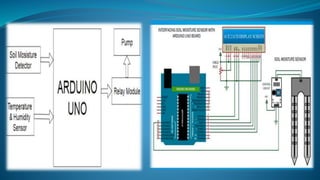
Hardware Components
1. Arduino UNO ATMega128p
2. Soil Moisture Sensor
3. DHT11 Sensor
4. Relay
5. Wi-Fi Module ESP8266
Software Tools
• Arduino.CC
Hardware:-Arduino
Arduino board designs use a variety of
microprocessors and controllers in
systems
1) To read input – light on a sensor
2)To twitter message – and turn it into an
output – activating a motor
3)Turning on an LED
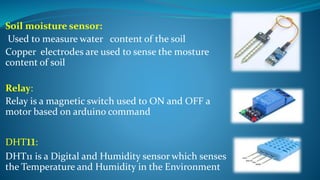
Soil moisture sensor:
Used to measure water content of the soil
Copper electrodes are used to sense the mosture
content of soil
Relay:
Relay is a magnetic switch used to ON and OFF a
motor based on arduino command
DHT11:
DHT11 is a Digital and Humidity sensor which senses
the Temperature and Humidity in the Environment
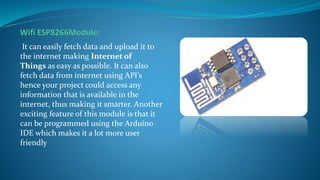
It can easily fetch data and upload it to
the internet making Internet of
Things as easy as possible. It can also
fetch data from internet using API’s
hence your project could access any
information that is available in the
internet, thus making it smarter. Another
exciting feature of this module is that it
can be programmed using the Arduino
IDE which makes it a lot more user
friendly
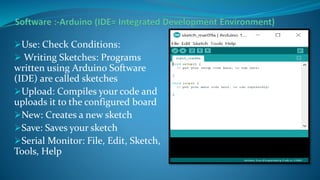
Use: Check Conditions:
 Writing Sketches: Programs
written using Arduino Software
(IDE) are called sketches
Upload: Compiles your code and
uploads it to the configured board
New: Creates a new sketch
Save: Saves your sketch
Serial Monitor: File, Edit, Sketch,
Tools, Help
Complexity : The IOT is a diverse and complex network
 Privacy/Security
 Lesser Employment of Manual Staff or unskilled
workers
 Equipment is costlier
 Awareness of Indian farmer for this technology
• Smart irrigation plays an important role in making agriculture
processes effective and efficient. And it helps farmers to prevent
water wastage during irrigation.
• These smart irrigation techniques enhance the overall quality
and quantity of crops by: Irrigating crops as per schedule.
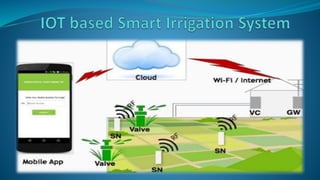
• The Smart Irrigation System is an IoT based device which is
capable of automating the irrigation process by analyzing the
moisture of soil and the climate condition (like raining).Also the
data of sensors will be displayed in graphical form on BOLT
cloud page.
 I conclude that this system is easy to implement and
time,
 Money and manpower saving solution for irrigating
fields
By using IOT we can monitor our farm from anywhere
else
Not only by hardwork we can irrigate crops by
smartwork(technology)
• Percentage of water utilized to water the plant, duration of time for
which the water pump is ON, etc.
•We can also show the graphical representation of the moisture content
levels in the soil.
•To improve the efficiency and effectiveness of the system, the following
recommendations can be put into consideration.
•Option of controlling the water pump can be given to the farmer. The
farmer may choose to stop the growth of crops or the crops may get
damaged due to adverse weather conditions.
•In such cases farmer may need to stop the system remotely. The idea of
using IOT for irrigation can be extended further to other activities in
farming such as cattle management, fire detection and climate control.
This would minimize human intervention in farming activities.
.

Smart irrigation ppt

  • 1.
    IOT Based SmartIrrigation Using Thingspeak Technology Submitted by K.PENCHALANARASAIAH 1610225 S.SWAMY NAIK 1610249 K.SREEVANI 1610264 K.GANGALAKSHMI 1610226 A.VYSHNAVI 1610202 Under the esteemed guidance of Mr. D.PURUSHOTHAM REDDY, M. Tech Lecturer, Department of ECE ,SKUCET DEPARTMENT OF ELECTRONICS & COMMUNICATION ENGINEERING SRI KRISHNADEVARAYA UNIVERSITY COLLEGE OF ENGINEERING & TECHNOLOGY ANANTAPURAMU-515003 ANDHRAPRADESH
  • 2.
    •Introduction •Block Diagram •Circuit Diagram •ComponentsRequired •Working •Advantages •Application •Conclusion •Future Scope
  • 3.
    India's population crossing1.3 billion in 2016 So balance between the optimum population growth and a healthy of nation is far to be achieved. The rising population need for increased agricultural production Irrigated agriculture has been important source increased agricultural production “IOT based smart irrigation system” is for to create an IOT base automated irrigation mechanism which turns the pumping motor ON and OFF pass command through IOT platform.
  • 6.
    Hardware Components 1. ArduinoUNO ATMega128p 2. Soil Moisture Sensor 3. DHT11 Sensor 4. Relay 5. Wi-Fi Module ESP8266 Software Tools • Arduino.CC
  • 7.
    Hardware:-Arduino Arduino board designsuse a variety of microprocessors and controllers in systems 1) To read input – light on a sensor 2)To twitter message – and turn it into an output – activating a motor 3)Turning on an LED
  • 8.
    Soil moisture sensor: Usedto measure water content of the soil Copper electrodes are used to sense the mosture content of soil Relay: Relay is a magnetic switch used to ON and OFF a motor based on arduino command DHT11: DHT11 is a Digital and Humidity sensor which senses the Temperature and Humidity in the Environment
  • 9.
    It can easilyfetch data and upload it to the internet making Internet of Things as easy as possible. It can also fetch data from internet using API’s hence your project could access any information that is available in the internet, thus making it smarter. Another exciting feature of this module is that it can be programmed using the Arduino IDE which makes it a lot more user friendly
  • 10.
    Use: Check Conditions: Writing Sketches: Programs written using Arduino Software (IDE) are called sketches Upload: Compiles your code and uploads it to the configured board New: Creates a new sketch Save: Saves your sketch Serial Monitor: File, Edit, Sketch, Tools, Help
  • 11.
    Complexity : TheIOT is a diverse and complex network  Privacy/Security  Lesser Employment of Manual Staff or unskilled workers  Equipment is costlier  Awareness of Indian farmer for this technology
  • 12.
    • Smart irrigationplays an important role in making agriculture processes effective and efficient. And it helps farmers to prevent water wastage during irrigation. • These smart irrigation techniques enhance the overall quality and quantity of crops by: Irrigating crops as per schedule. • The Smart Irrigation System is an IoT based device which is capable of automating the irrigation process by analyzing the moisture of soil and the climate condition (like raining).Also the data of sensors will be displayed in graphical form on BOLT cloud page.
  • 13.
     I concludethat this system is easy to implement and time,  Money and manpower saving solution for irrigating fields By using IOT we can monitor our farm from anywhere else Not only by hardwork we can irrigate crops by smartwork(technology)
  • 14.
    • Percentage ofwater utilized to water the plant, duration of time for which the water pump is ON, etc. •We can also show the graphical representation of the moisture content levels in the soil. •To improve the efficiency and effectiveness of the system, the following recommendations can be put into consideration. •Option of controlling the water pump can be given to the farmer. The farmer may choose to stop the growth of crops or the crops may get damaged due to adverse weather conditions. •In such cases farmer may need to stop the system remotely. The idea of using IOT for irrigation can be extended further to other activities in farming such as cattle management, fire detection and climate control. This would minimize human intervention in farming activities.
  • 15.