SMART
IRRIGATION
SYSTEM
PRESENTED BY:
IQRA ABBASI
AYESHA SAJJAD
INTRODUCTION
 Irrigation is the artificial application of water to
the land or soil to assist in the growing of
agricultural crops.
 oil moisture, air humidity, temperature and water
level in the soil are wirelessly transmitted using
wireless technology for better production.
 Interfacing of microcontroller through moisture
sensor and hence to GSM through raspberry pi.
OBJECTIVES
 Reduce the man power & conserve the
water
 Real time sensing and control
 To get the output of soil water sensor and
provide water to crop
 To observe other parameters for better
yield
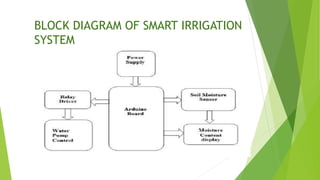
BLOCK DIAGRAM OF SMART IRRIGATION
SYSTEM
RESOURCES
SENSOR
MICROCONTROLLER
GSM MODULE
POWER SUPPLY
SENSOR
Three sensor used in this system are as
follow:
1. Soil moisture sensor
2. PIR sensor (Passive infrared sensor)
3. Humidity and temperature sensor
DHT11
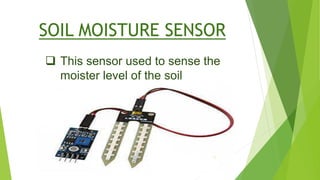
SOIL MOISTURE SENSOR
 This sensor used to sense the
moister level of the soil
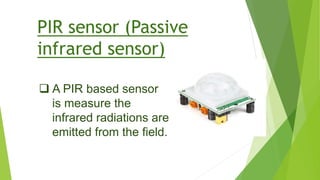
PIR sensor (Passive
infrared sensor)
 A PIR based sensor
is measure the
infrared radiations are
emitted from the field.
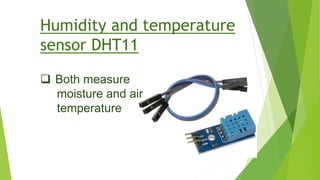
Humidity and temperature
sensor DHT11
 Both measure
moisture and air
temperature
MICROCONTROLLER
There are two types of
microcontroller:
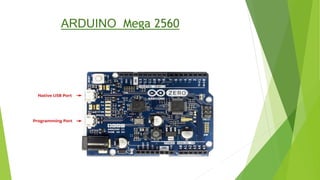
1. ARDUINO Mega 2560
2. Raspberry pi
ARDUINO Mega 2560
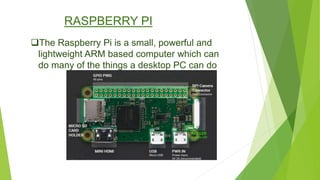
RASPBERRY PI
The Raspberry Pi is a small, powerful and
lightweight ARM based computer which can
do many of the things a desktop PC can do
GSM MODULE
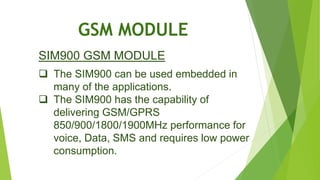
SIM900 GSM MODULE
 The SIM900 can be used embedded in
many of the applications.
 The SIM900 has the capability of
delivering GSM/GPRS
850/900/1800/1900MHz performance for
voice, Data, SMS and requires low power
consumption.
SIM900 GSM
Module Microcontroller sends the
measured values of
different parameter and
according that water is
given to the crops
Microcontroller sends
the measured values to
wireless communication
SIM900 module and
further uses GSM
module to send
message to the farmer.
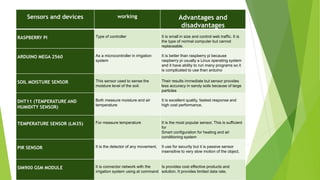
Sensors and devices working Advantages and
disadvantages
RASPBERRY PI Type of controller It is small in size and control web traffic. It is
the type of normal computer but cannot
replaceable.
ARDUINO MEGA 2560 As a microcontroller in irrigation
system
It is better than raspberry pi because
raspberry pi usually a Linux operating system
and it have ability to run many programs so it
is complicated to use than arduino
SOIL MOISTURE SENSOR This sensor used to sense the
moisture level of the soil.
Their results immediate but sensor provides
less accuracy in sandy soils because of large
particles
DHT11 (TEMPERATURE AND
HUMIDITY SENSOR)
Both measure moisture and air
temperature
It is excellent quality, fastest response and
high cost performance.
TEMPERATURE SENSOR (LM35) For measure temperature It is the most popular sensor. This is sufficient
for
Smart configuration for heating and air
conditioning system
PIR SENSOR It is the detector of any movement. It use for security but it is passive sensor
insensitive to very slow motion of the object.
SIM900 GSM MODULE It is connector network with the
irrigation system using at command
Is provides cost effective products and
solution. It provides limited data rate.
ADVANTAGES
Increase in productivity
 reduced water consumption
 Safe
No manpower required
Reduce soil erosion and nutrient
leaching
Require smaller water sources
CONCLUSION
The smart irrigation system is feasible and
cost effective for optimizing water
resources for agricultural production.
 This irrigation system allows cultivation in
places with water scarcity thereby
improving sustainability.
It proves that the use of water can be
diminished.
The use of solar power in this system is
significantly important for organic crops
THANKYOU!

Smart irrigation system

  • 2.
  • 3.
    INTRODUCTION  Irrigation isthe artificial application of water to the land or soil to assist in the growing of agricultural crops.  oil moisture, air humidity, temperature and water level in the soil are wirelessly transmitted using wireless technology for better production.  Interfacing of microcontroller through moisture sensor and hence to GSM through raspberry pi.
  • 4.
    OBJECTIVES  Reduce theman power & conserve the water  Real time sensing and control  To get the output of soil water sensor and provide water to crop  To observe other parameters for better yield
  • 5.
    BLOCK DIAGRAM OFSMART IRRIGATION SYSTEM
  • 6.
  • 7.
    SENSOR Three sensor usedin this system are as follow: 1. Soil moisture sensor 2. PIR sensor (Passive infrared sensor) 3. Humidity and temperature sensor DHT11
  • 8.
    SOIL MOISTURE SENSOR This sensor used to sense the moister level of the soil
  • 9.
    PIR sensor (Passive infraredsensor)  A PIR based sensor is measure the infrared radiations are emitted from the field.
  • 10.
    Humidity and temperature sensorDHT11  Both measure moisture and air temperature
  • 11.
    MICROCONTROLLER There are twotypes of microcontroller: 1. ARDUINO Mega 2560 2. Raspberry pi
  • 12.
  • 13.
    RASPBERRY PI The RaspberryPi is a small, powerful and lightweight ARM based computer which can do many of the things a desktop PC can do
  • 14.
    GSM MODULE SIM900 GSMMODULE  The SIM900 can be used embedded in many of the applications.  The SIM900 has the capability of delivering GSM/GPRS 850/900/1800/1900MHz performance for voice, Data, SMS and requires low power consumption.
  • 15.
    SIM900 GSM Module Microcontrollersends the measured values of different parameter and according that water is given to the crops Microcontroller sends the measured values to wireless communication SIM900 module and further uses GSM module to send message to the farmer.
  • 16.
    Sensors and devicesworking Advantages and disadvantages RASPBERRY PI Type of controller It is small in size and control web traffic. It is the type of normal computer but cannot replaceable. ARDUINO MEGA 2560 As a microcontroller in irrigation system It is better than raspberry pi because raspberry pi usually a Linux operating system and it have ability to run many programs so it is complicated to use than arduino SOIL MOISTURE SENSOR This sensor used to sense the moisture level of the soil. Their results immediate but sensor provides less accuracy in sandy soils because of large particles DHT11 (TEMPERATURE AND HUMIDITY SENSOR) Both measure moisture and air temperature It is excellent quality, fastest response and high cost performance. TEMPERATURE SENSOR (LM35) For measure temperature It is the most popular sensor. This is sufficient for Smart configuration for heating and air conditioning system PIR SENSOR It is the detector of any movement. It use for security but it is passive sensor insensitive to very slow motion of the object. SIM900 GSM MODULE It is connector network with the irrigation system using at command Is provides cost effective products and solution. It provides limited data rate.
  • 17.
    ADVANTAGES Increase in productivity reduced water consumption  Safe No manpower required Reduce soil erosion and nutrient leaching Require smaller water sources
  • 18.
    CONCLUSION The smart irrigationsystem is feasible and cost effective for optimizing water resources for agricultural production.  This irrigation system allows cultivation in places with water scarcity thereby improving sustainability. It proves that the use of water can be diminished. The use of solar power in this system is significantly important for organic crops
  • 19.