SMART ANTENNA FOR RFID
SYSTEMS
MAJID FALEH AL-ENZI 201111528
HANI ABDULSALAM ALGHAITHY 201108364
MAJED DHEYYEM ALRSHEEDI
201106135
RAKAN FAHED AL-ALI 201001311
SMART ANTENNA FOR RFID SYSTEMS RESEARCH GROUP, DR. MOHAMMED
ALIWA
SUPERVISOR:
DR. MOHAMED ELEIWA
ABSTRACT
The objectives of this project could be
summarized as:
• Study and analysis of RFID systems: concept, theory of
operation, block diagram and applications.
• Study and analysis of basic antenna concepts, types,
Parameters, design and measurements.
• Smart antennas applications for RFID systems.
• RFID antennas design, fabrication and measurements.
• RFID System evaluation, measurements and analysis.
Outlin
e:
• RFID
• Antenna
• Smart Antenna
• Smart antenna for
RFID
• Design and
Outlin
e:
• RFID
• Antenna
• Smart Antenna
• Smart antenna for
RFID
• Design and
What is RFID?
Radio Frequency Identification (RFID) is a rapidly developing technology
which uses RF signals for automatic identification of objects.
The use of RFID system is to transmit from portable devices, called
tags, then read by the RFID reader and processed data by computer
application that need it
The main two components:
1. tag 2. reader
Tags:
A small electronic data carrying device called a transponder
or tag that is attached to the item to be identified. It can
store a range of information from one serial number to
several pages of data.
chi
p
substrat
e
Antenna
coil
Active or passive
Passive (no battery)
Smaller, Lighter
Shorter range (<3m)
Smaller data storage
Lower cost
Active (with battery)
Larger, Heavier
Longer range (up to 100m)
Larger data storage
Higher cost
Classifications of Tags
Data storage (Programming)
Read Only
Write once
Read/write
Frequencies
Low—135 kHz
VHF—13.5 MHz
UHF—860MHz
Microwave—2.4 GHz
Reader:
The reader is a device that has one or more antennas that
transmit radio waves and receive signals back from the RFID
tag.
antennas reade
r
Reader types:
1. Passive Reader Active Tag
(PRAT).
2. Active Reader Passive Tag
(ARPT).
3. Active Reader Active Tag
(ARAT).
Lines
Frequency Bands:
Band Regulations Range Data speed
Application
Approximate
tag cost
in volume
(2006) US $
120–150 kHz
(LF)
Unregulated 10 cm Low
Animal identification, factory
data collection
$1
13.56 MHz
(HF)
ISM band
worldwide
10 cm - 1 m
Low to
moderate
Smart cards, Non fully ISO
compatible memory cards,
Microprocessor ISO compatible
cards
$0.50 to $5
433 MHz
(UHF)
Short Range
Devices
1–100 m Moderate
Defense applications, with
active tags
$5
865-868 MHz
(Europe)
902-928 MHz
(North
America) UHF
ISM band 1–12 m
Moderate to
high
EAN, various standards
$0.15
(passive
tags)
2450-
5800 MHz
(microwave)
ISM band 1–2 m High
802.11 WLAN, Bluetooth
standards
$25 (active
tags)
3.1–10 GHz
(microwave)
Ultra wide
band
to 200 m High
requires semi-active or
active tags
$5
projected
Outlin
e:
• RFID
• Antenna
• Smart Antenna
• Smart antenna for
RFID
• Design and
Antenna
:
Antennas are a very important component of
communication systems. By definition, an antenna is a
device used to transform an RF signal, traveling on a
conductor, into an electromagnetic wave in free space.
Antenna
parameters:
1. Input Impedance.
2. Return loss.
3. Bandwidth.
4. Directivity and
Gain.
5. Radiation Pattern.
6. Beam width.
7. Side lobes.
8. Nulls.
9. Polarization.
Circularly
Polarized
Linearly
Polarized
Radiation
Pattern
x y
Z
Outlin
e:
• RFID
• Antenna
• Smart Antenna
• Smart antenna for
RFID
• Design and
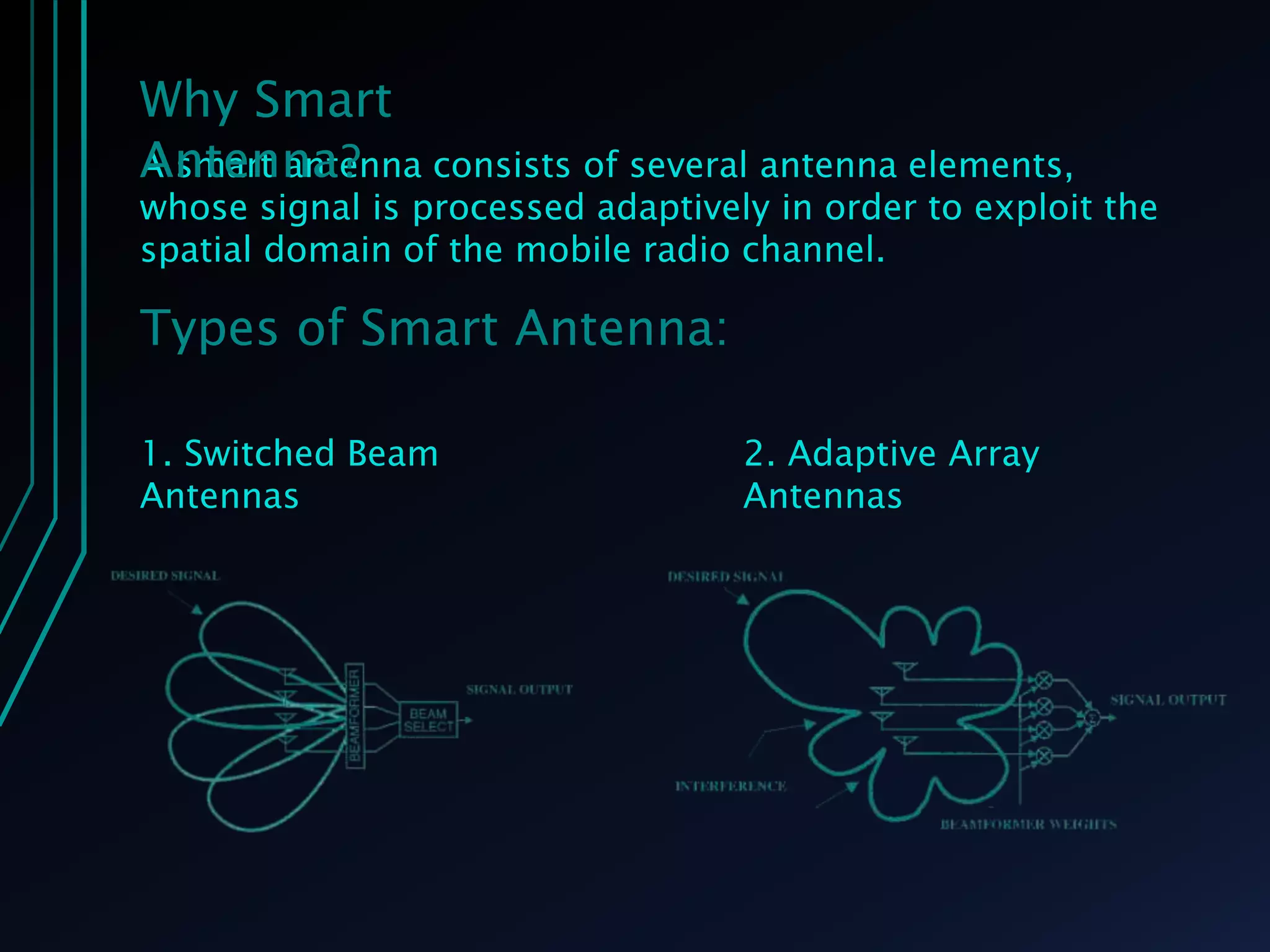
A smart antenna consists of several antenna elements,
whose signal is processed adaptively in order to exploit the
spatial domain of the mobile radio channel.
Types of Smart Antenna:
1. Switched Beam
Antennas
2. Adaptive Array
Antennas
Why Smart
Antenna?
Comparison between Switched Beam and Adaptive
Array Systems:
Switched Beam System Adaptive Array System
multiple fixed directional beams with narrow
beam widths
steers the beam towards desired signal of
interest and places nulls at the interfering signal
directions
The required phase shifts are provided by
simple fixed phase shifting networks like the
butler matrix
requires implementation of DSP technology
simple algorithms are used for beam selection requires complicated adaptive algorithms to
steer the beam and the nulls
requires only moderate interaction between
mobile unit and base station
It is not easy to implement in existing systems
i.e. up-gradation is difficult and expensive
Since low technology is used, it has lesser cost
and complexity
continuous steering of the beam is required as
the mobile moves; high interaction between
mobile unit and base station is required
Integration into existing cellular system is easy
and cheap.
It provides better coverage and increased
capacity because of improved interference
rejection as compared to the Switched beam
systems.
Outlin
e:
• RFID
• Antenna
• Smart Antenna
• Smart antenna for
RFID
• Design and
Benefits of Smart Antennas For RFID Reader
• Improved system capacities.
• Higher permissible signal bandwidths.
• Space division multiple access (SDMA).
• Higher signal-to-interference ratios.
• Increased frequency reuse.
• Side lobe canceling or null steering.
• Multipath mitigation.
• Reduced speckle in radar imaging.
RFID
Antennas
Tag Antennas
Single
Antenna Tag
Multiple
Antennas Tag
Reader
Antennas
Fixed Beam
Antenna
Agile Beam
Antennas
Switched
Beam Array
Switched
Beam Phased
Array
Phased Array
Adaptive
Antennas
Outlin
e:
• RFID
• Antenna
• Smart Antenna
• Smart antenna for
RFID
• Design and
Things we Will do:
• use the global band of the ultra-high frequency (860 –
960) MHz with central frequency 915 MHz.
• use “HFSS Antenna DesignKit” to design the antenna,
and for the simulation “HFSS 13“.
• Buy “SKYETEK SUPERNOVA EVALUATION KIT” In order
to evaluate the RFID system.
RFID System
Evaluation: Measure RFID range.
 Measure RFID sensitivity.
 Measure RFID parameters at different tag orientations
(polarization matching).
 Test the designed antennas.
Specification of SKYETEK SUPERNOVA EVALUATI
Air Interface Protocol EPCglobal UHF Class 1 Gen 2
(ISO 18000-6C)
Price 599 $
Operating Frequency Global 860-960 MHz
Transmit Power +27 dBm
Data Interface USB
Power Source 5V USB (Powered over USB)
Antenna Ports 2 SMA Female
Dimensions 2.67 x 2.28 x 0.43 in (68 x 58 x
11 mm)
Weight 1.7 lbs (771.1 g)
Operating Temperature -40° to +75°C
Host API SkyeTek API C, C #, .NET
Demo Software SkyeWare 4 Demo Software
Features of the Kit:
• Fast integration.
• SkyeTek adaptive antenna tuning.
• Greatest tag compatibility with Tagnostic and TAGIQ.
• USB communication and power, no external power source req
• Simple and intuitive API.
Rectangular Patch Circular Patch
Microstrip Antennas:
Design of Stacked patch for RFID Reader Anten
Design of PIFA for RFID Tag Antenna
Thank you for your
attention

Smart Antenna for RFID Systems 2.55

  • 1.
    SMART ANTENNA FORRFID SYSTEMS MAJID FALEH AL-ENZI 201111528 HANI ABDULSALAM ALGHAITHY 201108364 MAJED DHEYYEM ALRSHEEDI 201106135 RAKAN FAHED AL-ALI 201001311 SMART ANTENNA FOR RFID SYSTEMS RESEARCH GROUP, DR. MOHAMMED ALIWA SUPERVISOR: DR. MOHAMED ELEIWA
  • 2.
    ABSTRACT The objectives ofthis project could be summarized as: • Study and analysis of RFID systems: concept, theory of operation, block diagram and applications. • Study and analysis of basic antenna concepts, types, Parameters, design and measurements. • Smart antennas applications for RFID systems. • RFID antennas design, fabrication and measurements. • RFID System evaluation, measurements and analysis.
  • 3.
    Outlin e: • RFID • Antenna •Smart Antenna • Smart antenna for RFID • Design and
  • 4.
    Outlin e: • RFID • Antenna •Smart Antenna • Smart antenna for RFID • Design and
  • 5.
    What is RFID? RadioFrequency Identification (RFID) is a rapidly developing technology which uses RF signals for automatic identification of objects. The use of RFID system is to transmit from portable devices, called tags, then read by the RFID reader and processed data by computer application that need it The main two components: 1. tag 2. reader
  • 6.
    Tags: A small electronicdata carrying device called a transponder or tag that is attached to the item to be identified. It can store a range of information from one serial number to several pages of data. chi p substrat e Antenna coil Active or passive Passive (no battery) Smaller, Lighter Shorter range (<3m) Smaller data storage Lower cost Active (with battery) Larger, Heavier Longer range (up to 100m) Larger data storage Higher cost Classifications of Tags Data storage (Programming) Read Only Write once Read/write Frequencies Low—135 kHz VHF—13.5 MHz UHF—860MHz Microwave—2.4 GHz
  • 7.
    Reader: The reader isa device that has one or more antennas that transmit radio waves and receive signals back from the RFID tag. antennas reade r Reader types: 1. Passive Reader Active Tag (PRAT). 2. Active Reader Passive Tag (ARPT). 3. Active Reader Active Tag (ARAT). Lines
  • 8.
    Frequency Bands: Band RegulationsRange Data speed Application Approximate tag cost in volume (2006) US $ 120–150 kHz (LF) Unregulated 10 cm Low Animal identification, factory data collection $1 13.56 MHz (HF) ISM band worldwide 10 cm - 1 m Low to moderate Smart cards, Non fully ISO compatible memory cards, Microprocessor ISO compatible cards $0.50 to $5 433 MHz (UHF) Short Range Devices 1–100 m Moderate Defense applications, with active tags $5 865-868 MHz (Europe) 902-928 MHz (North America) UHF ISM band 1–12 m Moderate to high EAN, various standards $0.15 (passive tags) 2450- 5800 MHz (microwave) ISM band 1–2 m High 802.11 WLAN, Bluetooth standards $25 (active tags) 3.1–10 GHz (microwave) Ultra wide band to 200 m High requires semi-active or active tags $5 projected
  • 9.
    Outlin e: • RFID • Antenna •Smart Antenna • Smart antenna for RFID • Design and
  • 10.
    Antenna : Antennas are avery important component of communication systems. By definition, an antenna is a device used to transform an RF signal, traveling on a conductor, into an electromagnetic wave in free space.
  • 11.
    Antenna parameters: 1. Input Impedance. 2.Return loss. 3. Bandwidth. 4. Directivity and Gain. 5. Radiation Pattern. 6. Beam width. 7. Side lobes. 8. Nulls. 9. Polarization. Circularly Polarized Linearly Polarized Radiation Pattern x y Z
  • 12.
    Outlin e: • RFID • Antenna •Smart Antenna • Smart antenna for RFID • Design and
  • 13.
    A smart antennaconsists of several antenna elements, whose signal is processed adaptively in order to exploit the spatial domain of the mobile radio channel. Types of Smart Antenna: 1. Switched Beam Antennas 2. Adaptive Array Antennas Why Smart Antenna?
  • 14.
    Comparison between SwitchedBeam and Adaptive Array Systems: Switched Beam System Adaptive Array System multiple fixed directional beams with narrow beam widths steers the beam towards desired signal of interest and places nulls at the interfering signal directions The required phase shifts are provided by simple fixed phase shifting networks like the butler matrix requires implementation of DSP technology simple algorithms are used for beam selection requires complicated adaptive algorithms to steer the beam and the nulls requires only moderate interaction between mobile unit and base station It is not easy to implement in existing systems i.e. up-gradation is difficult and expensive Since low technology is used, it has lesser cost and complexity continuous steering of the beam is required as the mobile moves; high interaction between mobile unit and base station is required Integration into existing cellular system is easy and cheap. It provides better coverage and increased capacity because of improved interference rejection as compared to the Switched beam systems.
  • 15.
    Outlin e: • RFID • Antenna •Smart Antenna • Smart antenna for RFID • Design and
  • 16.
    Benefits of SmartAntennas For RFID Reader • Improved system capacities. • Higher permissible signal bandwidths. • Space division multiple access (SDMA). • Higher signal-to-interference ratios. • Increased frequency reuse. • Side lobe canceling or null steering. • Multipath mitigation. • Reduced speckle in radar imaging.
  • 17.
    RFID Antennas Tag Antennas Single Antenna Tag Multiple AntennasTag Reader Antennas Fixed Beam Antenna Agile Beam Antennas Switched Beam Array Switched Beam Phased Array Phased Array Adaptive Antennas
  • 18.
    Outlin e: • RFID • Antenna •Smart Antenna • Smart antenna for RFID • Design and
  • 19.
    Things we Willdo: • use the global band of the ultra-high frequency (860 – 960) MHz with central frequency 915 MHz. • use “HFSS Antenna DesignKit” to design the antenna, and for the simulation “HFSS 13“. • Buy “SKYETEK SUPERNOVA EVALUATION KIT” In order to evaluate the RFID system. RFID System Evaluation: Measure RFID range.  Measure RFID sensitivity.  Measure RFID parameters at different tag orientations (polarization matching).  Test the designed antennas.
  • 20.
    Specification of SKYETEKSUPERNOVA EVALUATI Air Interface Protocol EPCglobal UHF Class 1 Gen 2 (ISO 18000-6C) Price 599 $ Operating Frequency Global 860-960 MHz Transmit Power +27 dBm Data Interface USB Power Source 5V USB (Powered over USB) Antenna Ports 2 SMA Female Dimensions 2.67 x 2.28 x 0.43 in (68 x 58 x 11 mm) Weight 1.7 lbs (771.1 g) Operating Temperature -40° to +75°C Host API SkyeTek API C, C #, .NET Demo Software SkyeWare 4 Demo Software
  • 21.
    Features of theKit: • Fast integration. • SkyeTek adaptive antenna tuning. • Greatest tag compatibility with Tagnostic and TAGIQ. • USB communication and power, no external power source req • Simple and intuitive API.
  • 22.
    Rectangular Patch CircularPatch Microstrip Antennas:
  • 23.
    Design of Stackedpatch for RFID Reader Anten
  • 24.
    Design of PIFAfor RFID Tag Antenna
  • 25.
    Thank you foryour attention