BUILDING SMART CITIES WITH
SMART CITIZENS
Dr. Mazlan Abbas
CEO - REDtone IOT Sdn Bhd
Email: mazlan.abbas@redtone.com
GeoSmart Asia 2015, Malaysia
PRESENTATION CONTENTS
• Smart City with Smart Citizens
• Making Sense of City’s Data
• Participatory Approach - Empowering Citizens to Sense
• Summary
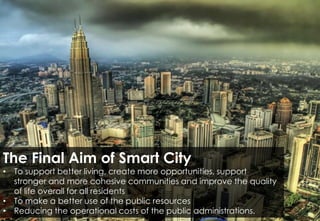
The Final Aim of Smart City
• To support better living, create more opportunities, support
stronger and more cohesive communities and improve the quality
of life overall for all residents
• To make a better use of the public resources
• Reducing the operational costs of the public administrations.
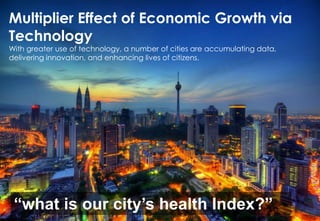
Multiplier Effect of Economic Growth via
Technology
With greater use of technology, a number of cities are accumulating data,
delivering innovation, and enhancing lives of citizens.
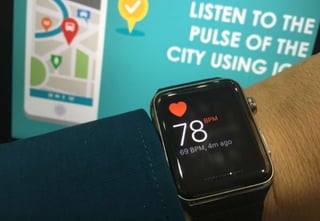
“what is our city’s health Index?”
What is Your Pulse Rate?
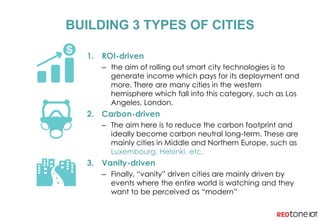
BUILDING 3 TYPES OF CITIES
1. ROI-driven
– the aim of rolling out smart city technologies is to
generate income which pays for its deployment and
more. There are many cities in the western
hemisphere which fall into this category, such as Los
Angeles, London.
2. Carbon-driven
– The aim here is to reduce the carbon footprint and
ideally become carbon neutral long-term. These are
mainly cities in Middle and Northern Europe, such as
Luxembourg, Helsinki, etc.
3. Vanity-driven
– Finally, “vanity” driven cities are mainly driven by
events where the entire world is watching and they
want to be perceived as “modern”
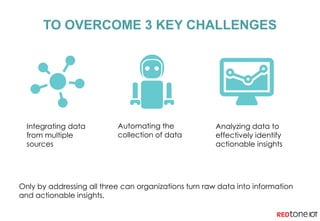
TO OVERCOME 3 KEY CHALLENGES
Only by addressing all three can organizations turn raw data into information
and actionable insights.
Integrating data
from multiple
sources
Automating the
collection of data
Analyzing data to
effectively identify
actionable insights
MAKING SENSE OF DATA … BUT
WHAT CITY DATA?
THE GOLD RUSH
Wisdom
Knowledge
Information
Data
More
Important
Less
Important
Evaluated understanding
Appreciation of
Answers to questions.
Symbols
Understanding
Answers to
questions
WHO
WHY
HOW
WHAT
WHERE WHEN
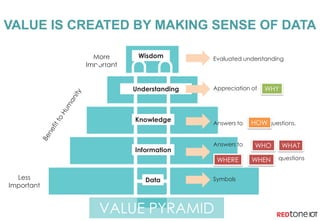
VALUE IS CREATED BY MAKING SENSE OF DATA
VALUE PYRAMID
Wisdom
Knowledge
Information
Data
More
Important
Less
Important
N/A
Empty (0), Full (1)
Understanding
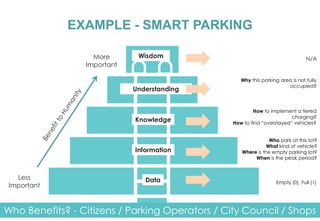
EXAMPLE - SMART PARKING
Who park at this lot?
What kind of vehicle?
Where is the empty parking lot?
When is the peak period?
How to implement a tiered
charging?
How to find “overstayed” vehicles?
Why this parking area is not fully
occupied?
Who Benefits? - Citizens / Parking Operators / City Council / Shops
HOW-TO PROVIDE A SMART CITY
SOLUTIONS?
HOW-TO
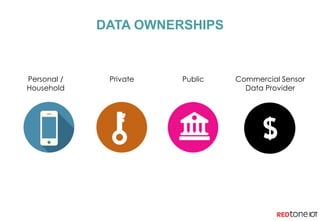
DATA OWNERSHIPS
Personal /
Household
Private Public Commercial Sensor
Data Provider
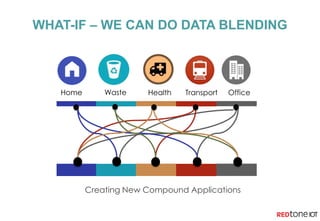
Home Health Transport OfficeWaste
WHAT-IF – WE CAN DO DATA BLENDING
Creating New Compound Applications
SENSING-AS-A-SERVICE
WHAT-IF
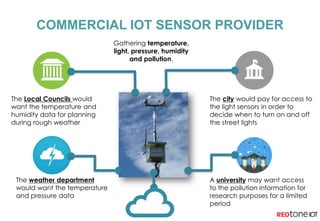
The city would pay for access to
the light sensors in order to
decide when to turn on and off
the street lights
Gathering temperature,
light, pressure, humidity
and pollution.
COMMERCIAL IOT SENSOR PROVIDER
A university may want access
to the pollution information for
research purposes for a limited
period
The weather department
would want the temperature
and pressure data
The Local Councils would
want the temperature and
humidity data for planning
during rough weather
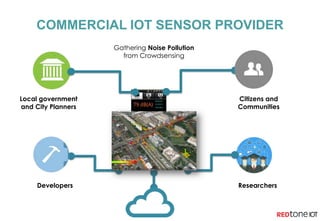
Citizens and
Communities
Gathering Noise Pollution
from Crowdsensing
COMMERCIAL IOT SENSOR PROVIDER
ResearchersDevelopers
Local government
and City Planners
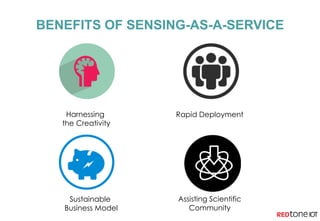
BENEFITS OF SENSING-AS-A-SERVICE
Harnessing
the Creativity
Rapid Deployment
Sustainable
Business Model
Assisting Scientific
Community
CROWDSENSING
GETTING INSIGHTS FROM
EMPOWER THE CITIZENS TO
SENSE
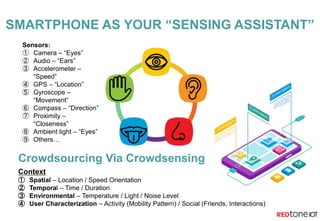
SMARTPHONE AS YOUR “SENSING ASSISTANT”
Sensors:
① Camera – “Eyes”
② Audio – “Ears”
③ Accelerometer –
“Speed”
④ GPS – “Location”
⑤ Gyroscope –
“Movement”
⑥ Compass – “Direction”
⑦ Proximity –
“Closeness”
⑧ Ambient light – “Eyes”
⑨ Others…
Crowdsourcing Via Crowdsensing
Context
① Spatial – Location / Speed Orientation
② Temporal – Time / Duration
③ Environmental – Temperature / Light / Noise Level
④ User Characterization – Activity (Mobility Pattern) / Social (Friends, Interactions)
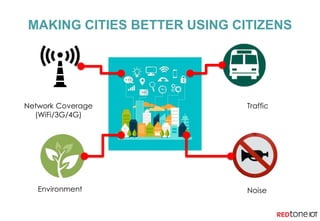
MAKING CITIES BETTER USING CITIZENS
Traffic
NoiseEnvironment
Network Coverage
(WiFi/3G/4G)
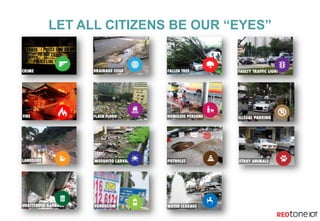
LET ALL CITIZENS BE OUR “EYES”
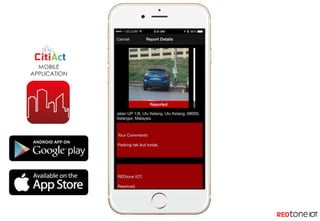
MOBILE
APPLICATION
Citiact
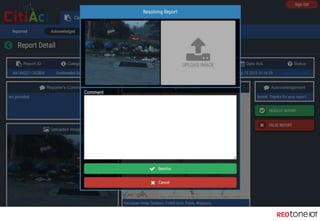
Case
management
system (CMS)
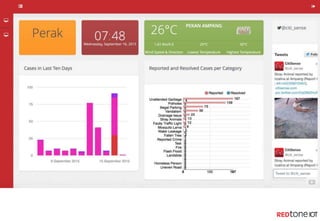
Citiact
dashboard
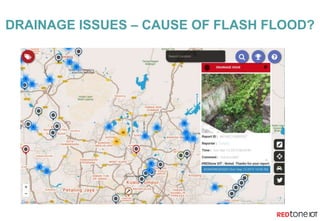
DRAINAGE ISSUES – CAUSE OF FLASH FLOOD?
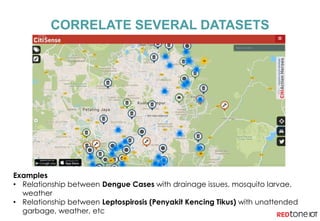
CORRELATE SEVERAL DATASETS
Examples
• Relationship between Dengue Cases with drainage issues, mosquito larvae,
weather
• Relationship between Leptospirosis (Penyakit Kencing Tikus) with unattended
garbage, weather, etc
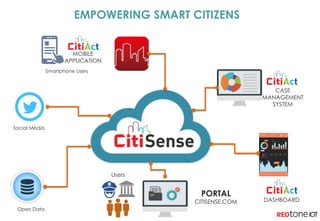
MOBILE
APPLICATION
Open Data
Smartphone Users
Social Media
Users
PORTAL
CITISENSE.COM
CASE
MANAGEMENT
SYSTEM
DASHBOARD
EMPOWERING SMART CITIZENS
SMART CITIZENS AND SENSORS
CONNECTING AND AGGREGATING
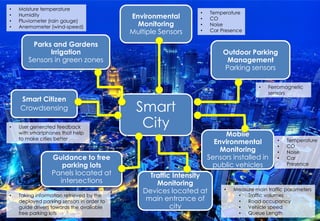
Smart
City
Environmental
Monitoring
Multiple Sensors
Outdoor Parking
Management
Parking sensors
Mobile
Environmental
Monitoring
Sensors installed in
public vehicles
Traffic Intensity
Monitoring
Devices located at
main entrance of
city
Guidance to free
parking lots
Panels located at
intersections
Smart Citizen
Crowdsensing
Parks and Gardens
Irrigation
Sensors in green zones
• Temperature
• CO
• Noise
• Car Presence
• Ferromagnetic
sensors
• Temperature
• CO
• Noise
• Car
Presence
• Measure main traffic parameters
• Traffic volumes
• Road occupancy
• Vehicle speed
• Queue Length
• Taking information retrieved by the
deployed parking sensors in order to
guide drivers towards the available
free parking lots
• Moisture temperature
• Humidity
• Pluviometer (rain gauge)
• Anemometer (wind-speed)
• User generated feedback
with smartphones that help
to make cities better
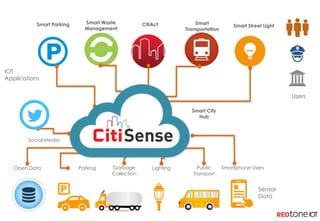
Smart Parking Smart Waste
Management
Smart Street Light
Smart
Transportation
Open Data Parking Garbage
Collection
Lighting Public
Transport
Smartphone Users
Smart City
Hub
Social Media
IOT
Applications
Sensor
Data
Users
CitiAct
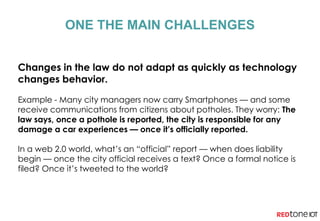
Changes in the law do not adapt as quickly as technology
changes behavior.
Example - Many city managers now carry Smartphones — and some
receive communications from citizens about potholes. They worry: The
law says, once a pothole is reported, the city is responsible for any
damage a car experiences — once it’s officially reported.
In a web 2.0 world, what’s an “official” report — when does liability
begin — once the city official receives a text? Once a formal notice is
filed? Once it’s tweeted to the world?
ONE THE MAIN CHALLENGES
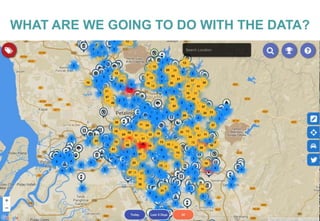
WHAT ARE WE GOING TO DO WITH THE DATA?
LET’S ASK OURSELVES
ARE WE READY?
THANK YOU
@REDtoneIOTREDtoneIOT
@citi_sensecitiactapp

Building Smart Cities with Smart Citizens

  • 1.
    BUILDING SMART CITIESWITH SMART CITIZENS Dr. Mazlan Abbas CEO - REDtone IOT Sdn Bhd Email: mazlan.abbas@redtone.com GeoSmart Asia 2015, Malaysia
  • 2.
    PRESENTATION CONTENTS • SmartCity with Smart Citizens • Making Sense of City’s Data • Participatory Approach - Empowering Citizens to Sense • Summary
  • 3.
    The Final Aimof Smart City • To support better living, create more opportunities, support stronger and more cohesive communities and improve the quality of life overall for all residents • To make a better use of the public resources • Reducing the operational costs of the public administrations.
  • 4.
    Multiplier Effect ofEconomic Growth via Technology With greater use of technology, a number of cities are accumulating data, delivering innovation, and enhancing lives of citizens. “what is our city’s health Index?”
  • 5.
    What is YourPulse Rate?
  • 6.
    BUILDING 3 TYPESOF CITIES 1. ROI-driven – the aim of rolling out smart city technologies is to generate income which pays for its deployment and more. There are many cities in the western hemisphere which fall into this category, such as Los Angeles, London. 2. Carbon-driven – The aim here is to reduce the carbon footprint and ideally become carbon neutral long-term. These are mainly cities in Middle and Northern Europe, such as Luxembourg, Helsinki, etc. 3. Vanity-driven – Finally, “vanity” driven cities are mainly driven by events where the entire world is watching and they want to be perceived as “modern”
  • 7.
    TO OVERCOME 3KEY CHALLENGES Only by addressing all three can organizations turn raw data into information and actionable insights. Integrating data from multiple sources Automating the collection of data Analyzing data to effectively identify actionable insights
  • 8.
    MAKING SENSE OFDATA … BUT WHAT CITY DATA? THE GOLD RUSH
  • 9.
    Wisdom Knowledge Information Data More Important Less Important Evaluated understanding Appreciation of Answersto questions. Symbols Understanding Answers to questions WHO WHY HOW WHAT WHERE WHEN VALUE IS CREATED BY MAKING SENSE OF DATA VALUE PYRAMID
  • 10.
    Wisdom Knowledge Information Data More Important Less Important N/A Empty (0), Full(1) Understanding EXAMPLE - SMART PARKING Who park at this lot? What kind of vehicle? Where is the empty parking lot? When is the peak period? How to implement a tiered charging? How to find “overstayed” vehicles? Why this parking area is not fully occupied? Who Benefits? - Citizens / Parking Operators / City Council / Shops
  • 11.
    HOW-TO PROVIDE ASMART CITY SOLUTIONS? HOW-TO
  • 12.
    DATA OWNERSHIPS Personal / Household PrivatePublic Commercial Sensor Data Provider
  • 13.
    Home Health TransportOfficeWaste WHAT-IF – WE CAN DO DATA BLENDING Creating New Compound Applications
  • 14.
  • 15.
    The city wouldpay for access to the light sensors in order to decide when to turn on and off the street lights Gathering temperature, light, pressure, humidity and pollution. COMMERCIAL IOT SENSOR PROVIDER A university may want access to the pollution information for research purposes for a limited period The weather department would want the temperature and pressure data The Local Councils would want the temperature and humidity data for planning during rough weather
  • 16.
    Citizens and Communities Gathering NoisePollution from Crowdsensing COMMERCIAL IOT SENSOR PROVIDER ResearchersDevelopers Local government and City Planners
  • 17.
    BENEFITS OF SENSING-AS-A-SERVICE Harnessing theCreativity Rapid Deployment Sustainable Business Model Assisting Scientific Community
  • 18.
  • 19.
    SMARTPHONE AS YOUR“SENSING ASSISTANT” Sensors: ① Camera – “Eyes” ② Audio – “Ears” ③ Accelerometer – “Speed” ④ GPS – “Location” ⑤ Gyroscope – “Movement” ⑥ Compass – “Direction” ⑦ Proximity – “Closeness” ⑧ Ambient light – “Eyes” ⑨ Others… Crowdsourcing Via Crowdsensing Context ① Spatial – Location / Speed Orientation ② Temporal – Time / Duration ③ Environmental – Temperature / Light / Noise Level ④ User Characterization – Activity (Mobility Pattern) / Social (Friends, Interactions)
  • 20.
    MAKING CITIES BETTERUSING CITIZENS Traffic NoiseEnvironment Network Coverage (WiFi/3G/4G)
  • 21.
    LET ALL CITIZENSBE OUR “EYES”
  • 22.
  • 23.
  • 24.
  • 25.
    DRAINAGE ISSUES –CAUSE OF FLASH FLOOD?
  • 26.
    CORRELATE SEVERAL DATASETS Examples •Relationship between Dengue Cases with drainage issues, mosquito larvae, weather • Relationship between Leptospirosis (Penyakit Kencing Tikus) with unattended garbage, weather, etc
  • 27.
    MOBILE APPLICATION Open Data Smartphone Users SocialMedia Users PORTAL CITISENSE.COM CASE MANAGEMENT SYSTEM DASHBOARD EMPOWERING SMART CITIZENS
  • 28.
    SMART CITIZENS ANDSENSORS CONNECTING AND AGGREGATING
  • 29.
    Smart City Environmental Monitoring Multiple Sensors Outdoor Parking Management Parkingsensors Mobile Environmental Monitoring Sensors installed in public vehicles Traffic Intensity Monitoring Devices located at main entrance of city Guidance to free parking lots Panels located at intersections Smart Citizen Crowdsensing Parks and Gardens Irrigation Sensors in green zones • Temperature • CO • Noise • Car Presence • Ferromagnetic sensors • Temperature • CO • Noise • Car Presence • Measure main traffic parameters • Traffic volumes • Road occupancy • Vehicle speed • Queue Length • Taking information retrieved by the deployed parking sensors in order to guide drivers towards the available free parking lots • Moisture temperature • Humidity • Pluviometer (rain gauge) • Anemometer (wind-speed) • User generated feedback with smartphones that help to make cities better
  • 30.
    Smart Parking SmartWaste Management Smart Street Light Smart Transportation Open Data Parking Garbage Collection Lighting Public Transport Smartphone Users Smart City Hub Social Media IOT Applications Sensor Data Users CitiAct
  • 31.
    Changes in thelaw do not adapt as quickly as technology changes behavior. Example - Many city managers now carry Smartphones — and some receive communications from citizens about potholes. They worry: The law says, once a pothole is reported, the city is responsible for any damage a car experiences — once it’s officially reported. In a web 2.0 world, what’s an “official” report — when does liability begin — once the city official receives a text? Once a formal notice is filed? Once it’s tweeted to the world? ONE THE MAIN CHALLENGES
  • 32.
    WHAT ARE WEGOING TO DO WITH THE DATA?
  • 33.
  • 34.