Basics of RFID Technology
by: Craig K. Harmon
by: Craig K. Harmon
16 September 2003
16 September 2003
 Chair, ASC INCITS T6 (Radio Frequency Identification) - ANS INCITS 256:1999, 2001
 Chair, U.S. TAG to ISO/IEC JTC 1/SC 31/WG 4 “RFID”
 Chair, ASC MH 10/SC 8/WG 4, RFID for Returnable Containers
 Chair, ISO TC 122/WG 4 (Shipping Labels) & ISO TC 122/WG 7 (Product Packaging)
 Chair, ISO TC 122/104 JWG - Supply Chain Applications of RFID
 Senior Project Editor ISO/IEC JTC 1/SC 31/WG 4/SG 3 (RFID - Air Interface)
 JTC 1/SC 31 Liaison Officer to the International Telecommunications Union (ITU-R)
 JTC 1/SC 31 Liaison Officer to the International Air Transport Association (IATA)
 JTC 1/SC 31 Liaison to the European Telecommunications Standards Institute (ETSI)
 ASC MH 10/SC 8 Liaison Universal Postal Union (UPU) Physical Encoding Group
(PEG)
 Expert to USPS Strategic Technology Council
 ISO TC 104 (Freight Containers / RFID) Liaison Officer to JTC 1/SC 31
 Project Editor, ISO 18185 (Freight Containers - Electronic Container Seals)
 Chairman & Project Editor, ANS MH10.8.2 (Data Application Identifiers)
 Vocabulary Rapporteur to ISO/IEC JTC 1/SC 31
 Project Editor, American Trucking Association (ATA) ADE Work Group
 AIAG Bar Code, Applications, 2D, Tire, Returnables, and RFID Committees
 Project Editor, EIA Shipping Label, Product, Product Package, & Component Marking
 Advisor, U.S. Department of Defense in Migration to Commercial Standards
 Project Editor, NATO STANAG 2233 (RFID for NATO Asset Tracking)
 Project Editor Designate (Japan) - ISO/IEC 15459-3 (Unique Identification of Items)
 Project Editor Designate (Japan) - Technical Report on Direct Part Marking
 Convenor (CKH) and Secretary (MAH) - INCITS T20 (Real Time Locating Systems)
Q.E.D. Systems • Craig K. Harmon • President
Visit our web sites:
Visit our web sites: http://www.qed.org
http://www.qed.org and
and http://www.autoid.org
http://www.autoid.org
http://www.autoid.org/presentations/F-ISCW_2003_RFID_Basics.zip
Session Description
It is unlikely that any technology in the automatic
identification and data capture industry has been
hyped more than RFID. So what is the truth?
What technologies are best suited for which
technologies? What is the relationship between
regulations in the United States and in other parts
of the world? What is the future of that
regulation? How to determine which technology is
best for you by asking yourself three little
questions: "How far?", "How fast?”, and "How
many?" Learn the answers to these and other
questions in this session.
What is RFID?
What is RFID?
• RFID is an ADC technology that
uses radio-frequency waves to
transfer data between a reader and
a movable item to identify,
categorize, track...
• RFID is fast, reliable, and does not
require physical sight or contact
between reader/scanner and the
tagged item
What Constitutes an RFID System?
• One or more RF tags
• Two or more antennas
• One or more interrogators
• One or more host computers
• Appropriate software
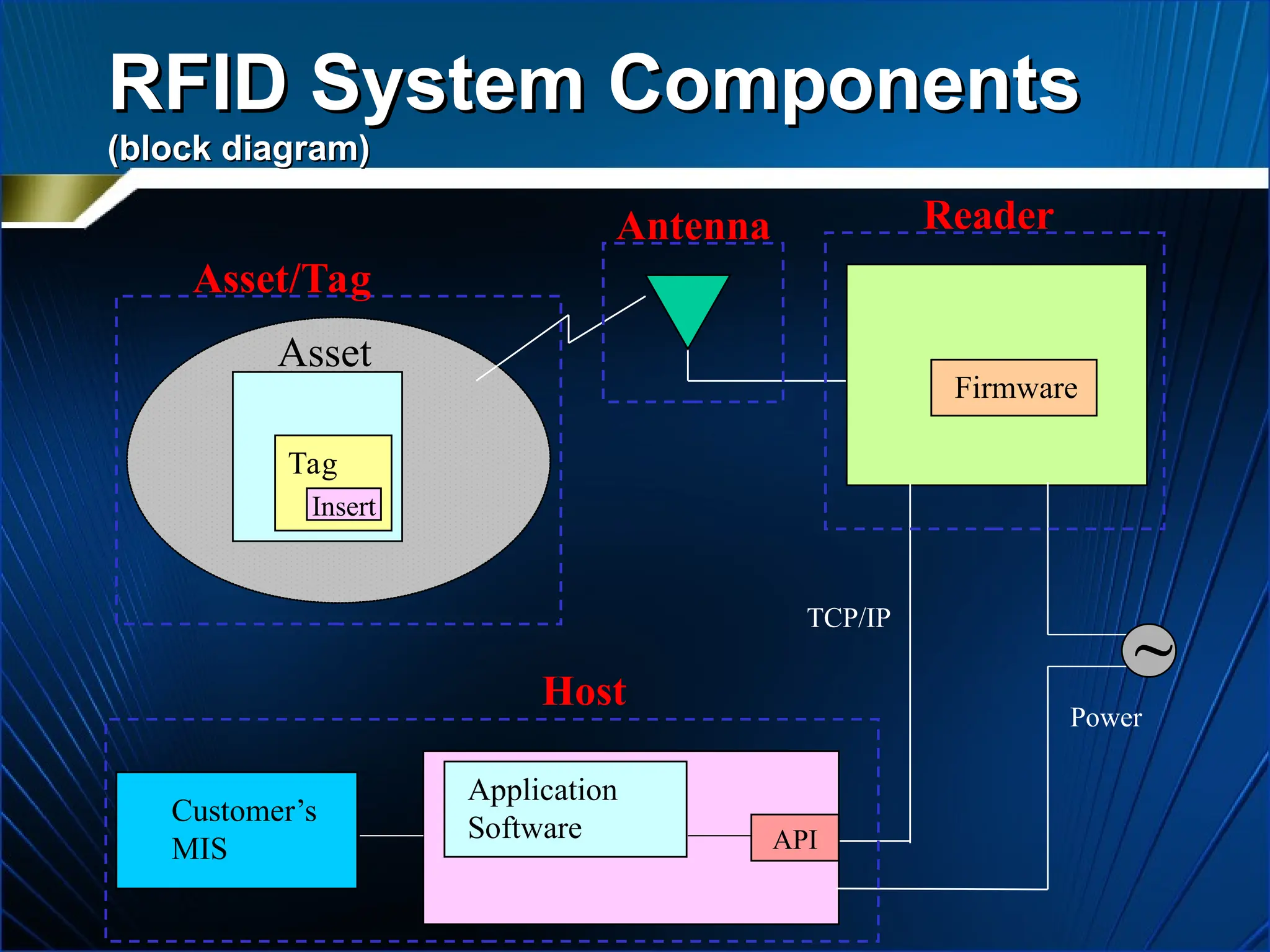
Tag
Insert
Antenna Reader
Firmware
Customer’s
MIS
Host
Application
Software API
TCP/IP
Power
~
Asset
Asset/Tag
RFID System Components
(block diagram)
(block diagram)
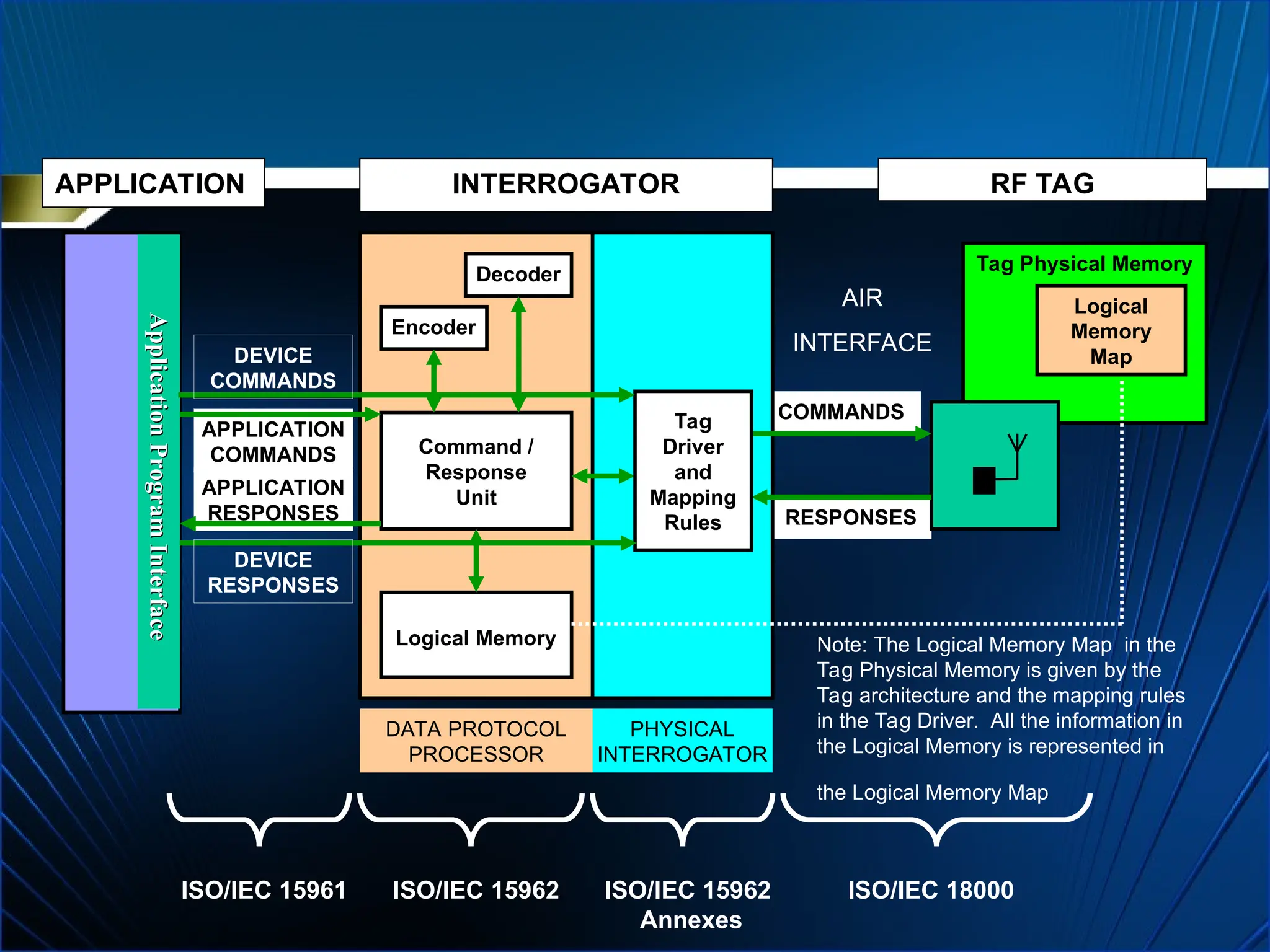
RESPONSES
COMMANDS
Tag Physical Memory
APPLICATION
RESPONSES
APPLICATION INTERROGATOR RF TAG
APPLICATION
COMMANDS Command /
Response
Unit
PHYSICAL
INTERROGATOR
DATA PROTOCOL
PROCESSOR
ISO/IEC 15961 ISO/IEC 18000
Encoder
Logical Memory
AIR
INTERFACE
ISO/IEC 15962 ISO/IEC 15962
Annexes
Logical
Memory
Map
Note: The Logical Memory Map in the
Tag Physical Memory is given by the
Tag architecture and the mapping rules
in the Tag Driver. All the information in
the Logical Memory is represented in
the Logical Memory Map
Decoder
Tag
Driver
and
Mapping
Rules
Application
Program
Interface
Application
Program
Interface
DEVICE
COMMANDS
DEVICE
RESPONSES
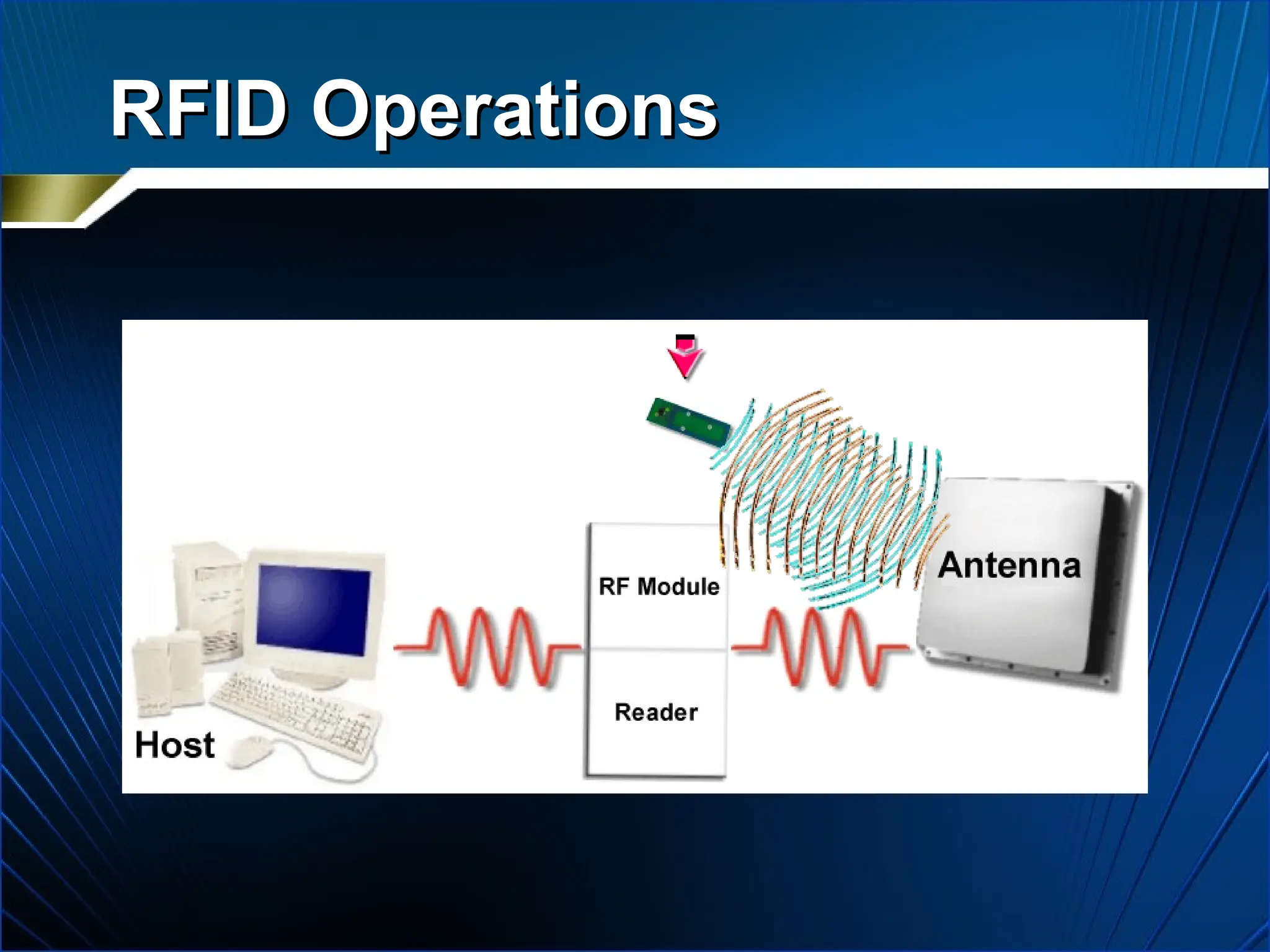
RFID Operation
RFID Operation
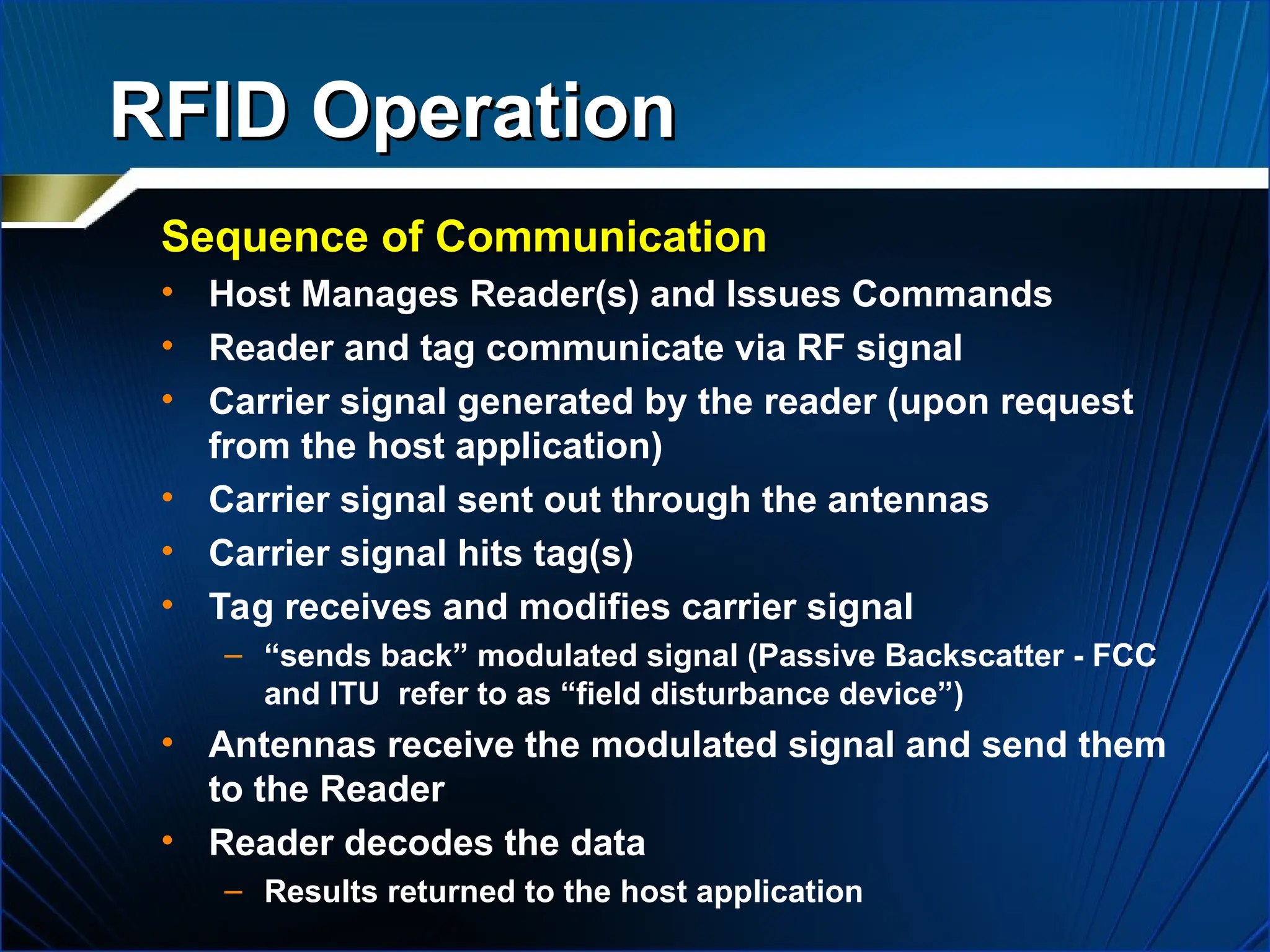
Sequence of Communication
• Host Manages Reader(s) and Issues Commands
• Reader and tag communicate via RF signal
• Carrier signal generated by the reader (upon request
from the host application)
• Carrier signal sent out through the antennas
• Carrier signal hits tag(s)
• Tag receives and modifies carrier signal
– “sends back” modulated signal (Passive Backscatter - FCC
and ITU refer to as “field disturbance device”)
• Antennas receive the modulated signal and send them
to the Reader
• Reader decodes the data
– Results returned to the host application
RFID Operations
RFID Operations
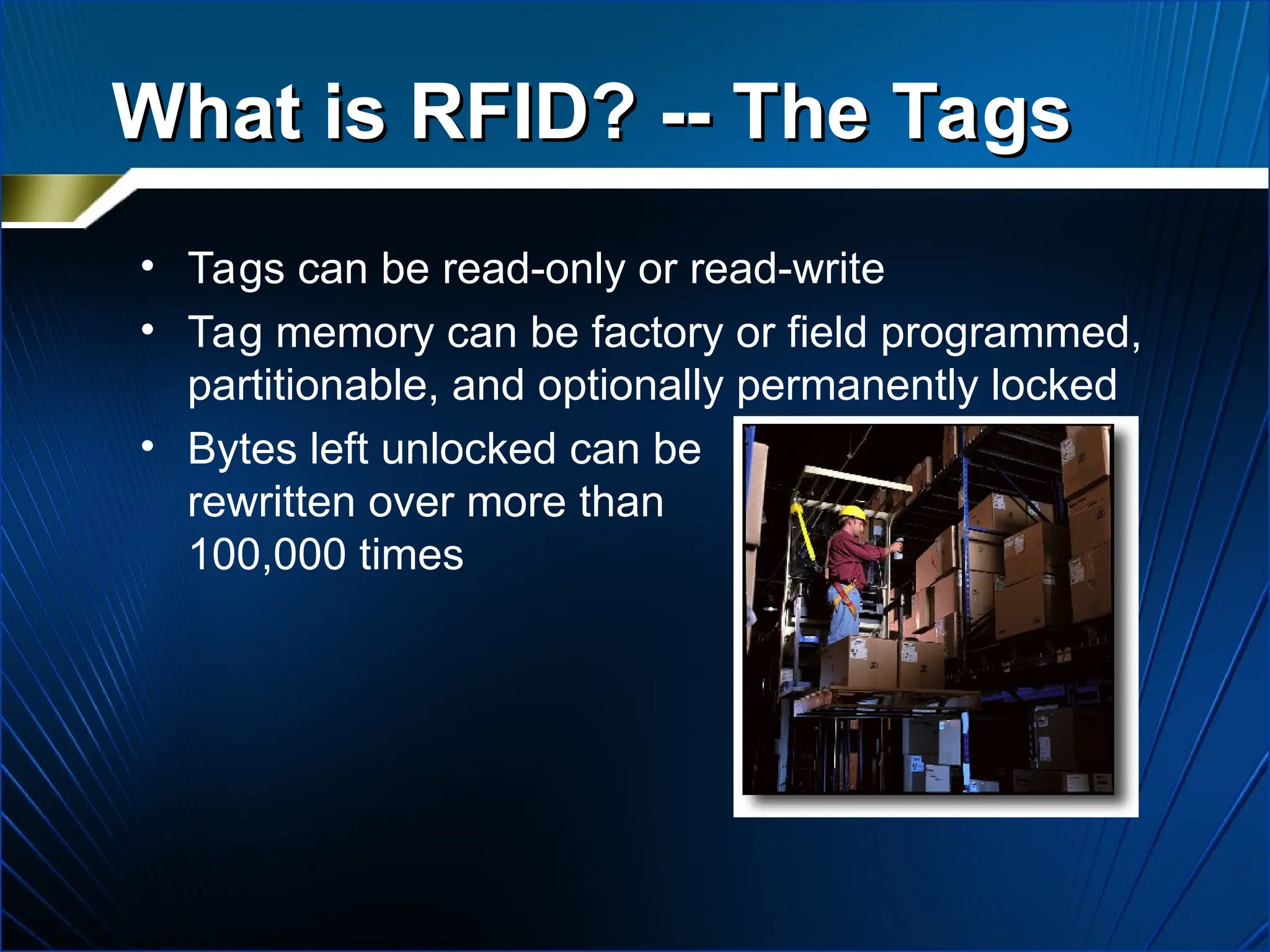
What is RFID? -- The Tags
• Tags can be read-only or read-write
• Tag memory can be factory or field programmed,
partitionable, and optionally permanently locked
• Bytes left unlocked can be
rewritten over more than
100,000 times
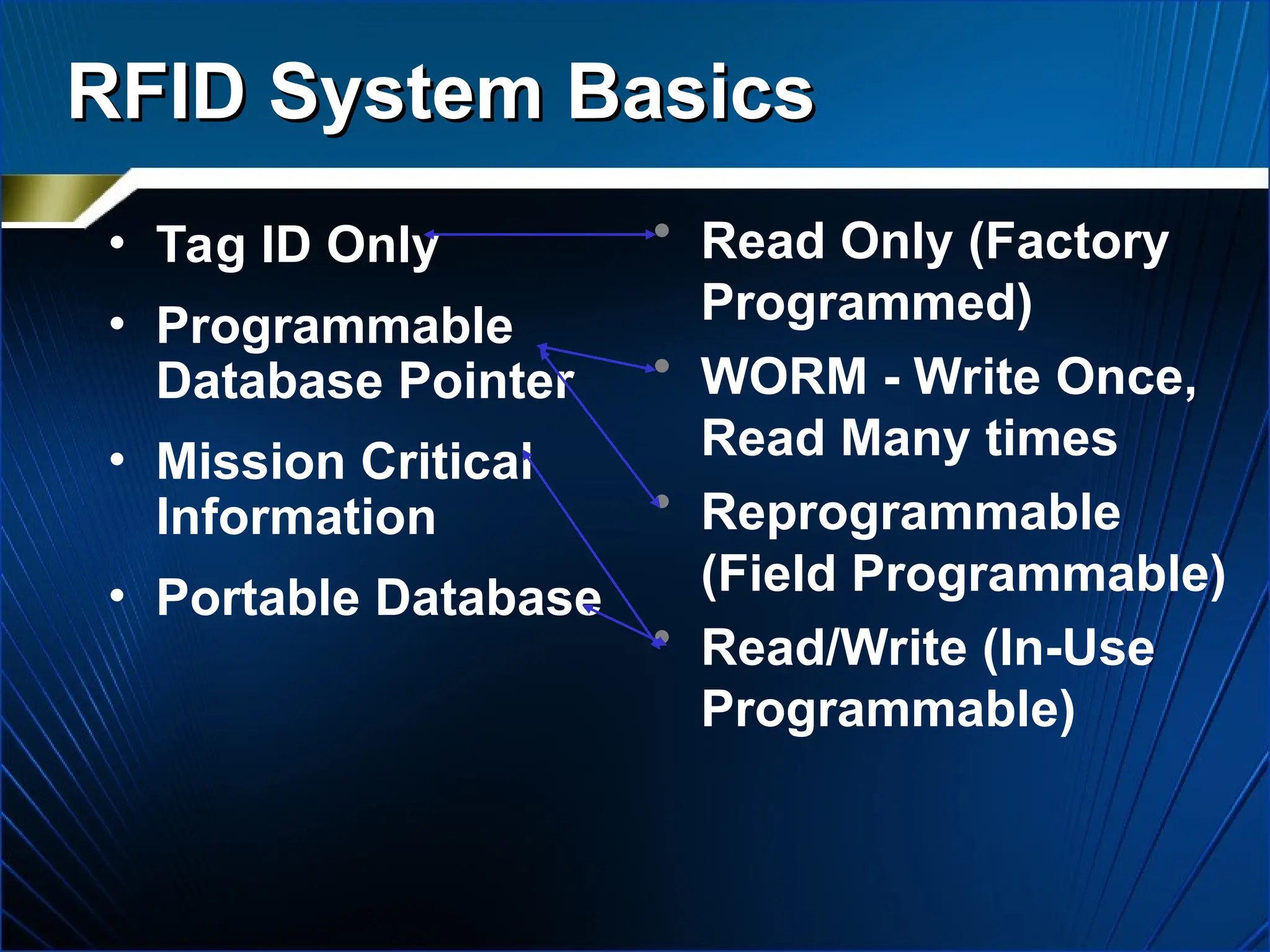
• Tag ID Only
• Programmable
Database Pointer
• Mission Critical
Information
• Portable Database
• Read Only (Factory
Programmed)
• WORM - Write Once,
Read Many times
• Reprogrammable
(Field Programmable)
• Read/Write (In-Use
Programmable)
RFID System Basics
RFID System Basics
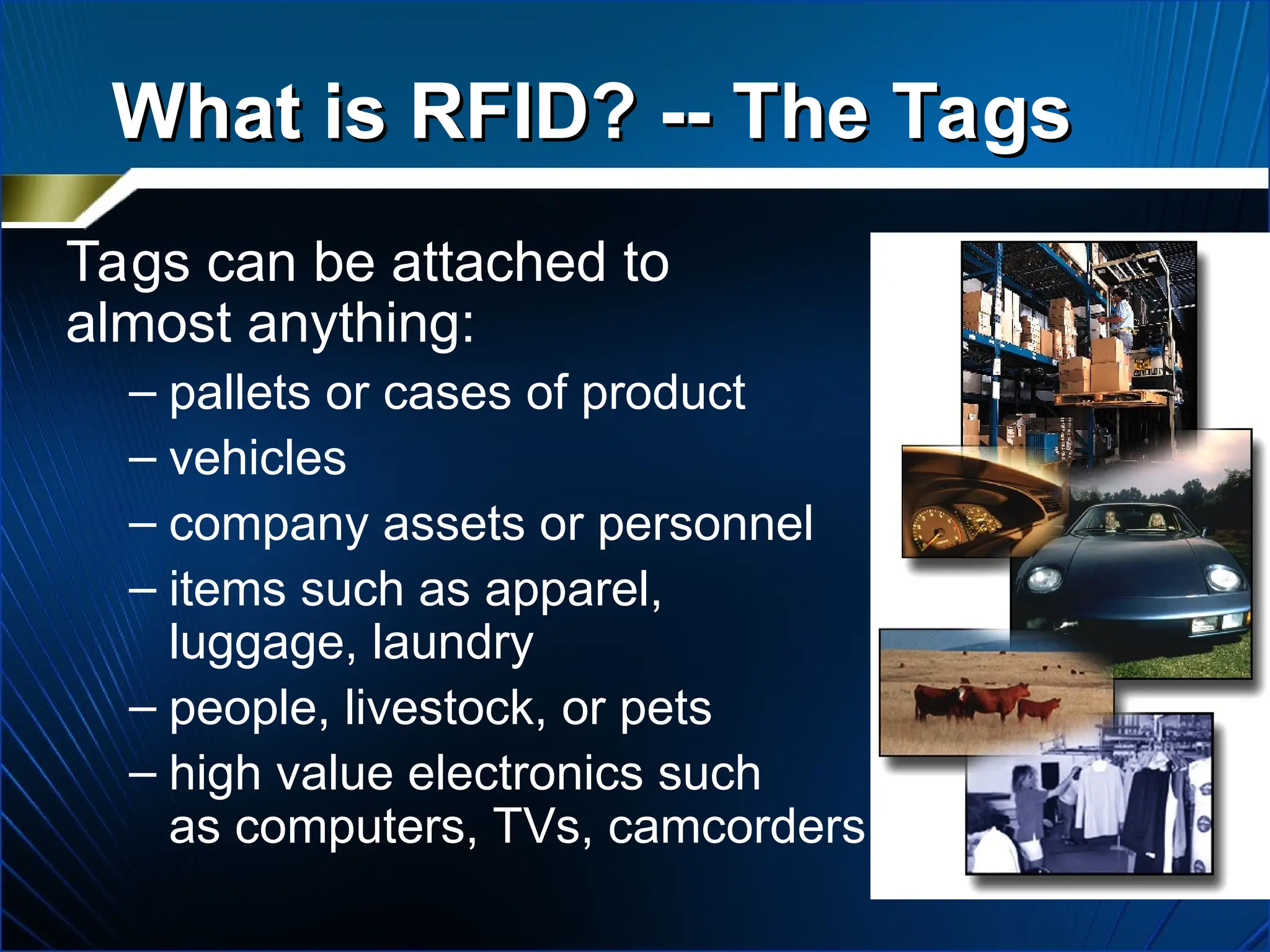
Tags can be attached to
almost anything:
– pallets or cases of product
– vehicles
– company assets or personnel
– items such as apparel,
luggage, laundry
– people, livestock, or pets
– high value electronics such
as computers, TVs, camcorders
What is RFID? -- The Tags
Are All Tags The Same?
Basic Types:
Active
• Tag transmits radio signal
• Battery powered memory, radio & circuitry
• High Read Range (300 feet)
Passive
• Tag reflects radio signal from reader
• Reader powered
• Shorter Read Range (4 inches - 15 feet)
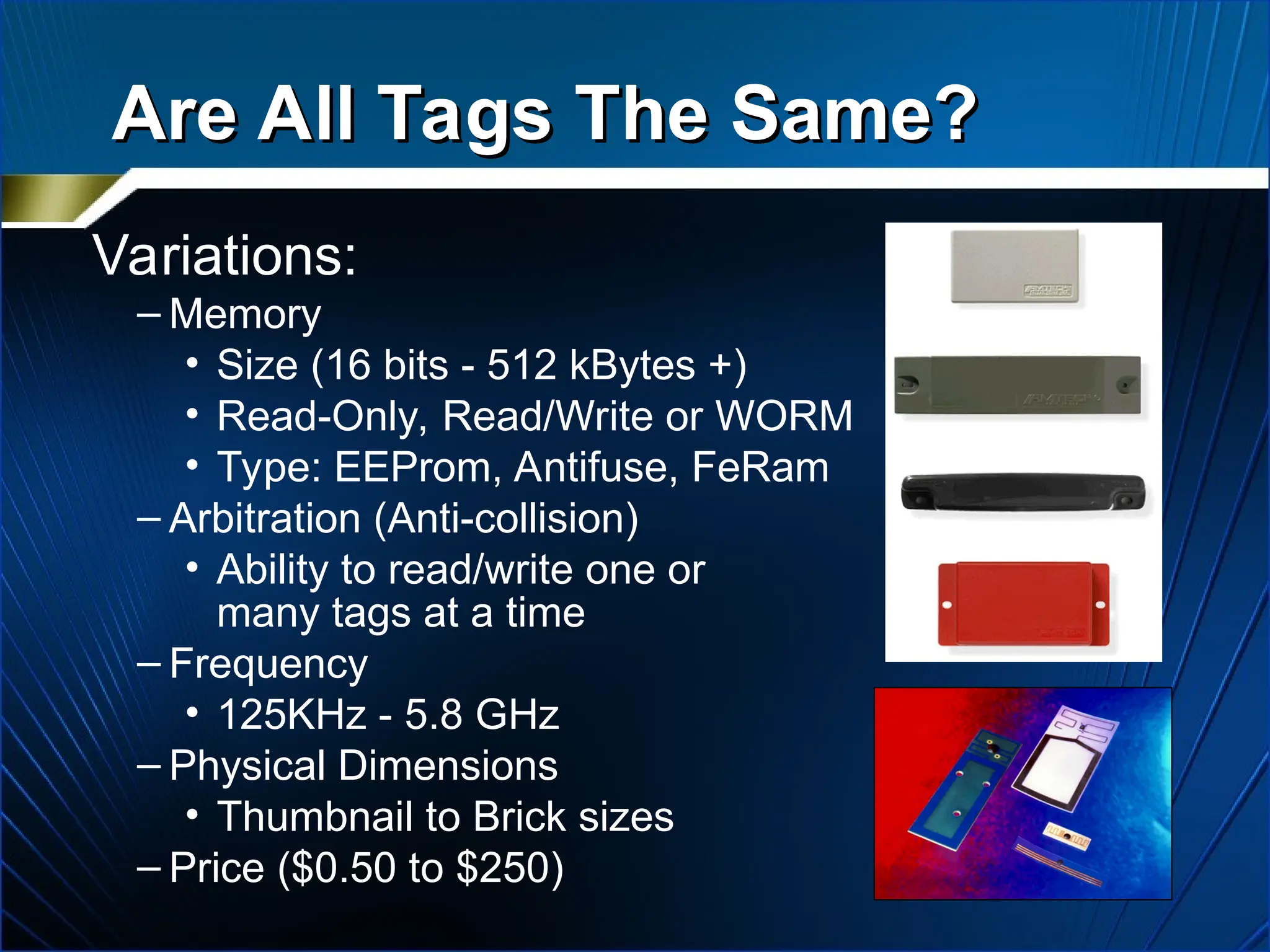
Variations:
– Memory
• Size (16 bits - 512 kBytes +)
• Read-Only, Read/Write or WORM
• Type: EEProm, Antifuse, FeRam
– Arbitration (Anti-collision)
• Ability to read/write one or
many tags at a time
– Frequency
• 125KHz - 5.8 GHz
– Physical Dimensions
• Thumbnail to Brick sizes
– Price ($0.50 to $250)
Are All Tags The Same?
RFID System Basics
RFID System Basics
• How far?
• How fast?
• How many?
• How much?
• Attached to and surround by what?
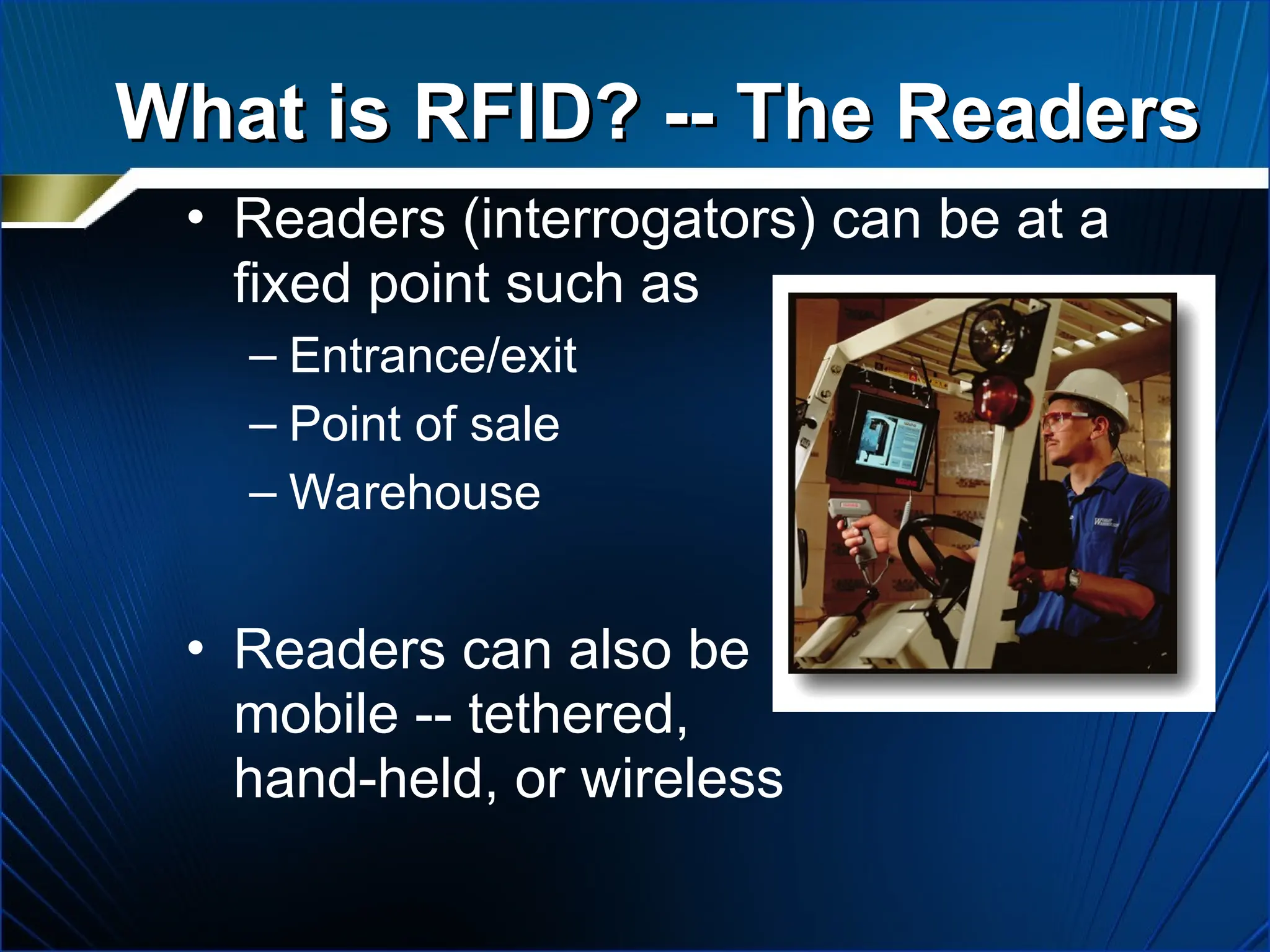
What is RFID? -- The Readers
• Readers (interrogators) can be at a
fixed point such as
– Entrance/exit
– Point of sale
– Warehouse
• Readers can also be
mobile -- tethered,
hand-held, or wireless
Advantages
• Uses normal CMOS processing —
basic and ubiquitous
• Relative freedom from
regulatory limitations
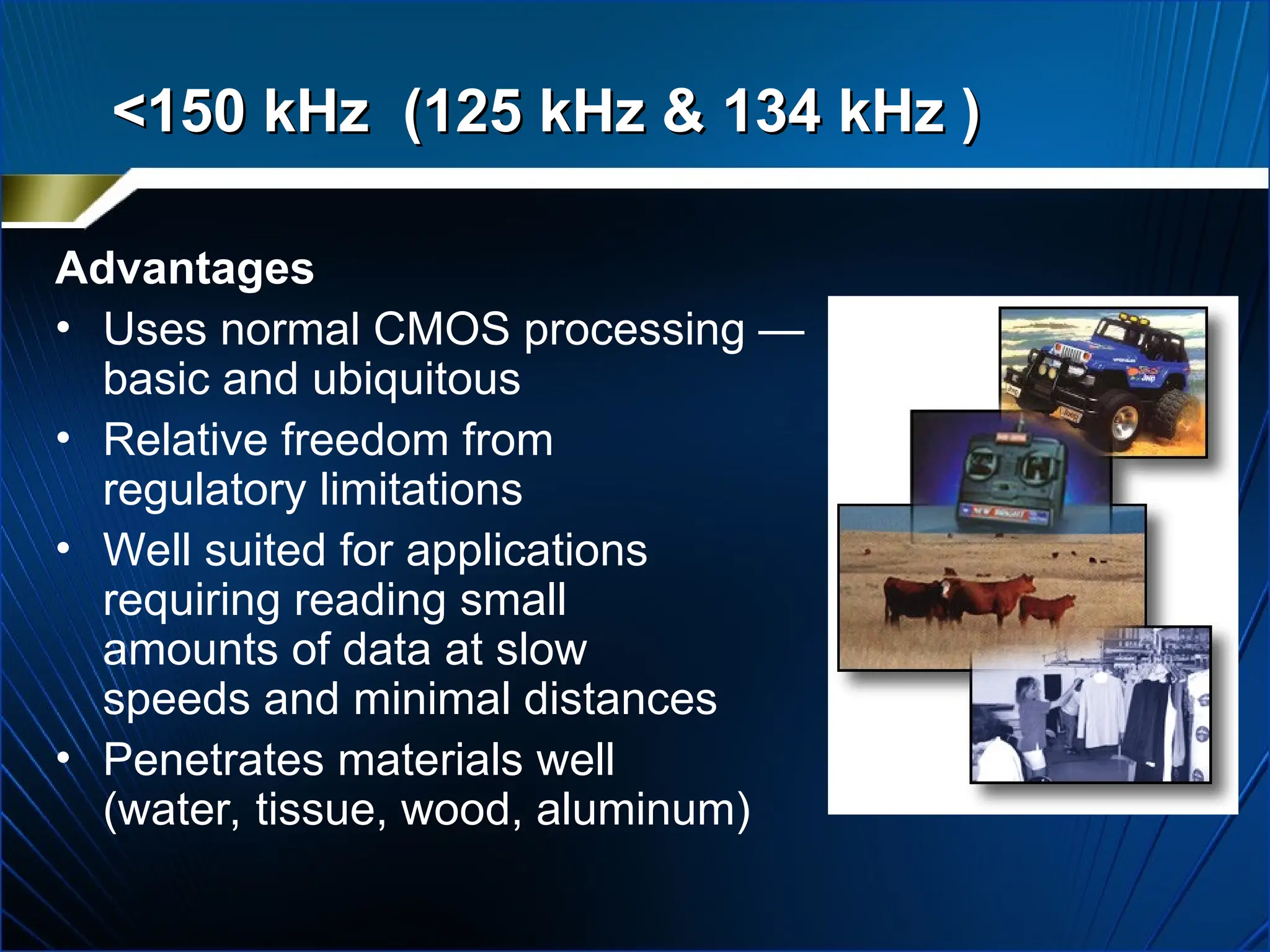
• Well suited for applications
requiring reading small
amounts of data at slow
speeds and minimal distances
• Penetrates materials well
(water, tissue, wood, aluminum)
<150 kHz (125 kHz & 134 kHz )
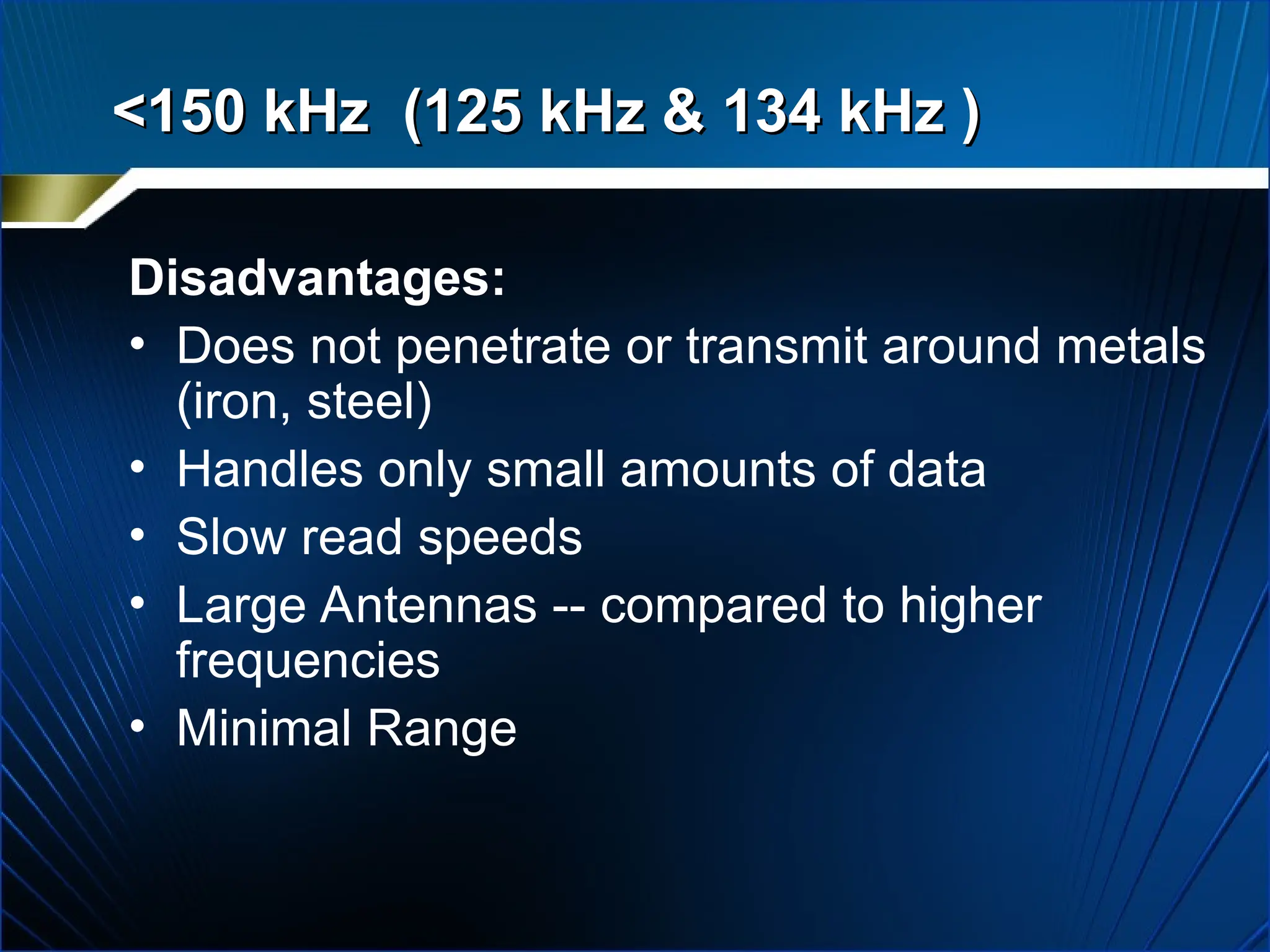
Disadvantages:
• Does not penetrate or transmit around metals
(iron, steel)
• Handles only small amounts of data
• Slow read speeds
• Large Antennas -- compared to higher
frequencies
• Minimal Range
<150 kHz (125 kHz & 134 kHz )
Disadvantages:
• Tag construction:
 is thicker (than 13.56 MHz)
 is more expensive (than 13.56 MHz)
 more complex
(requires more turns of the induction coil)
<150 kHz (125 kHz & 134 kHz )
13.56 MHz
13.56 MHz
Advantages
• Uses normal CMOS processing--basic and
ubiquitous
• Well suited for applications requiring reading small
amounts of data and minimal distances
• Penetrates water/tissue well
• Simpler antenna design (fewer turns of the coil);
lower costs to build
• Higher data rate (than 125 kHz--but slower than
higher MHz systems)
• Thinner tag construction (than 125 kHz)
• Popular Smart Card frequency
Disadvantages
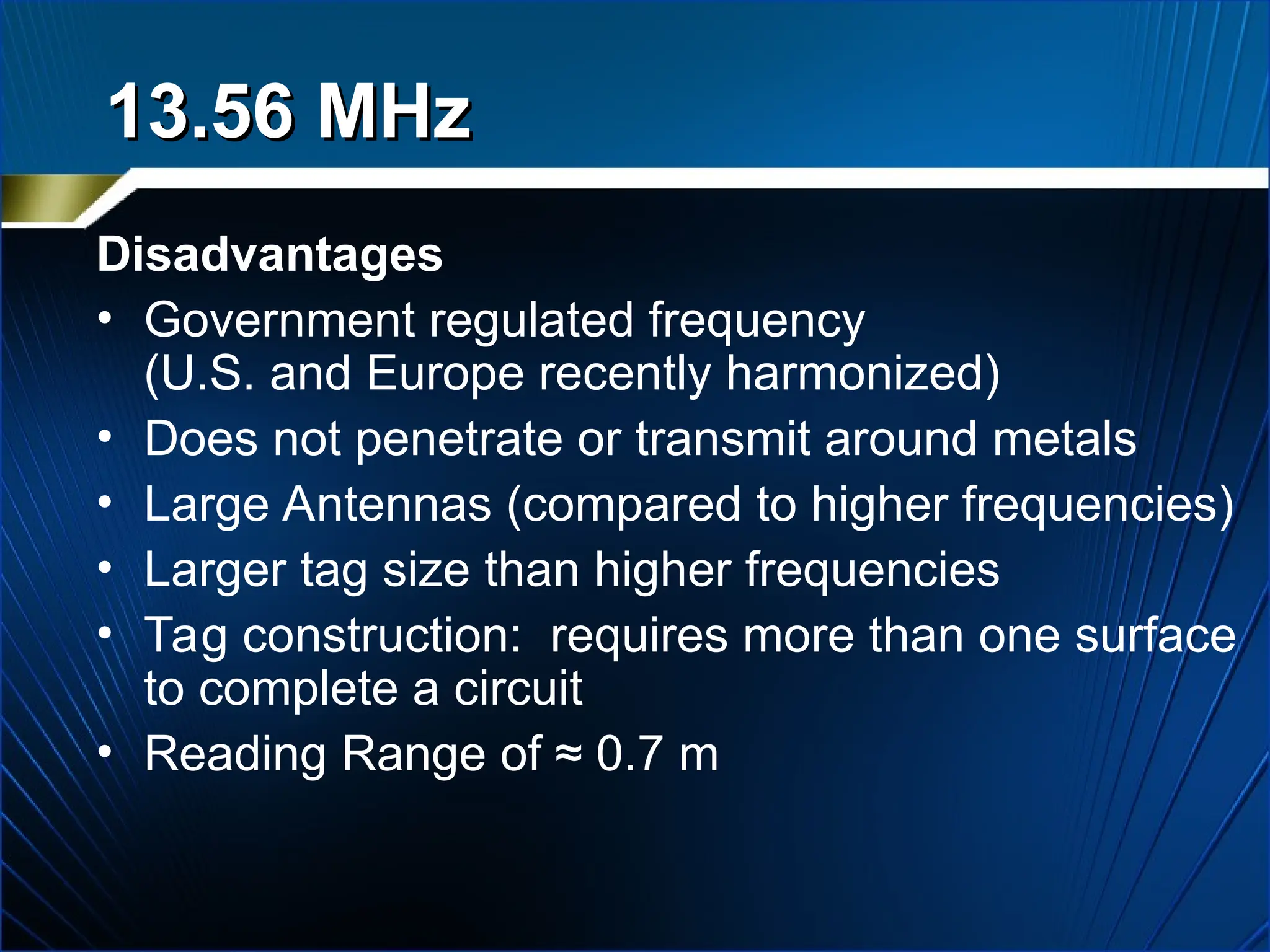
• Government regulated frequency
(U.S. and Europe recently harmonized)
• Does not penetrate or transmit around metals
• Large Antennas (compared to higher frequencies)
• Larger tag size than higher frequencies
• Tag construction: requires more than one surface
to complete a circuit
• Reading Range of ≈ 0.7 m
13.56 MHz
13.56 MHz
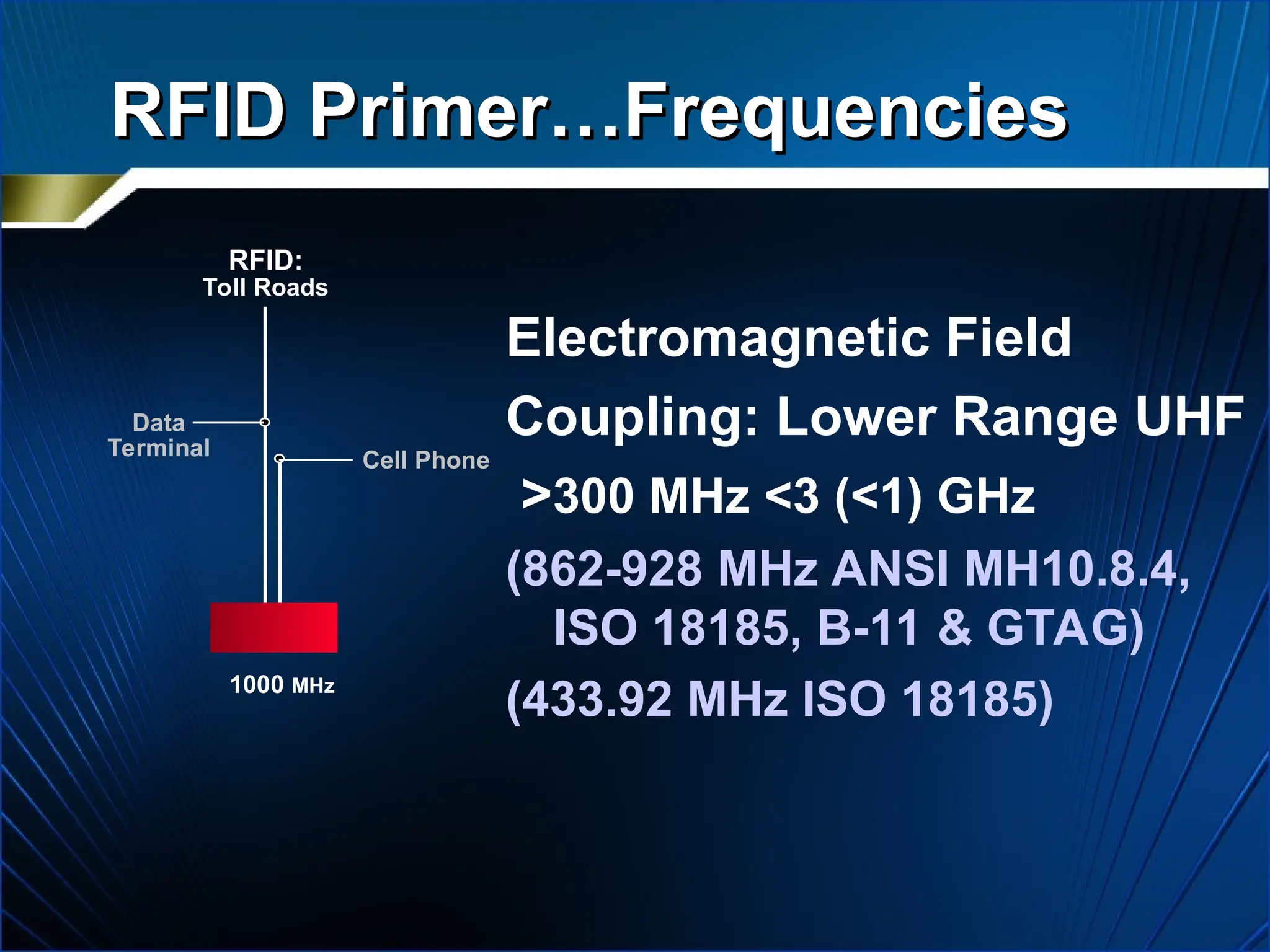
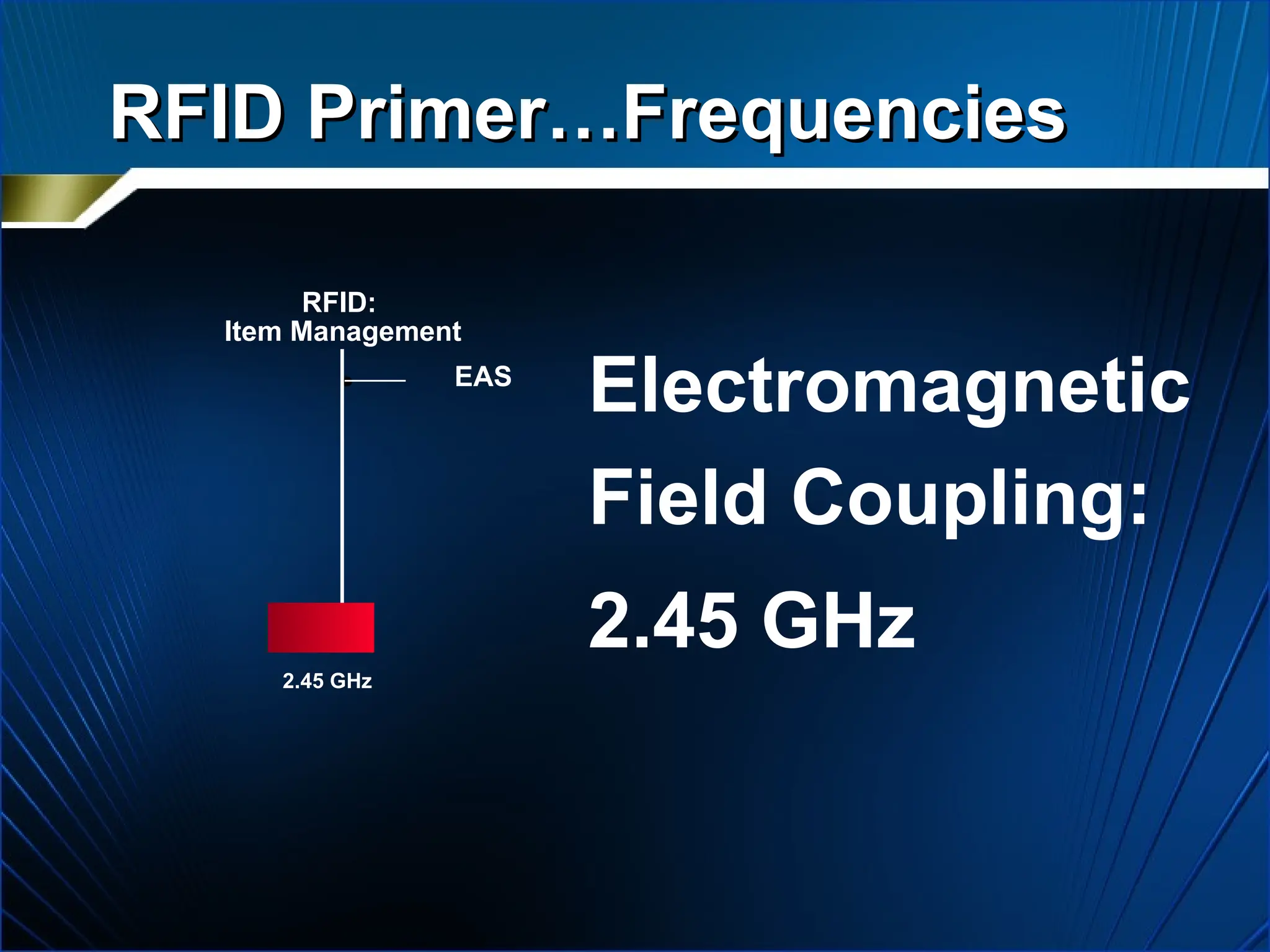
RFID Primer…Frequencies
Electromagnetic Field
Coupling: Lower Range UHF
>300 MHz <3 (<1) GHz
(862-928 MHz ANSI MH10.8.4,
ISO 18185, B-11 & GTAG)
(433.92 MHz ISO 18185)
1000 MHz
Cell Phone
RFID:
Toll Roads
Data
Terminal
>300 MHz <1GHz
>300 MHz <1GHz
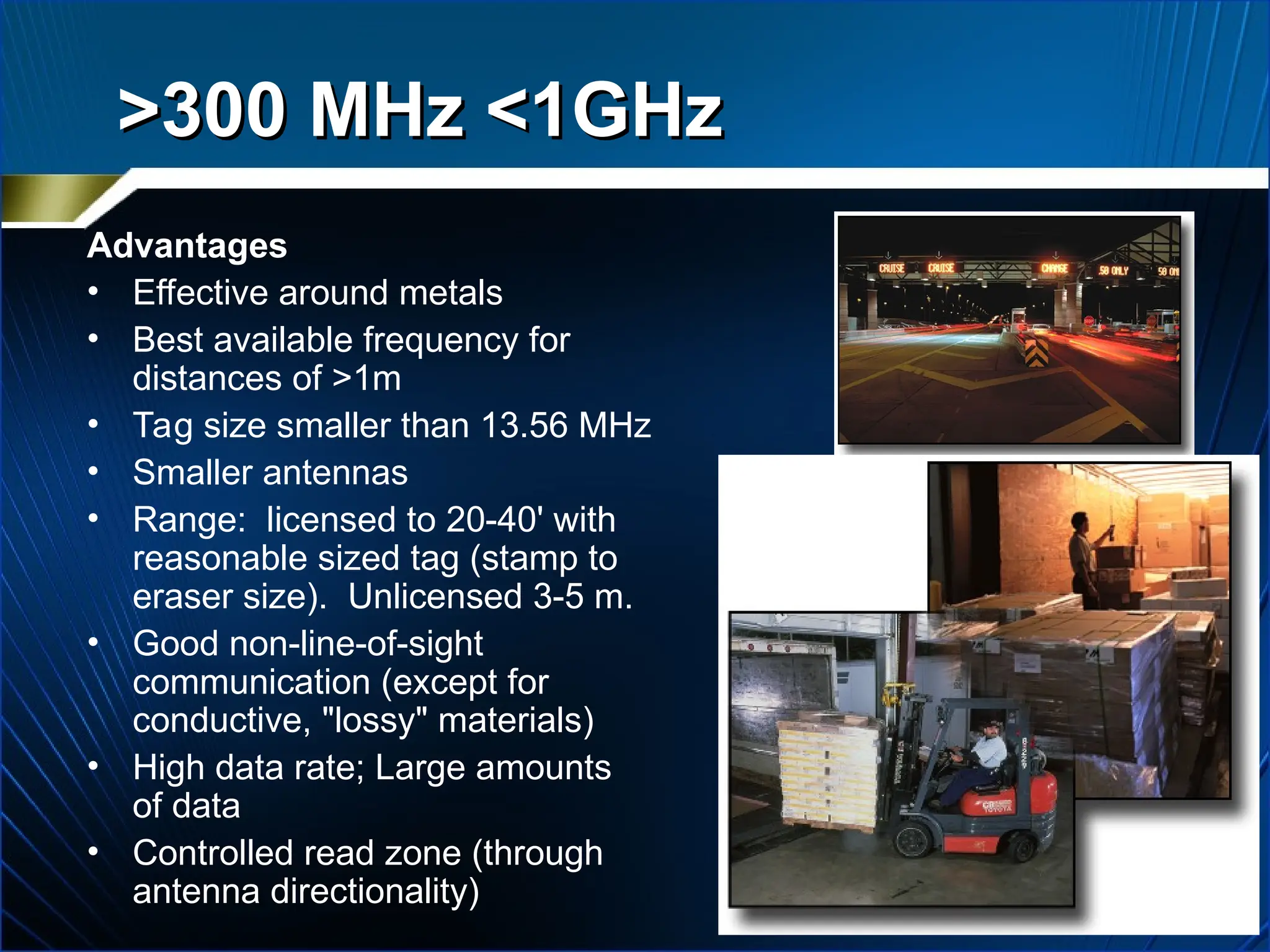
Advantages
• Effective around metals
• Best available frequency for
distances of >1m
• Tag size smaller than 13.56 MHz
• Smaller antennas
• Range: licensed to 20-40' with
reasonable sized tag (stamp to
eraser size). Unlicensed 3-5 m.
• Good non-line-of-sight
communication (except for
conductive, "lossy" materials)
• High data rate; Large amounts
of data
• Controlled read zone (through
antenna directionality)
Disadvantages
• Does not penetrate water/tissue
• Regulatory issues (differences in frequency,
channels, power, and duty cycle)
• Regulatory issues in Europe
(similar band 869 MHz requires frequency
agile chip)
950 - 956 MHz under study in Japan
>300 MHz <1GHz
>300 MHz <1GHz
RFID Primer…Frequencies
Electromagnetic
Field Coupling:
2.45 GHz
RFID:
Item Management
EAS
2.45 GHz
2.45 GHz
2.45 GHz
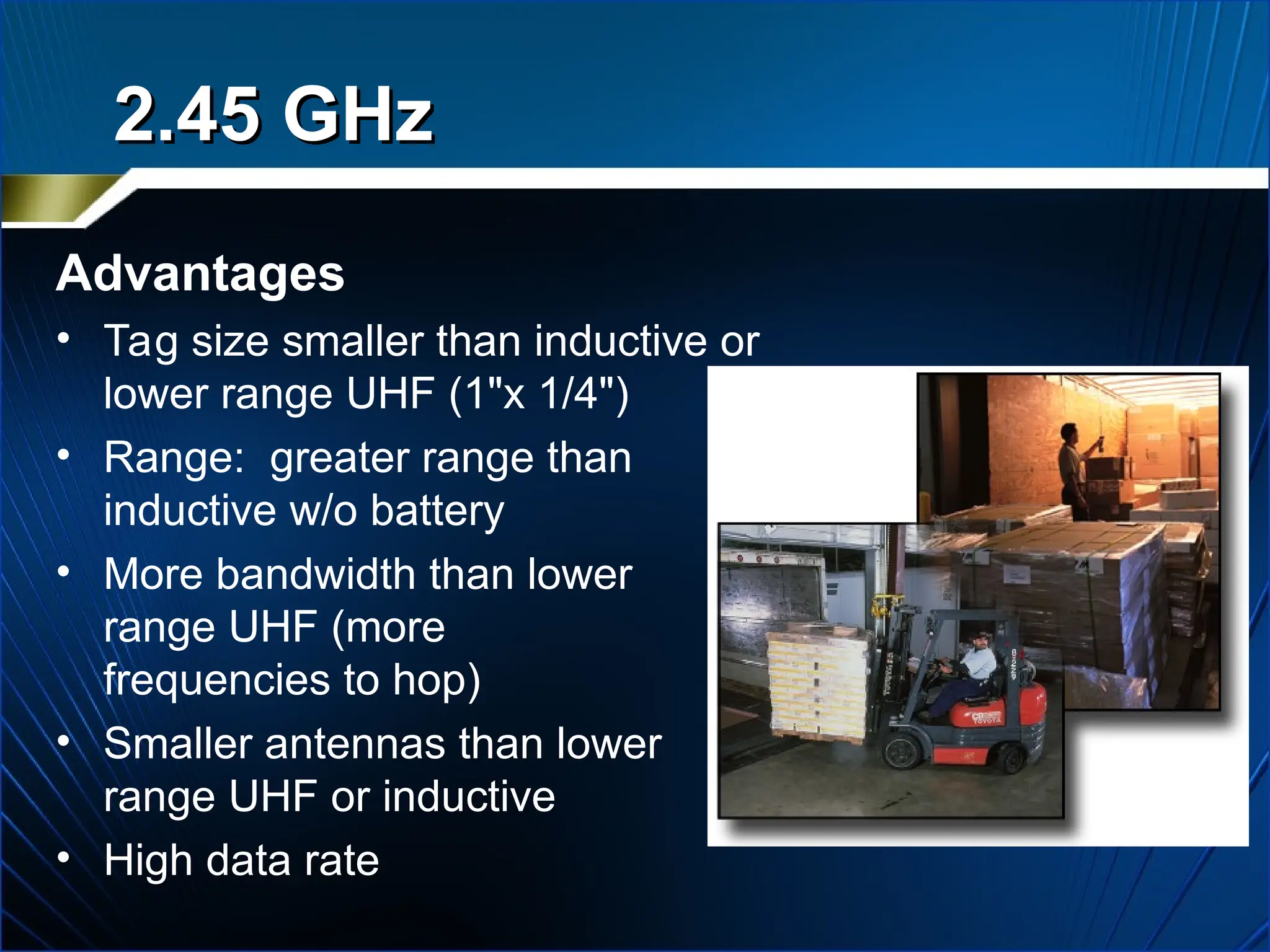
Advantages
• Tag size smaller than inductive or
lower range UHF (1"x 1/4")
• Range: greater range than
inductive w/o battery
• More bandwidth than lower
range UHF (more
frequencies to hop)
• Smaller antennas than lower
range UHF or inductive
• High data rate
Advantages
• Good non-line-of-sight communication
(except for conductive, "lossy" materials)
• Can transmit large amounts of data more
quickly than lower frequencies
• Controlled read zone
(through antenna directionality)
• Effective around metals with
tuning/design adaptations
2.45 GHz
2.45 GHz
Disadvantages
• More susceptible to electronic noise than lower
UHF bands, e.g. 433 MHz, 860-930 MHz
• Shared spectrum with other technologies--
microwave ovens, RLANS, TV devices, etc.
• Requires non-interfering, "good neighbor"
tactics like FHSS
• Competitive requirement: single chip--highly
technical; limited number of vendors
• Regulatory approvals still "in process"
2.45 GHz
2.45 GHz
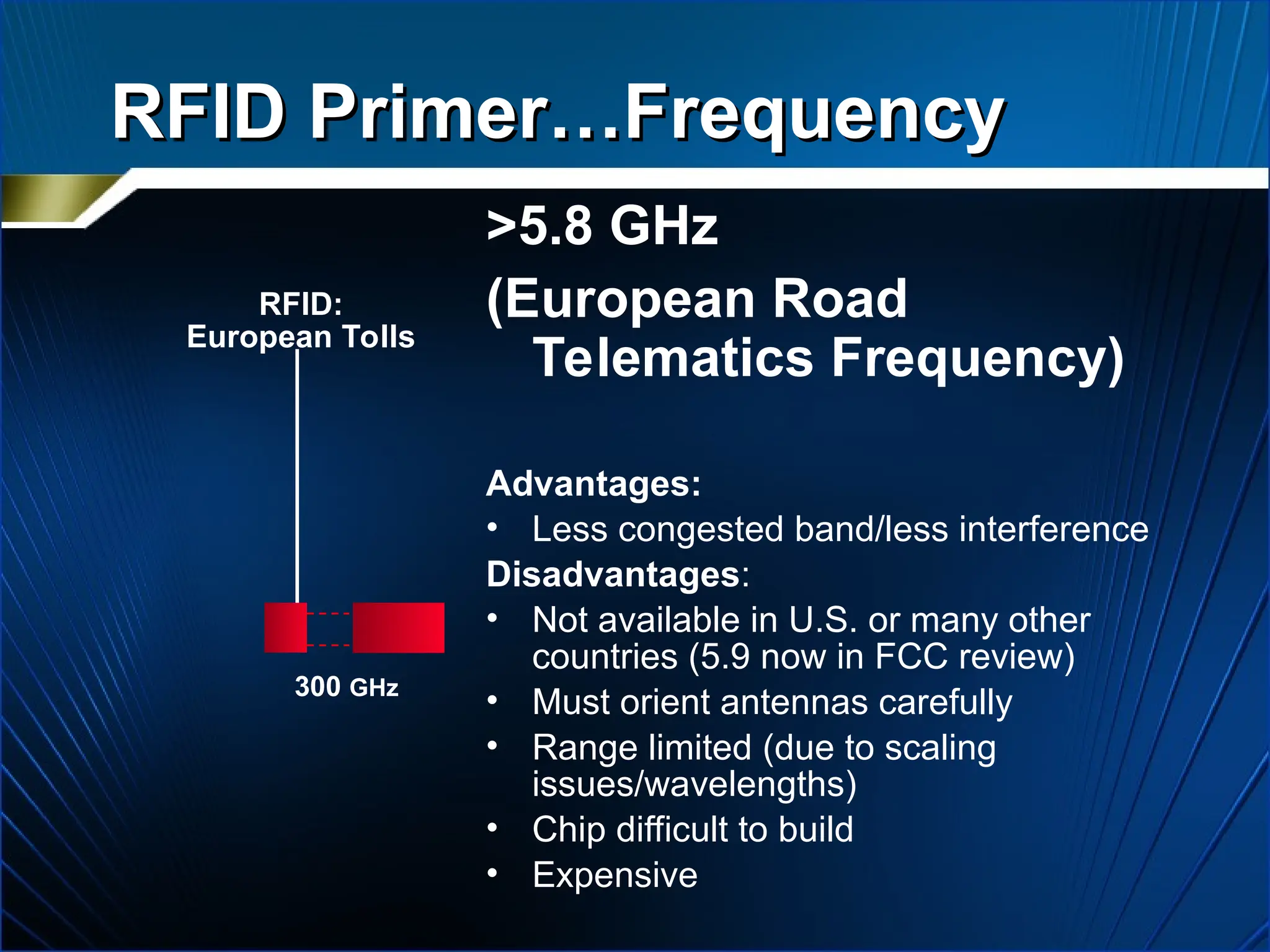
RFID Primer…Frequency
>5.8 GHz
(European Road
Telematics Frequency)
Advantages:
• Less congested band/less interference
Disadvantages:
• Not available in U.S. or many other
countries (5.9 now in FCC review)
• Must orient antennas carefully
• Range limited (due to scaling
issues/wavelengths)
• Chip difficult to build
• Expensive
RFID:
European Tolls
300 GHz
Spectrum Regulation
Spectrum Regulation
• The radio frequency (RF) spectrum is a scarce and
shared resource, used nationally and internationally,
and subject to a wide range of regulatory oversight. In
the U.S., the Federal Communications Commission is
a key regulatory body that allocates spectrum use and
resolves spectrum conflicts. The International
Telecommunication Union (ITU) is a specialized
agency of the United Nations which plays the same
role internationally.
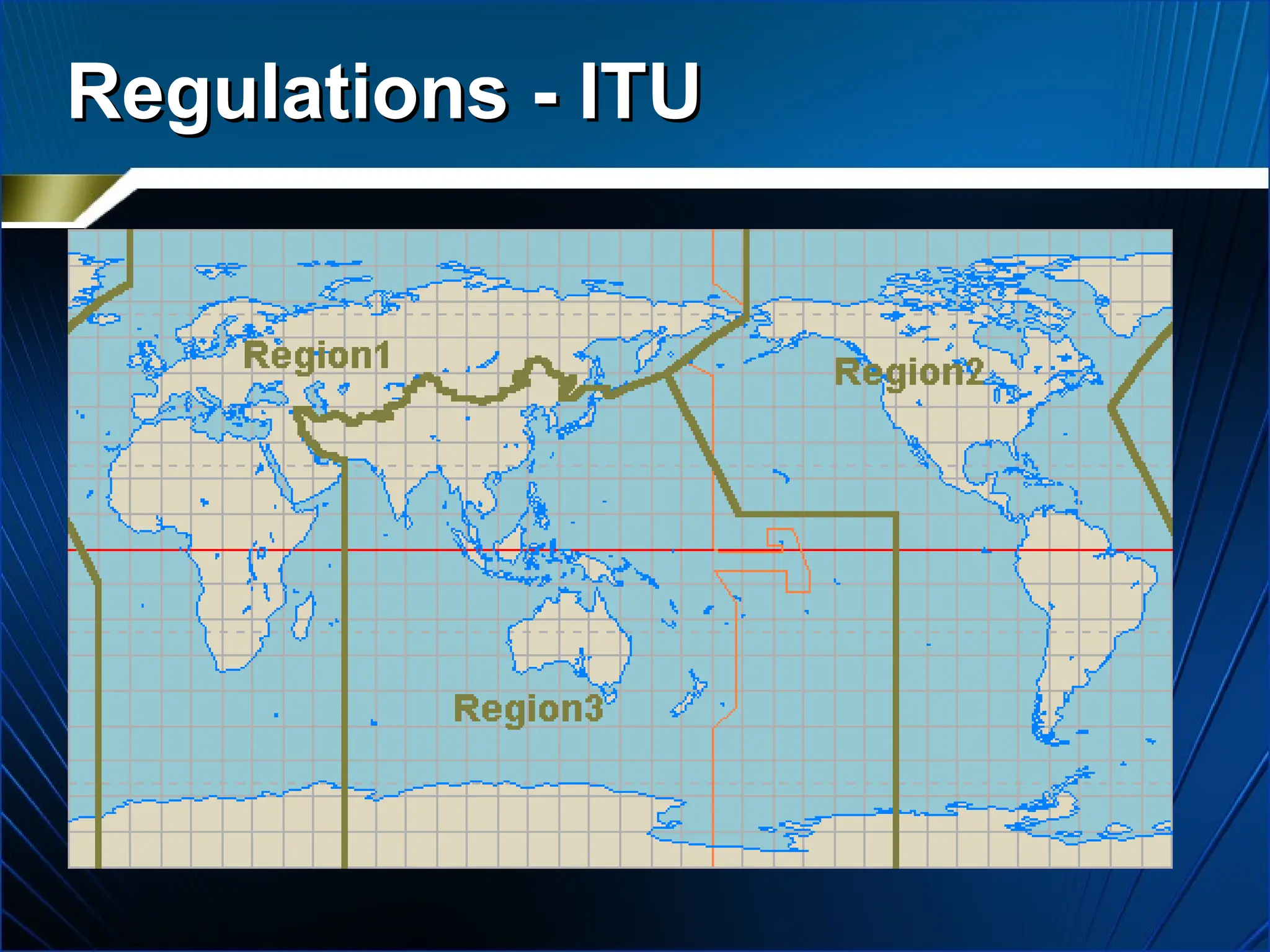
Regulations - ITU
Regulations - ITU
Regulatory Differences
• Usage of channel
– Primary service
– Secondary service
• Cannot interfere with primary service
• Cannot claim protection of interference from primary service
• Can claim protection of interference from other secondary users
– Industrial, Scientific, & Medical (ISM) Bands
• Narrowband or Spread Spectrum
• Power level
• Duty cycle
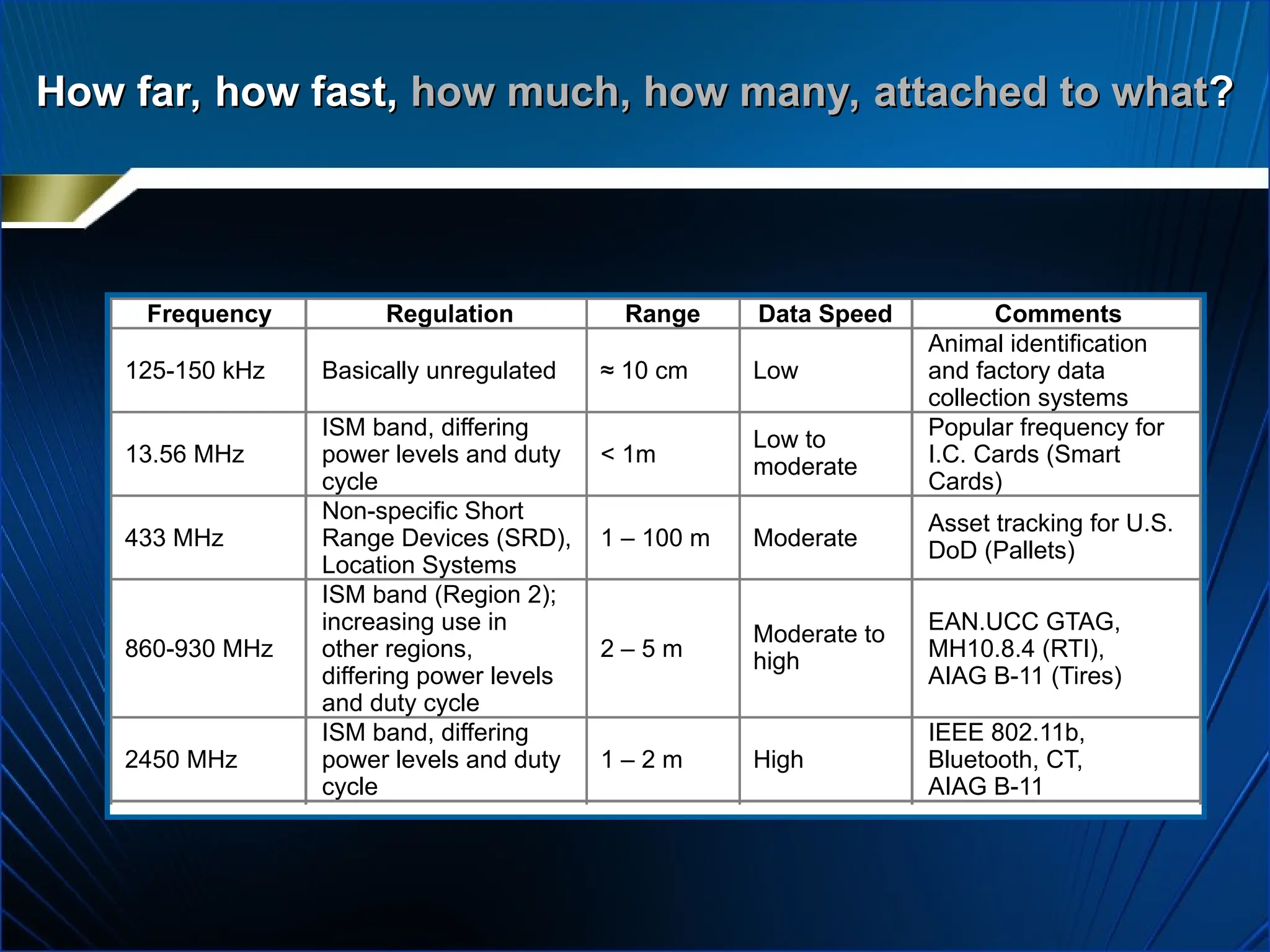
How far, how fast,
How far, how fast, how much, how many, attached to what
how much, how many, attached to what?
?
Frequency Regulation Range Data Speed Comments
125-150 kHz Basically unregulated ≈ 10 cm Low
Animal identification
and factory data
collection systems
13.56 MHz
ISM band, differing
power levels and duty
cycle
< 1m
Low to
moderate
Popular frequency for
I.C. Cards (Smart
Cards)
433 MHz
Non-specific Short
Range Devices (SRD),
Location Systems
1 – 100 m Moderate
Asset tracking for U.S.
DoD (Pallets)
860-930 MHz
ISM band (Region 2);
increasing use in
other regions,
differing power levels
and duty cycle
2 – 5 m
Moderate to
high
EAN.UCC GTAG,
MH10.8.4 (RTI),
AIAG B-11 (Tires)
2450 MHz
ISM band, differing
power levels and duty
cycle
1 – 2 m High
IEEE 802.11b,
Bluetooth, CT,
AIAG B-11
Radio Frequency Identification (RFID)
Applications
Applications
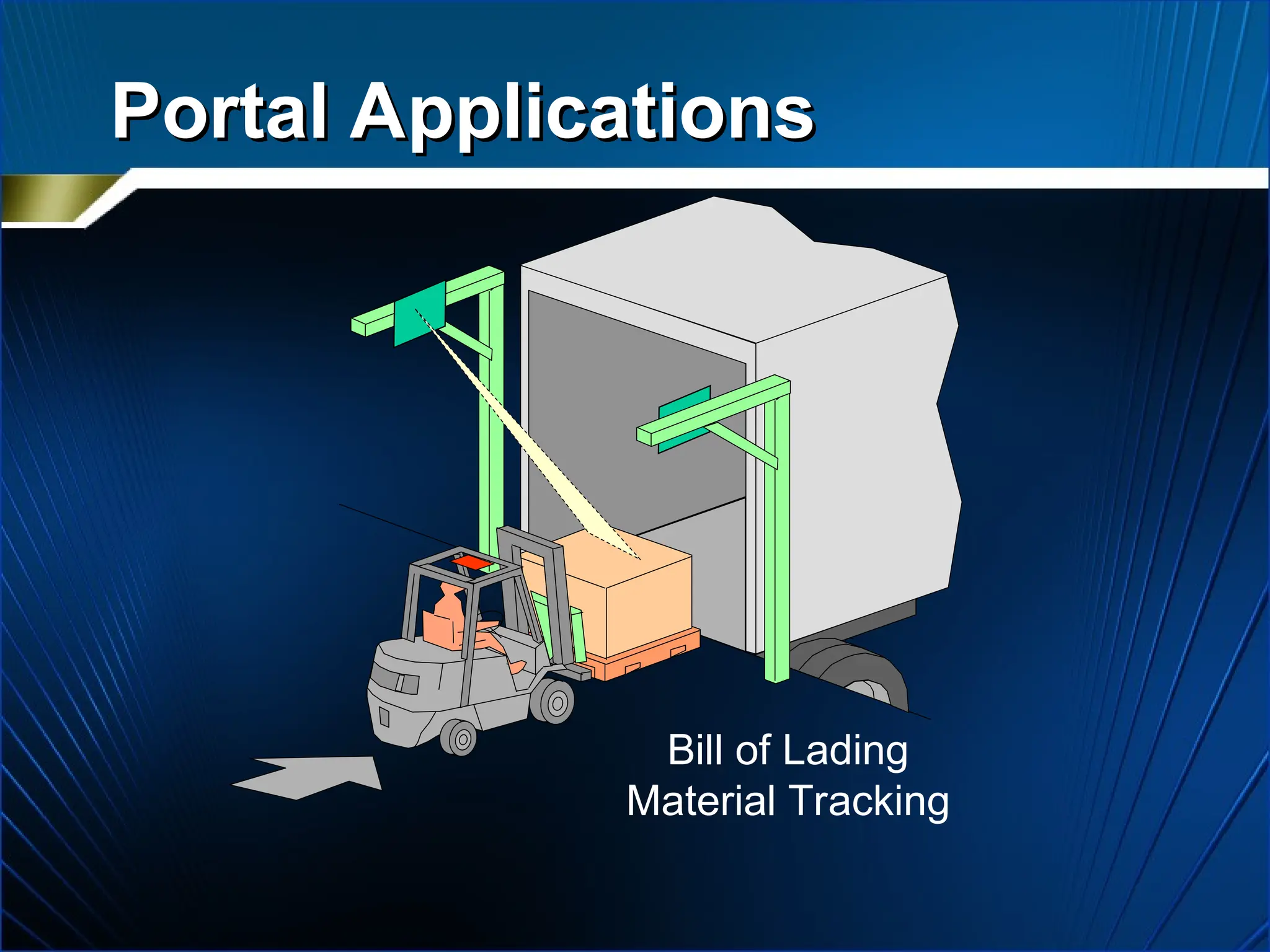
Portal Applications
Portal Applications
Bill of Lading
Material Tracking
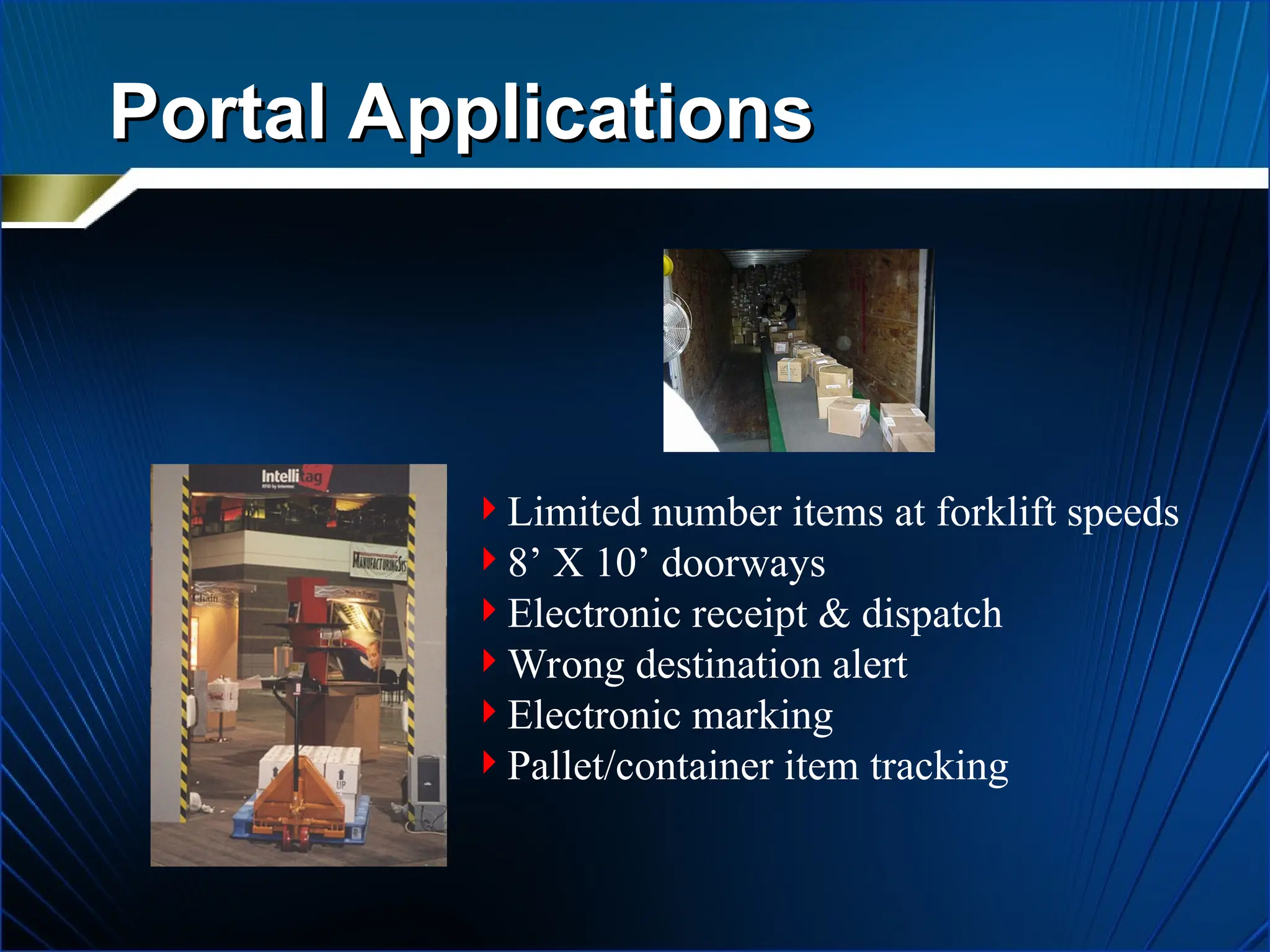
Portal Applications
Portal Applications
Limited number items at forklift speeds
8’ X 10’ doorways
Electronic receipt & dispatch
Wrong destination alert
Electronic marking
Pallet/container item tracking
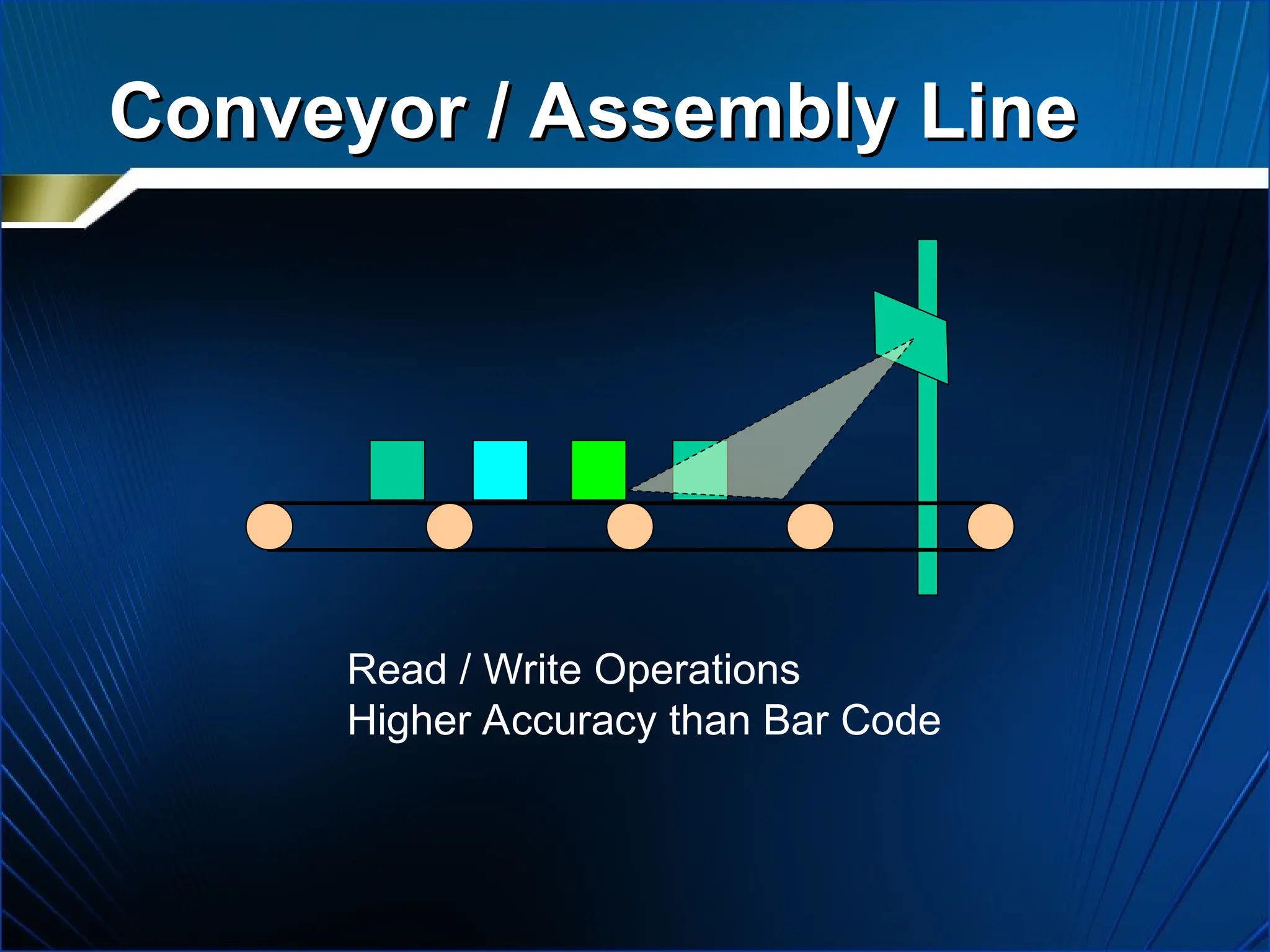
Conveyor / Assembly Line
Read / Write Operations
Higher Accuracy than Bar Code
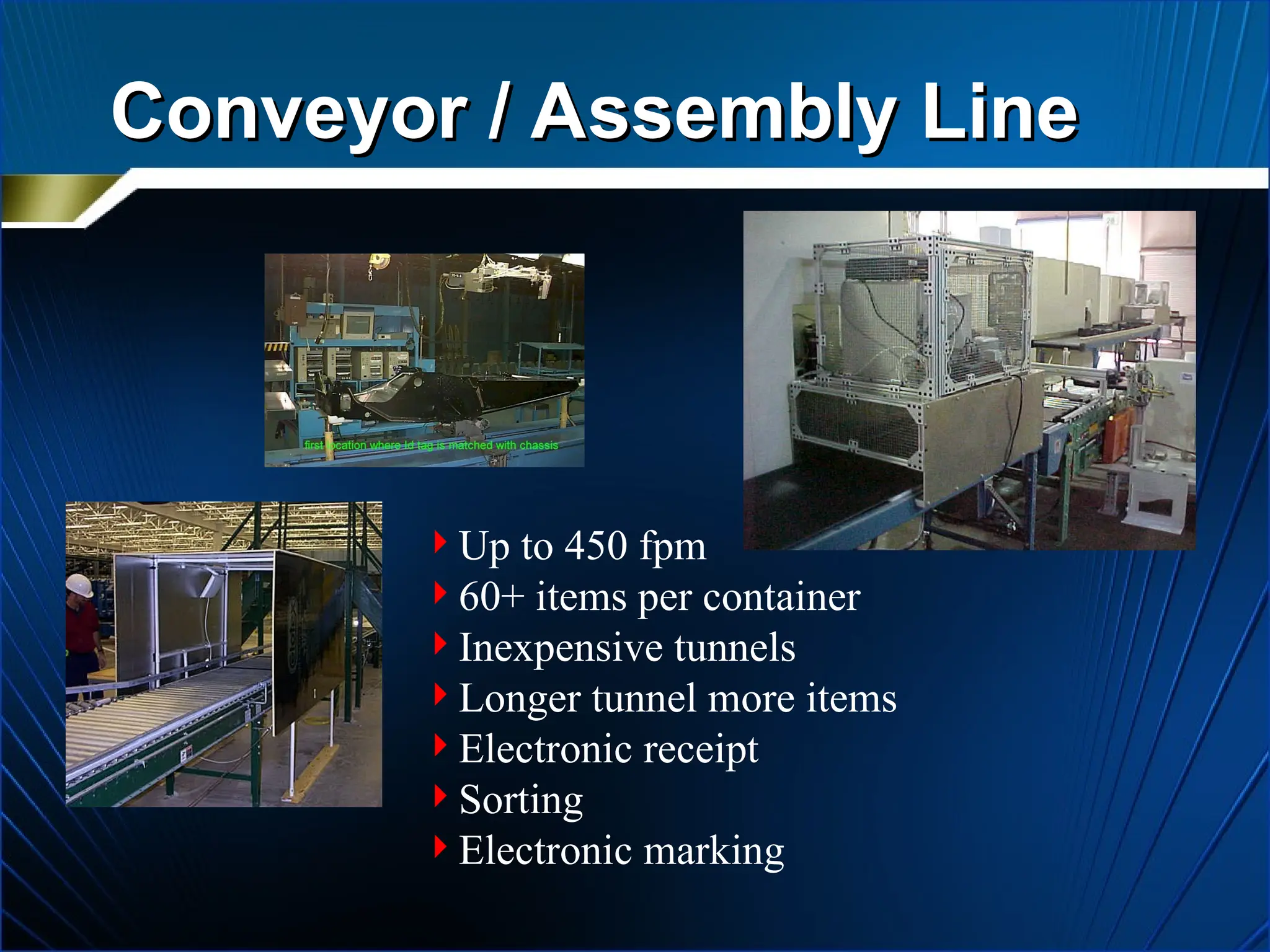
Conveyor / Assembly Line
Up to 450 fpm
60+ items per container
Inexpensive tunnels
Longer tunnel more items
Electronic receipt
Sorting
Electronic marking
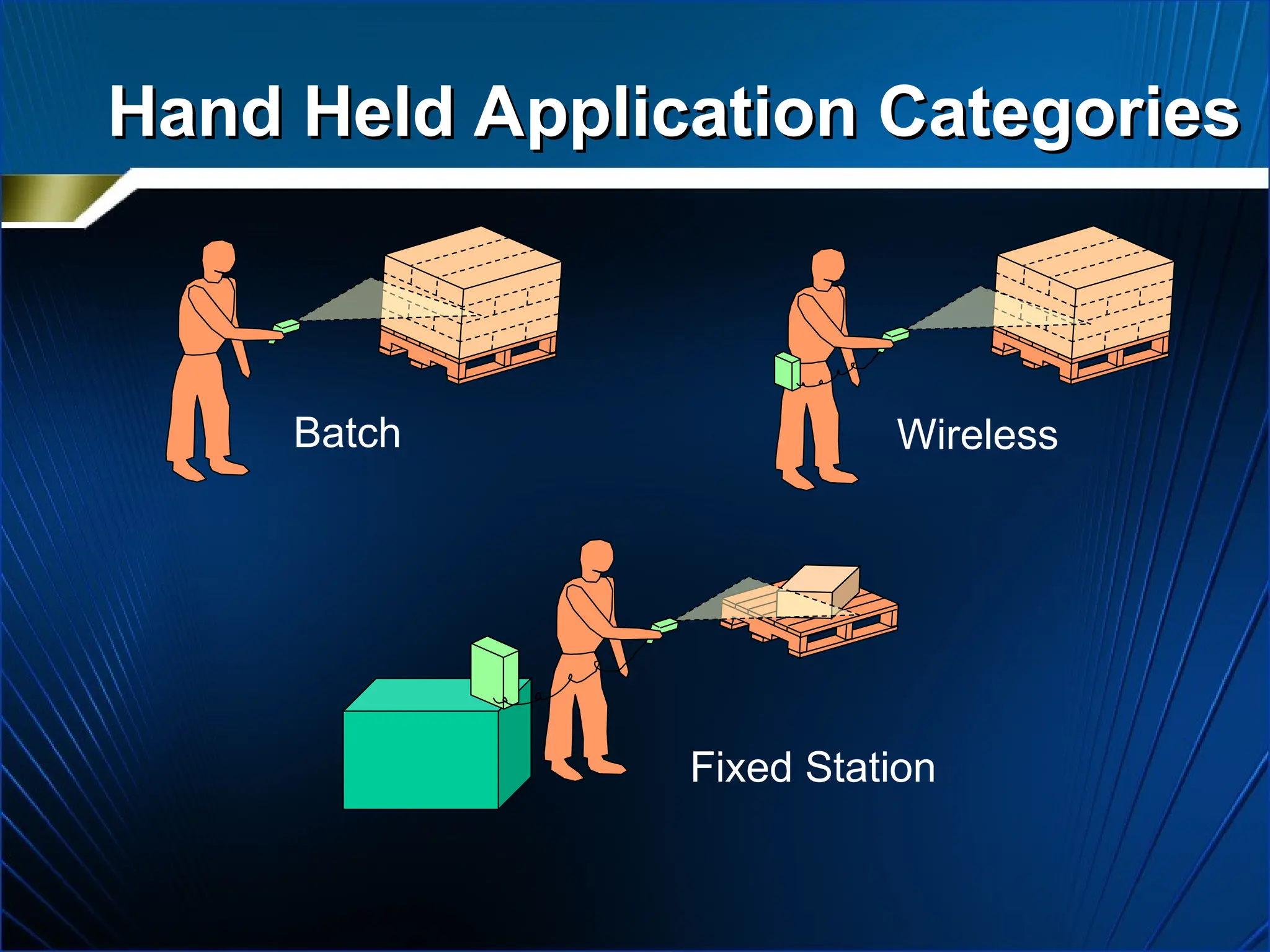
Hand Held Application Categories
Wireless
Batch
Fixed Station
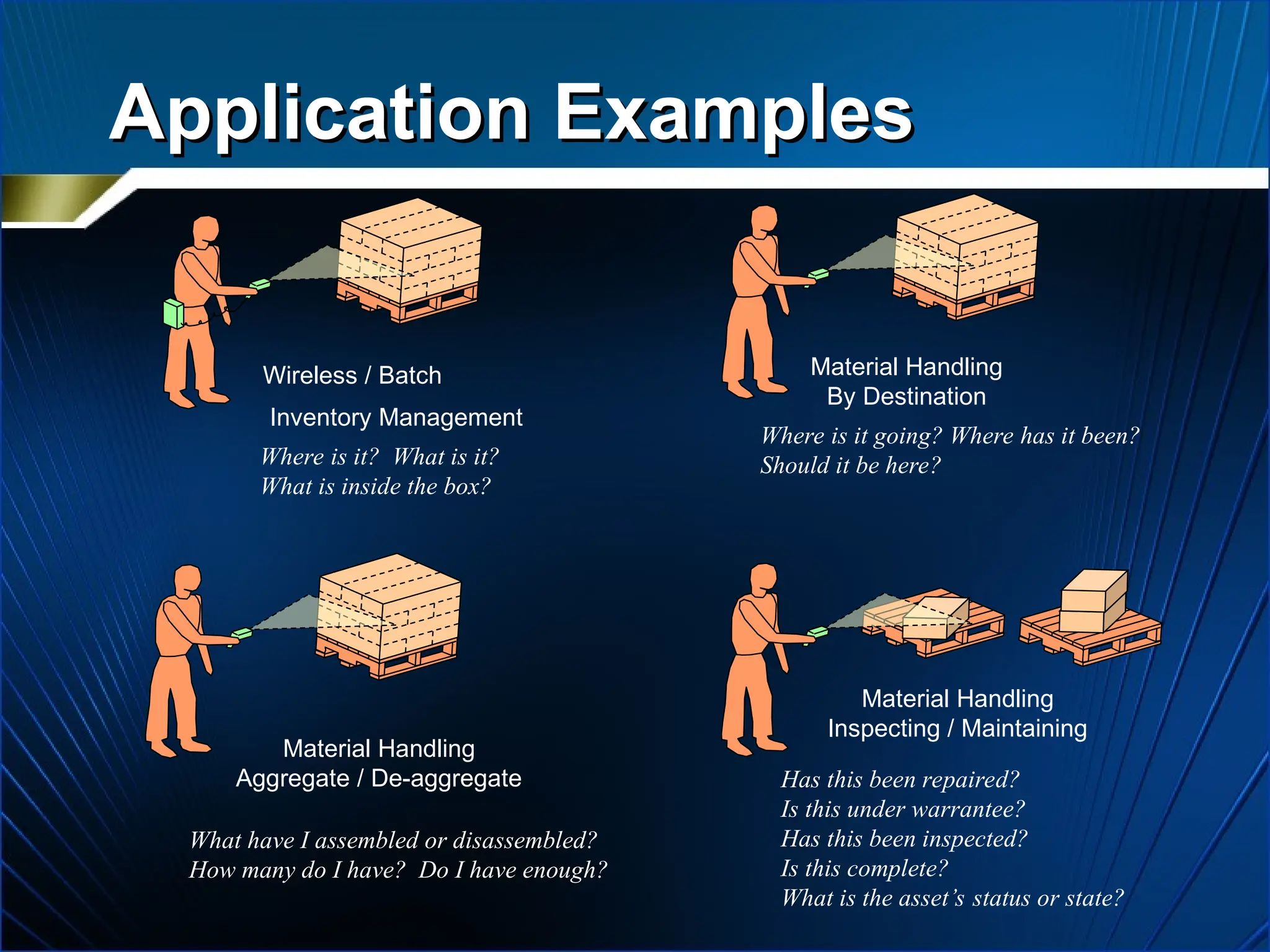
Application Examples
Wireless / Batch
Inventory Management
Material Handling
By Destination
Material Handling
Inspecting / Maintaining
Material Handling
Aggregate / De-aggregate
Where is it? What is it?
What is inside the box?
Where is it going? Where has it been?
Should it be here?
What have I assembled or disassembled?
How many do I have? Do I have enough?
Has this been repaired?
Is this under warrantee?
Has this been inspected?
Is this complete?
What is the asset’s status or state?
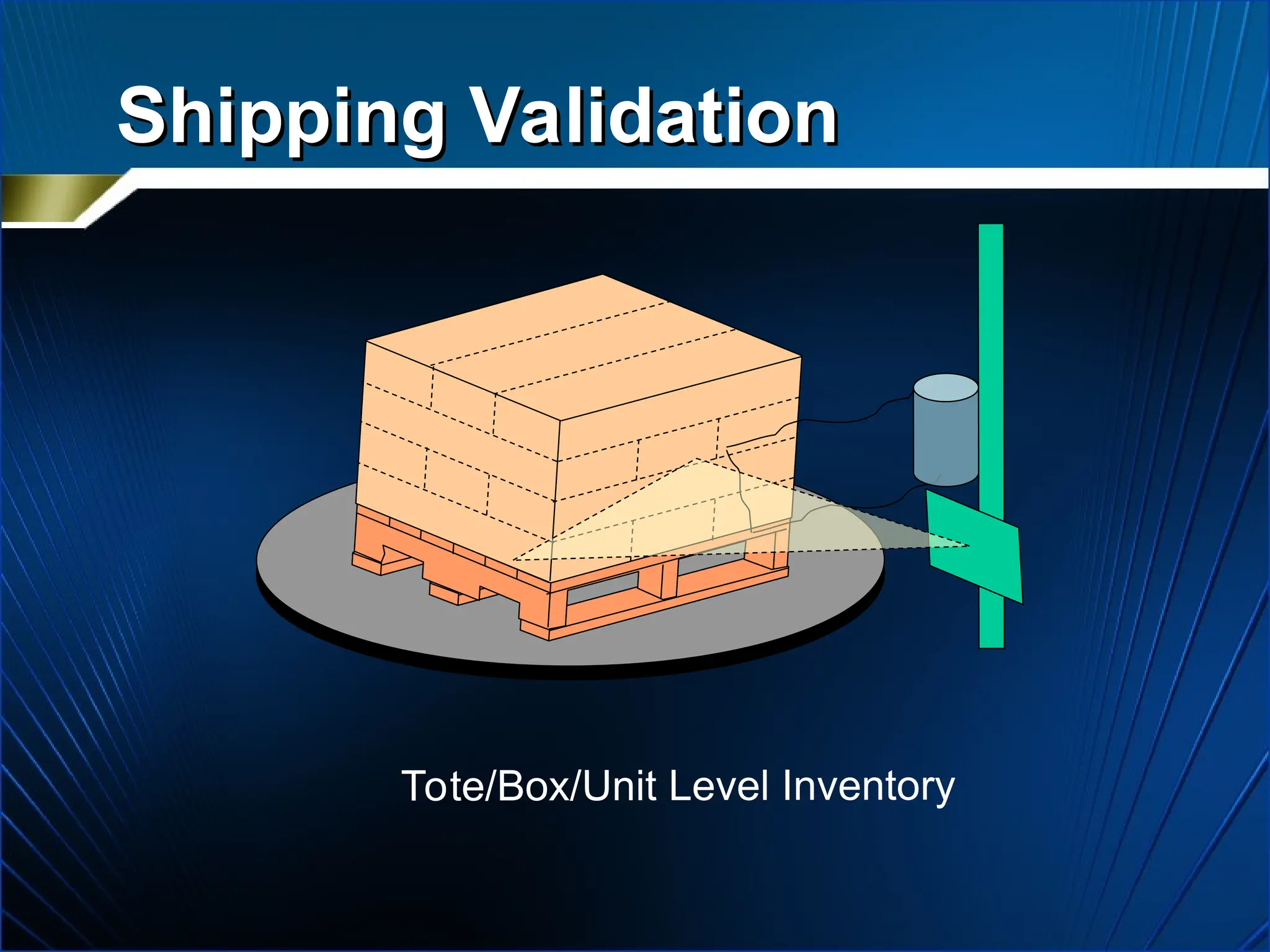
Shipping Validation
Shipping Validation
Tote/Box/Unit Level Inventory
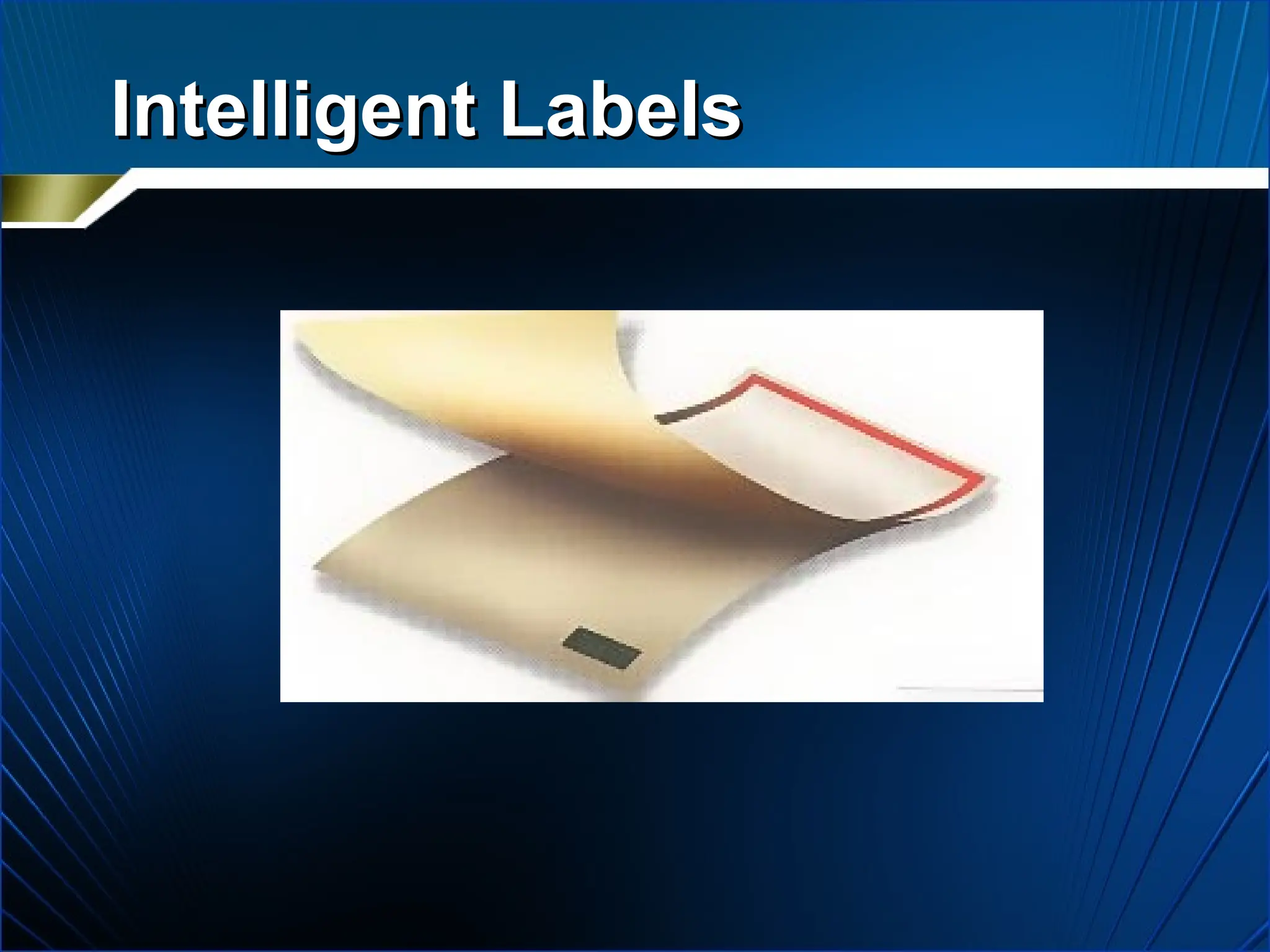
Intelligent Labels
Intelligent Labels
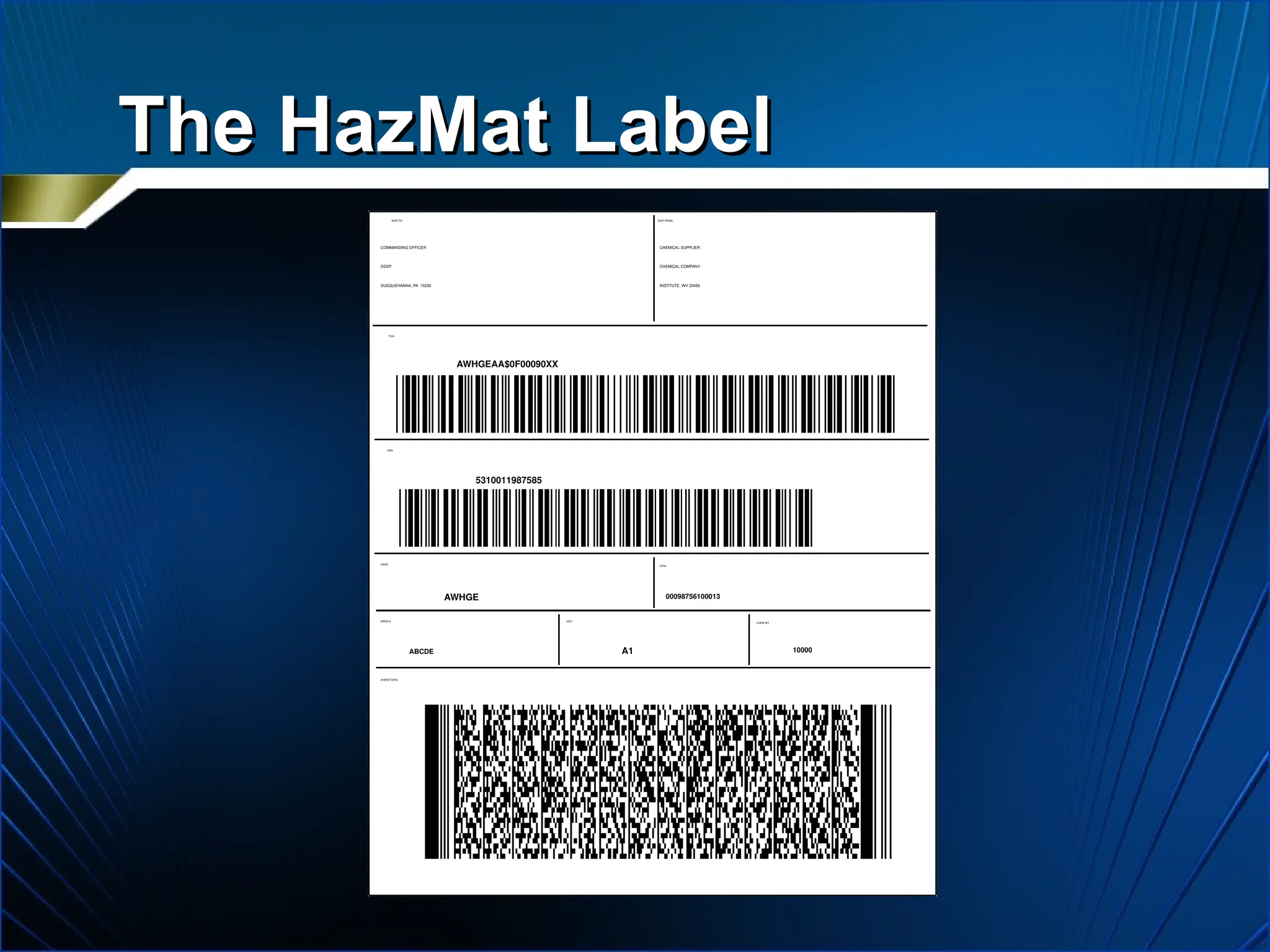
The HazMat Label
The HazMat Label
SHIP TO: SHIP FROM:
COMMANDING OFFICER
DDSP
SUSQUEHANNA, PA 15230
CHEMICAL SUPPLIER
CHEMICAL COMPANY
INSTITUTE, WV 23456
TCN:
NSN:
CAGE:
MSDS #:
GTIN:
HCC:
AHRIST DATA:
AWHGEAA$0F00090XX
5310011987585
AWHGE 00098756100013
CHEM WT:
ABCDE 10000
A1
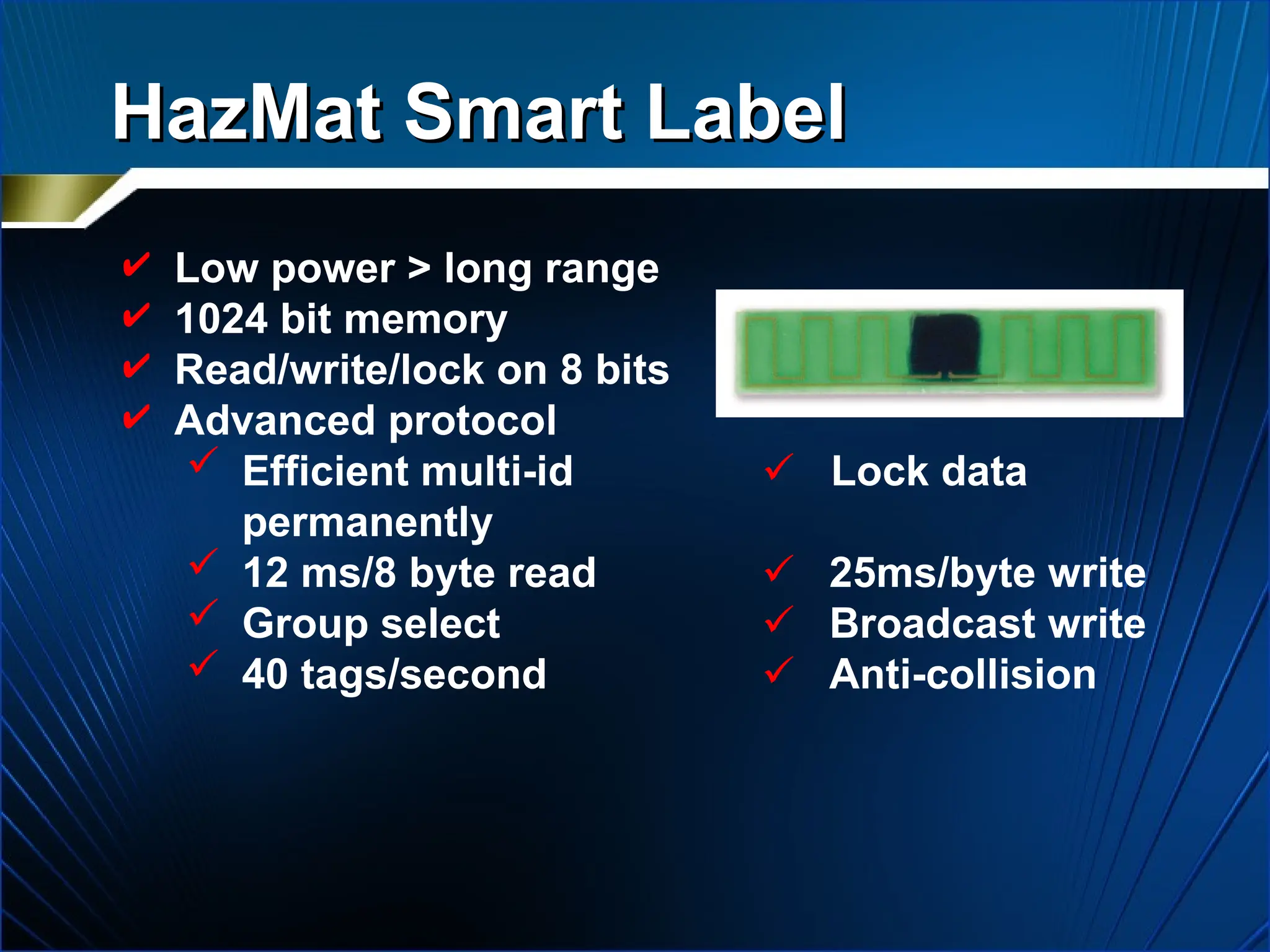
HazMat Smart Label
HazMat Smart Label
 Low power > long range
 1024 bit memory
 Read/write/lock on 8 bits
 Advanced protocol
 Efficient multi-id  Lock data
permanently
 12 ms/8 byte read  25ms/byte write
 Group select  Broadcast write
 40 tags/second  Anti-collision
Radio Frequency Identification (RFID)
Standards
Standards
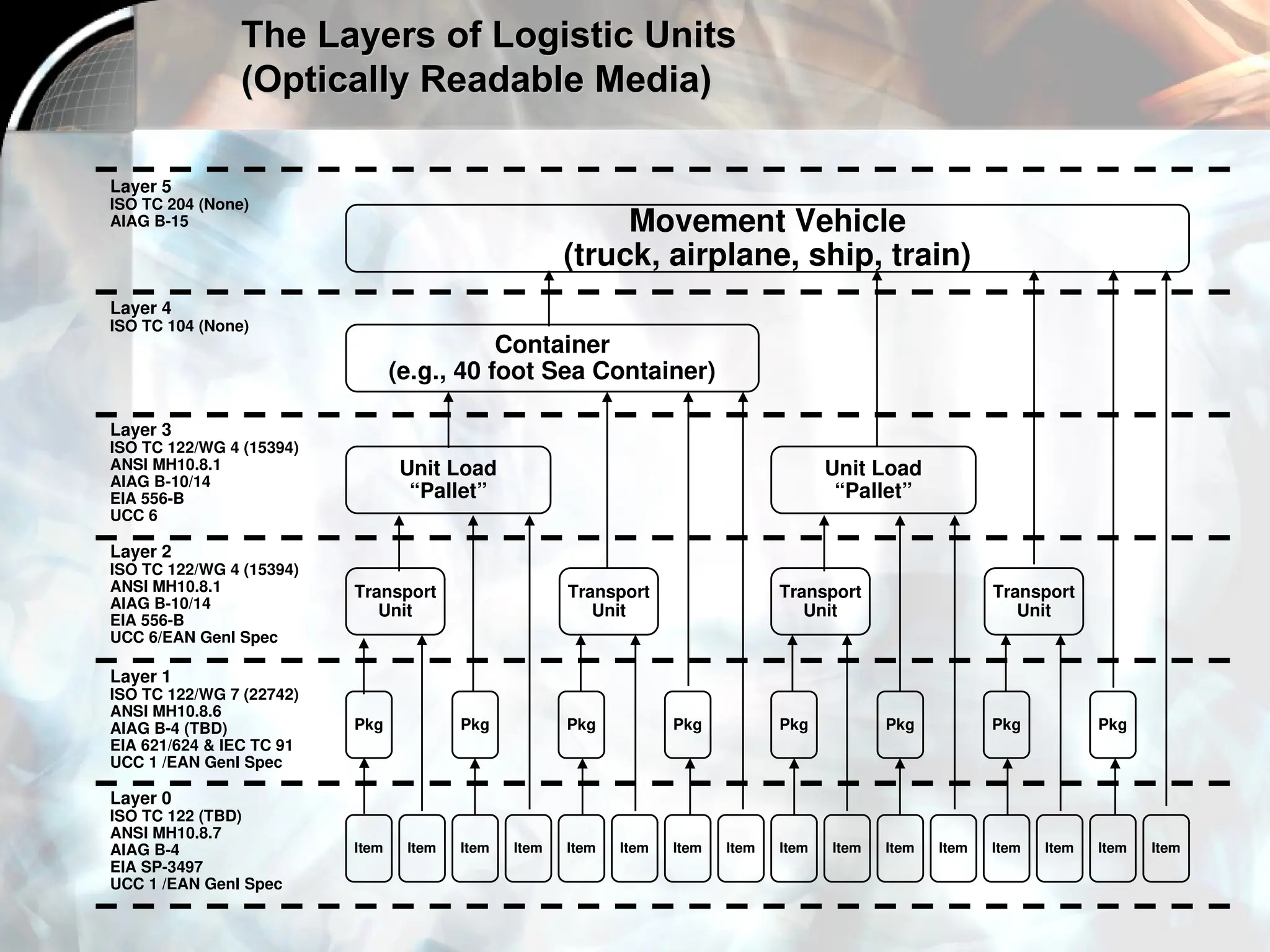
Movement Vehicle
(truck, airplane, ship, train)
Layer 5
ISO TC 204 (None)
AIAG B-15
Container
(e.g., 40 foot Sea Container)
Layer 4
ISO TC 104 (None)
Unit Load
“Pallet”
Unit Load
“Pallet”
Layer 3
ISO TC 122/WG 4 (15394)
ANSI MH10.8.1
AIAG B-10/14
EIA 556-B
UCC 6
Transport
Unit
Transport
Unit
Transport
Unit
Transport
Unit
Layer 2
ISO TC 122/WG 4 (15394)
ANSI MH10.8.1
AIAG B-10/14
EIA 556-B
UCC 6/EAN Genl Spec
Pkg Pkg Pkg Pkg Pkg Pkg Pkg Pkg
Layer 1
ISO TC 122/WG 7 (22742)
ANSI MH10.8.6
AIAG B-4 (TBD)
EIA 621/624 & IEC TC 91
UCC 1 /EAN Genl Spec
Item Item Item Item Item Item Item Item Item Item Item Item Item Item Item Item
Layer 0
ISO TC 122 (TBD)
ANSI MH10.8.7
AIAG B-4
EIA SP-3497
UCC 1 /EAN Genl Spec
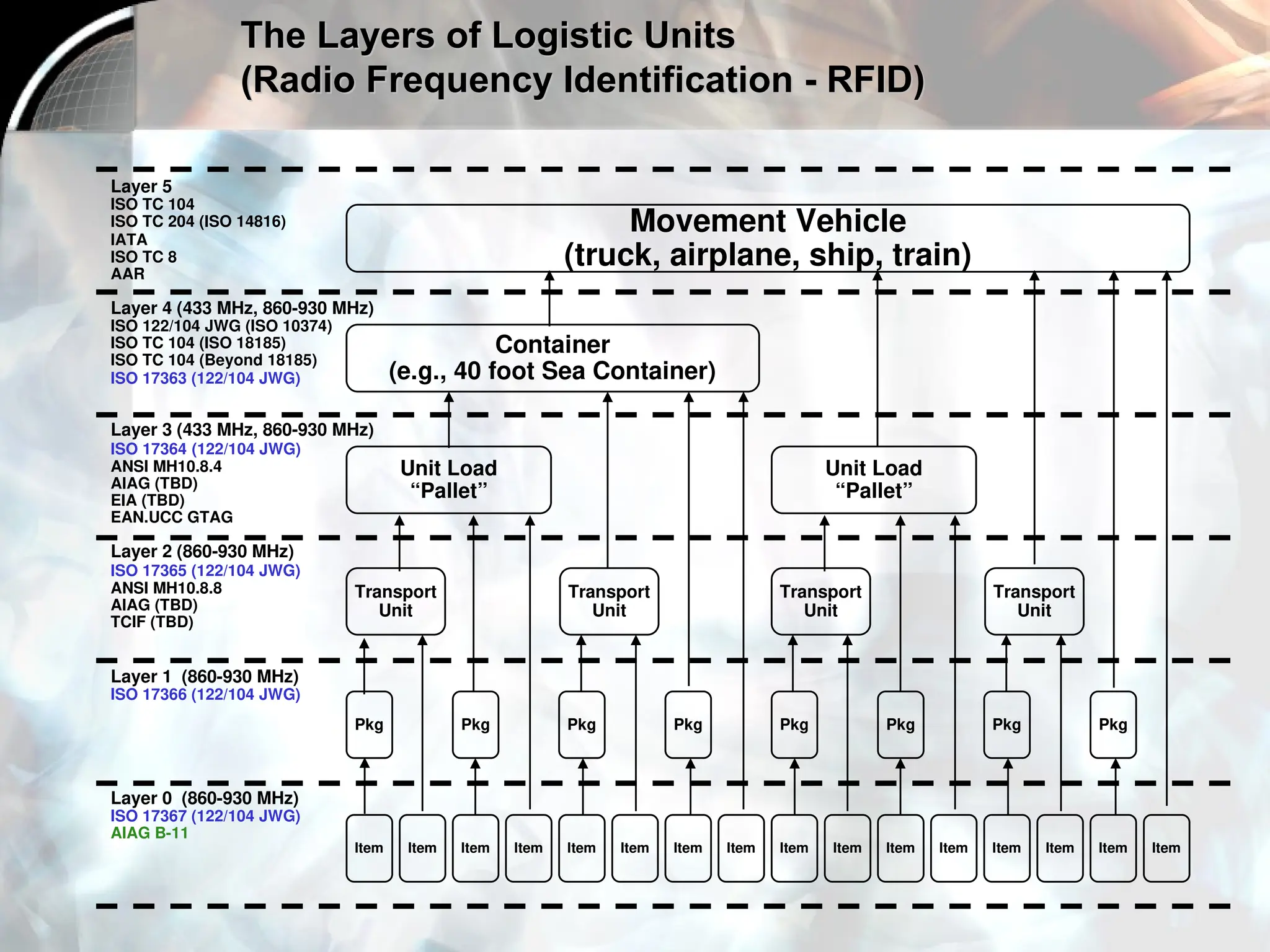
The Layers of Logistic Units
(Optically Readable Media)
Item Item Item Item Item Item Item Item Item Item Item Item Item Item Item Item
Pkg Pkg Pkg Pkg Pkg Pkg Pkg Pkg
Transport
Unit
Transport
Unit
Transport
Unit
Transport
Unit
Unit Load
“Pallet”
Unit Load
“Pallet”
Container
(e.g., 40 foot Sea Container)
Movement Vehicle
(truck, airplane, ship, train)
Layer 5
ISO TC 104
ISO TC 204 (ISO 14816)
IATA
ISO TC 8
AAR
Layer 4 (433 MHz, 860-930 MHz)
ISO 122/104 JWG (ISO 10374)
ISO TC 104 (ISO 18185)
ISO TC 104 (Beyond 18185)
ISO 17363 (122/104 JWG)
Layer 3 (433 MHz, 860-930 MHz)
ISO 17364 (122/104 JWG)
ANSI MH10.8.4
AIAG (TBD)
EIA (TBD)
EAN.UCC GTAG
Layer 2 (860-930 MHz)
ISO 17365 (122/104 JWG)
ANSI MH10.8.8
AIAG (TBD)
TCIF (TBD)
Layer 1 (860-930 MHz)
ISO 17366 (122/104 JWG)
Layer 0 (860-930 MHz)
ISO 17367 (122/104 JWG)
AIAG B-11
The Layers of Logistic Units
(Radio Frequency Identification - RFID)
© Q.E.D. Systems 2003
Application
Application Requirements
Requirements
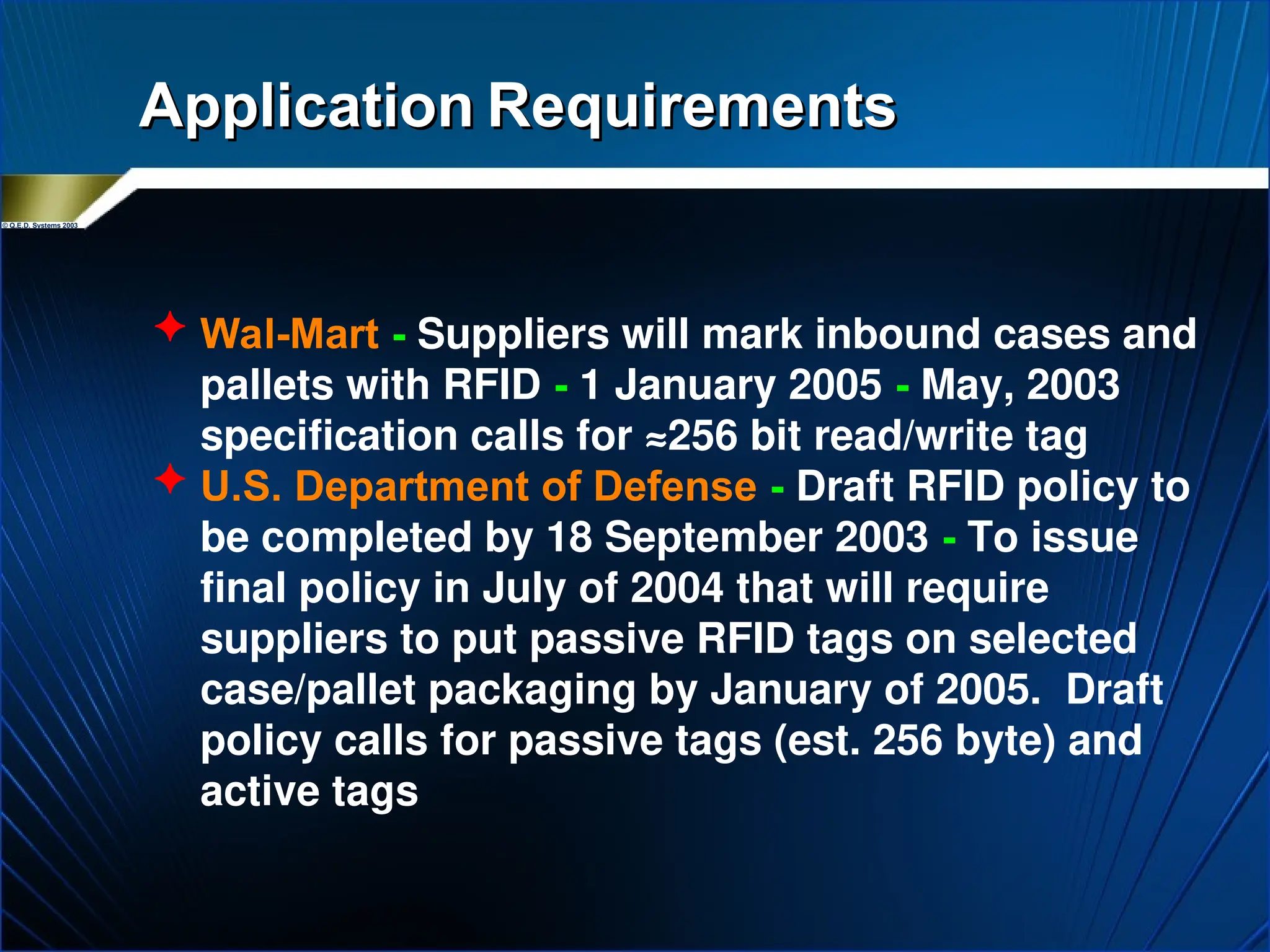
 Wal-Mart - Suppliers will mark inbound cases and
pallets with RFID - 1 January 2005 - May, 2003
specification calls for ≈256 bit read/write tag
 U.S. Department of Defense - Draft RFID policy to
be completed by 18 September 2003 - To issue
final policy in July of 2004 that will require
suppliers to put passive RFID tags on selected
case/pallet packaging by January of 2005. Draft
policy calls for passive tags (est. 256 byte) and
active tags
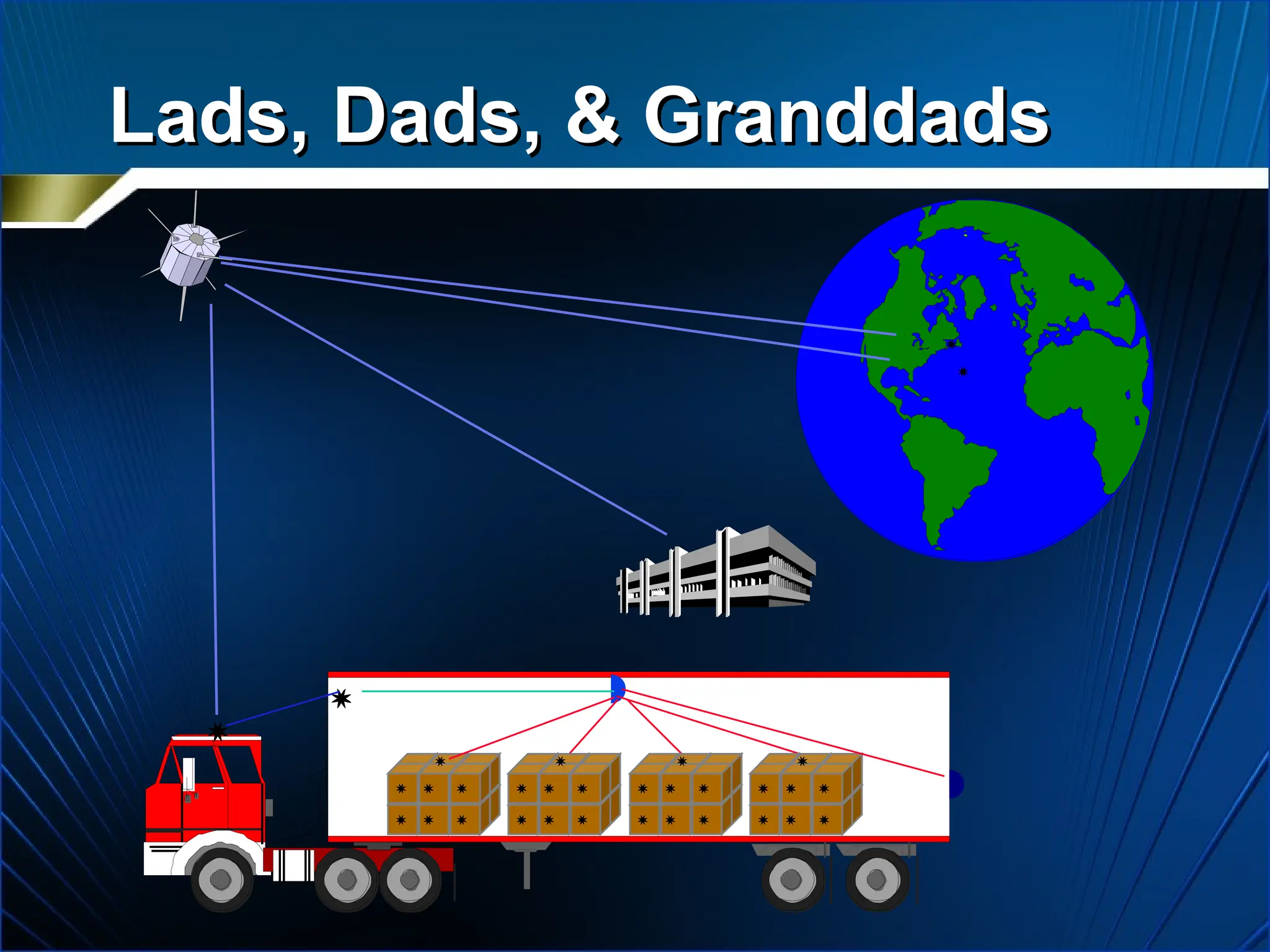
Lads, Dads, & Granddads


 

 

 

 

 

 

 

 

 


 

 

 

 


 

 

 

 




???
???
Thank
Thank
You!
You!
Basics of RFID Technologyddscccccddd.ppt

Basics of RFID Technologyddscccccddd.ppt

  • 1.
    Basics of RFIDTechnology Basics of RFID Technology by: Craig K. Harmon by: Craig K. Harmon 16 September 2003 16 September 2003
  • 2.
     Chair, ASCINCITS T6 (Radio Frequency Identification) - ANS INCITS 256:1999, 2001  Chair, U.S. TAG to ISO/IEC JTC 1/SC 31/WG 4 “RFID”  Chair, ASC MH 10/SC 8/WG 4, RFID for Returnable Containers  Chair, ISO TC 122/WG 4 (Shipping Labels) & ISO TC 122/WG 7 (Product Packaging)  Chair, ISO TC 122/104 JWG - Supply Chain Applications of RFID  Senior Project Editor ISO/IEC JTC 1/SC 31/WG 4/SG 3 (RFID - Air Interface)  JTC 1/SC 31 Liaison Officer to the International Telecommunications Union (ITU-R)  JTC 1/SC 31 Liaison Officer to the International Air Transport Association (IATA)  JTC 1/SC 31 Liaison to the European Telecommunications Standards Institute (ETSI)  ASC MH 10/SC 8 Liaison Universal Postal Union (UPU) Physical Encoding Group (PEG)  Expert to USPS Strategic Technology Council  ISO TC 104 (Freight Containers / RFID) Liaison Officer to JTC 1/SC 31  Project Editor, ISO 18185 (Freight Containers - Electronic Container Seals)  Chairman & Project Editor, ANS MH10.8.2 (Data Application Identifiers)  Vocabulary Rapporteur to ISO/IEC JTC 1/SC 31  Project Editor, American Trucking Association (ATA) ADE Work Group  AIAG Bar Code, Applications, 2D, Tire, Returnables, and RFID Committees  Project Editor, EIA Shipping Label, Product, Product Package, & Component Marking  Advisor, U.S. Department of Defense in Migration to Commercial Standards  Project Editor, NATO STANAG 2233 (RFID for NATO Asset Tracking)  Project Editor Designate (Japan) - ISO/IEC 15459-3 (Unique Identification of Items)  Project Editor Designate (Japan) - Technical Report on Direct Part Marking  Convenor (CKH) and Secretary (MAH) - INCITS T20 (Real Time Locating Systems) Q.E.D. Systems • Craig K. Harmon • President Q.E.D. Systems • Craig K. Harmon • President Visit our web sites: Visit our web sites: http://www.qed.org http://www.qed.org and and http://www.autoid.org http://www.autoid.org http://www.autoid.org/presentations/F-ISCW_2003_RFID_Basics.zip http://www.autoid.org/presentations/F-ISCW_2003_RFID_Basics.zip
  • 3.
    Session Description It isunlikely that any technology in the automatic identification and data capture industry has been hyped more than RFID. So what is the truth? What technologies are best suited for which technologies? What is the relationship between regulations in the United States and in other parts of the world? What is the future of that regulation? How to determine which technology is best for you by asking yourself three little questions: "How far?", "How fast?”, and "How many?" Learn the answers to these and other questions in this session.
  • 4.
    What is RFID? Whatis RFID? • RFID is an ADC technology that uses radio-frequency waves to transfer data between a reader and a movable item to identify, categorize, track... • RFID is fast, reliable, and does not require physical sight or contact between reader/scanner and the tagged item
  • 5.
    What Constitutes anRFID System? What Constitutes an RFID System? • One or more RF tags • Two or more antennas • One or more interrogators • One or more host computers • Appropriate software
  • 6.
  • 7.
    RESPONSES COMMANDS Tag Physical Memory APPLICATION RESPONSES APPLICATIONINTERROGATOR RF TAG APPLICATION COMMANDS Command / Response Unit PHYSICAL INTERROGATOR DATA PROTOCOL PROCESSOR ISO/IEC 15961 ISO/IEC 18000 Encoder Logical Memory AIR INTERFACE ISO/IEC 15962 ISO/IEC 15962 Annexes Logical Memory Map Note: The Logical Memory Map in the Tag Physical Memory is given by the Tag architecture and the mapping rules in the Tag Driver. All the information in the Logical Memory is represented in the Logical Memory Map Decoder Tag Driver and Mapping Rules Application Program Interface Application Program Interface DEVICE COMMANDS DEVICE RESPONSES
  • 8.
    RFID Operation RFID Operation Sequenceof Communication Sequence of Communication • Host Manages Reader(s) and Issues Commands • Reader and tag communicate via RF signal • Carrier signal generated by the reader (upon request from the host application) • Carrier signal sent out through the antennas • Carrier signal hits tag(s) • Tag receives and modifies carrier signal – “sends back” modulated signal (Passive Backscatter - FCC and ITU refer to as “field disturbance device”) • Antennas receive the modulated signal and send them to the Reader • Reader decodes the data – Results returned to the host application
  • 9.
  • 10.
    What is RFID?-- The Tags What is RFID? -- The Tags • Tags can be read-only or read-write • Tag memory can be factory or field programmed, partitionable, and optionally permanently locked • Bytes left unlocked can be rewritten over more than 100,000 times
  • 11.
    • Tag IDOnly • Programmable Database Pointer • Mission Critical Information • Portable Database • Read Only (Factory Programmed) • WORM - Write Once, Read Many times • Reprogrammable (Field Programmable) • Read/Write (In-Use Programmable) RFID System Basics RFID System Basics
  • 12.
    Tags can beattached to almost anything: – pallets or cases of product – vehicles – company assets or personnel – items such as apparel, luggage, laundry – people, livestock, or pets – high value electronics such as computers, TVs, camcorders What is RFID? -- The Tags What is RFID? -- The Tags
  • 13.
    Are All TagsThe Same? Are All Tags The Same? Basic Types: Active • Tag transmits radio signal • Battery powered memory, radio & circuitry • High Read Range (300 feet) Passive • Tag reflects radio signal from reader • Reader powered • Shorter Read Range (4 inches - 15 feet)
  • 14.
    Variations: – Memory • Size(16 bits - 512 kBytes +) • Read-Only, Read/Write or WORM • Type: EEProm, Antifuse, FeRam – Arbitration (Anti-collision) • Ability to read/write one or many tags at a time – Frequency • 125KHz - 5.8 GHz – Physical Dimensions • Thumbnail to Brick sizes – Price ($0.50 to $250) Are All Tags The Same? Are All Tags The Same?
  • 15.
    RFID System Basics RFIDSystem Basics • How far? • How fast? • How many? • How much? • Attached to and surround by what?
  • 16.
    What is RFID?-- The Readers What is RFID? -- The Readers • Readers (interrogators) can be at a fixed point such as – Entrance/exit – Point of sale – Warehouse • Readers can also be mobile -- tethered, hand-held, or wireless
  • 17.
    Advantages • Uses normalCMOS processing — basic and ubiquitous • Relative freedom from regulatory limitations • Well suited for applications requiring reading small amounts of data at slow speeds and minimal distances • Penetrates materials well (water, tissue, wood, aluminum) <150 kHz (125 kHz & 134 kHz ) <150 kHz (125 kHz & 134 kHz )
  • 18.
    Disadvantages: • Does notpenetrate or transmit around metals (iron, steel) • Handles only small amounts of data • Slow read speeds • Large Antennas -- compared to higher frequencies • Minimal Range <150 kHz (125 kHz & 134 kHz ) <150 kHz (125 kHz & 134 kHz )
  • 19.
    Disadvantages: • Tag construction: is thicker (than 13.56 MHz)  is more expensive (than 13.56 MHz)  more complex (requires more turns of the induction coil) <150 kHz (125 kHz & 134 kHz ) <150 kHz (125 kHz & 134 kHz )
  • 20.
    13.56 MHz 13.56 MHz Advantages •Uses normal CMOS processing--basic and ubiquitous • Well suited for applications requiring reading small amounts of data and minimal distances • Penetrates water/tissue well • Simpler antenna design (fewer turns of the coil); lower costs to build • Higher data rate (than 125 kHz--but slower than higher MHz systems) • Thinner tag construction (than 125 kHz) • Popular Smart Card frequency
  • 21.
    Disadvantages • Government regulatedfrequency (U.S. and Europe recently harmonized) • Does not penetrate or transmit around metals • Large Antennas (compared to higher frequencies) • Larger tag size than higher frequencies • Tag construction: requires more than one surface to complete a circuit • Reading Range of ≈ 0.7 m 13.56 MHz 13.56 MHz
  • 22.
    RFID Primer…Frequencies RFID Primer…Frequencies ElectromagneticField Coupling: Lower Range UHF >300 MHz <3 (<1) GHz (862-928 MHz ANSI MH10.8.4, ISO 18185, B-11 & GTAG) (433.92 MHz ISO 18185) 1000 MHz Cell Phone RFID: Toll Roads Data Terminal
  • 23.
    >300 MHz <1GHz >300MHz <1GHz Advantages • Effective around metals • Best available frequency for distances of >1m • Tag size smaller than 13.56 MHz • Smaller antennas • Range: licensed to 20-40' with reasonable sized tag (stamp to eraser size). Unlicensed 3-5 m. • Good non-line-of-sight communication (except for conductive, "lossy" materials) • High data rate; Large amounts of data • Controlled read zone (through antenna directionality)
  • 24.
    Disadvantages • Does notpenetrate water/tissue • Regulatory issues (differences in frequency, channels, power, and duty cycle) • Regulatory issues in Europe (similar band 869 MHz requires frequency agile chip) 950 - 956 MHz under study in Japan >300 MHz <1GHz >300 MHz <1GHz
  • 25.
    RFID Primer…Frequencies RFID Primer…Frequencies Electromagnetic FieldCoupling: 2.45 GHz RFID: Item Management EAS 2.45 GHz
  • 26.
    2.45 GHz 2.45 GHz Advantages •Tag size smaller than inductive or lower range UHF (1"x 1/4") • Range: greater range than inductive w/o battery • More bandwidth than lower range UHF (more frequencies to hop) • Smaller antennas than lower range UHF or inductive • High data rate
  • 27.
    Advantages • Good non-line-of-sightcommunication (except for conductive, "lossy" materials) • Can transmit large amounts of data more quickly than lower frequencies • Controlled read zone (through antenna directionality) • Effective around metals with tuning/design adaptations 2.45 GHz 2.45 GHz
  • 28.
    Disadvantages • More susceptibleto electronic noise than lower UHF bands, e.g. 433 MHz, 860-930 MHz • Shared spectrum with other technologies-- microwave ovens, RLANS, TV devices, etc. • Requires non-interfering, "good neighbor" tactics like FHSS • Competitive requirement: single chip--highly technical; limited number of vendors • Regulatory approvals still "in process" 2.45 GHz 2.45 GHz
  • 29.
    RFID Primer…Frequency RFID Primer…Frequency >5.8GHz (European Road Telematics Frequency) Advantages: • Less congested band/less interference Disadvantages: • Not available in U.S. or many other countries (5.9 now in FCC review) • Must orient antennas carefully • Range limited (due to scaling issues/wavelengths) • Chip difficult to build • Expensive RFID: European Tolls 300 GHz
  • 30.
    Spectrum Regulation Spectrum Regulation •The radio frequency (RF) spectrum is a scarce and shared resource, used nationally and internationally, and subject to a wide range of regulatory oversight. In the U.S., the Federal Communications Commission is a key regulatory body that allocates spectrum use and resolves spectrum conflicts. The International Telecommunication Union (ITU) is a specialized agency of the United Nations which plays the same role internationally.
  • 31.
  • 32.
    Regulatory Differences Regulatory Differences •Usage of channel – Primary service – Secondary service • Cannot interfere with primary service • Cannot claim protection of interference from primary service • Can claim protection of interference from other secondary users – Industrial, Scientific, & Medical (ISM) Bands • Narrowband or Spread Spectrum • Power level • Duty cycle
  • 33.
    How far, howfast, How far, how fast, how much, how many, attached to what how much, how many, attached to what? ? Frequency Regulation Range Data Speed Comments 125-150 kHz Basically unregulated ≈ 10 cm Low Animal identification and factory data collection systems 13.56 MHz ISM band, differing power levels and duty cycle < 1m Low to moderate Popular frequency for I.C. Cards (Smart Cards) 433 MHz Non-specific Short Range Devices (SRD), Location Systems 1 – 100 m Moderate Asset tracking for U.S. DoD (Pallets) 860-930 MHz ISM band (Region 2); increasing use in other regions, differing power levels and duty cycle 2 – 5 m Moderate to high EAN.UCC GTAG, MH10.8.4 (RTI), AIAG B-11 (Tires) 2450 MHz ISM band, differing power levels and duty cycle 1 – 2 m High IEEE 802.11b, Bluetooth, CT, AIAG B-11
  • 34.
    Radio Frequency Identification(RFID) Radio Frequency Identification (RFID) Applications Applications
  • 35.
  • 36.
    Portal Applications Portal Applications Limitednumber items at forklift speeds 8’ X 10’ doorways Electronic receipt & dispatch Wrong destination alert Electronic marking Pallet/container item tracking
  • 37.
    Conveyor / AssemblyLine Conveyor / Assembly Line Read / Write Operations Higher Accuracy than Bar Code
  • 38.
    Conveyor / AssemblyLine Conveyor / Assembly Line Up to 450 fpm 60+ items per container Inexpensive tunnels Longer tunnel more items Electronic receipt Sorting Electronic marking
  • 39.
    Hand Held ApplicationCategories Hand Held Application Categories Wireless Batch Fixed Station
  • 40.
    Application Examples Application Examples Wireless/ Batch Inventory Management Material Handling By Destination Material Handling Inspecting / Maintaining Material Handling Aggregate / De-aggregate Where is it? What is it? What is inside the box? Where is it going? Where has it been? Should it be here? What have I assembled or disassembled? How many do I have? Do I have enough? Has this been repaired? Is this under warrantee? Has this been inspected? Is this complete? What is the asset’s status or state?
  • 41.
  • 42.
  • 43.
    The HazMat Label TheHazMat Label SHIP TO: SHIP FROM: COMMANDING OFFICER DDSP SUSQUEHANNA, PA 15230 CHEMICAL SUPPLIER CHEMICAL COMPANY INSTITUTE, WV 23456 TCN: NSN: CAGE: MSDS #: GTIN: HCC: AHRIST DATA: AWHGEAA$0F00090XX 5310011987585 AWHGE 00098756100013 CHEM WT: ABCDE 10000 A1
  • 44.
    HazMat Smart Label HazMatSmart Label  Low power > long range  1024 bit memory  Read/write/lock on 8 bits  Advanced protocol  Efficient multi-id  Lock data permanently  12 ms/8 byte read  25ms/byte write  Group select  Broadcast write  40 tags/second  Anti-collision
  • 45.
    Radio Frequency Identification(RFID) Radio Frequency Identification (RFID) Standards Standards
  • 46.
    Movement Vehicle (truck, airplane,ship, train) Layer 5 ISO TC 204 (None) AIAG B-15 Container (e.g., 40 foot Sea Container) Layer 4 ISO TC 104 (None) Unit Load “Pallet” Unit Load “Pallet” Layer 3 ISO TC 122/WG 4 (15394) ANSI MH10.8.1 AIAG B-10/14 EIA 556-B UCC 6 Transport Unit Transport Unit Transport Unit Transport Unit Layer 2 ISO TC 122/WG 4 (15394) ANSI MH10.8.1 AIAG B-10/14 EIA 556-B UCC 6/EAN Genl Spec Pkg Pkg Pkg Pkg Pkg Pkg Pkg Pkg Layer 1 ISO TC 122/WG 7 (22742) ANSI MH10.8.6 AIAG B-4 (TBD) EIA 621/624 & IEC TC 91 UCC 1 /EAN Genl Spec Item Item Item Item Item Item Item Item Item Item Item Item Item Item Item Item Layer 0 ISO TC 122 (TBD) ANSI MH10.8.7 AIAG B-4 EIA SP-3497 UCC 1 /EAN Genl Spec The Layers of Logistic Units The Layers of Logistic Units (Optically Readable Media) (Optically Readable Media)
  • 47.
    Item Item ItemItem Item Item Item Item Item Item Item Item Item Item Item Item Pkg Pkg Pkg Pkg Pkg Pkg Pkg Pkg Transport Unit Transport Unit Transport Unit Transport Unit Unit Load “Pallet” Unit Load “Pallet” Container (e.g., 40 foot Sea Container) Movement Vehicle (truck, airplane, ship, train) Layer 5 ISO TC 104 ISO TC 204 (ISO 14816) IATA ISO TC 8 AAR Layer 4 (433 MHz, 860-930 MHz) ISO 122/104 JWG (ISO 10374) ISO TC 104 (ISO 18185) ISO TC 104 (Beyond 18185) ISO 17363 (122/104 JWG) Layer 3 (433 MHz, 860-930 MHz) ISO 17364 (122/104 JWG) ANSI MH10.8.4 AIAG (TBD) EIA (TBD) EAN.UCC GTAG Layer 2 (860-930 MHz) ISO 17365 (122/104 JWG) ANSI MH10.8.8 AIAG (TBD) TCIF (TBD) Layer 1 (860-930 MHz) ISO 17366 (122/104 JWG) Layer 0 (860-930 MHz) ISO 17367 (122/104 JWG) AIAG B-11 The Layers of Logistic Units The Layers of Logistic Units (Radio Frequency Identification - RFID) (Radio Frequency Identification - RFID)
  • 48.
    © Q.E.D. Systems2003 Application Application Requirements Requirements  Wal-Mart - Suppliers will mark inbound cases and pallets with RFID - 1 January 2005 - May, 2003 specification calls for ≈256 bit read/write tag  U.S. Department of Defense - Draft RFID policy to be completed by 18 September 2003 - To issue final policy in July of 2004 that will require suppliers to put passive RFID tags on selected case/pallet packaging by January of 2005. Draft policy calls for passive tags (est. 256 byte) and active tags
  • 49.
    Lads, Dads, &Granddads Lads, Dads, & Granddads                                                          
  • 50.
  • 51.

Editor's Notes

  • #7 To help you understand how tightly integrated RFID applications are to the customer’s environment, we have prepared an analysis of each system component, describing the component and environmental properties and considerations.
  • #9 NOTE: Bullet 5 - Tag is NOT actually generating and transmitting a signal. The Tag modifies the signal and sends it back to the reader. Intermec tags are “passive tags” because they are NOT generating and transmitting their own signal.