Centers and Small Group Instructionfor Foreign Language ClassroomsJessica HaxhiMaloney Interdistrict Magnet SchoolWaterbury, CTjhaxhi@waterbury.k12.ct.us
Jessica HaxhiMaloney Interdistrict Magnet SchoolWaterbury, CTjhaxhi@waterbury.k12.ct.usJapanese Language and Culture Programhttp://teacherweb.com/CT/maloneymagnetschool/japanese/Wiki for Resources and Handoutshttp://maloneyjapanese.wikispaces.com/(“World Language Teachers” Section)
Web ViewersPlease note that some videos were shown during this presentation that will not be shown in the online version.
Maloney Interdistrict Magnet SchoolJapanese Language and Culture ProgramPrekindergarten – 5th Grade ProgramMost classes meet 3 times per week for 25 minutes each2nd and 5th grade classes meet 2 times per week, one 25 minute, one 50 minute classAlumni students in grades 6-12 come once per week after school
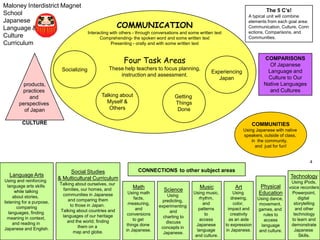
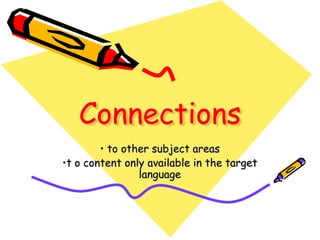
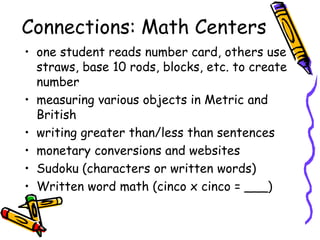
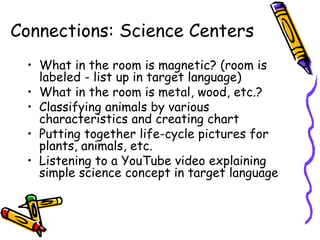
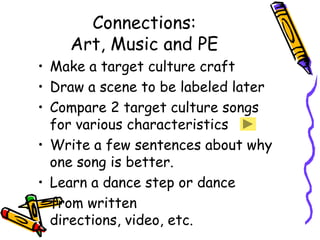
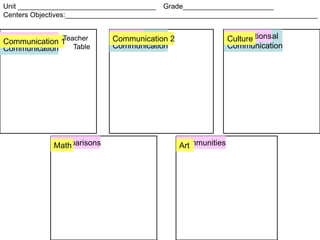
Maloney Interdistrict Magnet SchoolJapanese Language &Culture Curriculum 		The 5 C’s!A typical unit will combine elements from each goal area: Communication, Culture, Connections, Comparisons, and Communities. COMMUNICATIONInteracting with others - through conversations and some written textComprehending- the spoken word and some written textPresenting - orally and with some written textFour Task AreasThese help teachers to focus planning, instruction and assessment.SocializingCOMPARISONSOf Japanese Language and Culture to Our Native Languages and Culturesproducts,practices and perspectives of JapanCULTUREExperiencingJapanGetting ThingsDoneTalking aboutMyself &OthersCOMMUNITIESUsing Japanese with native speakers, outside of class, in  the community,  and  just for fun!4Social Studies& Multicultural CurriculumTalking about ourselves, our families, our homes, and communities in Japanese and comparing them to those in Japan. Talking about countries and languages of our heritage and the world; findingthem on a map and globe.Language ArtsUsing and reinforcing  language arts skills while talking about stories,  listening for a purpose, comparing languages, finding meaning in context, and reading in Japanese and English.CONNECTIONSto other subject areasTechnologyUsing iPods,voice recordersPowerpoint,digital storytellingand othertechnologyto learn anddemonstrateJapanese Skills.PhysicalEducationUsing dance, movement, games, and rules toaccess language and culture.MathUsing mathfacts,measuring,andconversionsto get things done in Japanese.MusicUsing music, rhythm, and patterns to access Japanese language and culture.ScienceUsing predicting, experimenting and charting to discussconcepts in Japanese.ArtUsing drawing,color, impact andcreativityas an aideto expressionin Japanese.
Who are you? What do you want to learn today?
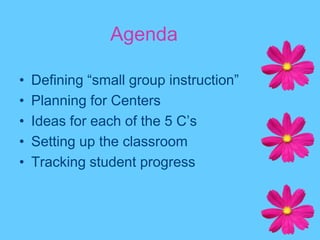
AgendaDefining “small group instruction”Planning for CentersIdeas for each of the 5 C’sSetting up the classroom Tracking student progress
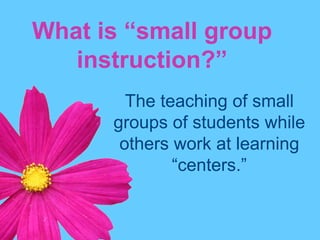
What is “small group instruction?”The teaching of small groups of students while others work at learning “centers.”
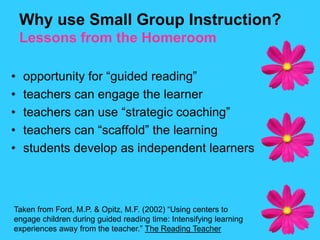
Why use Small Group Instruction?Lessons from the Homeroomopportunity for “guided reading”teachers can engage the learnerteachers can use “strategic coaching”teachers can “scaffold” the learningstudents develop as independent learnersTaken from Ford, M.P. & Opitz, M.F. (2002) “Using centers to engage children during guided reading time: Intensifying learning experiences away from the teacher.” The Reading Teacher
Why use Small Group Instruction and Centers in our FL Classrooms?Students develop individual study skills
 develop group work skills
 get one-on-one time with teachers
 get to interact with technology, realia,      or content can access a variety of activities in all     of the 5 Cs and for various intelligences appeals to the “iGeneration”Why use Small Group Instruction and Centers in our FL Classrooms?Teachers can get to know students more  individually can collect a variety of data all at once
 can use materials that are difficult to use       in large groups can reduce class management issues
 can sit down for awhile!Planning for Centers and Small Group Instruction
PlanningHow much time for each center?A whole class periodHalf a periodOne-thirdOne-fourthOne-fifth
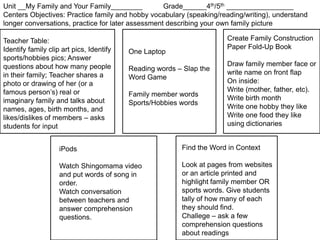
PlanningBrainstorming ActivitiesTeacher TableFour to five student centers
The Teacher TableWhat could you do... if you had 20 minutes with 5 of your students around a table?
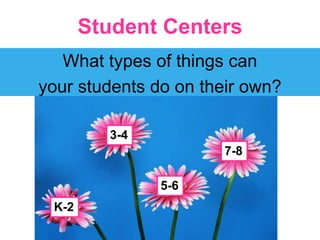
Student CentersWhat types of things can your students do on their own?3-47-85-6K-2
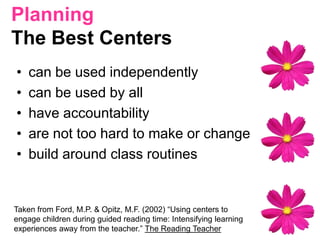
PlanningThe Best Centerscan be used independentlycan be used by allhave accountabilityare not too hard to make or changebuild around class routinesTaken from Ford, M.P. & Opitz, M.F. (2002) “Using centers to engage children during guided reading time: Intensifying learning experiences away from the teacher.” The Reading Teacher
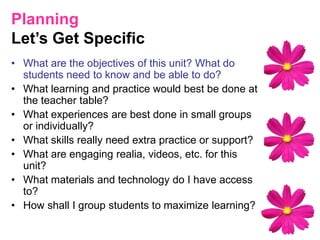
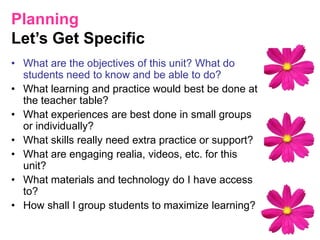
Planning Let’s Get SpecificWhat are the objectives of this unit? What do students need to know and be able to do?
What learning and practice would best be done at the teacher table?
What experiences are best done in small groups or individually?
What skills really need extra practice or support?
What are engaging realia, videos, etc. for this unit?
What materials and technology do I have access to?
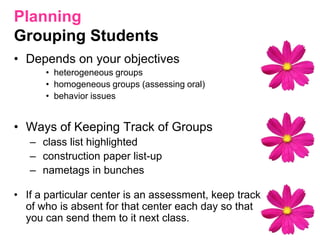
How shall I group students to maximize learning?PlanningGrouping StudentsDepends on your objectivesheterogeneous groups homogeneous groups (assessing oral)behavior issuesWays of Keeping Track of Groups class list highlighted construction paper list-up nametags in bunchesIf a particular center is an assessment, keep track of who is absent for that center each day so that you can send them to it next class.
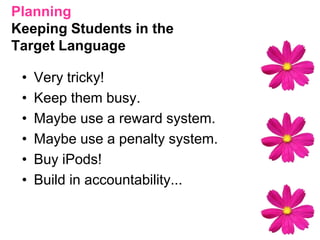
PlanningKeeping Students in the Target LanguageVery tricky!Keep them busy.Maybe use a reward system.Maybe use a penalty system.Buy iPods!Build in accountability...
PlanningAccountability for StudentsTeacherCollect papers each time and checkAsk homeroom teacher to circulateGroup (with lead student)Group checklist Lead student collects finished papers Group behavior system – gain/lose points, money, etc.Group test at endIndividual studentChecklist for each student as they go through centers (objectives or activities)Completing a packet as they goCorrecting papers as they go, inserting in folderTest on content at end Behavior system for good work/problemsAccountability Can be Fun! (when students record themselves)
Accountability can be Fun!(Students record themselves)From Low Tech to High Tech
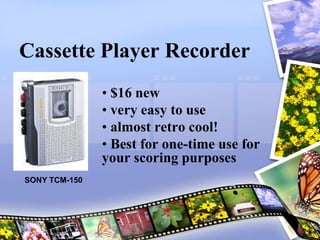
Cassette Player Recorder $16 new
 very easy to use
 almost retro cool!
 Best for one-time use for your scoring purposesSONY TCM-150
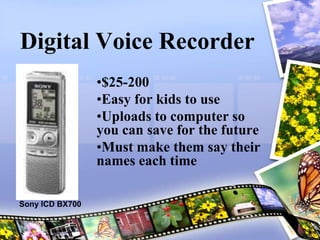
Digital Voice Recorder$25-200
Easy for kids to use
Uploads to computer so you can save for the future
Must make them say their names each timeSony ICD BX700
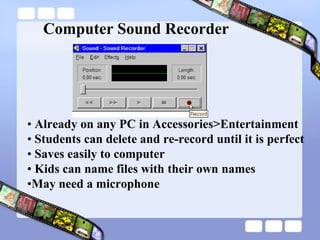
Computer Sound Recorder Already on any PC in Accessories>Entertainment Students can delete and re-record until it is perfect Saves easily to computer Kids can name files with their own namesMay need a microphone
Photostory 3 for Windows
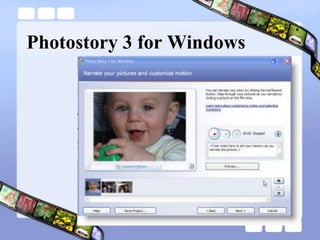
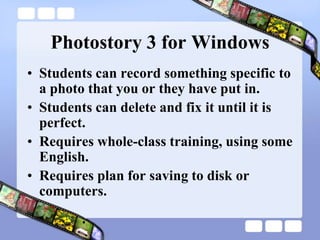
Photostory 3 for WindowsStudents can record something specific to a photo that you or they have put in.Students can delete and fix it until it is perfect. Requires whole-class training, using some English. Requires plan for saving to disk or computers.
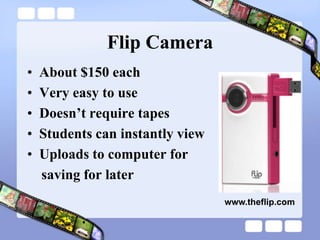
Flip CameraAbout $150 eachVery easy to useDoesn’t require tapesStudents can instantly viewUploads to computer for     saving for laterwww.theflip.com
Other OptionsRegular video cameraCamera already installed on computerFor voice – www.audacity.comFor creativity  – www.voki.com
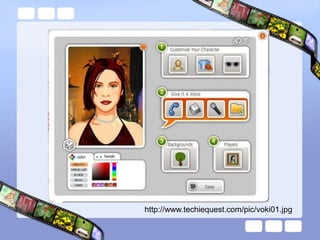
http://www.techiequest.com/pic/voki01.jpg
Quick Excitement BreakWhat has already gotten you thinking?
Activity IdeasThe 5 C’sInterpersonal (two-way conversations)Interpretive (listening/reading/watching)Presentational (creating a final product)CultureConnectionsComparisonsCommunities
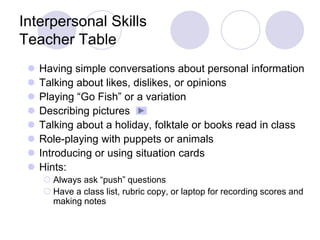
Interpersonal Skillsperson-to-person speaking
Interpersonal SkillsTeacher TableHaving simple conversations about personal informationTalking about likes, dislikes, or opinionsPlaying “Go Fish” or a variationDescribing picturesTalking about a holiday, folktale or books read in classRole-playing with puppets or animalsIntroducing or using situation cardsHints:Always ask “push” questionsHave a class list, rubric copy, or laptop for recording scores and making notes
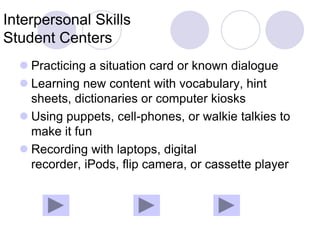
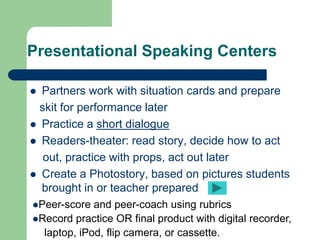
Interpersonal SkillsStudent CentersPracticing a situation card or known dialogueLearning new content with vocabulary, hint sheets, dictionaries or computer kiosksUsing puppets, cell-phones, or walkie talkies to make it funRecording with laptops, digital recorder, iPods, flip camera, or cassette player
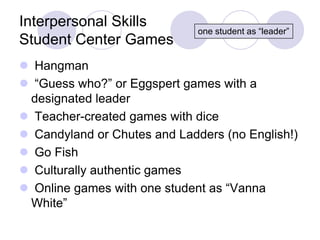
Interpersonal SkillsStudent Center Games Hangman “Guess who?” or Eggspert games with a designated leader Teacher-created games with dice Candyland or Chutes and Ladders (no English!) Go Fish Culturally authentic games Online games with one student as “Vanna White”one student as “leader”
Interpretive Skillslistening and reading for a purpose
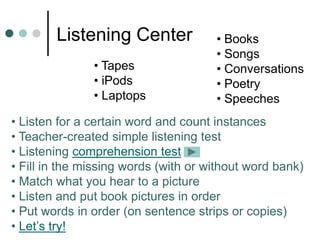
Listening Center Books
 Songs
 Conversations
 Poetry
 Speeches
 Tapes
 iPods
 Laptops
 Listen for a certain word and count instances
 Teacher-created simple listening test
 Listening comprehension test
 Fill in the missing words (with or without word bank)
 Match what you hear to a picture
 Listen and put book pictures in order
 Put words in order (on sentence strips or copies)
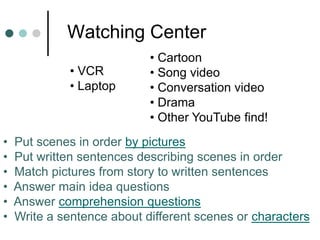
Let’s try!Watching Center Cartoon
 Song video
 Conversation video
 Drama
 Other YouTube find!
 VCR

Small Group Instruction for K-8 Foreign Language Classrooms

  • 1.
    Centers and SmallGroup Instructionfor Foreign Language ClassroomsJessica HaxhiMaloney Interdistrict Magnet SchoolWaterbury, CTjhaxhi@waterbury.k12.ct.us
  • 2.
    Jessica HaxhiMaloney InterdistrictMagnet SchoolWaterbury, CTjhaxhi@waterbury.k12.ct.usJapanese Language and Culture Programhttp://teacherweb.com/CT/maloneymagnetschool/japanese/Wiki for Resources and Handoutshttp://maloneyjapanese.wikispaces.com/(“World Language Teachers” Section)
  • 3.
    Web ViewersPlease notethat some videos were shown during this presentation that will not be shown in the online version.
  • 4.
    Maloney Interdistrict MagnetSchoolJapanese Language and Culture ProgramPrekindergarten – 5th Grade ProgramMost classes meet 3 times per week for 25 minutes each2nd and 5th grade classes meet 2 times per week, one 25 minute, one 50 minute classAlumni students in grades 6-12 come once per week after school
  • 5.
    Maloney Interdistrict MagnetSchoolJapanese Language &Culture Curriculum The 5 C’s!A typical unit will combine elements from each goal area: Communication, Culture, Connections, Comparisons, and Communities. COMMUNICATIONInteracting with others - through conversations and some written textComprehending- the spoken word and some written textPresenting - orally and with some written textFour Task AreasThese help teachers to focus planning, instruction and assessment.SocializingCOMPARISONSOf Japanese Language and Culture to Our Native Languages and Culturesproducts,practices and perspectives of JapanCULTUREExperiencingJapanGetting ThingsDoneTalking aboutMyself &OthersCOMMUNITIESUsing Japanese with native speakers, outside of class, in the community, and just for fun!4Social Studies& Multicultural CurriculumTalking about ourselves, our families, our homes, and communities in Japanese and comparing them to those in Japan. Talking about countries and languages of our heritage and the world; findingthem on a map and globe.Language ArtsUsing and reinforcing language arts skills while talking about stories, listening for a purpose, comparing languages, finding meaning in context, and reading in Japanese and English.CONNECTIONSto other subject areasTechnologyUsing iPods,voice recordersPowerpoint,digital storytellingand othertechnologyto learn anddemonstrateJapanese Skills.PhysicalEducationUsing dance, movement, games, and rules toaccess language and culture.MathUsing mathfacts,measuring,andconversionsto get things done in Japanese.MusicUsing music, rhythm, and patterns to access Japanese language and culture.ScienceUsing predicting, experimenting and charting to discussconcepts in Japanese.ArtUsing drawing,color, impact andcreativityas an aideto expressionin Japanese.
  • 6.
    Who are you?What do you want to learn today?
  • 7.
    AgendaDefining “small groupinstruction”Planning for CentersIdeas for each of the 5 C’sSetting up the classroom Tracking student progress
  • 8.
    What is “smallgroup instruction?”The teaching of small groups of students while others work at learning “centers.”
  • 9.
    Why use SmallGroup Instruction?Lessons from the Homeroomopportunity for “guided reading”teachers can engage the learnerteachers can use “strategic coaching”teachers can “scaffold” the learningstudents develop as independent learnersTaken from Ford, M.P. & Opitz, M.F. (2002) “Using centers to engage children during guided reading time: Intensifying learning experiences away from the teacher.” The Reading Teacher
  • 10.
    Why use SmallGroup Instruction and Centers in our FL Classrooms?Students develop individual study skills
  • 11.
    develop groupwork skills
  • 12.
    get one-on-onetime with teachers
  • 13.
    get tointeract with technology, realia, or content can access a variety of activities in all of the 5 Cs and for various intelligences appeals to the “iGeneration”Why use Small Group Instruction and Centers in our FL Classrooms?Teachers can get to know students more individually can collect a variety of data all at once
  • 14.
    can usematerials that are difficult to use in large groups can reduce class management issues
  • 15.
    can sitdown for awhile!Planning for Centers and Small Group Instruction
  • 16.
    PlanningHow much timefor each center?A whole class periodHalf a periodOne-thirdOne-fourthOne-fifth
  • 17.
  • 18.
    The Teacher TableWhatcould you do... if you had 20 minutes with 5 of your students around a table?
  • 19.
    Student CentersWhat typesof things can your students do on their own?3-47-85-6K-2
  • 20.
    PlanningThe Best Centerscanbe used independentlycan be used by allhave accountabilityare not too hard to make or changebuild around class routinesTaken from Ford, M.P. & Opitz, M.F. (2002) “Using centers to engage children during guided reading time: Intensifying learning experiences away from the teacher.” The Reading Teacher
  • 21.
    Planning Let’s GetSpecificWhat are the objectives of this unit? What do students need to know and be able to do?
  • 22.
    What learning andpractice would best be done at the teacher table?
  • 23.
    What experiences arebest done in small groups or individually?
  • 24.
    What skills reallyneed extra practice or support?
  • 25.
    What are engagingrealia, videos, etc. for this unit?
  • 26.
    What materials andtechnology do I have access to?
  • 27.
    How shall Igroup students to maximize learning?PlanningGrouping StudentsDepends on your objectivesheterogeneous groups homogeneous groups (assessing oral)behavior issuesWays of Keeping Track of Groups class list highlighted construction paper list-up nametags in bunchesIf a particular center is an assessment, keep track of who is absent for that center each day so that you can send them to it next class.
  • 28.
    PlanningKeeping Students inthe Target LanguageVery tricky!Keep them busy.Maybe use a reward system.Maybe use a penalty system.Buy iPods!Build in accountability...
  • 29.
    PlanningAccountability for StudentsTeacherCollectpapers each time and checkAsk homeroom teacher to circulateGroup (with lead student)Group checklist Lead student collects finished papers Group behavior system – gain/lose points, money, etc.Group test at endIndividual studentChecklist for each student as they go through centers (objectives or activities)Completing a packet as they goCorrecting papers as they go, inserting in folderTest on content at end Behavior system for good work/problemsAccountability Can be Fun! (when students record themselves)
  • 30.
    Accountability can beFun!(Students record themselves)From Low Tech to High Tech
  • 31.
  • 32.
  • 33.
  • 34.
    Best forone-time use for your scoring purposesSONY TCM-150
  • 35.
  • 36.
  • 37.
    Uploads to computerso you can save for the future
  • 38.
    Must make themsay their names each timeSony ICD BX700
  • 39.
    Computer Sound RecorderAlready on any PC in Accessories>Entertainment Students can delete and re-record until it is perfect Saves easily to computer Kids can name files with their own namesMay need a microphone
  • 40.
  • 41.
    Photostory 3 forWindowsStudents can record something specific to a photo that you or they have put in.Students can delete and fix it until it is perfect. Requires whole-class training, using some English. Requires plan for saving to disk or computers.
  • 42.
    Flip CameraAbout $150eachVery easy to useDoesn’t require tapesStudents can instantly viewUploads to computer for saving for laterwww.theflip.com
  • 43.
    Other OptionsRegular videocameraCamera already installed on computerFor voice – www.audacity.comFor creativity – www.voki.com
  • 44.
  • 45.
    Quick Excitement BreakWhathas already gotten you thinking?
  • 46.
    Activity IdeasThe 5C’sInterpersonal (two-way conversations)Interpretive (listening/reading/watching)Presentational (creating a final product)CultureConnectionsComparisonsCommunities
  • 47.
  • 48.
    Interpersonal SkillsTeacher TableHavingsimple conversations about personal informationTalking about likes, dislikes, or opinionsPlaying “Go Fish” or a variationDescribing picturesTalking about a holiday, folktale or books read in classRole-playing with puppets or animalsIntroducing or using situation cardsHints:Always ask “push” questionsHave a class list, rubric copy, or laptop for recording scores and making notes
  • 49.
    Interpersonal SkillsStudent CentersPracticinga situation card or known dialogueLearning new content with vocabulary, hint sheets, dictionaries or computer kiosksUsing puppets, cell-phones, or walkie talkies to make it funRecording with laptops, digital recorder, iPods, flip camera, or cassette player
  • 50.
    Interpersonal SkillsStudent CenterGames Hangman “Guess who?” or Eggspert games with a designated leader Teacher-created games with dice Candyland or Chutes and Ladders (no English!) Go Fish Culturally authentic games Online games with one student as “Vanna White”one student as “leader”
  • 51.
  • 52.
  • 53.
  • 54.
  • 55.
  • 56.
  • 57.
  • 58.
  • 59.
  • 60.
    Listen fora certain word and count instances
  • 61.
  • 62.
  • 63.
    Fill inthe missing words (with or without word bank)
  • 64.
    Match whatyou hear to a picture
  • 65.
    Listen andput book pictures in order
  • 66.
    Put wordsin order (on sentence strips or copies)
  • 67.
  • 68.
  • 69.
  • 70.
  • 71.
  • 72.