by Jesse Stommel (@Jessifer)
Photo by flickr user perlaroques
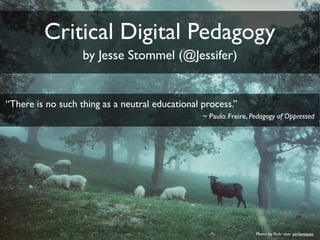
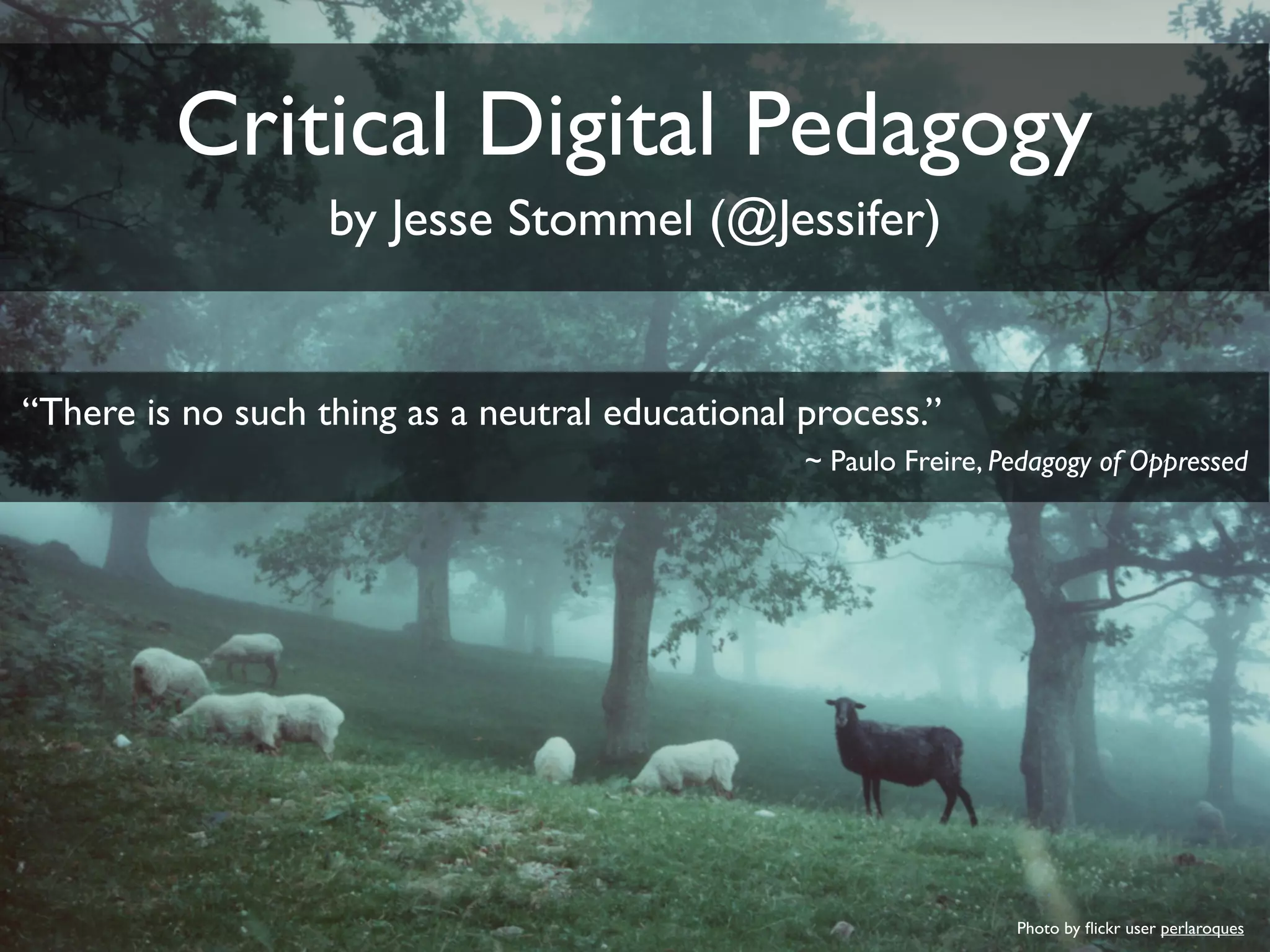
Critical Digital Pedagogy
“There is no such thing as a neutral educational process.”
~ Paulo Freire, Pedagogy of Oppressed
Photo by flickr user Fio
The project of education has been misdirected. Educators and students
alike have found themselves more and more flummoxed by a system
that values assessment over engagement, learning management over
discovery, content over community, outcomes over epiphanies.
Education has misrepresented itself as objective, quantifiable, apolitical.
Photo by flickr user Michael Kötter
Education is too often engaged in teaching that is not pedagogical.There are
a whole host of other words to describe this work: instruction, classroom
management, training, outcomes-driven, standards-based, content delivery.
Photo by flickr user Michael Kötter
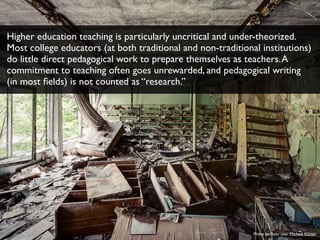
Higher education teaching is particularly uncritical and under-theorized.
Most college educators (at both traditional and non-traditional institutions)
do little direct pedagogical work to prepare themselves as teachers.A
commitment to teaching often goes unrewarded, and pedagogical writing
(in most fields) is not counted as “research.”
Photo by flickr user Fio
Pedagogy is not just a delivery device for the digital humanities. It should be
at the core of what the digital humanities is as an academic discipline.
Praxis
Pedagogy is the place where philosophy and practice meet.
Photo by flickr user henry grey
Photo by flickr user Ray Smith
Pedagogy is itself a discipline with a long history and its own
literature, but is also, as Cheryl E. Ball writes, a space where
“student and teacher, author and editor, reader and scholar learn
from each other.”
Critical Pedagogy is an approach to teaching and learning
predicated on fostering agency and empowering learners (implicitly
and explicitly critiquing oppressive power structures).The “critical”
in critical pedagogy functions in several registers:
1. Critical, as in mission-critical, essential;
2. Critical, as in literary criticism and critique, providing definitions and
interpretation;
3. Critical, as in a reflective and nuanced approach to a thing;
4. Critical, as in criticizing institutional or corporate impediments to learning;
5. Critical Pedagogy, as a disciplinary approach, which inflects (and is inflected
by) each of these other meanings.
Photo by flickr user Fio
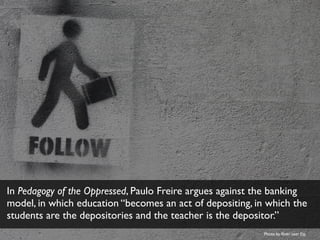
In Pedagogy of the Oppressed, Paulo Freire argues against the banking
model, in which education “becomes an act of depositing, in which the
students are the depositories and the teacher is the depositor.”
Photo by flickr user Fio
Photo by flickr user Luc De Leeuw
Teaching is deeply personal and political work, through which pedagogues
cannot and do not remain objective. Rather, pedagogy, and particularly
Critical Pedagogy, is work to which we must bring our full selves, and work
to which every learner must come with full agency.
Photo by flickr user Theen Moy
“Knowledge emerges only through invention and re-invention, through the
restless, impatient, continuing, hopeful inquiry human beings pursue in the
world, with the world, and with each other.”
~ Paulo Freire, Pedagogy of Oppressed
In place of the banking model, Freire advocates for “problem-posing
education,” in which a classroom or learning environment becomes a
space for asking questions -- a space of cognition not information.
Vertical (or hierarchical) relationships give way to more playful ones.
Photo by flickr user Fio
Can the necessary reflective dialogue flourish within web-based tools,
within social media platforms, within learning management systems,
within MOOCs?
“Unless the mass of workers are to be blind cogs and pinions in the
apparatus they employ, they must have some understanding of the
physical and social facts behind and ahead of the material and
appliances with which they are dealing.”
John Dewey, Schools ofTo-Morrow
Photo by flickr user Thomas Hawk
Critical Digital Pedagogy:
1. centers its practice on community and collaboration;
2. must remain open to diverse, international voices, and thus requires
invention to reimagine the ways that communication and collaboration
happen across cultural and political boundaries;
3. will not, cannot, be defined by a single voice but must gather together a
cacophony of voices;
4. must have use and application outside traditional institutions of education.
Photo by flickr user Fio
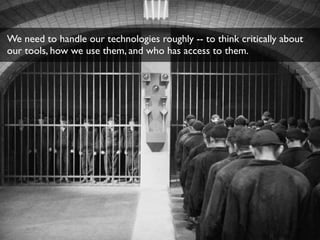
We need to handle our technologies roughly -- to think critically about
our tools, how we use them, and who has access to them.
Photo by flickr user Nathan Rupert
Platforms that do dictate too strongly how we might use them, or ones
that remove our agency by too covertly reducing us and our work to
commodified data, should be rooted out by a Critical Digital Pedagogy.
“It is possible to think critically about technology without running off to the
woods — although, I must warn you, it is possible that you will never be
quite so comfortable again about the moral dimensions of progress and the
part we all play in it. I know that I’m not.”
~ Howard Rheingold, “Technology 101”
Photo by flickr user SergeyYeliseev
Photo by flickr user kevin dooley
“I am hopeful, not out of mere stubbornness, but out of an existential,
concrete imperative.”
~ Paulo Freire, Pedagogy of Hope
Photo by flickr user
In order to make academic space more humane, we need to wear our
pedagogies in all the spaces in which we work, in our classrooms,
administrating our institutions, editing scholarly journals, on tenure and
promotion committees, and in our collaborations with faculty
colleagues, staff colleagues, adjunct colleagues, and student colleagues.
Photo by flickr user Fio
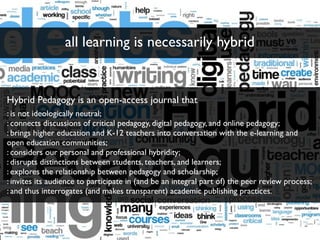
all learning is necessarily hybrid
Hybrid Pedagogy is an open-access journal that

: is not ideologically neutral;

: connects discussions of critical pedagogy, digital pedagogy, and online pedagogy;

: brings higher education and K-12 teachers into conversation with the e-learning and
open education communities;

: considers our personal and professional hybridity;

: disrupts distinctions between students, teachers, and learners;

: explores the relationship between pedagogy and scholarship;

: invites its audience to participate in (and be an integral part of) the peer review process;

: and thus interrogates (and makes transparent) academic publishing practices.
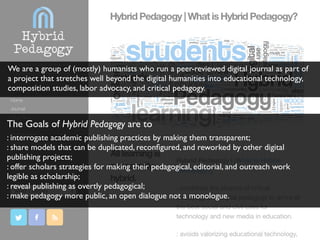
We are a group of (mostly) humanists who run a peer-reviewed digital journal as part of
a project that stretches well beyond the digital humanities into educational technology,
composition studies, labor advocacy, and critical pedagogy.
The Goals of Hybrid Pedagogy are to

: interrogate academic publishing practices by making them transparent;
: share models that can be duplicated, reconfigured, and reworked by other digital
publishing projects;
: offer scholars strategies for making their pedagogical, editorial, and outreach work
legible as scholarship;
: reveal publishing as overtly pedagogical;
: make pedagogy more public, an open dialogue not a monologue.
Photo by MythicSeabass
In our efforts at scholarly publishing, I would argue for the exact opposite
of objectivity -- for an intense subjectivity. Not just open peer review but
collaborative peer review, where works are read and produced by and for a
community of scholars.
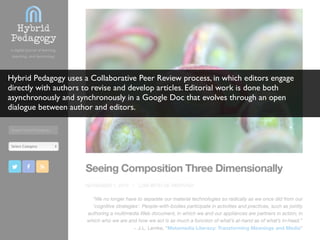
Hybrid Pedagogy uses a Collaborative Peer Review process, in which editors engage
directly with authors to revise and develop articles. Editorial work is done both
asynchronously and synchronously in a Google Doc that evolves through an open
dialogue between author and editors.
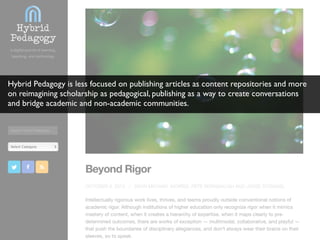
Hybrid Pedagogy is less focused on publishing articles as content repositories and more
on reimagining scholarship as pedagogical, publishing as a way to create conversations
and bridge academic and non-academic communities.
Photo by flickr user Holger H.
“The world is vast.Art is long.What else can we do but survey the field,
introduce a topic, plant a seed.”
~ Stephen Ramsay,“The Hermeneutics of Screwing Around; or WhatYou Do with a Million Books”
Photo by rromer
“The classroom, with all its limitations, remains a location of possibility. In
that field of possibility we have the opportunity to labor for freedom, to
demand of ourselves and our comrades, an openness of mind and heart
that allows us to face reality even as we collectively imagine ways to
move beyond boundaries, to transgress” (207).
~ bell hooks, Teaching toTransgress
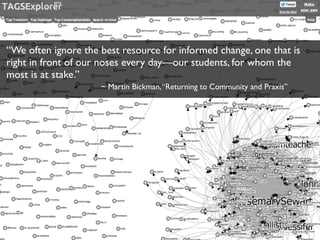
“We often ignore the best resource for informed change, one that is
right in front of our noses every day—our students, for whom the
most is at stake.”
~ Martin Bickman,“Returning to Community and Praxis”
bit.ly/critdigped
@Jessifer

Critical Digital Pedagogy

  • 1.
    by Jesse Stommel(@Jessifer) Photo by flickr user perlaroques Critical Digital Pedagogy “There is no such thing as a neutral educational process.” ~ Paulo Freire, Pedagogy of Oppressed
  • 2.
    Photo by flickruser Fio The project of education has been misdirected. Educators and students alike have found themselves more and more flummoxed by a system that values assessment over engagement, learning management over discovery, content over community, outcomes over epiphanies. Education has misrepresented itself as objective, quantifiable, apolitical.
  • 3.
    Photo by flickruser Michael Kötter Education is too often engaged in teaching that is not pedagogical.There are a whole host of other words to describe this work: instruction, classroom management, training, outcomes-driven, standards-based, content delivery.
  • 4.
    Photo by flickruser Michael Kötter Higher education teaching is particularly uncritical and under-theorized. Most college educators (at both traditional and non-traditional institutions) do little direct pedagogical work to prepare themselves as teachers.A commitment to teaching often goes unrewarded, and pedagogical writing (in most fields) is not counted as “research.”
  • 5.
    Photo by flickruser Fio Pedagogy is not just a delivery device for the digital humanities. It should be at the core of what the digital humanities is as an academic discipline.
  • 6.
    Praxis Pedagogy is theplace where philosophy and practice meet. Photo by flickr user henry grey
  • 7.
    Photo by flickruser Ray Smith Pedagogy is itself a discipline with a long history and its own literature, but is also, as Cheryl E. Ball writes, a space where “student and teacher, author and editor, reader and scholar learn from each other.”
  • 8.
    Critical Pedagogy isan approach to teaching and learning predicated on fostering agency and empowering learners (implicitly and explicitly critiquing oppressive power structures).The “critical” in critical pedagogy functions in several registers: 1. Critical, as in mission-critical, essential; 2. Critical, as in literary criticism and critique, providing definitions and interpretation; 3. Critical, as in a reflective and nuanced approach to a thing; 4. Critical, as in criticizing institutional or corporate impediments to learning; 5. Critical Pedagogy, as a disciplinary approach, which inflects (and is inflected by) each of these other meanings. Photo by flickr user Fio
  • 9.
    In Pedagogy ofthe Oppressed, Paulo Freire argues against the banking model, in which education “becomes an act of depositing, in which the students are the depositories and the teacher is the depositor.” Photo by flickr user Fio
  • 10.
    Photo by flickruser Luc De Leeuw Teaching is deeply personal and political work, through which pedagogues cannot and do not remain objective. Rather, pedagogy, and particularly Critical Pedagogy, is work to which we must bring our full selves, and work to which every learner must come with full agency.
  • 11.
    Photo by flickruser Theen Moy “Knowledge emerges only through invention and re-invention, through the restless, impatient, continuing, hopeful inquiry human beings pursue in the world, with the world, and with each other.” ~ Paulo Freire, Pedagogy of Oppressed
  • 12.
    In place ofthe banking model, Freire advocates for “problem-posing education,” in which a classroom or learning environment becomes a space for asking questions -- a space of cognition not information. Vertical (or hierarchical) relationships give way to more playful ones. Photo by flickr user Fio
  • 13.
    Photo by flickruser Fio Can the necessary reflective dialogue flourish within web-based tools, within social media platforms, within learning management systems, within MOOCs?
  • 14.
    “Unless the massof workers are to be blind cogs and pinions in the apparatus they employ, they must have some understanding of the physical and social facts behind and ahead of the material and appliances with which they are dealing.” John Dewey, Schools ofTo-Morrow Photo by flickr user Thomas Hawk
  • 15.
    Critical Digital Pedagogy: 1.centers its practice on community and collaboration; 2. must remain open to diverse, international voices, and thus requires invention to reimagine the ways that communication and collaboration happen across cultural and political boundaries; 3. will not, cannot, be defined by a single voice but must gather together a cacophony of voices; 4. must have use and application outside traditional institutions of education. Photo by flickr user Fio
  • 16.
    We need tohandle our technologies roughly -- to think critically about our tools, how we use them, and who has access to them.
  • 17.
    Photo by flickruser Nathan Rupert Platforms that do dictate too strongly how we might use them, or ones that remove our agency by too covertly reducing us and our work to commodified data, should be rooted out by a Critical Digital Pedagogy.
  • 18.
    “It is possibleto think critically about technology without running off to the woods — although, I must warn you, it is possible that you will never be quite so comfortable again about the moral dimensions of progress and the part we all play in it. I know that I’m not.” ~ Howard Rheingold, “Technology 101” Photo by flickr user SergeyYeliseev
  • 19.
    Photo by flickruser kevin dooley “I am hopeful, not out of mere stubbornness, but out of an existential, concrete imperative.” ~ Paulo Freire, Pedagogy of Hope
  • 20.
    Photo by flickruser In order to make academic space more humane, we need to wear our pedagogies in all the spaces in which we work, in our classrooms, administrating our institutions, editing scholarly journals, on tenure and promotion committees, and in our collaborations with faculty colleagues, staff colleagues, adjunct colleagues, and student colleagues. Photo by flickr user Fio
  • 21.
    all learning isnecessarily hybrid Hybrid Pedagogy is an open-access journal that
 : is not ideologically neutral;
 : connects discussions of critical pedagogy, digital pedagogy, and online pedagogy;
 : brings higher education and K-12 teachers into conversation with the e-learning and open education communities;
 : considers our personal and professional hybridity;
 : disrupts distinctions between students, teachers, and learners;
 : explores the relationship between pedagogy and scholarship;
 : invites its audience to participate in (and be an integral part of) the peer review process;
 : and thus interrogates (and makes transparent) academic publishing practices.
  • 22.
    We are agroup of (mostly) humanists who run a peer-reviewed digital journal as part of a project that stretches well beyond the digital humanities into educational technology, composition studies, labor advocacy, and critical pedagogy. The Goals of Hybrid Pedagogy are to
 : interrogate academic publishing practices by making them transparent; : share models that can be duplicated, reconfigured, and reworked by other digital publishing projects; : offer scholars strategies for making their pedagogical, editorial, and outreach work legible as scholarship; : reveal publishing as overtly pedagogical; : make pedagogy more public, an open dialogue not a monologue.
  • 23.
    Photo by MythicSeabass Inour efforts at scholarly publishing, I would argue for the exact opposite of objectivity -- for an intense subjectivity. Not just open peer review but collaborative peer review, where works are read and produced by and for a community of scholars.
  • 24.
    Hybrid Pedagogy usesa Collaborative Peer Review process, in which editors engage directly with authors to revise and develop articles. Editorial work is done both asynchronously and synchronously in a Google Doc that evolves through an open dialogue between author and editors.
  • 25.
    Hybrid Pedagogy isless focused on publishing articles as content repositories and more on reimagining scholarship as pedagogical, publishing as a way to create conversations and bridge academic and non-academic communities.
  • 26.
    Photo by flickruser Holger H. “The world is vast.Art is long.What else can we do but survey the field, introduce a topic, plant a seed.” ~ Stephen Ramsay,“The Hermeneutics of Screwing Around; or WhatYou Do with a Million Books”
  • 27.
    Photo by rromer “Theclassroom, with all its limitations, remains a location of possibility. In that field of possibility we have the opportunity to labor for freedom, to demand of ourselves and our comrades, an openness of mind and heart that allows us to face reality even as we collectively imagine ways to move beyond boundaries, to transgress” (207). ~ bell hooks, Teaching toTransgress
  • 28.
    “We often ignorethe best resource for informed change, one that is right in front of our noses every day—our students, for whom the most is at stake.” ~ Martin Bickman,“Returning to Community and Praxis”
  • 29.