

THE KENNEDY INSTITUTE’S
TEACHING KNOWLEDGETEST
PREPARATION AND CERTIFICATION COURSE
MODULE 1: LISTENING SKILL
Class4: Listening
Reading a book is like re-writing it for yourself. You bring to a
novel, anything you read, all your experience of the world.
You bring your history and youread it in your own terms.”
--AngelaCarter
LANGUAGEREFLECTION
INTRODUCTION
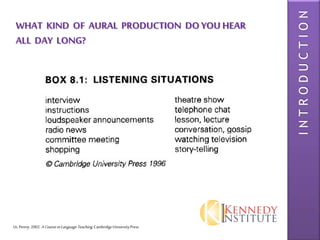
WHAT KIND OF AURAL PRODUCTION DO YOU HEAR
ALL DAY LONG?
Ur, Penny.2002.ACourseinLanguageTeaching.CambridgeUniversityPress
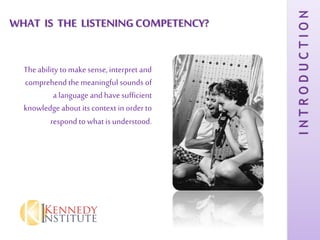
WHAT IS THE LISTENINGCOMPETENCY?
Theability to make sense, interpret and
comprehendthe meaningful sounds of
a language and havesufficient
knowledge about its context in orderto
respond to what is understood.
INTRODUCTION
INSTRUMENTAL LISTENING
A lot of the listening (like reading) we do is done for a specific purpose, or to
achieve a clear objective. This means we have a utilitarian purpose for it.
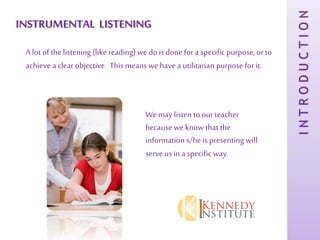
Wemay listen to ourteacher
because we know that the
information s/he is presenting will
serveus in a specific way.
INTRODUCTION
PLEASURABLE LISTENING
Listening (and reading) for pleasure involves a moreinteractive relationship
with what wearereceiving. This may include listening to the radio or
having a chat with a friend.
Instrumental listening can also be
pleasurable if theperson is
interested and enjoys the subject.
INTRODUCTION
LISTENINGSKILL
WHAT IS THE AIM OF DEVELOPING LISTENING SKILLS IN
THE CLASSROOM?
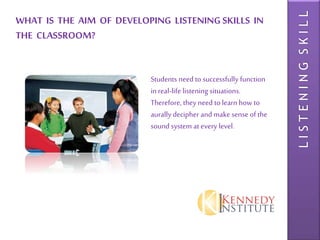
Students need to successfully function
in real-life listening situations.
Therefore, they need to learn how to
aurally decipher and make sense of the
sound system at every level.
LISTENINGSKILL
WHAT DOES LISTENING INVOLVE?
Listening involves connected speech: complete and incomplete sentences, single
words and utterances expressed through stress and intonation.
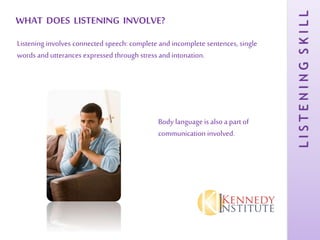
Body language is also a part of
communication involved.
WHAT DOES LISTENING INVOLVE?
LISTENINGSKILL
Weshould also take these factors into consideration:
Informal or less organized communication:
brevity of chunks,pronunciation, vocabulary, grammar,noise, redundancy,
non-repetition, hesitation
Listener expectation and purpose
Alwaysknowswhatthetopic isandsometimes canpredict whatis being said
Visual stimuli
Usually wecanreadthe speaker’s body languageorhave avisual aid(map,
scene, object)
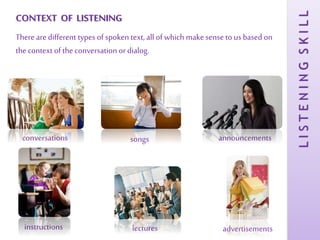
CONTEXT OF LISTENING
LISTENINGSKILL
There aredifferent types of spoken text, all of which makesense to us based on
the context ofthe conversation ordialog.
conversations songs announcements
instructions lectures advertisements
LISTENINGSKILL
UNDERSTANDING ACCENTS & EMOTIONS
To help us understand wider range of
listening, we must understand people’s
different ways of speaking which may
be affected by their personality,
speaking style, emotions, and where
they come from (accents).
LISTENINGSKILL
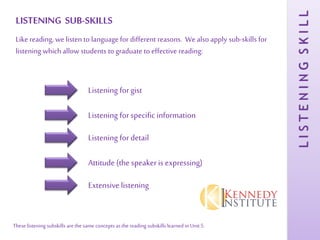
LISTENING SUB-SKILLS
Like reading, we listen to language for different reasons. We also apply sub-skills for
listening which allow students to graduate to effective reading:
*These listening subskills arethe same concepts as the reading subskills learned in Unit5.
Listening for gist
Listening for specific information
Listening for detail
Attitude (the speakeris expressing)
Extensive listening
LISTENINGSKILL
ASPECTS OF LISTENING
When we teach listening, there are different aspects that we can focus on:
Hearing the differences between common sounds
Identifying key words
Understanding and responding to instructions or commands
Recognizing basic differences in commands (question, statement, order, etc.)
Following a narrative with visual prompts
Recognize the sound patterns of simple rhythm words
LISTENINGSKILL
ASPECTS OF LISTENING
Understand the development of simple stories
Understanding and responding to simple requests and classroom instructions
Identifying main ideas
LISTENINGSKILL
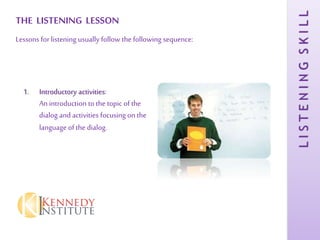
THE LISTENING LESSON
Lessons for listening usually follow the following sequence:
1. Introductory activities:
An introduction to the topic of the
dialog and activities focusing on the
language of the dialog.
LISTENINGSKILL
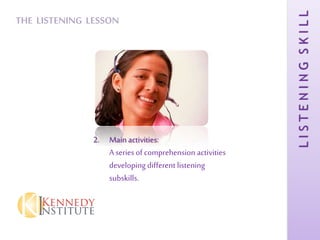
THE LISTENING LESSON
2. Main activities:
A series of comprehension activities
developing different listening
subskills.
LISTENINGSKILL
THE LISTENING LESSON
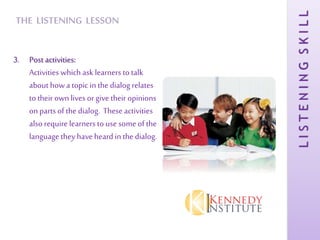
3. Post activities:
Activities which ask learners to talk
about howa topic in the dialog relates
to their ownlives or give their opinions
on parts of the dialog. Theseactivities
also require learners to use some of the
language they haveheard in the dialog.
LISTENINGSKILL
THE LISTENING LESSON
Focus should beon exposureto long listening tasks
during the main activity and noton the pre-listening
activities.
LISTENINGSKILL
PROBLEM AREAS
We can develop a learner’s listening skills by focusing regularly on particular aspects of
listening such as:
• problem sounds
• features of connected speech
• subskills
• vocabulary
• new language items
POINTS TO CONSIDER
REMEMBER
When we listen to recordings, we can’t see the speaker’s body language or ask
him/her to repeat what is said. This will make the listening task more difficult for the
learner than participating in a live conversation.
Children learn well from stories that interest them.
Some listening texts in coursebooks are authentic while others are written especially
for language learners. Listening to both is useful to develop listening skills.
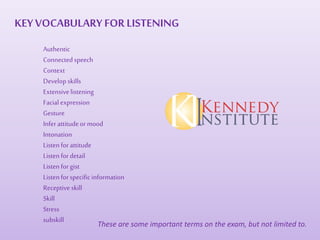
Authentic
Connectedspeech
Context
Develop skills
Extensivelistening
Facialexpression
Gesture
Inferattitudeormood
Intonation
Listenforattitude
Listenfordetail
Listenforgist
Listenforspecificinformation
Receptiveskill
Skill
Stress
subskill
These are some important terms on the exam, but not limited to.
KEYVOCABULARY FOR LISTENING
ENDOFPRESENTATION
This presentationis designedfortheexclusiveuse by
TheKennedyInstituteforthe
TeachingKnowledgeTest
PreparationandCertificationCourse
All rights reserved. 2011

Listening

  • 1.
    THE KENNEDY INSTITUTE’S TEACHINGKNOWLEDGETEST PREPARATION AND CERTIFICATION COURSE MODULE 1: LISTENING SKILL
  • 2.
  • 3.
    Reading a bookis like re-writing it for yourself. You bring to a novel, anything you read, all your experience of the world. You bring your history and youread it in your own terms.” --AngelaCarter LANGUAGEREFLECTION
  • 4.
    INTRODUCTION WHAT KIND OFAURAL PRODUCTION DO YOU HEAR ALL DAY LONG? Ur, Penny.2002.ACourseinLanguageTeaching.CambridgeUniversityPress
  • 5.
    WHAT IS THELISTENINGCOMPETENCY? Theability to make sense, interpret and comprehendthe meaningful sounds of a language and havesufficient knowledge about its context in orderto respond to what is understood. INTRODUCTION
  • 6.
    INSTRUMENTAL LISTENING A lotof the listening (like reading) we do is done for a specific purpose, or to achieve a clear objective. This means we have a utilitarian purpose for it. Wemay listen to ourteacher because we know that the information s/he is presenting will serveus in a specific way. INTRODUCTION
  • 7.
    PLEASURABLE LISTENING Listening (andreading) for pleasure involves a moreinteractive relationship with what wearereceiving. This may include listening to the radio or having a chat with a friend. Instrumental listening can also be pleasurable if theperson is interested and enjoys the subject. INTRODUCTION
  • 8.
    LISTENINGSKILL WHAT IS THEAIM OF DEVELOPING LISTENING SKILLS IN THE CLASSROOM? Students need to successfully function in real-life listening situations. Therefore, they need to learn how to aurally decipher and make sense of the sound system at every level.
  • 9.
    LISTENINGSKILL WHAT DOES LISTENINGINVOLVE? Listening involves connected speech: complete and incomplete sentences, single words and utterances expressed through stress and intonation. Body language is also a part of communication involved.
  • 10.
    WHAT DOES LISTENINGINVOLVE? LISTENINGSKILL Weshould also take these factors into consideration: Informal or less organized communication: brevity of chunks,pronunciation, vocabulary, grammar,noise, redundancy, non-repetition, hesitation Listener expectation and purpose Alwaysknowswhatthetopic isandsometimes canpredict whatis being said Visual stimuli Usually wecanreadthe speaker’s body languageorhave avisual aid(map, scene, object)
  • 11.
    CONTEXT OF LISTENING LISTENINGSKILL Therearedifferent types of spoken text, all of which makesense to us based on the context ofthe conversation ordialog. conversations songs announcements instructions lectures advertisements
  • 12.
    LISTENINGSKILL UNDERSTANDING ACCENTS &EMOTIONS To help us understand wider range of listening, we must understand people’s different ways of speaking which may be affected by their personality, speaking style, emotions, and where they come from (accents).
  • 13.
    LISTENINGSKILL LISTENING SUB-SKILLS Like reading,we listen to language for different reasons. We also apply sub-skills for listening which allow students to graduate to effective reading: *These listening subskills arethe same concepts as the reading subskills learned in Unit5. Listening for gist Listening for specific information Listening for detail Attitude (the speakeris expressing) Extensive listening
  • 14.
    LISTENINGSKILL ASPECTS OF LISTENING Whenwe teach listening, there are different aspects that we can focus on: Hearing the differences between common sounds Identifying key words Understanding and responding to instructions or commands Recognizing basic differences in commands (question, statement, order, etc.) Following a narrative with visual prompts Recognize the sound patterns of simple rhythm words
  • 15.
    LISTENINGSKILL ASPECTS OF LISTENING Understandthe development of simple stories Understanding and responding to simple requests and classroom instructions Identifying main ideas
  • 16.
    LISTENINGSKILL THE LISTENING LESSON Lessonsfor listening usually follow the following sequence: 1. Introductory activities: An introduction to the topic of the dialog and activities focusing on the language of the dialog.
  • 17.
    LISTENINGSKILL THE LISTENING LESSON 2.Main activities: A series of comprehension activities developing different listening subskills.
  • 18.
    LISTENINGSKILL THE LISTENING LESSON 3.Post activities: Activities which ask learners to talk about howa topic in the dialog relates to their ownlives or give their opinions on parts of the dialog. Theseactivities also require learners to use some of the language they haveheard in the dialog.
  • 19.
    LISTENINGSKILL THE LISTENING LESSON Focusshould beon exposureto long listening tasks during the main activity and noton the pre-listening activities.
  • 20.
    LISTENINGSKILL PROBLEM AREAS We candevelop a learner’s listening skills by focusing regularly on particular aspects of listening such as: • problem sounds • features of connected speech • subskills • vocabulary • new language items
  • 21.
    POINTS TO CONSIDER REMEMBER Whenwe listen to recordings, we can’t see the speaker’s body language or ask him/her to repeat what is said. This will make the listening task more difficult for the learner than participating in a live conversation. Children learn well from stories that interest them. Some listening texts in coursebooks are authentic while others are written especially for language learners. Listening to both is useful to develop listening skills.
  • 22.
  • 23.
    ENDOFPRESENTATION This presentationis designedfortheexclusiveuseby TheKennedyInstituteforthe TeachingKnowledgeTest PreparationandCertificationCourse All rights reserved. 2011