Activities for all 5
C’s During Small
Group Centers
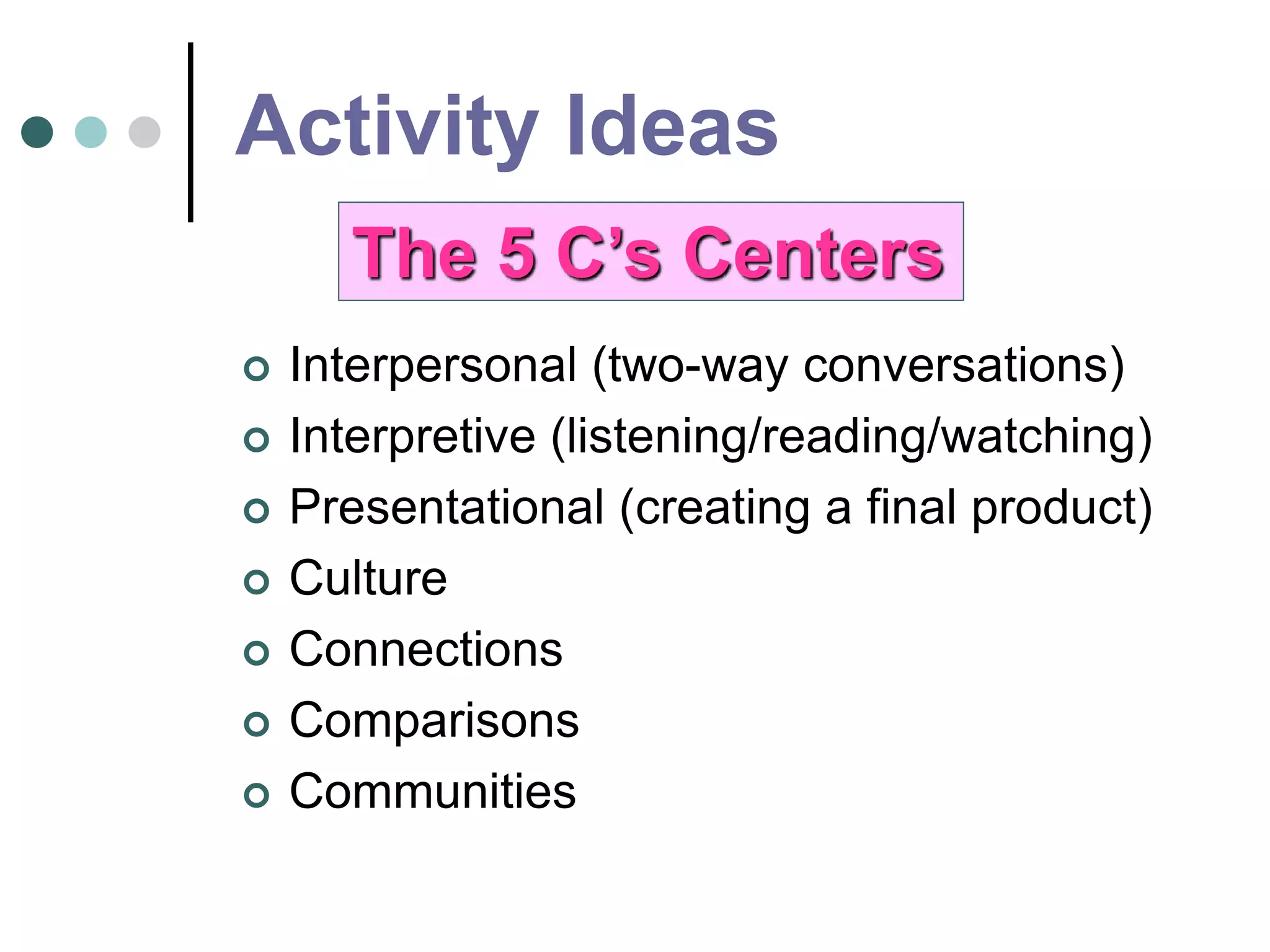
Activity Ideas
 Interpersonal (two-way conversations)
 Interpretive (listening/reading/watching)
 Presentational (creating a final product)
 Culture
 Connections
 Comparisons
 Communities
The 5 C’s Centers
Interpersonal Skills
person-to-person
speaking
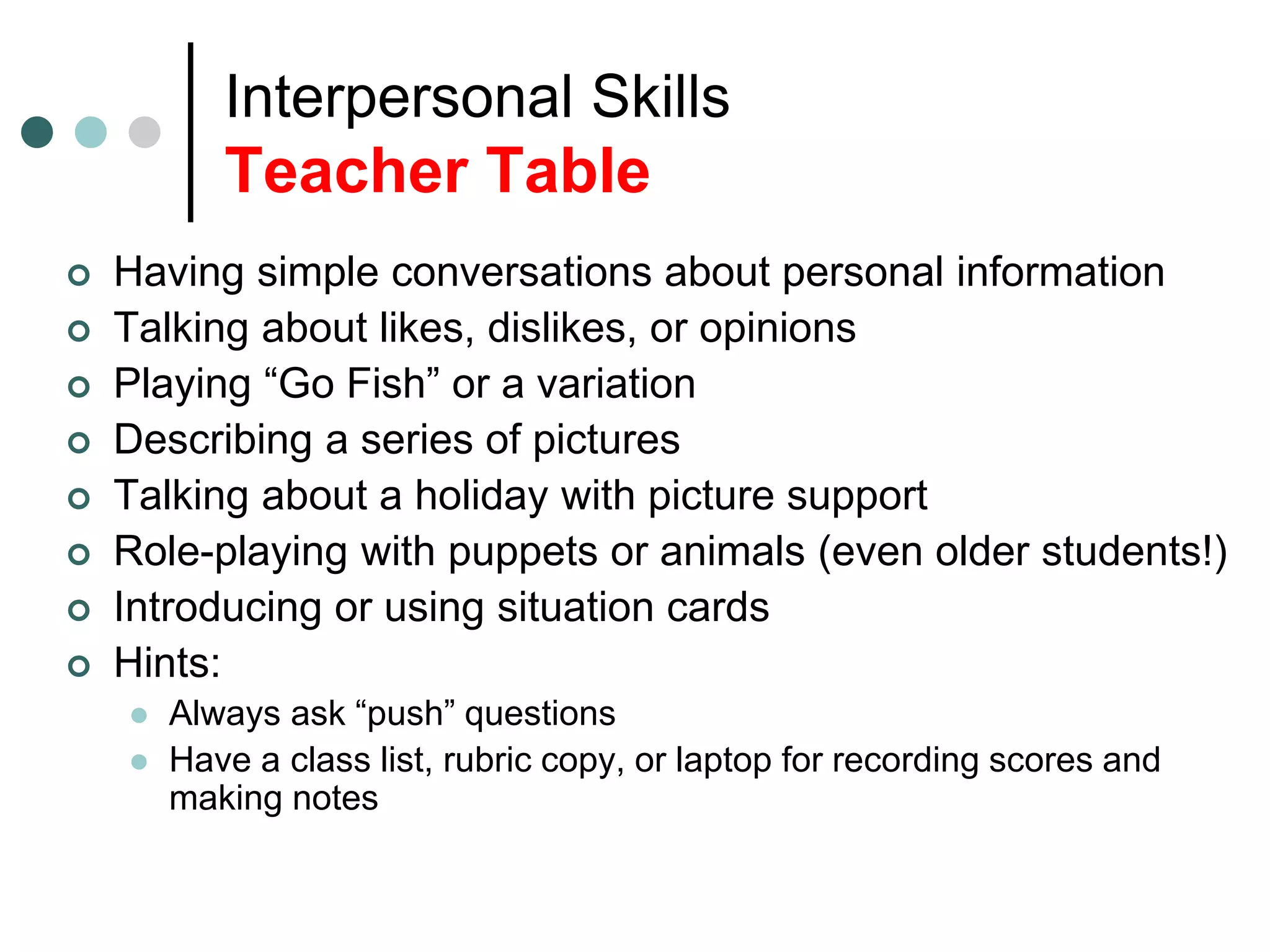
Interpersonal Skills
Teacher Table
 Having simple conversations about personal information
 Talking about likes, dislikes, or opinions
 Playing “Go Fish” or a variation
 Describing a series of pictures
 Talking about a holiday with picture support
 Role-playing with puppets or animals (even older students!)
 Introducing or using situation cards
 Hints:
 Always ask “push” questions
 Have a class list, rubric copy, or laptop for recording scores and
making notes
Interpersonal Skills
Student Centers
 Practicing a situation card or known
dialogue
 Learning new content with vocabulary,
hint sheets, dictionaries or computer
kiosks
 Using puppets, old cell-phones, or
walkie- talkies to make it fun
 Recording with laptops, digital recorder,
iPods, flip camera, or cassette player
Interpersonal Skills
Student Center Games
 Hangman
 “Guess who?” or Eggspert games with a
designated leader
 Teacher-created games with dice
 Candyland or Chutes and Ladders (no
English!)
 Go Fish
 Culturally authentic games
 Online games with one student as
“Vanna White”
one student as “leader”
Interpretive Skills
listening and reading for a purpose
Listening Center • Books
• Songs
• Conversations
• Poetry
• Speeches
• Listen for a certain word and count instances
• Teacher-created listening test with questions
• Fill in the missing words – works great for songs!
• Match what you hear to pictures
• Listen and put book pictures in order (great if you
have a children’s book on tape)
• Put words in order (on sentence strips or copies)
• Tapes
• iPods
• Laptops
Watching Center
• Cartoon
• Song video
• Conversation video
• Drama
• Other YouTube find!
• Put written sentences describing scenes in order
• Match pictures from story to written sentences
• Answer main idea questions
• Answer comprehension questions
• Listen for the number of times they hear a certain word.
• Write a sentence about different scenes or characters
• VCR
• Laptop
Reading Center • Books
• Poetry
• Articles
• Advertisements
• Cartoons
• Read an article and answer comprehension questions.
•Read an article and count how many times they find different
words or “find the cognates.”
• Put cut-up sentences in order
• Choose best sentence to describe character, main idea,
problem, solution.
• Do a word sort with cards and then transfer to a paper with
columns.
Authentic Materials
Reading Center
Teacher-created Materials
• Matching words to pictures
•Matching words to definitions
• Draw illustrations for words or paragraphs
• Word fill-in with sentences
Presentational Skills
one-way presentational
speaking and writing
final drafts, well-
practiced
Presentational Speaking
 Partners work with situation cards and prepare
skit for performance later
 Practice a short dialogue
 Readers-theater: read story, decide how to act
out, practice with props, act out later
 Use laptops or iPads to record their voices into PPT,
VoiceThread, or any other Web 2.0 presentation app)
Peer-score and peer-coach using rubrics
Record practice OR final product with digital recorder,
laptop, iPod, flip camera, or cassette.
Presentational Writing
Centers
 Write an acrostic poem in the target language.
 Label a picture or pictures
 Write a story about a picture prompt
 Write poetry, stories, etc.
 Create a construction paper organizer
 Teacher has pre-made PPT of pictures on laptop –
students write sentences to go with pictures on each
page
 Send a text or email to the teacher!
Options:
dictionaries or not
word lists or not
Culture Skills
exploring the relationship
between the products,
practices, and perspectives of
the target culture
Culture-Based Centers
 interacting with realia
 doing money rubbings
 learning about and practicing specific
customs
 playing culturally authentic games
 accessing websites in the target language
 viewing cultural topic videos
 eating, drinking something from culture
 creating models of food or art from clay or
other medium
Art-Based Culture Centers
 match an art piece to sentence or
paragraph that describes it
 brainstorm words or phrases about each
art piece
 write a paragraph or story about art
piece
 one partner describes, other points to
the art piece
 do “color-by-number” of art piece,
1 = rojo 2 = verde
Connections
• to other subject areas
• to content only available in the target
language
Connections: Math Centers
 one student reads number card, others use
straws, base 10 rods, blocks, etc. to create
number
 measuring various objects in Metric and British
 writing greater than/less than sentences
 monetary conversions and websites
 Sudoku (characters or written words)
 Written word math (cinco x cinco = ___)
Connections: Science Centers
 What in the room is magnetic? (room is
labeled - list up in target language)
 What in the room is metal, wood, etc.?
 Classifying animals by various characteristics
and creating chart
 Putting together life-cycle pictures for plants,
animals, etc.
 Listening to a YouTube video explaining
simple science concept in target language
Connections:
Art, Music and PE
 Make a target culture craft
 Draw a scene to be labeled later
 Compare 2 target culture songs for
various characteristics
 Write a few sentences about why one
song is better.
 Learn a dance step or dance
from written directions, video, etc.
Comparisons
of languages and cultures
Comparisons-based Centers
 Creating Venn diagrams (written or
pictures) or other graphic organizers.
 Writing about own family, home, etc.
versus target culture family, home,
studied (perhaps English)
 Investigating written work in both
languages (ex. same picture book in two
languages) and answering questions
about similarities/differences
 Looking at maps from different countries
and answering comparison questions or
highlighting countries.
Communities
The Ultimate Center!
Communities-based Centers
 Native-speaker visitor(s) as the center
(be sure to give task or games!)
 Reading, listening to or writing pen pal
letters
 Looking at video from pen pals
 Looking at YouTube video of peers
 Constructing an email, letter, picture, etc.
to share with native speakers
 Creating something in target language to
be shared with the school or home for
the purpose of language
sharing/teaching

Activities for all 5 C's During Small Group Centers

  • 1.
    Activities for all5 C’s During Small Group Centers
  • 2.
    Activity Ideas  Interpersonal(two-way conversations)  Interpretive (listening/reading/watching)  Presentational (creating a final product)  Culture  Connections  Comparisons  Communities The 5 C’s Centers
  • 3.
  • 4.
    Interpersonal Skills Teacher Table Having simple conversations about personal information  Talking about likes, dislikes, or opinions  Playing “Go Fish” or a variation  Describing a series of pictures  Talking about a holiday with picture support  Role-playing with puppets or animals (even older students!)  Introducing or using situation cards  Hints:  Always ask “push” questions  Have a class list, rubric copy, or laptop for recording scores and making notes
  • 5.
    Interpersonal Skills Student Centers Practicing a situation card or known dialogue  Learning new content with vocabulary, hint sheets, dictionaries or computer kiosks  Using puppets, old cell-phones, or walkie- talkies to make it fun  Recording with laptops, digital recorder, iPods, flip camera, or cassette player
  • 6.
    Interpersonal Skills Student CenterGames  Hangman  “Guess who?” or Eggspert games with a designated leader  Teacher-created games with dice  Candyland or Chutes and Ladders (no English!)  Go Fish  Culturally authentic games  Online games with one student as “Vanna White” one student as “leader”
  • 7.
    Interpretive Skills listening andreading for a purpose
  • 8.
    Listening Center •Books • Songs • Conversations • Poetry • Speeches • Listen for a certain word and count instances • Teacher-created listening test with questions • Fill in the missing words – works great for songs! • Match what you hear to pictures • Listen and put book pictures in order (great if you have a children’s book on tape) • Put words in order (on sentence strips or copies) • Tapes • iPods • Laptops
  • 9.
    Watching Center • Cartoon •Song video • Conversation video • Drama • Other YouTube find! • Put written sentences describing scenes in order • Match pictures from story to written sentences • Answer main idea questions • Answer comprehension questions • Listen for the number of times they hear a certain word. • Write a sentence about different scenes or characters • VCR • Laptop
  • 10.
    Reading Center •Books • Poetry • Articles • Advertisements • Cartoons • Read an article and answer comprehension questions. •Read an article and count how many times they find different words or “find the cognates.” • Put cut-up sentences in order • Choose best sentence to describe character, main idea, problem, solution. • Do a word sort with cards and then transfer to a paper with columns. Authentic Materials
  • 11.
    Reading Center Teacher-created Materials •Matching words to pictures •Matching words to definitions • Draw illustrations for words or paragraphs • Word fill-in with sentences
  • 12.
    Presentational Skills one-way presentational speakingand writing final drafts, well- practiced
  • 13.
    Presentational Speaking  Partnerswork with situation cards and prepare skit for performance later  Practice a short dialogue  Readers-theater: read story, decide how to act out, practice with props, act out later  Use laptops or iPads to record their voices into PPT, VoiceThread, or any other Web 2.0 presentation app) Peer-score and peer-coach using rubrics Record practice OR final product with digital recorder, laptop, iPod, flip camera, or cassette.
  • 14.
    Presentational Writing Centers  Writean acrostic poem in the target language.  Label a picture or pictures  Write a story about a picture prompt  Write poetry, stories, etc.  Create a construction paper organizer  Teacher has pre-made PPT of pictures on laptop – students write sentences to go with pictures on each page  Send a text or email to the teacher! Options: dictionaries or not word lists or not
  • 15.
    Culture Skills exploring therelationship between the products, practices, and perspectives of the target culture
  • 16.
    Culture-Based Centers  interactingwith realia  doing money rubbings  learning about and practicing specific customs  playing culturally authentic games  accessing websites in the target language  viewing cultural topic videos  eating, drinking something from culture  creating models of food or art from clay or other medium
  • 17.
    Art-Based Culture Centers match an art piece to sentence or paragraph that describes it  brainstorm words or phrases about each art piece  write a paragraph or story about art piece  one partner describes, other points to the art piece  do “color-by-number” of art piece, 1 = rojo 2 = verde
  • 18.
    Connections • to othersubject areas • to content only available in the target language
  • 19.
    Connections: Math Centers one student reads number card, others use straws, base 10 rods, blocks, etc. to create number  measuring various objects in Metric and British  writing greater than/less than sentences  monetary conversions and websites  Sudoku (characters or written words)  Written word math (cinco x cinco = ___)
  • 20.
    Connections: Science Centers What in the room is magnetic? (room is labeled - list up in target language)  What in the room is metal, wood, etc.?  Classifying animals by various characteristics and creating chart  Putting together life-cycle pictures for plants, animals, etc.  Listening to a YouTube video explaining simple science concept in target language
  • 21.
    Connections: Art, Music andPE  Make a target culture craft  Draw a scene to be labeled later  Compare 2 target culture songs for various characteristics  Write a few sentences about why one song is better.  Learn a dance step or dance from written directions, video, etc.
  • 22.
  • 23.
    Comparisons-based Centers  CreatingVenn diagrams (written or pictures) or other graphic organizers.  Writing about own family, home, etc. versus target culture family, home, studied (perhaps English)  Investigating written work in both languages (ex. same picture book in two languages) and answering questions about similarities/differences  Looking at maps from different countries and answering comparison questions or highlighting countries.
  • 24.
  • 25.
    Communities-based Centers  Native-speakervisitor(s) as the center (be sure to give task or games!)  Reading, listening to or writing pen pal letters  Looking at video from pen pals  Looking at YouTube video of peers  Constructing an email, letter, picture, etc. to share with native speakers  Creating something in target language to be shared with the school or home for the purpose of language sharing/teaching