DAILY LESSON PLAN
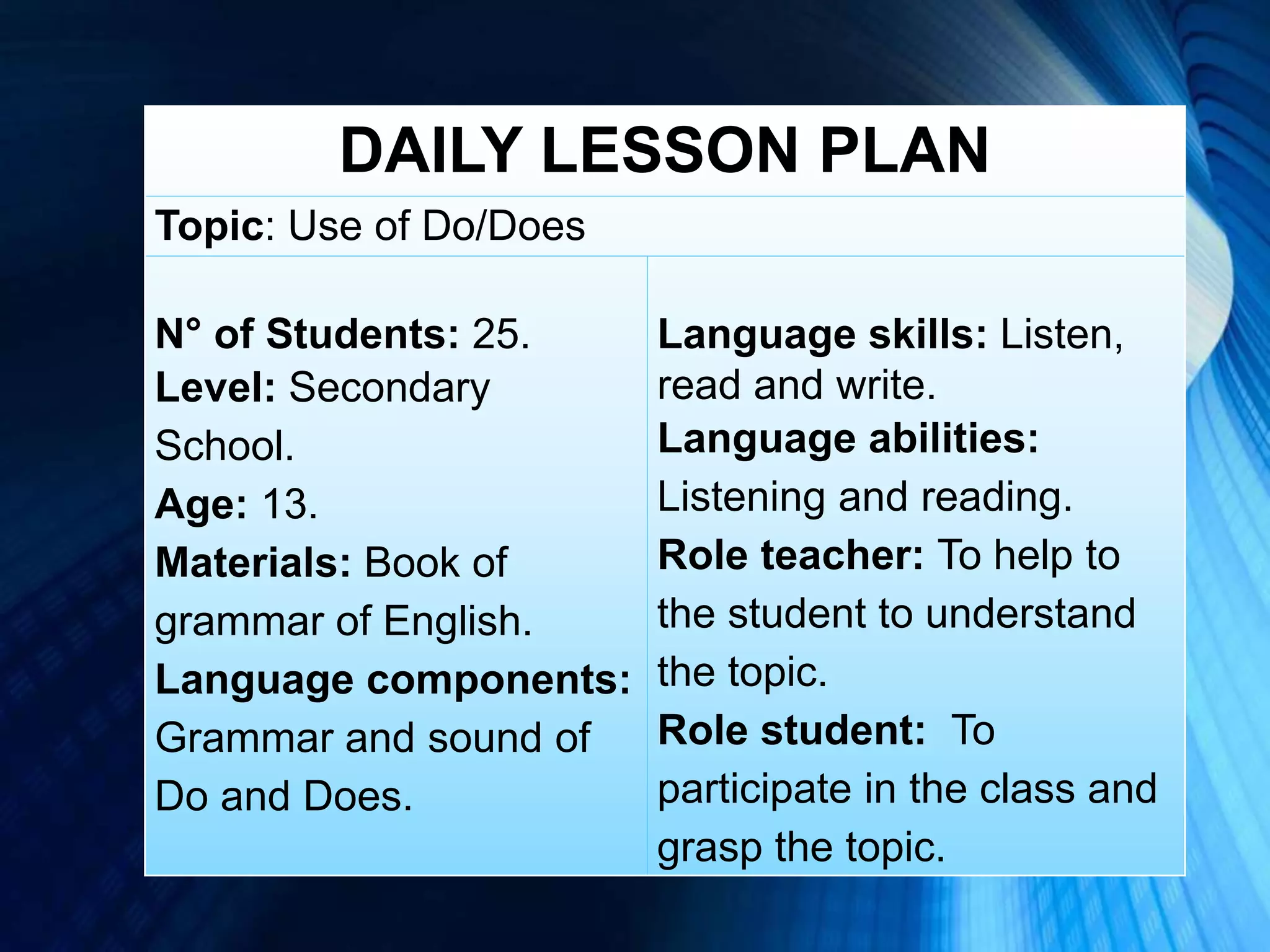
Topic: Use of Do/Does
N° of Students: 25.
Level: Secondary
School.
Age: 13.
Materials: Book of
grammar of English.
Language components:
Grammar and sound of
Do and Does.
Language skills: Listen,
read and write.
Language abilities:
Listening and reading.
Role teacher: To help to
the student to understand
the topic.
Role student: To
participate in the class and
grasp the topic.
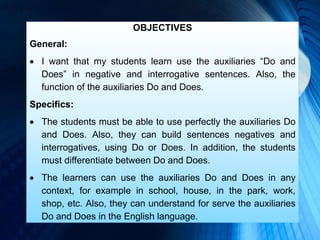
OBJECTIVES
General:
 I want that my students learn use the auxiliaries “Do and
Does” in negative and interrogative sentences. Also, the
function of the auxiliaries Do and Does.
Specifics:
 The students must be able to use perfectly the auxiliaries Do
and Does. Also, they can build sentences negatives and
interrogatives, using Do or Does. In addition, the students
must differentiate between Do and Does.
 The learners can use the auxiliaries Do and Does in any
context, for example in school, house, in the park, work,
shop, etc. Also, they can understand for serve the auxiliaries
Do and Does in the English language.
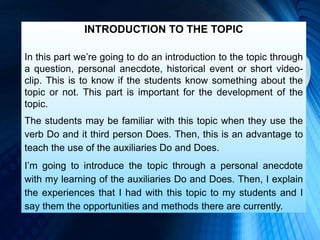
INTRODUCTION TO THE TOPIC
In this part we’re going to do an introduction to the topic through
a question, personal anecdote, historical event or short video-
clip. This is to know if the students know something about the
topic or not. This part is important for the development of the
topic.
The students may be familiar with this topic when they use the
verb Do and it third person Does. Then, this is an advantage to
teach the use of the auxiliaries Do and Does.
I’m going to introduce the topic through a personal anecdote
with my learning of the auxiliaries Do and Does. Then, I explain
the experiences that I had with this topic to my students and I
say them the opportunities and methods there are currently.
SPECIFIC LEARNING ACTIVITIES
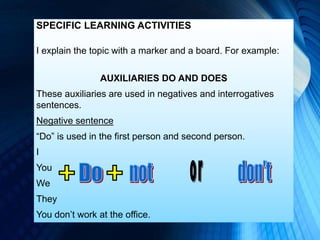
I explain the topic with a marker and a board. For example:
AUXILIARIES DO AND DOES
These auxiliaries are used in negatives and interrogatives
sentences.
Negative sentence
“Do” is used in the first person and second person.
I
You
We
They
You don’t work at the office.
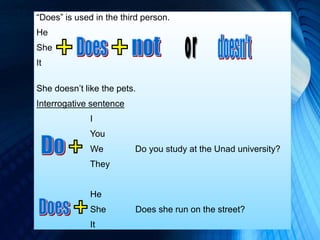
“Does” is used in the third person.
He
She
It
She doesn’t like the pets.
Interrogative sentence
I
You
We Do you study at the Unad university?
They
He
She Does she run on the street?
It
The students copy on the notebook. Then, other form to
learn this topic is to draw something referring to the topic.
For example, Camila doesn’t play in the park, so we draw
a girl playing in the park.
Teaching of this topic we can use the names of the
students to do sentences or to ask them what activities
they do and write on the board. Through this activity we
engage the students to the class.
The students can improve in this topic if the teacher uses
some strategies such as, to reword the students’ efforts
with grades or candies. Also, the students can do
dramatizations using the topic.
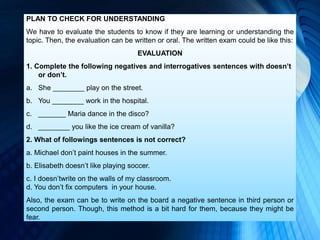
PLAN TO CHECK FOR UNDERSTANDING
We have to evaluate the students to know if they are learning or understanding the
topic. Then, the evaluation can be written or oral. The written exam could be like this:
EVALUATION
1. Complete the following negatives and interrogatives sentences with doesn’t
or don’t.
a. She ________ play on the street.
b. You ________ work in the hospital.
c. _______ Maria dance in the disco?
d. ________ you like the ice cream of vanilla?
2. What of followings sentences is not correct?
a. Michael don’t paint houses in the summer.
b. Elisabeth doesn’t like playing soccer.
c. I doesn’twrite on the walls of my classroom.
d. You don’t fix computers in your house.
Also, the exam can be to write on the board a negative sentence in third person or
second person. Though, this method is a bit hard for them, because they might be
fear.
CONCLUSION
After finishing the class the teacher or a student can do
summary about the viewed topic, this is to do a
feedback and learn more.
The auxiliaries do and does are used in negatives and
interrogatives sentences. The do is for first and second
person and does is for third person. This topic is very
important, because most people use this topic in their
speaking, reading and writing. Also, in English
language is essential this topic, because it permits to
communicate us and understanding easily.

Lesson plan

  • 1.
    DAILY LESSON PLAN Topic:Use of Do/Does N° of Students: 25. Level: Secondary School. Age: 13. Materials: Book of grammar of English. Language components: Grammar and sound of Do and Does. Language skills: Listen, read and write. Language abilities: Listening and reading. Role teacher: To help to the student to understand the topic. Role student: To participate in the class and grasp the topic.
  • 2.
    OBJECTIVES General:  I wantthat my students learn use the auxiliaries “Do and Does” in negative and interrogative sentences. Also, the function of the auxiliaries Do and Does. Specifics:  The students must be able to use perfectly the auxiliaries Do and Does. Also, they can build sentences negatives and interrogatives, using Do or Does. In addition, the students must differentiate between Do and Does.  The learners can use the auxiliaries Do and Does in any context, for example in school, house, in the park, work, shop, etc. Also, they can understand for serve the auxiliaries Do and Does in the English language.
  • 3.
    INTRODUCTION TO THETOPIC In this part we’re going to do an introduction to the topic through a question, personal anecdote, historical event or short video- clip. This is to know if the students know something about the topic or not. This part is important for the development of the topic. The students may be familiar with this topic when they use the verb Do and it third person Does. Then, this is an advantage to teach the use of the auxiliaries Do and Does. I’m going to introduce the topic through a personal anecdote with my learning of the auxiliaries Do and Does. Then, I explain the experiences that I had with this topic to my students and I say them the opportunities and methods there are currently.
  • 4.
    SPECIFIC LEARNING ACTIVITIES Iexplain the topic with a marker and a board. For example: AUXILIARIES DO AND DOES These auxiliaries are used in negatives and interrogatives sentences. Negative sentence “Do” is used in the first person and second person. I You We They You don’t work at the office.
  • 5.
    “Does” is usedin the third person. He She It She doesn’t like the pets. Interrogative sentence I You We Do you study at the Unad university? They He She Does she run on the street? It
  • 6.
    The students copyon the notebook. Then, other form to learn this topic is to draw something referring to the topic. For example, Camila doesn’t play in the park, so we draw a girl playing in the park. Teaching of this topic we can use the names of the students to do sentences or to ask them what activities they do and write on the board. Through this activity we engage the students to the class. The students can improve in this topic if the teacher uses some strategies such as, to reword the students’ efforts with grades or candies. Also, the students can do dramatizations using the topic.
  • 7.
    PLAN TO CHECKFOR UNDERSTANDING We have to evaluate the students to know if they are learning or understanding the topic. Then, the evaluation can be written or oral. The written exam could be like this: EVALUATION 1. Complete the following negatives and interrogatives sentences with doesn’t or don’t. a. She ________ play on the street. b. You ________ work in the hospital. c. _______ Maria dance in the disco? d. ________ you like the ice cream of vanilla? 2. What of followings sentences is not correct? a. Michael don’t paint houses in the summer. b. Elisabeth doesn’t like playing soccer. c. I doesn’twrite on the walls of my classroom. d. You don’t fix computers in your house. Also, the exam can be to write on the board a negative sentence in third person or second person. Though, this method is a bit hard for them, because they might be fear.
  • 8.
    CONCLUSION After finishing theclass the teacher or a student can do summary about the viewed topic, this is to do a feedback and learn more. The auxiliaries do and does are used in negatives and interrogatives sentences. The do is for first and second person and does is for third person. This topic is very important, because most people use this topic in their speaking, reading and writing. Also, in English language is essential this topic, because it permits to communicate us and understanding easily.