Strategic Planning
Nature of Strategic Planning
• Strategic Planning is process of deciding on the
programs that organisation will undertake and on
approximate resources that will be allocated to
each program over next several years
• Relation to Strategic Planning:
 after management arrives at goals of the
organisation in strategy formulation, strategic
planning process then takes goals and strategies
as given and develops programs to carry out
strategies and achieve goals efficiently and
effectively
Nature of Strategic Planning
 studies made during planning process may
indicate desirability of changing goals or
strategies, while formulation usually includes a
preliminary consideration of programs that will
be adopted as a means of achieving these goals
 strategic planning is systematic, having annual
process with prescribed procedures & timetables;
while strategy formulation is unsystematic
 in a formal strategic planning process, an
important first step often has to be to write
descriptions of organisation’s goals and strategies
Nature of Strategic Planning
• Evolution of Strategic Planning:
 a few companies started formal strategic
planning systems in late 1950s, but early efforts
were failures
 required data was much detailed than was
appropriate, staff people rather than line people
did most of the work
 participants spent more time filling in forms
than thinking deeply about alternatives
 currently, many organisations appreciate
advantages of making a plan for next 3 to 5 years
Nature of Strategic Planning
• Benefits of Strategic Planning:
 framework for developing annual budget:
It facilitates optimal resource allocation decisions
in support of key strategic options
 management development tool:
Formal system forces managers to take time to
think on important long-term issues
 means of aligning managers with corporate
strategies:
Debates, discussions and negotiations during
planning process
Nature of Strategic Planning
• Limitations of Strategic Planning:
 planning can end up becoming a “form filling”
bureaucratic exercise, devoid of strategic thinking
 organisation may create a large strategic
planning department and delegate preparation of
strategic plan to that staff department
 it is time consuming and expensive
• A formal strategic plan should have features
like:
 top management is convinced that strategic
planning is important
Nature of Strategic Planning
 organisation is relatively large and complex
 considerable uncertainty about future exists,
but organisation has flexibility to adjust to
changed circumstances
 in summary, formal strategic planning process
is not needed in small, relatively stable
organisations
• Program structure and content:
 in most industrial organisations, programs are
product families, plus R & D, general and
administrative expenses, not in existing products
Nature of Strategic Planning
 in service organisations, programs correspond
to types of services rendered by the entity
 typical strategic plan covers a period of five
future years
 rupee amounts for each plan show approximate
magnitude of its revenues, expenses and capital
expenditures
 if strategic plan is structured by business units,
the “Charter”, specifying boundaries within
which business unit is expected to operate, is also
stated
Nature of Strategic Planning
• Organisational Relationships:
 in some organisations, controller organisation
prepares strategic plan, as they may be skilled
primarily in detailed analytical techniques
required in fine-tuning annual budget & analysing
variances between actual & budgeted amounts
 in other organisations, separate planning staff
may support in analytical skills and broader
outlook that may not exist in controller set up
 headquarter staff members should facilitate,
not intervene in strategic planning process
Nature of Strategic Planning
 Top management style:
some Chief Executives prefer to make decisions
without benefit of a formal planning apparatus
In some companies, Chief Executive want some
overall plan for business, but by temperament has
an aversion to paperwork
In other companies, senior management prefers
extensive analysis and documentation of plans
and formal part of system is relatively elaborate
Designers must correctly diagnose style of senior
management and fit the system accordingly
Analysing Proposed New Programs
• Proposals for programs are essentially either
reactive or proactive
• Ideas for new programs can originate anywhere
in the organisation i.e. CEO, planning staff etc.
• Planners should view adoption of program not
as a single all-or-nothing decision but rather as a
series of decisions, each one a relatively small
step in testing and developing proposed program
• Planners should have full implementation and
its consequent significant investment only if tests
indicate about proposal’s good chance of success
Analysing Proposed New Programs
• Capital Investment Analysis:
 there are atleast four reasons for not using PV
in analysing all proposals:
proposal is obviously very attractive
estimates involved are so uncertain that PV
calculations cannot draw reliable conclusions
rationale for the approach is something other than
increased profitability
there is no feasible alternative to adoption
 either NPV or IRR is found for analysis
Analysing Proposed New Programs
• Rules:
 companies usually publish rules and procedures
for approval of capital expenditure proposals of
various magnitudes
 rules also contain certain guidelines for
preparing proposals and general criteria for
approving proposals
• Avoiding manipulation:
 sponsors who know that their project with
negative NPV is not likely to be approved may
have a gut feeling that project should be selected
Analysing Proposed New Programs
 in some cases, sponsors may make optimistic
estimates of sales revenues or reduce allowances
for contingencies in some of cost elements
 analyst may place reliance on sponsors having
an excellent track record
• Models:
 there are specialised techniques like risk
analysis, sensitivity analysis, simulation, scenario
planning, game theory, option pricing models etc.
 planning staff should know such methods and
use them in situations when required
Analysing Proposed New Programs
• Organisation for Analysis:
 decision to proceed with proposal may require
a succession of development and testing hurdles
to be crossed before full implementation
 expert systems use computer software in
analysis of proposed programs
 software for expert systems permits each
participant to vote on an explicitly rank, each of
criteria used to judge the project
 computer then tabulates results and uncovers
misunderstandings and raises queries to be solved
Analysing Ongoing Programs
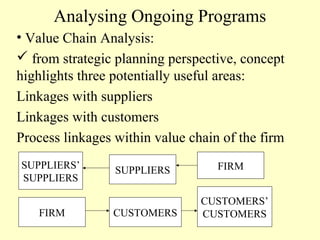
• Value Chain Analysis:
 from strategic planning perspective, concept
highlights three potentially useful areas:
Linkages with suppliers
Linkages with customers
Process linkages within value chain of the firm
SUPPLIERS’
SUPPLIERS
FIRM

SUPPLIERS

CUSTOMERS

FIRM
CUSTOMERS’
CUSTOMERS
Analysing Ongoing Programs
 Process linkages with Value Chain of the Firm:
 individual activities within a firm are not
independent but rather are interdependent
 efficiency of design portion of value chain can
be improved by reducing number of separate
parts and increasing their ease of manufacture
 efficiency of inward portion i.e. preceding
production, can be improved by reducing number
of vendors, by Just-in-time deliveries, by having
computer system placing automatic orders etc.
Analysing Ongoing Programs
 efficiency of production portion can be
improved by increased automation, by rearranging
machines into cells and by better production
control systems
 efficiency of outward portion (i.e. from factory
door to customer) can be improved by having
customers place orders electronically, by changing
locations of warehouses etc.
 Such efficiency-oriented initiatives involve
trade-offs e.g. direct computer orders may speed
up delivery but order filling costs may increase
Analysing Ongoing Programs
• Activity-Based Costing:
 sixty years ago, most companies allocated
overhead costs to products by means of
plantwide overhead rate based on direct labour
hours
 today, an increasing number of companies
collect costs for material-related costs e.g.
storage, seperately from other manufacturing
costs, collected from individual departments
 in these cost centers, direct labour costs may
be combined with other costs, giving conversion
Analysing Ongoing Programs
 with conversion costs, new system assigns R
& D, general and administrative and marketing
costs to products
 basis of allocation or cost driver, for each of
cost centers reflect cause of cost incurrence
 ABC concept is not particularly subtle or
counter intuitive, but in line with common sense
 advocates of ABC maintain that a meaningful
assessment of full cost today must involve
assigning overhead in proportion to activities that
generate it in long run
Analysing Ongoing Programs
• Use of ABC information:
 it may show that complex products with many
separate parts have higher design and production
costs than simple products
 many engineering change orders have higher
unit costs than other products
 information on magnitude of such differences
may lead to changes in policies relating to full
line v/s focused product line, product pricing,
make or buy decisions, adding/deleting products
Strategic Planning Process
• This process involves the following steps:
 Reviewing and updating the strategic plan:
first step is to review and update the strategic
plan agreed to last year
Actual experience for first few months of current
year is already reflected in accounting reports
and these are extrapolated for current best
estimate of the year as a whole
 Deciding on assumptions and guidelines:
 updated strategic plan incorporates broad
assumptions as growth in GDP, labour rates etc.
Strategic Planning Process
 updated strategic plan contains implications
on revenues, expenses and cash flows of existing
operating facilities and changes in facilities like
opening new plants, expanding or closing plants
 it also shows amount of new capital likely
from retained earnings and new financing
 objectives are stated seperately for each
product line and are expressed as sales revenue,
as a profit percentage/return on capital employed
 principal guidelines are assumptions about
wage and salary increases, selling prices etc.
Strategic Planning Process
 Management meetings:
Many companies hold an annual meeting of
corporate and business unit managers, often
called “summit conference”, to discuss proposed
objectives and guidelines
 First Iteration of Strategic Plan:
Business units and other operating units prepare
their “first cut” of strategic plan, including
different operating plans from those included in
current plan such as change in marketing tactics;
these are supported by reasons
Strategic Planning Process
Completed Strategic Plan consists of income
statements; inventory, accounts receivable and
other key balance sheet items; quantitative
information on sales and production; expenditures
for plant & other capital acquisitions; any unusual
cash flows; number of employees and a narrative
explanation and justification
 Analysis (of first iteration):
when headquarters receive business unit plans,
they aggregate them into overall corporate
strategic plan
Strategic Planning Process
headquarter people examine business unit plans
for consistency also
headquarters staff and their counterparts in
business units resolve some of these questions by
discussion and report others to corporate
management, where, they are basis for discussions
between corporate and business unit managers
in many cases, sum of business unit plans reveals
a planning gap
from planning numbers, headquarters can develop
planned cash requirements for whole organisation
Strategic Planning Process
Planning gap can be closed by:
finding opportunities for improvements in plans
make acquisitions
review the corporate objectives
 Second Iteration of Strategic Plan:
Revision of plans of only certain business units
may be required, limited to change in
assumptions and guidelines that affect all
business units
Some companies do not require a formal revision
from business units, changes are negotiated and
Strategic Planning Process
 Final Review and Approval:
A meeting of senior corporate officials usually
discusses the revised plan at length
Plan may also be presented at a meeting of the
Board of Directors
Chief Executive Officer gives final approval
Approval has to come prior to beginning of the
Budget preparation process because the strategic
plan is an important input to that process

Chap 8

  • 1.
  • 2.
    Nature of StrategicPlanning • Strategic Planning is process of deciding on the programs that organisation will undertake and on approximate resources that will be allocated to each program over next several years • Relation to Strategic Planning:  after management arrives at goals of the organisation in strategy formulation, strategic planning process then takes goals and strategies as given and develops programs to carry out strategies and achieve goals efficiently and effectively
  • 3.
    Nature of StrategicPlanning  studies made during planning process may indicate desirability of changing goals or strategies, while formulation usually includes a preliminary consideration of programs that will be adopted as a means of achieving these goals  strategic planning is systematic, having annual process with prescribed procedures & timetables; while strategy formulation is unsystematic  in a formal strategic planning process, an important first step often has to be to write descriptions of organisation’s goals and strategies
  • 4.
    Nature of StrategicPlanning • Evolution of Strategic Planning:  a few companies started formal strategic planning systems in late 1950s, but early efforts were failures  required data was much detailed than was appropriate, staff people rather than line people did most of the work  participants spent more time filling in forms than thinking deeply about alternatives  currently, many organisations appreciate advantages of making a plan for next 3 to 5 years
  • 5.
    Nature of StrategicPlanning • Benefits of Strategic Planning:  framework for developing annual budget: It facilitates optimal resource allocation decisions in support of key strategic options  management development tool: Formal system forces managers to take time to think on important long-term issues  means of aligning managers with corporate strategies: Debates, discussions and negotiations during planning process
  • 6.
    Nature of StrategicPlanning • Limitations of Strategic Planning:  planning can end up becoming a “form filling” bureaucratic exercise, devoid of strategic thinking  organisation may create a large strategic planning department and delegate preparation of strategic plan to that staff department  it is time consuming and expensive • A formal strategic plan should have features like:  top management is convinced that strategic planning is important
  • 7.
    Nature of StrategicPlanning  organisation is relatively large and complex  considerable uncertainty about future exists, but organisation has flexibility to adjust to changed circumstances  in summary, formal strategic planning process is not needed in small, relatively stable organisations • Program structure and content:  in most industrial organisations, programs are product families, plus R & D, general and administrative expenses, not in existing products
  • 8.
    Nature of StrategicPlanning  in service organisations, programs correspond to types of services rendered by the entity  typical strategic plan covers a period of five future years  rupee amounts for each plan show approximate magnitude of its revenues, expenses and capital expenditures  if strategic plan is structured by business units, the “Charter”, specifying boundaries within which business unit is expected to operate, is also stated
  • 9.
    Nature of StrategicPlanning • Organisational Relationships:  in some organisations, controller organisation prepares strategic plan, as they may be skilled primarily in detailed analytical techniques required in fine-tuning annual budget & analysing variances between actual & budgeted amounts  in other organisations, separate planning staff may support in analytical skills and broader outlook that may not exist in controller set up  headquarter staff members should facilitate, not intervene in strategic planning process
  • 10.
    Nature of StrategicPlanning  Top management style: some Chief Executives prefer to make decisions without benefit of a formal planning apparatus In some companies, Chief Executive want some overall plan for business, but by temperament has an aversion to paperwork In other companies, senior management prefers extensive analysis and documentation of plans and formal part of system is relatively elaborate Designers must correctly diagnose style of senior management and fit the system accordingly
  • 11.
    Analysing Proposed NewPrograms • Proposals for programs are essentially either reactive or proactive • Ideas for new programs can originate anywhere in the organisation i.e. CEO, planning staff etc. • Planners should view adoption of program not as a single all-or-nothing decision but rather as a series of decisions, each one a relatively small step in testing and developing proposed program • Planners should have full implementation and its consequent significant investment only if tests indicate about proposal’s good chance of success
  • 12.
    Analysing Proposed NewPrograms • Capital Investment Analysis:  there are atleast four reasons for not using PV in analysing all proposals: proposal is obviously very attractive estimates involved are so uncertain that PV calculations cannot draw reliable conclusions rationale for the approach is something other than increased profitability there is no feasible alternative to adoption  either NPV or IRR is found for analysis
  • 13.
    Analysing Proposed NewPrograms • Rules:  companies usually publish rules and procedures for approval of capital expenditure proposals of various magnitudes  rules also contain certain guidelines for preparing proposals and general criteria for approving proposals • Avoiding manipulation:  sponsors who know that their project with negative NPV is not likely to be approved may have a gut feeling that project should be selected
  • 14.
    Analysing Proposed NewPrograms  in some cases, sponsors may make optimistic estimates of sales revenues or reduce allowances for contingencies in some of cost elements  analyst may place reliance on sponsors having an excellent track record • Models:  there are specialised techniques like risk analysis, sensitivity analysis, simulation, scenario planning, game theory, option pricing models etc.  planning staff should know such methods and use them in situations when required
  • 15.
    Analysing Proposed NewPrograms • Organisation for Analysis:  decision to proceed with proposal may require a succession of development and testing hurdles to be crossed before full implementation  expert systems use computer software in analysis of proposed programs  software for expert systems permits each participant to vote on an explicitly rank, each of criteria used to judge the project  computer then tabulates results and uncovers misunderstandings and raises queries to be solved
  • 16.
    Analysing Ongoing Programs •Value Chain Analysis:  from strategic planning perspective, concept highlights three potentially useful areas: Linkages with suppliers Linkages with customers Process linkages within value chain of the firm SUPPLIERS’ SUPPLIERS FIRM SUPPLIERS CUSTOMERS FIRM CUSTOMERS’ CUSTOMERS
  • 17.
    Analysing Ongoing Programs Process linkages with Value Chain of the Firm:  individual activities within a firm are not independent but rather are interdependent  efficiency of design portion of value chain can be improved by reducing number of separate parts and increasing their ease of manufacture  efficiency of inward portion i.e. preceding production, can be improved by reducing number of vendors, by Just-in-time deliveries, by having computer system placing automatic orders etc.
  • 18.
    Analysing Ongoing Programs efficiency of production portion can be improved by increased automation, by rearranging machines into cells and by better production control systems  efficiency of outward portion (i.e. from factory door to customer) can be improved by having customers place orders electronically, by changing locations of warehouses etc.  Such efficiency-oriented initiatives involve trade-offs e.g. direct computer orders may speed up delivery but order filling costs may increase
  • 19.
    Analysing Ongoing Programs •Activity-Based Costing:  sixty years ago, most companies allocated overhead costs to products by means of plantwide overhead rate based on direct labour hours  today, an increasing number of companies collect costs for material-related costs e.g. storage, seperately from other manufacturing costs, collected from individual departments  in these cost centers, direct labour costs may be combined with other costs, giving conversion
  • 20.
    Analysing Ongoing Programs with conversion costs, new system assigns R & D, general and administrative and marketing costs to products  basis of allocation or cost driver, for each of cost centers reflect cause of cost incurrence  ABC concept is not particularly subtle or counter intuitive, but in line with common sense  advocates of ABC maintain that a meaningful assessment of full cost today must involve assigning overhead in proportion to activities that generate it in long run
  • 21.
    Analysing Ongoing Programs •Use of ABC information:  it may show that complex products with many separate parts have higher design and production costs than simple products  many engineering change orders have higher unit costs than other products  information on magnitude of such differences may lead to changes in policies relating to full line v/s focused product line, product pricing, make or buy decisions, adding/deleting products
  • 22.
    Strategic Planning Process •This process involves the following steps:  Reviewing and updating the strategic plan: first step is to review and update the strategic plan agreed to last year Actual experience for first few months of current year is already reflected in accounting reports and these are extrapolated for current best estimate of the year as a whole  Deciding on assumptions and guidelines:  updated strategic plan incorporates broad assumptions as growth in GDP, labour rates etc.
  • 23.
    Strategic Planning Process updated strategic plan contains implications on revenues, expenses and cash flows of existing operating facilities and changes in facilities like opening new plants, expanding or closing plants  it also shows amount of new capital likely from retained earnings and new financing  objectives are stated seperately for each product line and are expressed as sales revenue, as a profit percentage/return on capital employed  principal guidelines are assumptions about wage and salary increases, selling prices etc.
  • 24.
    Strategic Planning Process Management meetings: Many companies hold an annual meeting of corporate and business unit managers, often called “summit conference”, to discuss proposed objectives and guidelines  First Iteration of Strategic Plan: Business units and other operating units prepare their “first cut” of strategic plan, including different operating plans from those included in current plan such as change in marketing tactics; these are supported by reasons
  • 25.
    Strategic Planning Process CompletedStrategic Plan consists of income statements; inventory, accounts receivable and other key balance sheet items; quantitative information on sales and production; expenditures for plant & other capital acquisitions; any unusual cash flows; number of employees and a narrative explanation and justification  Analysis (of first iteration): when headquarters receive business unit plans, they aggregate them into overall corporate strategic plan
  • 26.
    Strategic Planning Process headquarterpeople examine business unit plans for consistency also headquarters staff and their counterparts in business units resolve some of these questions by discussion and report others to corporate management, where, they are basis for discussions between corporate and business unit managers in many cases, sum of business unit plans reveals a planning gap from planning numbers, headquarters can develop planned cash requirements for whole organisation
  • 27.
    Strategic Planning Process Planninggap can be closed by: finding opportunities for improvements in plans make acquisitions review the corporate objectives  Second Iteration of Strategic Plan: Revision of plans of only certain business units may be required, limited to change in assumptions and guidelines that affect all business units Some companies do not require a formal revision from business units, changes are negotiated and
  • 28.
    Strategic Planning Process Final Review and Approval: A meeting of senior corporate officials usually discusses the revised plan at length Plan may also be presented at a meeting of the Board of Directors Chief Executive Officer gives final approval Approval has to come prior to beginning of the Budget preparation process because the strategic plan is an important input to that process