SLUM UPGRADING
“I was born in a slum,
but
the slum wasn’t born in me”
BY
ARUNA.C
JESUBALAN.J
PAVITHRA.S.G
SLUM
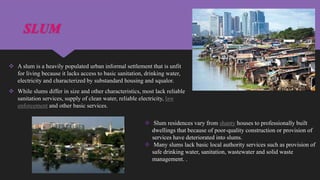
 A slum is a heavily populated urban informal settlement that is unfit
for living because it lacks access to basic sanitation, drinking water,
electricity and characterized by substandard housing and squalor.
 While slums differ in size and other characteristics, most lack reliable
sanitation services, supply of clean water, reliable electricity, law
enforcement and other basic services.
 Slum residences vary from shanty houses to professionally built
dwellings that because of poor-quality construction or provision of
services have deteriorated into slums.
 Many slums lack basic local authority services such as provision of
safe drinking water, sanitation, wastewater and solid waste
management. .
SLUM UPGRADING
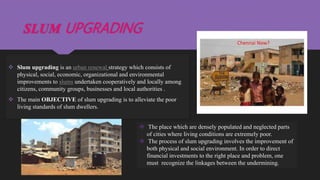
 Slum upgrading is an urban renewal strategy which consists of
physical, social, economic, organizational and environmental
improvements to slums undertaken cooperatively and locally among
citizens, community groups, businesses and local authorities .
 The main OBJECTIVE of slum upgrading is to alleviate the poor
living standards of slum dwellers.
 The place which are densely populated and neglected parts
of cities where living conditions are extremely poor.
 The process of slum upgrading involves the improvement of
both physical and social environment. In order to direct
financial investments to the right place and problem, one
must recognize the linkages between the undermining.
SITUATION OF SLUM
 Unhygienic conditions.
 Lack of medical facilities.
 Lack of sanitation.
 Congested.
 No access to drinking water and electricity.
 Most of the slums inhabitants can’t be beneficiaries to government schemes.
 Only few slums are recognized by Government and conditions in unrecognized slums are even more worse.
 No drainage system.
 In most slums, waste water flow in between houses.
 The little medical facilities available in slums is provided by NGOs.
SCHEMES FOR SLUM DEVELOPMENT IN INDIA
 The Ministry of Housing and Urban Poverty
Alleviation has set up a Committee to look into
various aspects of Slum Statistics , Census and
issues regarding conduct of slum census 2011 under
the chairmanship of Pranab Sen.
 The Pranab Sen Committee has defined Slums as:
"A Slum is a compact settlement of at least 20
households with a collection of poorly built tenements,
mostly of temporary nature, crowded together usually
with inadequate sanitary and drinking water facilities in
unhygienic conditions".
In a bid to address the issue of slums and urban
poverty, the Government of India has undertaken
several initiatives such as:
a) Valmiki Ambedkar Awas Yojana (VAMBAY)
b) Jawaharlal Nehru National Urban Renewal
Mission (JNNURM)
c) Swarna Jayanti Shahari Rozgar Yojana (SJSRY)
d) Integrated Low Cost Sanitation (ILCS)
e) Affordable Housing in Partnership (AHP)
f) Rajiv Awas Yojana.
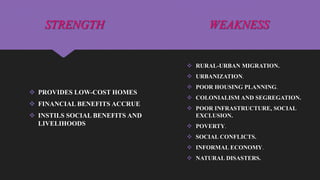
STRENGTH
 PROVIDES LOW-COST HOMES
 FINANCIAL BENEFITS ACCRUE
 INSTILS SOCIAL BENEFITS AND
LIVELIHOODS
WEAKNESS
 RURAL-URBAN MIGRATION.
 URBANIZATION.
 POOR HOUSING PLANNING.
 COLONIALISM AND SEGREGATION.
 POOR INFRASTRUCTURE, SOCIAL
EXCLUSION.
 POVERTY.
 SOCIAL CONFLICTS.
 INFORMAL ECONOMY.
 NATURAL DISASTERS.
CAUSES
 Increasing rural to urban migration.
 Urban areas are not being improved enough to
accommodate the new inhabitants.
 Poor planning of cities.
 Poverty and lack of job opportunities in rural areas
are the push factors of migration.
 Urbanization – Pull factor of rural migration.
 High cost of living in urban areas.
 Increasing population.
 Social exclusion.
 Informal economy.
 Some politicians use slum inhabitants as their vote
banks as giving fake promises of improving the
living conditions, they encourage slums.
 Social conflicts – civil wars.
EFFECTS
 Reduced life expectancy of slum inhabitants.
 Health problems due to drinking contaminated
water.
 Environment pollution.
 Low standard of living.
 Degraded health conditions.
 Those living in slums get victimized easily by
alcohol and drugs.
 Slums breed violence, crime, diseases, epidemics
and psychological illnesses.
 Preterm births.
 Malnutrition in children.
 Child labor.
 No safety for women living in slums due to high
number of drunkards.
CHALLENGES
 RAPID URBANIZATION
 ACHIEVING CRITICAL MASS
 TECHNICAL CAPACITY NEEDED
IMPLEMENTING
 ENSURE STRONG LOCAL GOVERNMENT
SUPPORT.
 ENCOURAGE COMMUNITY ACTION AND
PARTICIPATION
 BUILD WIN-WIN PARTNERSHIPS
 SECURE LAND TENURE
HARD LIFE OF SLUM
SOLUTION
 URBAN WATER AND WASTE WATER
 Water distillation.
 Improved toilets.
 Plastics recycling
 Rainwater harvesting.
 Dams.
 Health and hygiene education.
 Home composting.
 Solid waste management.
 Solar-powered water pumps.
SOLAR-POWERED WATER PUMPS
 In drought-affected areas, women must walk miles to find
water, risking violence or animal attack, in order to
sustain their families and animals. They do this with the
knowledge that the dirty water they have collected may
well make their children very ill.
 Working with community members, Practical Action
developed a solar powered water pump that can
pump up to 30,000 litres of clean water per day.
 Using the overabundance of sunshine, the solar pump
draws water from a 100-metre-deep well, providing
families with the water that they desperately need and
rendering cases of water-related diseases a thing of the
past.
Contd(solutions)…
 SLUM IMPROVEMENT
 Urban waste management.
 Urban waste pickers.
 WATER AND SANITATION
 WASTE MANAGEMENT
FAILED SOLUTIONS
 SLUM REMOVAL – It made slum inhabitants
homeless.
 SLUM RELOCATION – It moved poor people
further away from their work places.
SUCESSFUL STEPS
 SLUM UPGRADING -- It improved slum’s
living conditions. But it does not address
poverty and low wages of informal economy.
 Organized urbanization – Planning
& Modifying urban areas to accommodate
newcomers.
 Legitimizing slums instead of driving them out
of their homes.
 Improving job opportunities in rural as well as
urban areas.
 Planning rural development along with urban
development.
 Economic development.
 Better transport facilities.
 Affordable housing in urban areas.
BEING CIVIL ENGINEER ;
 We have to understsnd that although slum engineering is a part of civil engineering but a social
aspect in slum engineering is essential without which the projects fail. We have seen in india that
many projects failed because of less social mobalisation.
 Other regular features of an engineering projects should also be a part of project formulation like
• Assessment of infrastructure demand
• Preparation of detailed design
• Integration of social infrastructure
• Establish linkage with citywide network
• Use of green technology
• Examination of environmental & social impact
• Estimation of project cost
• Implementation and management arrangements including tendering, appointment
of contractors, construction schedule, construction activities, project schedule.
 Govt of India launched ‘National Urban Health Mission’ to
improve health care facilities for urban poor and implemented
‘slum upgrading’ in a few recognized slums.
 In 2015, Indian Govt allocated budget to replace crowded slums
with 2 crore homes.
CONCLUSION
Besides improving the slums, the causes of slums creation should be addressed.
Distributive development will serve the purpose and thereby everyone can have a
dignified and healthy life.
“The Slum is the measure of civilization”
THANK YOU…
TO SOME EXTENT , “I WOULD SAY THIS; IF YOU’VE SEEN ONE CITY
SLUM, YOU’VE SEEN THEM ALL”

Slum upgrading

  • 1.
    SLUM UPGRADING “I wasborn in a slum, but the slum wasn’t born in me” BY ARUNA.C JESUBALAN.J PAVITHRA.S.G
  • 2.
    SLUM  A slumis a heavily populated urban informal settlement that is unfit for living because it lacks access to basic sanitation, drinking water, electricity and characterized by substandard housing and squalor.  While slums differ in size and other characteristics, most lack reliable sanitation services, supply of clean water, reliable electricity, law enforcement and other basic services.  Slum residences vary from shanty houses to professionally built dwellings that because of poor-quality construction or provision of services have deteriorated into slums.  Many slums lack basic local authority services such as provision of safe drinking water, sanitation, wastewater and solid waste management. .
  • 3.
    SLUM UPGRADING  Slumupgrading is an urban renewal strategy which consists of physical, social, economic, organizational and environmental improvements to slums undertaken cooperatively and locally among citizens, community groups, businesses and local authorities .  The main OBJECTIVE of slum upgrading is to alleviate the poor living standards of slum dwellers.  The place which are densely populated and neglected parts of cities where living conditions are extremely poor.  The process of slum upgrading involves the improvement of both physical and social environment. In order to direct financial investments to the right place and problem, one must recognize the linkages between the undermining.
  • 4.
    SITUATION OF SLUM Unhygienic conditions.  Lack of medical facilities.  Lack of sanitation.  Congested.  No access to drinking water and electricity.  Most of the slums inhabitants can’t be beneficiaries to government schemes.  Only few slums are recognized by Government and conditions in unrecognized slums are even more worse.  No drainage system.  In most slums, waste water flow in between houses.  The little medical facilities available in slums is provided by NGOs.
  • 5.
    SCHEMES FOR SLUMDEVELOPMENT IN INDIA  The Ministry of Housing and Urban Poverty Alleviation has set up a Committee to look into various aspects of Slum Statistics , Census and issues regarding conduct of slum census 2011 under the chairmanship of Pranab Sen.  The Pranab Sen Committee has defined Slums as: "A Slum is a compact settlement of at least 20 households with a collection of poorly built tenements, mostly of temporary nature, crowded together usually with inadequate sanitary and drinking water facilities in unhygienic conditions". In a bid to address the issue of slums and urban poverty, the Government of India has undertaken several initiatives such as: a) Valmiki Ambedkar Awas Yojana (VAMBAY) b) Jawaharlal Nehru National Urban Renewal Mission (JNNURM) c) Swarna Jayanti Shahari Rozgar Yojana (SJSRY) d) Integrated Low Cost Sanitation (ILCS) e) Affordable Housing in Partnership (AHP) f) Rajiv Awas Yojana.
  • 6.
    STRENGTH  PROVIDES LOW-COSTHOMES  FINANCIAL BENEFITS ACCRUE  INSTILS SOCIAL BENEFITS AND LIVELIHOODS WEAKNESS  RURAL-URBAN MIGRATION.  URBANIZATION.  POOR HOUSING PLANNING.  COLONIALISM AND SEGREGATION.  POOR INFRASTRUCTURE, SOCIAL EXCLUSION.  POVERTY.  SOCIAL CONFLICTS.  INFORMAL ECONOMY.  NATURAL DISASTERS.
  • 7.
    CAUSES  Increasing ruralto urban migration.  Urban areas are not being improved enough to accommodate the new inhabitants.  Poor planning of cities.  Poverty and lack of job opportunities in rural areas are the push factors of migration.  Urbanization – Pull factor of rural migration.  High cost of living in urban areas.  Increasing population.  Social exclusion.  Informal economy.  Some politicians use slum inhabitants as their vote banks as giving fake promises of improving the living conditions, they encourage slums.  Social conflicts – civil wars. EFFECTS  Reduced life expectancy of slum inhabitants.  Health problems due to drinking contaminated water.  Environment pollution.  Low standard of living.  Degraded health conditions.  Those living in slums get victimized easily by alcohol and drugs.  Slums breed violence, crime, diseases, epidemics and psychological illnesses.  Preterm births.  Malnutrition in children.  Child labor.  No safety for women living in slums due to high number of drunkards.
  • 8.
    CHALLENGES  RAPID URBANIZATION ACHIEVING CRITICAL MASS  TECHNICAL CAPACITY NEEDED IMPLEMENTING  ENSURE STRONG LOCAL GOVERNMENT SUPPORT.  ENCOURAGE COMMUNITY ACTION AND PARTICIPATION  BUILD WIN-WIN PARTNERSHIPS  SECURE LAND TENURE
  • 9.
  • 10.
    SOLUTION  URBAN WATERAND WASTE WATER  Water distillation.  Improved toilets.  Plastics recycling  Rainwater harvesting.  Dams.  Health and hygiene education.  Home composting.  Solid waste management.  Solar-powered water pumps.
  • 11.
    SOLAR-POWERED WATER PUMPS In drought-affected areas, women must walk miles to find water, risking violence or animal attack, in order to sustain their families and animals. They do this with the knowledge that the dirty water they have collected may well make their children very ill.  Working with community members, Practical Action developed a solar powered water pump that can pump up to 30,000 litres of clean water per day.  Using the overabundance of sunshine, the solar pump draws water from a 100-metre-deep well, providing families with the water that they desperately need and rendering cases of water-related diseases a thing of the past.
  • 12.
    Contd(solutions)…  SLUM IMPROVEMENT Urban waste management.  Urban waste pickers.  WATER AND SANITATION  WASTE MANAGEMENT
  • 13.
    FAILED SOLUTIONS  SLUMREMOVAL – It made slum inhabitants homeless.  SLUM RELOCATION – It moved poor people further away from their work places. SUCESSFUL STEPS  SLUM UPGRADING -- It improved slum’s living conditions. But it does not address poverty and low wages of informal economy.  Organized urbanization – Planning & Modifying urban areas to accommodate newcomers.  Legitimizing slums instead of driving them out of their homes.  Improving job opportunities in rural as well as urban areas.  Planning rural development along with urban development.  Economic development.  Better transport facilities.  Affordable housing in urban areas.
  • 14.
    BEING CIVIL ENGINEER;  We have to understsnd that although slum engineering is a part of civil engineering but a social aspect in slum engineering is essential without which the projects fail. We have seen in india that many projects failed because of less social mobalisation.  Other regular features of an engineering projects should also be a part of project formulation like • Assessment of infrastructure demand • Preparation of detailed design • Integration of social infrastructure • Establish linkage with citywide network • Use of green technology • Examination of environmental & social impact • Estimation of project cost • Implementation and management arrangements including tendering, appointment of contractors, construction schedule, construction activities, project schedule.
  • 15.
     Govt ofIndia launched ‘National Urban Health Mission’ to improve health care facilities for urban poor and implemented ‘slum upgrading’ in a few recognized slums.  In 2015, Indian Govt allocated budget to replace crowded slums with 2 crore homes.
  • 16.
    CONCLUSION Besides improving theslums, the causes of slums creation should be addressed. Distributive development will serve the purpose and thereby everyone can have a dignified and healthy life. “The Slum is the measure of civilization”
  • 17.
    THANK YOU… TO SOMEEXTENT , “I WOULD SAY THIS; IF YOU’VE SEEN ONE CITY SLUM, YOU’VE SEEN THEM ALL”