SSlloowwllyy CChhaannggiinngg DDiimmeennssiioonnss 
Presented by: 
Informatica Training Classes 
Email : info@informaticatrainingclasses.com 
Call us : 404-900-9988 
WebSite: www.informaticatrainingclasses.com
TTooppiiccss 
What we’ll see: 
SCD in DWH 
Why? 
Who? When? 
How? 
We won’t see: 
SCD in OLAP
3 
??WWhhyy 
Let’s take Sales fact table for example 
Every day more and more sales take place, hence: 
More and more rows are added to the fact table 
Very rarely are the rows in the fact table updated with changes 
Also Consider... 
How will we adjust the fact table when changes are made?
4 
’’……WWhhyy?? ccoonntt 
Consider the dimension tables 
Comapred to the fact tables, they are more stable and less volatile 
However, unlike fact tables, a dimension table does not change just 
through the increase of number of rows, but also through 
changes to the attributes themselves
5 
??WWhhoo?? WWhheenn 
Who? 
Fact tables and Dimension tables 
We will focus on (Slowly Changing) Dimensions 
When? 
Good question: 
 Inside the ETL process 
 After the ETL process, as a stored procedure 
 Never (wait, you’ll see…)
6 
??HHooww 
This is the big question. 
From what we discussed for now, we can derive these principles: 
 Most dimensions are generally constant over time 
 Many dimensions, through not constant over time, change slowly 
 The product (business) key of the source record does not change 
 The description and other attributes change slowly over time 
 In the source OLTP system, the new values overwrite the old ones 
 Overwriting of dimension table attributes is not always the 
appropriate option in a data warehouse 
 The ways changes are made to the dimension tables depend on 
the types of changes and what information must be preserved in 
the DWH
::HHooww?? 33 AAnnsswweerrss 
The usual changes to dimension tables are classified into three types 
 Type 1 
 Type 2 
 Type 3 
We will consider the points discussed earlier when deciding which 
Before going on, we must talk about one more thing. 
7 
type to use 
Also Consider… 
Do we have to use the same type for the entire DWH? 
For the same dimension?
8 
SSuurrrrooggaattee KKeeyy 
• A surrogate key is a unique identifier for the entity in the modeled 
world 
• It is not derived from application data 
• It’s not meant to be shown outside the DWH 
• It’s only significance is to act as the primary key 
• Frequently it’s a sequential number (Sequence in Oracle or 
Identity in SQL Server)
SSuurrrrooggaattee KKeeyy,, ccoonntt.. 
• Having the key independent of all other columns insulates the 
database relationships from changes in the data values or 
database design (making the database more agile) and guarentees 
uniqueness 
• For example: An employee ID is chosen as the neutral (business) 
key of an employee DWH. Because of a merger with another 
company, new employees from the merged company must be 
inserted. There is one employee who works in both companies… 
• If the key is a compound key, joining is more expensive because 
there are multiple columns to compare. Surrogate keys are always 
contained in a single column 
9
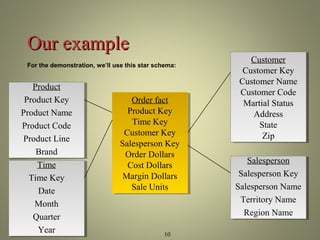
OOuurr eexxaammppllee 
For the demonstration, we’ll use this star schema: 
Order fact 
Product Key 
Time Key 
Customer Key 
Salesperson Key 
Order Dollars 
Cost Dollars 
Margin Dollars 
Sale Units 
Order fact 
Product Key 
Time Key 
Customer Key 
Salesperson Key 
Order Dollars 
Cost Dollars 
Margin Dollars 
Sale Units 
10 
Customer 
Customer Key 
Customer Name 
Customer Code 
Martial Status 
Customer 
Customer Key 
Customer Name 
Customer Code 
Martial Status 
Address 
State 
Zip 
Address 
State 
Zip 
Salesperson 
Salesperson Key 
Salesperson Name 
Territory Name 
Region Name 
Salesperson 
Salesperson Key 
Salesperson Name 
Territory Name 
Region Name 
Product 
Product Key 
Product Name 
Product Code 
Product Line 
Product 
Product Key 
Product Name 
Product Code 
Product Line 
Brand 
Brand 
Time 
Time Key 
Date 
Month 
Quarter 
Year 
Time 
Time Key 
Date 
Month 
Quarter 
Year
11 
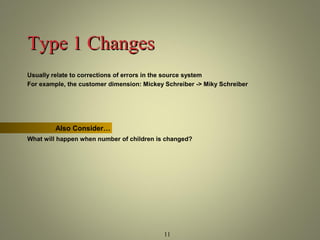
TTyyppee 11 CChhaannggeess 
Usually relate to corrections of errors in the source system 
For example, the customer dimension: Mickey Schreiber -> Miky Schreiber 
Also Consider… 
What will happen when number of children is changed?
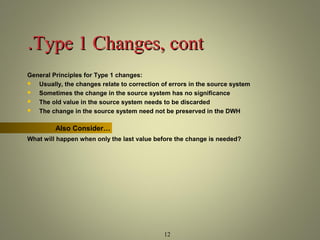
..TTyyppee 11 CChhaannggeess,, ccoonntt 
General Principles for Type 1 changes: 
 Usually, the changes relate to correction of errors in the source system 
 Sometimes the change in the source system has no significance 
 The old value in the source system needs to be discarded 
 The change in the source system need not be preserved in the DWH 
12 
Also Consider… 
What will happen when only the last value before the change is needed?
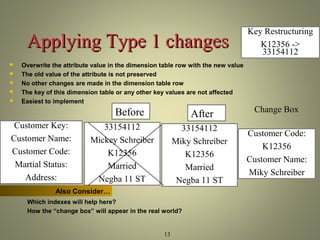
AAppppllyyiinngg TTyyppee 11 cchhaannggeess 
 Overwrite the attribute value in the dimension table row with the new value 
 The old value of the attribute is not preserved 
 No other changes are made in the dimension table row 
 The key of this dimension table or any other key values are not affected 
 Easiest to implement 
13 
33154112 
Mickey Schreiber 
K12356 
Married 
Negba 11 ST 
Customer Key: 
Customer Name: 
Customer Code: 
Martial Status: 
Address: 
33154112 
Miky Schreiber 
K12356 
Married 
Negba 11 ST 
Customer Code: 
K12356 
Customer Name: 
Miky Schreiber 
Before After 
Key Restructuring 
K12356 -> 
33154112 
Also Consider… 
Which indexes will help here? 
How the “change box” will appear in the real world? 
Change Box
14 
TTyyppee 22 CChhaannggeess 
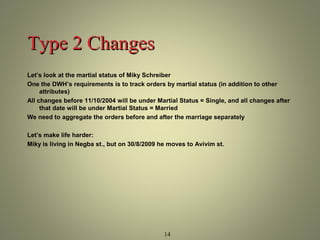
Let’s look at the martial status of Miky Schreiber 
One the DWH’s requirements is to track orders by martial status (in addition to other 
attributes) 
All changes before 11/10/2004 will be under Martial Status = Single, and all changes after 
that date will be under Martial Status = Married 
We need to aggregate the orders before and after the marriage separately 
Let’s make life harder: 
Miky is living in Negba st., but on 30/8/2009 he moves to Avivim st.
..TTyyppee 22 CChhaannggeess,, ccoonntt 
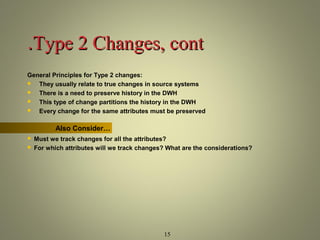
General Principles for Type 2 changes: 
 They usually relate to true changes in source systems 
 There is a need to preserve history in the DWH 
 This type of change partitions the history in the DWH 
 Every change for the same attributes must be preserved 
15 
Also Consider… 
 Must we track changes for all the attributes? 
 For which attributes will we track changes? What are the considerations?
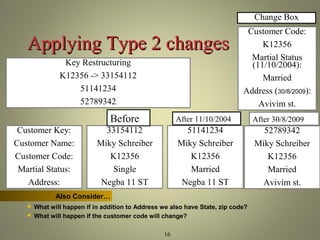
AAppppllyyiinngg TTyyppee 22 cchhaannggeess 
16 
Key Restructuring 
K12356 -> 33154112 
51141234 
52789342 
33154112 
Miky Schreiber 
K12356 
Single 
Negba 11 ST 
Customer Key: 
Customer Name: 
Customer Code: 
Martial Status: 
Address: 
51141234 
Miky Schreiber 
K12356 
Married 
Negba 11 ST 
Customer Code: 
K12356 
Martial Status 
(11/10/2004): 
Married 
Address (30/8/2009): 
Avivim st. 
Before After 11/10/2004 
After 30/8/2009 
52789342 
Miky Schreiber 
K12356 
Married 
Avivim st. 
Also Consider… 
 What will happen if in addition to Address we also have State, zip code? 
 What will happen if the customer code will change? 
Change Box
TTyyppee 22 ccoonncclluuddeedd 
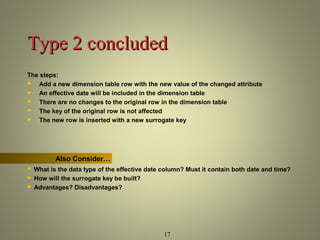
The steps: 
 Add a new dimension table row with the new value of the changed attribute 
 An effective date will be included in the dimension table 
 There are no changes to the original row in the dimension table 
 The key of the original row is not affected 
 The new row is inserted with a new surrogate key 
17 
Also Consider… 
 What is the data type of the effective date column? Must it contain both date and time? 
 How will the surrogate key be built? 
 Advantages? Disadvantages?
18 
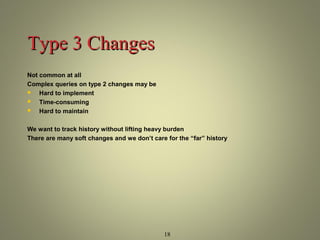
TTyyppee 33 CChhaannggeess 
Not common at all 
Complex queries on type 2 changes may be 
 Hard to implement 
 Time-consuming 
 Hard to maintain 
We want to track history without lifting heavy burden 
There are many soft changes and we don’t care for the “far” history
19 
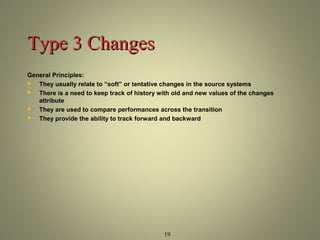
TTyyppee 33 CChhaannggeess 
General Principles: 
 They usually relate to “soft” or tentative changes in the source systems 
 There is a need to keep track of history with old and new values of the changes 
attribute 
 They are used to compare performances across the transition 
 They provide the ability to track forward and backward
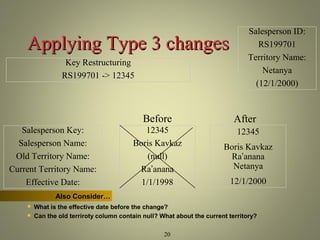
AAppppllyyiinngg TTyyppee 33 cchhaannggeess 
12345 
Boris Kavkaz 
(null) 
Ra’anana 
1/1/1998 
20 
Salesperson Key: 
Salesperson Name: 
Old Territory Name: 
Current Territory Name: 
Effective Date: 
Salesperson ID: 
RS199701 
Territory Name: 
Netanya 
(12/1/2000) 
Before After 
Key Restructuring 
RS199701 -> 12345 
Also Consider… 
12345 
Boris Kavkaz 
Ra’anana 
Netanya 
12/1/2000 
 What is the effective date before the change? 
 Can the old terriroty column contain null? What about the current territory?
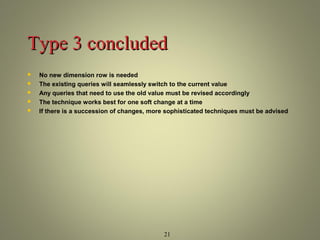
TTyyppee 33 ccoonncclluuddeedd 
 No new dimension row is needed 
 The existing queries will seamlessly switch to the current value 
 Any queries that need to use the old value must be revised accordingly 
 The technique works best for one soft change at a time 
 If there is a succession of changes, more sophisticated techniques must be advised 
21
TThheerree’’ss eevveenn mmoorree 
22 
 Type 0 changes 
 Type 4 – using history tables 
 Type 6 – Hybrid (what about 5?) 
 Type 6 – Alternative implementation 
 SCD in OLAP
23 
CCoonncclluussiioonnss 
 3 Main ways of history tracking 
 Choose the way you’d like for every dimension table 
 You may combine the types 
 It all depends on the system’s requirements
24 
BBiibblliiooggrraapphhyy 
 Data Warehousing Fundamentals, Paulraj Ponniah, John 
Wiley Publication 
 Wikipedia (Slowly Changing Dimension)
TThhaannkk yyoouu 
25

Slowly changing dimensions informatica

  • 1.
    SSlloowwllyy CChhaannggiinngg DDiimmeennssiioonnss Presented by: Informatica Training Classes Email : info@informaticatrainingclasses.com Call us : 404-900-9988 WebSite: www.informaticatrainingclasses.com
  • 2.
    TTooppiiccss What we’llsee: SCD in DWH Why? Who? When? How? We won’t see: SCD in OLAP
  • 3.
    3 ??WWhhyy Let’stake Sales fact table for example Every day more and more sales take place, hence: More and more rows are added to the fact table Very rarely are the rows in the fact table updated with changes Also Consider... How will we adjust the fact table when changes are made?
  • 4.
    4 ’’……WWhhyy?? ccoonntt Consider the dimension tables Comapred to the fact tables, they are more stable and less volatile However, unlike fact tables, a dimension table does not change just through the increase of number of rows, but also through changes to the attributes themselves
  • 5.
    5 ??WWhhoo?? WWhheenn Who? Fact tables and Dimension tables We will focus on (Slowly Changing) Dimensions When? Good question:  Inside the ETL process  After the ETL process, as a stored procedure  Never (wait, you’ll see…)
  • 6.
    6 ??HHooww Thisis the big question. From what we discussed for now, we can derive these principles:  Most dimensions are generally constant over time  Many dimensions, through not constant over time, change slowly  The product (business) key of the source record does not change  The description and other attributes change slowly over time  In the source OLTP system, the new values overwrite the old ones  Overwriting of dimension table attributes is not always the appropriate option in a data warehouse  The ways changes are made to the dimension tables depend on the types of changes and what information must be preserved in the DWH
  • 7.
    ::HHooww?? 33 AAnnsswweerrss The usual changes to dimension tables are classified into three types  Type 1  Type 2  Type 3 We will consider the points discussed earlier when deciding which Before going on, we must talk about one more thing. 7 type to use Also Consider… Do we have to use the same type for the entire DWH? For the same dimension?
  • 8.
    8 SSuurrrrooggaattee KKeeyy • A surrogate key is a unique identifier for the entity in the modeled world • It is not derived from application data • It’s not meant to be shown outside the DWH • It’s only significance is to act as the primary key • Frequently it’s a sequential number (Sequence in Oracle or Identity in SQL Server)
  • 9.
    SSuurrrrooggaattee KKeeyy,, ccoonntt.. • Having the key independent of all other columns insulates the database relationships from changes in the data values or database design (making the database more agile) and guarentees uniqueness • For example: An employee ID is chosen as the neutral (business) key of an employee DWH. Because of a merger with another company, new employees from the merged company must be inserted. There is one employee who works in both companies… • If the key is a compound key, joining is more expensive because there are multiple columns to compare. Surrogate keys are always contained in a single column 9
  • 10.
    OOuurr eexxaammppllee Forthe demonstration, we’ll use this star schema: Order fact Product Key Time Key Customer Key Salesperson Key Order Dollars Cost Dollars Margin Dollars Sale Units Order fact Product Key Time Key Customer Key Salesperson Key Order Dollars Cost Dollars Margin Dollars Sale Units 10 Customer Customer Key Customer Name Customer Code Martial Status Customer Customer Key Customer Name Customer Code Martial Status Address State Zip Address State Zip Salesperson Salesperson Key Salesperson Name Territory Name Region Name Salesperson Salesperson Key Salesperson Name Territory Name Region Name Product Product Key Product Name Product Code Product Line Product Product Key Product Name Product Code Product Line Brand Brand Time Time Key Date Month Quarter Year Time Time Key Date Month Quarter Year
  • 11.
    11 TTyyppee 11CChhaannggeess Usually relate to corrections of errors in the source system For example, the customer dimension: Mickey Schreiber -> Miky Schreiber Also Consider… What will happen when number of children is changed?
  • 12.
    ..TTyyppee 11 CChhaannggeess,,ccoonntt General Principles for Type 1 changes:  Usually, the changes relate to correction of errors in the source system  Sometimes the change in the source system has no significance  The old value in the source system needs to be discarded  The change in the source system need not be preserved in the DWH 12 Also Consider… What will happen when only the last value before the change is needed?
  • 13.
    AAppppllyyiinngg TTyyppee 11cchhaannggeess  Overwrite the attribute value in the dimension table row with the new value  The old value of the attribute is not preserved  No other changes are made in the dimension table row  The key of this dimension table or any other key values are not affected  Easiest to implement 13 33154112 Mickey Schreiber K12356 Married Negba 11 ST Customer Key: Customer Name: Customer Code: Martial Status: Address: 33154112 Miky Schreiber K12356 Married Negba 11 ST Customer Code: K12356 Customer Name: Miky Schreiber Before After Key Restructuring K12356 -> 33154112 Also Consider… Which indexes will help here? How the “change box” will appear in the real world? Change Box
  • 14.
    14 TTyyppee 22CChhaannggeess Let’s look at the martial status of Miky Schreiber One the DWH’s requirements is to track orders by martial status (in addition to other attributes) All changes before 11/10/2004 will be under Martial Status = Single, and all changes after that date will be under Martial Status = Married We need to aggregate the orders before and after the marriage separately Let’s make life harder: Miky is living in Negba st., but on 30/8/2009 he moves to Avivim st.
  • 15.
    ..TTyyppee 22 CChhaannggeess,,ccoonntt General Principles for Type 2 changes:  They usually relate to true changes in source systems  There is a need to preserve history in the DWH  This type of change partitions the history in the DWH  Every change for the same attributes must be preserved 15 Also Consider…  Must we track changes for all the attributes?  For which attributes will we track changes? What are the considerations?
  • 16.
    AAppppllyyiinngg TTyyppee 22cchhaannggeess 16 Key Restructuring K12356 -> 33154112 51141234 52789342 33154112 Miky Schreiber K12356 Single Negba 11 ST Customer Key: Customer Name: Customer Code: Martial Status: Address: 51141234 Miky Schreiber K12356 Married Negba 11 ST Customer Code: K12356 Martial Status (11/10/2004): Married Address (30/8/2009): Avivim st. Before After 11/10/2004 After 30/8/2009 52789342 Miky Schreiber K12356 Married Avivim st. Also Consider…  What will happen if in addition to Address we also have State, zip code?  What will happen if the customer code will change? Change Box
  • 17.
    TTyyppee 22 ccoonncclluuddeedd The steps:  Add a new dimension table row with the new value of the changed attribute  An effective date will be included in the dimension table  There are no changes to the original row in the dimension table  The key of the original row is not affected  The new row is inserted with a new surrogate key 17 Also Consider…  What is the data type of the effective date column? Must it contain both date and time?  How will the surrogate key be built?  Advantages? Disadvantages?
  • 18.
    18 TTyyppee 33CChhaannggeess Not common at all Complex queries on type 2 changes may be  Hard to implement  Time-consuming  Hard to maintain We want to track history without lifting heavy burden There are many soft changes and we don’t care for the “far” history
  • 19.
    19 TTyyppee 33CChhaannggeess General Principles:  They usually relate to “soft” or tentative changes in the source systems  There is a need to keep track of history with old and new values of the changes attribute  They are used to compare performances across the transition  They provide the ability to track forward and backward
  • 20.
    AAppppllyyiinngg TTyyppee 33cchhaannggeess 12345 Boris Kavkaz (null) Ra’anana 1/1/1998 20 Salesperson Key: Salesperson Name: Old Territory Name: Current Territory Name: Effective Date: Salesperson ID: RS199701 Territory Name: Netanya (12/1/2000) Before After Key Restructuring RS199701 -> 12345 Also Consider… 12345 Boris Kavkaz Ra’anana Netanya 12/1/2000  What is the effective date before the change?  Can the old terriroty column contain null? What about the current territory?
  • 21.
    TTyyppee 33 ccoonncclluuddeedd  No new dimension row is needed  The existing queries will seamlessly switch to the current value  Any queries that need to use the old value must be revised accordingly  The technique works best for one soft change at a time  If there is a succession of changes, more sophisticated techniques must be advised 21
  • 22.
    TThheerree’’ss eevveenn mmoorree 22  Type 0 changes  Type 4 – using history tables  Type 6 – Hybrid (what about 5?)  Type 6 – Alternative implementation  SCD in OLAP
  • 23.
    23 CCoonncclluussiioonnss 3 Main ways of history tracking  Choose the way you’d like for every dimension table  You may combine the types  It all depends on the system’s requirements
  • 24.
    24 BBiibblliiooggrraapphhyy Data Warehousing Fundamentals, Paulraj Ponniah, John Wiley Publication  Wikipedia (Slowly Changing Dimension)
  • 25.