NoSQL Databases

  technology watch #2


       Mar 2010
Contents

• Introduction
• Key-Value stores
• Column stores
• Document stores
• Graph Databases
• Benchmarks
• RDF & NoSQL


                     NoSQL Databases   Mar 2010   #2
Contents


       Part I

Introduction


   NoSQL Databases   Mar 2010   #3
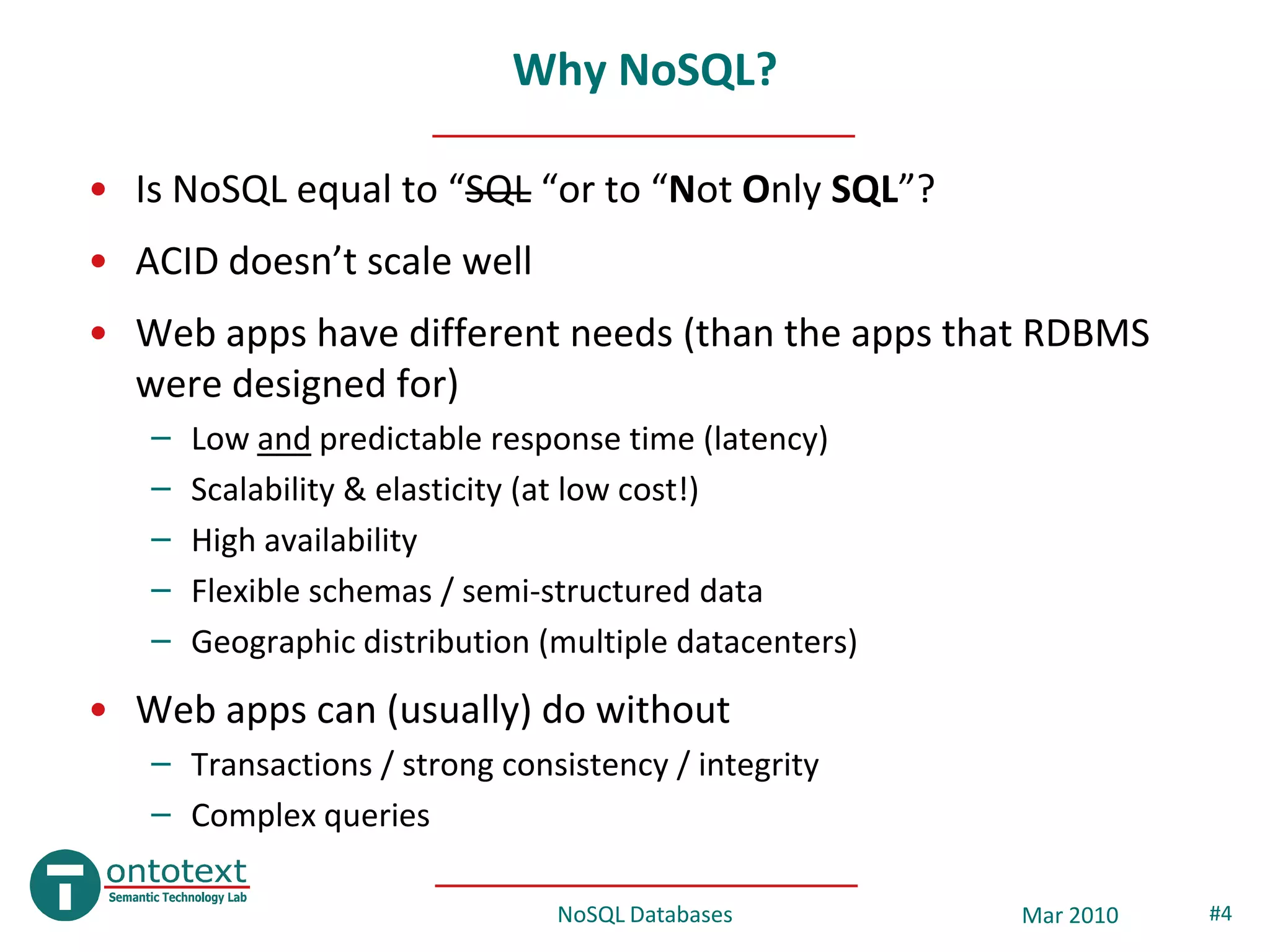
Why NoSQL?

• Is NoSQL equal to “SQL “or to “Not Only SQL”?
• ACID doesn’t scale well
• Web apps have different needs (than the apps that RDBMS
  were designed for)
   –   Low and predictable response time (latency)
   –   Scalability & elasticity (at low cost!)
   –   High availability
   –   Flexible schemas / semi-structured data
   –   Geographic distribution (multiple datacenters)
• Web apps can (usually) do without
   – Transactions / strong consistency / integrity
   – Complex queries

                                NoSQL Databases         Mar 2010   #4
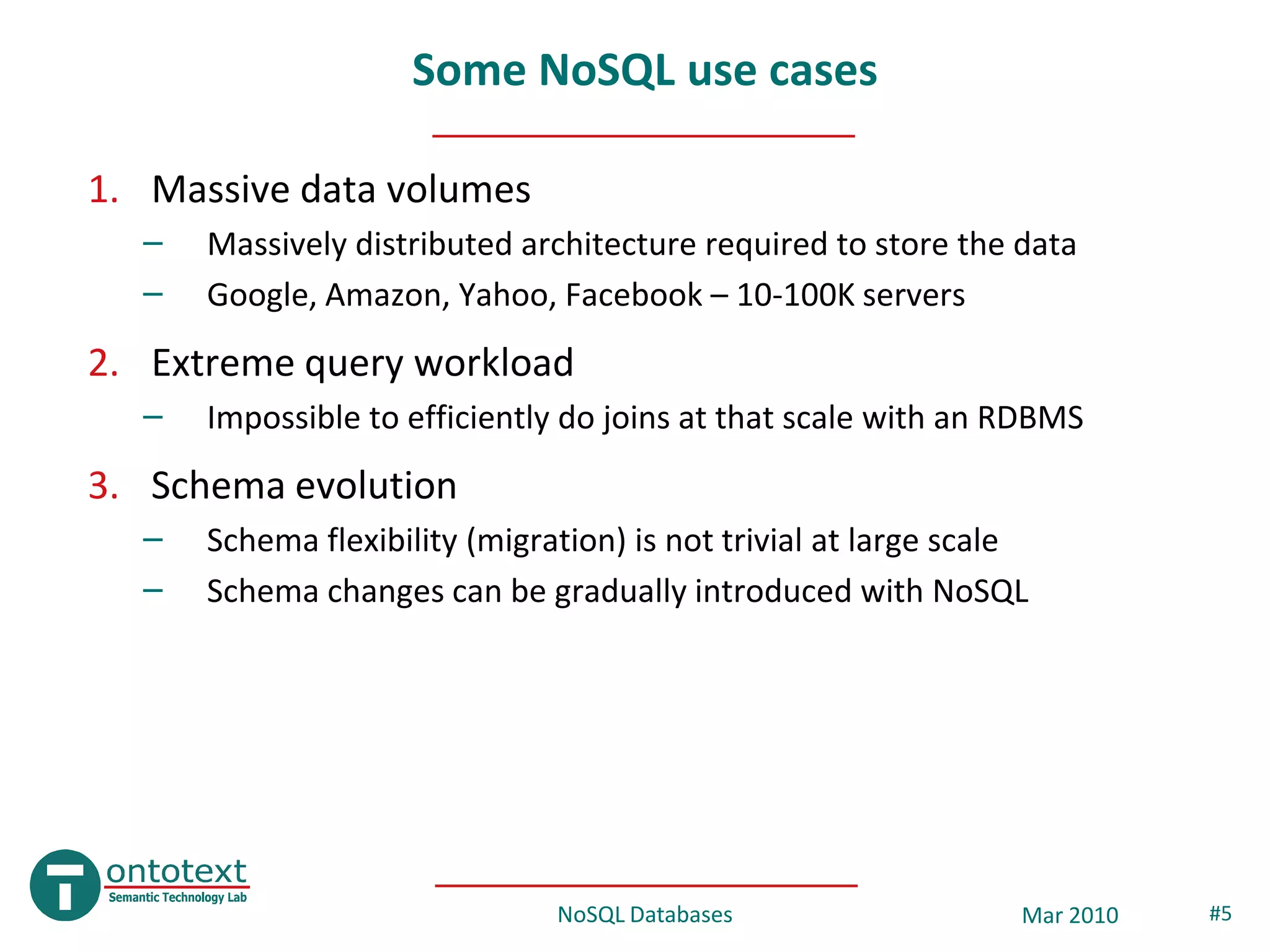
Some NoSQL use cases

1. Massive data volumes
  –   Massively distributed architecture required to store the data
  –   Google, Amazon, Yahoo, Facebook – 10-100K servers
2. Extreme query workload
  –   Impossible to efficiently do joins at that scale with an RDBMS
3. Schema evolution
  –   Schema flexibility (migration) is not trivial at large scale
  –   Schema changes can be gradually introduced with NoSQL


                               NoSQL Databases                   Mar 2010   #5
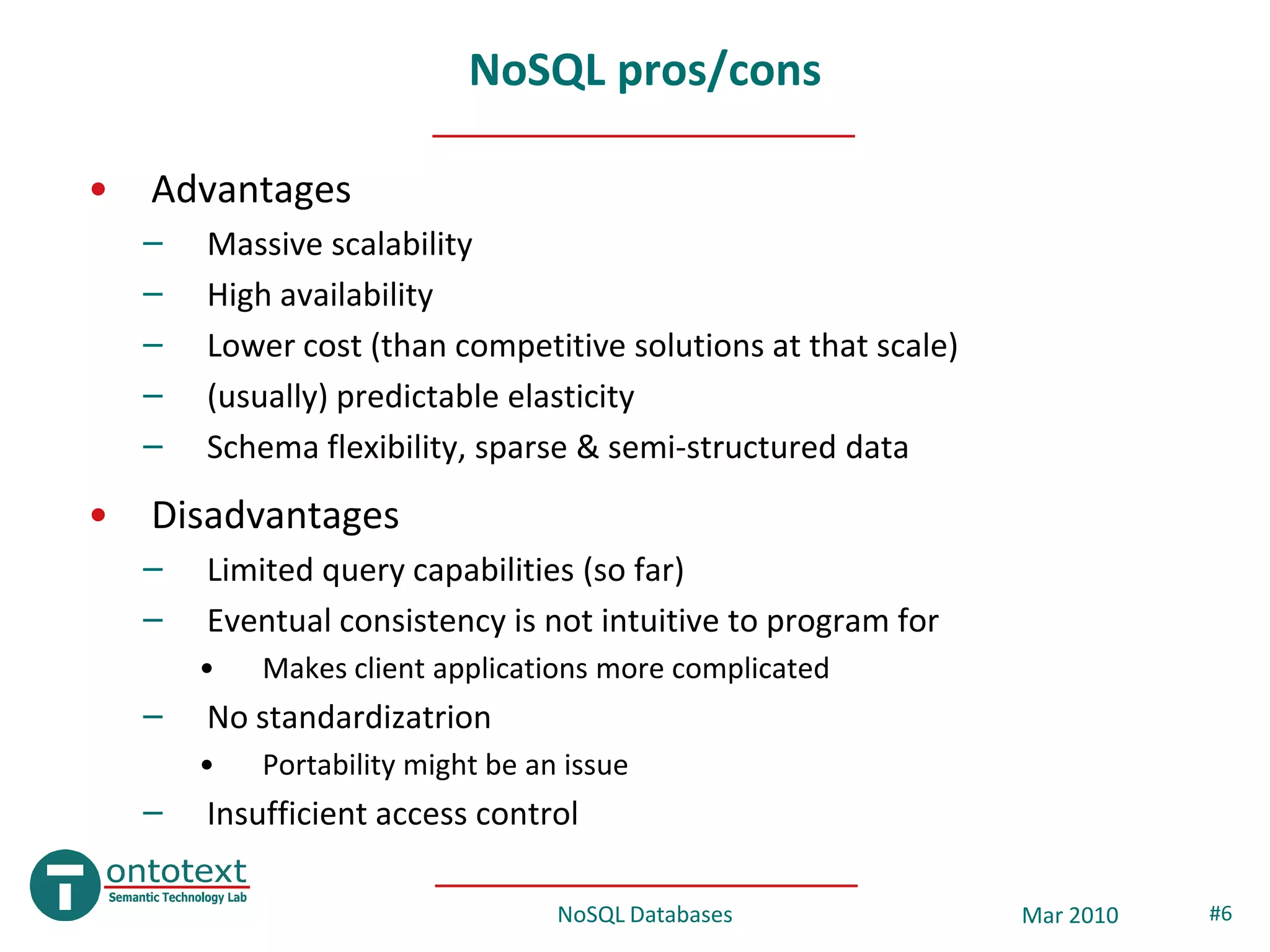
NoSQL pros/cons

•   Advantages
    –   Massive scalability
    –   High availability
    –   Lower cost (than competitive solutions at that scale)
    –   (usually) predictable elasticity
    –   Schema flexibility, sparse & semi-structured data
•   Disadvantages
    –   Limited query capabilities (so far)
    –   Eventual consistency is not intuitive to program for
        •   Makes client applications more complicated
    –   No standardizatrion
        •   Portability might be an issue
    –   Insufficient access control

                                   NoSQL Databases              Mar 2010   #6
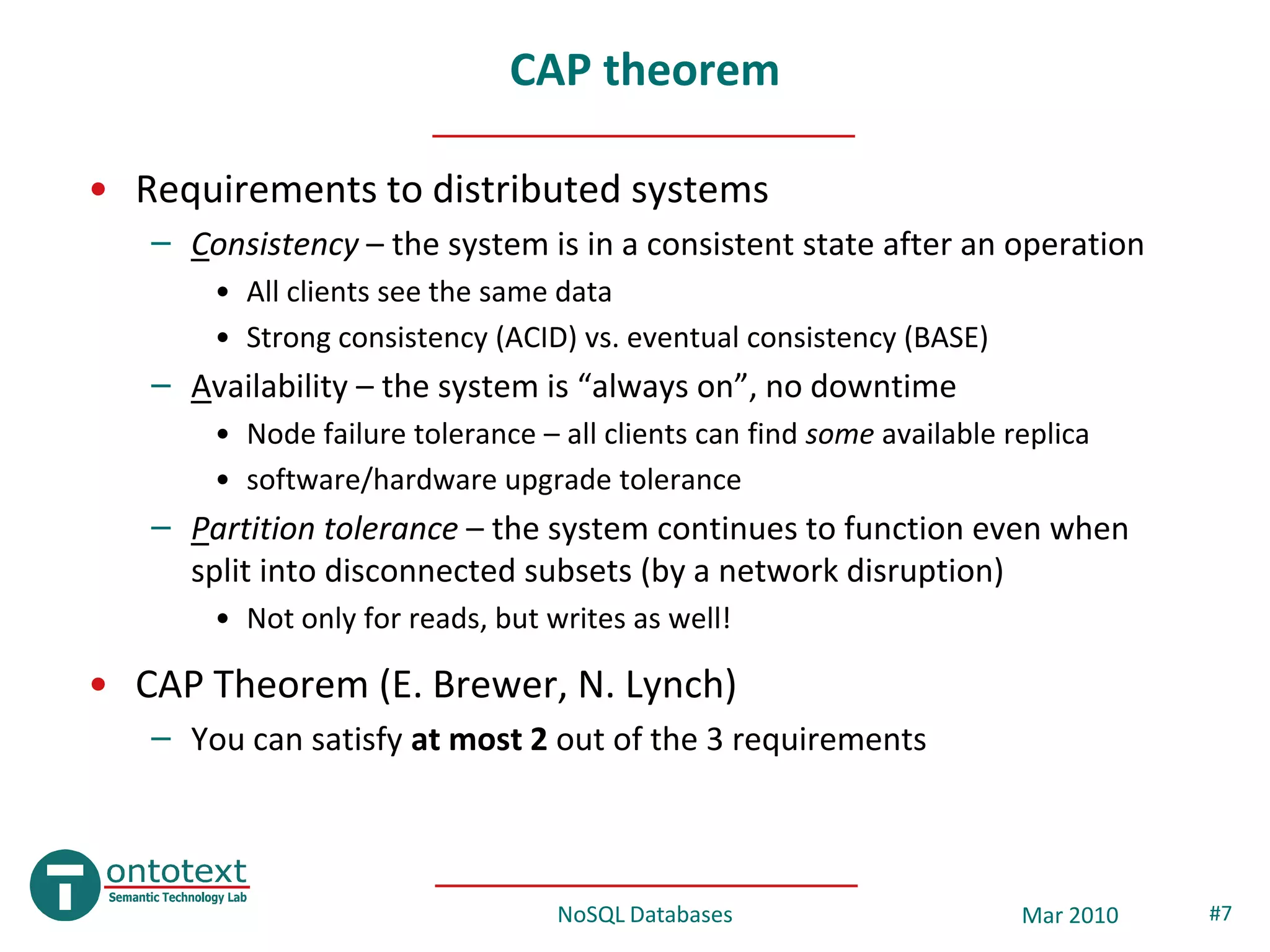
CAP theorem

• Requirements to distributed systems
   – Consistency – the system is in a consistent state after an operation
       • All clients see the same data
       • Strong consistency (ACID) vs. eventual consistency (BASE)
   – Availability – the system is “always on”, no downtime
       • Node failure tolerance – all clients can find some available replica
       • software/hardware upgrade tolerance
   – Partition tolerance – the system continues to function even when
     split into disconnected subsets (by a network disruption)
       • Not only for reads, but writes as well!

• CAP Theorem (E. Brewer, N. Lynch)
   – You can satisfy at most 2 out of the 3 requirements


                                  NoSQL Databases                      Mar 2010   #7
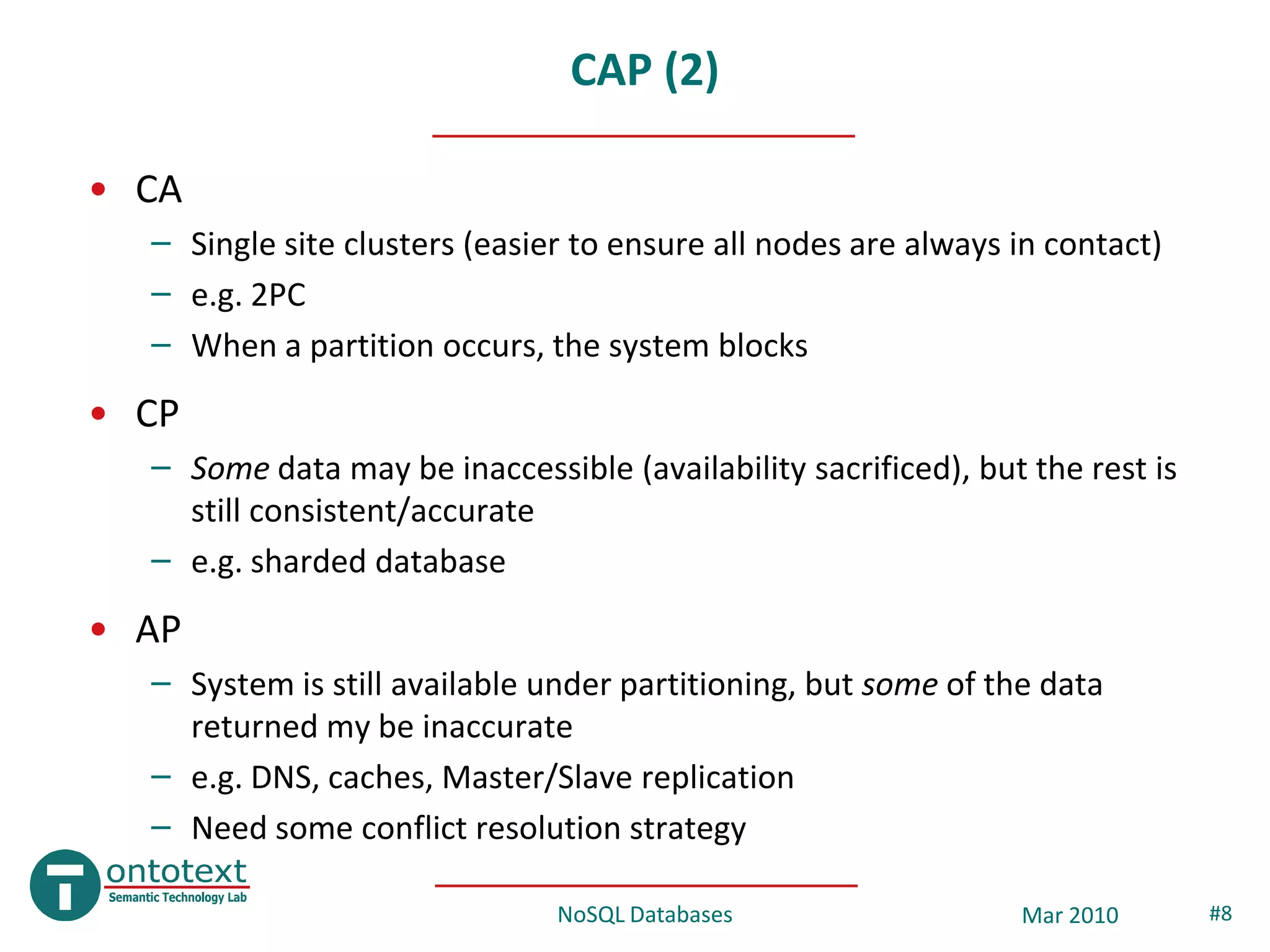
CAP (2)

• CA
  – Single site clusters (easier to ensure all nodes are always in contact)
  – e.g. 2PC
  – When a partition occurs, the system blocks
• CP
  – Some data may be inaccessible (availability sacrificed), but the rest is
    still consistent/accurate
  – e.g. sharded database
• AP
  – System is still available under partitioning, but some of the data
    returned my be inaccurate
  – e.g. DNS, caches, Master/Slave replication
  – Need some conflict resolution strategy

                               NoSQL Databases                  Mar 2010       #8
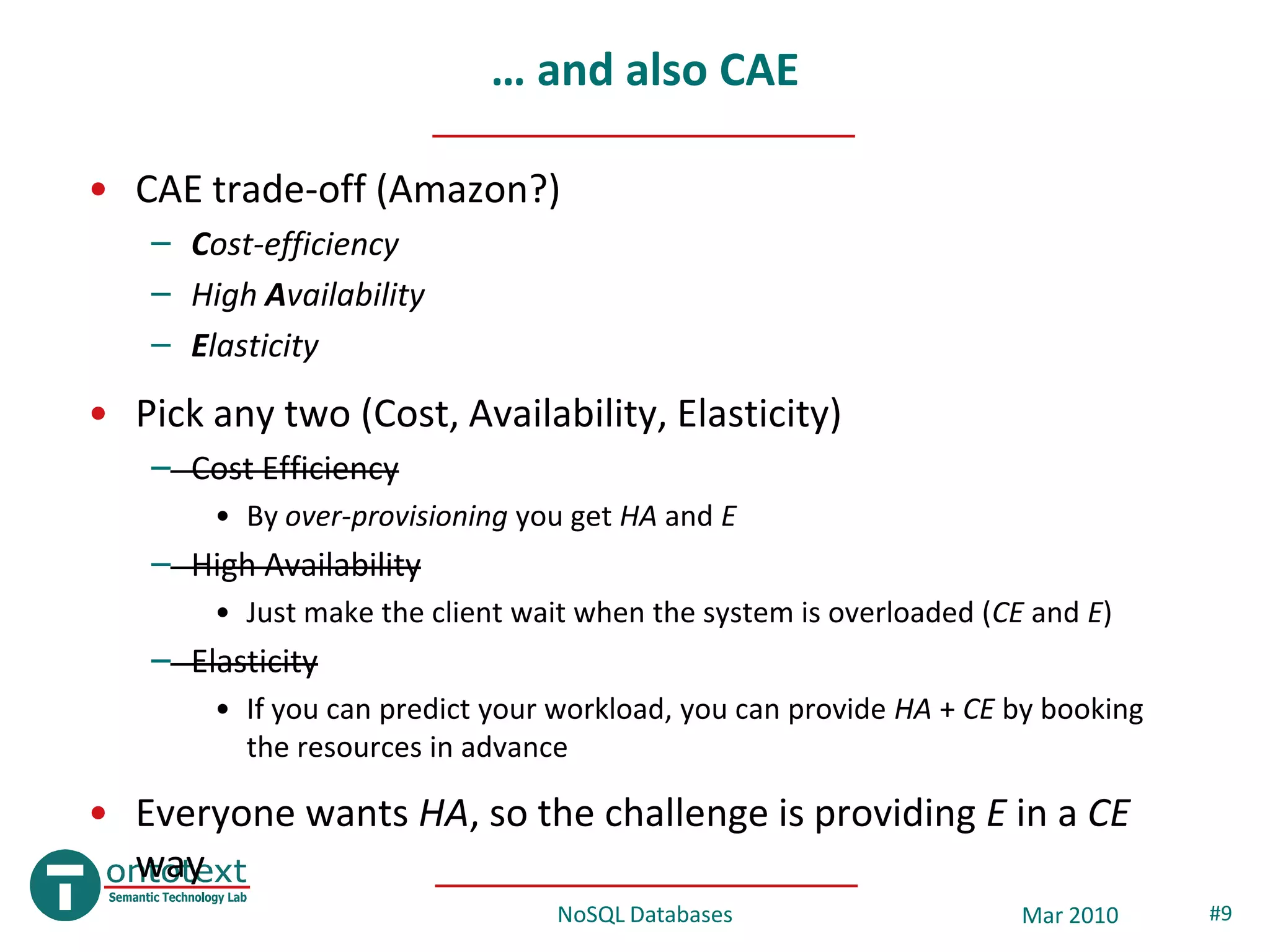
… and also CAE

• CAE trade-off (Amazon?)
   – Cost-efficiency
   – High Availability
   – Elasticity
• Pick any two (Cost, Availability, Elasticity)
   – Cost Efficiency
       • By over-provisioning you get HA and E
   – High Availability
       • Just make the client wait when the system is overloaded (CE and E)
   – Elasticity
       • If you can predict your workload, you can provide HA + CE by booking
         the resources in advance

• Everyone wants HA, so the challenge is providing E in a CE
  way
                                NoSQL Databases                     Mar 2010    #9
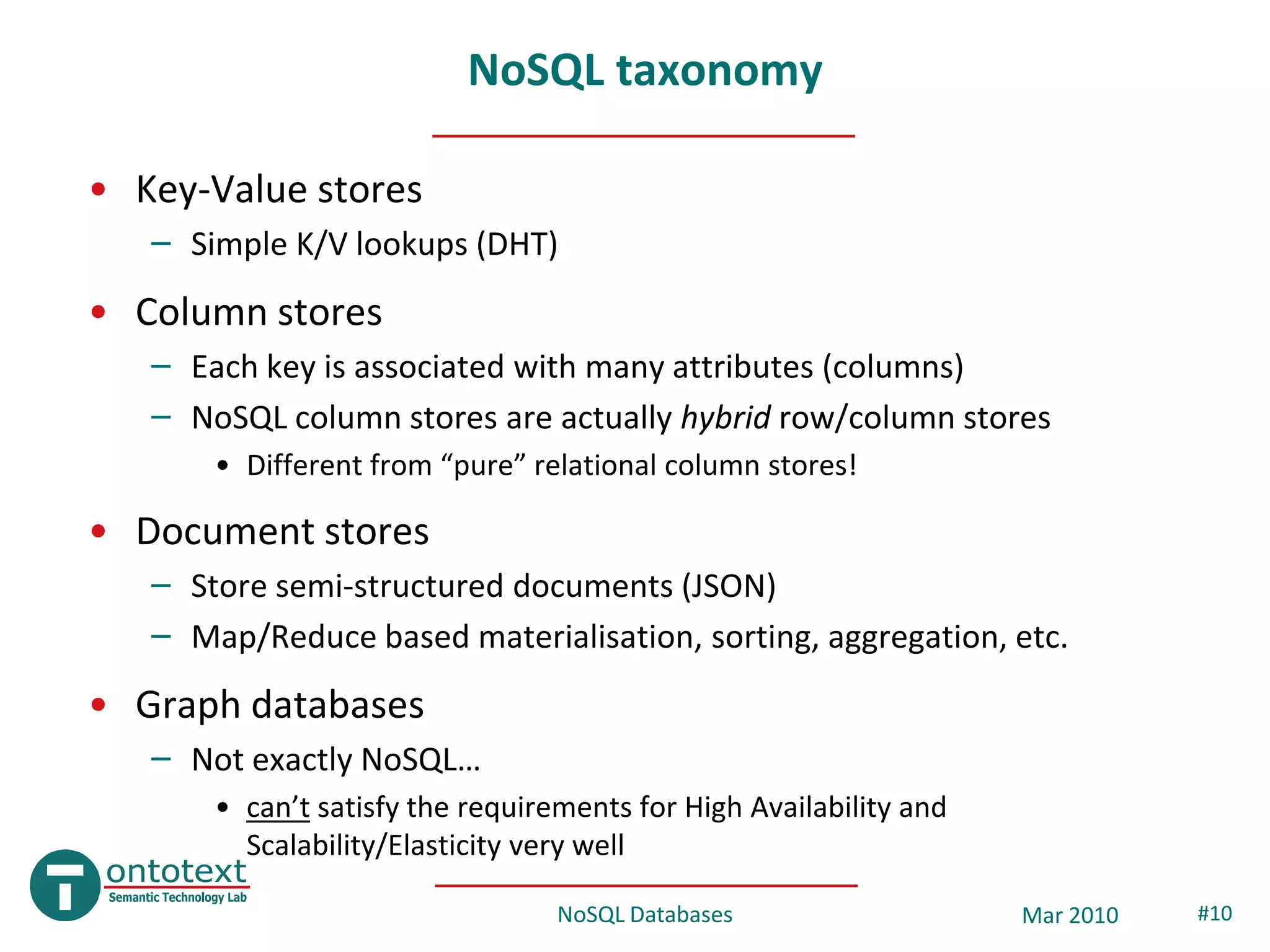
NoSQL taxonomy

• Key-Value stores
   – Simple K/V lookups (DHT)
• Column stores
   – Each key is associated with many attributes (columns)
   – NoSQL column stores are actually hybrid row/column stores
       • Different from “pure” relational column stores!

• Document stores
   – Store semi-structured documents (JSON)
   – Map/Reduce based materialisation, sorting, aggregation, etc.
• Graph databases
   – Not exactly NoSQL…
       • can’t satisfy the requirements for High Availability and
         Scalability/Elasticity very well

                                  NoSQL Databases                   Mar 2010   #10
Contents


          Part II

Key-Value stores
PNUTS, Dynamo, Voldemort


       NoSQL Databases     Mar 2010   #11
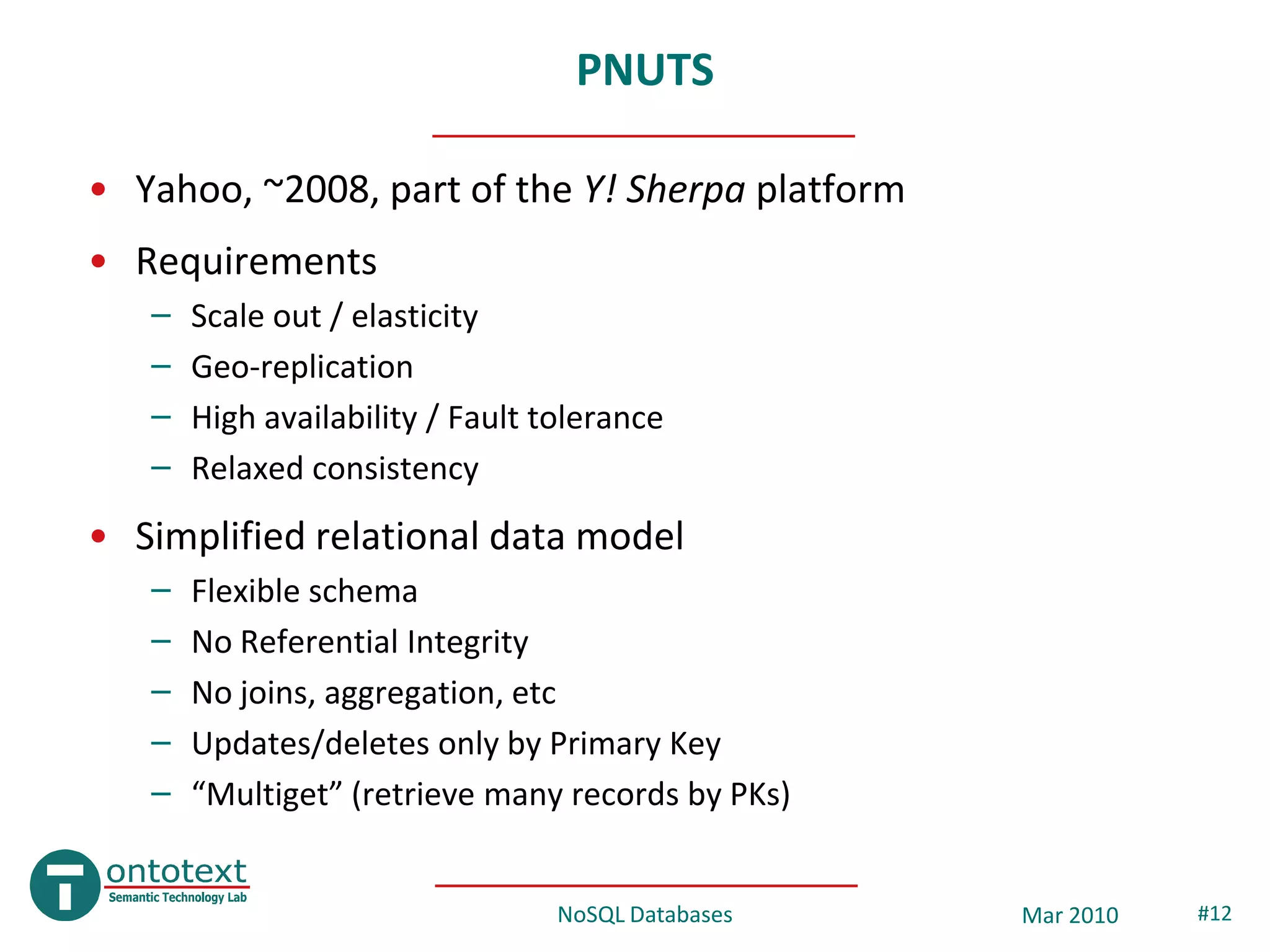
PNUTS

• Yahoo, ~2008, part of the Y! Sherpa platform
• Requirements
   –   Scale out / elasticity
   –   Geo-replication
   –   High availability / Fault tolerance
   –   Relaxed consistency
• Simplified relational data model
   –   Flexible schema
   –   No Referential Integrity
   –   No joins, aggregation, etc
   –   Updates/deletes only by Primary Key
   –   “Multiget” (retrieve many records by PKs)


                                  NoSQL Databases   Mar 2010   #12
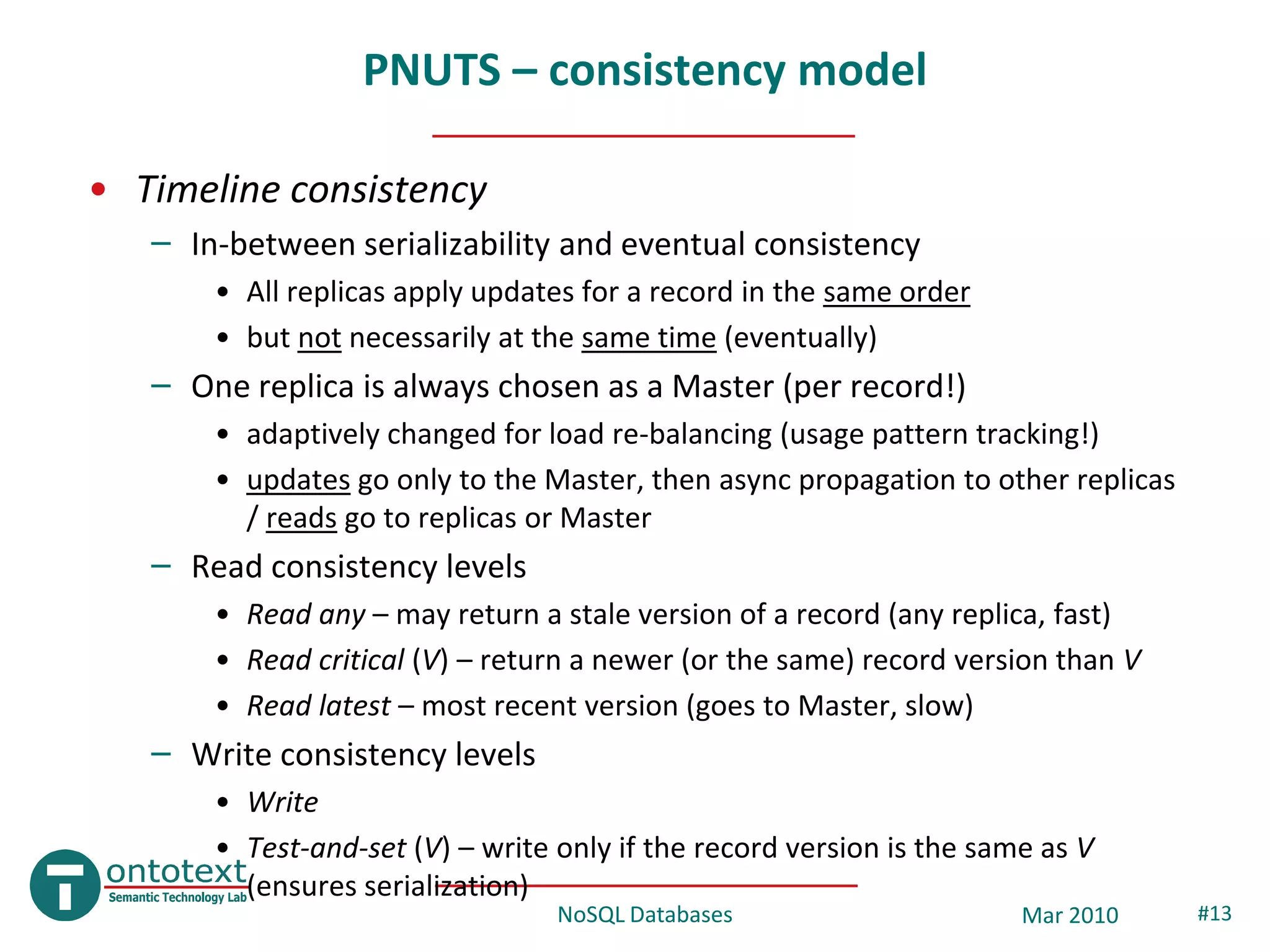
PNUTS – consistency model

• Timeline consistency
   – In-between serializability and eventual consistency
       • All replicas apply updates for a record in the same order
       • but not necessarily at the same time (eventually)
   – One replica is always chosen as a Master (per record!)
       • adaptively changed for load re-balancing (usage pattern tracking!)
       • updates go only to the Master, then async propagation to other replicas
         / reads go to replicas or Master
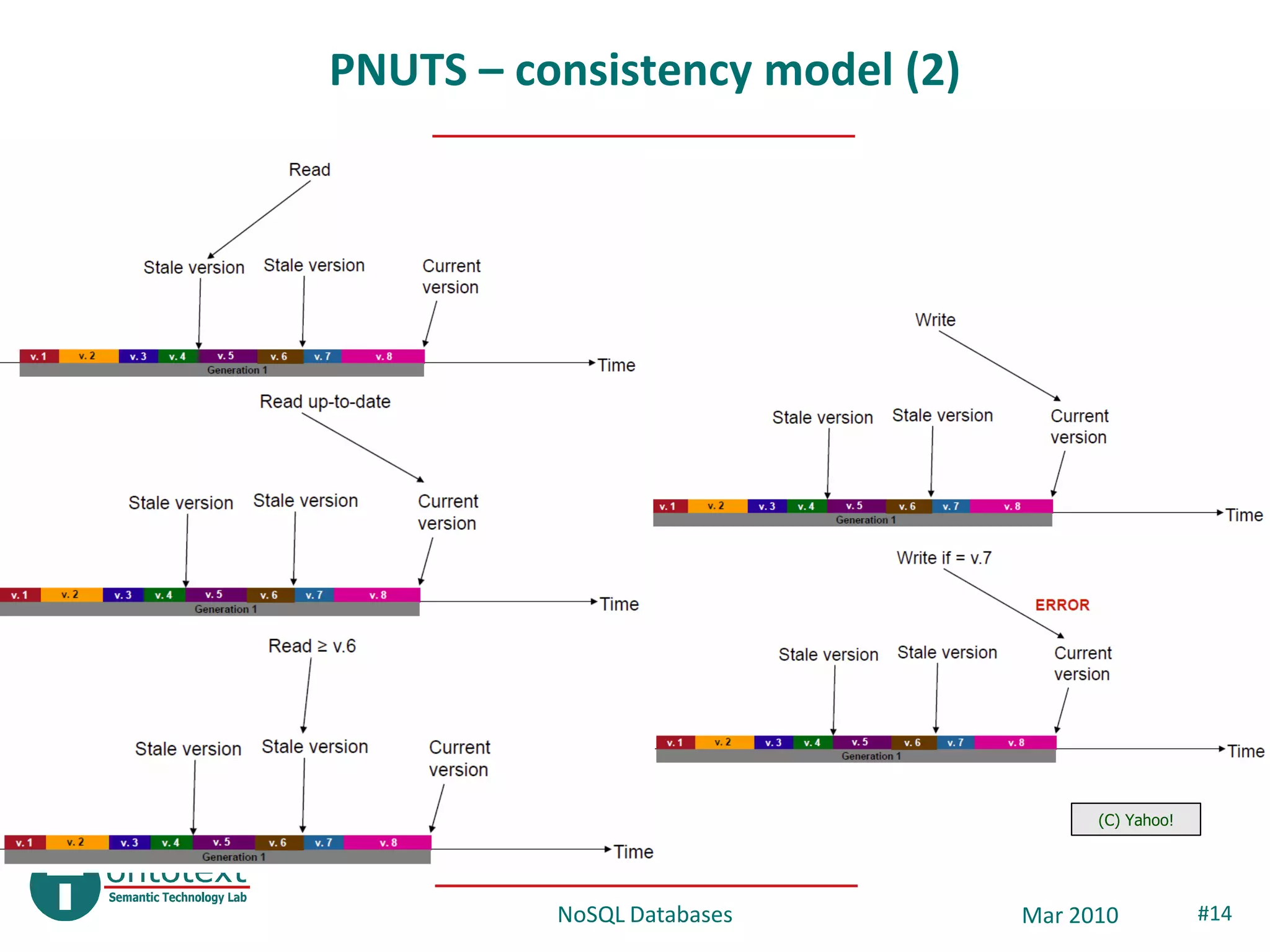
   – Read consistency levels
       • Read any – may return a stale version of a record (any replica, fast)
       • Read critical (V) – return a newer (or the same) record version than V
       • Read latest – most recent version (goes to Master, slow)
   – Write consistency levels
       • Write
       • Test-and-set (V) – write only if the record version is the same as V
         (ensures serialization)
                                  NoSQL Databases                      Mar 2010    #13
PNUTS – consistency model (2)


                                      (C) Yahoo!


          NoSQL Databases       Mar 2010           #14
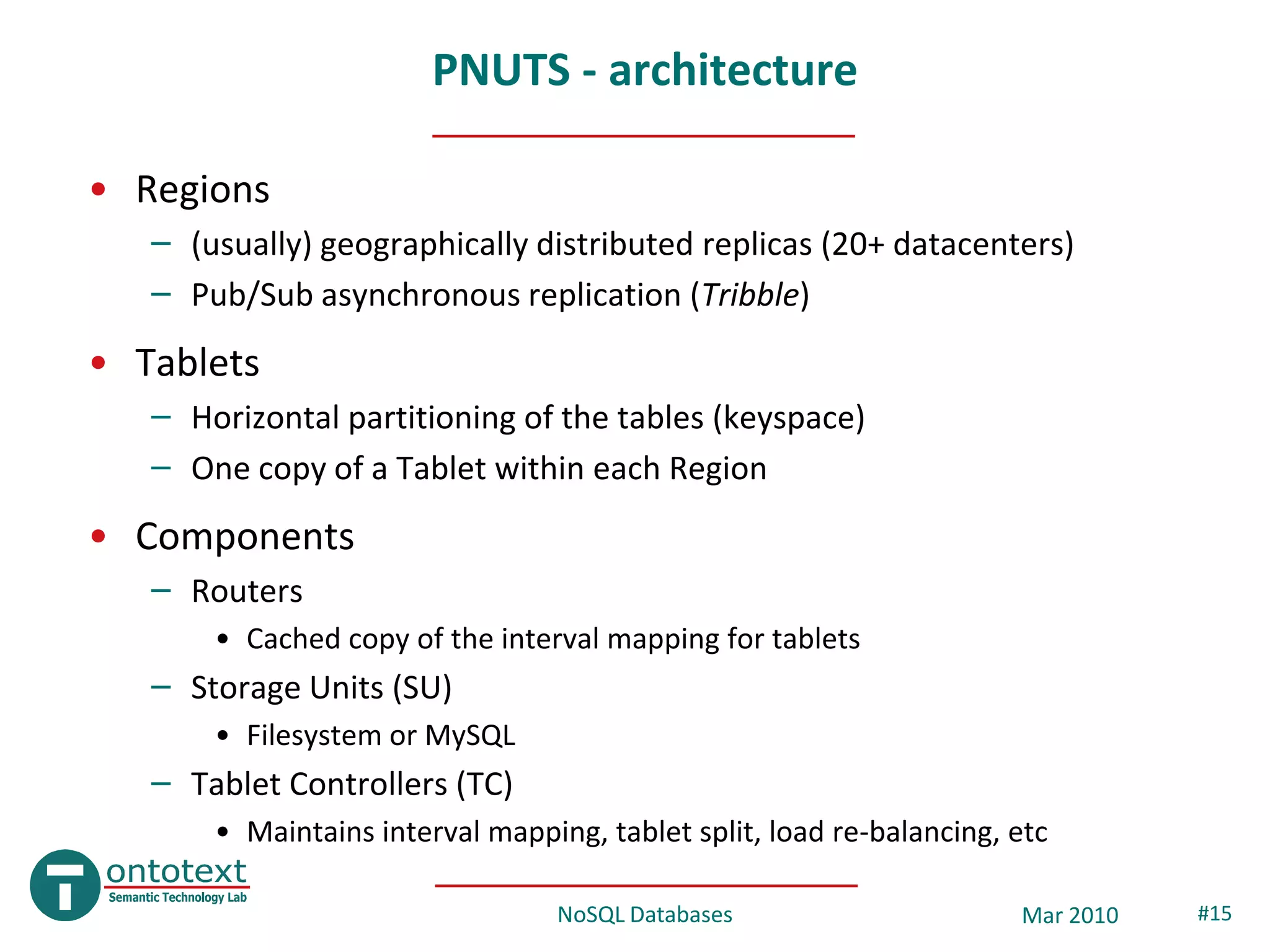
PNUTS - architecture

• Regions
   – (usually) geographically distributed replicas (20+ datacenters)
   – Pub/Sub asynchronous replication (Tribble)
• Tablets
   – Horizontal partitioning of the tables (keyspace)
   – One copy of a Tablet within each Region
• Components
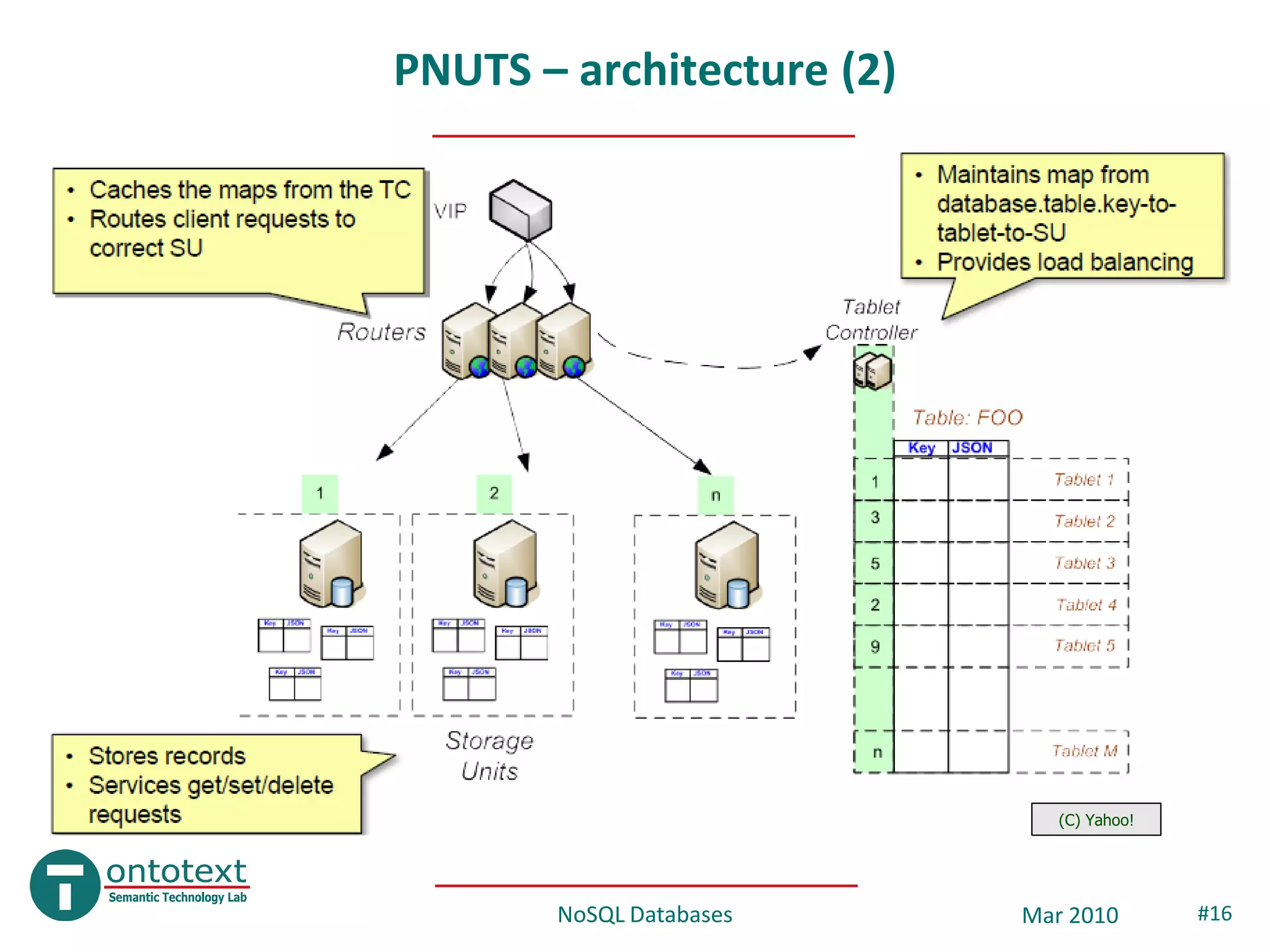
   – Routers
       • Cached copy of the interval mapping for tablets
   – Storage Units (SU)
       • Filesystem or MySQL
   – Tablet Controllers (TC)
       • Maintains interval mapping, tablet split, load re-balancing, etc

                                  NoSQL Databases                     Mar 2010   #15
PNUTS – architecture (2)


                              (C) Yahoo!


       NoSQL Databases     Mar 2010        #16
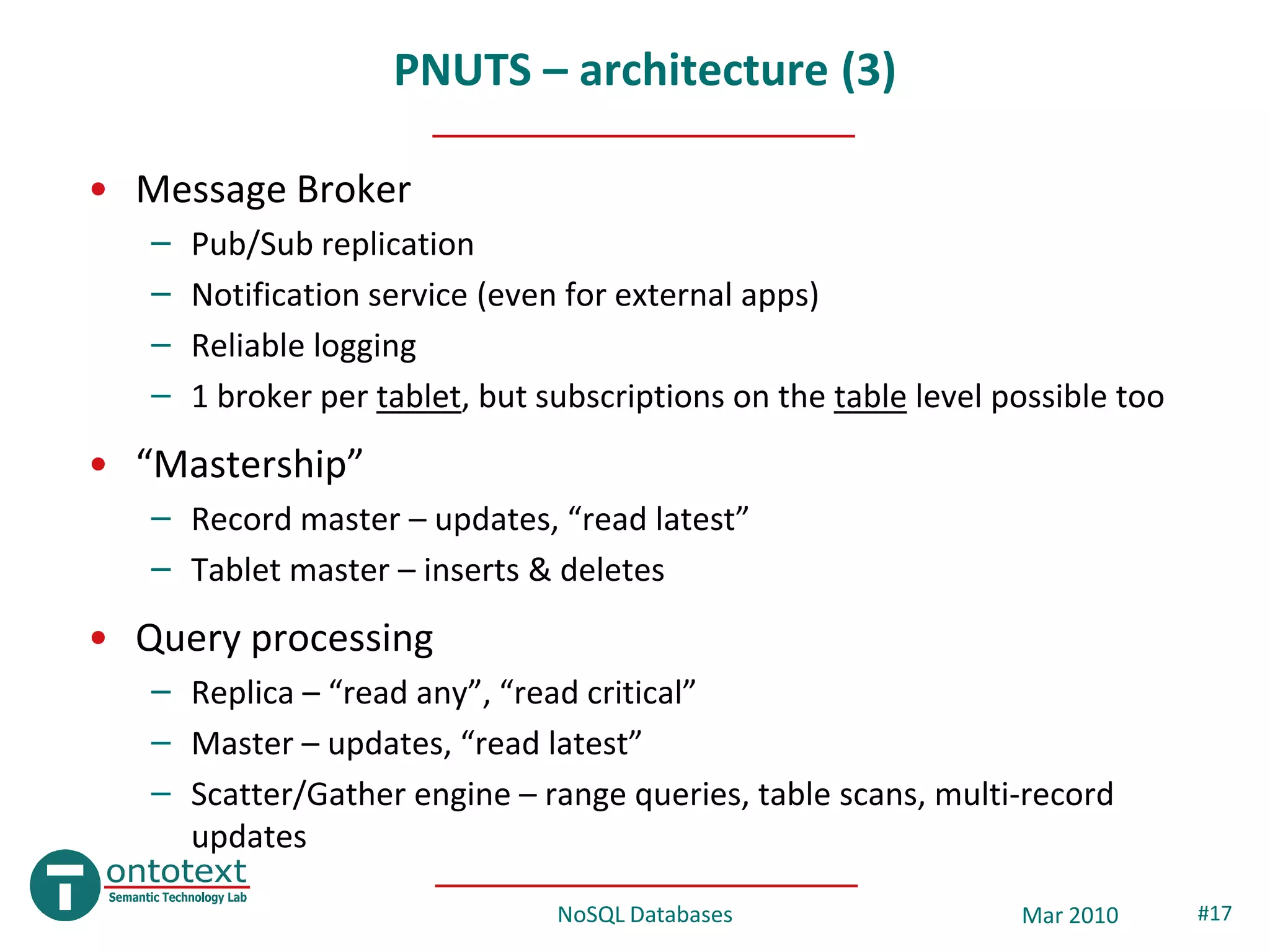
PNUTS – architecture (3)

• Message Broker
   –   Pub/Sub replication
   –   Notification service (even for external apps)
   –   Reliable logging
   –   1 broker per tablet, but subscriptions on the table level possible too
• “Mastership”
   – Record master – updates, “read latest”
   – Tablet master – inserts & deletes
• Query processing
   – Replica – “read any”, “read critical”
   – Master – updates, “read latest”
   – Scatter/Gather engine – range queries, table scans, multi-record
     updates

                                 NoSQL Databases                  Mar 2010      #17
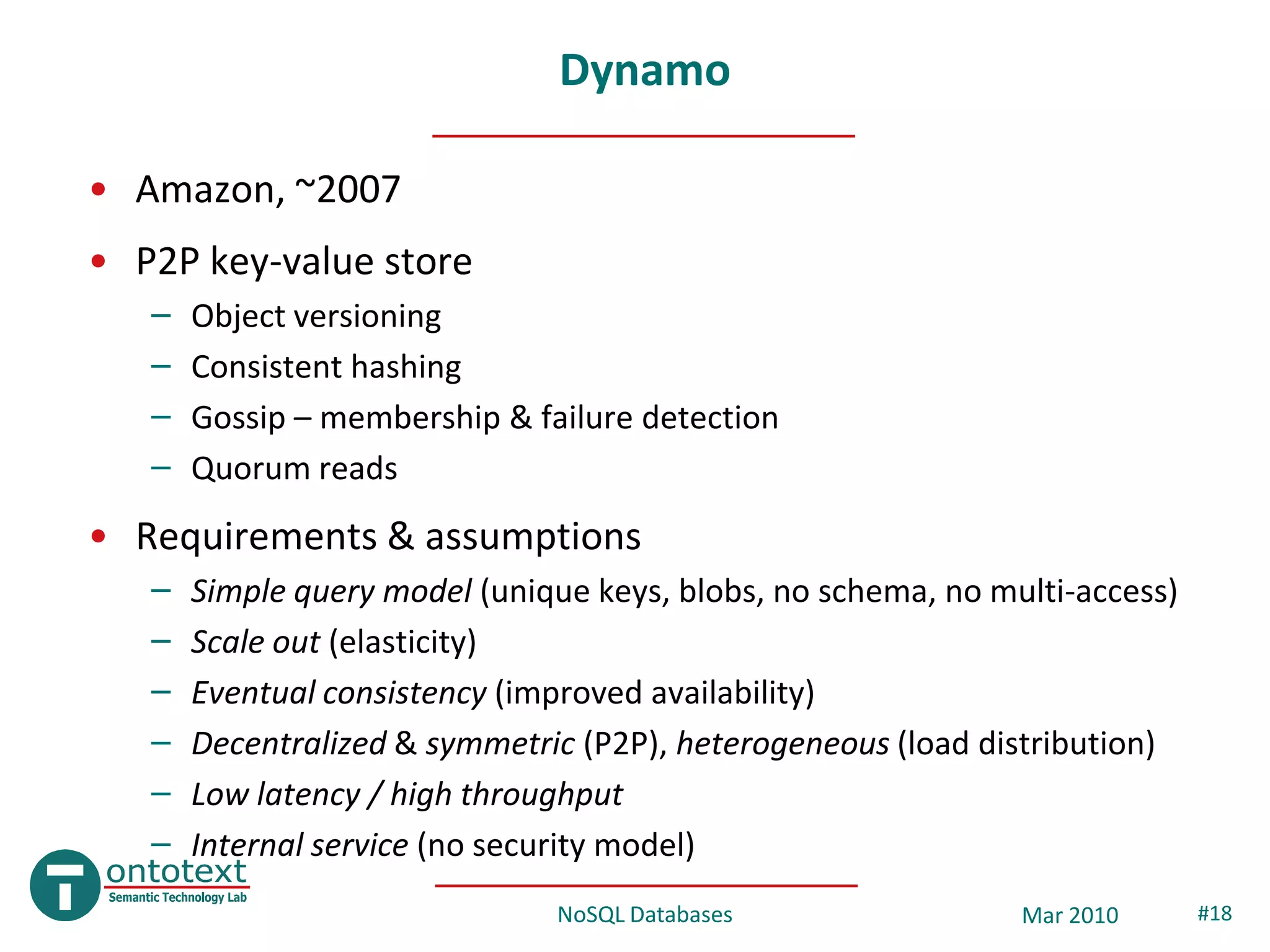
Dynamo

• Amazon, ~2007
• P2P key-value store
   –   Object versioning
   –   Consistent hashing
   –   Gossip – membership & failure detection
   –   Quorum reads
• Requirements & assumptions
   –   Simple query model (unique keys, blobs, no schema, no multi-access)
   –   Scale out (elasticity)
   –   Eventual consistency (improved availability)
   –   Decentralized & symmetric (P2P), heterogeneous (load distribution)
   –   Low latency / high throughput
   –   Internal service (no security model)
                               NoSQL Databases                 Mar 2010      #18
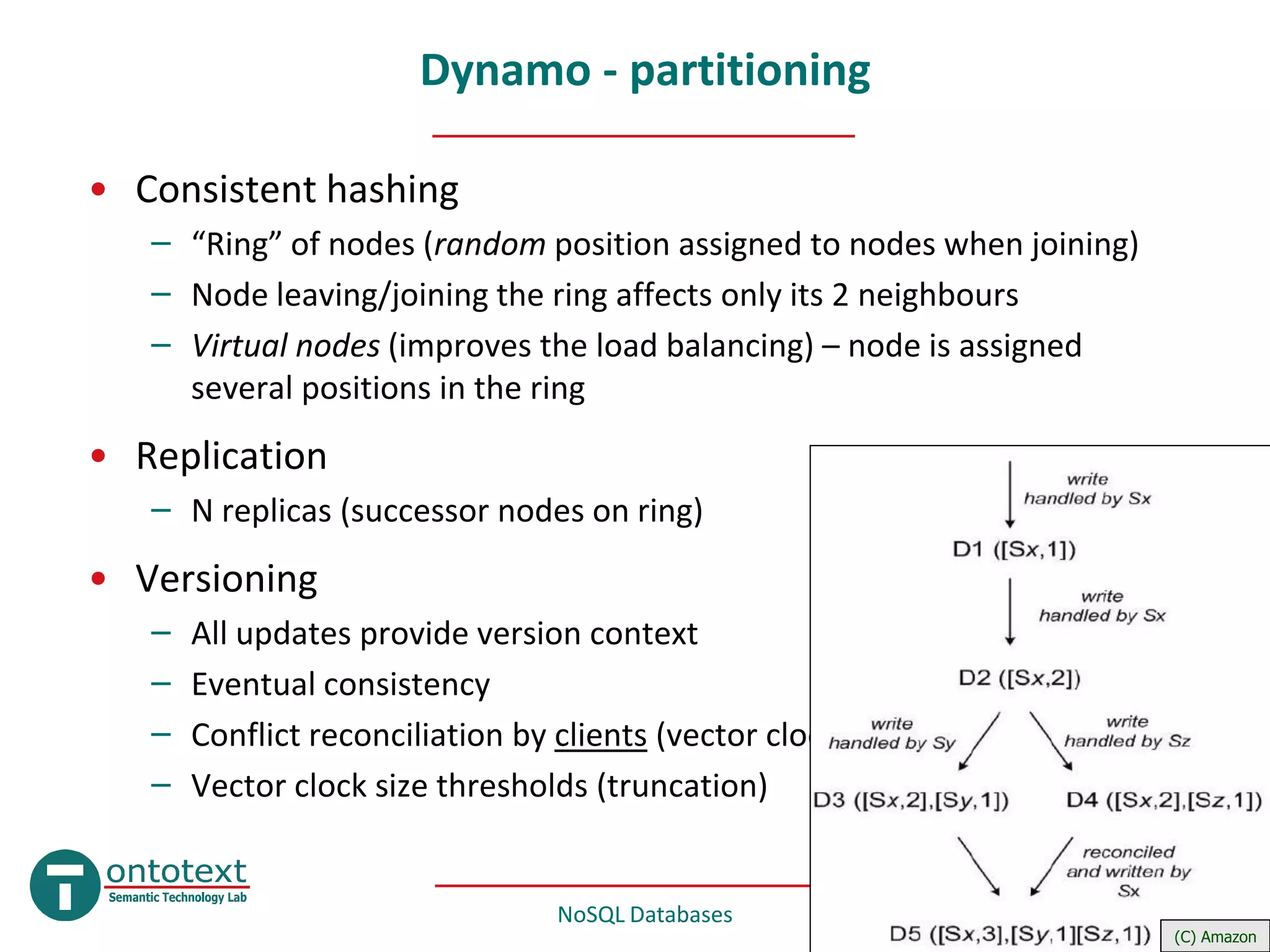
Dynamo - partitioning

• Consistent hashing
   – “Ring” of nodes (random position assigned to nodes when joining)
   – Node leaving/joining the ring affects only its 2 neighbours
   – Virtual nodes (improves the load balancing) – node is assigned
     several positions in the ring
• Replication
   – N replicas (successor nodes on ring)
• Versioning
   –   All updates provide version context
   –   Eventual consistency
   –   Conflict reconciliation by clients (vector clocks)
   –   Vector clock size thresholds (truncation)


                                  NoSQL Databases            Mar 2010     #19
                                                                        (C) Amazon
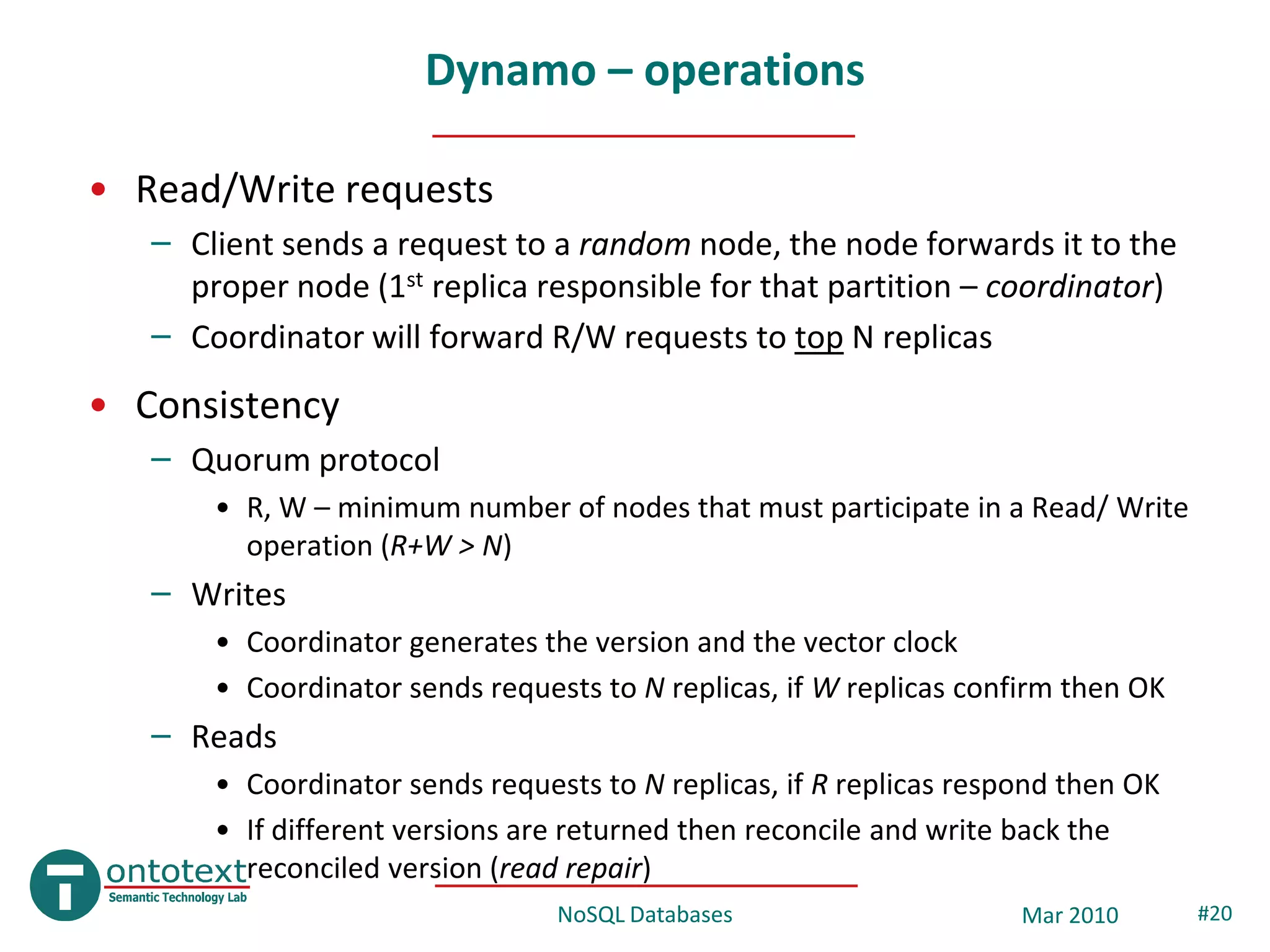
Dynamo – operations

• Read/Write requests
   – Client sends a request to a random node, the node forwards it to the
     proper node (1st replica responsible for that partition – coordinator)
   – Coordinator will forward R/W requests to top N replicas
• Consistency
   – Quorum protocol
       • R, W – minimum number of nodes that must participate in a Read/ Write
         operation (R+W > N)
   – Writes
       • Coordinator generates the version and the vector clock
       • Coordinator sends requests to N replicas, if W replicas confirm then OK
   – Reads
       • Coordinator sends requests to N replicas, if R replicas respond then OK
       • If different versions are returned then reconcile and write back the
         reconciled version (read repair)
                                 NoSQL Databases                     Mar 2010      #20
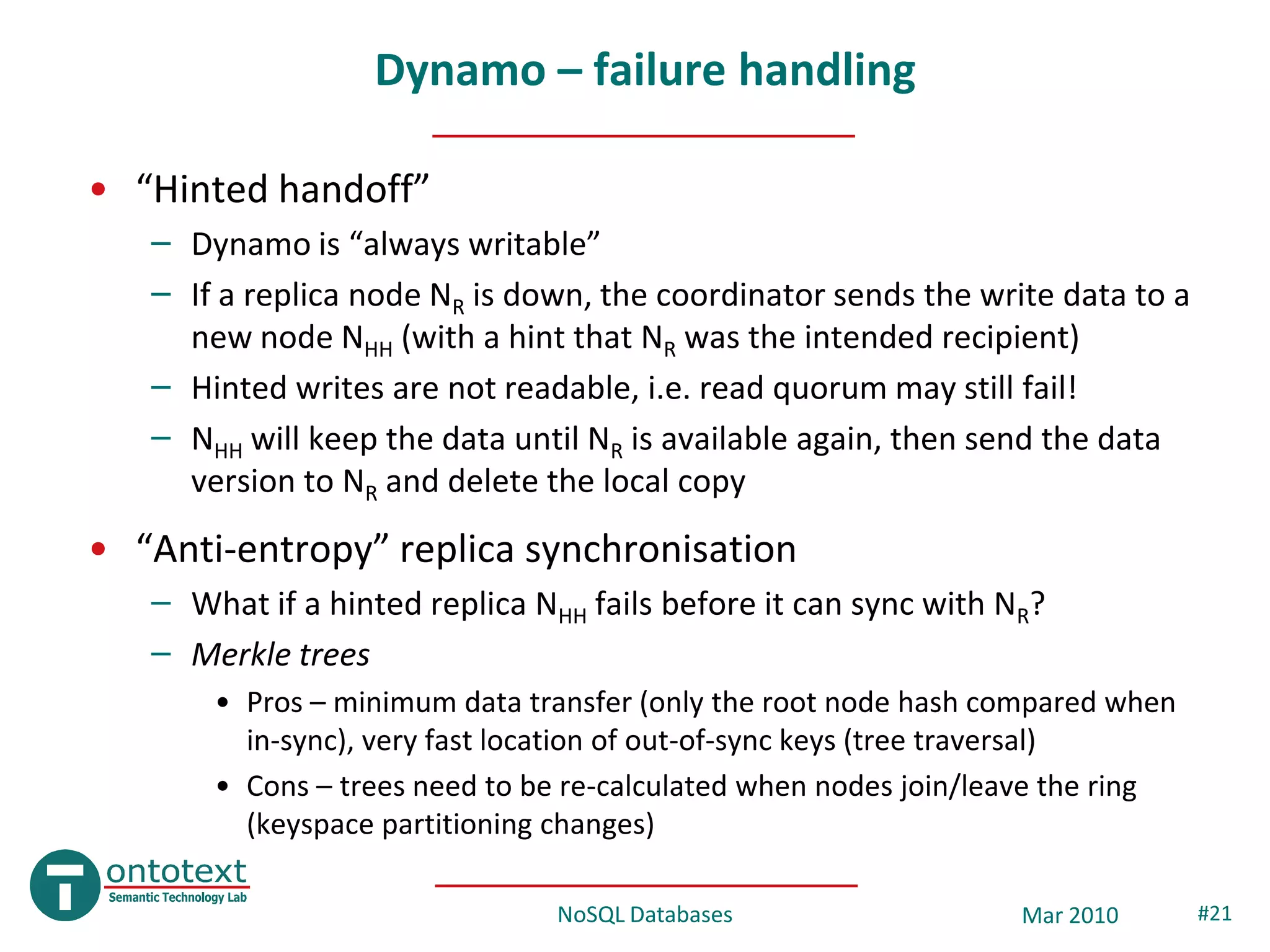
Dynamo – failure handling

• “Hinted handoff”
   – Dynamo is “always writable”
   – If a replica node NR is down, the coordinator sends the write data to a
     new node NHH (with a hint that NR was the intended recipient)
   – Hinted writes are not readable, i.e. read quorum may still fail!
   – NHH will keep the data until NR is available again, then send the data
     version to NR and delete the local copy
• “Anti-entropy” replica synchronisation
   – What if a hinted replica NHH fails before it can sync with NR?
   – Merkle trees
       • Pros – minimum data transfer (only the root node hash compared when
         in-sync), very fast location of out-of-sync keys (tree traversal)
       • Cons – trees need to be re-calculated when nodes join/leave the ring
         (keyspace partitioning changes)

                                NoSQL Databases                  Mar 2010       #21
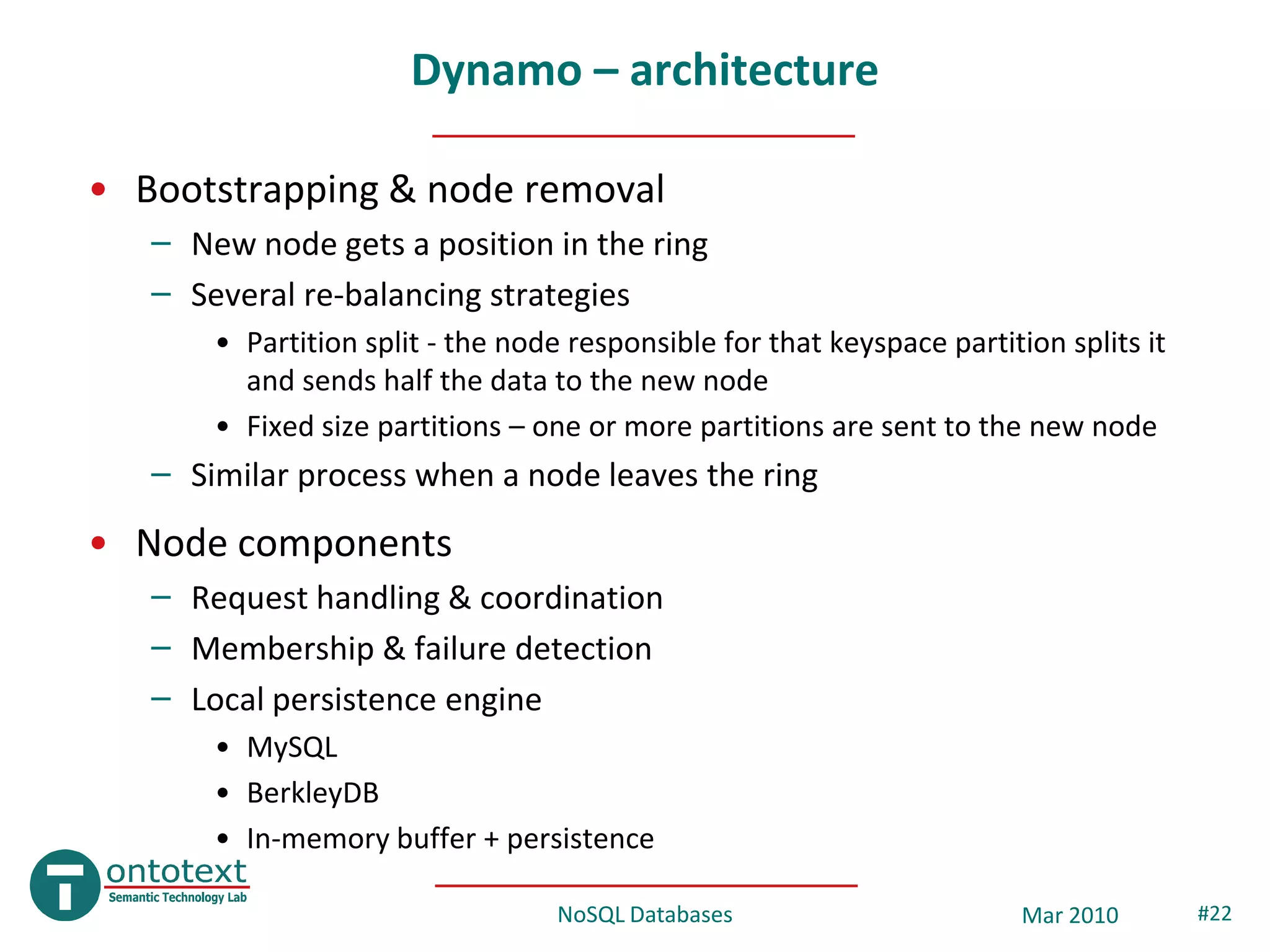
Dynamo – architecture

• Bootstrapping & node removal
   – New node gets a position in the ring
   – Several re-balancing strategies
       • Partition split - the node responsible for that keyspace partition splits it
         and sends half the data to the new node
       • Fixed size partitions – one or more partitions are sent to the new node
   – Similar process when a node leaves the ring
• Node components
   – Request handling & coordination
   – Membership & failure detection
   – Local persistence engine
       • MySQL
       • BerkleyDB
       • In-memory buffer + persistence

                                   NoSQL Databases                       Mar 2010       #22
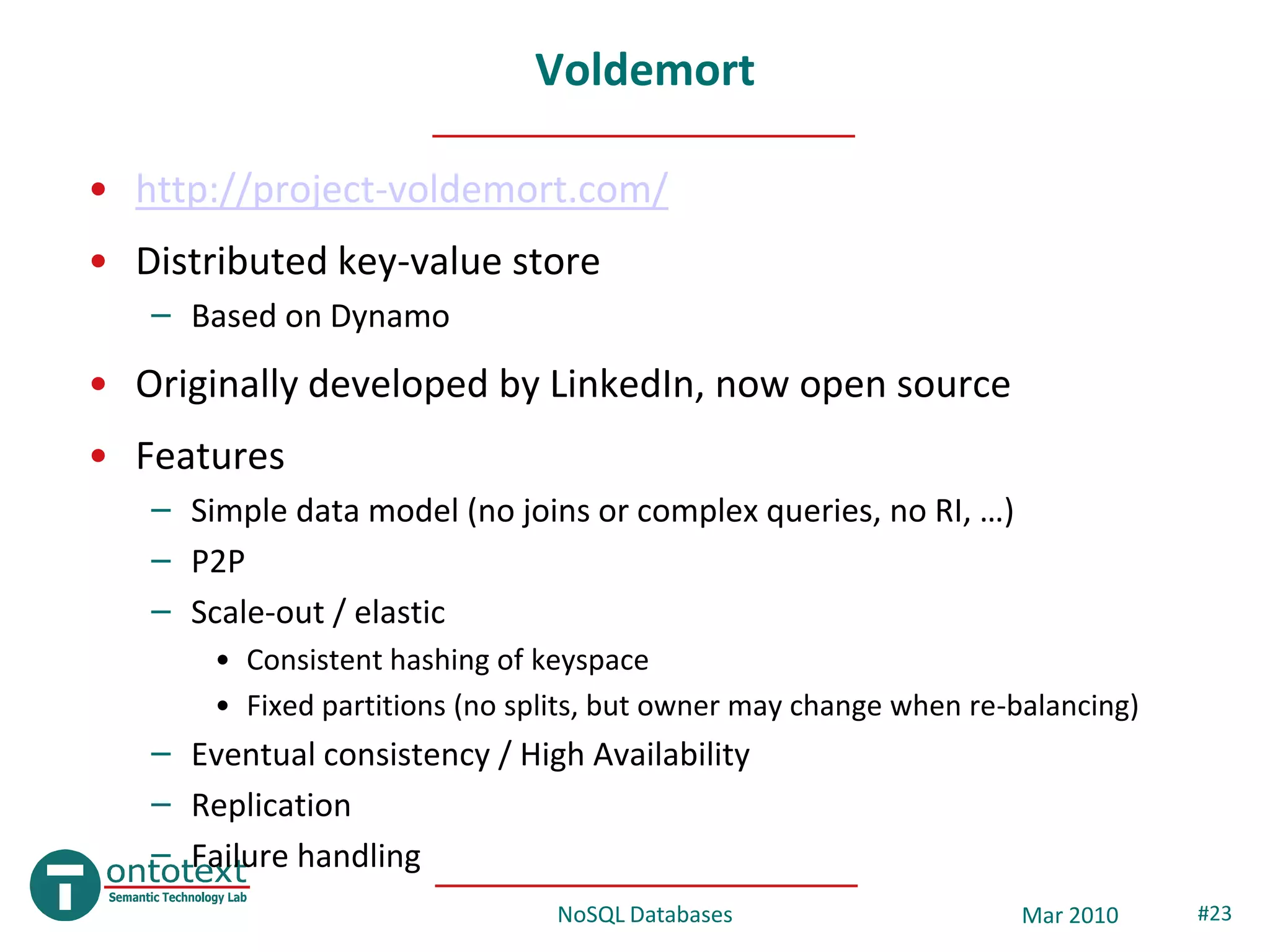
Voldemort

• http://project-voldemort.com/
• Distributed key-value store
   – Based on Dynamo
• Originally developed by LinkedIn, now open source
• Features
   – Simple data model (no joins or complex queries, no RI, …)
   – P2P
   – Scale-out / elastic
       • Consistent hashing of keyspace
       • Fixed partitions (no splits, but owner may change when re-balancing)
   – Eventual consistency / High Availability
   – Replication
   – Failure handling
                                NoSQL Databases                     Mar 2010    #23
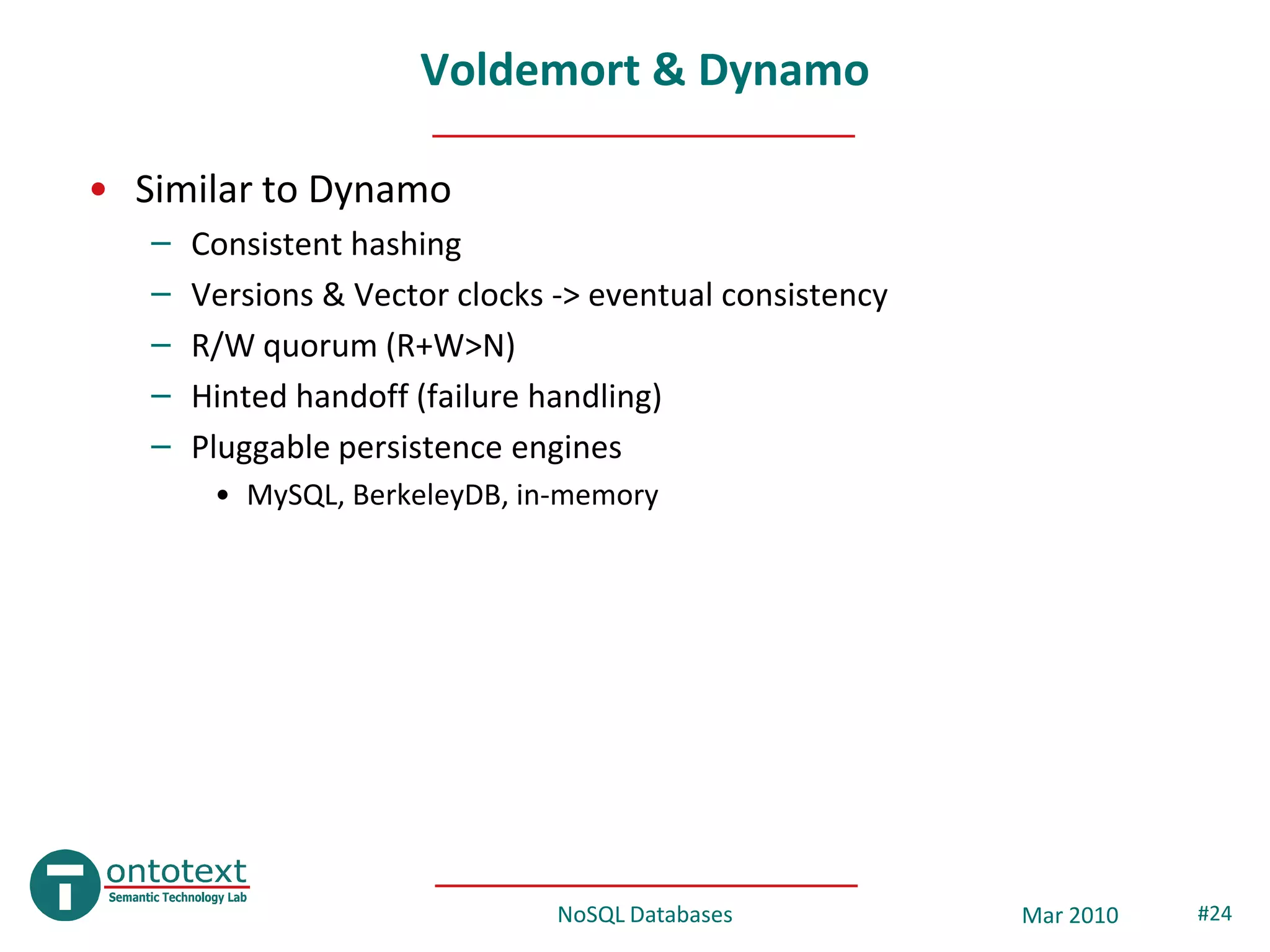
Voldemort & Dynamo

• Similar to Dynamo
   –   Consistent hashing
   –   Versions & Vector clocks -> eventual consistency
   –   R/W quorum (R+W>N)
   –   Hinted handoff (failure handling)
   –   Pluggable persistence engines
        • MySQL, BerkeleyDB, in-memory


                                NoSQL Databases           Mar 2010   #24
Contents


           Part III

 Column stores
BigTable, HBase, Cassandra


        NoSQL Databases      Mar 2010   #25
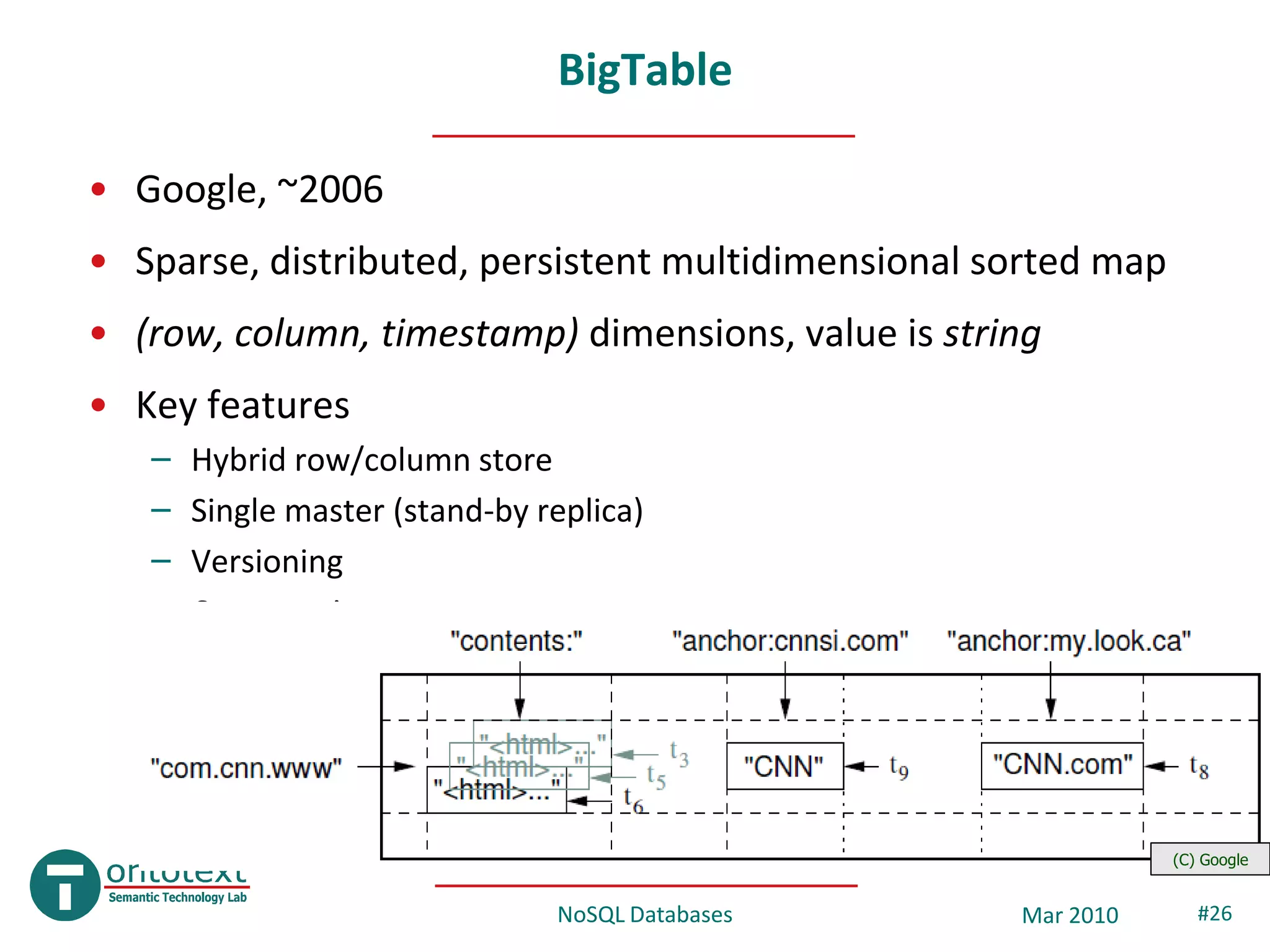
BigTable

• Google, ~2006
• Sparse, distributed, persistent multidimensional sorted map
• (row, column, timestamp) dimensions, value is string
• Key features
   –   Hybrid row/column store
   –   Single master (stand-by replica)
   –   Versioning
   –   Compression


                                                                (C) Google


                                NoSQL Databases     Mar 2010       #26
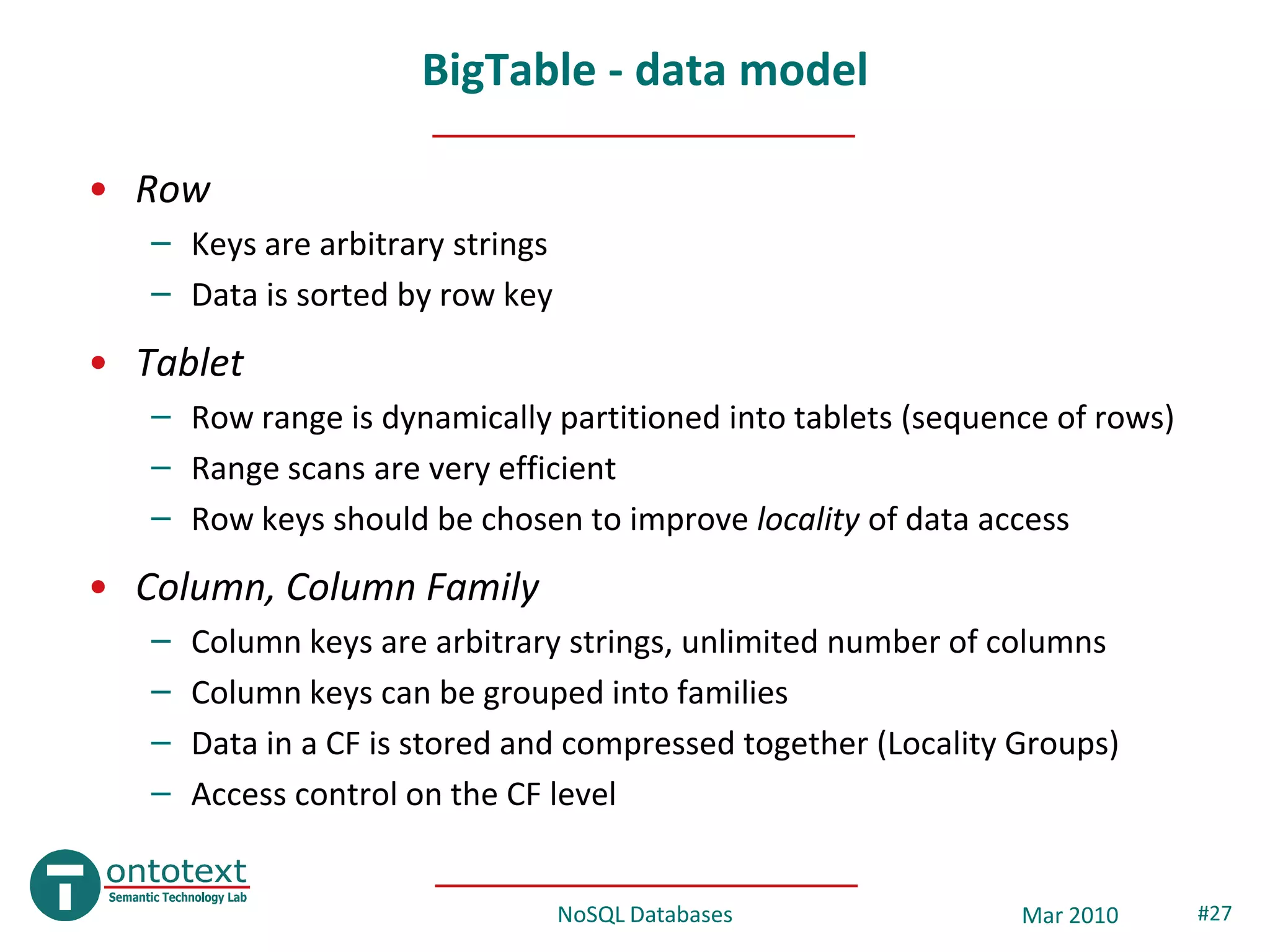
BigTable - data model

• Row
   – Keys are arbitrary strings
   – Data is sorted by row key
• Tablet
   – Row range is dynamically partitioned into tablets (sequence of rows)
   – Range scans are very efficient
   – Row keys should be chosen to improve locality of data access
• Column, Column Family
   –   Column keys are arbitrary strings, unlimited number of columns
   –   Column keys can be grouped into families
   –   Data in a CF is stored and compressed together (Locality Groups)
   –   Access control on the CF level


                                  NoSQL Databases               Mar 2010    #27
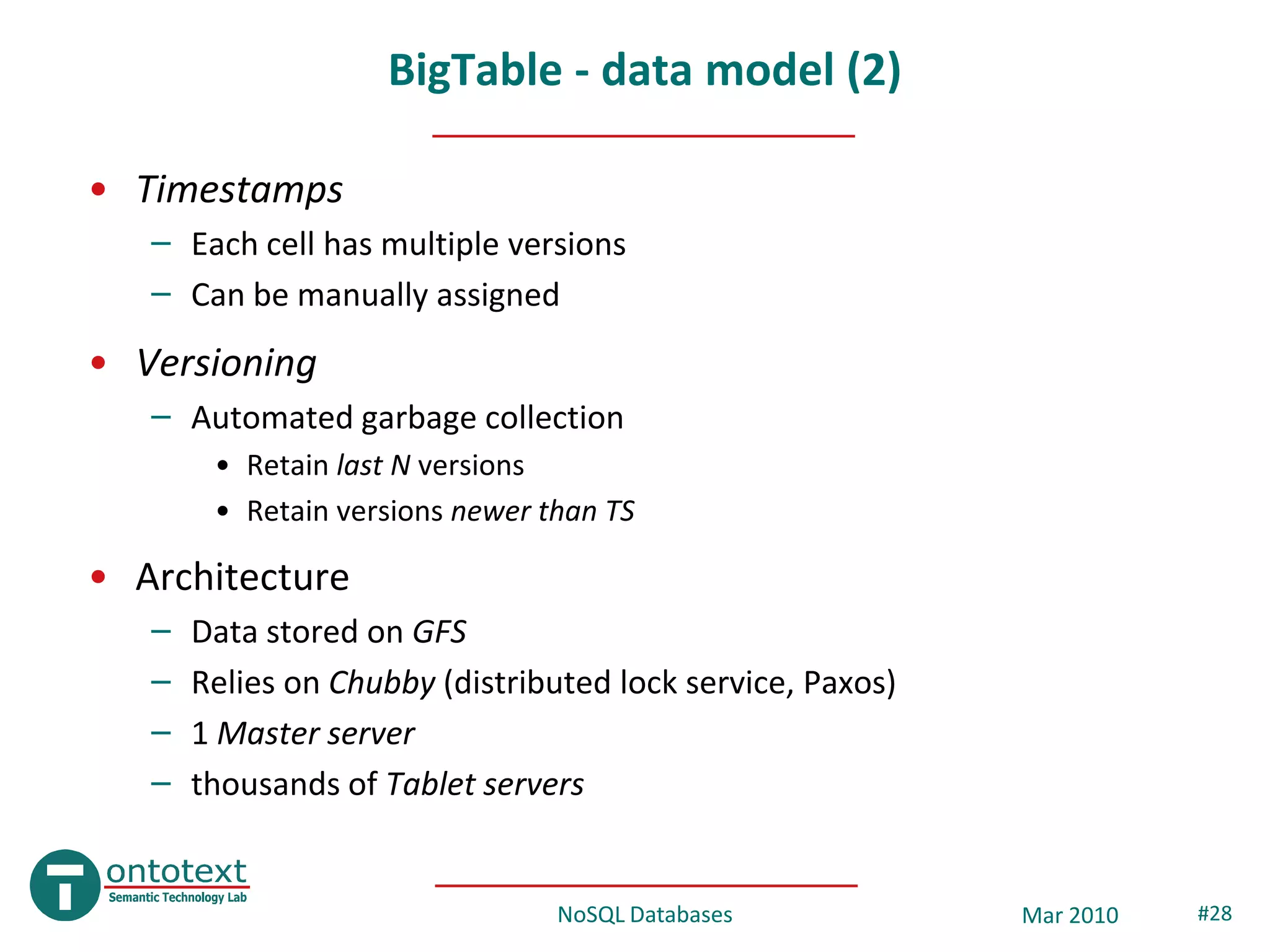
BigTable - data model (2)

• Timestamps
   – Each cell has multiple versions
   – Can be manually assigned
• Versioning
   – Automated garbage collection
        • Retain last N versions
        • Retain versions newer than TS

• Architecture
   –   Data stored on GFS
   –   Relies on Chubby (distributed lock service, Paxos)
   –   1 Master server
   –   thousands of Tablet servers


                                 NoSQL Databases            Mar 2010   #28
BigTable - architecture

• Master server
   –   Assign tablets to Tablet Servers
   –   Balance TS load
   –   Garbage collection
   –   Schema management
   –   Client data does not move through the MS (directly through TS)
   –   Tablet location not handled by MS
• Tablet server (many)
   – thousands of tablets per TS
   – Manages Read / Write / Split of its tablets


                               NoSQL Databases                 Mar 2010   #29
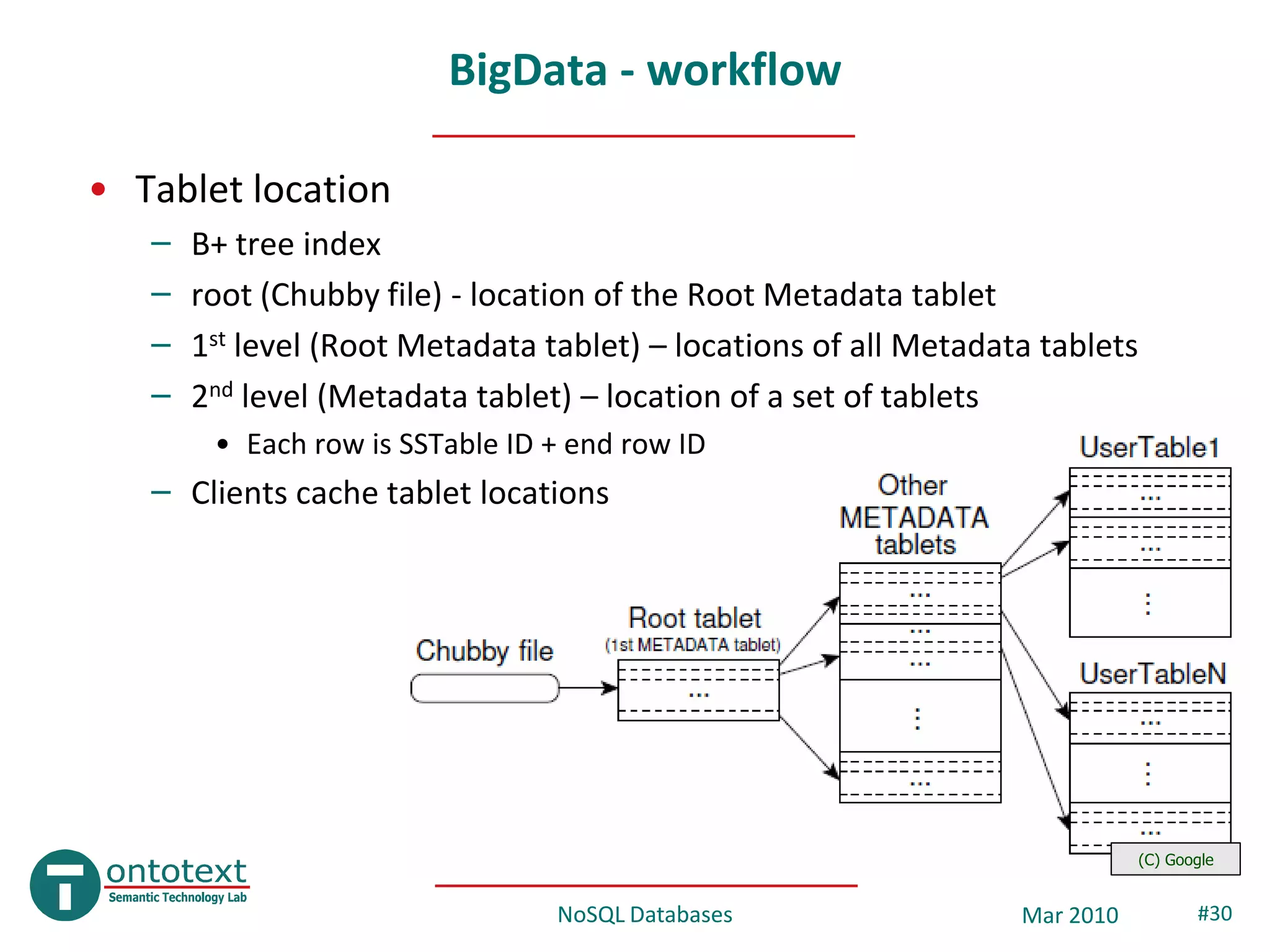
BigData - workflow

• Tablet location
   –   B+ tree index
   –   root (Chubby file) - location of the Root Metadata tablet
   –   1st level (Root Metadata tablet) – locations of all Metadata tablets
   –   2nd level (Metadata tablet) – location of a set of tablets
        • Each row is SSTable ID + end row ID
   – Clients cache tablet locations


                                                                              (C) Google


                                 NoSQL Databases                  Mar 2010           #30
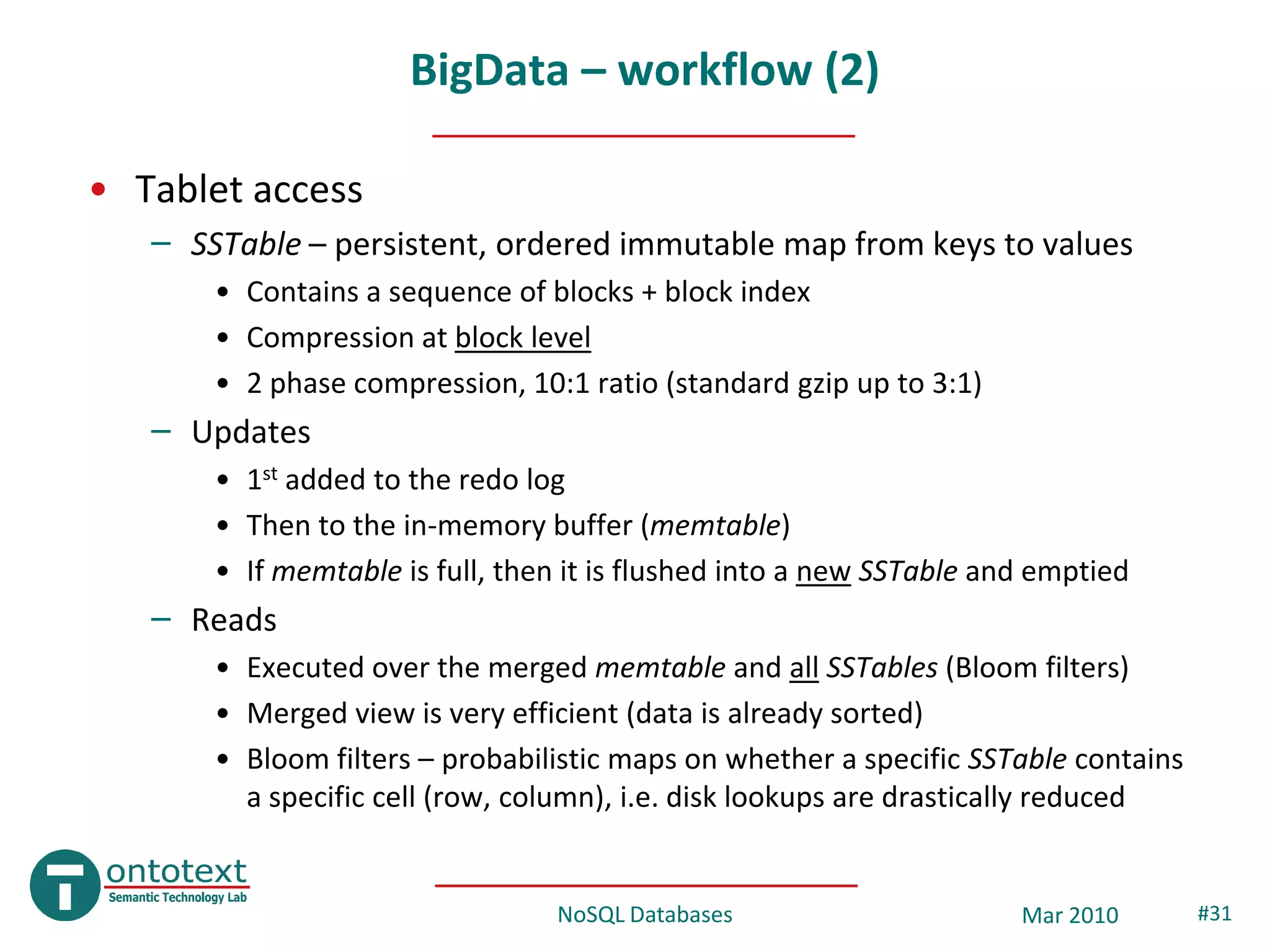
BigData – workflow (2)

• Tablet access
   – SSTable – persistent, ordered immutable map from keys to values
       • Contains a sequence of blocks + block index
       • Compression at block level
       • 2 phase compression, 10:1 ratio (standard gzip up to 3:1)
   – Updates
       • 1st added to the redo log
       • Then to the in-memory buffer (memtable)
       • If memtable is full, then it is flushed into a new SSTable and emptied
   – Reads
       • Executed over the merged memtable and all SSTables (Bloom filters)
       • Merged view is very efficient (data is already sorted)
       • Bloom filters – probabilistic maps on whether a specific SSTable contains
         a specific cell (row, column), i.e. disk lookups are drastically reduced


                                 NoSQL Databases                      Mar 2010       #31
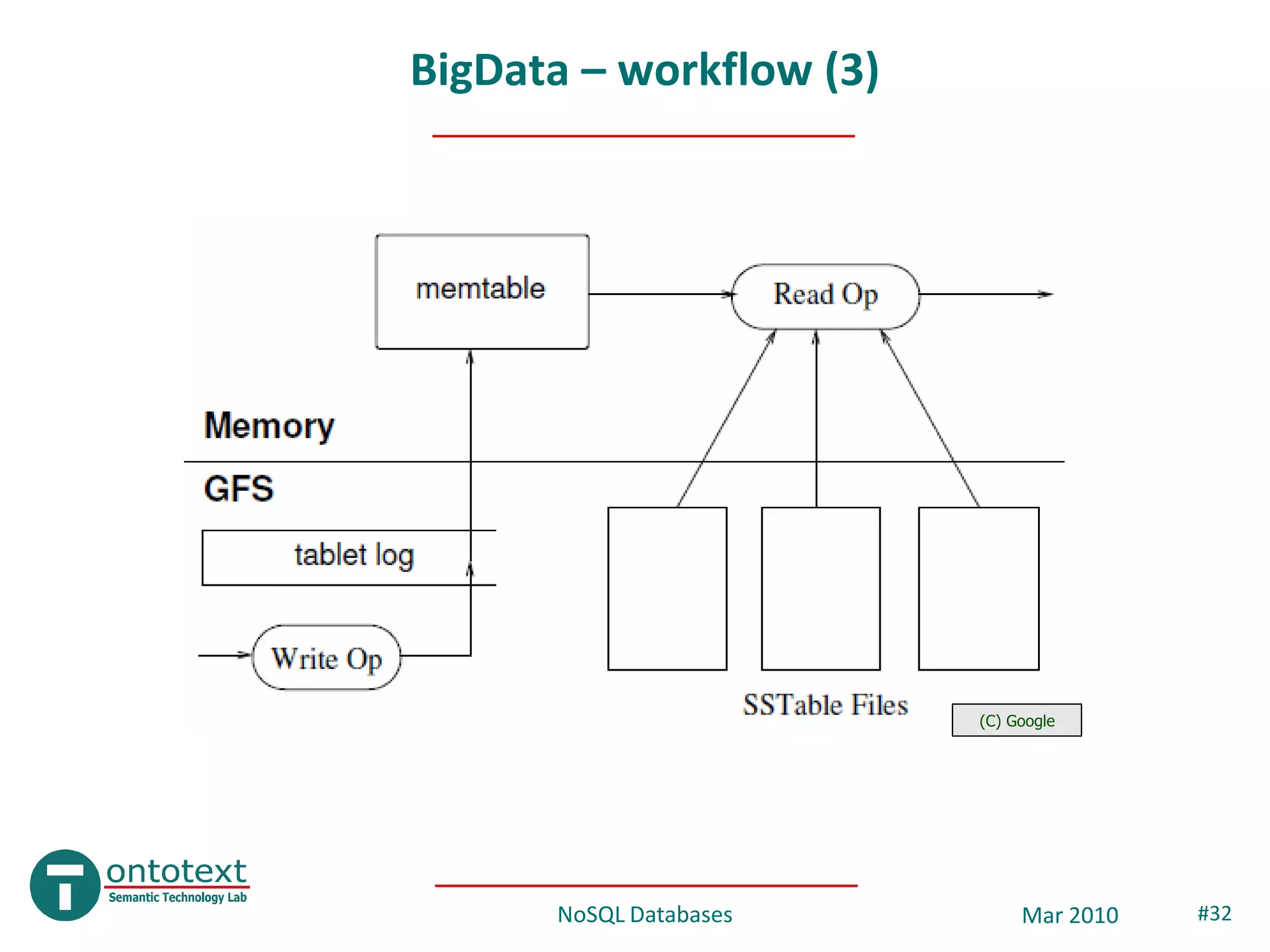
BigData – workflow (3)


                         (C) Google


      NoSQL Databases         Mar 2010   #32
BigData – workflow (4)

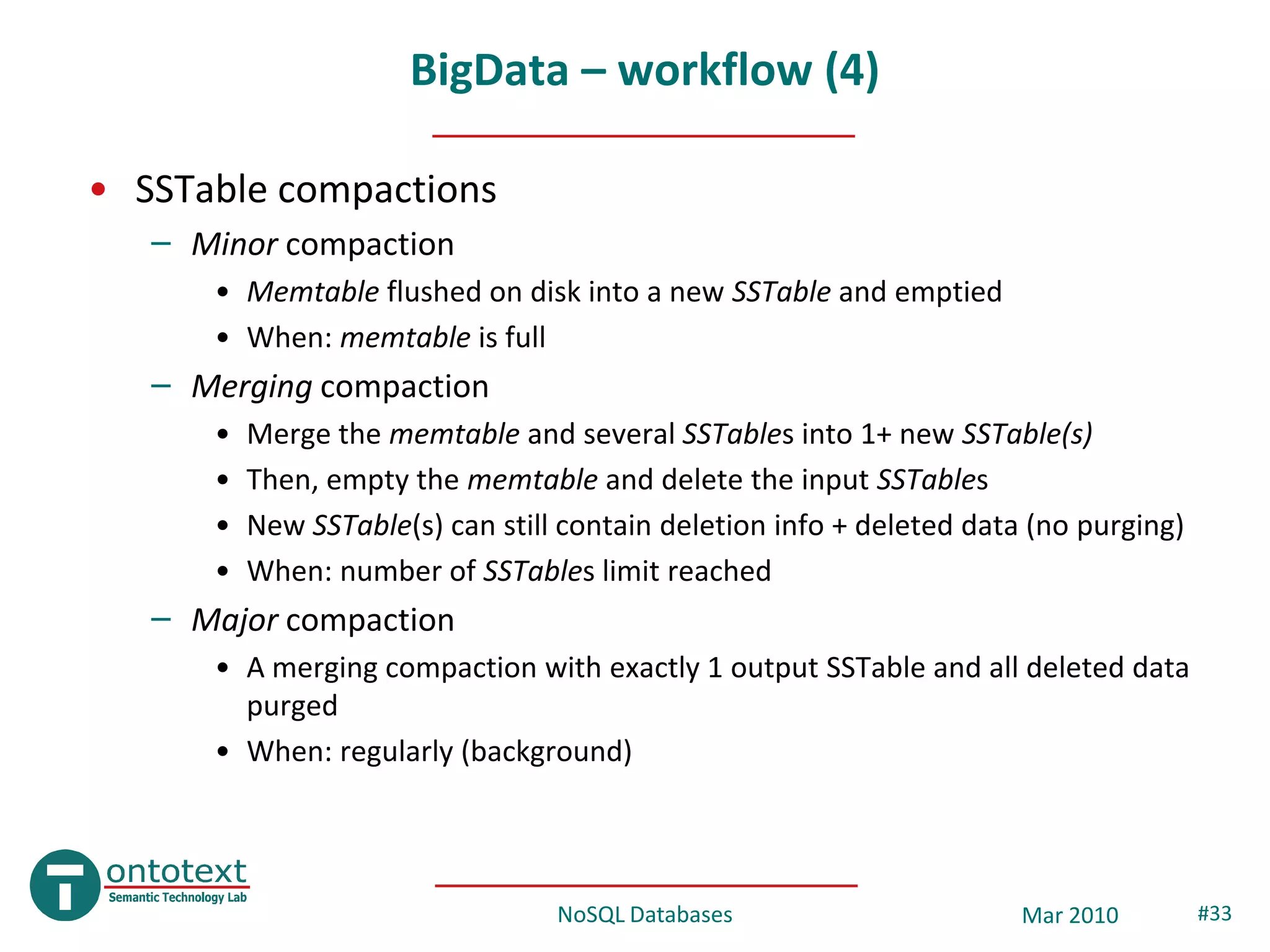
• SSTable compactions
   – Minor compaction
      • Memtable flushed on disk into a new SSTable and emptied
      • When: memtable is full
   – Merging compaction
      •   Merge the memtable and several SSTables into 1+ new SSTable(s)
      •   Then, empty the memtable and delete the input SSTables
      •   New SSTable(s) can still contain deletion info + deleted data (no purging)
      •   When: number of SSTables limit reached
   – Major compaction
      • A merging compaction with exactly 1 output SSTable and all deleted data
        purged
      • When: regularly (background)


                                  NoSQL Databases                      Mar 2010        #33
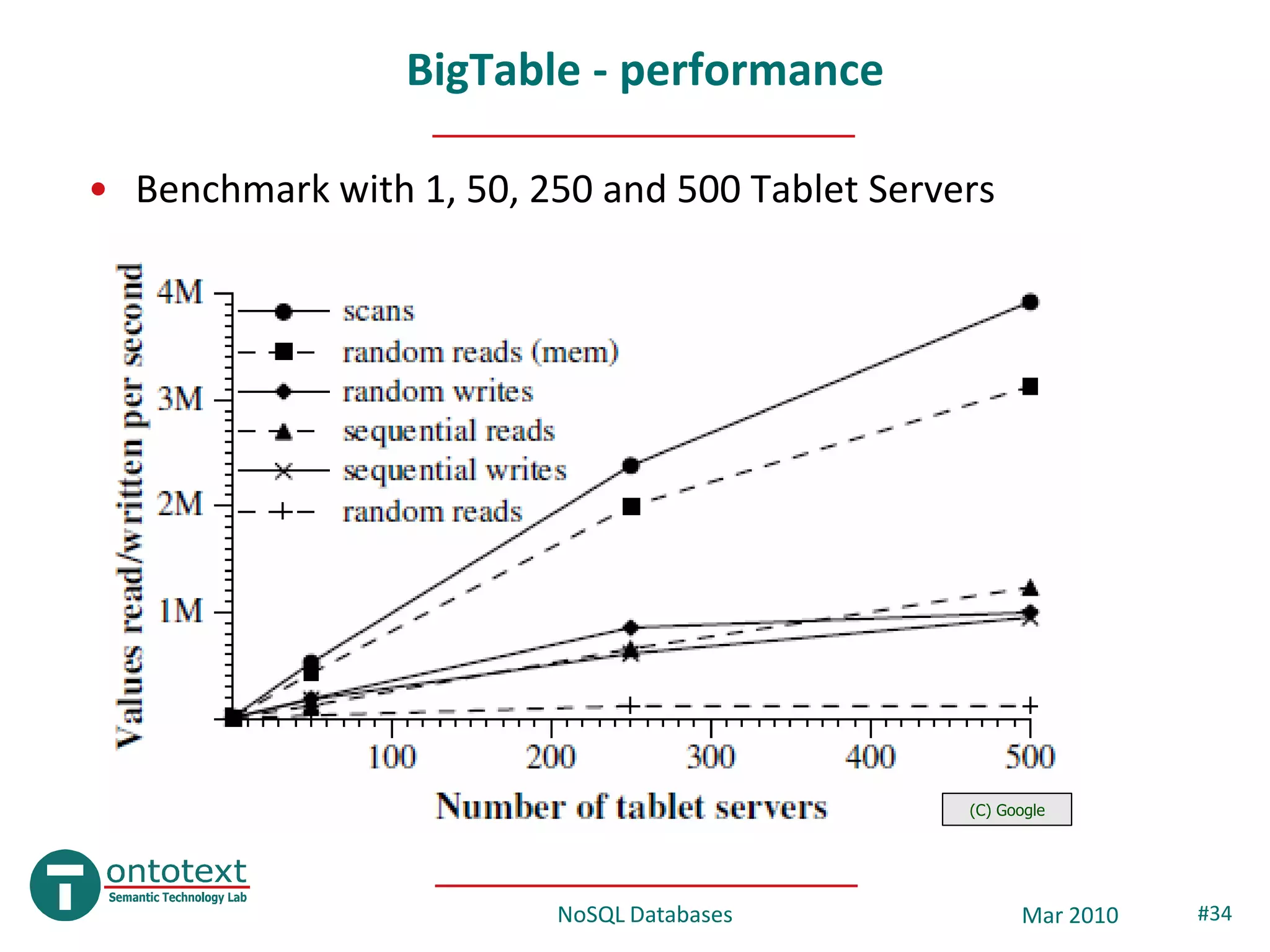
BigTable - performance

• Benchmark with 1, 50, 250 and 500 Tablet Servers


                                                (C) Google


                         NoSQL Databases              Mar 2010   #34
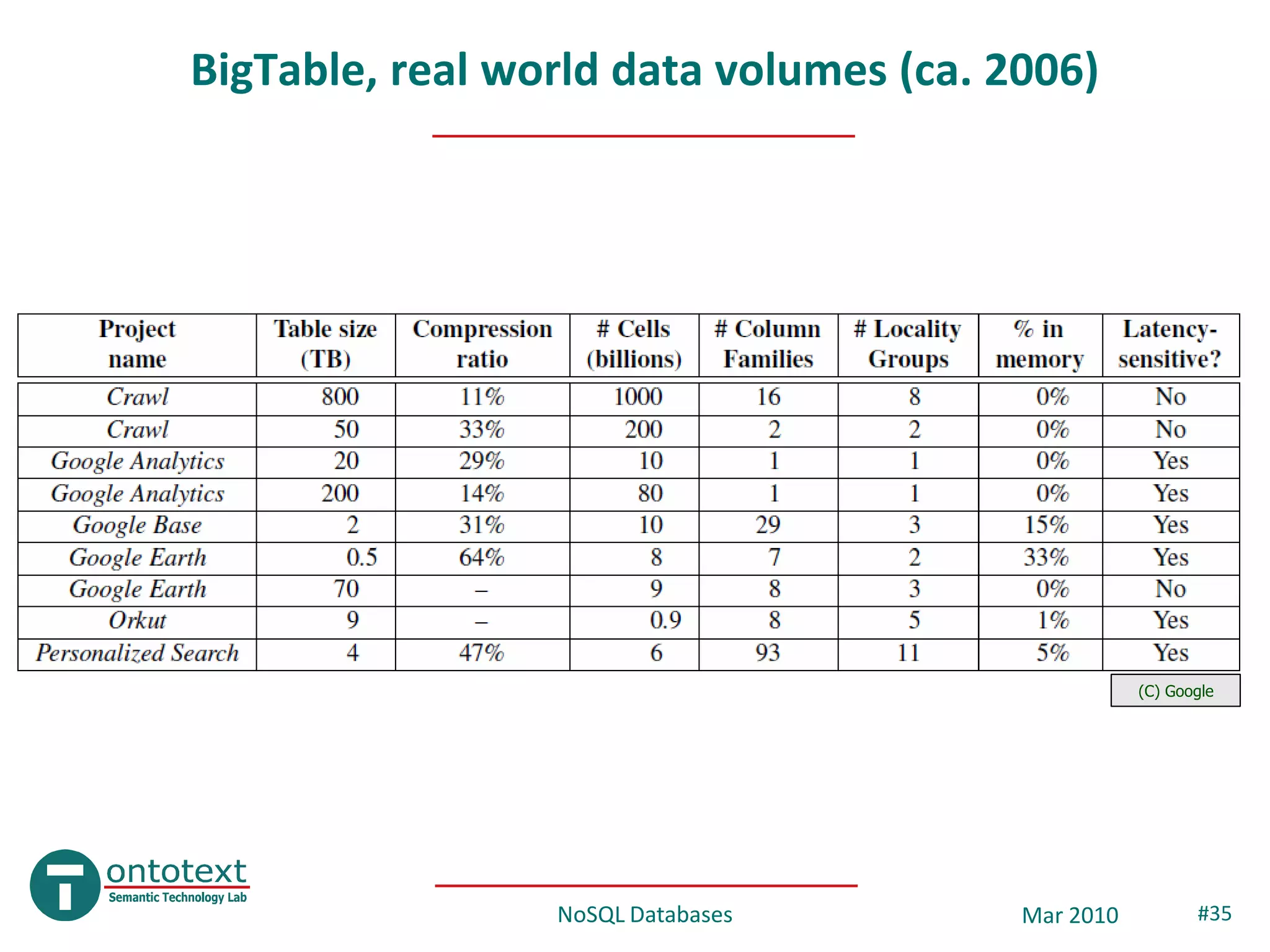
BigTable, real world data volumes (ca. 2006)


                                                   (C) Google


                 NoSQL Databases        Mar 2010          #35
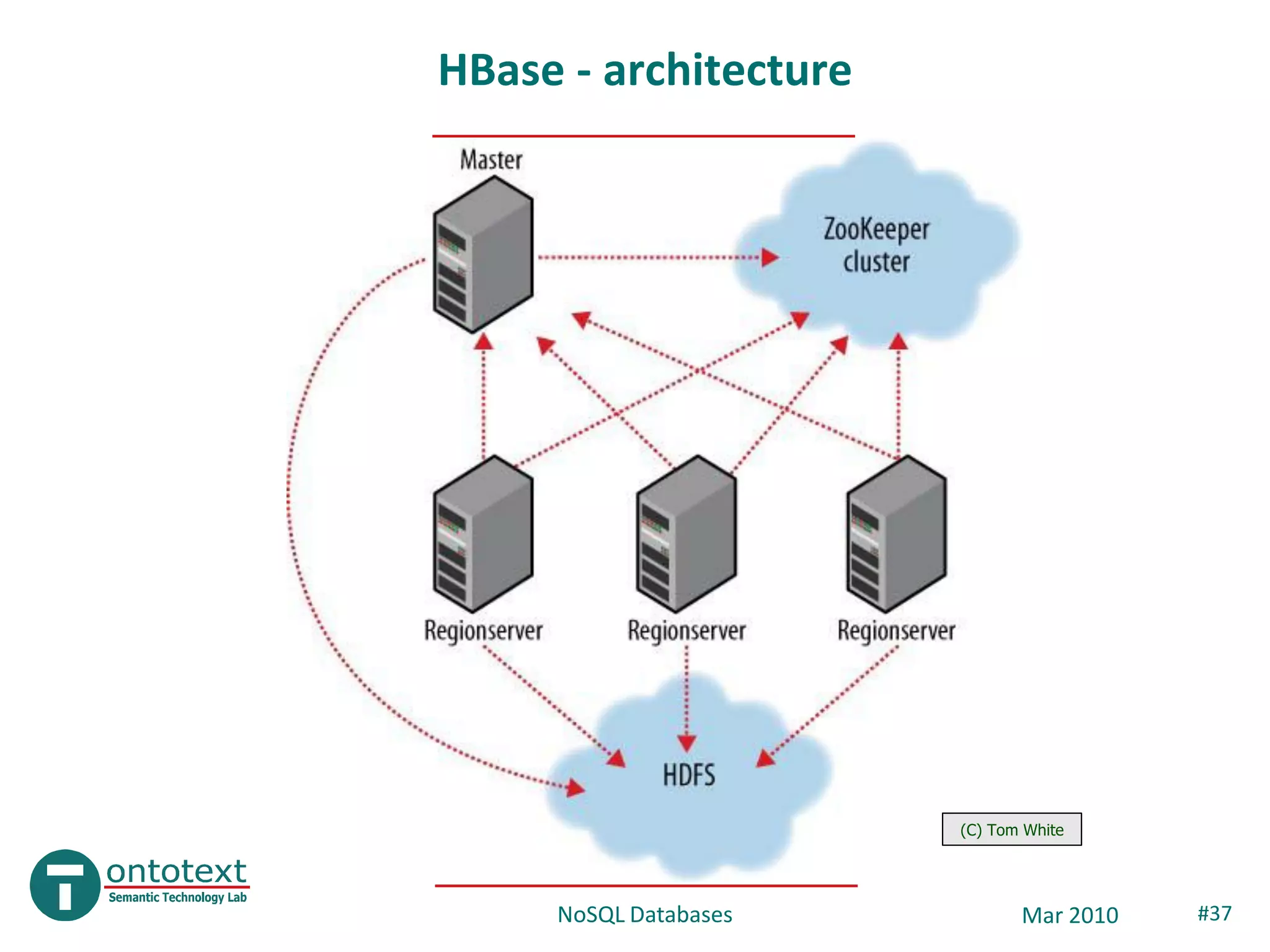
HBase

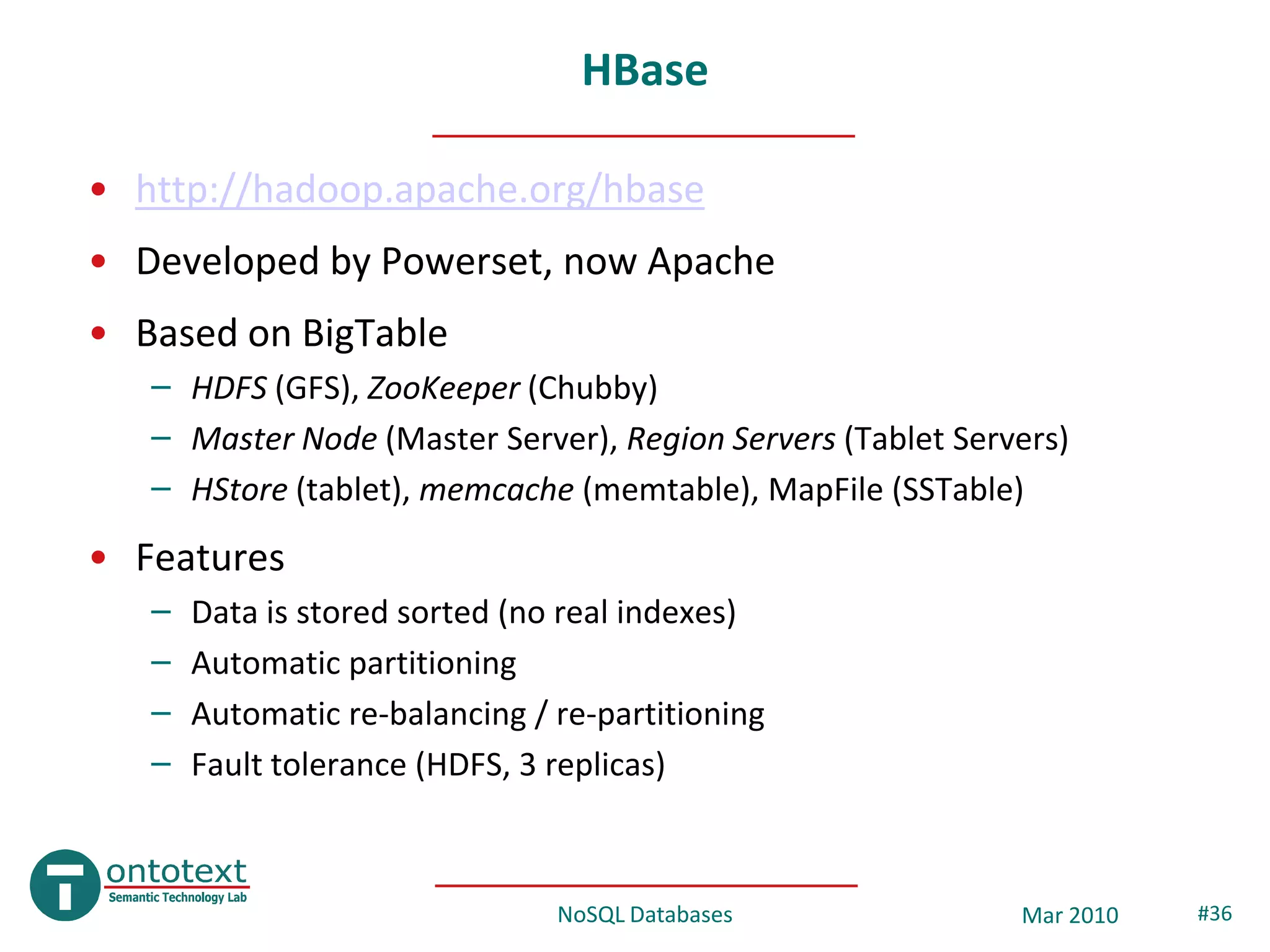
• http://hadoop.apache.org/hbase
• Developed by Powerset, now Apache
• Based on BigTable
   – HDFS (GFS), ZooKeeper (Chubby)
   – Master Node (Master Server), Region Servers (Tablet Servers)
   – HStore (tablet), memcache (memtable), MapFile (SSTable)
• Features
   –   Data is stored sorted (no real indexes)
   –   Automatic partitioning
   –   Automatic re-balancing / re-partitioning
   –   Fault tolerance (HDFS, 3 replicas)


                                NoSQL Databases              Mar 2010   #36
HBase - architecture


                       (C) Tom White


     NoSQL Databases          Mar 2010   #37
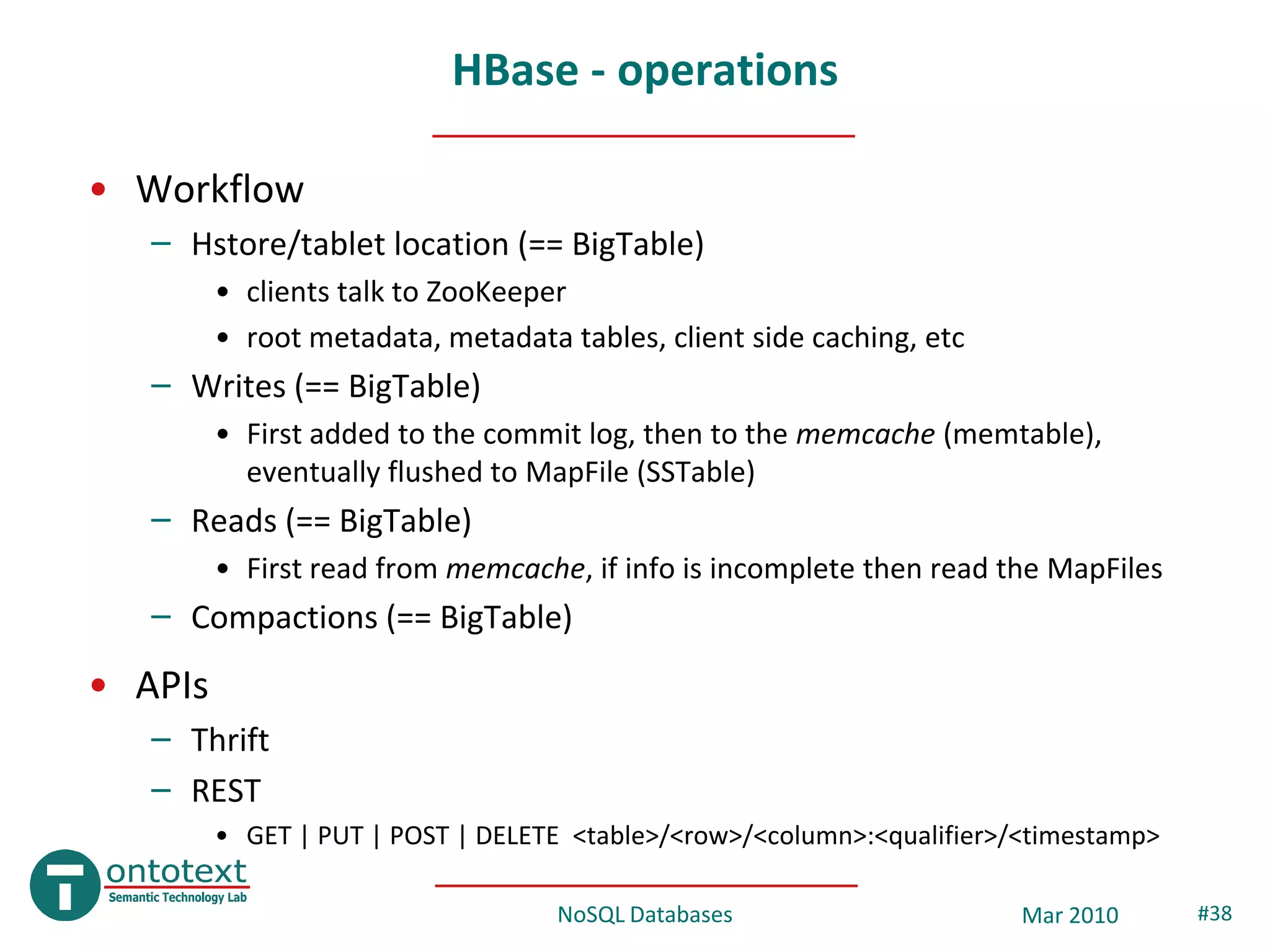
HBase - operations

• Workflow
   – Hstore/tablet location (== BigTable)
         • clients talk to ZooKeeper
         • root metadata, metadata tables, client side caching, etc
   – Writes (== BigTable)
         • First added to the commit log, then to the memcache (memtable),
           eventually flushed to MapFile (SSTable)
   – Reads (== BigTable)
         • First read from memcache, if info is incomplete then read the MapFiles
   – Compactions (== BigTable)
• APIs
   – Thrift
   – REST
         • GET | PUT | POST | DELETE <table>/<row>/<column>:<qualifier>/<timestamp>

                                   NoSQL Databases                      Mar 2010      #38
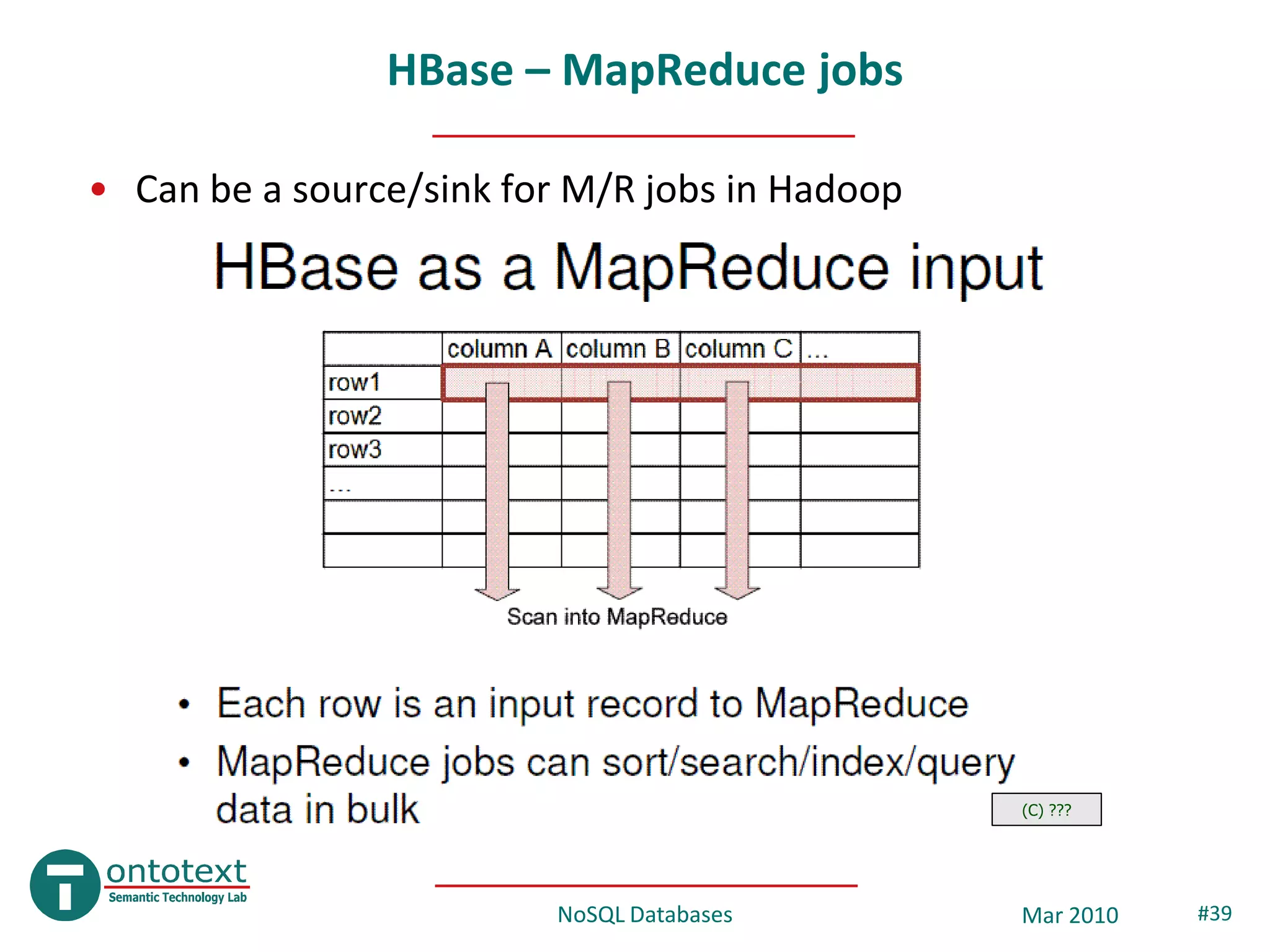
HBase – MapReduce jobs

• Can be a source/sink for M/R jobs in Hadoop


                                                (C) ???


                         NoSQL Databases        Mar 2010   #39
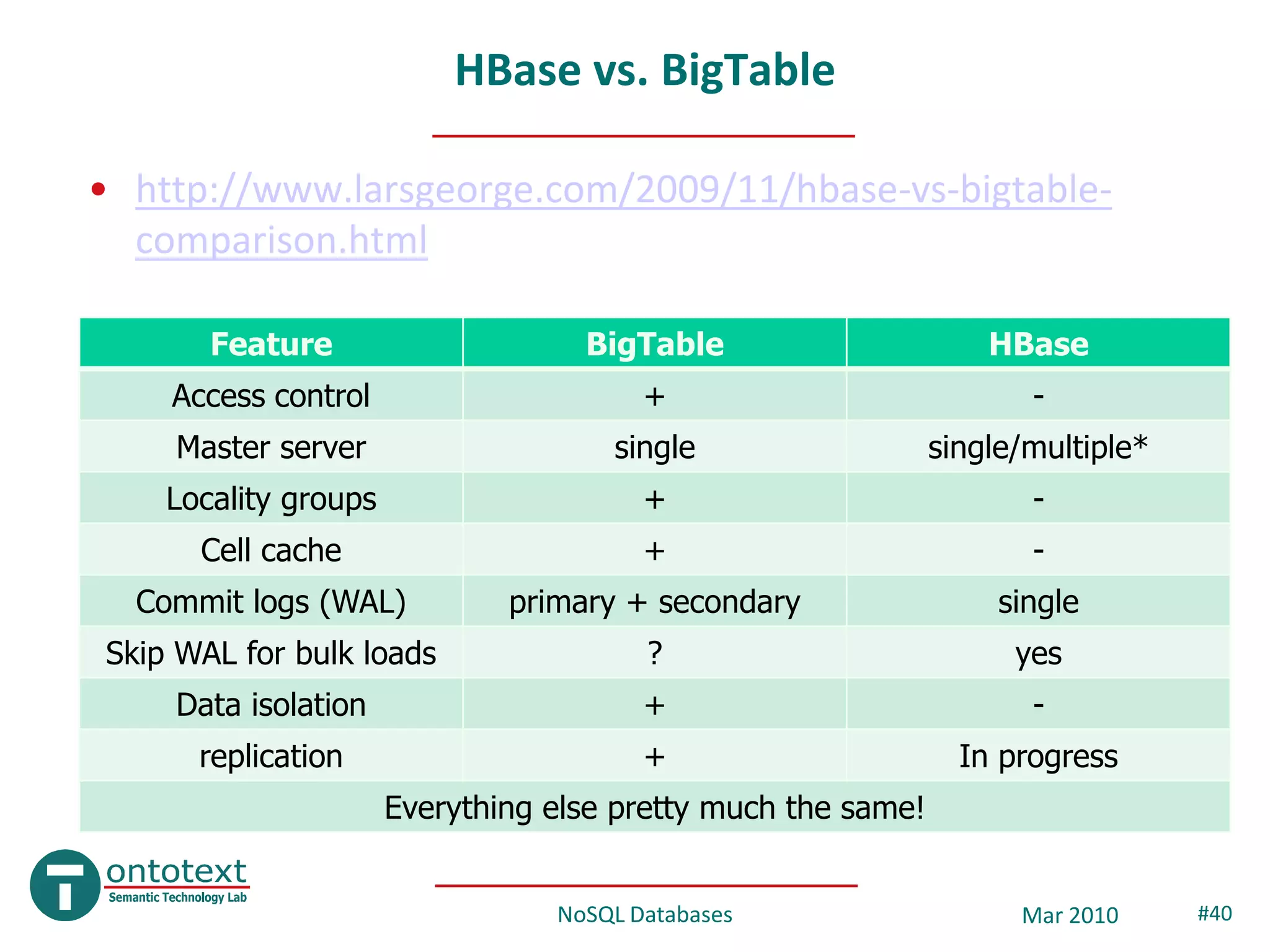
HBase vs. BigTable

• http://www.larsgeorge.com/2009/11/hbase-vs-bigtable-
  comparison.html

       Feature                     BigTable                       HBase
    Access control                      +                            -
    Master server                    single                   single/multiple*
    Locality groups                     +                            -
      Cell cache                        +                            -
  Commit logs (WAL)           primary + secondary                  single
Skip WAL for bulk loads                 ?                           yes
    Data isolation                      +                            -
      replication                       +                       In progress
                      Everything else pretty much the same!


                                 NoSQL Databases                    Mar 2010     #40
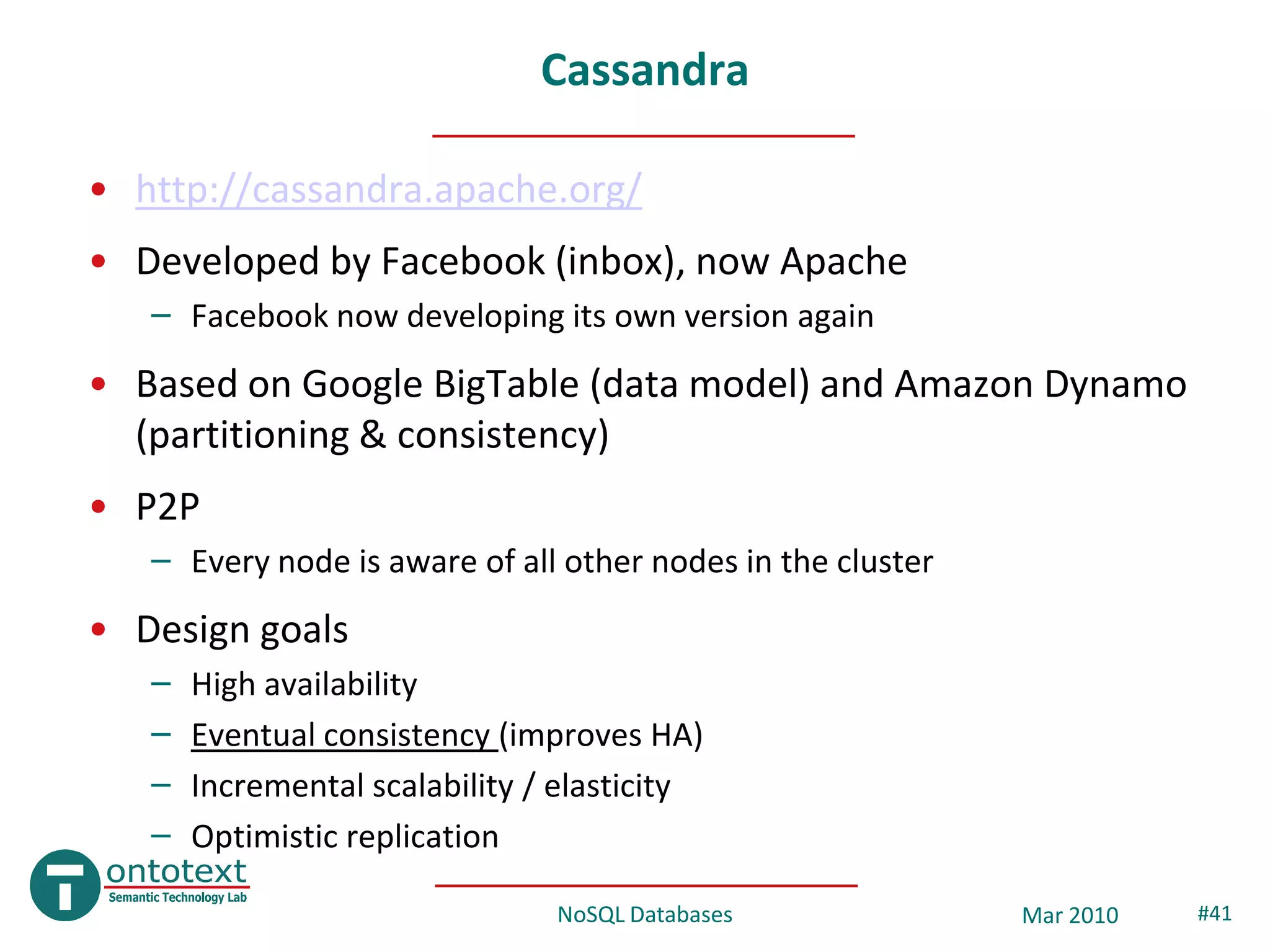
Cassandra

• http://cassandra.apache.org/
• Developed by Facebook (inbox), now Apache
   – Facebook now developing its own version again
• Based on Google BigTable (data model) and Amazon Dynamo
  (partitioning & consistency)
• P2P
   – Every node is aware of all other nodes in the cluster
• Design goals
   –   High availability
   –   Eventual consistency (improves HA)
   –   Incremental scalability / elasticity
   –   Optimistic replication

                                NoSQL Databases              Mar 2010   #41
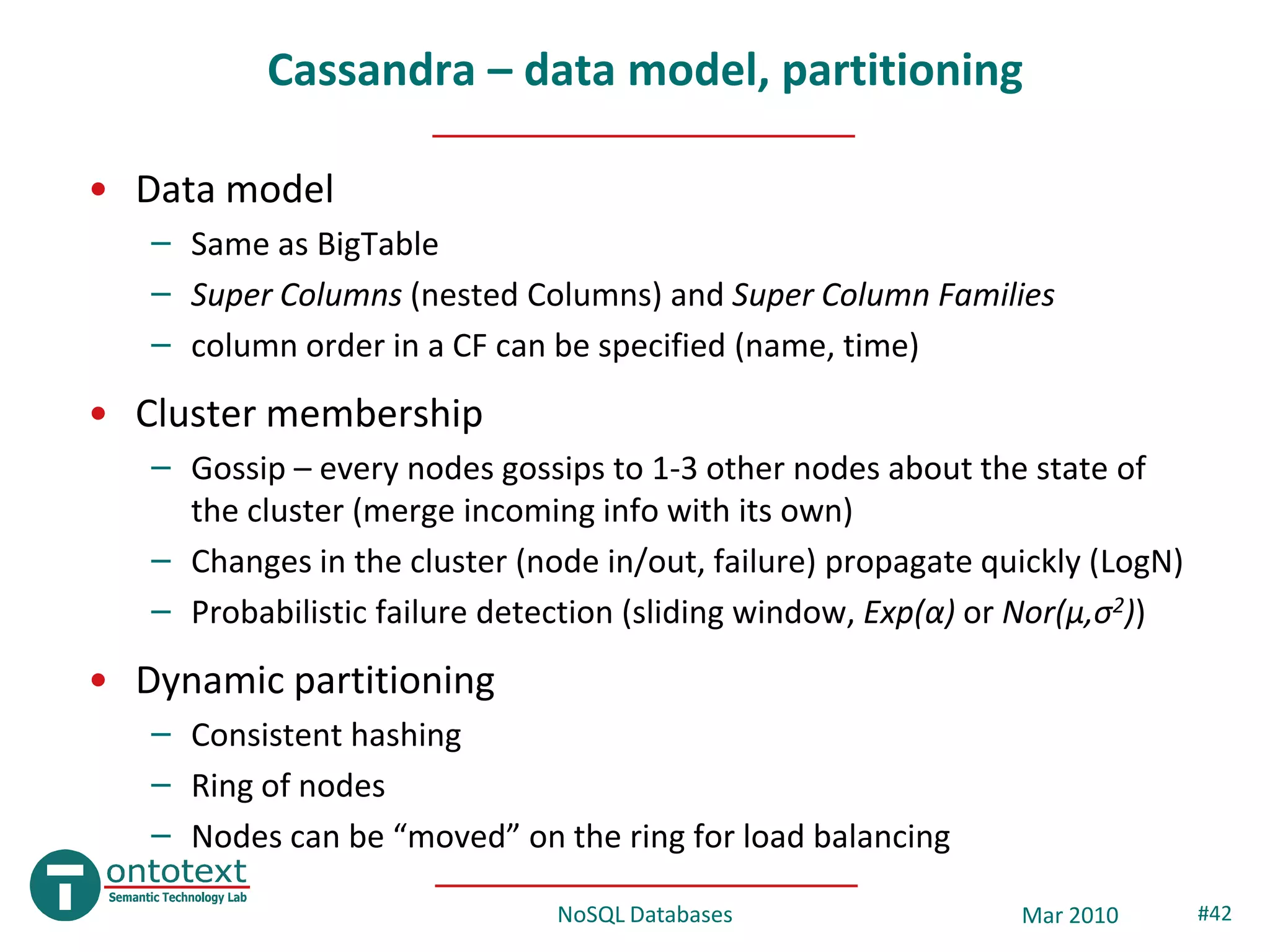
Cassandra – data model, partitioning

• Data model
   – Same as BigTable
   – Super Columns (nested Columns) and Super Column Families
   – column order in a CF can be specified (name, time)
• Cluster membership
   – Gossip – every nodes gossips to 1-3 other nodes about the state of
     the cluster (merge incoming info with its own)
   – Changes in the cluster (node in/out, failure) propagate quickly (LogN)
   – Probabilistic failure detection (sliding window, Exp(α) or Nor(μ,σ2))
• Dynamic partitioning
   – Consistent hashing
   – Ring of nodes
   – Nodes can be “moved” on the ring for load balancing

                               NoSQL Databases                 Mar 2010       #42
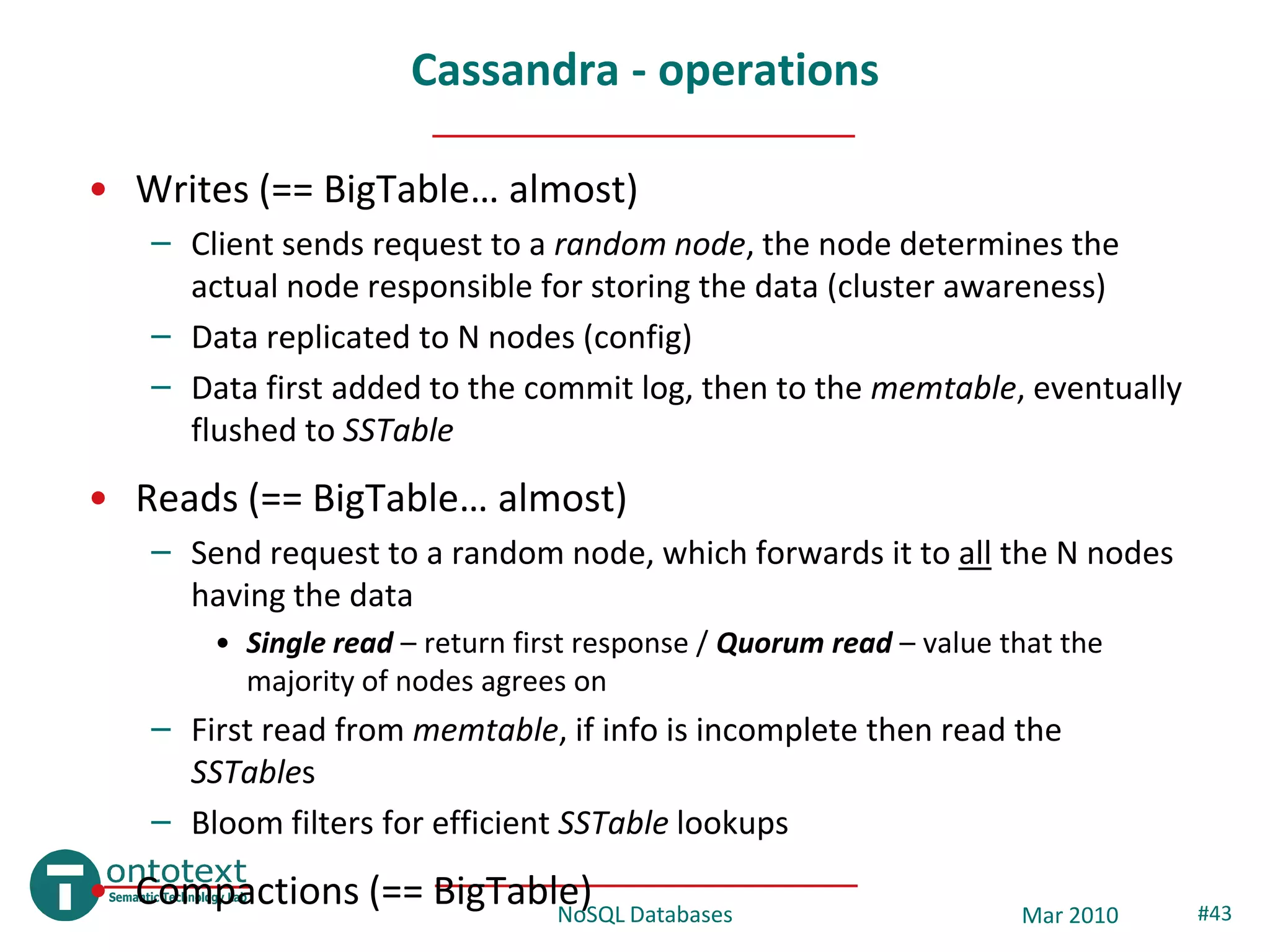
Cassandra - operations

• Writes (== BigTable… almost)
   – Client sends request to a random node, the node determines the
     actual node responsible for storing the data (cluster awareness)
   – Data replicated to N nodes (config)
   – Data first added to the commit log, then to the memtable, eventually
     flushed to SSTable
• Reads (== BigTable… almost)
   – Send request to a random node, which forwards it to all the N nodes
     having the data
       • Single read – return first response / Quorum read – value that the
         majority of nodes agrees on
   – First read from memtable, if info is incomplete then read the
     SSTables
   – Bloom filters for efficient SSTable lookups
• Compactions (== BigTable) Databases
                         NoSQL                                      Mar 2010   #43
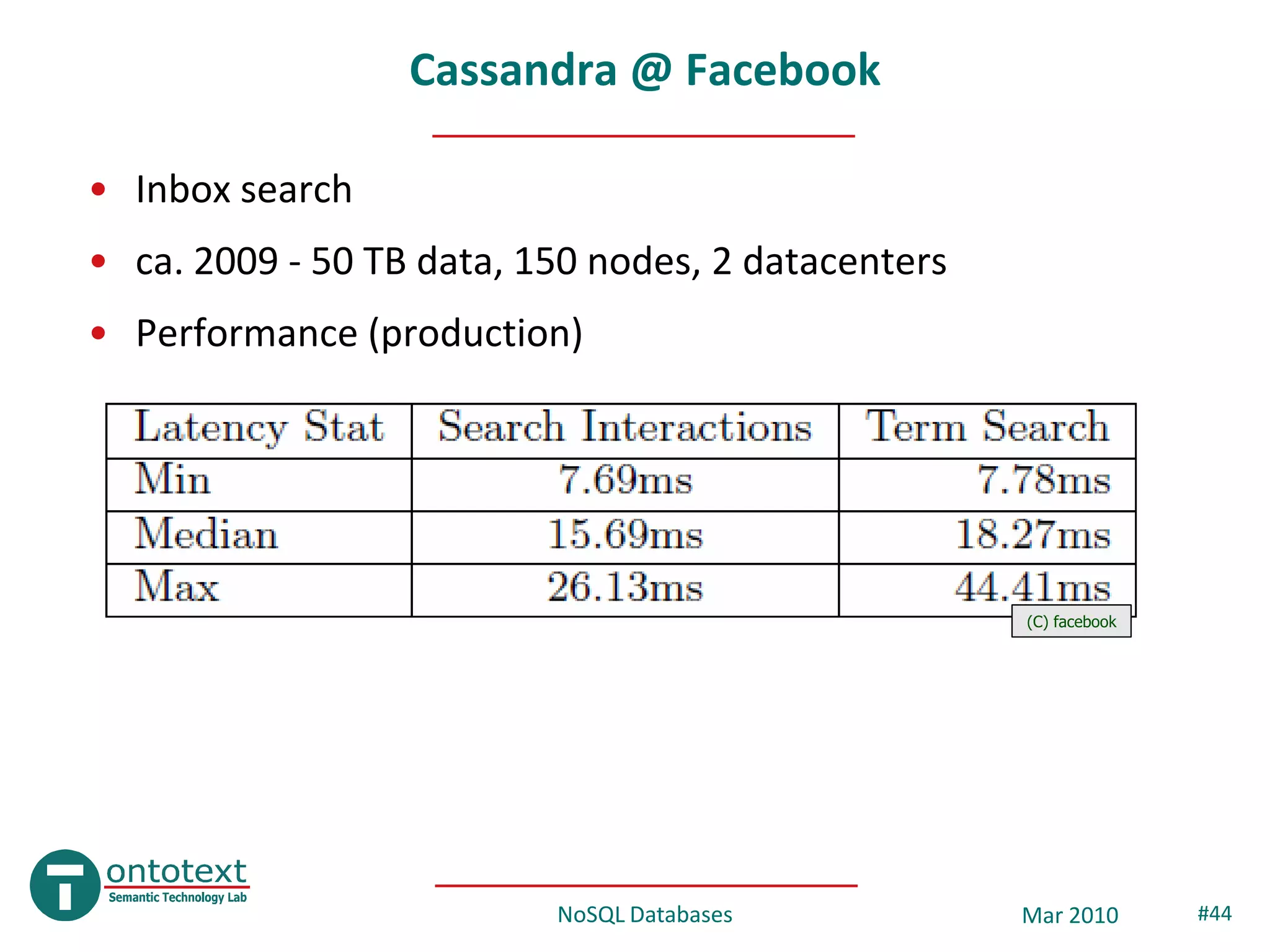
Cassandra @ Facebook

• Inbox search
• ca. 2009 - 50 TB data, 150 nodes, 2 datacenters
• Performance (production)


                                                    (C) facebook


                          NoSQL Databases           Mar 2010       #44
Contents


       Part IV

Document stores
     CouchDB


    NoSQL Databases   Mar 2010   #45
CouchDB

• http://couchdb.apache.org/ , ~2005
• Schema-free, document oriented database
   –   Documents stored in JSON format (XML in old versions)
   –   B-tree storage engine
   –   MVCC model, no locking
   –   no joins, no PK/FK (UUIDs are auto assigned)
   –   Implemented in Erlang
        • 1st version in C++, 2nd in Erlang and 500 times more scalable (source:
          “Erlang Programming” by Cesarini & Thompson)
   – Replication (incremental)
                                   {
• Documents                            “name”: “Ontotext”,
                                       “url”: “www.ontotext.com”
   – UUID, version                     “employees”: 40
   – Old versions retained             “products”: [“OWLIM”, “KIM”, “LifeSKIM”, “JOCI”]
                                   }
                                   NoSQL Databases                      Mar 2010      #46
CouchDB (2)

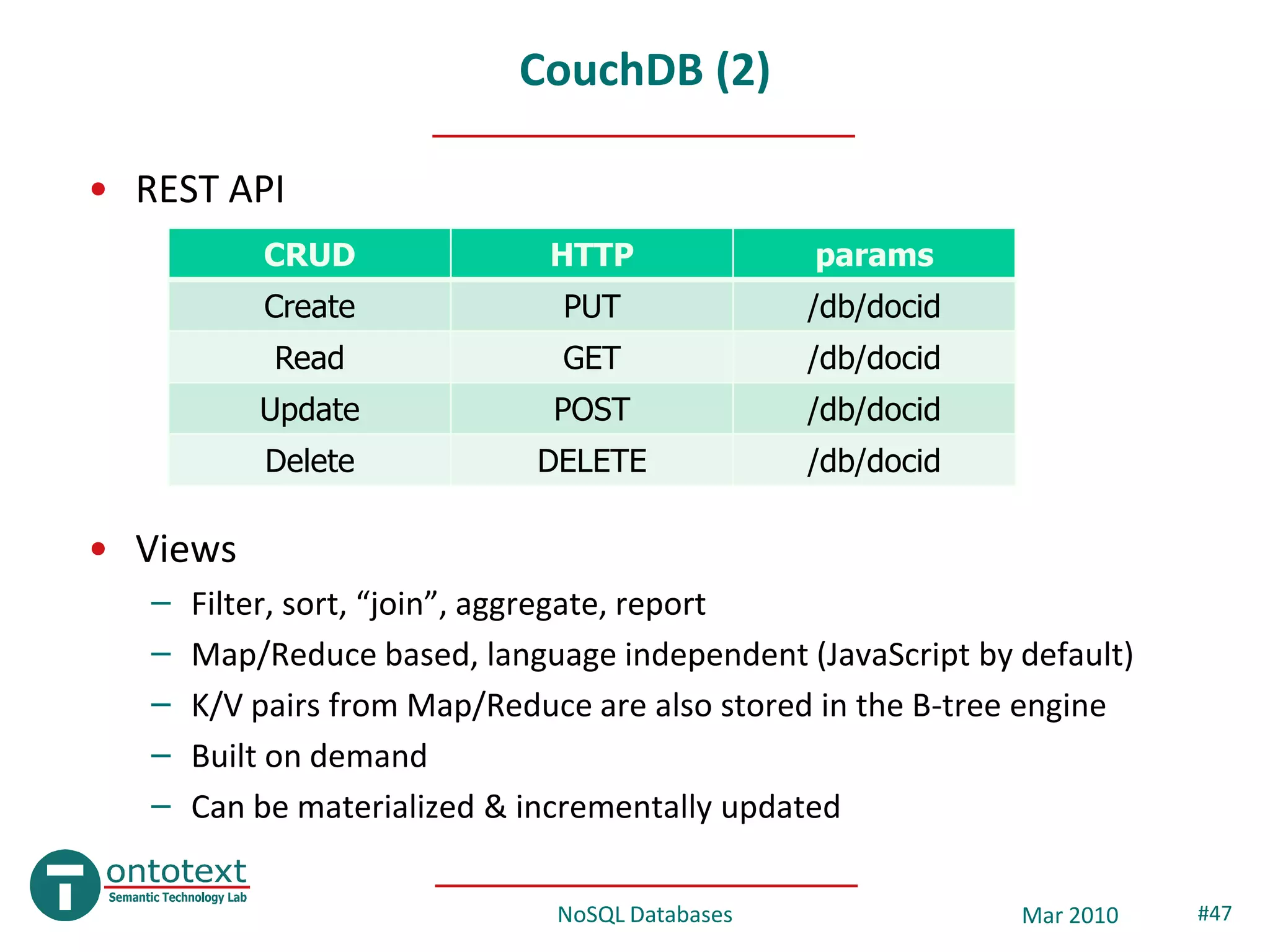
• REST API
           CRUD               HTTP               params
           Create              PUT               /db/docid
            Read               GET               /db/docid
           Update             POST               /db/docid
           Delete            DELETE              /db/docid

• Views
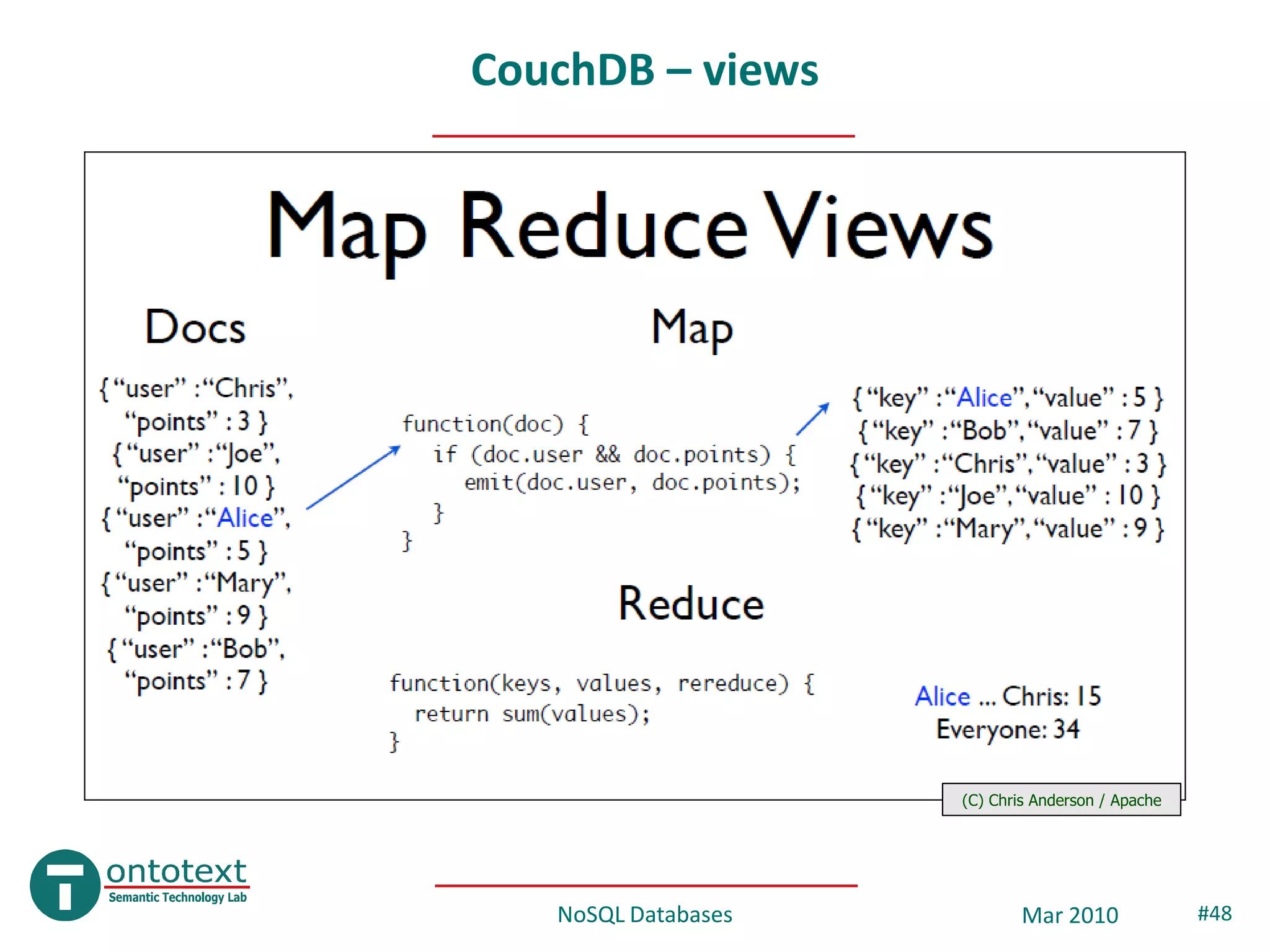
   –   Filter, sort, “join”, aggregate, report
   –   Map/Reduce based, language independent (JavaScript by default)
   –   K/V pairs from Map/Reduce are also stored in the B-tree engine
   –   Built on demand
   –   Can be materialized & incrementally updated

                               NoSQL Databases               Mar 2010   #47
CouchDB – views


                     (C) Chris Anderson / Apache


   NoSQL Databases           Mar 2010              #48
Contents


     Part V

Benchmarks


  NoSQL Databases   Mar 2010   #49
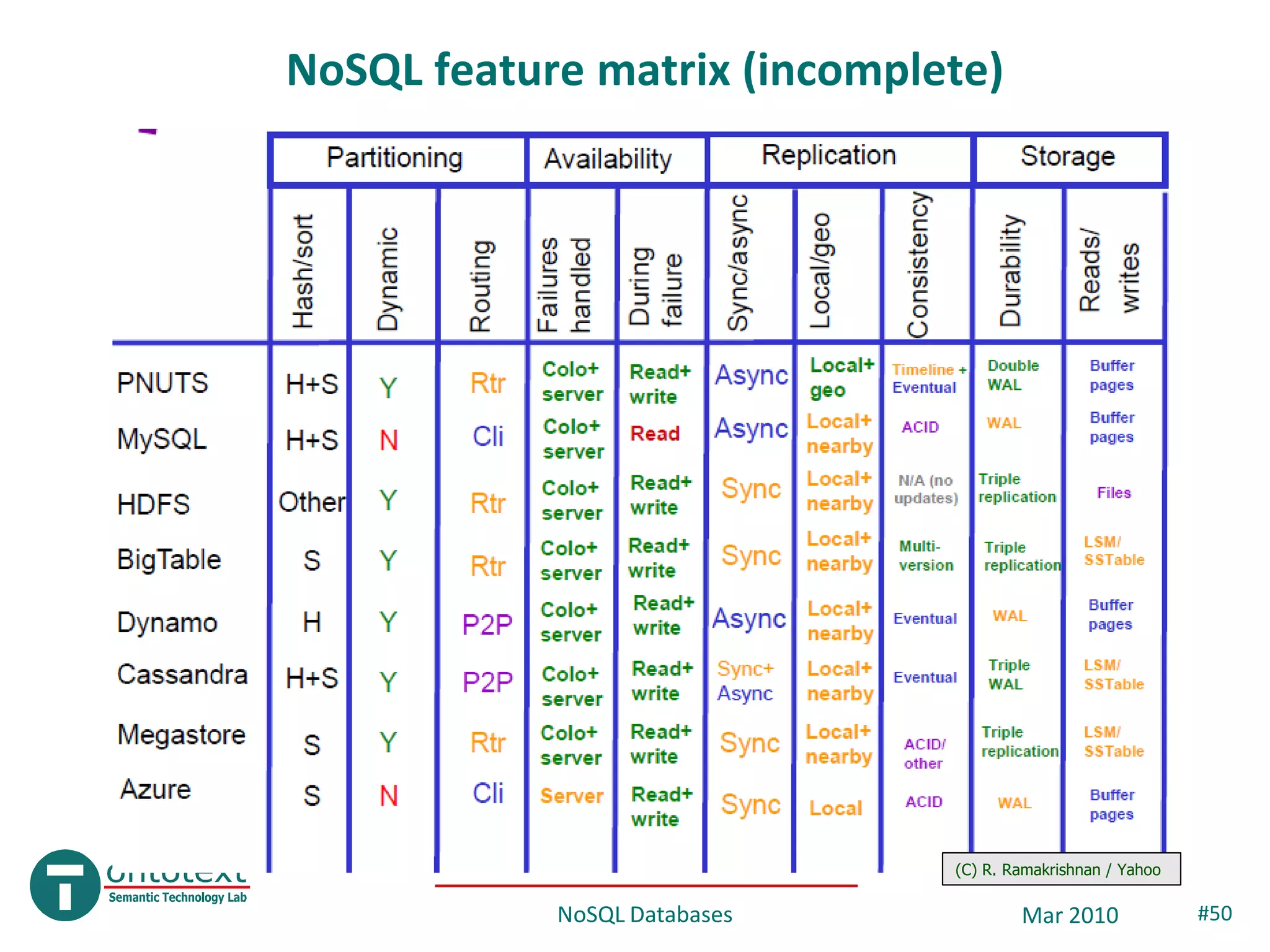
NoSQL feature matrix (incomplete)


                              (C) R. Ramakrishnan / Yahoo

            NoSQL Databases           Mar 2010              #50
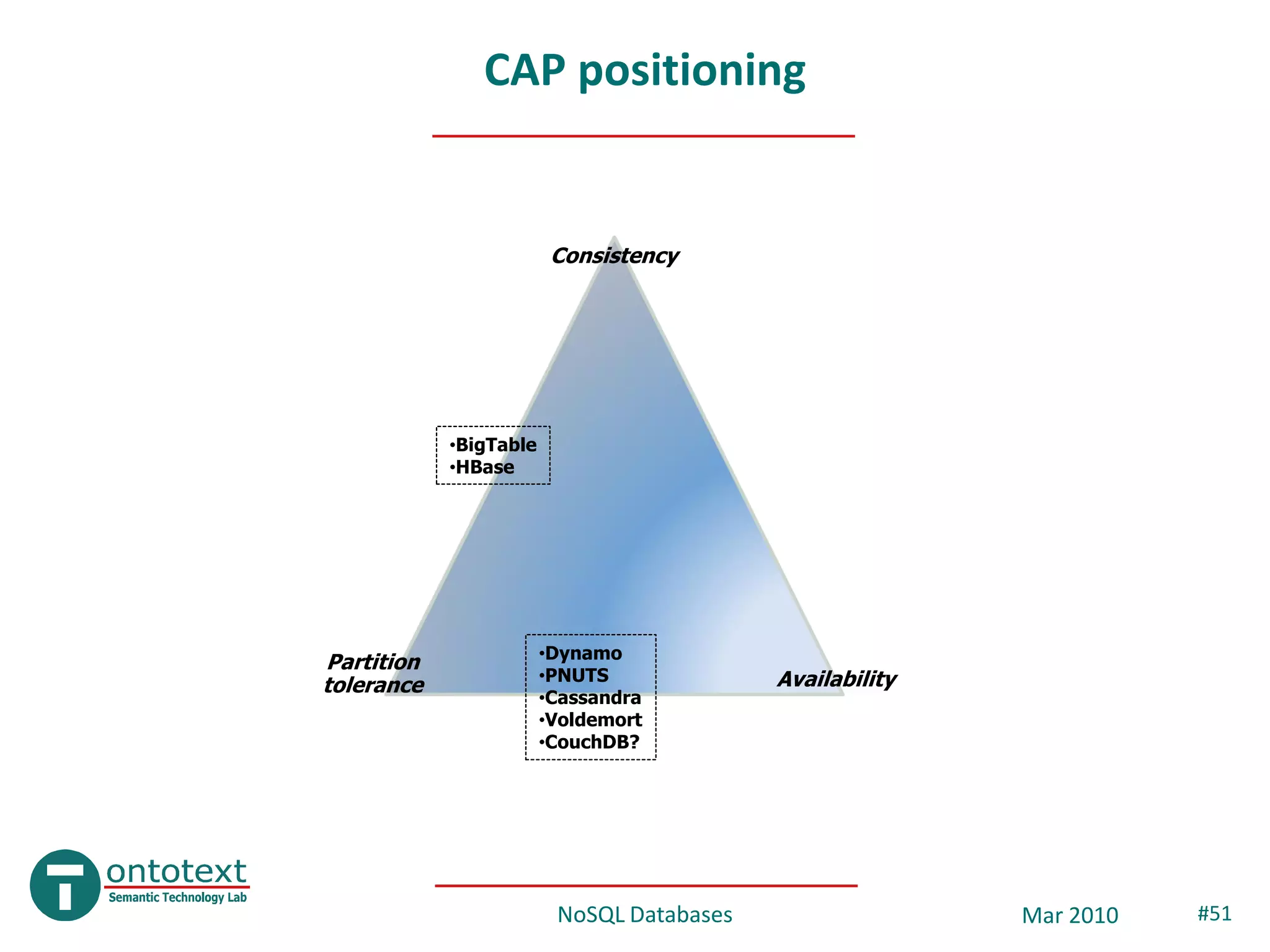
CAP positioning


                         Consistency


            •BigTable
            •HBase


                        •Dynamo
Partition
tolerance               •PNUTS             Availability
                        •Cassandra
                        •Voldemort
                        •CouchDB?


                         NoSQL Databases                  Mar 2010   #51
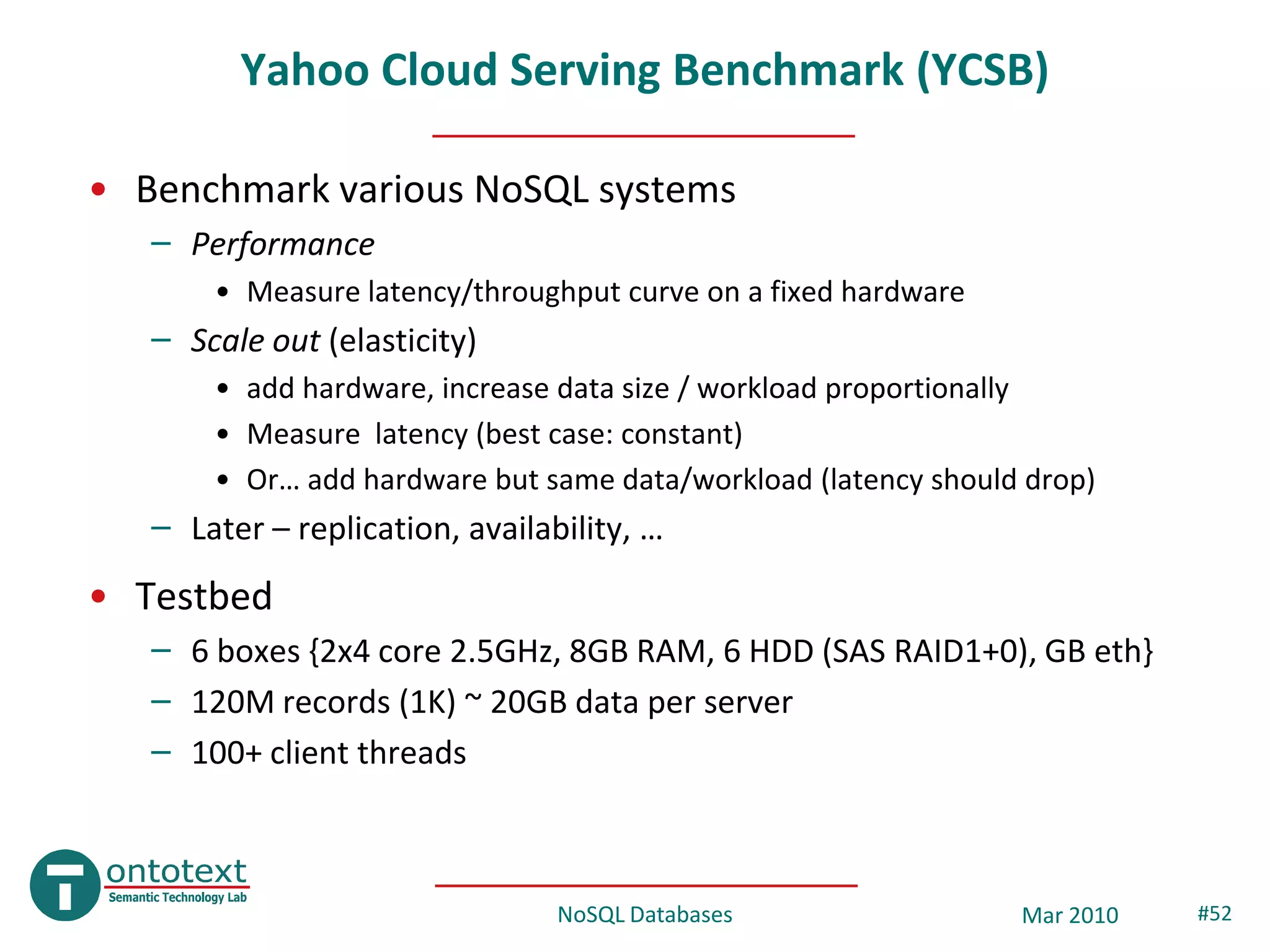
Yahoo Cloud Serving Benchmark (YCSB)

• Benchmark various NoSQL systems
   – Performance
       • Measure latency/throughput curve on a fixed hardware
   – Scale out (elasticity)
       • add hardware, increase data size / workload proportionally
       • Measure latency (best case: constant)
       • Or… add hardware but same data/workload (latency should drop)
   – Later – replication, availability, …
• Testbed
   – 6 boxes {2x4 core 2.5GHz, 8GB RAM, 6 HDD (SAS RAID1+0), GB eth}
   – 120M records (1K) ~ 20GB data per server
   – 100+ client threads


                                 NoSQL Databases                Mar 2010   #52
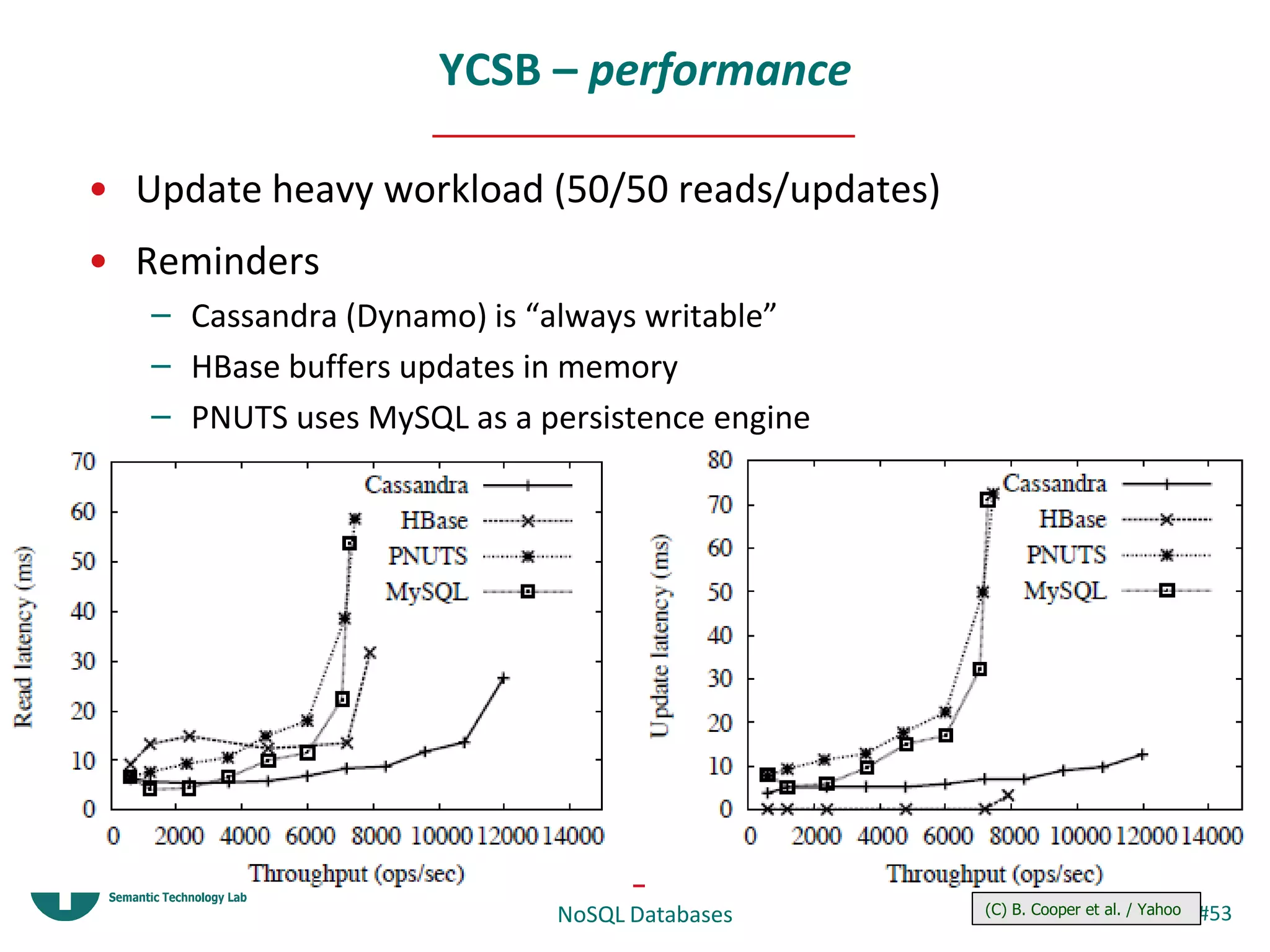
YCSB – performance

• Update heavy workload (50/50 reads/updates)
• Reminders
   – Cassandra (Dynamo) is “always writable”
   – HBase buffers updates in memory
   – PNUTS uses MySQL as a persistence engine


                            NoSQL Databases     (C) B. Cooper et al. / Yahoo   #53
                                                     Mar 2010
YCSB – performance (2)

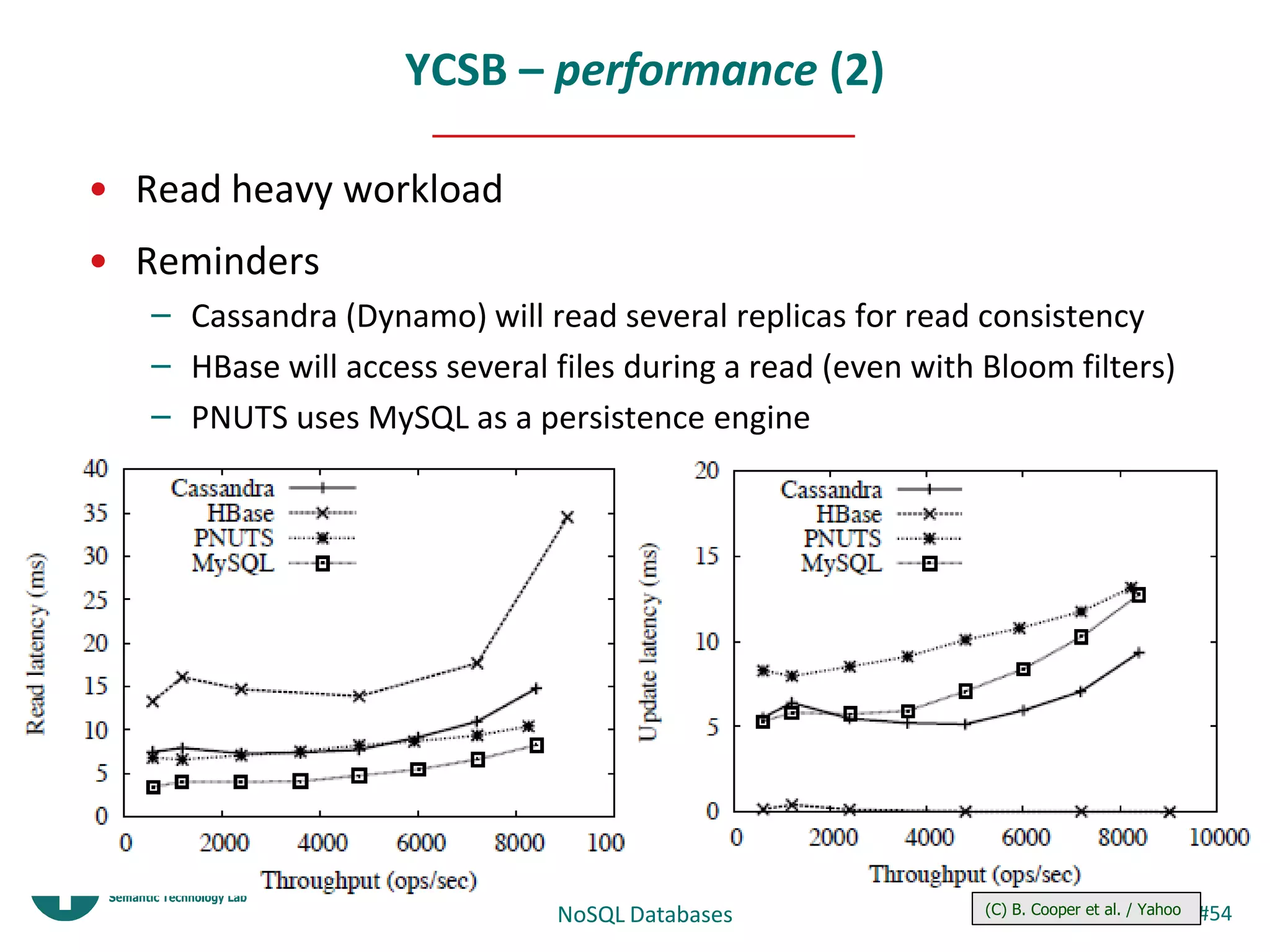
• Read heavy workload
• Reminders
   – Cassandra (Dynamo) will read several replicas for read consistency
   – HBase will access several files during a read (even with Bloom filters)
   – PNUTS uses MySQL as a persistence engine


                               NoSQL Databases                (C) B. Cooper et al. / Yahoo   #54
                                                                   Mar 2010
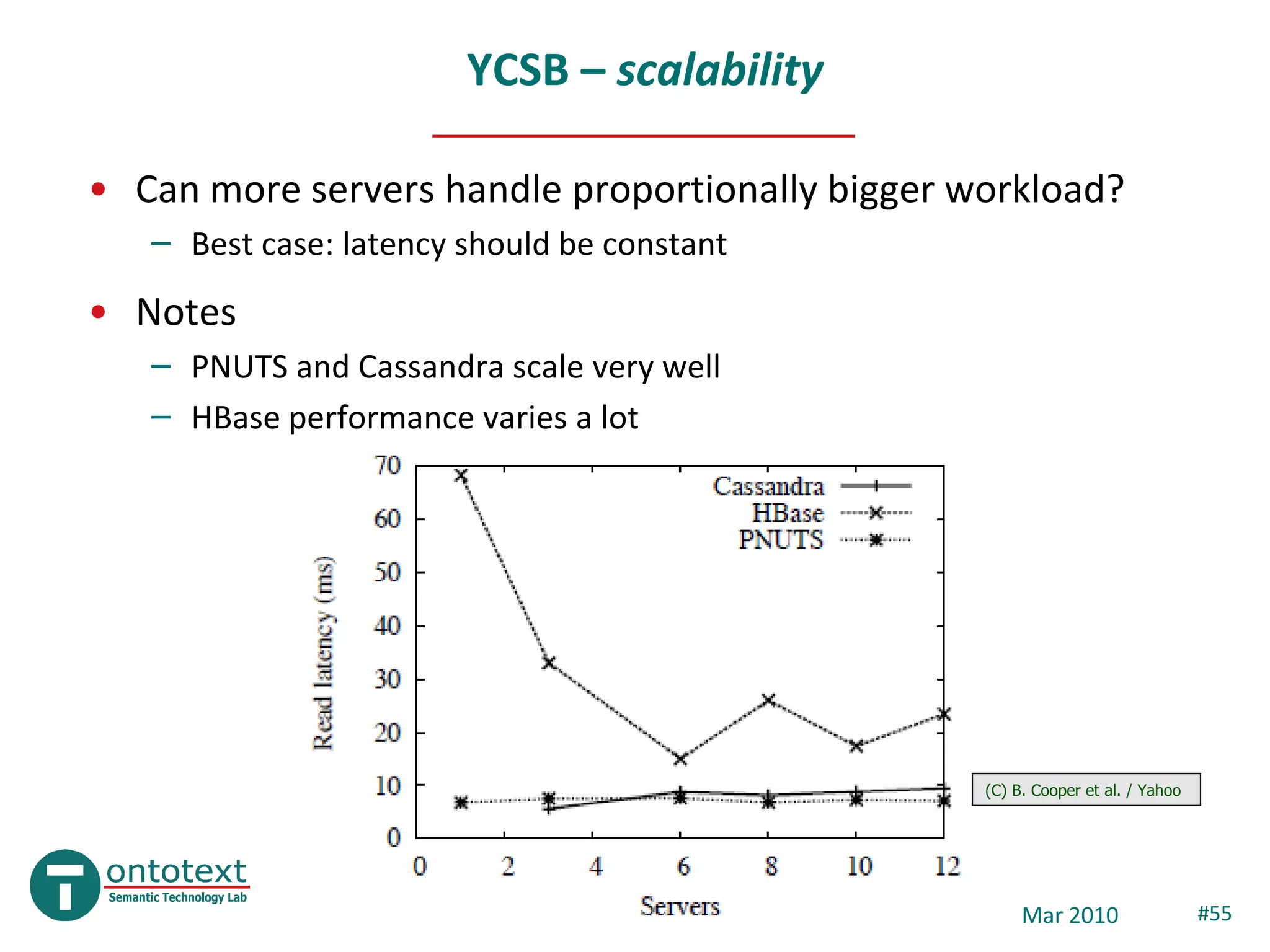
YCSB – scalability

• Can more servers handle proportionally bigger workload?
   – Best case: latency should be constant
• Notes
   – PNUTS and Cassandra scale very well
   – HBase performance varies a lot


                                                 (C) B. Cooper et al. / Yahoo


                              NoSQL Databases         Mar 2010                  #55
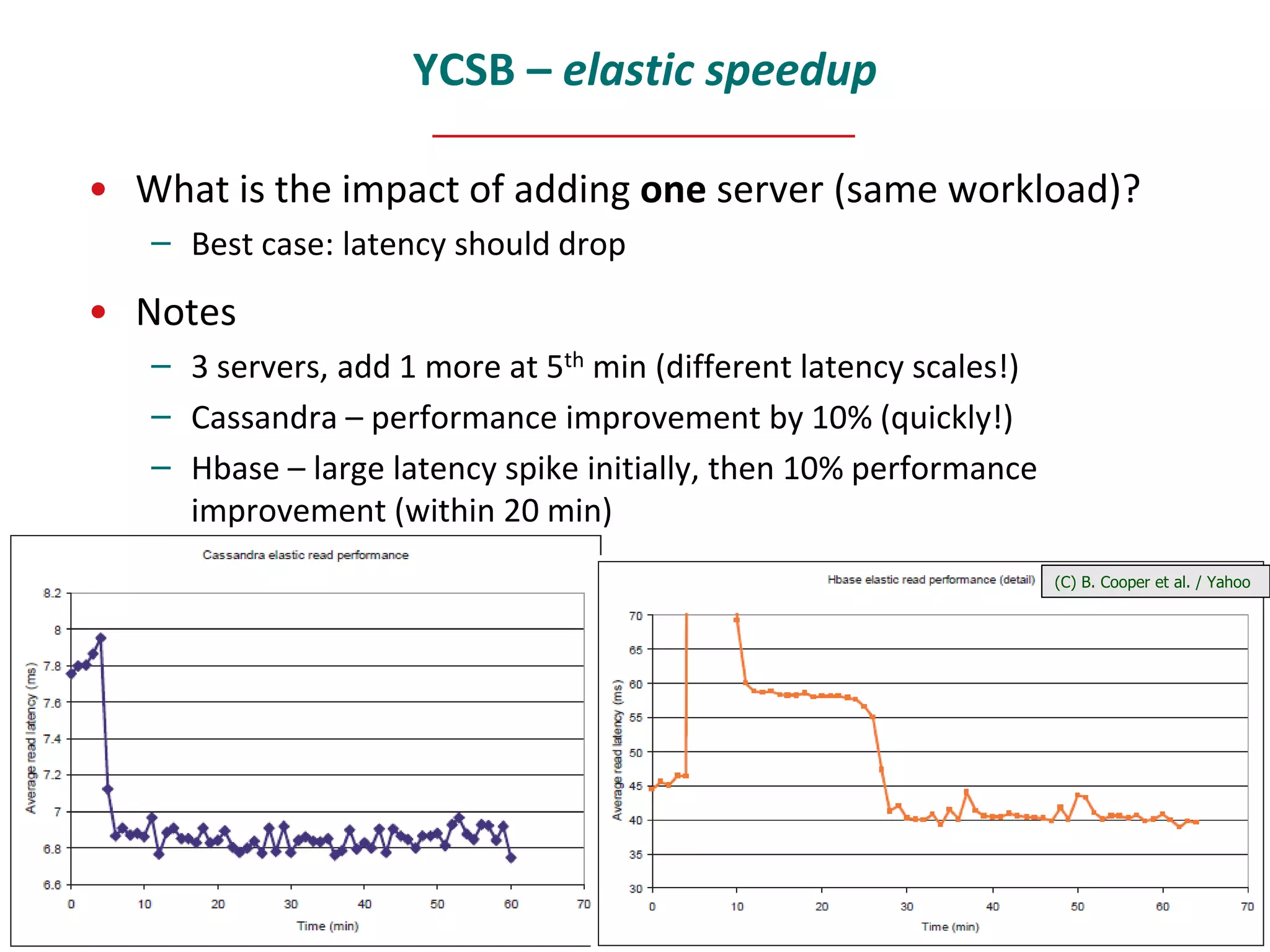
YCSB – elastic speedup

• What is the impact of adding one server (same workload)?
   – Best case: latency should drop
• Notes
   – 3 servers, add 1 more at 5th min (different latency scales!)
   – Cassandra – performance improvement by 10% (quickly!)
   – Hbase – large latency spike initially, then 10% performance
     improvement (within 20 min)
                                                                    (C) B. Cooper et al. / Yahoo


                               NoSQL Databases                 Mar 2010                 #56
Contents


      Part VI

RDF & NoSQL?


   NoSQL Databases   Mar 2010   #57
RDF & NoSQL

• No easy match
   – Partitioning by key not so suitable for RDF (S, P, O)
   – Data locality insufficient for RDF materialisation
   – Full featured query language (SPARQL) cannot be efficiently mapped
     to NoSQL key/value lookups and range scans
   – Eventual consistency is a problem (materialisation with stale data)
• So far RDF limited to the graph databases subset of NoSQL
   – But graph databases don’t provide massive scalability


                              NoSQL Databases                Mar 2010      #58
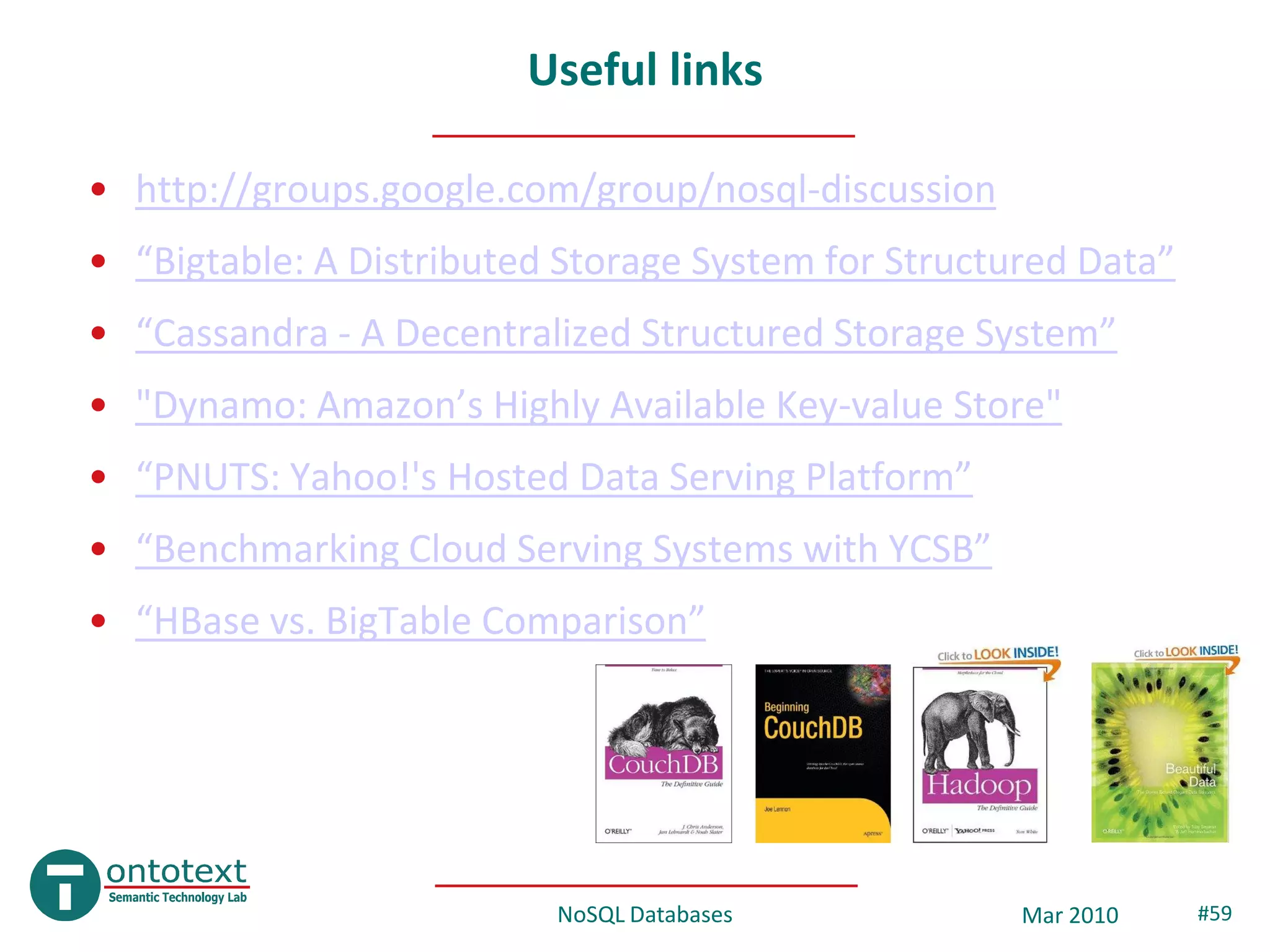
Useful links

• http://groups.google.com/group/nosql-discussion
• “Bigtable: A Distributed Storage System for Structured Data”
• “Cassandra - A Decentralized Structured Storage System”
• "Dynamo: Amazon’s Highly Available Key-value Store"
• “PNUTS: Yahoo!'s Hosted Data Serving Platform”
• “Benchmarking Cloud Serving Systems with YCSB”
• “HBase vs. BigTable Comparison”


                          NoSQL Databases            Mar 2010    #59
Q&A


Questions?


  NoSQL Databases   Mar 2010   #60

NoSQL databases

  • 1.
    NoSQL Databases technology watch #2 Mar 2010
  • 2.
    Contents • Introduction • Key-Valuestores • Column stores • Document stores • Graph Databases • Benchmarks • RDF & NoSQL NoSQL Databases Mar 2010 #2
  • 3.
    Contents Part I Introduction NoSQL Databases Mar 2010 #3
  • 4.
    Why NoSQL? • IsNoSQL equal to “SQL “or to “Not Only SQL”? • ACID doesn’t scale well • Web apps have different needs (than the apps that RDBMS were designed for) – Low and predictable response time (latency) – Scalability & elasticity (at low cost!) – High availability – Flexible schemas / semi-structured data – Geographic distribution (multiple datacenters) • Web apps can (usually) do without – Transactions / strong consistency / integrity – Complex queries NoSQL Databases Mar 2010 #4
  • 5.
    Some NoSQL usecases 1. Massive data volumes – Massively distributed architecture required to store the data – Google, Amazon, Yahoo, Facebook – 10-100K servers 2. Extreme query workload – Impossible to efficiently do joins at that scale with an RDBMS 3. Schema evolution – Schema flexibility (migration) is not trivial at large scale – Schema changes can be gradually introduced with NoSQL NoSQL Databases Mar 2010 #5
  • 6.
    NoSQL pros/cons • Advantages – Massive scalability – High availability – Lower cost (than competitive solutions at that scale) – (usually) predictable elasticity – Schema flexibility, sparse & semi-structured data • Disadvantages – Limited query capabilities (so far) – Eventual consistency is not intuitive to program for • Makes client applications more complicated – No standardizatrion • Portability might be an issue – Insufficient access control NoSQL Databases Mar 2010 #6
  • 7.
    CAP theorem • Requirementsto distributed systems – Consistency – the system is in a consistent state after an operation • All clients see the same data • Strong consistency (ACID) vs. eventual consistency (BASE) – Availability – the system is “always on”, no downtime • Node failure tolerance – all clients can find some available replica • software/hardware upgrade tolerance – Partition tolerance – the system continues to function even when split into disconnected subsets (by a network disruption) • Not only for reads, but writes as well! • CAP Theorem (E. Brewer, N. Lynch) – You can satisfy at most 2 out of the 3 requirements NoSQL Databases Mar 2010 #7
  • 8.
    CAP (2) • CA – Single site clusters (easier to ensure all nodes are always in contact) – e.g. 2PC – When a partition occurs, the system blocks • CP – Some data may be inaccessible (availability sacrificed), but the rest is still consistent/accurate – e.g. sharded database • AP – System is still available under partitioning, but some of the data returned my be inaccurate – e.g. DNS, caches, Master/Slave replication – Need some conflict resolution strategy NoSQL Databases Mar 2010 #8
  • 9.
    … and alsoCAE • CAE trade-off (Amazon?) – Cost-efficiency – High Availability – Elasticity • Pick any two (Cost, Availability, Elasticity) – Cost Efficiency • By over-provisioning you get HA and E – High Availability • Just make the client wait when the system is overloaded (CE and E) – Elasticity • If you can predict your workload, you can provide HA + CE by booking the resources in advance • Everyone wants HA, so the challenge is providing E in a CE way NoSQL Databases Mar 2010 #9
  • 10.
    NoSQL taxonomy • Key-Valuestores – Simple K/V lookups (DHT) • Column stores – Each key is associated with many attributes (columns) – NoSQL column stores are actually hybrid row/column stores • Different from “pure” relational column stores! • Document stores – Store semi-structured documents (JSON) – Map/Reduce based materialisation, sorting, aggregation, etc. • Graph databases – Not exactly NoSQL… • can’t satisfy the requirements for High Availability and Scalability/Elasticity very well NoSQL Databases Mar 2010 #10
  • 11.
    Contents Part II Key-Value stores PNUTS, Dynamo, Voldemort NoSQL Databases Mar 2010 #11
  • 12.
    PNUTS • Yahoo, ~2008,part of the Y! Sherpa platform • Requirements – Scale out / elasticity – Geo-replication – High availability / Fault tolerance – Relaxed consistency • Simplified relational data model – Flexible schema – No Referential Integrity – No joins, aggregation, etc – Updates/deletes only by Primary Key – “Multiget” (retrieve many records by PKs) NoSQL Databases Mar 2010 #12
  • 13.
    PNUTS – consistencymodel • Timeline consistency – In-between serializability and eventual consistency • All replicas apply updates for a record in the same order • but not necessarily at the same time (eventually) – One replica is always chosen as a Master (per record!) • adaptively changed for load re-balancing (usage pattern tracking!) • updates go only to the Master, then async propagation to other replicas / reads go to replicas or Master – Read consistency levels • Read any – may return a stale version of a record (any replica, fast) • Read critical (V) – return a newer (or the same) record version than V • Read latest – most recent version (goes to Master, slow) – Write consistency levels • Write • Test-and-set (V) – write only if the record version is the same as V (ensures serialization) NoSQL Databases Mar 2010 #13
  • 14.
    PNUTS – consistencymodel (2) (C) Yahoo! NoSQL Databases Mar 2010 #14
  • 15.
    PNUTS - architecture •Regions – (usually) geographically distributed replicas (20+ datacenters) – Pub/Sub asynchronous replication (Tribble) • Tablets – Horizontal partitioning of the tables (keyspace) – One copy of a Tablet within each Region • Components – Routers • Cached copy of the interval mapping for tablets – Storage Units (SU) • Filesystem or MySQL – Tablet Controllers (TC) • Maintains interval mapping, tablet split, load re-balancing, etc NoSQL Databases Mar 2010 #15
  • 16.
    PNUTS – architecture(2) (C) Yahoo! NoSQL Databases Mar 2010 #16
  • 17.
    PNUTS – architecture(3) • Message Broker – Pub/Sub replication – Notification service (even for external apps) – Reliable logging – 1 broker per tablet, but subscriptions on the table level possible too • “Mastership” – Record master – updates, “read latest” – Tablet master – inserts & deletes • Query processing – Replica – “read any”, “read critical” – Master – updates, “read latest” – Scatter/Gather engine – range queries, table scans, multi-record updates NoSQL Databases Mar 2010 #17
  • 18.
    Dynamo • Amazon, ~2007 •P2P key-value store – Object versioning – Consistent hashing – Gossip – membership & failure detection – Quorum reads • Requirements & assumptions – Simple query model (unique keys, blobs, no schema, no multi-access) – Scale out (elasticity) – Eventual consistency (improved availability) – Decentralized & symmetric (P2P), heterogeneous (load distribution) – Low latency / high throughput – Internal service (no security model) NoSQL Databases Mar 2010 #18
  • 19.
    Dynamo - partitioning •Consistent hashing – “Ring” of nodes (random position assigned to nodes when joining) – Node leaving/joining the ring affects only its 2 neighbours – Virtual nodes (improves the load balancing) – node is assigned several positions in the ring • Replication – N replicas (successor nodes on ring) • Versioning – All updates provide version context – Eventual consistency – Conflict reconciliation by clients (vector clocks) – Vector clock size thresholds (truncation) NoSQL Databases Mar 2010 #19 (C) Amazon
  • 20.
    Dynamo – operations •Read/Write requests – Client sends a request to a random node, the node forwards it to the proper node (1st replica responsible for that partition – coordinator) – Coordinator will forward R/W requests to top N replicas • Consistency – Quorum protocol • R, W – minimum number of nodes that must participate in a Read/ Write operation (R+W > N) – Writes • Coordinator generates the version and the vector clock • Coordinator sends requests to N replicas, if W replicas confirm then OK – Reads • Coordinator sends requests to N replicas, if R replicas respond then OK • If different versions are returned then reconcile and write back the reconciled version (read repair) NoSQL Databases Mar 2010 #20
  • 21.
    Dynamo – failurehandling • “Hinted handoff” – Dynamo is “always writable” – If a replica node NR is down, the coordinator sends the write data to a new node NHH (with a hint that NR was the intended recipient) – Hinted writes are not readable, i.e. read quorum may still fail! – NHH will keep the data until NR is available again, then send the data version to NR and delete the local copy • “Anti-entropy” replica synchronisation – What if a hinted replica NHH fails before it can sync with NR? – Merkle trees • Pros – minimum data transfer (only the root node hash compared when in-sync), very fast location of out-of-sync keys (tree traversal) • Cons – trees need to be re-calculated when nodes join/leave the ring (keyspace partitioning changes) NoSQL Databases Mar 2010 #21
  • 22.
    Dynamo – architecture •Bootstrapping & node removal – New node gets a position in the ring – Several re-balancing strategies • Partition split - the node responsible for that keyspace partition splits it and sends half the data to the new node • Fixed size partitions – one or more partitions are sent to the new node – Similar process when a node leaves the ring • Node components – Request handling & coordination – Membership & failure detection – Local persistence engine • MySQL • BerkleyDB • In-memory buffer + persistence NoSQL Databases Mar 2010 #22
  • 23.
    Voldemort • http://project-voldemort.com/ • Distributedkey-value store – Based on Dynamo • Originally developed by LinkedIn, now open source • Features – Simple data model (no joins or complex queries, no RI, …) – P2P – Scale-out / elastic • Consistent hashing of keyspace • Fixed partitions (no splits, but owner may change when re-balancing) – Eventual consistency / High Availability – Replication – Failure handling NoSQL Databases Mar 2010 #23
  • 24.
    Voldemort & Dynamo •Similar to Dynamo – Consistent hashing – Versions & Vector clocks -> eventual consistency – R/W quorum (R+W>N) – Hinted handoff (failure handling) – Pluggable persistence engines • MySQL, BerkeleyDB, in-memory NoSQL Databases Mar 2010 #24
  • 25.
    Contents Part III Column stores BigTable, HBase, Cassandra NoSQL Databases Mar 2010 #25
  • 26.
    BigTable • Google, ~2006 •Sparse, distributed, persistent multidimensional sorted map • (row, column, timestamp) dimensions, value is string • Key features – Hybrid row/column store – Single master (stand-by replica) – Versioning – Compression (C) Google NoSQL Databases Mar 2010 #26
  • 27.
    BigTable - datamodel • Row – Keys are arbitrary strings – Data is sorted by row key • Tablet – Row range is dynamically partitioned into tablets (sequence of rows) – Range scans are very efficient – Row keys should be chosen to improve locality of data access • Column, Column Family – Column keys are arbitrary strings, unlimited number of columns – Column keys can be grouped into families – Data in a CF is stored and compressed together (Locality Groups) – Access control on the CF level NoSQL Databases Mar 2010 #27
  • 28.
    BigTable - datamodel (2) • Timestamps – Each cell has multiple versions – Can be manually assigned • Versioning – Automated garbage collection • Retain last N versions • Retain versions newer than TS • Architecture – Data stored on GFS – Relies on Chubby (distributed lock service, Paxos) – 1 Master server – thousands of Tablet servers NoSQL Databases Mar 2010 #28
  • 29.
    BigTable - architecture •Master server – Assign tablets to Tablet Servers – Balance TS load – Garbage collection – Schema management – Client data does not move through the MS (directly through TS) – Tablet location not handled by MS • Tablet server (many) – thousands of tablets per TS – Manages Read / Write / Split of its tablets NoSQL Databases Mar 2010 #29
  • 30.
    BigData - workflow •Tablet location – B+ tree index – root (Chubby file) - location of the Root Metadata tablet – 1st level (Root Metadata tablet) – locations of all Metadata tablets – 2nd level (Metadata tablet) – location of a set of tablets • Each row is SSTable ID + end row ID – Clients cache tablet locations (C) Google NoSQL Databases Mar 2010 #30
  • 31.
    BigData – workflow(2) • Tablet access – SSTable – persistent, ordered immutable map from keys to values • Contains a sequence of blocks + block index • Compression at block level • 2 phase compression, 10:1 ratio (standard gzip up to 3:1) – Updates • 1st added to the redo log • Then to the in-memory buffer (memtable) • If memtable is full, then it is flushed into a new SSTable and emptied – Reads • Executed over the merged memtable and all SSTables (Bloom filters) • Merged view is very efficient (data is already sorted) • Bloom filters – probabilistic maps on whether a specific SSTable contains a specific cell (row, column), i.e. disk lookups are drastically reduced NoSQL Databases Mar 2010 #31
  • 32.
    BigData – workflow(3) (C) Google NoSQL Databases Mar 2010 #32
  • 33.
    BigData – workflow(4) • SSTable compactions – Minor compaction • Memtable flushed on disk into a new SSTable and emptied • When: memtable is full – Merging compaction • Merge the memtable and several SSTables into 1+ new SSTable(s) • Then, empty the memtable and delete the input SSTables • New SSTable(s) can still contain deletion info + deleted data (no purging) • When: number of SSTables limit reached – Major compaction • A merging compaction with exactly 1 output SSTable and all deleted data purged • When: regularly (background) NoSQL Databases Mar 2010 #33
  • 34.
    BigTable - performance •Benchmark with 1, 50, 250 and 500 Tablet Servers (C) Google NoSQL Databases Mar 2010 #34
  • 35.
    BigTable, real worlddata volumes (ca. 2006) (C) Google NoSQL Databases Mar 2010 #35
  • 36.
    HBase • http://hadoop.apache.org/hbase • Developedby Powerset, now Apache • Based on BigTable – HDFS (GFS), ZooKeeper (Chubby) – Master Node (Master Server), Region Servers (Tablet Servers) – HStore (tablet), memcache (memtable), MapFile (SSTable) • Features – Data is stored sorted (no real indexes) – Automatic partitioning – Automatic re-balancing / re-partitioning – Fault tolerance (HDFS, 3 replicas) NoSQL Databases Mar 2010 #36
  • 37.
    HBase - architecture (C) Tom White NoSQL Databases Mar 2010 #37
  • 38.
    HBase - operations •Workflow – Hstore/tablet location (== BigTable) • clients talk to ZooKeeper • root metadata, metadata tables, client side caching, etc – Writes (== BigTable) • First added to the commit log, then to the memcache (memtable), eventually flushed to MapFile (SSTable) – Reads (== BigTable) • First read from memcache, if info is incomplete then read the MapFiles – Compactions (== BigTable) • APIs – Thrift – REST • GET | PUT | POST | DELETE <table>/<row>/<column>:<qualifier>/<timestamp> NoSQL Databases Mar 2010 #38
  • 39.
    HBase – MapReducejobs • Can be a source/sink for M/R jobs in Hadoop (C) ??? NoSQL Databases Mar 2010 #39
  • 40.
    HBase vs. BigTable •http://www.larsgeorge.com/2009/11/hbase-vs-bigtable- comparison.html Feature BigTable HBase Access control + - Master server single single/multiple* Locality groups + - Cell cache + - Commit logs (WAL) primary + secondary single Skip WAL for bulk loads ? yes Data isolation + - replication + In progress Everything else pretty much the same! NoSQL Databases Mar 2010 #40
  • 41.
    Cassandra • http://cassandra.apache.org/ • Developedby Facebook (inbox), now Apache – Facebook now developing its own version again • Based on Google BigTable (data model) and Amazon Dynamo (partitioning & consistency) • P2P – Every node is aware of all other nodes in the cluster • Design goals – High availability – Eventual consistency (improves HA) – Incremental scalability / elasticity – Optimistic replication NoSQL Databases Mar 2010 #41
  • 42.
    Cassandra – datamodel, partitioning • Data model – Same as BigTable – Super Columns (nested Columns) and Super Column Families – column order in a CF can be specified (name, time) • Cluster membership – Gossip – every nodes gossips to 1-3 other nodes about the state of the cluster (merge incoming info with its own) – Changes in the cluster (node in/out, failure) propagate quickly (LogN) – Probabilistic failure detection (sliding window, Exp(α) or Nor(μ,σ2)) • Dynamic partitioning – Consistent hashing – Ring of nodes – Nodes can be “moved” on the ring for load balancing NoSQL Databases Mar 2010 #42
  • 43.
    Cassandra - operations •Writes (== BigTable… almost) – Client sends request to a random node, the node determines the actual node responsible for storing the data (cluster awareness) – Data replicated to N nodes (config) – Data first added to the commit log, then to the memtable, eventually flushed to SSTable • Reads (== BigTable… almost) – Send request to a random node, which forwards it to all the N nodes having the data • Single read – return first response / Quorum read – value that the majority of nodes agrees on – First read from memtable, if info is incomplete then read the SSTables – Bloom filters for efficient SSTable lookups • Compactions (== BigTable) Databases NoSQL Mar 2010 #43
  • 44.
    Cassandra @ Facebook •Inbox search • ca. 2009 - 50 TB data, 150 nodes, 2 datacenters • Performance (production) (C) facebook NoSQL Databases Mar 2010 #44
  • 45.
    Contents Part IV Document stores CouchDB NoSQL Databases Mar 2010 #45
  • 46.
    CouchDB • http://couchdb.apache.org/ ,~2005 • Schema-free, document oriented database – Documents stored in JSON format (XML in old versions) – B-tree storage engine – MVCC model, no locking – no joins, no PK/FK (UUIDs are auto assigned) – Implemented in Erlang • 1st version in C++, 2nd in Erlang and 500 times more scalable (source: “Erlang Programming” by Cesarini & Thompson) – Replication (incremental) { • Documents “name”: “Ontotext”, “url”: “www.ontotext.com” – UUID, version “employees”: 40 – Old versions retained “products”: [“OWLIM”, “KIM”, “LifeSKIM”, “JOCI”] } NoSQL Databases Mar 2010 #46
  • 47.
    CouchDB (2) • RESTAPI CRUD HTTP params Create PUT /db/docid Read GET /db/docid Update POST /db/docid Delete DELETE /db/docid • Views – Filter, sort, “join”, aggregate, report – Map/Reduce based, language independent (JavaScript by default) – K/V pairs from Map/Reduce are also stored in the B-tree engine – Built on demand – Can be materialized & incrementally updated NoSQL Databases Mar 2010 #47
  • 48.
    CouchDB – views (C) Chris Anderson / Apache NoSQL Databases Mar 2010 #48
  • 49.
    Contents Part V Benchmarks NoSQL Databases Mar 2010 #49
  • 50.
    NoSQL feature matrix(incomplete) (C) R. Ramakrishnan / Yahoo NoSQL Databases Mar 2010 #50
  • 51.
    CAP positioning Consistency •BigTable •HBase •Dynamo Partition tolerance •PNUTS Availability •Cassandra •Voldemort •CouchDB? NoSQL Databases Mar 2010 #51
  • 52.
    Yahoo Cloud ServingBenchmark (YCSB) • Benchmark various NoSQL systems – Performance • Measure latency/throughput curve on a fixed hardware – Scale out (elasticity) • add hardware, increase data size / workload proportionally • Measure latency (best case: constant) • Or… add hardware but same data/workload (latency should drop) – Later – replication, availability, … • Testbed – 6 boxes {2x4 core 2.5GHz, 8GB RAM, 6 HDD (SAS RAID1+0), GB eth} – 120M records (1K) ~ 20GB data per server – 100+ client threads NoSQL Databases Mar 2010 #52
  • 53.
    YCSB – performance •Update heavy workload (50/50 reads/updates) • Reminders – Cassandra (Dynamo) is “always writable” – HBase buffers updates in memory – PNUTS uses MySQL as a persistence engine NoSQL Databases (C) B. Cooper et al. / Yahoo #53 Mar 2010
  • 54.
    YCSB – performance(2) • Read heavy workload • Reminders – Cassandra (Dynamo) will read several replicas for read consistency – HBase will access several files during a read (even with Bloom filters) – PNUTS uses MySQL as a persistence engine NoSQL Databases (C) B. Cooper et al. / Yahoo #54 Mar 2010
  • 55.
    YCSB – scalability •Can more servers handle proportionally bigger workload? – Best case: latency should be constant • Notes – PNUTS and Cassandra scale very well – HBase performance varies a lot (C) B. Cooper et al. / Yahoo NoSQL Databases Mar 2010 #55
  • 56.
    YCSB – elasticspeedup • What is the impact of adding one server (same workload)? – Best case: latency should drop • Notes – 3 servers, add 1 more at 5th min (different latency scales!) – Cassandra – performance improvement by 10% (quickly!) – Hbase – large latency spike initially, then 10% performance improvement (within 20 min) (C) B. Cooper et al. / Yahoo NoSQL Databases Mar 2010 #56
  • 57.
    Contents Part VI RDF & NoSQL? NoSQL Databases Mar 2010 #57
  • 58.
    RDF & NoSQL •No easy match – Partitioning by key not so suitable for RDF (S, P, O) – Data locality insufficient for RDF materialisation – Full featured query language (SPARQL) cannot be efficiently mapped to NoSQL key/value lookups and range scans – Eventual consistency is a problem (materialisation with stale data) • So far RDF limited to the graph databases subset of NoSQL – But graph databases don’t provide massive scalability NoSQL Databases Mar 2010 #58
  • 59.
    Useful links • http://groups.google.com/group/nosql-discussion •“Bigtable: A Distributed Storage System for Structured Data” • “Cassandra - A Decentralized Structured Storage System” • "Dynamo: Amazon’s Highly Available Key-value Store" • “PNUTS: Yahoo!'s Hosted Data Serving Platform” • “Benchmarking Cloud Serving Systems with YCSB” • “HBase vs. BigTable Comparison” NoSQL Databases Mar 2010 #59
  • 60.
    Q&A Questions? NoSQLDatabases Mar 2010 #60