Prof. Sunita Sahu
Dimensional Modeling
Dimensional modeling (DM) names a set of
techniques and concepts used in data warehouse design.
Dimensional modeling is one of the methods of data
modeling, that help us store the data in such a way that it
is relatively easy to retrieve the data from the database.
Dimensional modeling always uses the concepts of facts
(measures), and dimensions (context).
Dimensional Models
A denormalized relational model
Made up of tables with attributes
Relationships defined by keys and foreign keys
Organized for understandability and ease of reporting
rather than update
Queried and maintained by SQL or special purpose
management tools.
Benefits of dimensional
modeling
Understand ability –
 Compared to the normalized model, the dimensional
model is easier to understand and more intuitive.
 In dimensional models, information is grouped into
coherent business categories or dimensions, making it
easier to read and interpret.
Simplicity also allows software to navigate databases
efficiently.
Benefits of dimensional
modeling
Query performance
Dimensional models are more denormalized and optimized for
data querying, while normalized models seek to eliminate data
redundancies and are optimized for transaction loading and
updating.
The predictable framework of a dimensional model allows the
database to make strong assumptions about the data which may
have a positive impact on performance.
Each dimension is an equivalent entry point into the fact table,
and this symmetrical structure allows effective handling of
complex queries.
Query optimization is simple, predictable, and controllable.
Benefits of dimensional
modeling
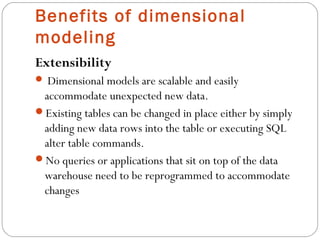
Extensibility
 Dimensional models are scalable and easily
accommodate unexpected new data.
Existing tables can be changed in place either by simply
adding new data rows into the table or executing SQL
alter table commands.
No queries or applications that sit on top of the data
warehouse need to be reprogrammed to accommodate
changes
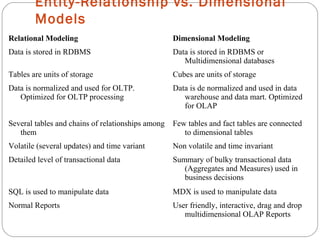
Relational Modeling Dimensional Modeling
Data is stored in RDBMS Data is stored in RDBMS or
Multidimensional databases
Tables are units of storage Cubes are units of storage
Data is normalized and used for OLTP.
Optimized for OLTP processing
Data is de normalized and used in data
warehouse and data mart. Optimized
for OLAP
Several tables and chains of relationships among
them
Few tables and fact tables are connected
to dimensional tables
Volatile (several updates) and time variant Non volatile and time invariant
Detailed level of transactional data Summary of bulky transactional data
(Aggregates and Measures) used in
business decisions
SQL is used to manipulate data MDX is used to manipulate data
Normal Reports User friendly, interactive, drag and drop
multidimensional OLAP Reports
Entity-Relationship vs. Dimensional
Models
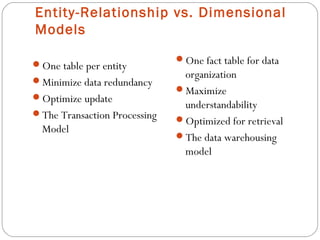
Entity-Relationship vs. Dimensional
Models
One table per entity
Minimize data redundancy
Optimize update
The Transaction Processing
Model
One fact table for data
organization
Maximize
understandability
Optimized for retrieval
The data warehousing
model
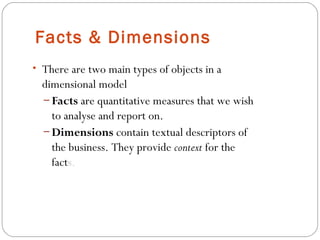
Facts & Dimensions
• There are two main types of objects in a
dimensional model
– Facts are quantitative measures that we wish
to analyse and report on.
– Dimensions contain textual descriptors of
the business. They provide context for the
facts.
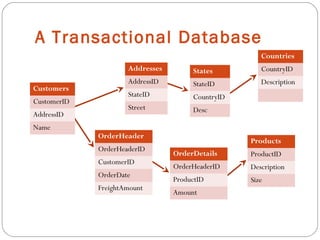
A Transactional Database
OrderDetails
OrderHeaderID
ProductID
Amount
OrderHeader
OrderHeaderID
CustomerID
OrderDate
FreightAmount
Products
ProductID
Description
Size
Customers
CustomerID
AddressID
Name
Addresses
AddressID
StateID
Street
States
StateID
CountryID
Desc
Countries
CountryID
Description
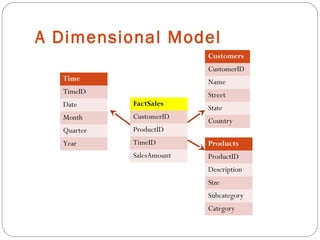
A Dimensional Model
FactSales
CustomerID
ProductID
TimeID
SalesAmount
Products
ProductID
Description
Size
Subcategory
Category
Customers
CustomerID
Name
Street
State
Country
Time
TimeID
Date
Month
Quarter
Year
Fact Tables
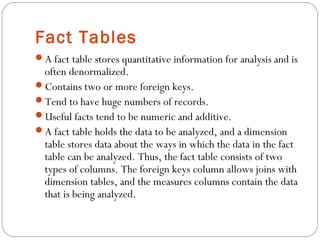
A fact table stores quantitative information for analysis and is
often denormalized.
Contains two or more foreign keys.
Tend to have huge numbers of records.
Useful facts tend to be numeric and additive.
A fact table holds the data to be analyzed, and a dimension
table stores data about the ways in which the data in the fact
table can be analyzed. Thus, the fact table consists of two
types of columns. The foreign keys column allows joins with
dimension tables, and the measures columns contain the data
that is being analyzed.
Example :Fact Table
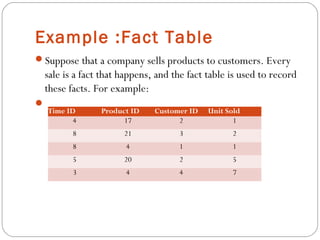
Suppose that a company sells products to customers. Every
sale is a fact that happens, and the fact table is used to record
these facts. For example:

Time ID Product ID Customer ID Unit Sold
4 17 2 1
8 21 3 2
8 4 1 1
5 20 2 5
3 4 4 7
Dimension Table
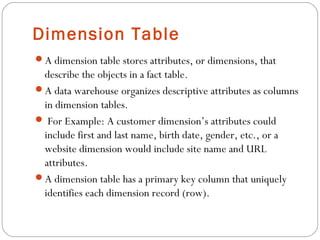
A dimension table stores attributes, or dimensions, that
describe the objects in a fact table.
A data warehouse organizes descriptive attributes as columns
in dimension tables. 
 For Example: A customer dimension’s attributes could
include first and last name, birth date, gender, etc., or a
website dimension would include site name and URL
attributes. 
A dimension table has a primary key column that uniquely
identifies each dimension record (row).
Example:Dimension Table
Customer
ID
Name Gender Income Education Region
1 Brian Edge M 2 3 4
2 Fred Smith M 3 5 1
3 Sally Jones F 1 7 3
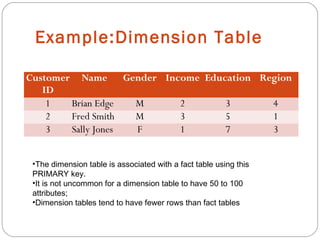
•The dimension table is associated with a fact table using this
PRIMARY key. 
•It is not uncommon for a dimension table to have 50 to 100
attributes;
•Dimension tables tend to have fewer rows than fact tables
Dimension tables are referenced by fact tables using keys.
When creating a dimension table in a data warehouse, a
system-generated key is used to uniquely identify a row in
the dimension. This key is also known as a surrogate key.
The surrogate key is used as the primary key in the
dimension table.
The surrogate key is placed in the fact table and a foreign key
is defined between the two tables. When the data is joined, it
does so just as any other join within the database.
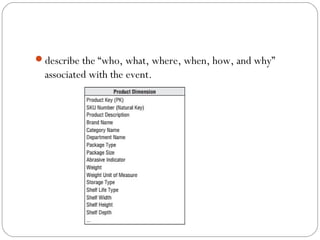
describe the “who, what, where, when, how, and why”
associated with the event.
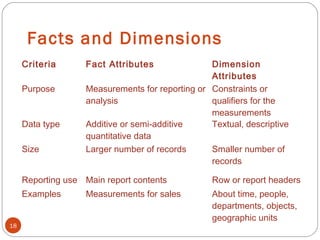
Facts and Dimensions
18
Criteria Fact Attributes Dimension
Attributes
Purpose Measurements for reporting or
analysis
Constraints or
qualifiers for the
measurements
Data type Additive or semi-additive
quantitative data
Textual, descriptive
Size Larger number of records Smaller number of
records
Reporting use Main report contents Row or report headers
Examples Measurements for sales About time, people,
departments, objects,
geographic units
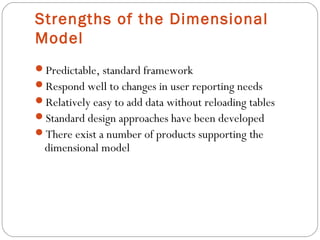
Strengths of the Dimensional
Model
Predictable, standard framework
Respond well to changes in user reporting needs
Relatively easy to add data without reloading tables
Standard design approaches have been developed
There exist a number of products supporting the
dimensional model
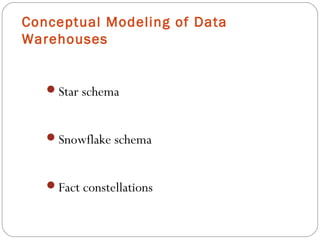
Conceptual Modeling of Data
Warehouses
Star schema
Snowflake schema
Fact constellations
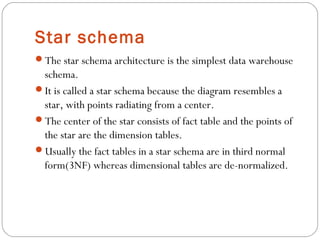
Star schema
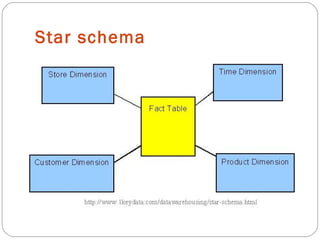
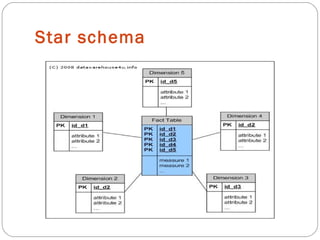
The star schema architecture is the simplest data warehouse
schema.
It is called a star schema because the diagram resembles a
star, with points radiating from a center.
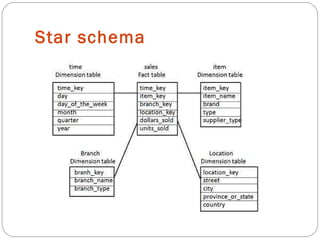
The center of the star consists of fact table and the points of
the star are the dimension tables.
Usually the fact tables in a star schema are in third normal
form(3NF) whereas dimensional tables are de-normalized.
Star schema
Star schema
Star schema
Querying Star Schema
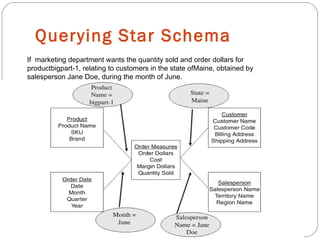
If marketing department wants the quantity sold and order dollars for
productbigpart-1, relating to customers in the state ofMaine, obtained by
salesperson Jane Doe, during the month of June.
Snowflake Schema
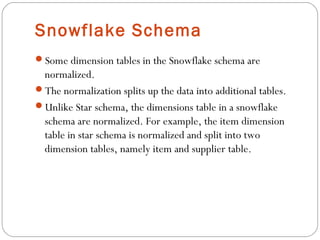
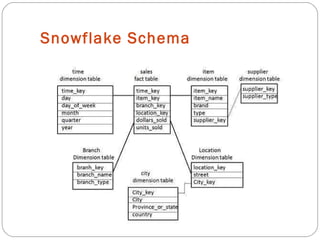
Some dimension tables in the Snowflake schema are
normalized.
The normalization splits up the data into additional tables.
Unlike Star schema, the dimensions table in a snowflake
schema are normalized. For example, the item dimension
table in star schema is normalized and split into two
dimension tables, namely item and supplier table.
Snowflake Schema
Fact Constellation Schema
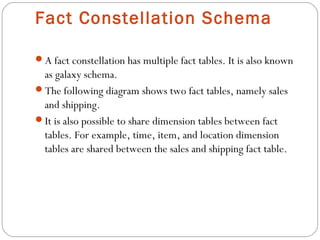
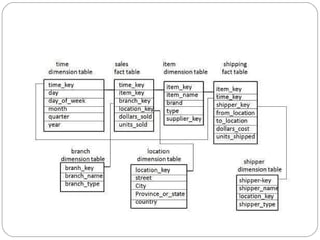
A fact constellation has multiple fact tables. It is also known
as galaxy schema.
The following diagram shows two fact tables, namely sales
and shipping.
It is also possible to share dimension tables between fact
tables. For example, time, item, and location dimension
tables are shared between the sales and shipping fact table.
Business Model
As always in life, there are some disadvantages to 3NF:
Performance can be truly awful. Most of the work that is
performed on denormalizing a data model is an attempt
to reach performance objectives.
The structure can be overwhelmingly complex. We may
wind up creating many small relations which the user
might think of as a single relation or group of data.
The 4 Step Design Process
Choose the Data Mart
Declare the Grain
Choose the Dimensions
Choose the Facts
Building a Data Warehouse from a
Normalized Database
The steps
Develop a normalized entity-relationship business model
of the data warehouse.
Translate this into a dimensional model. This step
reflects the information and analytical characteristics of
the data warehouse.
Translate this into the physical model. This reflects the
changes necessary to reach the stated performance
objectives.
Structural Dimensions
The first step is the development of the structural
dimensions. This step corresponds very closely to what
we normally do in a relational database.
The star architecture that we will develop here depends
upon taking the central intersection entities as the fact
tables and building the foreign key => primary key
relations as dimensions.
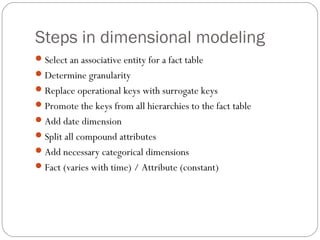
Steps in dimensional modeling
Select an associative entity for a fact table
Determine granularity
Replace operational keys with surrogate keys
Promote the keys from all hierarchies to the fact table
Add date dimension
Split all compound attributes
Add necessary categorical dimensions
Fact (varies with time) / Attribute (constant)
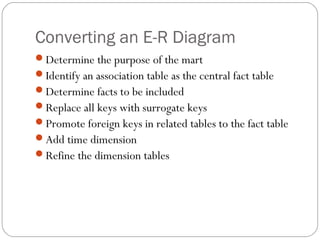
Converting an E-R Diagram
Determine the purpose of the mart
Identify an association table as the central fact table
Determine facts to be included
Replace all keys with surrogate keys
Promote foreign keys in related tables to the fact table
Add time dimension
Refine the dimension tables
Choosing the Mart
A set of related fact and dimension tables
Single source or multiple source
Conformed dimensions
Typically have a fact table for each process
Fact Tables
Represent a process or reporting environment that is of value
to the organization
It is important to determine the identity of the fact table and
specify exactly what it represents.
Typically correspond to an associative entity in the E-R
model
Grain (unit of analysis)
The grain determines what each fact record represents: the
level of detail.
For example
Individual transactions
Snapshots (points in time)
Line items on a document
Generally better to focus on the smallest grain
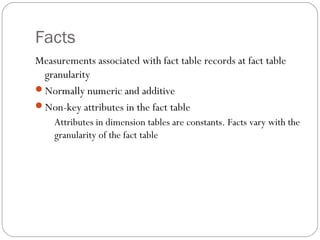
Facts
Measurements associated with fact table records at fact table
granularity
Normally numeric and additive
Non-key attributes in the fact table
Attributes in dimension tables are constants. Facts vary with the
granularity of the fact table
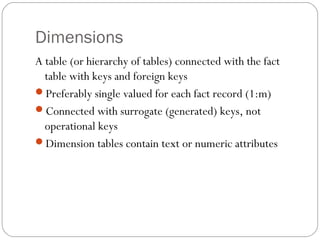
Dimensions
A table (or hierarchy of tables) connected with the fact
table with keys and foreign keys
Preferably single valued for each fact record (1:m)
Connected with surrogate (generated) keys, not
operational keys
Dimension tables contain text or numeric attributes
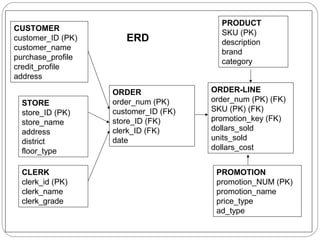
ORDER
order_num (PK)
customer_ID (FK)
store_ID (FK)
clerk_ID (FK)
date
STORE
store_ID (PK)
store_name
address
district
floor_type
CLERK
clerk_id (PK)
clerk_name
clerk_grade
PRODUCT
SKU (PK)
description
brand
category
CUSTOMER
customer_ID (PK)
customer_name
purchase_profile
credit_profile
address
PROMOTION
promotion_NUM (PK)
promotion_name
price_type
ad_type
ORDER-LINE
order_num (PK) (FK)
SKU (PK) (FK)
promotion_key (FK)
dollars_sold
units_sold
dollars_cost
ERD
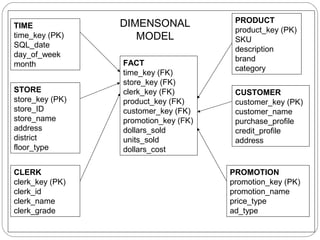
TIME
time_key (PK)
SQL_date
day_of_week
month
STORE
store_key (PK)
store_ID
store_name
address
district
floor_type
CLERK
clerk_key (PK)
clerk_id
clerk_name
clerk_grade
PRODUCT
product_key (PK)
SKU
description
brand
category
CUSTOMER
customer_key (PK)
customer_name
purchase_profile
credit_profile
address
PROMOTION
promotion_key (PK)
promotion_name
price_type
ad_type
FACT
time_key (FK)
store_key (FK)
clerk_key (FK)
product_key (FK)
customer_key (FK)
promotion_key (FK)
dollars_sold
units_sold
dollars_cost
DIMENSONAL
MODEL
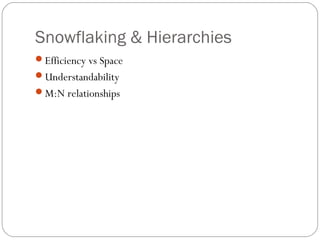
Snowflaking & Hierarchies
Efficiency vs Space
Understandability
M:N relationships
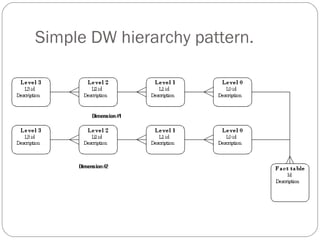
Simple DW hierarchy pattern.
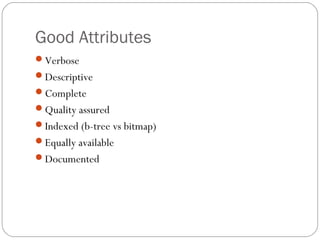
Good Attributes
Verbose
Descriptive
Complete
Quality assured
Indexed (b-tree vs bitmap)
Equally available
Documented
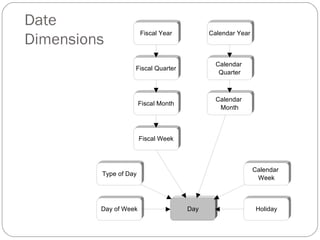
Date
Dimensions
Day of Week
Type of Day
Fiscal Week
Fiscal Month
Fiscal Quarter
Fiscal Year
Day
Calendar
Month
Calendar
Quarter
Calendar Year
Holiday
Calendar
Week
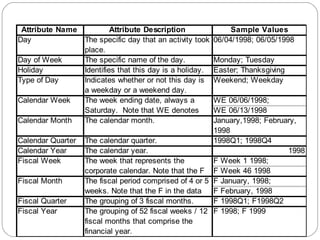
Attribute Name Attribute Description Sample Values
Day The specific day that an activity took
place.
06/04/1998; 06/05/1998
Day of Week The specific name of the day. Monday; Tuesday
Holiday Identifies that this day is a holiday. Easter; Thanksgiving
Type of Day Indicates whether or not this day is
a weekday or a weekend day.
Weekend; Weekday
WE 06/06/1998;
WE 06/13/1998
Calendar Month The calendar month. January,1998; February,
1998
Calendar Quarter The calendar quarter. 1998Q1; 1998Q4
Calendar Year The calendar year. 1998
F Week 1 1998;
F Week 46 1998
F January, 1998;
F February, 1998
Fiscal Quarter The grouping of 3 fiscal months. F 1998Q1; F1998Q2
Fiscal Year The grouping of 52 fiscal weeks / 12
fiscal months that comprise the
financial year.
F 1998; F 1999
Fiscal Month The fiscal period comprised of 4 or 5
weeks. Note that the F in the data
Calendar Week The week ending date, always a
Saturday. Note that WE denotes
Fiscal Week The week that represents the
corporate calendar. Note that the F
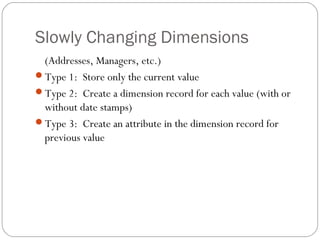
Slowly Changing Dimensions
(Addresses, Managers, etc.)
Type 1: Store only the current value
Type 2: Create a dimension record for each value (with or
without date stamps)
Type 3: Create an attribute in the dimension record for
previous value
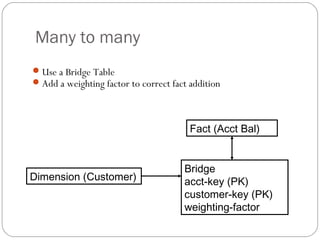
Many to many
Use a Bridge Table
Add a weighting factor to correct fact addition
Fact (Acct Bal)
Dimension (Customer)
Bridge
acct-key (PK)
customer-key (PK)
weighting-factor
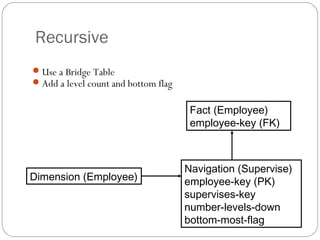
Recursive
Use a Bridge Table
Add a level count and bottom flag
Fact (Employee)
employee-key (FK)
Dimension (Employee)
Navigation (Supervise)
employee-key (PK)
supervises-key
number-levels-down
bottom-most-flag

Dimensional Modeling

  • 1.
  • 2.
    Dimensional Modeling Dimensional modeling (DM)names a set of techniques and concepts used in data warehouse design. Dimensional modeling is one of the methods of data modeling, that help us store the data in such a way that it is relatively easy to retrieve the data from the database. Dimensional modeling always uses the concepts of facts (measures), and dimensions (context).
  • 3.
    Dimensional Models A denormalizedrelational model Made up of tables with attributes Relationships defined by keys and foreign keys Organized for understandability and ease of reporting rather than update Queried and maintained by SQL or special purpose management tools.
  • 4.
    Benefits of dimensional modeling Understandability –  Compared to the normalized model, the dimensional model is easier to understand and more intuitive.  In dimensional models, information is grouped into coherent business categories or dimensions, making it easier to read and interpret. Simplicity also allows software to navigate databases efficiently.
  • 5.
    Benefits of dimensional modeling Queryperformance Dimensional models are more denormalized and optimized for data querying, while normalized models seek to eliminate data redundancies and are optimized for transaction loading and updating. The predictable framework of a dimensional model allows the database to make strong assumptions about the data which may have a positive impact on performance. Each dimension is an equivalent entry point into the fact table, and this symmetrical structure allows effective handling of complex queries. Query optimization is simple, predictable, and controllable.
  • 6.
    Benefits of dimensional modeling Extensibility Dimensional models are scalable and easily accommodate unexpected new data. Existing tables can be changed in place either by simply adding new data rows into the table or executing SQL alter table commands. No queries or applications that sit on top of the data warehouse need to be reprogrammed to accommodate changes
  • 7.
    Relational Modeling DimensionalModeling Data is stored in RDBMS Data is stored in RDBMS or Multidimensional databases Tables are units of storage Cubes are units of storage Data is normalized and used for OLTP. Optimized for OLTP processing Data is de normalized and used in data warehouse and data mart. Optimized for OLAP Several tables and chains of relationships among them Few tables and fact tables are connected to dimensional tables Volatile (several updates) and time variant Non volatile and time invariant Detailed level of transactional data Summary of bulky transactional data (Aggregates and Measures) used in business decisions SQL is used to manipulate data MDX is used to manipulate data Normal Reports User friendly, interactive, drag and drop multidimensional OLAP Reports Entity-Relationship vs. Dimensional Models
  • 8.
    Entity-Relationship vs. Dimensional Models Onetable per entity Minimize data redundancy Optimize update The Transaction Processing Model One fact table for data organization Maximize understandability Optimized for retrieval The data warehousing model
  • 9.
    Facts & Dimensions •There are two main types of objects in a dimensional model – Facts are quantitative measures that we wish to analyse and report on. – Dimensions contain textual descriptors of the business. They provide context for the facts.
  • 10.
  • 11.
  • 12.
    Fact Tables A facttable stores quantitative information for analysis and is often denormalized. Contains two or more foreign keys. Tend to have huge numbers of records. Useful facts tend to be numeric and additive. A fact table holds the data to be analyzed, and a dimension table stores data about the ways in which the data in the fact table can be analyzed. Thus, the fact table consists of two types of columns. The foreign keys column allows joins with dimension tables, and the measures columns contain the data that is being analyzed.
  • 13.
    Example :Fact Table Supposethat a company sells products to customers. Every sale is a fact that happens, and the fact table is used to record these facts. For example:  Time ID Product ID Customer ID Unit Sold 4 17 2 1 8 21 3 2 8 4 1 1 5 20 2 5 3 4 4 7
  • 14.
    Dimension Table A dimensiontable stores attributes, or dimensions, that describe the objects in a fact table. A data warehouse organizes descriptive attributes as columns in dimension tables.   For Example: A customer dimension’s attributes could include first and last name, birth date, gender, etc., or a website dimension would include site name and URL attributes.  A dimension table has a primary key column that uniquely identifies each dimension record (row).
  • 15.
    Example:Dimension Table Customer ID Name GenderIncome Education Region 1 Brian Edge M 2 3 4 2 Fred Smith M 3 5 1 3 Sally Jones F 1 7 3 •The dimension table is associated with a fact table using this PRIMARY key.  •It is not uncommon for a dimension table to have 50 to 100 attributes; •Dimension tables tend to have fewer rows than fact tables
  • 16.
    Dimension tables arereferenced by fact tables using keys. When creating a dimension table in a data warehouse, a system-generated key is used to uniquely identify a row in the dimension. This key is also known as a surrogate key. The surrogate key is used as the primary key in the dimension table. The surrogate key is placed in the fact table and a foreign key is defined between the two tables. When the data is joined, it does so just as any other join within the database.
  • 17.
    describe the “who,what, where, when, how, and why” associated with the event.
  • 18.
    Facts and Dimensions 18 CriteriaFact Attributes Dimension Attributes Purpose Measurements for reporting or analysis Constraints or qualifiers for the measurements Data type Additive or semi-additive quantitative data Textual, descriptive Size Larger number of records Smaller number of records Reporting use Main report contents Row or report headers Examples Measurements for sales About time, people, departments, objects, geographic units
  • 19.
    Strengths of theDimensional Model Predictable, standard framework Respond well to changes in user reporting needs Relatively easy to add data without reloading tables Standard design approaches have been developed There exist a number of products supporting the dimensional model
  • 20.
    Conceptual Modeling ofData Warehouses Star schema Snowflake schema Fact constellations
  • 21.
    Star schema The starschema architecture is the simplest data warehouse schema. It is called a star schema because the diagram resembles a star, with points radiating from a center. The center of the star consists of fact table and the points of the star are the dimension tables. Usually the fact tables in a star schema are in third normal form(3NF) whereas dimensional tables are de-normalized.
  • 22.
  • 23.
  • 24.
  • 25.
    Querying Star Schema Ifmarketing department wants the quantity sold and order dollars for productbigpart-1, relating to customers in the state ofMaine, obtained by salesperson Jane Doe, during the month of June.
  • 26.
    Snowflake Schema Some dimensiontables in the Snowflake schema are normalized. The normalization splits up the data into additional tables. Unlike Star schema, the dimensions table in a snowflake schema are normalized. For example, the item dimension table in star schema is normalized and split into two dimension tables, namely item and supplier table.
  • 27.
  • 28.
    Fact Constellation Schema Afact constellation has multiple fact tables. It is also known as galaxy schema. The following diagram shows two fact tables, namely sales and shipping. It is also possible to share dimension tables between fact tables. For example, time, item, and location dimension tables are shared between the sales and shipping fact table.
  • 30.
    Business Model As alwaysin life, there are some disadvantages to 3NF: Performance can be truly awful. Most of the work that is performed on denormalizing a data model is an attempt to reach performance objectives. The structure can be overwhelmingly complex. We may wind up creating many small relations which the user might think of as a single relation or group of data.
  • 31.
    The 4 StepDesign Process Choose the Data Mart Declare the Grain Choose the Dimensions Choose the Facts
  • 32.
    Building a DataWarehouse from a Normalized Database The steps Develop a normalized entity-relationship business model of the data warehouse. Translate this into a dimensional model. This step reflects the information and analytical characteristics of the data warehouse. Translate this into the physical model. This reflects the changes necessary to reach the stated performance objectives.
  • 33.
    Structural Dimensions The firststep is the development of the structural dimensions. This step corresponds very closely to what we normally do in a relational database. The star architecture that we will develop here depends upon taking the central intersection entities as the fact tables and building the foreign key => primary key relations as dimensions.
  • 34.
    Steps in dimensionalmodeling Select an associative entity for a fact table Determine granularity Replace operational keys with surrogate keys Promote the keys from all hierarchies to the fact table Add date dimension Split all compound attributes Add necessary categorical dimensions Fact (varies with time) / Attribute (constant)
  • 35.
    Converting an E-RDiagram Determine the purpose of the mart Identify an association table as the central fact table Determine facts to be included Replace all keys with surrogate keys Promote foreign keys in related tables to the fact table Add time dimension Refine the dimension tables
  • 36.
    Choosing the Mart Aset of related fact and dimension tables Single source or multiple source Conformed dimensions Typically have a fact table for each process
  • 37.
    Fact Tables Represent aprocess or reporting environment that is of value to the organization It is important to determine the identity of the fact table and specify exactly what it represents. Typically correspond to an associative entity in the E-R model
  • 38.
    Grain (unit ofanalysis) The grain determines what each fact record represents: the level of detail. For example Individual transactions Snapshots (points in time) Line items on a document Generally better to focus on the smallest grain
  • 39.
    Facts Measurements associated withfact table records at fact table granularity Normally numeric and additive Non-key attributes in the fact table Attributes in dimension tables are constants. Facts vary with the granularity of the fact table
  • 40.
    Dimensions A table (orhierarchy of tables) connected with the fact table with keys and foreign keys Preferably single valued for each fact record (1:m) Connected with surrogate (generated) keys, not operational keys Dimension tables contain text or numeric attributes
  • 41.
    ORDER order_num (PK) customer_ID (FK) store_ID(FK) clerk_ID (FK) date STORE store_ID (PK) store_name address district floor_type CLERK clerk_id (PK) clerk_name clerk_grade PRODUCT SKU (PK) description brand category CUSTOMER customer_ID (PK) customer_name purchase_profile credit_profile address PROMOTION promotion_NUM (PK) promotion_name price_type ad_type ORDER-LINE order_num (PK) (FK) SKU (PK) (FK) promotion_key (FK) dollars_sold units_sold dollars_cost ERD
  • 42.
    TIME time_key (PK) SQL_date day_of_week month STORE store_key (PK) store_ID store_name address district floor_type CLERK clerk_key(PK) clerk_id clerk_name clerk_grade PRODUCT product_key (PK) SKU description brand category CUSTOMER customer_key (PK) customer_name purchase_profile credit_profile address PROMOTION promotion_key (PK) promotion_name price_type ad_type FACT time_key (FK) store_key (FK) clerk_key (FK) product_key (FK) customer_key (FK) promotion_key (FK) dollars_sold units_sold dollars_cost DIMENSONAL MODEL
  • 43.
    Snowflaking & Hierarchies Efficiencyvs Space Understandability M:N relationships
  • 44.
  • 45.
  • 46.
    Date Dimensions Day of Week Typeof Day Fiscal Week Fiscal Month Fiscal Quarter Fiscal Year Day Calendar Month Calendar Quarter Calendar Year Holiday Calendar Week
  • 47.
    Attribute Name AttributeDescription Sample Values Day The specific day that an activity took place. 06/04/1998; 06/05/1998 Day of Week The specific name of the day. Monday; Tuesday Holiday Identifies that this day is a holiday. Easter; Thanksgiving Type of Day Indicates whether or not this day is a weekday or a weekend day. Weekend; Weekday WE 06/06/1998; WE 06/13/1998 Calendar Month The calendar month. January,1998; February, 1998 Calendar Quarter The calendar quarter. 1998Q1; 1998Q4 Calendar Year The calendar year. 1998 F Week 1 1998; F Week 46 1998 F January, 1998; F February, 1998 Fiscal Quarter The grouping of 3 fiscal months. F 1998Q1; F1998Q2 Fiscal Year The grouping of 52 fiscal weeks / 12 fiscal months that comprise the financial year. F 1998; F 1999 Fiscal Month The fiscal period comprised of 4 or 5 weeks. Note that the F in the data Calendar Week The week ending date, always a Saturday. Note that WE denotes Fiscal Week The week that represents the corporate calendar. Note that the F
  • 48.
    Slowly Changing Dimensions (Addresses,Managers, etc.) Type 1: Store only the current value Type 2: Create a dimension record for each value (with or without date stamps) Type 3: Create an attribute in the dimension record for previous value
  • 49.
    Many to many Usea Bridge Table Add a weighting factor to correct fact addition Fact (Acct Bal) Dimension (Customer) Bridge acct-key (PK) customer-key (PK) weighting-factor
  • 50.
    Recursive Use a BridgeTable Add a level count and bottom flag Fact (Employee) employee-key (FK) Dimension (Employee) Navigation (Supervise) employee-key (PK) supervises-key number-levels-down bottom-most-flag

Editor's Notes

  • #10 Facts work best if they are additive Dimensions allow us to “slice & dice” the facts into meaningful groups. The provide context
  • #11 A simplistic transactional schema showing 7 tables relating to sales orders
  • #12 This is a star schema, (later on we will discuss snowflake schemas.) showing 4 tables that relate to the previous transactional schema State and Country have been denormalized under Customer Dimensions are in Blue These are the things that we analyse “by” (eg. By Time, By Customer, By Region) Fact is yellow These are ususally quantitative things that we are interested in
  • #33 Designing the Perfect Data Warehouse (the paper formerly known as: Data Modeling for Data Warehouses), Frank McGuff , http://members.aol.com/fmcguff/dwmodel/