ETL vs ELT
ginacostag
by
What’s the
Difference?
Data Warehouse
Load
Load
Extract
Transform
ETL
DWH
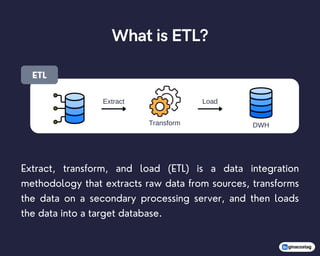
Extract, transform, and load (ETL) is a data integration
methodology that extracts raw data from sources, transforms
the data on a secondary processing server, and then loads
the data into a target database.
What is ETL?
ginacostag
Extract Transform
Load
ELT
DWH
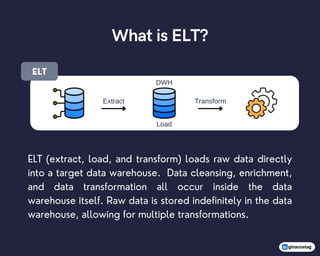
ELT (extract, load, and transform) loads raw data directly
into a target data warehouse. Data cleansing, enrichment,
and data transformation all occur inside the data
warehouse itself. Raw data is stored indefinitely in the data
warehouse, allowing for multiple transformations.
What is ELT?
ginacostag
Cloud-based data warehouses offer near-endless storage
capabilities and scalable processing power. For example,
platforms like Amazon Redshift and Google BigQuery
make ELT pipelines possible because of their incredible
processing capabilities.
What is ELT?
ginacostag
ETL
Maturity. ETL was developed first and has been in practice for more
than two decades. This means that there are more engineers with
experience in ETL implementations and more ETL tools in the
marketplace to build data pipelines within organizations.
Compliance. ETL transforms data before it reaches its destination.
When companies are subject to data privacy regulations such as GDPR,
ETL allows them to remove, mask, or encrypt sensitive data before it's
loaded to the data warehouse to ensure compliance.
Frequent maintenance. ETL data pipelines handle both extraction and
transformation. But they have to undergo refactors if analysts require
different data types or if the source systems start to produce data with
deviating formats and schemas.
Higher upfront cost. Defining business logic and transformations can
increase the scope of a data integration project.
Advantages
Drawbacks
ginacostag
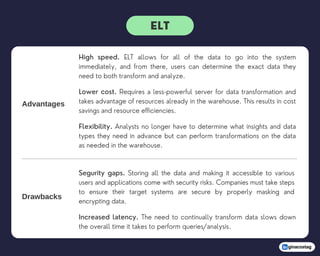
High speed. ELT allows for all of the data to go into the system
immediately, and from there, users can determine the exact data they
need to both transform and analyze.
Lower cost. Requires a less-powerful server for data transformation and
takes advantage of resources already in the warehouse. This results in cost
savings and resource efficiencies.
Segurity gaps. Storing all the data and making it accessible to various
users and applications come with security risks. Companies must take steps
to ensure their target systems are secure by properly masking and
encrypting data.
Increased latency. The need to continually transform data slows down
the overall time it takes to perform queries/analysis.
ELT
Flexibility. Analysts no longer have to determine what insights and data
types they need in advance but can perform transformations on the data
as needed in the warehouse.
Advantages
Drawbacks
ginacostag
ginacostag
Follow for more updates
Was this helpful?

ETL VS ELT.pdf

  • 1.
  • 2.
    Data Warehouse Load Load Extract Transform ETL DWH Extract, transform,and load (ETL) is a data integration methodology that extracts raw data from sources, transforms the data on a secondary processing server, and then loads the data into a target database. What is ETL? ginacostag
  • 3.
    Extract Transform Load ELT DWH ELT (extract,load, and transform) loads raw data directly into a target data warehouse. Data cleansing, enrichment, and data transformation all occur inside the data warehouse itself. Raw data is stored indefinitely in the data warehouse, allowing for multiple transformations. What is ELT? ginacostag
  • 4.
    Cloud-based data warehousesoffer near-endless storage capabilities and scalable processing power. For example, platforms like Amazon Redshift and Google BigQuery make ELT pipelines possible because of their incredible processing capabilities. What is ELT? ginacostag
  • 5.
    ETL Maturity. ETL wasdeveloped first and has been in practice for more than two decades. This means that there are more engineers with experience in ETL implementations and more ETL tools in the marketplace to build data pipelines within organizations. Compliance. ETL transforms data before it reaches its destination. When companies are subject to data privacy regulations such as GDPR, ETL allows them to remove, mask, or encrypt sensitive data before it's loaded to the data warehouse to ensure compliance. Frequent maintenance. ETL data pipelines handle both extraction and transformation. But they have to undergo refactors if analysts require different data types or if the source systems start to produce data with deviating formats and schemas. Higher upfront cost. Defining business logic and transformations can increase the scope of a data integration project. Advantages Drawbacks ginacostag
  • 6.
    High speed. ELTallows for all of the data to go into the system immediately, and from there, users can determine the exact data they need to both transform and analyze. Lower cost. Requires a less-powerful server for data transformation and takes advantage of resources already in the warehouse. This results in cost savings and resource efficiencies. Segurity gaps. Storing all the data and making it accessible to various users and applications come with security risks. Companies must take steps to ensure their target systems are secure by properly masking and encrypting data. Increased latency. The need to continually transform data slows down the overall time it takes to perform queries/analysis. ELT Flexibility. Analysts no longer have to determine what insights and data types they need in advance but can perform transformations on the data as needed in the warehouse. Advantages Drawbacks ginacostag
  • 7.
    ginacostag Follow for moreupdates Was this helpful?