Norwegian University of Life Sciences 1
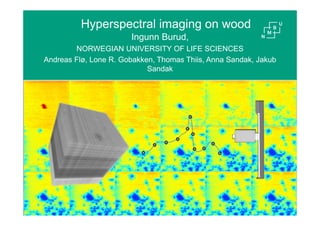
Hyperspectral imaging on wood
Ingunn Burud,
NORWEGIAN UNIVERSITY OF LIFE SCIENCES
Andreas Flø, Lone R. Gobakken, Thomas Thiis, Anna Sandak, Jakub
Sandak
Norwegian University of Life Sciences
Norwegian University of Life Sciences 2
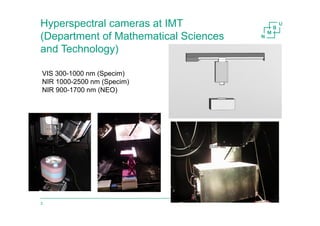
Hyperspectral cameras at IMT
(Department of Mathematical Sciences
and Technology)
3
VIS 300-1000 nm (Specim)
NIR 1000-2500 nm (Specim)
NIR 900-1700 nm (NEO)
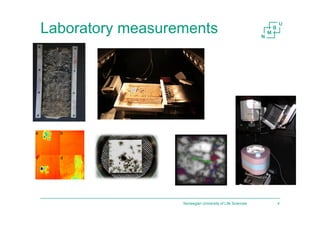
Laboratory measurements
Norwegian University of Life Sciences 4
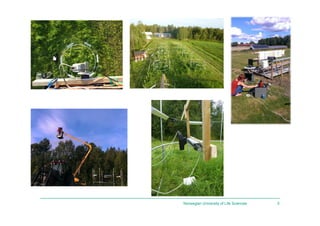
Norwegian University of Life Sciences 5
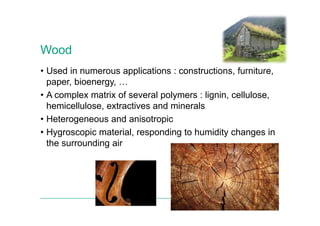
Wood
• Used in numerous applications : constructions, furniture,
paper, bioenergy, …
• A complex matrix of several polymers : lignin, cellulose,
hemicellulose, extractives and minerals
• Heterogeneous and anisotropic
• Hygroscopic material, responding to humidity changes in
the surrounding air
Norwegian University of Life Sciences 6
Why hyperspectral imaging ?
• More than the eye can see
–Chemical properties can be derived, depending on
wavelength (lignin, cellulose)
• Spectral information + spatial information
• Development of new technologies for sensors that can be
applied in-line
–Band selection to define important wavelengths
–Spectral library for calibration of outdoor
measurements from multispectral cameras
Norwegian University of Life Sciences 7
Because it’s fun !!
Norwegian University of Life SciencesTittel på presentasjon 8
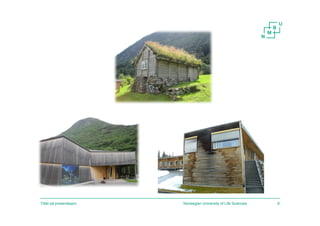
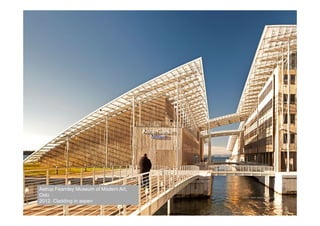
Astrup Fearnley Museum of Modern Art,
Oslo
2012. Cladding in aspen
Photo: www.expo-nova.no
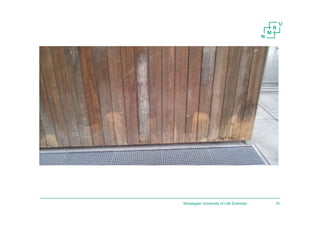
Norwegian University of Life Sciences 10
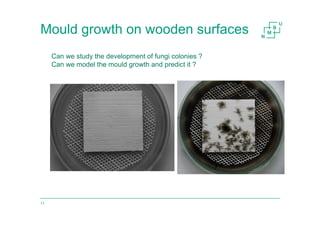
Mould growth on wooden surfaces
11
Can we study the development of fungi colonies ?
Can we model the mould growth and predict it ?
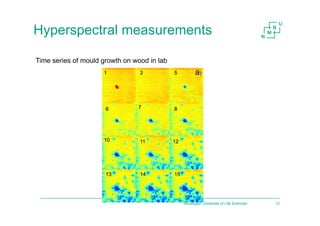
Norwegian University of Life Sciences 12
Hyperspectral measurements
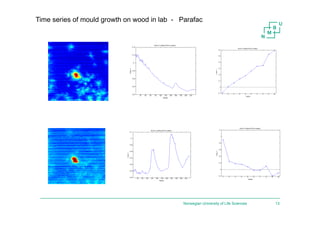
Time series of mould growth on wood in lab
Norwegian University of Life Sciences 13
Time series of mould growth on wood in lab - Parafac
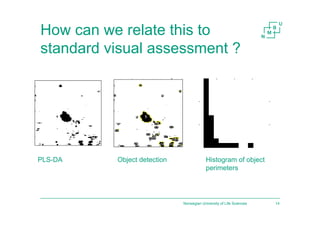
How can we relate this to
standard visual assessment ?
Norwegian University of Life Sciences 14
PLS-DA Object detection Histogram of object
perimeters
Norwegian University of Life Sciences 15
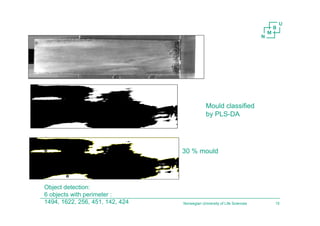
Mould classified
by PLS-DA
30 % mould
Object detection:
6 objects with perimeter :
1494, 1622, 256, 451, 142, 424
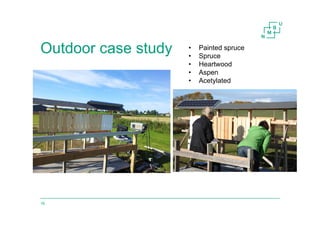
Outdoor case study
16
• Painted spruce
• Spruce
• Heartwood
• Aspen
• Acetylated
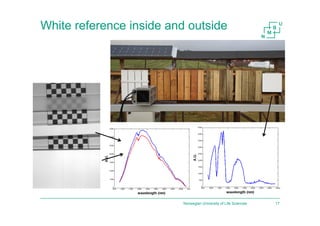
White reference inside and outside
Norwegian University of Life Sciences 17
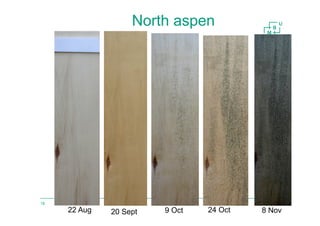
North aspen
18
22 Aug 20 Sept 9 Oct 24 Oct 8 Nov
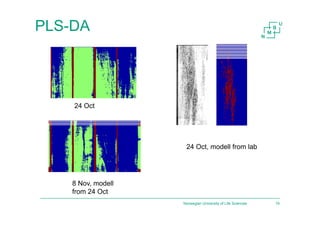
PLS-DA
Norwegian University of Life Sciences 19
24 Oct
8 Nov, modell
from 24 Oct
24 Oct, modell from lab
Norwegian University of Life Sciences 20
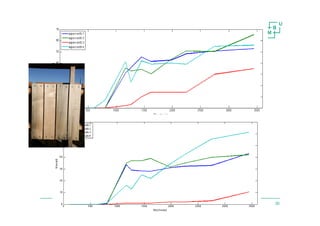
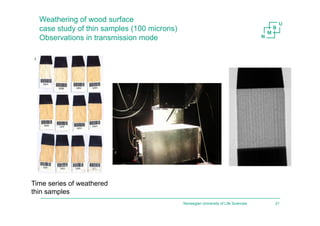
Weathering of wood surface
case study of thin samples (100 microns)
Observations in transmission mode
Norwegian University of Life Sciences 21
Time series of weathered
thin samples
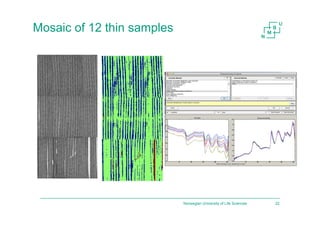
Mosaic of 12 thin samples
Norwegian University of Life Sciences 22
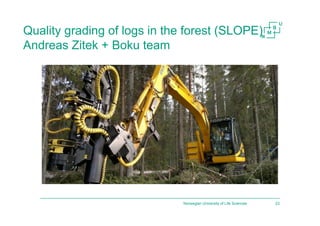
Quality grading of logs in the forest (SLOPE)
Andreas Zitek + Boku team
Norwegian University of Life Sciences 23
Hyperspectral imaging of logs in forest
• Varying moisture conditions
• Varying light conditions
–Use natural light or artificial ?
–White reference
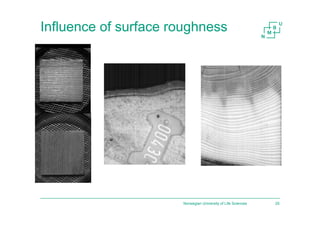
• Surface roughness
Norwegian University of Life Sciences 24
Challenges :
Influence of surface roughness
Norwegian University of Life Sciences 25
Norwegian University of Life Sciences 26
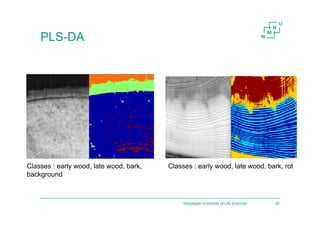
PLS-DA
Classes : early wood, late wood, bark, rotClasses : early wood, late wood, bark,
background
Band selection
• A number of known interesting wavelength bands
–e.g., lignin, cellulose, decay, bark
• Research to find selected bands that will cover what we
are interested in
• Hyperspectral  Multispectral
Norwegian University of Life Sciences 27
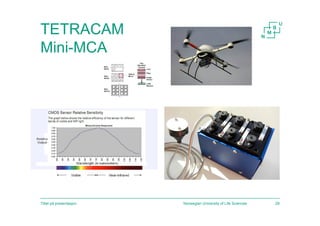
TETRACAM
Mini-MCA
Norwegian University of Life SciencesTittel på presentasjon 28
Norwegian University of Life Sciences
29
Thanks for your
attention

SLOPE 1st workshop - presentation 4

  • 1.
    Norwegian University ofLife Sciences 1 Hyperspectral imaging on wood Ingunn Burud, NORWEGIAN UNIVERSITY OF LIFE SCIENCES Andreas Flø, Lone R. Gobakken, Thomas Thiis, Anna Sandak, Jakub Sandak
  • 2.
    Norwegian University ofLife Sciences Norwegian University of Life Sciences 2
  • 3.
    Hyperspectral cameras atIMT (Department of Mathematical Sciences and Technology) 3 VIS 300-1000 nm (Specim) NIR 1000-2500 nm (Specim) NIR 900-1700 nm (NEO)
  • 4.
  • 5.
    Norwegian University ofLife Sciences 5
  • 6.
    Wood • Used innumerous applications : constructions, furniture, paper, bioenergy, … • A complex matrix of several polymers : lignin, cellulose, hemicellulose, extractives and minerals • Heterogeneous and anisotropic • Hygroscopic material, responding to humidity changes in the surrounding air Norwegian University of Life Sciences 6
  • 7.
    Why hyperspectral imaging? • More than the eye can see –Chemical properties can be derived, depending on wavelength (lignin, cellulose) • Spectral information + spatial information • Development of new technologies for sensors that can be applied in-line –Band selection to define important wavelengths –Spectral library for calibration of outdoor measurements from multispectral cameras Norwegian University of Life Sciences 7 Because it’s fun !!
  • 8.
    Norwegian University ofLife SciencesTittel på presentasjon 8
  • 9.
    Astrup Fearnley Museumof Modern Art, Oslo 2012. Cladding in aspen Photo: www.expo-nova.no
  • 10.
    Norwegian University ofLife Sciences 10
  • 11.
    Mould growth onwooden surfaces 11 Can we study the development of fungi colonies ? Can we model the mould growth and predict it ?
  • 12.
    Norwegian University ofLife Sciences 12 Hyperspectral measurements Time series of mould growth on wood in lab
  • 13.
    Norwegian University ofLife Sciences 13 Time series of mould growth on wood in lab - Parafac
  • 14.
    How can werelate this to standard visual assessment ? Norwegian University of Life Sciences 14 PLS-DA Object detection Histogram of object perimeters
  • 15.
    Norwegian University ofLife Sciences 15 Mould classified by PLS-DA 30 % mould Object detection: 6 objects with perimeter : 1494, 1622, 256, 451, 142, 424
  • 16.
    Outdoor case study 16 •Painted spruce • Spruce • Heartwood • Aspen • Acetylated
  • 17.
    White reference insideand outside Norwegian University of Life Sciences 17
  • 18.
    North aspen 18 22 Aug20 Sept 9 Oct 24 Oct 8 Nov
  • 19.
    PLS-DA Norwegian University ofLife Sciences 19 24 Oct 8 Nov, modell from 24 Oct 24 Oct, modell from lab
  • 20.
    Norwegian University ofLife Sciences 20
  • 21.
    Weathering of woodsurface case study of thin samples (100 microns) Observations in transmission mode Norwegian University of Life Sciences 21 Time series of weathered thin samples
  • 22.
    Mosaic of 12thin samples Norwegian University of Life Sciences 22
  • 23.
    Quality grading oflogs in the forest (SLOPE) Andreas Zitek + Boku team Norwegian University of Life Sciences 23
  • 24.
    Hyperspectral imaging oflogs in forest • Varying moisture conditions • Varying light conditions –Use natural light or artificial ? –White reference • Surface roughness Norwegian University of Life Sciences 24 Challenges :
  • 25.
    Influence of surfaceroughness Norwegian University of Life Sciences 25
  • 26.
    Norwegian University ofLife Sciences 26 PLS-DA Classes : early wood, late wood, bark, rotClasses : early wood, late wood, bark, background
  • 27.
    Band selection • Anumber of known interesting wavelength bands –e.g., lignin, cellulose, decay, bark • Research to find selected bands that will cover what we are interested in • Hyperspectral  Multispectral Norwegian University of Life Sciences 27
  • 28.
    TETRACAM Mini-MCA Norwegian University ofLife SciencesTittel på presentasjon 28
  • 29.
    Norwegian University ofLife Sciences 29 Thanks for your attention