Download to read offline
![American Journal of Applied Sciences 3(6): 1864-1871, 2006
ISSN 1546-9239
© 2005 Science Publications
Corresponding Author: Department of Civil Engineering, Universiti Putra Malaysia (UPM), 43400 Serdang, Selangor,
MALAYSIA. Tel: 03-89466459, Fax:03-86567129
1864
Hyperspectral Remote Sensing of Vegetation Using Red Edge Position Techniques
1
Helmi Zulhaidi Mohd Shafri, 2
Mohamad Amran Mohd Salleh and 1
Azadeh Ghiyamat
1
Geomatics Eng. Unit, Dep. of Civil Eng., Universiti Putra Malaysia (UPM), 43400 Serdang, Selangor, Malaysia
2
Material Science Eng. Unit, Dep. of Chemical and Environmental Eng., UPM, 43400 Serdang, Selangor, Malaysia
Abstract: Two red edge position (REP) techniques, Linear and Lagrangian, were applied on
hyperspectral data acquired from the HyMap sensor for a forested area in Thetford Forest, UK. Red
edge positions of different vegetation covers were extracted with the two approaches from the
hyperspectral data. Based on the estimated REPs, the Linear and Lagrangian interpolation methods
were compared with ground reference image to analyse different vegetation types and ages.
Experimental results of both interpolation techniques indicate that the wavelength and reflectance of
REP for younger plants (higher chlorophyll content) shift towards longer wavelength and of higher
reflectance in comparison with older plants (lower chlorophyll content).
Key words: Hyperspectral, Linear, Lagrangian, chlorophyll, red edge position
INTRODUCTION
Approximately, 70 percent of the Earth’s land
surface is covered with vegetation[1]
. Furthermore,
vegetation provides a basic foundation for all living
beings and it is one of the most important components
of the ecosystem[1-2]
. Knowledge about variations in
vegetation species and community distribution patterns,
alterations in vegetation phenological (growth) cycles,
and modifications in the plant physiology and
morphology provide valuable insight into the climatic,
edaphic, geologic, and physiographic characteristics of
an area[3]
.
Scientists are concerned with observing nature, making
careful observations and measurements, and then
attempting to accept or reject hypotheses concerning
these phenomena[1]
. As direct data measurement and
collection is labor intensive and time consuming[4]
, it is
also possible to collect information about an object or
geographic area from a distant vantage point using
specialized instruments (sensors).
Scientists have devoted a significant amount of
effort to develop sensors and visual and digital image
processing algorithms to extract important vegetation
biophysical information from remotely sensed data [5-6]
.
Hyperspectral remote sensor data can provide a
significant enhancement of spectral measurement
capabilities over conventional remote sensor systems
that can be useful for the identification and subsequent
modeling of terrestrial ecosystem characteristics[7-8]
.
Hyperspectral data also can provide significant
improvements in spectral information content when
compared with broadbands for detecting plant stress[9-
10]
, measuring chlorophyll content of plants[11]
,
identifying small differences in percent green vegetation
cover[12]
, extracting biochemical variables such as
nitrogen and lignin[13]
, discriminating land cover (LC)
types[14]
, crop moisture variations[15-16]
, leaf pigment
concentrations[11]
, modeling quantitative biophysical
and yield characteristics of agricultural crops[17]
,
improving detection change in sparse vegetation[18-19]
and assessing absolute water content in plant leaves[20]
.
Currently, a variety of techniques have been used
for the detection of early-stage vegetation stress in
airborne and satellite imagery. These techniques include
a number of different vegetation indices (VI), “red-
edge” detection, band absorption analysis, spectral
mixture analysis, wavelet transform and neural
networks[21]
. Red edge parameters, compared with VIs,
are relatively insensitive to changes of biophysical
factors, such as soil cover percentage and optical
properties[22-24]
, canopy structure and leaf optical
properties[22, 25]
, atmospheric effects[26]
and irradiance
and solar zenith angle[22, 25]
.
The red edge is the name given to the abrupt
reflectance change in the 680-740 nm region of
vegetation spectra that is caused by the combined
effects of strong chlorophyll absorption and leaf internal
scattering[27]
. Experimental and theoretical studies show
that REP shifts according to changes of chlorophyll
content[28-29]
, LAI[30]
, biomass and hydric status[31]
,
age[32]
, plant health levels[33]
, and seasonal patterns[34]
.
When a plant is healthy with high chlorophyll content
and high LAI, the red edge position shifts toward the
longer wavelengths; when it suffers from disease or
chlorosis and low LAI, it shifts toward the shorter
wavelengths[4]
. These observations on REP can
effectively be used to classify and distinguish different
vegetation types and ages in this study.
To investigate the use of REP as a mean to classify
vegetation, various techniques of analysis such as, four
point interpolation (Linear), Gaussian, Lagrangian,](https://image.slidesharecdn.com/hyperspectralremotesensingofvegetationusingrededgepositiontechniques-231221200617-087fbcbd/85/Hyperspectral-Remote-Sensing-Of-Vegetation-Using-Red-Edge-Position-Techniques-1-320.jpg)
![American Journal of Applied Sciences 3(6): 1864-1871, 2006
ISSN 1546-9239
© 2005 Science Publications
Corresponding Author: Department of Civil Engineering, Universiti Putra Malaysia (UPM), 43400 Serdang, Selangor,
MALAYSIA. Tel: 03-89466459, Fax:03-86567129
1864
Hyperspectral Remote Sensing of Vegetation Using Red Edge Position Techniques
1
Helmi Zulhaidi Mohd Shafri, 2
Mohamad Amran Mohd Salleh and 1
Azadeh Ghiyamat
1
Geomatics Eng. Unit, Dep. of Civil Eng., Universiti Putra Malaysia (UPM), 43400 Serdang, Selangor, Malaysia
2
Material Science Eng. Unit, Dep. of Chemical and Environmental Eng., UPM, 43400 Serdang, Selangor, Malaysia
Abstract: Two red edge position (REP) techniques, Linear and Lagrangian, were applied on
hyperspectral data acquired from the HyMap sensor for a forested area in Thetford Forest, UK. Red
edge positions of different vegetation covers were extracted with the two approaches from the
hyperspectral data. Based on the estimated REPs, the Linear and Lagrangian interpolation methods
were compared with ground reference image to analyse different vegetation types and ages.
Experimental results of both interpolation techniques indicate that the wavelength and reflectance of
REP for younger plants (higher chlorophyll content) shift towards longer wavelength and of higher
reflectance in comparison with older plants (lower chlorophyll content).
Key words: Hyperspectral, Linear, Lagrangian, chlorophyll, red edge position
INTRODUCTION
Approximately, 70 percent of the Earth’s land
surface is covered with vegetation[1]
. Furthermore,
vegetation provides a basic foundation for all living
beings and it is one of the most important components
of the ecosystem[1-2]
. Knowledge about variations in
vegetation species and community distribution patterns,
alterations in vegetation phenological (growth) cycles,
and modifications in the plant physiology and
morphology provide valuable insight into the climatic,
edaphic, geologic, and physiographic characteristics of
an area[3]
.
Scientists are concerned with observing nature, making
careful observations and measurements, and then
attempting to accept or reject hypotheses concerning
these phenomena[1]
. As direct data measurement and
collection is labor intensive and time consuming[4]
, it is
also possible to collect information about an object or
geographic area from a distant vantage point using
specialized instruments (sensors).
Scientists have devoted a significant amount of
effort to develop sensors and visual and digital image
processing algorithms to extract important vegetation
biophysical information from remotely sensed data [5-6]
.
Hyperspectral remote sensor data can provide a
significant enhancement of spectral measurement
capabilities over conventional remote sensor systems
that can be useful for the identification and subsequent
modeling of terrestrial ecosystem characteristics[7-8]
.
Hyperspectral data also can provide significant
improvements in spectral information content when
compared with broadbands for detecting plant stress[9-
10]
, measuring chlorophyll content of plants[11]
,
identifying small differences in percent green vegetation
cover[12]
, extracting biochemical variables such as
nitrogen and lignin[13]
, discriminating land cover (LC)
types[14]
, crop moisture variations[15-16]
, leaf pigment
concentrations[11]
, modeling quantitative biophysical
and yield characteristics of agricultural crops[17]
,
improving detection change in sparse vegetation[18-19]
and assessing absolute water content in plant leaves[20]
.
Currently, a variety of techniques have been used
for the detection of early-stage vegetation stress in
airborne and satellite imagery. These techniques include
a number of different vegetation indices (VI), “red-
edge” detection, band absorption analysis, spectral
mixture analysis, wavelet transform and neural
networks[21]
. Red edge parameters, compared with VIs,
are relatively insensitive to changes of biophysical
factors, such as soil cover percentage and optical
properties[22-24]
, canopy structure and leaf optical
properties[22, 25]
, atmospheric effects[26]
and irradiance
and solar zenith angle[22, 25]
.
The red edge is the name given to the abrupt
reflectance change in the 680-740 nm region of
vegetation spectra that is caused by the combined
effects of strong chlorophyll absorption and leaf internal
scattering[27]
. Experimental and theoretical studies show
that REP shifts according to changes of chlorophyll
content[28-29]
, LAI[30]
, biomass and hydric status[31]
,
age[32]
, plant health levels[33]
, and seasonal patterns[34]
.
When a plant is healthy with high chlorophyll content
and high LAI, the red edge position shifts toward the
longer wavelengths; when it suffers from disease or
chlorosis and low LAI, it shifts toward the shorter
wavelengths[4]
. These observations on REP can
effectively be used to classify and distinguish different
vegetation types and ages in this study.
To investigate the use of REP as a mean to classify
vegetation, various techniques of analysis such as, four
point interpolation (Linear), Gaussian, Lagrangian,](https://image.slidesharecdn.com/hyperspectralremotesensingofvegetationusingrededgepositiontechniques-231221200617-087fbcbd/75/Hyperspectral-Remote-Sensing-Of-Vegetation-Using-Red-Edge-Position-Techniques-1-2048.jpg)
![Am. J. Appl. Sci3 (6): 1864-1871, 2006
1865
polynomial fitting and high order curve fitting
techniques have been developed to minimize errors in
determining the red edge position[4, 27]
. Through these
techniques, the Gaussian and high order curve fitting
techniques are more complex in implementation than
the Linear and Lagrangian techniques[27]
. The Linear
approach is computationally simple, robust, the most
practical and suitable method for extracting the REP
from hyperspectral data rather than other methods
because only four bands and a simple interpolation
computation are needed[35]
. On the other hand, the
Lagrangian interpolation which is based on derivative
analysis, estimates REP by using wavebands with no
equal-space requirement, minimizes interpolation errors
and soil background effects and computationally, it is
one of the simpler curve fitting techniques[36]
. Based on
these advantages of the two Linear and Lagrangian
methods, recently many applications have been
considered to these methods for estimating REP[4, 27, 37-
44]
. Therefore, in this analysis the objective is to study
the performance of Linear and Lagrangian approaches
for extracting the REP from HyMap data for estimating
different vegetation covers (types and ages), to compare
the two methods in detecting REP and to assess the
ability of hyperspectral remote sensing data to estimate
different vegetation covers based on the Linear and
Lagrangian REP.
STUDY AREA AND DATA SETS
Study area: The study area is located in the Thetford
Forest of Breckland, East Anglia. It is Britain’s largest
lowland pine forest area and occupies an area of
approximately 22,000 hectares. The forest area consists
mainly of planted and managed Corsican and Scots pine
of different age classes, and has a low relative relief.
Corsican pine is the most profitable and suitable conifer
for planting in much of lowland Britain particularly on
light soils in the East of the country. It grows quickly
and the combination of its straight trunks and light
branches produces good timber with few knots.
Corsican pine dominates Thetford Forest in East Anglia,
which is the largest man-made pine forest in Britain.
Timber from this pine is used in building, roofing,
flooring and interior framing.
The native Scots pine is also common in Britain.
Scots pine was planted as early as 1922 but has been
slowly replaced with Corsican pine due to the latter’s
higher yield, better timber and greater resistance to
disease. The Forestry Commission (UK) is the
government agency responsible for the management and
maintenance of British forests.
Hyperspectral data: The hyperspectral data used in
this study was acquired from the HyMap sensor for a
forested area in Thetford Forest, UK. The HyMap data
was acquired on 17 June 2000 as part of the BNSC-
NERC SHAC airborne campaign. This campaign aims
to support UK academic and industrial research and
application developments[45]
. The spatial resolution of
the data is 5 m. The spectral characteristics of the
HyMap data are shown in Table 1. The HyMap sensor
provides an excellent signal to noise ratio (>500:1) and
image quality that is setting the industry standard[46]
.
Table 1: The spectral characteristics of the HyMap sensor (Adapted
from HyVista, 2002[46]
)
Spectral configuration
Module Spectral range
Bandwidth
across module
Average spectral
sampling interval
VIS 0.45 – 0.89 m 15 – 16 nm 15 nm
NIR 0.89 – 1.35 m 15 – 16 nm 15 nm
SWIR1 1.40 – 1.80 m 15 – 16 nm 13 nm
SWIR2 1.95 – 2.48 m 18 – 20 nm 17 nm
Fig. 1: Ground reference image of the study area
Ground reference data: The ground reference data are
generated from the UK Forestry Commission’s GIS
vector data and stock map, which is a scanned image of
the digitized and vectorised ground reference data, is
presented in Fig. 1. There are several regions in the
ground reference data, which include seven different
vegetation covers such as old Scots pine (OCP), young
Scots pine (YSP), mature Corsican pine (MCP), young
Corsican pine (YCP), old Corsican pine (OCP),
broadleaved (BL) and grassland (GL).
MATERIALS AND METHODS
Linear interpolation technique: Guyot and Baret
(1988)[37]
have applied a simple linear model to the red
infrared slope. They used four wavelength bands,
centered at 670, 700, 740 and 780nm. Reflectance
measurements at 670nm and 780nm are used to estimate
the inflection point reflectance (Equation 1) and a linear
interpolation procedure is applied between 700nm and
740nm to estimate the wavelength of the inflection
point (Equation 2)[7]
2
780
670 R
R
RREP
+
= (1)](https://image.slidesharecdn.com/hyperspectralremotesensingofvegetationusingrededgepositiontechniques-231221200617-087fbcbd/85/Hyperspectral-Remote-Sensing-Of-Vegetation-Using-Red-Edge-Position-Techniques-2-320.jpg)
![Am. J. Appl. Sci3 (6): 1864-1871, 2006
1866
−
−
×
−
+
=
700
740
700
700
740
700 )
(
R
R
R
RREP
REP λ
λ
λ
λ . (2)
For calculating red edge position of each pixel,
reflectance and wavelength of those bands, which have
closest wavelength values to the 670, 700, 740 and 780
nm, need to be extracted from the original image.
Calculation of REP for the selected pixel based on
Equations 1 and 2 are presented in the following, in
which the reflectance at the inflection point (RREP) is:
5
.
1192
2
2089
296
2
780
670
=
+
=
+
=
R
R
RREP
and wavelength of red edge )
( REP
λ corresponding to
the estimated reflectance value at the inflection point is:
−
−
×
−
+
=
700
740
700
700
740
700 )
(
R
R
R
RREP
REP λ
λ
λ
λ
9812
.
722
706
1677
706
5
.
1192
)
8
.
707
1
.
738
(
8
.
707 =
−
−
×
−
+
=
REP
λ
(nm).
REP for the selected pixel which was calculated by
using the Linear method is represented on its zoomed
plot of spectral profile as shown in Fig. 2.
Fig. 2: REP for the selected pixel, which was
calculated by using the Linear method
Lagrangian interpolation technique: Another
technique for calculating REP in this study is the
Lagrangian technique, which is based on spectrum
derivative analysis, proposed by Dawson and Curran
(1998)[27]
. The advantage of derivative spectroscopy is
that it is relatively insensitive to variations in
illumination intensity, which may be caused by changes
in sun angle, cloud cover, topography and atmospheric
attenuation[43]
. When such factors are removed, any
differences observed are more likely to be due to leaf
chemical composition, leaf structure or water content[47]
.
Secondly, derivative spectroscopy can enhance smaller
peaks that are obscured by larger peaks due to noise[48]
and can be used to facilitate the location of key spectral
features such as the red edge and chlorophyll peak
reflectance[49]
.
The Lagrangian technique uses three points
interpolation for estimating REP. A second order
polynomial uses to fit the first derivative vegetation
reflectance spectrum and reflectance in three
wavebands, in which they are the bands with maximum
first derivative reflectance and two adjoining bands. The
derivative reflectance (DRREP) and wavelength ( REP) of
REP were calculated using equation (3) and (4)
respectively, i.e.,
)
(
1
1
1
1
)
1
(
1
1
1
1
)
)(
(
)
)(
(
)
)(
(
)
)(
(
i
i
i
i
i
i
i
i
i
i
i
i
i
i
REP D
D
DR λ
λ
λ
λ
λ
λ
λ
λ
λ
λ
λ
λ
λ
λ
λ
λ
λ
λ
+
−
+
−
−
+
−
−
+
−
−
−
−
+
−
−
−
−
=
)
1
(
1
1
1
1
)
)(
(
)
)(
(
+
+
−
+
−
−
−
−
−
+ i
i
i
i
i
i
i
Dλ
λ
λ
λ
λ
λ
λ
λ
λ (3)
)
(
2
)
(
)
(
)
( 1
1
1
1
C
B
A
C
B
A i
i
i
i
i
i
REP
+
+
+
+
+
+
+
= −
+
−
+ λ
λ
λ
λ
λ
λ
λ (4)
where
)
)(
( 1
1
1
)
1
(
+
−
−
−
−
−
=
i
i
i
i
i
D
A
λ
λ
λ
λ
λ
,
)
)(
( 1
1
)
(
+
− −
−
=
i
i
i
i
i
D
B
λ
λ
λ
λ
λ
and
)
)(
( 1
1
1
)
1
(
i
i
i
i
i
D
C
λ
λ
λ
λ
λ
−
−
=
+
−
+
+
(5)
and where D (i-1), D (i) and D (i+1) are the first derivative
reflectance values around the red edge position of the
maximum slope at wavelengths i-1, i and i+1
respectively. In this study, for each pixel, wavelength
and derivative reflectance of the maximum first
derivative (band 20) and the two adjoining bands 19 and
21 are extracted from first derivative of original
hyperspectral image. Then, the Lagrangian’s equations
applied to estimate red edge position of the selected
pixel, are shown as the following:
=
−
−
=
)
)(
( 21
19
20
19
)
19
(
λ
λ
λ
λ
λ
D
A 8688
.
0
)
1
.
738
8
.
707
)(
9
.
722
8
.
707
(
5
.
397
=
−
−
,
=
−
−
=
)
)(
( 21
20
19
20
)
20
(
λ
λ
λ
λ
λ
D
B
1153
.
2
)
1
.
738
9
.
722
)(
8
.
707
9
.
722
(
5
.
485
−
=
−
−
and
=
−
−
=
)
)(
( 20
21
19
21
)
21
(
λ
λ
λ
λ
λ
D
C
8055
.
0
)
9
.
722
1
.
738
)(
8
.
707
1
.
738
(
371
=
−
−
.
Based on Equation 4, the wavelength value of REP
( REP) is calculated as:
Reflectance
Value](https://image.slidesharecdn.com/hyperspectralremotesensingofvegetationusingrededgepositiontechniques-231221200617-087fbcbd/85/Hyperspectral-Remote-Sensing-Of-Vegetation-Using-Red-Edge-Position-Techniques-3-320.jpg)
![Am. J. Appl. Sci3 (6): 1864-1871, 2006
1867
)
(
2
)
(
)
(
)
( 20
19
21
19
21
20
C
B
A
C
B
A
REP
+
+
+
+
+
+
+
=
λ
λ
λ
λ
λ
λ
λ
+
+
−
+
= )
1
.
738
8
.
707
(
1153
.
2
)
1
.
738
9
.
722
(
8688
.
0
[
+
−
+ )]
8055
.
0
1153
.
2
8688
.
0
(
2
/[
)]
8
.
722
8
.
707
(
8055
.
0
721.9583
=
REP
λ (nm)
and derivative reflectance value of REP (DRREP) is
calculated as:
)
19
(
21
19
20
19
21
20
)
)(
(
)
)(
(
λ
λ
λ
λ
λ
λ
λ
λ
λ
D
DRREP
−
−
−
−
=
)
20
(
21
20
19
20
21
19
)
)(
(
)
)(
(
λ
λ
λ
λ
λ
λ
λ
λ
λ
D
−
−
−
−
+
)
21
(
20
21
19
21
20
19
)
)(
(
)
)(
(
λ
λ
λ
λ
λ
λ
λ
λ
λ
D
−
−
−
−
+
×
−
−
−
−
= 5
.
397
)
1
.
738
8
.
707
)(
9
.
722
8
.
707
(
)
1
.
738
9583
.
721
)(
9
.
722
9583
.
721
(
REP
DR
×
−
−
−
−
+ 5
.
485
)
1
.
738
9
.
722
)(
8
.
707
9
.
722
(
)
1
.
738
9583
.
721
)(
8
.
707
9583
.
721
(
×
−
−
−
−
+ 371
)
9
.
722
1
.
738
)(
8
.
707
1
.
738
(
)
9
.
722
9583
.
721
)(
8
.
707
9583
.
721
(
485.8910
= .
The calculated REP based on the Lagrangian
interpolation technique is shown in Fig. 3, in which the
horizontal and vertical axes represent wavelength (nm)
and first derivative reflectance respectively. The Matlab
software is used to create and plot the interpolation
curve.
RESULTS AND ANALYSIS
Performance of the Linear interpolation method: For
classifying different vegetation covers, 139 test pixels
are extracted from the 7 different vegetation covers of
the original hyperspectral data. The REPs of these
pixels are calculated based on the Linear method as
shown in Fig. 4.
The results based on the scatter plot of the REPs
show that the two coniferous and broadleaved species
can easily be distinguished from each other as shown in
Fig. 4. REPs of the broadleaved shift towards the longer
wavelength and higher reflectance than REPs of the
coniferous species. Based on REPs of the GL species in
the scatter plot, this species cannot be distinguished
from the two other species easily. Also, based on the
scatter plot, REPs of different ages of the coniferous
species are much dispersed with different location,
therefore it is difficult to classify them. The statistical
analysis (mean) was used to check if it offers better
results than the scatter plot for classifying the vegetation
covers.
650 700 721.9583 750 800
0
100
200
300
400
485.891
600
Wavelength (nm)
First
derivative
reflectance
value
Lagrangian interpolation technique to determine the red edge position
REP
Fig. 3: The Lagrangian interpolation technique to
estimate REP of the selected pixel
Fig. 4: Classifying vegetation species based on scatter
plot of REP values for the Linear method
The results based on this simple statistical analysis
confirm the results of the scatter plot for distinguishing
between the coniferous and broadleaved species in
which REP of the broadleaved species shifts towards
longer wavelength and also has higher reflectance value
than REPs of the coniferous species. The statistical
analysis in Fig. 5 shows that distinguishing between
grassland and broadleaved can also be done easily as
REP of the broadleaved has longer wavelength and
higher reflectance than REP of the grassland. But this
classification parameters cannot easily be used to
distinguish between grassland and coniferous.
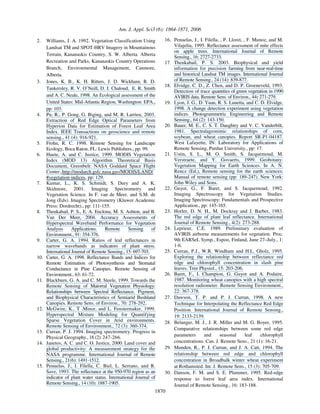
For classifying the coniferous species based on
their age, in this study they are classified into three
groups of ages as young, mature and old. For classifying
ages of plants, the theoretical study shows that, when
plants have higher chlorophyll content and LAI
(young), the REP shifts toward the longer wavelengths;
when plants have low chlorophyll content and LAI
(old), the REP shifts toward the shorter wavelengths[4]
.
The results based on the statistical analysis as shown in
Fig. 5 is corresponding to the theoretical results in](https://image.slidesharecdn.com/hyperspectralremotesensingofvegetationusingrededgepositiontechniques-231221200617-087fbcbd/85/Hyperspectral-Remote-Sensing-Of-Vegetation-Using-Red-Edge-Position-Techniques-4-320.jpg)
![Am. J. Appl. Sci3 (6): 1864-1871, 2006
1869
Table 2: A summary of the advantages and attributes of the two interpolation techniques for determining the REP
Methods Implementation
Required spectral
type
Suitability for canopy
spectra
Red edge detection
Minimizing soil background
effects
Linear
Lagrangian
Easy
Moderate
Reflectance
Derivative
Yes
Yes
Good
Good
Low
High
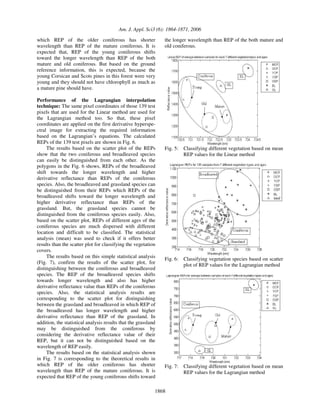
Comparison of the Linear and Lagrangian
interpolation techniques: For having a better
comparison between the two methods to estimate REP,
the mean values of the REPs for the two methods are
represented together in Fig. 8. It shows that, there is
similarity between the both methods for estimating the
REPs of different vegetation covers, which wavelength
of the young, old and mature coniferous and broadleav-
ed species are distributed from the shorter to longer
wavelength in both methods respectively. Based on the
statistical analysis results, both the Lagrangian and
Linear methods generate similar results for estimating
REP of the coniferous and broadleaved species and
different results for estimating REP of the grassland.
As the REP of the grassland in the Lagrangian
method goes towards shorter wavelength and lower
reflectance than the Linear method, it can be concluded
that the Lagrangian approach offers more accurate
results than the Linear method in estimating grassland,
because the derivative approaches (Lagrangian
technique) minimizes the soil background reflectance
effects[27, 50-55]
. In classifying different ages of conifer-
ous species, both methods offer the same results in
extracting REP for different ages of coniferous species.
A summary of the attributes of the two methods is
presented in Table 2. The differences between these two
methods based on the computation are that the Linear
method can be done easily as it only requires four
bands. Implementation of the Lagrangian technique
needs more computation time and if the first derivative
spectra are available, we can simply take three bands
containing the maximum first derivative reflectance
value to determine REP. However, if the first derivative
spectra are not available (for example, multispectral
remote sensing data with very small number of bands),
this method cannot be used.
Fig. 8: Comparison of the mean REP values of the
Linear and Lagrangian methods
CONCLUSION
139 test pixels from the HyMap were selected to
extract REP using the two Linear and Lagrangian
approaches for the goal of classifying vegetation
species. The statistical analysis is applied to calculate
the mean value of the REP for both methods. The
statistical results show that, both the Linear and
Lagrangian approaches generated similar results in
extracting REP for the coniferous and the broadleaved
species. They also offer similar results in estimating
REP of different ages of coniferous species. But there
are some differences between the two approaches in
estimating REP of the grassland in which the
Lagrangian technique generate more accurate results
than the Linear method because of its less sensitivity to
the soil background reflectance effects.
Comparison of the ground reference map and the
REP of the test data suggested some degree of success
in discriminating the broadleaved and coniferous trees.
Based on the statistical results of both the Linear and
Lagrangian methods, the broadleaved trees can be
distinguished from the coniferous tress by considering
their REP, in which REP of the broadleaved trees shift
toward the longer wavelength and of higher reflectance
than REP of the coniferous trees. Another successful
result which had been obtained by comparison with the
ground reference image is that different ages of the
coniferous trees can be distinguished easily by
considering the wavelength of their REP. The REP of
the younger trees shift towards longer wavelength and
REP of the older trees shift towards the shorter
wavelength. The above results demonstrate the potential
application of hyperspectral remote sensing and red
edge position analysis for detecting different vegetation
types and ages in a forested area.
ACKNOWLEDGMENT
We would like to thank Universiti Putra Malaysia
(UPM) for the financial support in completing this
research.
REFERENCES
1. Jensen, J.R, 2000. Remote sensing of the
environment: an earth resource perspective. Prentice
Hall series in geographic information science, USA,
Chap.1 and 10, pp: 1-28 and 333-377.](https://image.slidesharecdn.com/hyperspectralremotesensingofvegetationusingrededgepositiontechniques-231221200617-087fbcbd/85/Hyperspectral-Remote-Sensing-Of-Vegetation-Using-Red-Edge-Position-Techniques-6-320.jpg)

This document summarizes a study that used two techniques - linear interpolation and Lagrangian interpolation - to extract red edge positions (REPs) from hyperspectral data of different vegetation covers in a forest area. The linear technique used four bands to calculate REP wavelength and reflectance values simply. The Lagrangian technique fitted a polynomial to derivative reflectance values around the red edge to estimate REP. Both techniques were compared to ground reference data. Results showed younger plants with higher chlorophyll had REPs at longer wavelengths and higher reflectances than older plants with lower chlorophyll.


