NIR spectroscopy as a tool for in-field
determination of log/biomass quality
index in mountain forests
– SLOPE project approach
Jakub Sandak1, Anna Sandak1, Gianni Picchi1,
Katharina Böhm2, Andreas Zitek2, Barbara Hintestoisser2
1) CNR-IVALSA, San Michele all’Adige (TN), Italy
2) University of Natural Resources and Life Sciences, Vienna, Austria
Federico Prandi
Before starting…
• The forest in mountains is peculiar, and very different
than such of flat lands!!!
• Trees in mountains are (mostly) BIG…
• Big/old tree may be or superior quality, or “fuel wood”
• Trees from mountains might be of really high value
• We do support “PROPER LOG FOR PROPER USE”
• The quality of wood/log/tree is an issue!!!!!
• The quality of wood is not only external dimensions,
taper and diameter…
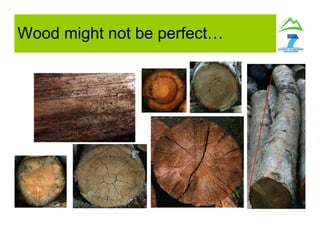
Wood might not be perfect…
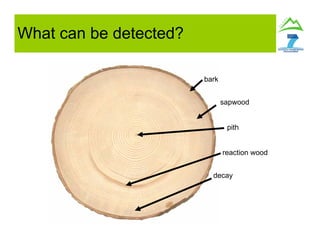
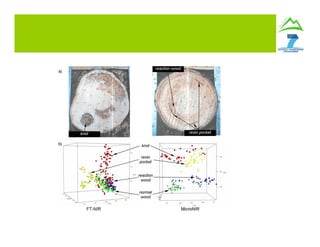
What can be detected?
bark
sapwood
pith
reaction wood
decay
Outline
• Current methods for logs grading are based on visual
rating, which is operator-dependant, time-consuming,
subjective and no precise.
• The efficient grading should be conducted by means of
automatic measurement of selected wood properties
that are essential for the foreseen final product.
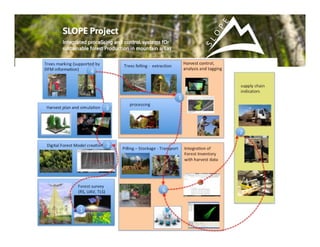
• The work presented here is a part of the SLOPE project,
which is focused on development of the integrated
surveying system for mountainous forest.
• The aim is to exploit the advantages of combined
diagnostics techniques and multivariate data analysis for
more reliable and rational assessment of the harvesting
material.
• In this case usability of NIR spectroscopy for
characterization of bio-resources along harvesting chain
is investigated.
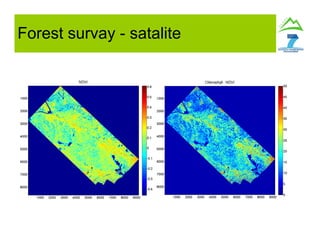
Forest survay - satalite
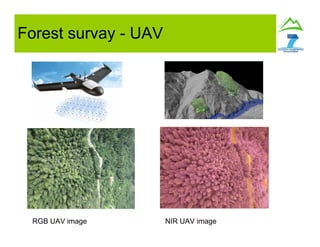
Forest survay - UAV
RGB UAV image NIR UAV image
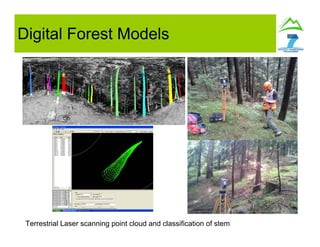
Digital Forest Models
Terrestrial Laser scanning point cloud and classification of stem
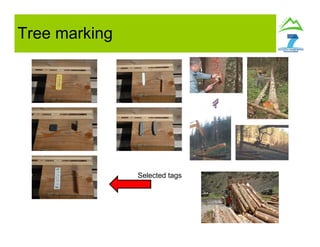
Tree marking
Selected tags
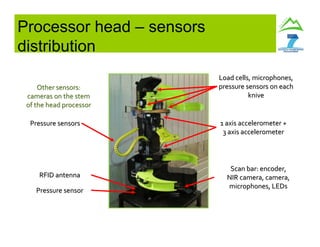
Processor head – sensors
distribution
Pressure sensorsPressure sensors
Load cells, microphones,Load cells, microphones,
pressure sensors on eachpressure sensors on each
kniveknive
1 axis accelerometer +1 axis accelerometer +
3 axis accelerometer3 axis accelerometer
Scan bar: encoder,Scan bar: encoder,
NIR camera, camera,NIR camera, camera,
microphones,microphones, LEDsLEDs
RFID antennaRFID antenna
Pressure sensorPressure sensor
Other sensors:Other sensors:
cameras on the stemcameras on the stem
of the head processorof the head processor
Multi-sensor model-based quality
control
• The goals are:
– to develop an automated and real-time grading
(optimization) system for the forest production, in
order to improve log/biomass segregation and to help
develop a more efficient supply chain of mountain
forest products
– to design software solutions for continuous update
the pre-harvest inventory procedures in the
mountain areas
– to provide data to refine stand growth and yield
models for long-term silvicultural management
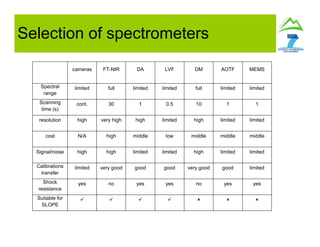
Selection of spectrometers
cameras FT-NIR DA LVF DM AOTF MEMS
Spectral
range
limited full limited limited full limited limited
Scanning
time (s)
cont. 30 1 0.5 10 1 1
resolution high very high high limited high limited limited
cost N/A high middle low middle middle middle
Signal/noise high high limited limited high limited limited
Calibrations
transfer
limited very good good good very good good limited
Shock
resistance
yes no yes yes no yes yes
Suitable for
SLOPE
      
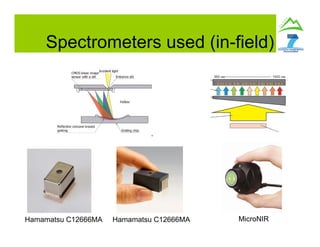
Spectrometers used (in-field)
Hamamatsu C12666MA Hamamatsu C12666MA MicroNIR
Instrument type FT-NIR dispersive linear variable filter MicroNIR
Moisture content of sample wet dry wet dry wet dry
Surface of sample smooth rough smooth rough smooth rough smooth rough smooth rough smooth rough
knots            
resin pocket            
twist            
eccentric pith            
compression wood      ?    ?  
sweep            
taper            
shakes            
insects ?   ? ?  ? ? ?  ? ?
dote  ?  ?  ?  ? ? ? ? ?
rot            
WooddefectsaccordingtoEN
1927-1:2008
stain  ?   ? ?  ? ? ?  ?
lignin ? ?   ? ?   ? ?  ?
cellulose ? ?   ? ?   ? ?  ?
hemicellulose ? ?   ? ?   ? ?  ?
extractives ? ?   ? ?   ? ?  ?
microfibryl angle ? ?     ? ?   ? ?
calorific value ? ?   ? ?  ? ? ?  ?
heartwood/sapwood       ? ?   ? ?
density      ?  ?  ?  ?
mechanical properties      ?  ?  ?  ?
moisture content            
provenance    ?        
resonance wood ? ?  ? ? ? ? ? ? ? ? ?
Otherwoodproperties/characteristics
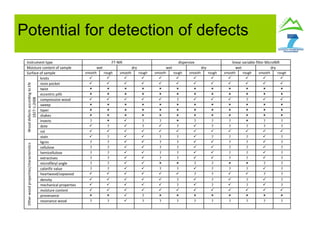
Potential for detection of defects
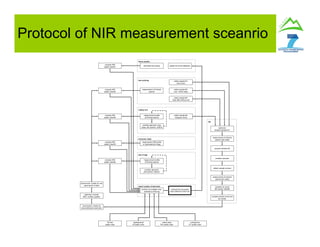
Protocol of NIR measurement sceanrio
(optional)
prepare samples #1
measurement of infrared
spectra (wet state)
prepare samples #2
condition samples
chemometric models for wet
wood and/or in field
chemometric models for
dry/conditioned wood (lab)
measurement of infrared
spectra
collect sample #1:
chip of axe
collect sample #2:
core ~30mm deep
collect sample #3:
chips after drilling core
collect sample #4:
triangular slices
measurement NIR profile
or hyperspectral image
measurement profile
of infrared spectra
consider approach: max
slope, pith position, WSEN
compute NIR
quality index#2
compute NIR
quality index#3
compute NIR
quality index#4
measurement profile
of infrared spectra
consider approach:
pith position, defects
compute NIR
quality index#5
tree marking
cutting tree
processor head
pile of logs
expert system & data base
refresh sample surface
measurement of infrared
spectra (dry state)
compute dry wood
NIR quality index#6compute the log quality
class (optimize cross-cut)
estimated tree quality
forest models
update the forest database
compare results of wet and
dry woods
combine all available char-
acteristics of the log
lab
Calibration transfer
f(MC, surface_quality)
3D tree
quality index
hyperspectral
HI quality index
stress wave
SW quality index
cutting force
CF quality index
compute NIR
quality index#1
Quality indexes
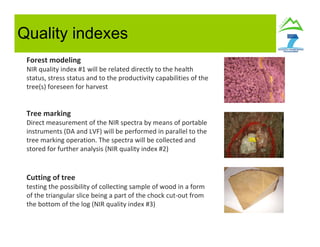
Forest modeling
NIR quality index #1 will be related directly to the health
status, stress status and to the productivity capabilities of the
tree(s) foreseen for harvest
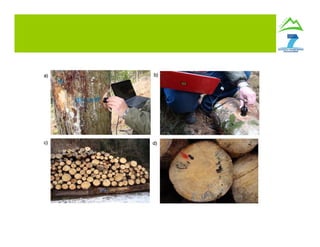
Tree marking
Direct measurement of the NIR spectra by means of portable
instruments (DA and LVF) will be performed in parallel to the
tree marking operation. The spectra will be collected and
stored for further analysis (NIR quality index #2)
Cutting of tree
testing the possibility of collecting sample of wood in a form
of the triangular slice being a part of the chock cut-out from
the bottom of the log (NIR quality index #3)
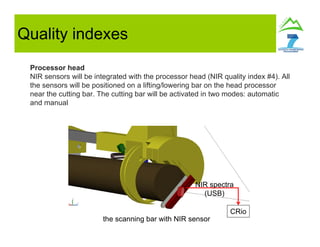
the scanning bar with NIR sensor
CRio
NIR spectra
(USB)
Processor head
NIR sensors will be integrated with the processor head (NIR quality index #4). All
the sensors will be positioned on a lifting/lowering bar on the head processor
near the cutting bar. The cutting bar will be activated in two modes: automatic
and manual
Quality indexes
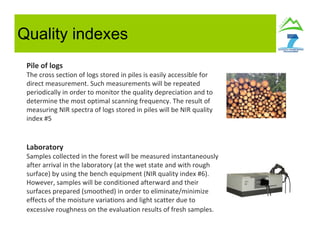
Pile of logs
The cross section of logs stored in piles is easily accessible for
direct measurement. Such measurements will be repeated
periodically in order to monitor the quality depreciation and to
determine the most optimal scanning frequency. The result of
measuring NIR spectra of logs stored in piles will be NIR quality
index #5
Laboratory
Samples collected in the forest will be measured instantaneously
after arrival in the laboratory (at the wet state and with rough
surface) by using the bench equipment (NIR quality index #6).
However, samples will be conditioned afterward and their
surfaces prepared (smoothed) in order to eliminate/minimize
effects of the moisture variations and light scatter due to
excessive roughness on the evaluation results of fresh samples.
Quality indexes
• PLS models for suitability indexes (0= no suitable, 1 –
perfectly suitable) for different uses (structural, pulp,
resonance etc.)
• PLS models for prediction of logs moisture, density,
calorific value etc.
• Clasifications models for defects detection
• Classification models for quality class assignment
(A,B,C,D)
Quality indexes - calculations
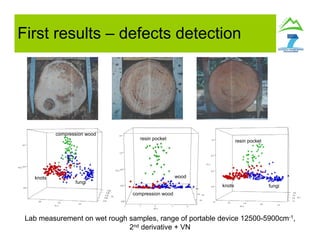
First results – defects detection
knots
compression wood
fungi
compression wood
wood
resin pocket
Lab measurement on wet rough samples, range of portable device 12500-5900cm-1,
2nd derivative + VN
knots
resin pocket
fungi
bark
comp.wood
decay
knots
resin
wood
bark
comp. w ood
decay
knots
resin
w ood
0,0
5,0
10,0
15,0
20,0
25,0
frequency (%)
predicted
reference
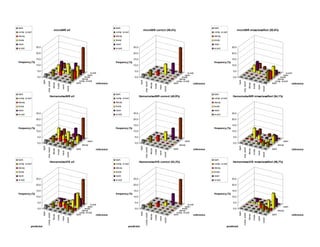
microNIR all
bark
comp. w ood
decay
knots
resin
w ood
bark
comp.wood
decay
knots
resin
wood
bark
comp. w ood
decay
knots
resin
w ood
0,0
5,0
10,0
15,0
20,0
25,0
frequency (%)
predicted
reference
microNIR correct (49,4%)
bark
comp. w ood
decay
knots
resin
w ood
bark
comp.wood
decay
knots
resin
wood
bark
comp. w ood
decay
knots
resin
w ood
0,0
5,0
10,0
15,0
20,0
25,0
frequency (%)
predicted
reference
microNIR missclassified (50,6%)
bark
comp. w ood
decay
knots
resin
w ood
bark
comp.wood
decay
knots
resin
wood
bark
decay
resin
0,0
5,0
10,0
15,0
20,0
25,0
frequency (%)
predicted
reference
HamamatsuNIR all
bark
comp. w ood
decay
knots
resin
w ood
bark
comp.wood
decay
knots
resin
wood
bark
decay
resin
0,0
5,0
10,0
15,0
20,0
25,0
frequency (%)
predicted
reference
HamamatsuNIR correct (45,9%)
bark
comp. w ood
decay
knots
resin
w ood
bark
comp.wood
decay
knots
resin
wood
bark
decay
resin
0,0
5,0
10,0
15,0
20,0
25,0
frequency (%)
predicted
reference
HamamatsuNIR missclassified (54,1%)
bark
comp. w ood
decay
knots
resin
w ood
bark
comp.wood
decay
knots
resin
wood
bark
comp. w ood
decay
knots
resin
w ood
0,0
5,0
10,0
15,0
20,0
25,0
frequency (%)
predicted
reference
HamamatsuVIS all
bark
comp. w ood
decay
knots
resin
w ood
bark
comp.wood
decay
knots
resin
wood
bark
comp. w ood
decay
knots
resin
w ood
0,0
5,0
10,0
15,0
20,0
25,0
frequency (%)
predicted
reference
HamamatsuVIS correct (43,3%)
bark
comp. w ood
decay
knots
resin
w ood
bark
comp.wood
decay
knots
resin
wood
bark
decay
resin
0,0
5,0
10,0
15,0
20,0
25,0
frequency (%)
predicted
reference
HamamatsuVIS missclassified (56,7%)
bark
comp. w ood
decay
knots
resin
w ood
y = 0.93x + 1.86
R² = 0.93
25,0
27,0
29,0
31,0
33,0
25,0 27,0 29,0 31,0 33,0
Measured total lignin content (%)
NIR-predictedtotallignincontent(%)
y = 0.93x + 1.86
R² = 0.93
y = 0,99x + 0,31
R
2
= 0,86
25,0
27,0
29,0
31,0
33,0
25,0 27,0 29,0 31,0 33,0
Measured total lignin content (%)
NIR-predictedtotallignincontent(%)
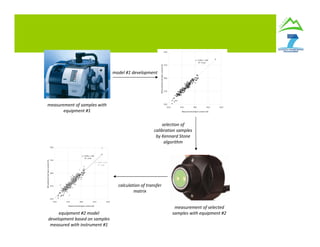
measurement of samples with
equipment #1
measurement of selected
samples with equipment #2equipment #2 model
development based on samples
measured with instrument #1
model #1 development
calculation of transfer
matrix
selection of
calibration samples
by Kennard Stone
algorithm
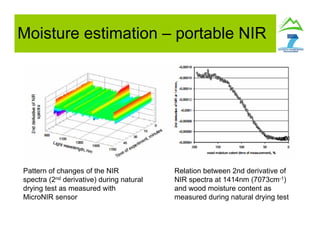
Moisture estimation – portable NIR
Pattern of changes of the NIR
spectra (2nd derivative) during natural
drying test as measured with
MicroNIR sensor
Relation between 2nd derivative of
NIR spectra at 1414nm (7073cm-1)
and wood moisture content as
measured during natural drying test
Calibration transfer
1
Calibration transfer algorithm:
•Bias/slope correction
•Picewise direct standardization
•Wavelets
•…..
Measurements eg.
200 samples with
laboratory equipment
Model development
Measurements
eg. 20 out of the 200 samples
with field equipment
Field model
development
based on the 200
transfered
samples of the
laboratory
equipment
Calibration sample (20) selection using
the Kennard Stone algorithm
miboe1
Slide 27
miboe1 Please use here a picture of the micronir sensor!
Michael Böhm, 10/13/2015
Acknowledgment
This work has been conducted within the
framework of the project SLOPE receiving
funding from the European Union's Seventh
Framework Programme for research,
technological development and demonstration
under the NMP.2013.3.0-2 (Grant number
604129).
Thank you

SLOPE 3rd workshop - presentation 2

  • 1.
    NIR spectroscopy asa tool for in-field determination of log/biomass quality index in mountain forests – SLOPE project approach Jakub Sandak1, Anna Sandak1, Gianni Picchi1, Katharina Böhm2, Andreas Zitek2, Barbara Hintestoisser2 1) CNR-IVALSA, San Michele all’Adige (TN), Italy 2) University of Natural Resources and Life Sciences, Vienna, Austria Federico Prandi
  • 2.
    Before starting… • Theforest in mountains is peculiar, and very different than such of flat lands!!! • Trees in mountains are (mostly) BIG… • Big/old tree may be or superior quality, or “fuel wood” • Trees from mountains might be of really high value • We do support “PROPER LOG FOR PROPER USE” • The quality of wood/log/tree is an issue!!!!! • The quality of wood is not only external dimensions, taper and diameter…
  • 4.
    Wood might notbe perfect…
  • 5.
    What can bedetected? bark sapwood pith reaction wood decay
  • 6.
    Outline • Current methodsfor logs grading are based on visual rating, which is operator-dependant, time-consuming, subjective and no precise. • The efficient grading should be conducted by means of automatic measurement of selected wood properties that are essential for the foreseen final product. • The work presented here is a part of the SLOPE project, which is focused on development of the integrated surveying system for mountainous forest. • The aim is to exploit the advantages of combined diagnostics techniques and multivariate data analysis for more reliable and rational assessment of the harvesting material. • In this case usability of NIR spectroscopy for characterization of bio-resources along harvesting chain is investigated.
  • 7.
  • 8.
    Forest survay -UAV RGB UAV image NIR UAV image
  • 9.
    Digital Forest Models TerrestrialLaser scanning point cloud and classification of stem
  • 10.
  • 11.
    Processor head –sensors distribution Pressure sensorsPressure sensors Load cells, microphones,Load cells, microphones, pressure sensors on eachpressure sensors on each kniveknive 1 axis accelerometer +1 axis accelerometer + 3 axis accelerometer3 axis accelerometer Scan bar: encoder,Scan bar: encoder, NIR camera, camera,NIR camera, camera, microphones,microphones, LEDsLEDs RFID antennaRFID antenna Pressure sensorPressure sensor Other sensors:Other sensors: cameras on the stemcameras on the stem of the head processorof the head processor
  • 12.
    Multi-sensor model-based quality control •The goals are: – to develop an automated and real-time grading (optimization) system for the forest production, in order to improve log/biomass segregation and to help develop a more efficient supply chain of mountain forest products – to design software solutions for continuous update the pre-harvest inventory procedures in the mountain areas – to provide data to refine stand growth and yield models for long-term silvicultural management
  • 13.
    Selection of spectrometers camerasFT-NIR DA LVF DM AOTF MEMS Spectral range limited full limited limited full limited limited Scanning time (s) cont. 30 1 0.5 10 1 1 resolution high very high high limited high limited limited cost N/A high middle low middle middle middle Signal/noise high high limited limited high limited limited Calibrations transfer limited very good good good very good good limited Shock resistance yes no yes yes no yes yes Suitable for SLOPE       
  • 14.
    Spectrometers used (in-field) HamamatsuC12666MA Hamamatsu C12666MA MicroNIR
  • 15.
    Instrument type FT-NIRdispersive linear variable filter MicroNIR Moisture content of sample wet dry wet dry wet dry Surface of sample smooth rough smooth rough smooth rough smooth rough smooth rough smooth rough knots             resin pocket             twist             eccentric pith             compression wood      ?    ?   sweep             taper             shakes             insects ?   ? ?  ? ? ?  ? ? dote  ?  ?  ?  ? ? ? ? ? rot             WooddefectsaccordingtoEN 1927-1:2008 stain  ?   ? ?  ? ? ?  ? lignin ? ?   ? ?   ? ?  ? cellulose ? ?   ? ?   ? ?  ? hemicellulose ? ?   ? ?   ? ?  ? extractives ? ?   ? ?   ? ?  ? microfibryl angle ? ?     ? ?   ? ? calorific value ? ?   ? ?  ? ? ?  ? heartwood/sapwood       ? ?   ? ? density      ?  ?  ?  ? mechanical properties      ?  ?  ?  ? moisture content             provenance    ?         resonance wood ? ?  ? ? ? ? ? ? ? ? ? Otherwoodproperties/characteristics Potential for detection of defects
  • 16.
    Protocol of NIRmeasurement sceanrio (optional) prepare samples #1 measurement of infrared spectra (wet state) prepare samples #2 condition samples chemometric models for wet wood and/or in field chemometric models for dry/conditioned wood (lab) measurement of infrared spectra collect sample #1: chip of axe collect sample #2: core ~30mm deep collect sample #3: chips after drilling core collect sample #4: triangular slices measurement NIR profile or hyperspectral image measurement profile of infrared spectra consider approach: max slope, pith position, WSEN compute NIR quality index#2 compute NIR quality index#3 compute NIR quality index#4 measurement profile of infrared spectra consider approach: pith position, defects compute NIR quality index#5 tree marking cutting tree processor head pile of logs expert system & data base refresh sample surface measurement of infrared spectra (dry state) compute dry wood NIR quality index#6compute the log quality class (optimize cross-cut) estimated tree quality forest models update the forest database compare results of wet and dry woods combine all available char- acteristics of the log lab Calibration transfer f(MC, surface_quality) 3D tree quality index hyperspectral HI quality index stress wave SW quality index cutting force CF quality index compute NIR quality index#1
  • 17.
    Quality indexes Forest modeling NIRquality index #1 will be related directly to the health status, stress status and to the productivity capabilities of the tree(s) foreseen for harvest Tree marking Direct measurement of the NIR spectra by means of portable instruments (DA and LVF) will be performed in parallel to the tree marking operation. The spectra will be collected and stored for further analysis (NIR quality index #2) Cutting of tree testing the possibility of collecting sample of wood in a form of the triangular slice being a part of the chock cut-out from the bottom of the log (NIR quality index #3)
  • 18.
    the scanning barwith NIR sensor CRio NIR spectra (USB) Processor head NIR sensors will be integrated with the processor head (NIR quality index #4). All the sensors will be positioned on a lifting/lowering bar on the head processor near the cutting bar. The cutting bar will be activated in two modes: automatic and manual Quality indexes
  • 19.
    Pile of logs Thecross section of logs stored in piles is easily accessible for direct measurement. Such measurements will be repeated periodically in order to monitor the quality depreciation and to determine the most optimal scanning frequency. The result of measuring NIR spectra of logs stored in piles will be NIR quality index #5 Laboratory Samples collected in the forest will be measured instantaneously after arrival in the laboratory (at the wet state and with rough surface) by using the bench equipment (NIR quality index #6). However, samples will be conditioned afterward and their surfaces prepared (smoothed) in order to eliminate/minimize effects of the moisture variations and light scatter due to excessive roughness on the evaluation results of fresh samples. Quality indexes
  • 20.
    • PLS modelsfor suitability indexes (0= no suitable, 1 – perfectly suitable) for different uses (structural, pulp, resonance etc.) • PLS models for prediction of logs moisture, density, calorific value etc. • Clasifications models for defects detection • Classification models for quality class assignment (A,B,C,D) Quality indexes - calculations
  • 21.
    First results –defects detection knots compression wood fungi compression wood wood resin pocket Lab measurement on wet rough samples, range of portable device 12500-5900cm-1, 2nd derivative + VN knots resin pocket fungi
  • 22.
    bark comp.wood decay knots resin wood bark comp. w ood decay knots resin wood 0,0 5,0 10,0 15,0 20,0 25,0 frequency (%) predicted reference microNIR all bark comp. w ood decay knots resin w ood bark comp.wood decay knots resin wood bark comp. w ood decay knots resin w ood 0,0 5,0 10,0 15,0 20,0 25,0 frequency (%) predicted reference microNIR correct (49,4%) bark comp. w ood decay knots resin w ood bark comp.wood decay knots resin wood bark comp. w ood decay knots resin w ood 0,0 5,0 10,0 15,0 20,0 25,0 frequency (%) predicted reference microNIR missclassified (50,6%) bark comp. w ood decay knots resin w ood bark comp.wood decay knots resin wood bark decay resin 0,0 5,0 10,0 15,0 20,0 25,0 frequency (%) predicted reference HamamatsuNIR all bark comp. w ood decay knots resin w ood bark comp.wood decay knots resin wood bark decay resin 0,0 5,0 10,0 15,0 20,0 25,0 frequency (%) predicted reference HamamatsuNIR correct (45,9%) bark comp. w ood decay knots resin w ood bark comp.wood decay knots resin wood bark decay resin 0,0 5,0 10,0 15,0 20,0 25,0 frequency (%) predicted reference HamamatsuNIR missclassified (54,1%) bark comp. w ood decay knots resin w ood bark comp.wood decay knots resin wood bark comp. w ood decay knots resin w ood 0,0 5,0 10,0 15,0 20,0 25,0 frequency (%) predicted reference HamamatsuVIS all bark comp. w ood decay knots resin w ood bark comp.wood decay knots resin wood bark comp. w ood decay knots resin w ood 0,0 5,0 10,0 15,0 20,0 25,0 frequency (%) predicted reference HamamatsuVIS correct (43,3%) bark comp. w ood decay knots resin w ood bark comp.wood decay knots resin wood bark decay resin 0,0 5,0 10,0 15,0 20,0 25,0 frequency (%) predicted reference HamamatsuVIS missclassified (56,7%) bark comp. w ood decay knots resin w ood
  • 25.
    y = 0.93x+ 1.86 R² = 0.93 25,0 27,0 29,0 31,0 33,0 25,0 27,0 29,0 31,0 33,0 Measured total lignin content (%) NIR-predictedtotallignincontent(%) y = 0.93x + 1.86 R² = 0.93 y = 0,99x + 0,31 R 2 = 0,86 25,0 27,0 29,0 31,0 33,0 25,0 27,0 29,0 31,0 33,0 Measured total lignin content (%) NIR-predictedtotallignincontent(%) measurement of samples with equipment #1 measurement of selected samples with equipment #2equipment #2 model development based on samples measured with instrument #1 model #1 development calculation of transfer matrix selection of calibration samples by Kennard Stone algorithm
  • 26.
    Moisture estimation –portable NIR Pattern of changes of the NIR spectra (2nd derivative) during natural drying test as measured with MicroNIR sensor Relation between 2nd derivative of NIR spectra at 1414nm (7073cm-1) and wood moisture content as measured during natural drying test
  • 27.
    Calibration transfer 1 Calibration transferalgorithm: •Bias/slope correction •Picewise direct standardization •Wavelets •….. Measurements eg. 200 samples with laboratory equipment Model development Measurements eg. 20 out of the 200 samples with field equipment Field model development based on the 200 transfered samples of the laboratory equipment Calibration sample (20) selection using the Kennard Stone algorithm miboe1
  • 28.
    Slide 27 miboe1 Pleaseuse here a picture of the micronir sensor! Michael Böhm, 10/13/2015
  • 29.
    Acknowledgment This work hasbeen conducted within the framework of the project SLOPE receiving funding from the European Union's Seventh Framework Programme for research, technological development and demonstration under the NMP.2013.3.0-2 (Grant number 604129).
  • 30.