Review Meeting
2-4/Jul/2015
Review Meeting
2-4/Jul/2015
Project SLOPE
1
WP 2 – Forest information collection and
analysis
Review Meeting
2-4/Jul/2015
Review Meeting
2-4/Jul/2015
Project SLOPE
T2.1– Remote Sensing and Multispectral
Analysis
Brussels, July 2nd, 2015
Review Meeting
2-4/Jul/2015
Review Meeting
2-4/Jul/2015
Overview
• Status: Completed (100%)
• Length: 4 Months (From M4 to M8)
• Involved Partners
• Leader: Flyby
• Participants: Coastway, CNR, Treemetrics
• Aim: Define a methodology to obtain a description of the
scenarios with multispectral and multisensor data for forest
status characterization; Define how to realize a more complete
forest inventory
• Output: D.2.01 Remote Sensing and Data Analysis
Review Meeting
2-4/Jul/2015
Review Meeting
2-4/Jul/2015
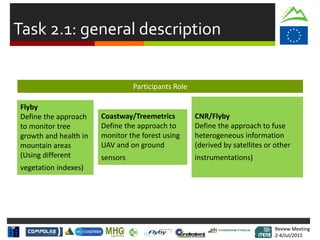
Task 2.1: general description
Flyby
Define the approach
to monitor tree
growth and health in
mountain areas
(Using different
vegetation indexes)
Coastway/Treemetrics
Define the approach to
monitor the forest using
UAV and on ground
sensors
CNR/Flyby
Define the approach to fuse
heterogeneous information
(derived by satellites or other
instrumentations)
Participants Role
Review Meeting
2-4/Jul/2015
Review Meeting
2-4/Jul/2015
Main Results
• Determination of useful VIs from sensed data
• Estimation of biological parameters from VIs
• Analysis of parameter with growing level of
detail (Satellite -> UAVs -> Laser scanner)
• Utilizability
Review Meeting
2-4/Jul/2015
Review Meeting
2-4/Jul/2015
Issues, delays and actions
• Case study chosen, with post inspection, revealed too young/thin
trees
• The alternative (Gortahile forest) was not present in Sat data
(geographical mismatch)
•Action Taken: Acquisition of EO images over the Trentino area visited
with UAVs in order to have a comparable dataset
• Possible issue (resolved): lack (at least for now) of a specific band
(RE) which could be useful for tree inspection in UAVs camera
Review Meeting
2-4/Jul/2015
Review Meeting
2-4/Jul/2015
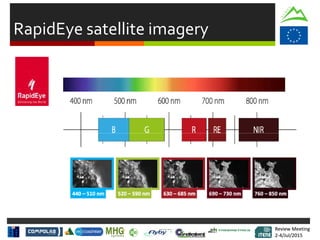
RapidEye satellite imagery
Review Meeting
2-4/Jul/2015
Review Meeting
2-4/Jul/2015
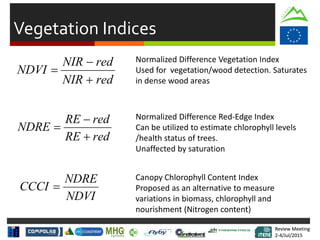
Vegetation Indices
redNIR
redNIR
NDVI
+
−
=
redRE
redRE
NDRE
+
−
=
NDVI
NDRE
CCCI =
Normalized Difference Vegetation Index
Used for vegetation/wood detection. Saturates
in dense wood areas
Normalized Difference Red-Edge Index
Can be utilized to estimate chlorophyll levels
/health status of trees.
Unaffected by saturation
Canopy Chlorophyll Content Index
Proposed as an alternative to measure
variations in biomass, chlorophyll and
nourishment (Nitrogen content)
Review Meeting
2-4/Jul/2015
Review Meeting
2-4/Jul/2015
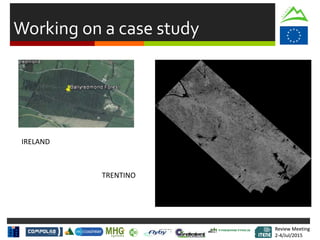
Working on a case study
IRELAND
TRENTINO
Review Meeting
2-4/Jul/2015
Review Meeting
2-4/Jul/2015
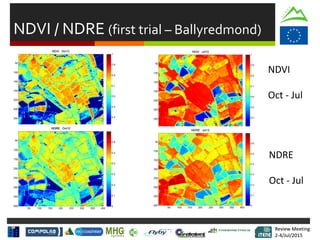
NDVI / NDRE (first trial – Ballyredmond)
NDVI
Oct - Jul
NDRE
Oct - Jul
Review Meeting
2-4/Jul/2015
Review Meeting
2-4/Jul/2015
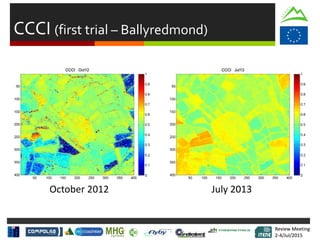
CCCI (first trial – Ballyredmond)
October 2012 July 2013
Review Meeting
2-4/Jul/2015
Review Meeting
2-4/Jul/2015
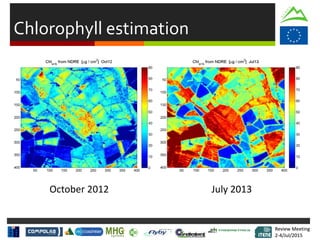
Chlorophyll estimation
October 2012 July 2013
Review Meeting
2-4/Jul/2015
Review Meeting
2-4/Jul/2015
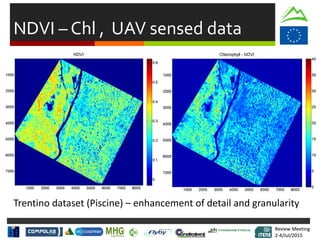
NDVI – Chl , UAV sensed data
Trentino dataset (Piscine) – enhancement of detail and granularity
Review Meeting
2-4/Jul/2015
Review Meeting
2-4/Jul/2015
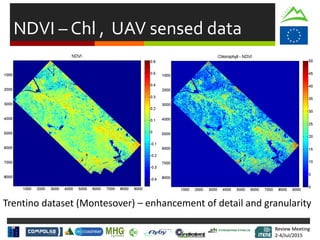
NDVI – Chl , UAV sensed data
Trentino dataset (Montesover) – enhancement of detail and granularity
Review Meeting
2-4/Jul/2015
Review Meeting
2-4/Jul/2015
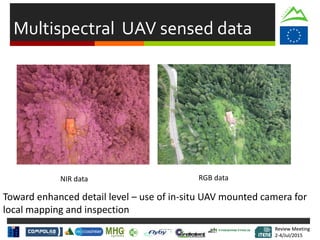
Multispectral UAV sensed data
Toward enhanced detail level – use of in-situ UAV mounted camera for
local mapping and inspection
NIR data RGB data
Review Meeting
2-4/Jul/2015
Review Meeting
2-4/Jul/2015
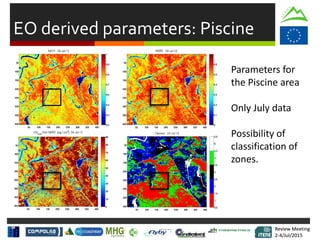
EO derived parameters: Piscine
Parameters for
the Piscine area
Only July data
Possibility of
classification of
zones.
Review Meeting
2-4/Jul/2015
Review Meeting
2-4/Jul/2015
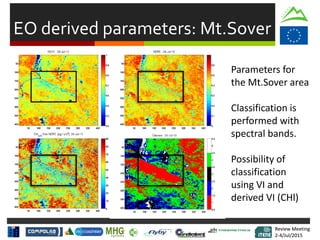
EO derived parameters: Mt.Sover
Parameters for
the Mt.Sover area
Classification is
performed with
spectral bands.
Possibility of
classification
using VI and
derived VI (CHl)
Review Meeting
2-4/Jul/2015
Review Meeting
2-4/Jul/2015
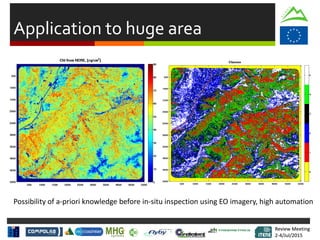
Application to huge area
Possibility of a-priori knowledge before in-situ inspection using EO imagery, high automation
Review Meeting
2-4/Jul/2015
Review Meeting
2-4/Jul/2015
Conclusions
• Development of an integrated wood monitoring system
• Definition of a processing chain for data from different
platforms
• Relation between VI indices and biomass productivity index
• Possibility of tree classification from EO data – synergy with
UAVs
• Toward very detailed information to tree-level for woodcutting
operators
Review Meeting
2-4/Jul/2015
Review Meeting
2-4/Jul/2015
Conclusions
• Additional analysis is expected as soon as Austrian UAV
imagery is ready
• Better comparison with the datasets
Review Meeting
2-4/Jul/2015
Review Meeting
2-4/Jul/2015
Mid-term Review 2/Jul/15
Contact info
Andrea Masini: andrea.masini@flyby.it
Alberto Lupidi: alberto.lupidi@flyby.it
Thank you for your attention
Review Meeting
2-4/Jul/2015
Review Meeting
2-4/Jul/2015
WP2 Slope Project
WP2.2 Forest Information Collection and Analysis
Brussels, July 2nd, 2015
Partners: Coastway /CNR / Treemetrics / FLYby
Review Meeting
2-4/Jul/2015
Review Meeting
2-4/Jul/2015
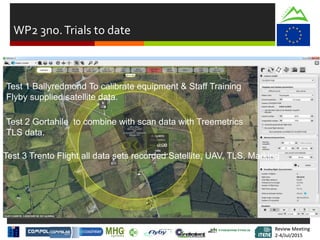
WP2 3no.Trials to date
Test 1 Ballyredmond To calibrate equipment & Staff Training
Flyby supplied satellite data.
Test 2 Gortahile to combine with scan data with Treemetrics
TLS data.
Test 3 Trento Flight all data sets recorded Satellite, UAV, TLS, Marking
Review Meeting
2-4/Jul/2015
Review Meeting
2-4/Jul/2015
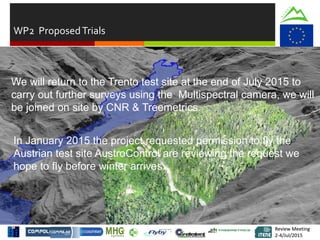
WP2 ProposedTrials
We will return to the Trento test site at the end of July 2015 to
carry out further surveys using the Multispectral camera, we will
be joined on site by CNR & Treemetrics.
In January 2015 the project requested permission to fly the
Austrian test site AustroControl are reviewing the request we
hope to fly before winter arrives.
Review Meeting
2-4/Jul/2015
Review Meeting
2-4/Jul/2015
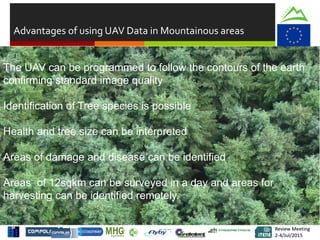
Advantages of using UAV Data in Mountainous areas
RGB Data enables you to determine the species and density of growthThe UAV can be programmed to follow the contours of the earth
confirming standard image quality
Identification of Tree species is possible
Health and tree size can be interpreted
Areas of damage and disease can be identified
Areas of 12sqkm can be surveyed in a day and areas for
harvesting can be identified remotely.
Review Meeting
2-4/Jul/2015
Review Meeting
2-4/Jul/2015
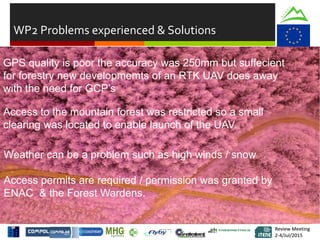
WP2 Problems experienced & Solutions
Weather can be a problem such as high winds / snow
Access permits are required / permission was granted by
ENAC & the Forest Wardens.
GPS quality is poor the accuracy was 250mm but suffecient
for forestry new developmemts of an RTK UAV does away
with the need for GCP’s
Access to the mountain forest was restricted so a small
clearing was located to enable launch of the UAV.
Review Meeting
2-4/Jul/2015
Review Meeting
2-4/Jul/2015
“Beyond the State of the Art”
The Advantages of Multispectral data over RGB & IR
multiSPEC 4C - Ultra precise 4-band accuracy
The multiSPEC 4C provides image data across four highly precise bands - Green,
Red, Red-edge and NIR - with no spectral overlap. In addition, its upward-facing
irradiance sensor automatically compensates for sunlight variations, resulting in
unparalleled reflectance measurement accuracy.
Technical features
Resolution 4 sensors of 1.2 Mp
Ground resolution 10 cm/px (@100m)
Sensor size 4.8 x 3.6 mm per sensor
Pixel pitch 3.75 um
Image format RAW (Tiff)
Review Meeting
2nd July 2015
Review Meeting
2nd July 2015
Review Meeting
2-4/Jul/2015
Review Meeting
2-4/Jul/2015
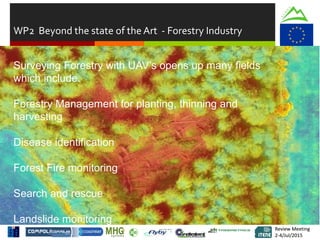
WP2 Beyond the state of the Art - Forestry Industry
Surveying Forestry with UAV’s opens up many fields
which include.
Forestry Management for planting, thinning and
harvesting
Disease identification
Forest Fire monitoring
Search and rescue
Landslide monitoring
Review Meeting
2-4/Jul/2015
Review Meeting
2-4/Jul/2015
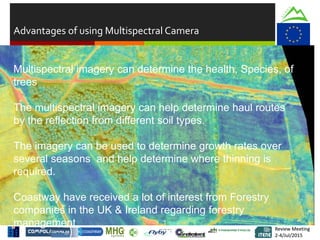
Advantages of using Multispectral Camera
Growth and yield of the forestry crop is the result of its interaction with
environmental factors, soil conditions and availability of water and nutrients in the
soil.
With the availability of crop-health detecting sensors,
it its now possible to obtain indicator kinetics such as NDVI, biomass, chlorophyll
rate, leaf area index, water stress, flowering ,on a much smaller scale than
before.
Multispectral imagery can determine the health, Species, of
trees
The multispectral imagery can help determine haul routes
by the reflection from different soil types.
The imagery can be used to determine growth rates over
several seasons and help determine where thinning is
required.
Coastway have received a lot of interest from Forestry
companies in the UK & Ireland regarding forestry
management.
Review Meeting
2-4/Jul/2015
Review Meeting
2-4/Jul/2015
Questions
Thank you for your attention
Endanolan@coastway.net
Review Meeting
2-4/Jul/2015
Review Meeting
2-4/Jul/2015
Task: T2.03 On-field digital survey systems
Task Leader: Treemetrics
Partners involved: CNR, COASTWAY, FLYBY
Deliverable: D2.03 TLS data analysis
Status: Completed
T2.03 On-field digital survey systems
Introduction
Mid-term Review
2/July/15
Review Meeting
2-4/Jul/2015
Review Meeting
2-4/Jul/2015
Task 2.03 TLS data and analysis
This task includes:
• Field measurement.
• TLS analysis
• TLS and UAV combination
• Estimation of the forest timber assets
D2.03 TLS data analysis
This deliverable contains a report on TLS data collected, the methodologies and
algorithm to extract needed information and the generated output information.
T2.03 On-field digital survey systems
Introduction
Mid-term Review
2/July/15
Review Meeting
2-4/Jul/2015
Review Meeting
2-4/Jul/2015
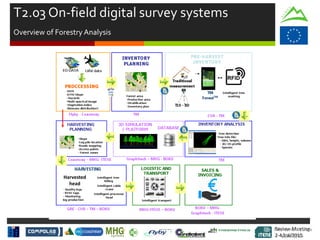
T2.03 On-field digital survey systems
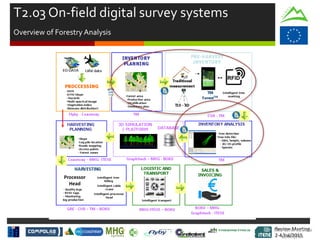
Overview of Forestry Analysis
Harvested
head
Mid-term Review
2/July/15
Review Meeting
2-4/Jul/2015
Review Meeting
2-4/Jul/2015
T2.03 On-field digital survey systems
Overview of Forestry Analysis
Processor
Head
Mid-term Review
2/July/15
Review Meeting
2-4/Jul/2015
Review Meeting
2-4/Jul/2015
Kick-off Meeting
8-9/jan/2014
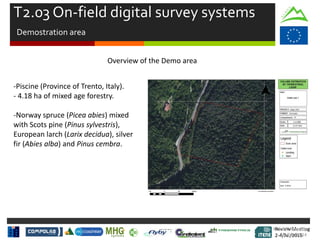
Overview of the Demo area
-Piscine (Province of Trento, Italy).
- 4.18 ha of mixed age forestry.
-Norway spruce (Picea abies) mixed
with Scots pine (Pinus sylvestris),
European larch (Larix decidua), silver
fir (Abies alba) and Pinus cembra.
T2.03 On-field digital survey systems
Demostration area
Review Meeting
2-4/Jul/2015
Review Meeting
2-4/Jul/2015
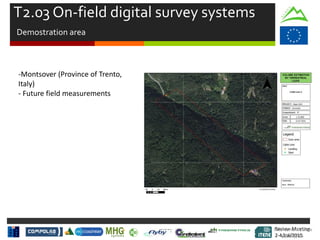
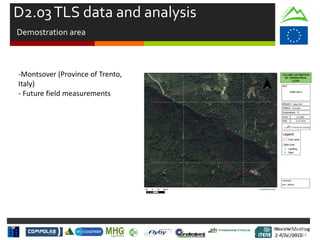
-Montsover (Province of Trento,
Italy)
- Future field measurements
T2.03 On-field digital survey systems
Demostration area
Mid-term Review
2/July/15
Review Meeting
2-4/Jul/2015
Review Meeting
2-4/Jul/2015
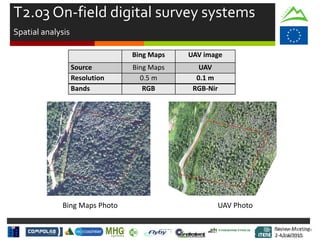
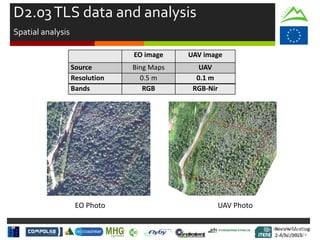
Bing Maps Photo UAV Photo
Bing Maps UAV image
Source Bing Maps UAV
Resolution 0.5 m 0.1 m
Bands RGB RGB-Nir
T2.03 On-field digital survey systems
Spatial analysis
Mid-term Review
2/July/15
Review Meeting
2-4/Jul/2015
Review Meeting
2-4/Jul/2015
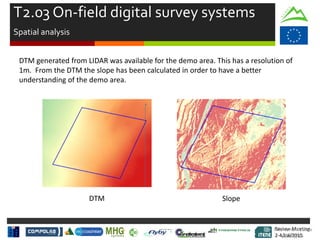
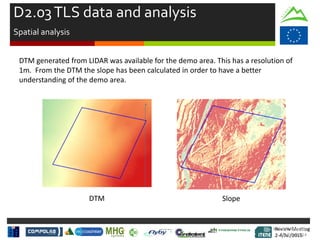
DTM Slope
DTM generated from LIDAR was available for the demo area. This has a resolution of
1m. From the DTM the slope has been calculated in order to have a better
understanding of the demo area.
T2.03 On-field digital survey systems
Spatial analysis
Mid-term Review
2/July/15
Review Meeting
2-4/Jul/2015
Review Meeting
2-4/Jul/2015
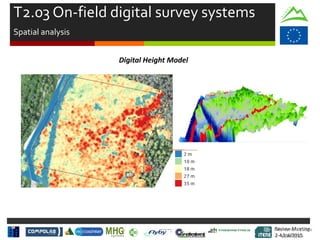
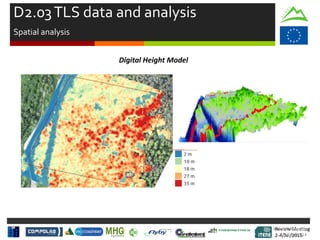
Digital Height Model
T2.03 On-field digital survey systems
Spatial analysis
Mid-term Review
2/July/15
Review Meeting
2-4/Jul/2015
Review Meeting
2-4/Jul/2015
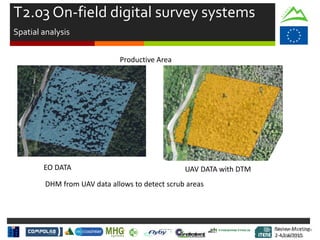
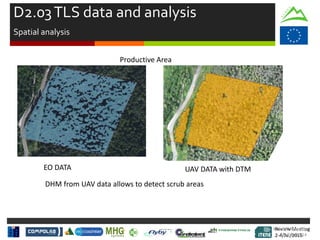
Productive Area
EO DATA UAV DATA with DTM
DHM from UAV data allows to detect scrub areas
T2.03 On-field digital survey systems
Spatial analysis
Mid-term Review
2/July/15
Review Meeting
2-4/Jul/2015
Review Meeting
2-4/Jul/2015
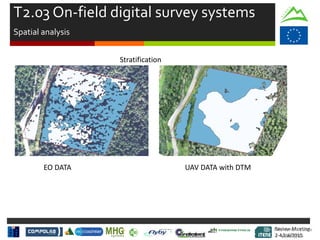
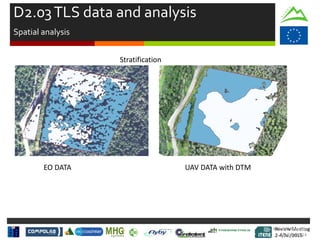
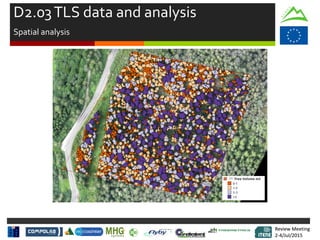
Stratification
EO DATA UAV DATA with DTM
T2.03 On-field digital survey systems
Spatial analysis
Mid-term Review
2/July/15
Review Meeting
2-4/Jul/2015
Review Meeting
2-4/Jul/2015
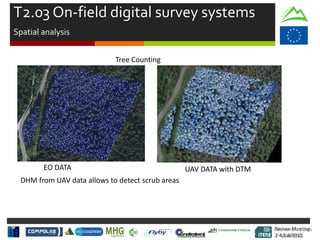
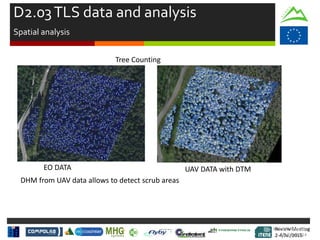
Tree Counting
EO DATA UAV DATA with DTM
DHM from UAV data allows to detect scrub areas
T2.03 On-field digital survey systems
Spatial analysis
Mid-term Review
2/July/15
Review Meeting
2-4/Jul/2015
Review Meeting
2-4/Jul/2015
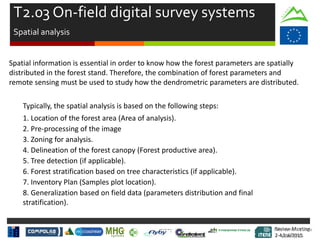
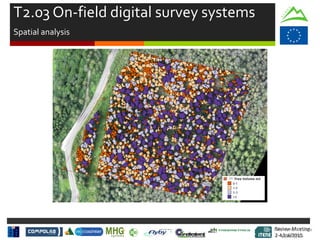
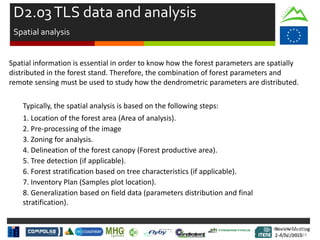
Spatial information is essential in order to know how the forest parameters are spatially
distributed in the forest stand. Therefore, the combination of forest parameters and
remote sensing must be used to study how the dendrometric parameters are distributed.
Typically, the spatial analysis is based on the following steps:
1. Location of the forest area (Area of analysis).
2. Pre-processing of the image
3. Zoning for analysis.
4. Delineation of the forest canopy (Forest productive area).
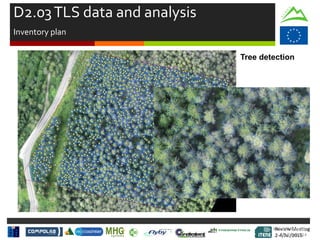
5. Tree detection (if applicable).
6. Forest stratification based on tree characteristics (if applicable).
7. Inventory Plan (Samples plot location).
8. Generalization based on field data (parameters distribution and final
stratification).
T2.03 On-field digital survey systems
Spatial analysis
Mid-term Review
2/July/15
Review Meeting
2-4/Jul/2015
Review Meeting
2-4/Jul/2015
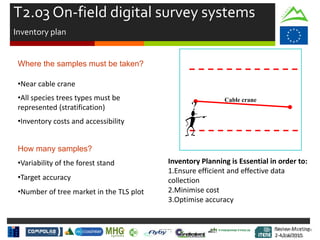
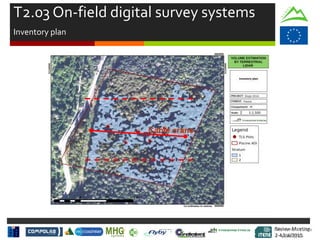
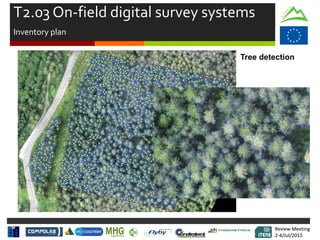
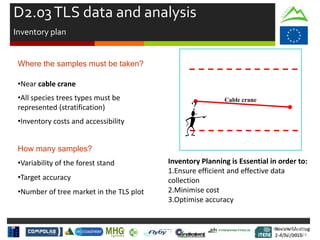
Inventory Planning is Essential in order to:
1.Ensure efficient and effective data
collection
2.Minimise cost
3.Optimise accuracy
T2.03 On-field digital survey systems
Inventory plan
Where the samples must be taken?
•Near cable crane
•All species trees types must be
represented (stratification)
•Inventory costs and accessibility
•Variability of the forest stand
•Target accuracy
•Number of tree market in the TLS plot
How many samples?
Cable crane
Mid-term Review
2/July/15
Review Meeting
2-4/Jul/2015
Review Meeting
2-4/Jul/2015
T2.03 On-field digital survey systems
Inventory plan
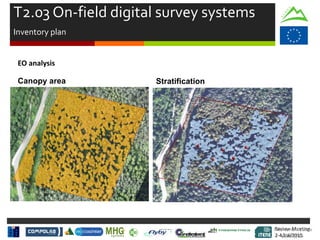
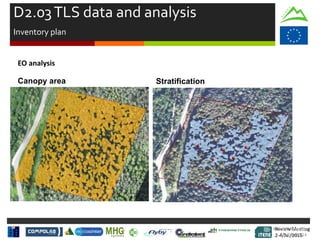
EO analysis
Canopy area Stratification
Mid-term Review
2/July/15
Review Meeting
2-4/Jul/2015
Review Meeting
2-4/Jul/2015
T2.03 On-field digital survey systems
Inventory plan
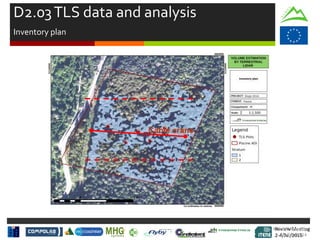
Cable crane
Mid-term Review
2/July/15
Review Meeting
2-4/Jul/2015
Review Meeting
2-4/Jul/2015
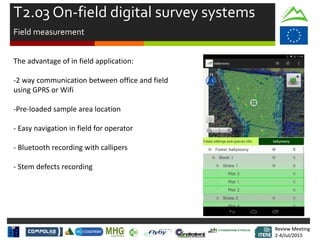
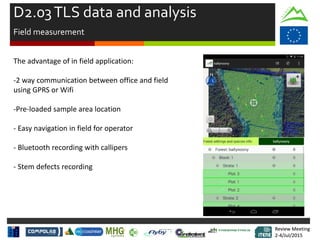
The advantage of in field application:
-2 way communication between office and field
using GPRS or Wifi
-Pre-loaded sample area location
- Easy navigation in field for operator
- Bluetooth recording with callipers
- Stem defects recording
T2.03 On-field digital survey systems
Field measurement
Review Meeting
2-4/Jul/2015
Review Meeting
2-4/Jul/2015
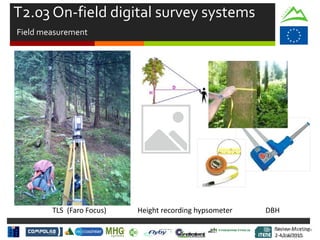
TLS (Faro Focus) Height recording hypsometer DBH
T2.03 On-field digital survey systems
Field measurement
Mid-term Review
2/July/15
Review Meeting
2-4/Jul/2015
Review Meeting
2-4/Jul/2015
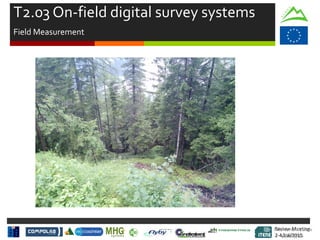
T2.03 On-field digital survey systems
Field Measurement
Mid-term Review
2/July/15
Review Meeting
2-4/Jul/2015
Review Meeting
2-4/Jul/2015
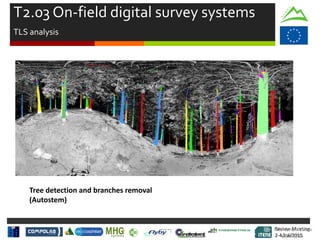
Tree detection and branches removal
(Autostem)
T2.03 On-field digital survey systems
TLS analysis
Mid-term Review
2/July/15
Review Meeting
2-4/Jul/2015
Review Meeting
2-4/Jul/2015
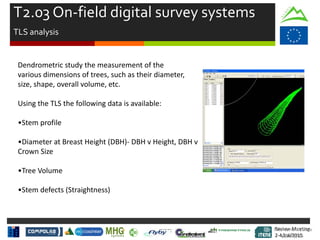
Dendrometric study the measurement of the
various dimensions of trees, such as their diameter,
size, shape, overall volume, etc.
Using the TLS the following data is available:
•Stem profile
•Diameter at Breast Height (DBH)- DBH v Height, DBH v
Crown Size
•Tree Volume
•Stem defects (Straightness)
T2.03 On-field digital survey systems
TLS analysis
Mid-term Review
2/July/15
Review Meeting
2-4/Jul/2015
Review Meeting
2-4/Jul/2015
T2.03 On-field digital survey systems
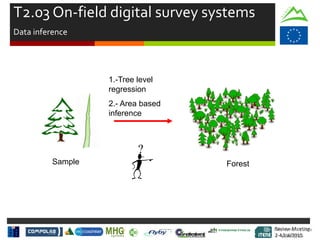
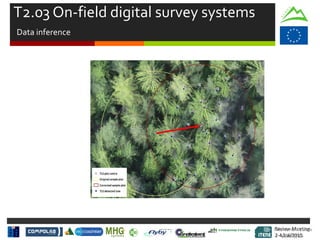
Data inference
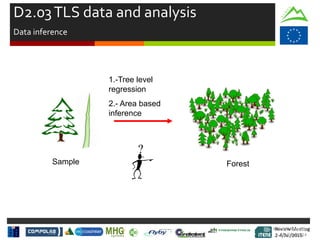
Sample Forest
1.-Tree level
regression
2.- Area based
inference
Mid-term Review
2/July/15
Review Meeting
2-4/Jul/2015
Review Meeting
2-4/Jul/2015
T2.03 On-field digital survey systems
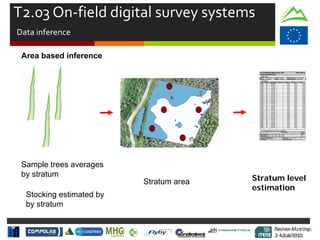
Data inference
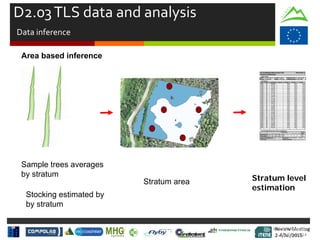
Sample trees averages
by stratum
Stocking estimated by
by stratum
Stratum area
Area based inference
Stratum level
estimation
Mid-term Review
2/July/15
Review Meeting
2-4/Jul/2015
Review Meeting
2-4/Jul/2015
T2.03 On-field digital survey systems
Data inference
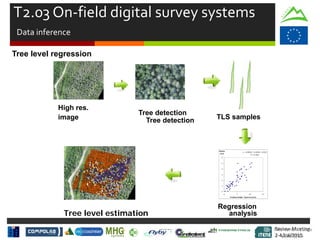
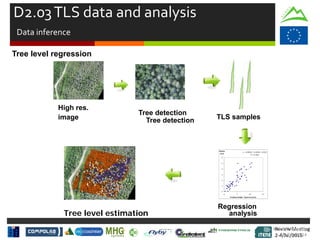
Tree level estimation
High res.
image
Tree level regression
Tree detection
Tree detection TLS samples
y = -0.0069x2
+ 0.4969x - 0.0193
R2
= 0.7064
0
1
2
3
4
5
6
0 5 10 15
Predicted Height * Basal Area (m3)
Volume
(m3)
Regression
analysis
Mid-term Review
2/July/15
Review Meeting
2-4/Jul/2015
Review Meeting
2-4/Jul/2015
T2.03 On-field digital survey systems
Data inference
Mid-term Review
2/July/15
Review Meeting
2-4/Jul/2015
Review Meeting
2-4/Jul/2015
T2.03 On-field digital survey systems
Inventory plan
Tree detection
Review Meeting
2-4/Jul/2015
Review Meeting
2-4/Jul/2015
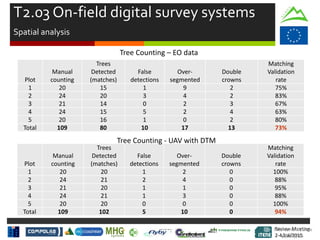
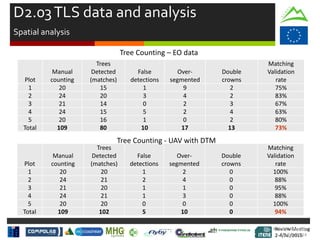
Tree Counting – EO data
Plot
Manual
counting
Trees
Detected
(matches)
False
detections
Over-
segmented
Double
crowns
Matching
Validation
rate
1 20 15 1 9 2 75%
2 24 20 3 4 2 83%
3 21 14 0 2 3 67%
4 24 15 5 2 4 63%
5 20 16 1 0 2 80%
Total 109 80 10 17 13 73%
T2.03 On-field digital survey systems
Spatial analysis
Plot
Manual
counting
Trees
Detected
(matches)
False
detections
Over-
segmented
Double
crowns
Matching
Validation
rate
1 20 20 1 2 0 100%
2 24 21 2 4 0 88%
3 21 20 1 1 0 95%
4 24 21 1 3 0 88%
5 20 20 0 0 0 100%
Total 109 102 5 10 0 94%
Tree Counting - UAV with DTM
Mid-term Review
2/July/15
Review Meeting
2-4/Jul/2015
Review Meeting
2-4/Jul/2015
T2.03 On-field digital survey systems
Spatial analysis
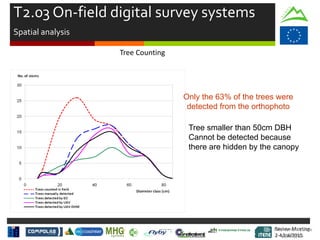
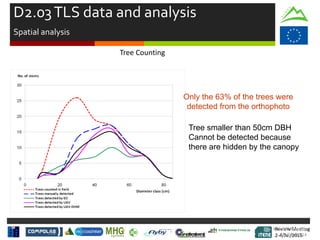
Tree Counting
Tree smaller than 50cm DBH
Cannot be detected because
there are hidden by the canopy
Only the 63% of the trees were
detected from the orthophoto
Mid-term Review
2/July/15
Review Meeting
2-4/Jul/2015
Review Meeting
2-4/Jul/2015
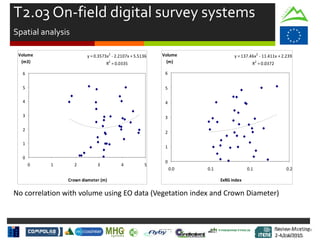
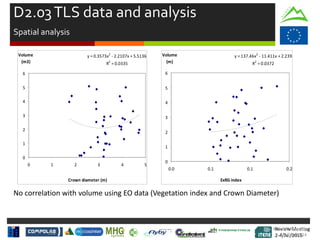
y = 0.3573x2
- 2.2107x + 5.5136
R2
= 0.0335
0
1
2
3
4
5
6
0 1 2 3 4 5
Crown diameter (m)
Volume
(m3)
y = 137.46x2
- 11.411x + 2.239
R2
= 0.0372
0
1
2
3
4
5
6
0.0 0.1 0.1 0.2
ExRG index
Volume
(m)
No correlation with volume using EO data (Vegetation index and Crown Diameter)
T2.03 On-field digital survey systems
Spatial analysis
Mid-term Review
2/July/15
Review Meeting
2-4/Jul/2015
Review Meeting
2-4/Jul/2015
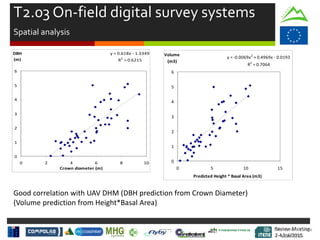
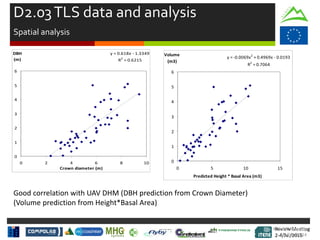
Good correlation with UAV DHM (DBH prediction from Crown Diameter)
(Volume prediction from Height*Basal Area)
y = -0.0069x2
+ 0.4969x - 0.0193
R2
= 0.7064
0
1
2
3
4
5
6
0 5 10 15
Predicted Height * Basal Area (m3)
Volume
(m3)
y = 0.618x - 1.3349
R2
= 0.6215
0
1
2
3
4
5
6
0 2 4 6 8 10
Crown diameter (m)
DBH
(m)
T2.03 On-field digital survey systems
Spatial analysis
Mid-term Review
2/July/15
Review Meeting
2-4/Jul/2015
Review Meeting
2-4/Jul/2015
T2.03 On-field digital survey systems
Spatial analysis
Mid-term Review
2/July/15
Review Meeting
2-4/Jul/2015
Review Meeting
2-4/Jul/2015
T2.03 On-field digital survey systems
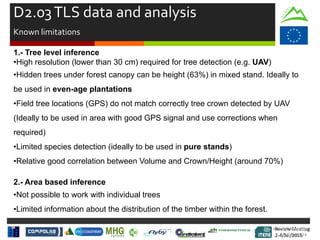
Known limitations
1.- Tree level inference
•High resolution (higher than 30 cm) required for tree detection (e.g. UAV)
•Hidden trees under forest canopy can be height (63%) in mixed stand.
Improvement expected in even-age plantations
•Field tree locations (GPS) do not match correctly tree crown detected by UAV
(Ideally to be used in area with good GPS signal and use corrections when
required)
•Limited species detection (Improvement expected to be used in pure stands)
•Relative good correlation between Volume and Crown/Height (around 70%)
2.- Area based inference
•Not possible to work with individual trees
•Limited information about the distribution of the timber within the forest.
Mid-term Review
2/July/15
Review Meeting
2-4/Jul/2015
Review Meeting
2-4/Jul/2015
T2.03 On-field digital survey systems
Implementation
Mid-term Review
2/July/15
Review Meeting
2-4/Jul/2015
Review Meeting
2-4/Jul/2015
T2.03 On-field digital survey systems
Implementation
•The use of TLS in forest inventory improves significantly the estimation
of tree volume
•The use of UAV image (0.2cm) or medium resolution EO (0.5m) can improve
significantly the field inventory planning.
•The combination of TLS and UAV image can improve significantly the estimation
and location of the timber in the forest.
•The analysis of allometric relationships at tree level has result successful using
UAV stereo analysis and very limited using EO data .
•The estimation of the timber in the forest need to take into the trees hidden trees
Mid-term Review
2/July/15
Review Meeting
2-4/Jul/2015
Review Meeting
2-4/Jul/2015
T2.03 On-field digital survey systems
Implementation
Future measurements and analysis:
•Montsover (Province of Trento, Italy) –End of July
• Austria
Mid-term Review
2/July/15
Review Meeting
2-4/Jul/2015
Review Meeting
2-4/Jul/2015
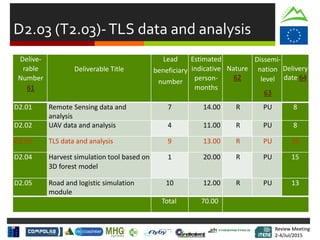
D2.03 (T2.03)-TLS data and analysis
Delive-
rable
Number
61
Deliverable Title
Lead
beneficiary
number
Estimated
indicative
person-
months
Nature
62
Dissemi-
nation
level
63
Delivery
date 64
D2.01 Remote Sensing data and
analysis
7 14.00 R PU 8
D2.02 UAV data and analysis 4 11.00 R PU 8
D2.03 TLS data and analysis 9 13.00 R PU 10
D2.04 Harvest simulation tool based on
3D forest model
1 20.00 R PU 15
D2.05 Road and logistic simulation
module
10 12.00 R PU 13
Total 70.00
Review Meeting
2-4/Jul/2015
Review Meeting
2-4/Jul/2015
TLS data and analysis
This deliverable contains a report on TLS data collected, the
methodologies and algorithm to extract needed
information and the generated output information.
D2.03TLS data and analysis
Introduction
Review Meeting
2-4/Jul/2015
Review Meeting
2-4/Jul/2015
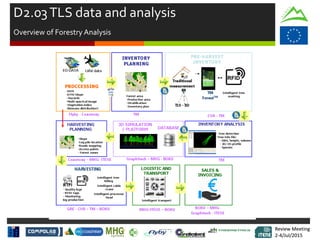
D2.03TLS data and analysis
Overview of Forestry Analysis
Review Meeting
2-4/Jul/2015
Review Meeting
2-4/Jul/2015
Kick-off Meeting
8-9/jan/2014
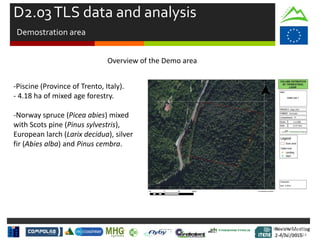
Overview of the Demo area
-Piscine (Province of Trento, Italy).
- 4.18 ha of mixed age forestry.
-Norway spruce (Picea abies) mixed
with Scots pine (Pinus sylvestris),
European larch (Larix decidua), silver
fir (Abies alba) and Pinus cembra.
D2.03TLS data and analysis
Demostration area
Review Meeting
2-4/Jul/2015
Review Meeting
2-4/Jul/2015
Kick-off Meeting
8-9/jan/2014
-Montsover (Province of Trento,
Italy)
- Future field measurements
D2.03TLS data and analysis
Demostration area
Review Meeting
2-4/Jul/2015
Review Meeting
2-4/Jul/2015
Kick-off Meeting
8-9/jan/2014
EO Photo UAV Photo
EO image UAV image
Source Bing Maps UAV
Resolution 0.5 m 0.1 m
Bands RGB RGB-Nir
D2.03TLS data and analysis
Spatial analysis
Review Meeting
2-4/Jul/2015
Review Meeting
2-4/Jul/2015
Kick-off Meeting
8-9/jan/2014
DTM Slope
DTM generated from LIDAR was available for the demo area. This has a resolution of
1m. From the DTM the slope has been calculated in order to have a better
understanding of the demo area.
D2.03TLS data and analysis
Spatial analysis
Review Meeting
2-4/Jul/2015
Review Meeting
2-4/Jul/2015
Kick-off Meeting
8-9/jan/2014
Digital Height Model
D2.03TLS data and analysis
Spatial analysis
Review Meeting
2-4/Jul/2015
Review Meeting
2-4/Jul/2015
Kick-off Meeting
8-9/jan/2014
Productive Area
EO DATA UAV DATA with DTM
DHM from UAV data allows to detect scrub areas
D2.03TLS data and analysis
Spatial analysis
Review Meeting
2-4/Jul/2015
Review Meeting
2-4/Jul/2015
Kick-off Meeting
8-9/jan/2014
Stratification
EO DATA UAV DATA with DTM
D2.03TLS data and analysis
Spatial analysis
Review Meeting
2-4/Jul/2015
Review Meeting
2-4/Jul/2015
Kick-off Meeting
8-9/jan/2014
Tree Counting
EO DATA UAV DATA with DTM
DHM from UAV data allows to detect scrub areas
D2.03TLS data and analysis
Spatial analysis
Review Meeting
2-4/Jul/2015
Review Meeting
2-4/Jul/2015
Kick-off Meeting
8-9/jan/2014
Spatial information is essential in order to know how the forest parameters are spatially
distributed in the forest stand. Therefore, the combination of forest parameters and
remote sensing must be used to study how the dendrometric parameters are distributed.
Typically, the spatial analysis is based on the following steps:
1. Location of the forest area (Area of analysis).
2. Pre-processing of the image
3. Zoning for analysis.
4. Delineation of the forest canopy (Forest productive area).
5. Tree detection (if applicable).
6. Forest stratification based on tree characteristics (if applicable).
7. Inventory Plan (Samples plot location).
8. Generalization based on field data (parameters distribution and final
stratification).
D2.03TLS data and analysis
Spatial analysis
Review Meeting
2-4/Jul/2015
Review Meeting
2-4/Jul/2015
Kick-off Meeting
8-9/jan/2014
Inventory Planning is Essential in order to:
1.Ensure efficient and effective data
collection
2.Minimise cost
3.Optimise accuracy
D2.03TLS data and analysis
Inventory plan
Where the samples must be taken?
•Near cable crane
•All species trees types must be
represented (stratification)
•Inventory costs and accessibility
•Variability of the forest stand
•Target accuracy
•Number of tree market in the TLS plot
How many samples?
Cable crane
Review Meeting
2-4/Jul/2015
Review Meeting
2-4/Jul/2015
Kick-off Meeting
8-9/jan/2014
D2.03TLS data and analysis
Inventory plan
EO analysis
Canopy area Stratification
Review Meeting
2-4/Jul/2015
Review Meeting
2-4/Jul/2015
Kick-off Meeting
8-9/jan/2014
D2.03TLS data and analysis
Inventory plan
Cable crane
Review Meeting
2-4/Jul/2015
Review Meeting
2-4/Jul/2015
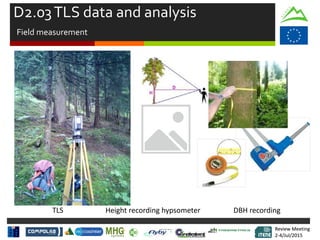
The advantage of in field application:
-2 way communication between office and field
using GPRS or Wifi
-Pre-loaded sample area location
- Easy navigation in field for operator
- Bluetooth recording with callipers
- Stem defects recording
D2.03TLS data and analysis
Field measurement
Review Meeting
2-4/Jul/2015
Review Meeting
2-4/Jul/2015
TLS Height recording hypsometer DBH recording
D2.03TLS data and analysis
Field measurement
Review Meeting
2-4/Jul/2015
Review Meeting
2-4/Jul/2015
Kick-off Meeting
8-9/jan/2014
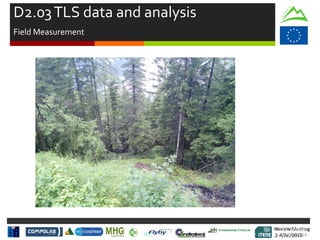
D2.03TLS data and analysis
Field Measurement
Review Meeting
2-4/Jul/2015
Review Meeting
2-4/Jul/2015
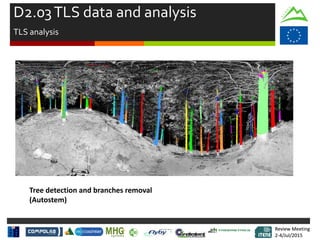
Tree detection and branches removal
(Autostem)
D2.03TLS data and analysis
TLS analysis
Review Meeting
2-4/Jul/2015
Review Meeting
2-4/Jul/2015
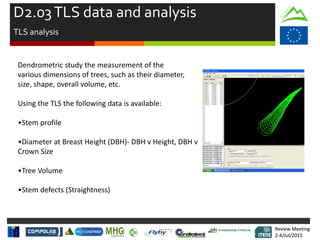
Dendrometric study the measurement of the
various dimensions of trees, such as their diameter,
size, shape, overall volume, etc.
Using the TLS the following data is available:
•Stem profile
•Diameter at Breast Height (DBH)- DBH v Height, DBH v
Crown Size
•Tree Volume
•Stem defects (Straightness)
D2.03TLS data and analysis
TLS analysis
Review Meeting
2-4/Jul/2015
Review Meeting
2-4/Jul/2015
Kick-off Meeting
8-9/jan/2014
D2.03TLS data and analysis
Data inference
Sample Forest
1.-Tree level
regression
2.- Area based
inference
Review Meeting
2-4/Jul/2015
Review Meeting
2-4/Jul/2015
Kick-off Meeting
8-9/jan/2014
D2.03TLS data and analysis
Data inference
Sample trees averages
by stratum
Stocking estimated by
by stratum
Stratum area
Area based inference
Stratum level
estimation
Review Meeting
2-4/Jul/2015
Review Meeting
2-4/Jul/2015
Kick-off Meeting
8-9/jan/2014
D2.03TLS data and analysis
Data inference
Tree level estimation
High res.
image
Tree level regression
Tree detection
Tree detection TLS samples
y = -0.0069x2
+ 0.4969x - 0.0193
R2
= 0.7064
0
1
2
3
4
5
6
0 5 10 15
Predicted Height * Basal Area (m3)
Volume
(m3)
Regression
analysis
Review Meeting
2-4/Jul/2015
Review Meeting
2-4/Jul/2015
Kick-off Meeting
8-9/jan/2014
D2.03TLS data and analysis
Data inference
Review Meeting
2-4/Jul/2015
Review Meeting
2-4/Jul/2015
Kick-off Meeting
8-9/jan/2014
D2.03TLS data and analysis
Inventory plan
Tree detection
Review Meeting
2-4/Jul/2015
Review Meeting
2-4/Jul/2015
Kick-off Meeting
8-9/jan/2014
Tree Counting – EO data
Plot
Manual
counting
Trees
Detected
(matches)
False
detections
Over-
segmented
Double
crowns
Matching
Validation
rate
1 20 15 1 9 2 75%
2 24 20 3 4 2 83%
3 21 14 0 2 3 67%
4 24 15 5 2 4 63%
5 20 16 1 0 2 80%
Total 109 80 10 17 13 73%
D2.03TLS data and analysis
Spatial analysis
Plot
Manual
counting
Trees
Detected
(matches)
False
detections
Over-
segmented
Double
crowns
Matching
Validation
rate
1 20 20 1 2 0 100%
2 24 21 2 4 0 88%
3 21 20 1 1 0 95%
4 24 21 1 3 0 88%
5 20 20 0 0 0 100%
Total 109 102 5 10 0 94%
Tree Counting - UAV with DTM
Review Meeting
2-4/Jul/2015
Review Meeting
2-4/Jul/2015
Kick-off Meeting
8-9/jan/2014
D2.03TLS data and analysis
Spatial analysis
Tree Counting
Tree smaller than 50cm DBH
Cannot be detected because
there are hidden by the canopy
Only the 63% of the trees were
detected from the orthophoto
Review Meeting
2-4/Jul/2015
Review Meeting
2-4/Jul/2015
Kick-off Meeting
8-9/jan/2014
y = 0.3573x2
- 2.2107x + 5.5136
R2
= 0.0335
0
1
2
3
4
5
6
0 1 2 3 4 5
Crown diameter (m)
Volume
(m3)
y = 137.46x2
- 11.411x + 2.239
R2
= 0.0372
0
1
2
3
4
5
6
0.0 0.1 0.1 0.2
ExRG index
Volume
(m)
No correlation with volume using EO data (Vegetation index and Crown Diameter)
D2.03TLS data and analysis
Spatial analysis
Review Meeting
2-4/Jul/2015
Review Meeting
2-4/Jul/2015
Kick-off Meeting
8-9/jan/2014
Good correlation with UAV DHM (DBH prediction from Crown Diameter)
(Volume prediction from Height*Basal Area)
y = -0.0069x2
+ 0.4969x - 0.0193
R2
= 0.7064
0
1
2
3
4
5
6
0 5 10 15
Predicted Height * Basal Area (m3)
Volume
(m3)
y = 0.618x - 1.3349
R2
= 0.6215
0
1
2
3
4
5
6
0 2 4 6 8 10
Crown diameter (m)
DBH
(m)
D2.03TLS data and analysis
Spatial analysis
Review Meeting
2-4/Jul/2015
Review Meeting
2-4/Jul/2015
D2.03TLS data and analysis
Spatial analysis
Review Meeting
2-4/Jul/2015
Review Meeting
2-4/Jul/2015
Kick-off Meeting
8-9/jan/2014
D2.03TLS data and analysis
Known limitations
1.- Tree level inference
•High resolution (lower than 30 cm) required for tree detection (e.g. UAV)
•Hidden trees under forest canopy can be height (63%) in mixed stand. Ideally to
be used in even-age plantations
•Field tree locations (GPS) do not match correctly tree crown detected by UAV
(Ideally to be used in area with good GPS signal and use corrections when
required)
•Limited species detection (ideally to be used in pure stands)
•Relative good correlation between Volume and Crown/Height (around 70%)
2.- Area based inference
•Not possible to work with individual trees
•Limited information about the distribution of the timber within the forest.
Review Meeting
2-4/Jul/2015
Review Meeting
2-4/Jul/2015
Kick-off Meeting
8-9/jan/2014
D2.03TLS data and analysis
Implementation
Review Meeting
2-4/Jul/2015
Review Meeting
2-4/Jul/2015
Kick-off Meeting
8-9/jan/2014
D2.03TLS data and analysis
Implementation
•The use of TLS in forest inventory improves significantly the estimation
of tree volume
•The use of UAV image (0.2cm) or medium resolution EO (0.5m) can improve
significantly the field inventory planning.
•The combination of TLS and UAV image can improve significantly the estimation
and location of the timber in the forest.
•The analysis of allometric relationships at tree level has result successful using
UAV stereo analysis and very limited using EO data .
•The estimation of the timber in the forest need to take into the trees hidden trees
Review Meeting
2-4/Jul/2015
Review Meeting
2-4/Jul/2015
Project SLOPE
T2.4– 3D Modeling for harvesting planning
Brussels, July 2nd, 2015
Review Meeting
2-4/Jul/2015
Review Meeting
2-4/Jul/2015
Task Overview
• Status: Completed (100%)
• Length: 10 Months (From M8 to M17)
• 6 Involved Partners
• Leader: GraphiTech
• Participants: CNR, COAST, BOKU, GRE, FLY, TRE
• Aim: generate and make accessible a detailed interactive
3D model of the forest
• Accurate tree profile information
• Remote sensing data
• Cableway positioning simulation
• Output:
• D.2.04 Harvest simulation tool based on 3D forest model
(Prototype)
Review Meeting
2-4/Jul/2015
Review Meeting
2-4/Jul/2015
Development Details
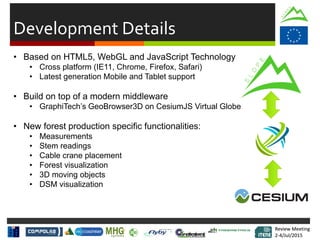
• Based on HTML5, WebGL and JavaScript Technology
• Cross platform (IE11, Chrome, Firefox, Safari)
• Latest generation Mobile and Tablet support
• Build on top of a modern middleware
• GraphiTech’s GeoBrowser3D on CesiumJS Virtual Globe
• New forest production specific functionalities:
• Measurements
• Stem readings
• Cable crane placement
• Forest visualization
• 3D moving objects
• DSM visualization
Review Meeting
2-4/Jul/2015
Review Meeting
2-4/Jul/2015
Development Details
• Open Data exploitation
• Streets, forest roads, gas ways, high voltage lines, unproductive terrain,
forest, high forest, coppice, etc.
• Per pilot data visualization
• NIR, RGB
• Focus on functionalities
• Interface not final
• In evolution during the integration phase (alpha 1.0, 1.1, 1.2, …)
• Interface
• Functionalities
• Available at http://slope.graphitech-projects.com/slope/Slope/Viewer/index2.html
Review Meeting
2-4/Jul/2015
Review Meeting
2-4/Jul/2015
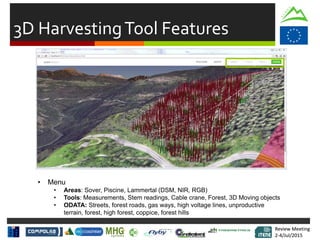
3D HarvestingTool Features
• Menu
• Areas: Sover, Piscine, Lammertal (DSM, NIR, RGB)
• Tools: Measurements, Stem readings, Cable crane, Forest, 3D Moving objects
• ODATA: Streets, forest roads, gas ways, high voltage lines, unproductive
terrain, forest, high forest, coppice, forest hills
Review Meeting
2-4/Jul/2015
Review Meeting
2-4/Jul/2015
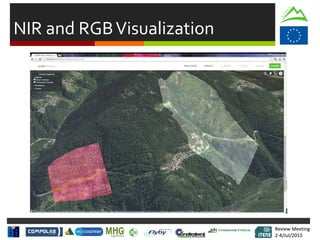
NIR and RGBVisualization
Review Meeting
2-4/Jul/2015
Review Meeting
2-4/Jul/2015
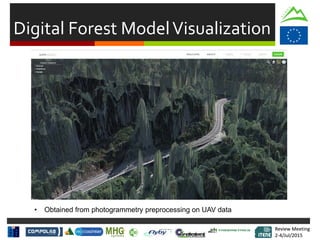
Digital Forest ModelVisualization
• Obtained from photogrammetry preprocessing on UAV data
Review Meeting
2-4/Jul/2015
Review Meeting
2-4/Jul/2015
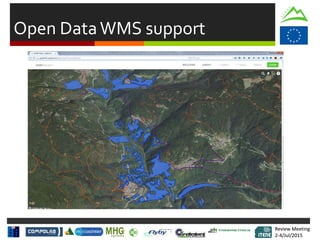
Open DataWMS support
Review Meeting
2-4/Jul/2015
Review Meeting
2-4/Jul/2015
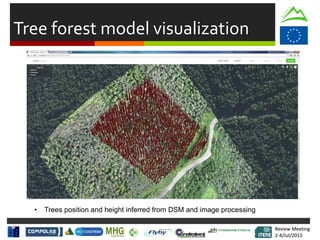
Tree forest model visualization
• Trees position and height inferred from DSM and image processing
Review Meeting
2-4/Jul/2015
Review Meeting
2-4/Jul/2015
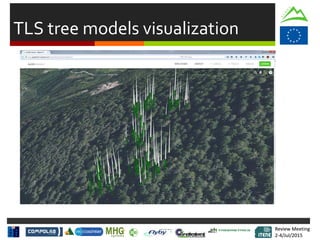
TLS tree models visualization
Review Meeting
2-4/Jul/2015
Review Meeting
2-4/Jul/2015
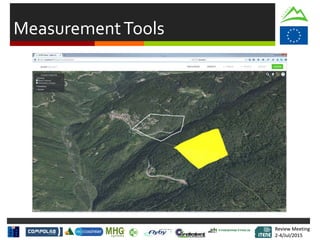
MeasurementTools
Review Meeting
2-4/Jul/2015
Review Meeting
2-4/Jul/2015
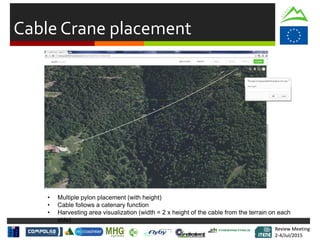
Cable Crane placement
• Multiple pylon placement (with height)
• Cable follows a catenary function
• Harvesting area visualization (width = 2 x height of the cable from the terrain on each
side)
Review Meeting
2-4/Jul/2015
Review Meeting
2-4/Jul/2015
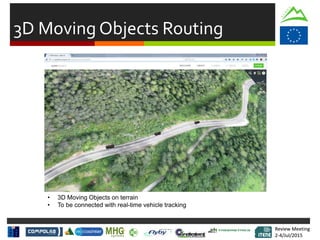
3D Moving Objects Routing
• 3D Moving Objects on terrain
• To be connected with real-time vehicle tracking
Review Meeting
2-4/Jul/2015
Review Meeting
2-4/Jul/2015
Conclusions
• A new set of functionalities for forest production on a cloud cross-
platform system
• Interactive
• Real-time
• Scalable
• Exploitation of the available open data for the pilot areas (e.g. Trentino)
• Platform in evolution
• Regular updates and improvement of the application (Alpha 1.0, 1.1, 1.2)
• Shared among partners http://slope.graphitech-
projects.com/slope/Slope/Viewer1.x/
• New interface
• New functionalities already implemented (WP6)
Review Meeting
2-4/Jul/2015
Review Meeting
2-4/Jul/2015
Contact info
Daniele Magliocchetti: daniele.magliocchetti@graphitech.it
Giulio Panizzoni: giulio.panizzoni@graphitech.it
Thank you for your attention
Review Meeting
2-4/Jul/2015
Review Meeting
2-4/Jul/2015
Project SLOPE
T 2.5 – Road and Logistic planning
Brussels, 2nd July, 2015
Review Meeting
2-4/Jul/2015
Review Meeting
2-4/Jul/2015
Overview
• Status: Completed (100%)
• Length: 7 months (from M8 to M15)
• Involved Partners
• Leader: ITENE
• Participants: BOKU, GRAPHITECH, CNR, FLY
• Aim:
• Develop a logistic optimization model for a regional wood supply
network.
• Minimizing transportation costs.
• Analyzing relevant logistics locations (buffers, storage yards,
terminals…)
• Output: Deliverable D2.05 (Submitted)
Review Meeting
2-4/Jul/2015
Review Meeting
2-4/Jul/2015
1.Task objectives
 LOGISTIC OPTIMIZATION MODEL:
 The goal is to determine an optimal forest logistic
network to respond future demands.
 The approach would determine:
 Allocation of each buffer to the customer considering lowest
supply costs
 Which storage yards to open and how much timber will flow
via these yards during damage events, i.e. when too much
timber is produced within a certain period
Review Meeting
2-4/Jul/2015
Review Meeting
2-4/Jul/2015
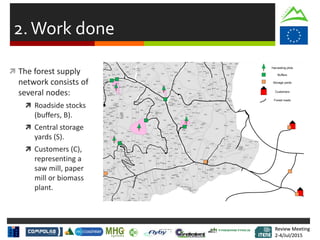
2.Work done
Harvesting plots
Buffers
Storage yards
Customers
Forest roads
 The forest supply
network consists of
several nodes:
 Roadside stocks
(buffers, B).
 Central storage
yards (S).
 Customers (C),
representing a
saw mill, paper
mill or biomass
plant.
Review Meeting
2-4/Jul/2015
Review Meeting
2-4/Jul/2015
2.Work done
 Main task activities:
 2.1. Definition of main logistic elements
 2.2 Logistic model development
 2.3 Implementation and trials with real data
 2.4 Data model for the integration with the whole
SLOPE system
Review Meeting
2-4/Jul/2015
Review Meeting
2-4/Jul/2015
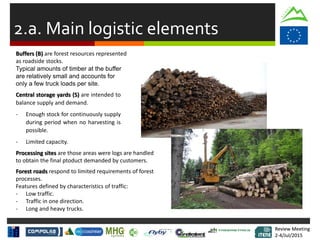
2.a. Main logistic elements
Central storage yards (S) are intended to
balance supply and demand.
- Enough stock for continuously supply
during period when no harvesting is
possible.
- Limited capacity.
Forest roads respond to limited requirements of forest
processes.
Features defined by characteristics of traffic:
- Low traffic.
- Traffic in one direction.
- Long and heavy trucks.
Buffers (B) are forest resources represented
as roadside stocks.
Typical amounts of timber at the buffer
are relatively small and accounts for
only a few truck loads per site.
Processing sites are those areas were logs are handled
to obtain the final ptoduct demanded by customers.
Review Meeting
2-4/Jul/2015
Review Meeting
2-4/Jul/2015
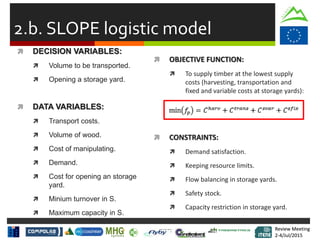
2.b. SLOPE logistic model
 DECISION VARIABLES:
 Volume to be transported.
 Opening a storage yard.
 DATA VARIABLES:
 Transport costs.
 Volume of wood.
 Cost of manipulating.
 Demand.
 Cost for opening an storage
yard.
 Minium turnover in S.
 Maximum capacity in S.
 CONSTRAINTS:
 Demand satisfaction.
 Keeping resource limits.
 Flow balancing in storage yards.
 Safety stock.
 Capacity restriction in storage yard.
 OBJECTIVE FUNCTION:
 To supply timber at the lowest supply
costs (harvesting, transportation and
fixed and variable costs at storage yards):
Review Meeting
2-4/Jul/2015
Review Meeting
2-4/Jul/2015
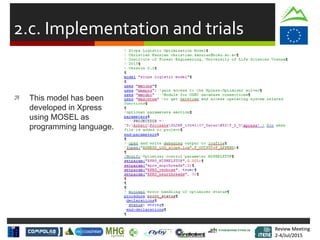
2.c. Implementation and trials
 This model has been
developed in Xpress
using MOSEL as
programming language.
Review Meeting
2-4/Jul/2015
Review Meeting
2-4/Jul/2015
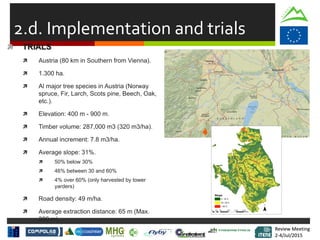
2.d. Implementation and trials
 TRIALS
 Austria (80 km in Southern from Vienna).
 1.300 ha.
 Al major tree species in Austria (Norway
spruce, Fir, Larch, Scots pine, Beech, Oak,
etc.).
 Elevation: 400 m - 900 m.
 Timber volume: 287,000 m3 (320 m3/ha).
 Annual increment: 7.8 m3/ha.
 Average slope: 31%.
 50% below 30%
 46% between 30 and 60%
 4% over 60% (only harvested by tower
yarders)
 Road density: 49 m/ha.
 Average extraction distance: 65 m (Max.
300 m).
Review Meeting
2-4/Jul/2015
Review Meeting
2-4/Jul/2015
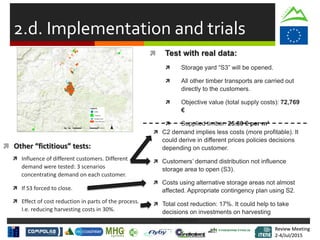
 Total cost reduction: 17%. It could help to take
decisions on investments on harvesting
technologies.
2.d. Implementation and trials
 Test with real data:
 Storage yard “S3” will be opened.
 All other timber transports are carried out
directly to the customers.
 Objective value (total supply costs): 72,769
€
 Supplied timber: 25.80 € per m³
 Other “fictitious” tests:
 C2 demand implies less costs (more profitable). It
could derive in different prices policies decisions
depending on customer.
 Customers’ demand distribution not influence
storage area to open (S3).
 Influence of different customers. Different
demand were tested: 3 scenarios
concentrating demand on each customer.
 If S3 forced to close.
 Effect of cost reduction in parts of the process.
I.e. reducing harvesting costs in 30%.
 Costs using alternative storage areas not almost
affected. Appropriate contingency plan using S2.
Review Meeting
2-4/Jul/2015
Review Meeting
2-4/Jul/2015
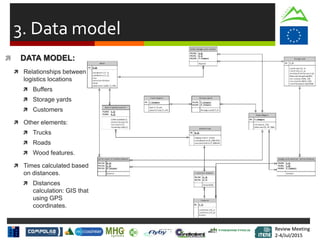
3. Data model
 DATA MODEL:
 Relationships between
logistics locations
 Buffers
 Storage yards
 Customers
 Other elements:
 Trucks
 Roads
 Wood features.
 Times calculated based
on distances.
 Distances
calculation: GIS that
using GPS
coordinates.
Review Meeting
2-4/Jul/2015
Review Meeting
2-4/Jul/2015
4. Conclusions
 Developed a logistic optimization model for a regional wood supply network
based on an objective function, which minimizes transportation costs.
 Model integrated with the whole SLOPE model to support the decision for
the optimal supply network.
 Model developed based on:
Kanzian, C., Holzleitner, F., Stampfer, K. & Ashton, S. 2009
“Regional Energy Wood Logistics – Optimizing Local Fuel Supply”.
 Logistic model implemented using XPRESS software.
 Test done using real data from State Forests in Austria.
 Possible improvements:
 Include in the model other relevant aspects for forestry companies (restrictions in
seasons with bad weather conditions…).
 Completing this task with a tool for visualization of storage areas and the
determination of the capacity.
Review Meeting
2-4/Jul/2015
Review Meeting
2-4/Jul/2015Mid-term
Contact info
Loli Herrero (dolores.herrero@itene.com)
Juan de Dios Díaz (juan.diaz@itene.com)
Emilio Gonzalez(egonzalez@itene.com)
Thank you for your attention

Mid-term Review Meeting - WP2

  • 1.
    Review Meeting 2-4/Jul/2015 Review Meeting 2-4/Jul/2015 ProjectSLOPE 1 WP 2 – Forest information collection and analysis
  • 2.
    Review Meeting 2-4/Jul/2015 Review Meeting 2-4/Jul/2015 ProjectSLOPE T2.1– Remote Sensing and Multispectral Analysis Brussels, July 2nd, 2015
  • 3.
    Review Meeting 2-4/Jul/2015 Review Meeting 2-4/Jul/2015 Overview •Status: Completed (100%) • Length: 4 Months (From M4 to M8) • Involved Partners • Leader: Flyby • Participants: Coastway, CNR, Treemetrics • Aim: Define a methodology to obtain a description of the scenarios with multispectral and multisensor data for forest status characterization; Define how to realize a more complete forest inventory • Output: D.2.01 Remote Sensing and Data Analysis
  • 4.
    Review Meeting 2-4/Jul/2015 Review Meeting 2-4/Jul/2015 Task2.1: general description Flyby Define the approach to monitor tree growth and health in mountain areas (Using different vegetation indexes) Coastway/Treemetrics Define the approach to monitor the forest using UAV and on ground sensors CNR/Flyby Define the approach to fuse heterogeneous information (derived by satellites or other instrumentations) Participants Role
  • 5.
    Review Meeting 2-4/Jul/2015 Review Meeting 2-4/Jul/2015 MainResults • Determination of useful VIs from sensed data • Estimation of biological parameters from VIs • Analysis of parameter with growing level of detail (Satellite -> UAVs -> Laser scanner) • Utilizability
  • 6.
    Review Meeting 2-4/Jul/2015 Review Meeting 2-4/Jul/2015 Issues,delays and actions • Case study chosen, with post inspection, revealed too young/thin trees • The alternative (Gortahile forest) was not present in Sat data (geographical mismatch) •Action Taken: Acquisition of EO images over the Trentino area visited with UAVs in order to have a comparable dataset • Possible issue (resolved): lack (at least for now) of a specific band (RE) which could be useful for tree inspection in UAVs camera
  • 7.
  • 8.
    Review Meeting 2-4/Jul/2015 Review Meeting 2-4/Jul/2015 VegetationIndices redNIR redNIR NDVI + − = redRE redRE NDRE + − = NDVI NDRE CCCI = Normalized Difference Vegetation Index Used for vegetation/wood detection. Saturates in dense wood areas Normalized Difference Red-Edge Index Can be utilized to estimate chlorophyll levels /health status of trees. Unaffected by saturation Canopy Chlorophyll Content Index Proposed as an alternative to measure variations in biomass, chlorophyll and nourishment (Nitrogen content)
  • 9.
  • 10.
    Review Meeting 2-4/Jul/2015 Review Meeting 2-4/Jul/2015 NDVI/ NDRE (first trial – Ballyredmond) NDVI Oct - Jul NDRE Oct - Jul
  • 11.
    Review Meeting 2-4/Jul/2015 Review Meeting 2-4/Jul/2015 CCCI(first trial – Ballyredmond) October 2012 July 2013
  • 12.
  • 13.
    Review Meeting 2-4/Jul/2015 Review Meeting 2-4/Jul/2015 NDVI– Chl , UAV sensed data Trentino dataset (Piscine) – enhancement of detail and granularity
  • 14.
    Review Meeting 2-4/Jul/2015 Review Meeting 2-4/Jul/2015 NDVI– Chl , UAV sensed data Trentino dataset (Montesover) – enhancement of detail and granularity
  • 15.
    Review Meeting 2-4/Jul/2015 Review Meeting 2-4/Jul/2015 MultispectralUAV sensed data Toward enhanced detail level – use of in-situ UAV mounted camera for local mapping and inspection NIR data RGB data
  • 16.
    Review Meeting 2-4/Jul/2015 Review Meeting 2-4/Jul/2015 EOderived parameters: Piscine Parameters for the Piscine area Only July data Possibility of classification of zones.
  • 17.
    Review Meeting 2-4/Jul/2015 Review Meeting 2-4/Jul/2015 EOderived parameters: Mt.Sover Parameters for the Mt.Sover area Classification is performed with spectral bands. Possibility of classification using VI and derived VI (CHl)
  • 18.
    Review Meeting 2-4/Jul/2015 Review Meeting 2-4/Jul/2015 Applicationto huge area Possibility of a-priori knowledge before in-situ inspection using EO imagery, high automation
  • 19.
    Review Meeting 2-4/Jul/2015 Review Meeting 2-4/Jul/2015 Conclusions •Development of an integrated wood monitoring system • Definition of a processing chain for data from different platforms • Relation between VI indices and biomass productivity index • Possibility of tree classification from EO data – synergy with UAVs • Toward very detailed information to tree-level for woodcutting operators
  • 20.
    Review Meeting 2-4/Jul/2015 Review Meeting 2-4/Jul/2015 Conclusions •Additional analysis is expected as soon as Austrian UAV imagery is ready • Better comparison with the datasets
  • 21.
    Review Meeting 2-4/Jul/2015 Review Meeting 2-4/Jul/2015 Mid-termReview 2/Jul/15 Contact info Andrea Masini: andrea.masini@flyby.it Alberto Lupidi: alberto.lupidi@flyby.it Thank you for your attention
  • 22.
    Review Meeting 2-4/Jul/2015 Review Meeting 2-4/Jul/2015 WP2Slope Project WP2.2 Forest Information Collection and Analysis Brussels, July 2nd, 2015 Partners: Coastway /CNR / Treemetrics / FLYby
  • 23.
    Review Meeting 2-4/Jul/2015 Review Meeting 2-4/Jul/2015 WP23no.Trials to date Test 1 Ballyredmond To calibrate equipment & Staff Training Flyby supplied satellite data. Test 2 Gortahile to combine with scan data with Treemetrics TLS data. Test 3 Trento Flight all data sets recorded Satellite, UAV, TLS, Marking
  • 24.
    Review Meeting 2-4/Jul/2015 Review Meeting 2-4/Jul/2015 WP2ProposedTrials We will return to the Trento test site at the end of July 2015 to carry out further surveys using the Multispectral camera, we will be joined on site by CNR & Treemetrics. In January 2015 the project requested permission to fly the Austrian test site AustroControl are reviewing the request we hope to fly before winter arrives.
  • 25.
    Review Meeting 2-4/Jul/2015 Review Meeting 2-4/Jul/2015 Advantagesof using UAV Data in Mountainous areas RGB Data enables you to determine the species and density of growthThe UAV can be programmed to follow the contours of the earth confirming standard image quality Identification of Tree species is possible Health and tree size can be interpreted Areas of damage and disease can be identified Areas of 12sqkm can be surveyed in a day and areas for harvesting can be identified remotely.
  • 26.
    Review Meeting 2-4/Jul/2015 Review Meeting 2-4/Jul/2015 WP2Problems experienced & Solutions Weather can be a problem such as high winds / snow Access permits are required / permission was granted by ENAC & the Forest Wardens. GPS quality is poor the accuracy was 250mm but suffecient for forestry new developmemts of an RTK UAV does away with the need for GCP’s Access to the mountain forest was restricted so a small clearing was located to enable launch of the UAV.
  • 27.
    Review Meeting 2-4/Jul/2015 Review Meeting 2-4/Jul/2015 “Beyondthe State of the Art” The Advantages of Multispectral data over RGB & IR multiSPEC 4C - Ultra precise 4-band accuracy The multiSPEC 4C provides image data across four highly precise bands - Green, Red, Red-edge and NIR - with no spectral overlap. In addition, its upward-facing irradiance sensor automatically compensates for sunlight variations, resulting in unparalleled reflectance measurement accuracy. Technical features Resolution 4 sensors of 1.2 Mp Ground resolution 10 cm/px (@100m) Sensor size 4.8 x 3.6 mm per sensor Pixel pitch 3.75 um Image format RAW (Tiff) Review Meeting 2nd July 2015 Review Meeting 2nd July 2015
  • 28.
    Review Meeting 2-4/Jul/2015 Review Meeting 2-4/Jul/2015 WP2Beyond the state of the Art - Forestry Industry Surveying Forestry with UAV’s opens up many fields which include. Forestry Management for planting, thinning and harvesting Disease identification Forest Fire monitoring Search and rescue Landslide monitoring
  • 29.
    Review Meeting 2-4/Jul/2015 Review Meeting 2-4/Jul/2015 Advantagesof using Multispectral Camera Growth and yield of the forestry crop is the result of its interaction with environmental factors, soil conditions and availability of water and nutrients in the soil. With the availability of crop-health detecting sensors, it its now possible to obtain indicator kinetics such as NDVI, biomass, chlorophyll rate, leaf area index, water stress, flowering ,on a much smaller scale than before. Multispectral imagery can determine the health, Species, of trees The multispectral imagery can help determine haul routes by the reflection from different soil types. The imagery can be used to determine growth rates over several seasons and help determine where thinning is required. Coastway have received a lot of interest from Forestry companies in the UK & Ireland regarding forestry management.
  • 30.
  • 31.
    Review Meeting 2-4/Jul/2015 Review Meeting 2-4/Jul/2015 Task:T2.03 On-field digital survey systems Task Leader: Treemetrics Partners involved: CNR, COASTWAY, FLYBY Deliverable: D2.03 TLS data analysis Status: Completed T2.03 On-field digital survey systems Introduction Mid-term Review 2/July/15
  • 32.
    Review Meeting 2-4/Jul/2015 Review Meeting 2-4/Jul/2015 Task2.03 TLS data and analysis This task includes: • Field measurement. • TLS analysis • TLS and UAV combination • Estimation of the forest timber assets D2.03 TLS data analysis This deliverable contains a report on TLS data collected, the methodologies and algorithm to extract needed information and the generated output information. T2.03 On-field digital survey systems Introduction Mid-term Review 2/July/15
  • 33.
    Review Meeting 2-4/Jul/2015 Review Meeting 2-4/Jul/2015 T2.03On-field digital survey systems Overview of Forestry Analysis Harvested head Mid-term Review 2/July/15
  • 34.
    Review Meeting 2-4/Jul/2015 Review Meeting 2-4/Jul/2015 T2.03On-field digital survey systems Overview of Forestry Analysis Processor Head Mid-term Review 2/July/15
  • 35.
    Review Meeting 2-4/Jul/2015 Review Meeting 2-4/Jul/2015 Kick-offMeeting 8-9/jan/2014 Overview of the Demo area -Piscine (Province of Trento, Italy). - 4.18 ha of mixed age forestry. -Norway spruce (Picea abies) mixed with Scots pine (Pinus sylvestris), European larch (Larix decidua), silver fir (Abies alba) and Pinus cembra. T2.03 On-field digital survey systems Demostration area
  • 36.
    Review Meeting 2-4/Jul/2015 Review Meeting 2-4/Jul/2015 -Montsover(Province of Trento, Italy) - Future field measurements T2.03 On-field digital survey systems Demostration area Mid-term Review 2/July/15
  • 37.
    Review Meeting 2-4/Jul/2015 Review Meeting 2-4/Jul/2015 BingMaps Photo UAV Photo Bing Maps UAV image Source Bing Maps UAV Resolution 0.5 m 0.1 m Bands RGB RGB-Nir T2.03 On-field digital survey systems Spatial analysis Mid-term Review 2/July/15
  • 38.
    Review Meeting 2-4/Jul/2015 Review Meeting 2-4/Jul/2015 DTMSlope DTM generated from LIDAR was available for the demo area. This has a resolution of 1m. From the DTM the slope has been calculated in order to have a better understanding of the demo area. T2.03 On-field digital survey systems Spatial analysis Mid-term Review 2/July/15
  • 39.
    Review Meeting 2-4/Jul/2015 Review Meeting 2-4/Jul/2015 DigitalHeight Model T2.03 On-field digital survey systems Spatial analysis Mid-term Review 2/July/15
  • 40.
    Review Meeting 2-4/Jul/2015 Review Meeting 2-4/Jul/2015 ProductiveArea EO DATA UAV DATA with DTM DHM from UAV data allows to detect scrub areas T2.03 On-field digital survey systems Spatial analysis Mid-term Review 2/July/15
  • 41.
    Review Meeting 2-4/Jul/2015 Review Meeting 2-4/Jul/2015 Stratification EODATA UAV DATA with DTM T2.03 On-field digital survey systems Spatial analysis Mid-term Review 2/July/15
  • 42.
    Review Meeting 2-4/Jul/2015 Review Meeting 2-4/Jul/2015 TreeCounting EO DATA UAV DATA with DTM DHM from UAV data allows to detect scrub areas T2.03 On-field digital survey systems Spatial analysis Mid-term Review 2/July/15
  • 43.
    Review Meeting 2-4/Jul/2015 Review Meeting 2-4/Jul/2015 Spatialinformation is essential in order to know how the forest parameters are spatially distributed in the forest stand. Therefore, the combination of forest parameters and remote sensing must be used to study how the dendrometric parameters are distributed. Typically, the spatial analysis is based on the following steps: 1. Location of the forest area (Area of analysis). 2. Pre-processing of the image 3. Zoning for analysis. 4. Delineation of the forest canopy (Forest productive area). 5. Tree detection (if applicable). 6. Forest stratification based on tree characteristics (if applicable). 7. Inventory Plan (Samples plot location). 8. Generalization based on field data (parameters distribution and final stratification). T2.03 On-field digital survey systems Spatial analysis Mid-term Review 2/July/15
  • 44.
    Review Meeting 2-4/Jul/2015 Review Meeting 2-4/Jul/2015 InventoryPlanning is Essential in order to: 1.Ensure efficient and effective data collection 2.Minimise cost 3.Optimise accuracy T2.03 On-field digital survey systems Inventory plan Where the samples must be taken? •Near cable crane •All species trees types must be represented (stratification) •Inventory costs and accessibility •Variability of the forest stand •Target accuracy •Number of tree market in the TLS plot How many samples? Cable crane Mid-term Review 2/July/15
  • 45.
    Review Meeting 2-4/Jul/2015 Review Meeting 2-4/Jul/2015 T2.03On-field digital survey systems Inventory plan EO analysis Canopy area Stratification Mid-term Review 2/July/15
  • 46.
    Review Meeting 2-4/Jul/2015 Review Meeting 2-4/Jul/2015 T2.03On-field digital survey systems Inventory plan Cable crane Mid-term Review 2/July/15
  • 47.
    Review Meeting 2-4/Jul/2015 Review Meeting 2-4/Jul/2015 Theadvantage of in field application: -2 way communication between office and field using GPRS or Wifi -Pre-loaded sample area location - Easy navigation in field for operator - Bluetooth recording with callipers - Stem defects recording T2.03 On-field digital survey systems Field measurement
  • 48.
    Review Meeting 2-4/Jul/2015 Review Meeting 2-4/Jul/2015 TLS(Faro Focus) Height recording hypsometer DBH T2.03 On-field digital survey systems Field measurement Mid-term Review 2/July/15
  • 49.
    Review Meeting 2-4/Jul/2015 Review Meeting 2-4/Jul/2015 T2.03On-field digital survey systems Field Measurement Mid-term Review 2/July/15
  • 50.
    Review Meeting 2-4/Jul/2015 Review Meeting 2-4/Jul/2015 Treedetection and branches removal (Autostem) T2.03 On-field digital survey systems TLS analysis Mid-term Review 2/July/15
  • 51.
    Review Meeting 2-4/Jul/2015 Review Meeting 2-4/Jul/2015 Dendrometricstudy the measurement of the various dimensions of trees, such as their diameter, size, shape, overall volume, etc. Using the TLS the following data is available: •Stem profile •Diameter at Breast Height (DBH)- DBH v Height, DBH v Crown Size •Tree Volume •Stem defects (Straightness) T2.03 On-field digital survey systems TLS analysis Mid-term Review 2/July/15
  • 52.
    Review Meeting 2-4/Jul/2015 Review Meeting 2-4/Jul/2015 T2.03On-field digital survey systems Data inference Sample Forest 1.-Tree level regression 2.- Area based inference Mid-term Review 2/July/15
  • 53.
    Review Meeting 2-4/Jul/2015 Review Meeting 2-4/Jul/2015 T2.03On-field digital survey systems Data inference Sample trees averages by stratum Stocking estimated by by stratum Stratum area Area based inference Stratum level estimation Mid-term Review 2/July/15
  • 54.
    Review Meeting 2-4/Jul/2015 Review Meeting 2-4/Jul/2015 T2.03On-field digital survey systems Data inference Tree level estimation High res. image Tree level regression Tree detection Tree detection TLS samples y = -0.0069x2 + 0.4969x - 0.0193 R2 = 0.7064 0 1 2 3 4 5 6 0 5 10 15 Predicted Height * Basal Area (m3) Volume (m3) Regression analysis Mid-term Review 2/July/15
  • 55.
    Review Meeting 2-4/Jul/2015 Review Meeting 2-4/Jul/2015 T2.03On-field digital survey systems Data inference Mid-term Review 2/July/15
  • 56.
    Review Meeting 2-4/Jul/2015 Review Meeting 2-4/Jul/2015 T2.03On-field digital survey systems Inventory plan Tree detection
  • 57.
    Review Meeting 2-4/Jul/2015 Review Meeting 2-4/Jul/2015 TreeCounting – EO data Plot Manual counting Trees Detected (matches) False detections Over- segmented Double crowns Matching Validation rate 1 20 15 1 9 2 75% 2 24 20 3 4 2 83% 3 21 14 0 2 3 67% 4 24 15 5 2 4 63% 5 20 16 1 0 2 80% Total 109 80 10 17 13 73% T2.03 On-field digital survey systems Spatial analysis Plot Manual counting Trees Detected (matches) False detections Over- segmented Double crowns Matching Validation rate 1 20 20 1 2 0 100% 2 24 21 2 4 0 88% 3 21 20 1 1 0 95% 4 24 21 1 3 0 88% 5 20 20 0 0 0 100% Total 109 102 5 10 0 94% Tree Counting - UAV with DTM Mid-term Review 2/July/15
  • 58.
    Review Meeting 2-4/Jul/2015 Review Meeting 2-4/Jul/2015 T2.03On-field digital survey systems Spatial analysis Tree Counting Tree smaller than 50cm DBH Cannot be detected because there are hidden by the canopy Only the 63% of the trees were detected from the orthophoto Mid-term Review 2/July/15
  • 59.
    Review Meeting 2-4/Jul/2015 Review Meeting 2-4/Jul/2015 y= 0.3573x2 - 2.2107x + 5.5136 R2 = 0.0335 0 1 2 3 4 5 6 0 1 2 3 4 5 Crown diameter (m) Volume (m3) y = 137.46x2 - 11.411x + 2.239 R2 = 0.0372 0 1 2 3 4 5 6 0.0 0.1 0.1 0.2 ExRG index Volume (m) No correlation with volume using EO data (Vegetation index and Crown Diameter) T2.03 On-field digital survey systems Spatial analysis Mid-term Review 2/July/15
  • 60.
    Review Meeting 2-4/Jul/2015 Review Meeting 2-4/Jul/2015 Goodcorrelation with UAV DHM (DBH prediction from Crown Diameter) (Volume prediction from Height*Basal Area) y = -0.0069x2 + 0.4969x - 0.0193 R2 = 0.7064 0 1 2 3 4 5 6 0 5 10 15 Predicted Height * Basal Area (m3) Volume (m3) y = 0.618x - 1.3349 R2 = 0.6215 0 1 2 3 4 5 6 0 2 4 6 8 10 Crown diameter (m) DBH (m) T2.03 On-field digital survey systems Spatial analysis Mid-term Review 2/July/15
  • 61.
    Review Meeting 2-4/Jul/2015 Review Meeting 2-4/Jul/2015 T2.03On-field digital survey systems Spatial analysis Mid-term Review 2/July/15
  • 62.
    Review Meeting 2-4/Jul/2015 Review Meeting 2-4/Jul/2015 T2.03On-field digital survey systems Known limitations 1.- Tree level inference •High resolution (higher than 30 cm) required for tree detection (e.g. UAV) •Hidden trees under forest canopy can be height (63%) in mixed stand. Improvement expected in even-age plantations •Field tree locations (GPS) do not match correctly tree crown detected by UAV (Ideally to be used in area with good GPS signal and use corrections when required) •Limited species detection (Improvement expected to be used in pure stands) •Relative good correlation between Volume and Crown/Height (around 70%) 2.- Area based inference •Not possible to work with individual trees •Limited information about the distribution of the timber within the forest. Mid-term Review 2/July/15
  • 63.
    Review Meeting 2-4/Jul/2015 Review Meeting 2-4/Jul/2015 T2.03On-field digital survey systems Implementation Mid-term Review 2/July/15
  • 64.
    Review Meeting 2-4/Jul/2015 Review Meeting 2-4/Jul/2015 T2.03On-field digital survey systems Implementation •The use of TLS in forest inventory improves significantly the estimation of tree volume •The use of UAV image (0.2cm) or medium resolution EO (0.5m) can improve significantly the field inventory planning. •The combination of TLS and UAV image can improve significantly the estimation and location of the timber in the forest. •The analysis of allometric relationships at tree level has result successful using UAV stereo analysis and very limited using EO data . •The estimation of the timber in the forest need to take into the trees hidden trees Mid-term Review 2/July/15
  • 65.
    Review Meeting 2-4/Jul/2015 Review Meeting 2-4/Jul/2015 T2.03On-field digital survey systems Implementation Future measurements and analysis: •Montsover (Province of Trento, Italy) –End of July • Austria Mid-term Review 2/July/15
  • 66.
    Review Meeting 2-4/Jul/2015 Review Meeting 2-4/Jul/2015 D2.03(T2.03)-TLS data and analysis Delive- rable Number 61 Deliverable Title Lead beneficiary number Estimated indicative person- months Nature 62 Dissemi- nation level 63 Delivery date 64 D2.01 Remote Sensing data and analysis 7 14.00 R PU 8 D2.02 UAV data and analysis 4 11.00 R PU 8 D2.03 TLS data and analysis 9 13.00 R PU 10 D2.04 Harvest simulation tool based on 3D forest model 1 20.00 R PU 15 D2.05 Road and logistic simulation module 10 12.00 R PU 13 Total 70.00
  • 67.
    Review Meeting 2-4/Jul/2015 Review Meeting 2-4/Jul/2015 TLSdata and analysis This deliverable contains a report on TLS data collected, the methodologies and algorithm to extract needed information and the generated output information. D2.03TLS data and analysis Introduction
  • 68.
    Review Meeting 2-4/Jul/2015 Review Meeting 2-4/Jul/2015 D2.03TLSdata and analysis Overview of Forestry Analysis
  • 69.
    Review Meeting 2-4/Jul/2015 Review Meeting 2-4/Jul/2015 Kick-offMeeting 8-9/jan/2014 Overview of the Demo area -Piscine (Province of Trento, Italy). - 4.18 ha of mixed age forestry. -Norway spruce (Picea abies) mixed with Scots pine (Pinus sylvestris), European larch (Larix decidua), silver fir (Abies alba) and Pinus cembra. D2.03TLS data and analysis Demostration area
  • 70.
    Review Meeting 2-4/Jul/2015 Review Meeting 2-4/Jul/2015 Kick-offMeeting 8-9/jan/2014 -Montsover (Province of Trento, Italy) - Future field measurements D2.03TLS data and analysis Demostration area
  • 71.
    Review Meeting 2-4/Jul/2015 Review Meeting 2-4/Jul/2015 Kick-offMeeting 8-9/jan/2014 EO Photo UAV Photo EO image UAV image Source Bing Maps UAV Resolution 0.5 m 0.1 m Bands RGB RGB-Nir D2.03TLS data and analysis Spatial analysis
  • 72.
    Review Meeting 2-4/Jul/2015 Review Meeting 2-4/Jul/2015 Kick-offMeeting 8-9/jan/2014 DTM Slope DTM generated from LIDAR was available for the demo area. This has a resolution of 1m. From the DTM the slope has been calculated in order to have a better understanding of the demo area. D2.03TLS data and analysis Spatial analysis
  • 73.
    Review Meeting 2-4/Jul/2015 Review Meeting 2-4/Jul/2015 Kick-offMeeting 8-9/jan/2014 Digital Height Model D2.03TLS data and analysis Spatial analysis
  • 74.
    Review Meeting 2-4/Jul/2015 Review Meeting 2-4/Jul/2015 Kick-offMeeting 8-9/jan/2014 Productive Area EO DATA UAV DATA with DTM DHM from UAV data allows to detect scrub areas D2.03TLS data and analysis Spatial analysis
  • 75.
    Review Meeting 2-4/Jul/2015 Review Meeting 2-4/Jul/2015 Kick-offMeeting 8-9/jan/2014 Stratification EO DATA UAV DATA with DTM D2.03TLS data and analysis Spatial analysis
  • 76.
    Review Meeting 2-4/Jul/2015 Review Meeting 2-4/Jul/2015 Kick-offMeeting 8-9/jan/2014 Tree Counting EO DATA UAV DATA with DTM DHM from UAV data allows to detect scrub areas D2.03TLS data and analysis Spatial analysis
  • 77.
    Review Meeting 2-4/Jul/2015 Review Meeting 2-4/Jul/2015 Kick-offMeeting 8-9/jan/2014 Spatial information is essential in order to know how the forest parameters are spatially distributed in the forest stand. Therefore, the combination of forest parameters and remote sensing must be used to study how the dendrometric parameters are distributed. Typically, the spatial analysis is based on the following steps: 1. Location of the forest area (Area of analysis). 2. Pre-processing of the image 3. Zoning for analysis. 4. Delineation of the forest canopy (Forest productive area). 5. Tree detection (if applicable). 6. Forest stratification based on tree characteristics (if applicable). 7. Inventory Plan (Samples plot location). 8. Generalization based on field data (parameters distribution and final stratification). D2.03TLS data and analysis Spatial analysis
  • 78.
    Review Meeting 2-4/Jul/2015 Review Meeting 2-4/Jul/2015 Kick-offMeeting 8-9/jan/2014 Inventory Planning is Essential in order to: 1.Ensure efficient and effective data collection 2.Minimise cost 3.Optimise accuracy D2.03TLS data and analysis Inventory plan Where the samples must be taken? •Near cable crane •All species trees types must be represented (stratification) •Inventory costs and accessibility •Variability of the forest stand •Target accuracy •Number of tree market in the TLS plot How many samples? Cable crane
  • 79.
    Review Meeting 2-4/Jul/2015 Review Meeting 2-4/Jul/2015 Kick-offMeeting 8-9/jan/2014 D2.03TLS data and analysis Inventory plan EO analysis Canopy area Stratification
  • 80.
    Review Meeting 2-4/Jul/2015 Review Meeting 2-4/Jul/2015 Kick-offMeeting 8-9/jan/2014 D2.03TLS data and analysis Inventory plan Cable crane
  • 81.
    Review Meeting 2-4/Jul/2015 Review Meeting 2-4/Jul/2015 Theadvantage of in field application: -2 way communication between office and field using GPRS or Wifi -Pre-loaded sample area location - Easy navigation in field for operator - Bluetooth recording with callipers - Stem defects recording D2.03TLS data and analysis Field measurement
  • 82.
    Review Meeting 2-4/Jul/2015 Review Meeting 2-4/Jul/2015 TLSHeight recording hypsometer DBH recording D2.03TLS data and analysis Field measurement
  • 83.
    Review Meeting 2-4/Jul/2015 Review Meeting 2-4/Jul/2015 Kick-offMeeting 8-9/jan/2014 D2.03TLS data and analysis Field Measurement
  • 84.
    Review Meeting 2-4/Jul/2015 Review Meeting 2-4/Jul/2015 Treedetection and branches removal (Autostem) D2.03TLS data and analysis TLS analysis
  • 85.
    Review Meeting 2-4/Jul/2015 Review Meeting 2-4/Jul/2015 Dendrometricstudy the measurement of the various dimensions of trees, such as their diameter, size, shape, overall volume, etc. Using the TLS the following data is available: •Stem profile •Diameter at Breast Height (DBH)- DBH v Height, DBH v Crown Size •Tree Volume •Stem defects (Straightness) D2.03TLS data and analysis TLS analysis
  • 86.
    Review Meeting 2-4/Jul/2015 Review Meeting 2-4/Jul/2015 Kick-offMeeting 8-9/jan/2014 D2.03TLS data and analysis Data inference Sample Forest 1.-Tree level regression 2.- Area based inference
  • 87.
    Review Meeting 2-4/Jul/2015 Review Meeting 2-4/Jul/2015 Kick-offMeeting 8-9/jan/2014 D2.03TLS data and analysis Data inference Sample trees averages by stratum Stocking estimated by by stratum Stratum area Area based inference Stratum level estimation
  • 88.
    Review Meeting 2-4/Jul/2015 Review Meeting 2-4/Jul/2015 Kick-offMeeting 8-9/jan/2014 D2.03TLS data and analysis Data inference Tree level estimation High res. image Tree level regression Tree detection Tree detection TLS samples y = -0.0069x2 + 0.4969x - 0.0193 R2 = 0.7064 0 1 2 3 4 5 6 0 5 10 15 Predicted Height * Basal Area (m3) Volume (m3) Regression analysis
  • 89.
    Review Meeting 2-4/Jul/2015 Review Meeting 2-4/Jul/2015 Kick-offMeeting 8-9/jan/2014 D2.03TLS data and analysis Data inference
  • 90.
    Review Meeting 2-4/Jul/2015 Review Meeting 2-4/Jul/2015 Kick-offMeeting 8-9/jan/2014 D2.03TLS data and analysis Inventory plan Tree detection
  • 91.
    Review Meeting 2-4/Jul/2015 Review Meeting 2-4/Jul/2015 Kick-offMeeting 8-9/jan/2014 Tree Counting – EO data Plot Manual counting Trees Detected (matches) False detections Over- segmented Double crowns Matching Validation rate 1 20 15 1 9 2 75% 2 24 20 3 4 2 83% 3 21 14 0 2 3 67% 4 24 15 5 2 4 63% 5 20 16 1 0 2 80% Total 109 80 10 17 13 73% D2.03TLS data and analysis Spatial analysis Plot Manual counting Trees Detected (matches) False detections Over- segmented Double crowns Matching Validation rate 1 20 20 1 2 0 100% 2 24 21 2 4 0 88% 3 21 20 1 1 0 95% 4 24 21 1 3 0 88% 5 20 20 0 0 0 100% Total 109 102 5 10 0 94% Tree Counting - UAV with DTM
  • 92.
    Review Meeting 2-4/Jul/2015 Review Meeting 2-4/Jul/2015 Kick-offMeeting 8-9/jan/2014 D2.03TLS data and analysis Spatial analysis Tree Counting Tree smaller than 50cm DBH Cannot be detected because there are hidden by the canopy Only the 63% of the trees were detected from the orthophoto
  • 93.
    Review Meeting 2-4/Jul/2015 Review Meeting 2-4/Jul/2015 Kick-offMeeting 8-9/jan/2014 y = 0.3573x2 - 2.2107x + 5.5136 R2 = 0.0335 0 1 2 3 4 5 6 0 1 2 3 4 5 Crown diameter (m) Volume (m3) y = 137.46x2 - 11.411x + 2.239 R2 = 0.0372 0 1 2 3 4 5 6 0.0 0.1 0.1 0.2 ExRG index Volume (m) No correlation with volume using EO data (Vegetation index and Crown Diameter) D2.03TLS data and analysis Spatial analysis
  • 94.
    Review Meeting 2-4/Jul/2015 Review Meeting 2-4/Jul/2015 Kick-offMeeting 8-9/jan/2014 Good correlation with UAV DHM (DBH prediction from Crown Diameter) (Volume prediction from Height*Basal Area) y = -0.0069x2 + 0.4969x - 0.0193 R2 = 0.7064 0 1 2 3 4 5 6 0 5 10 15 Predicted Height * Basal Area (m3) Volume (m3) y = 0.618x - 1.3349 R2 = 0.6215 0 1 2 3 4 5 6 0 2 4 6 8 10 Crown diameter (m) DBH (m) D2.03TLS data and analysis Spatial analysis
  • 95.
  • 96.
    Review Meeting 2-4/Jul/2015 Review Meeting 2-4/Jul/2015 Kick-offMeeting 8-9/jan/2014 D2.03TLS data and analysis Known limitations 1.- Tree level inference •High resolution (lower than 30 cm) required for tree detection (e.g. UAV) •Hidden trees under forest canopy can be height (63%) in mixed stand. Ideally to be used in even-age plantations •Field tree locations (GPS) do not match correctly tree crown detected by UAV (Ideally to be used in area with good GPS signal and use corrections when required) •Limited species detection (ideally to be used in pure stands) •Relative good correlation between Volume and Crown/Height (around 70%) 2.- Area based inference •Not possible to work with individual trees •Limited information about the distribution of the timber within the forest.
  • 97.
    Review Meeting 2-4/Jul/2015 Review Meeting 2-4/Jul/2015 Kick-offMeeting 8-9/jan/2014 D2.03TLS data and analysis Implementation
  • 98.
    Review Meeting 2-4/Jul/2015 Review Meeting 2-4/Jul/2015 Kick-offMeeting 8-9/jan/2014 D2.03TLS data and analysis Implementation •The use of TLS in forest inventory improves significantly the estimation of tree volume •The use of UAV image (0.2cm) or medium resolution EO (0.5m) can improve significantly the field inventory planning. •The combination of TLS and UAV image can improve significantly the estimation and location of the timber in the forest. •The analysis of allometric relationships at tree level has result successful using UAV stereo analysis and very limited using EO data . •The estimation of the timber in the forest need to take into the trees hidden trees
  • 99.
    Review Meeting 2-4/Jul/2015 Review Meeting 2-4/Jul/2015 ProjectSLOPE T2.4– 3D Modeling for harvesting planning Brussels, July 2nd, 2015
  • 100.
    Review Meeting 2-4/Jul/2015 Review Meeting 2-4/Jul/2015 TaskOverview • Status: Completed (100%) • Length: 10 Months (From M8 to M17) • 6 Involved Partners • Leader: GraphiTech • Participants: CNR, COAST, BOKU, GRE, FLY, TRE • Aim: generate and make accessible a detailed interactive 3D model of the forest • Accurate tree profile information • Remote sensing data • Cableway positioning simulation • Output: • D.2.04 Harvest simulation tool based on 3D forest model (Prototype)
  • 101.
    Review Meeting 2-4/Jul/2015 Review Meeting 2-4/Jul/2015 DevelopmentDetails • Based on HTML5, WebGL and JavaScript Technology • Cross platform (IE11, Chrome, Firefox, Safari) • Latest generation Mobile and Tablet support • Build on top of a modern middleware • GraphiTech’s GeoBrowser3D on CesiumJS Virtual Globe • New forest production specific functionalities: • Measurements • Stem readings • Cable crane placement • Forest visualization • 3D moving objects • DSM visualization
  • 102.
    Review Meeting 2-4/Jul/2015 Review Meeting 2-4/Jul/2015 DevelopmentDetails • Open Data exploitation • Streets, forest roads, gas ways, high voltage lines, unproductive terrain, forest, high forest, coppice, etc. • Per pilot data visualization • NIR, RGB • Focus on functionalities • Interface not final • In evolution during the integration phase (alpha 1.0, 1.1, 1.2, …) • Interface • Functionalities • Available at http://slope.graphitech-projects.com/slope/Slope/Viewer/index2.html
  • 103.
    Review Meeting 2-4/Jul/2015 Review Meeting 2-4/Jul/2015 3DHarvestingTool Features • Menu • Areas: Sover, Piscine, Lammertal (DSM, NIR, RGB) • Tools: Measurements, Stem readings, Cable crane, Forest, 3D Moving objects • ODATA: Streets, forest roads, gas ways, high voltage lines, unproductive terrain, forest, high forest, coppice, forest hills
  • 104.
  • 105.
    Review Meeting 2-4/Jul/2015 Review Meeting 2-4/Jul/2015 DigitalForest ModelVisualization • Obtained from photogrammetry preprocessing on UAV data
  • 106.
  • 107.
    Review Meeting 2-4/Jul/2015 Review Meeting 2-4/Jul/2015 Treeforest model visualization • Trees position and height inferred from DSM and image processing
  • 108.
  • 109.
  • 110.
    Review Meeting 2-4/Jul/2015 Review Meeting 2-4/Jul/2015 CableCrane placement • Multiple pylon placement (with height) • Cable follows a catenary function • Harvesting area visualization (width = 2 x height of the cable from the terrain on each side)
  • 111.
    Review Meeting 2-4/Jul/2015 Review Meeting 2-4/Jul/2015 3DMoving Objects Routing • 3D Moving Objects on terrain • To be connected with real-time vehicle tracking
  • 112.
    Review Meeting 2-4/Jul/2015 Review Meeting 2-4/Jul/2015 Conclusions •A new set of functionalities for forest production on a cloud cross- platform system • Interactive • Real-time • Scalable • Exploitation of the available open data for the pilot areas (e.g. Trentino) • Platform in evolution • Regular updates and improvement of the application (Alpha 1.0, 1.1, 1.2) • Shared among partners http://slope.graphitech- projects.com/slope/Slope/Viewer1.x/ • New interface • New functionalities already implemented (WP6)
  • 113.
    Review Meeting 2-4/Jul/2015 Review Meeting 2-4/Jul/2015 Contactinfo Daniele Magliocchetti: daniele.magliocchetti@graphitech.it Giulio Panizzoni: giulio.panizzoni@graphitech.it Thank you for your attention
  • 114.
    Review Meeting 2-4/Jul/2015 Review Meeting 2-4/Jul/2015 ProjectSLOPE T 2.5 – Road and Logistic planning Brussels, 2nd July, 2015
  • 115.
    Review Meeting 2-4/Jul/2015 Review Meeting 2-4/Jul/2015 Overview •Status: Completed (100%) • Length: 7 months (from M8 to M15) • Involved Partners • Leader: ITENE • Participants: BOKU, GRAPHITECH, CNR, FLY • Aim: • Develop a logistic optimization model for a regional wood supply network. • Minimizing transportation costs. • Analyzing relevant logistics locations (buffers, storage yards, terminals…) • Output: Deliverable D2.05 (Submitted)
  • 116.
    Review Meeting 2-4/Jul/2015 Review Meeting 2-4/Jul/2015 1.Taskobjectives  LOGISTIC OPTIMIZATION MODEL:  The goal is to determine an optimal forest logistic network to respond future demands.  The approach would determine:  Allocation of each buffer to the customer considering lowest supply costs  Which storage yards to open and how much timber will flow via these yards during damage events, i.e. when too much timber is produced within a certain period
  • 117.
    Review Meeting 2-4/Jul/2015 Review Meeting 2-4/Jul/2015 2.Workdone Harvesting plots Buffers Storage yards Customers Forest roads  The forest supply network consists of several nodes:  Roadside stocks (buffers, B).  Central storage yards (S).  Customers (C), representing a saw mill, paper mill or biomass plant.
  • 118.
    Review Meeting 2-4/Jul/2015 Review Meeting 2-4/Jul/2015 2.Workdone  Main task activities:  2.1. Definition of main logistic elements  2.2 Logistic model development  2.3 Implementation and trials with real data  2.4 Data model for the integration with the whole SLOPE system
  • 119.
    Review Meeting 2-4/Jul/2015 Review Meeting 2-4/Jul/2015 2.a.Main logistic elements Central storage yards (S) are intended to balance supply and demand. - Enough stock for continuously supply during period when no harvesting is possible. - Limited capacity. Forest roads respond to limited requirements of forest processes. Features defined by characteristics of traffic: - Low traffic. - Traffic in one direction. - Long and heavy trucks. Buffers (B) are forest resources represented as roadside stocks. Typical amounts of timber at the buffer are relatively small and accounts for only a few truck loads per site. Processing sites are those areas were logs are handled to obtain the final ptoduct demanded by customers.
  • 120.
    Review Meeting 2-4/Jul/2015 Review Meeting 2-4/Jul/2015 2.b.SLOPE logistic model  DECISION VARIABLES:  Volume to be transported.  Opening a storage yard.  DATA VARIABLES:  Transport costs.  Volume of wood.  Cost of manipulating.  Demand.  Cost for opening an storage yard.  Minium turnover in S.  Maximum capacity in S.  CONSTRAINTS:  Demand satisfaction.  Keeping resource limits.  Flow balancing in storage yards.  Safety stock.  Capacity restriction in storage yard.  OBJECTIVE FUNCTION:  To supply timber at the lowest supply costs (harvesting, transportation and fixed and variable costs at storage yards):
  • 121.
    Review Meeting 2-4/Jul/2015 Review Meeting 2-4/Jul/2015 2.c.Implementation and trials  This model has been developed in Xpress using MOSEL as programming language.
  • 122.
    Review Meeting 2-4/Jul/2015 Review Meeting 2-4/Jul/2015 2.d.Implementation and trials  TRIALS  Austria (80 km in Southern from Vienna).  1.300 ha.  Al major tree species in Austria (Norway spruce, Fir, Larch, Scots pine, Beech, Oak, etc.).  Elevation: 400 m - 900 m.  Timber volume: 287,000 m3 (320 m3/ha).  Annual increment: 7.8 m3/ha.  Average slope: 31%.  50% below 30%  46% between 30 and 60%  4% over 60% (only harvested by tower yarders)  Road density: 49 m/ha.  Average extraction distance: 65 m (Max. 300 m).
  • 123.
    Review Meeting 2-4/Jul/2015 Review Meeting 2-4/Jul/2015 Total cost reduction: 17%. It could help to take decisions on investments on harvesting technologies. 2.d. Implementation and trials  Test with real data:  Storage yard “S3” will be opened.  All other timber transports are carried out directly to the customers.  Objective value (total supply costs): 72,769 €  Supplied timber: 25.80 € per m³  Other “fictitious” tests:  C2 demand implies less costs (more profitable). It could derive in different prices policies decisions depending on customer.  Customers’ demand distribution not influence storage area to open (S3).  Influence of different customers. Different demand were tested: 3 scenarios concentrating demand on each customer.  If S3 forced to close.  Effect of cost reduction in parts of the process. I.e. reducing harvesting costs in 30%.  Costs using alternative storage areas not almost affected. Appropriate contingency plan using S2.
  • 124.
    Review Meeting 2-4/Jul/2015 Review Meeting 2-4/Jul/2015 3.Data model  DATA MODEL:  Relationships between logistics locations  Buffers  Storage yards  Customers  Other elements:  Trucks  Roads  Wood features.  Times calculated based on distances.  Distances calculation: GIS that using GPS coordinates.
  • 125.
    Review Meeting 2-4/Jul/2015 Review Meeting 2-4/Jul/2015 4.Conclusions  Developed a logistic optimization model for a regional wood supply network based on an objective function, which minimizes transportation costs.  Model integrated with the whole SLOPE model to support the decision for the optimal supply network.  Model developed based on: Kanzian, C., Holzleitner, F., Stampfer, K. & Ashton, S. 2009 “Regional Energy Wood Logistics – Optimizing Local Fuel Supply”.  Logistic model implemented using XPRESS software.  Test done using real data from State Forests in Austria.  Possible improvements:  Include in the model other relevant aspects for forestry companies (restrictions in seasons with bad weather conditions…).  Completing this task with a tool for visualization of storage areas and the determination of the capacity.
  • 126.
    Review Meeting 2-4/Jul/2015 Review Meeting 2-4/Jul/2015Mid-term Contactinfo Loli Herrero (dolores.herrero@itene.com) Juan de Dios Díaz (juan.diaz@itene.com) Emilio Gonzalez(egonzalez@itene.com) Thank you for your attention