Application Layer Anycasting:  A Server Selection Architecture and Use in Replicated Web Service Ellen W. Zegura Mostafa H. Amamr Zongming Fei Networking and Telecommunications Group Georgia Tech, Atlanta, GA Samrat Battacharjee Department of Computer Science University of Maryland, College Park, MD Presented by Anwar M. Haneef Electrical and Computer Engineering University of Massachusetts, Amherst
Agenda Problem Statement The Anycasting Communication Paradigm Some Related Work Application Layer Anycasting Experimental Results Conclusions
Problem Statement Efficient service provision in wide area networks Replicated services Applications want access to the best server Best may depend on time, performance, policy
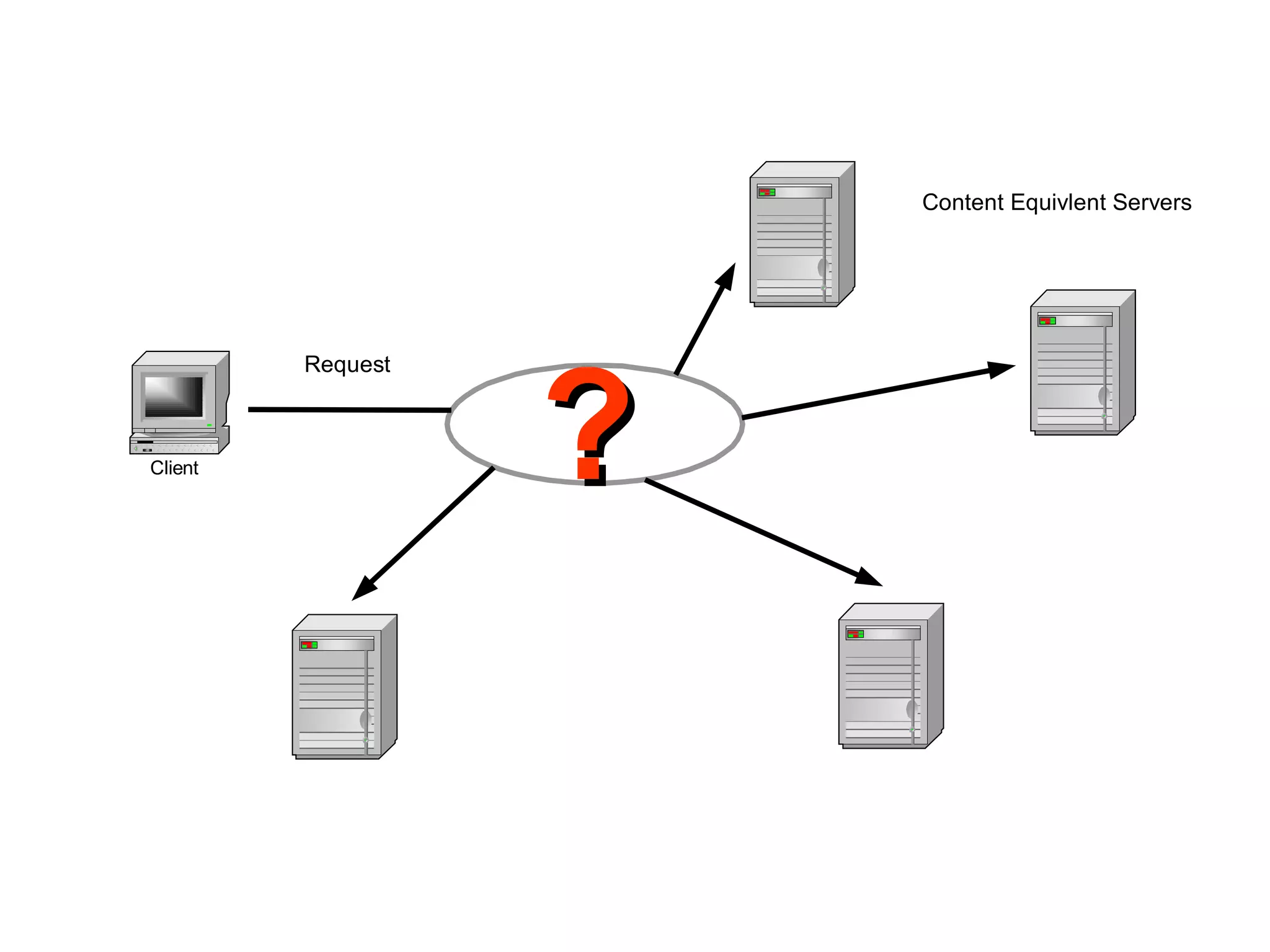
Server Replication Standard technique to improve scalability of a service Issues in server replication Location of servers Consistency across servers Server selection Server selection problem How does a client determine which of the replicated servers to access ?
?
Server Selection Alternatives Designated (e.g. nearest) server Round robin assignment (e.g. DNS rotator) Explicit list with user selection Selection architecture (e.g. Cisco DistributedDirector) Application-Layer Anycasting: Client requests connection to anycast group Anycast group consists of replicated (equivalent) servers System connects client to any good server
Anycasting Communication Paradigm Anycast identifier specifies a group of equivalent hosts Requests are sent to best host in the group
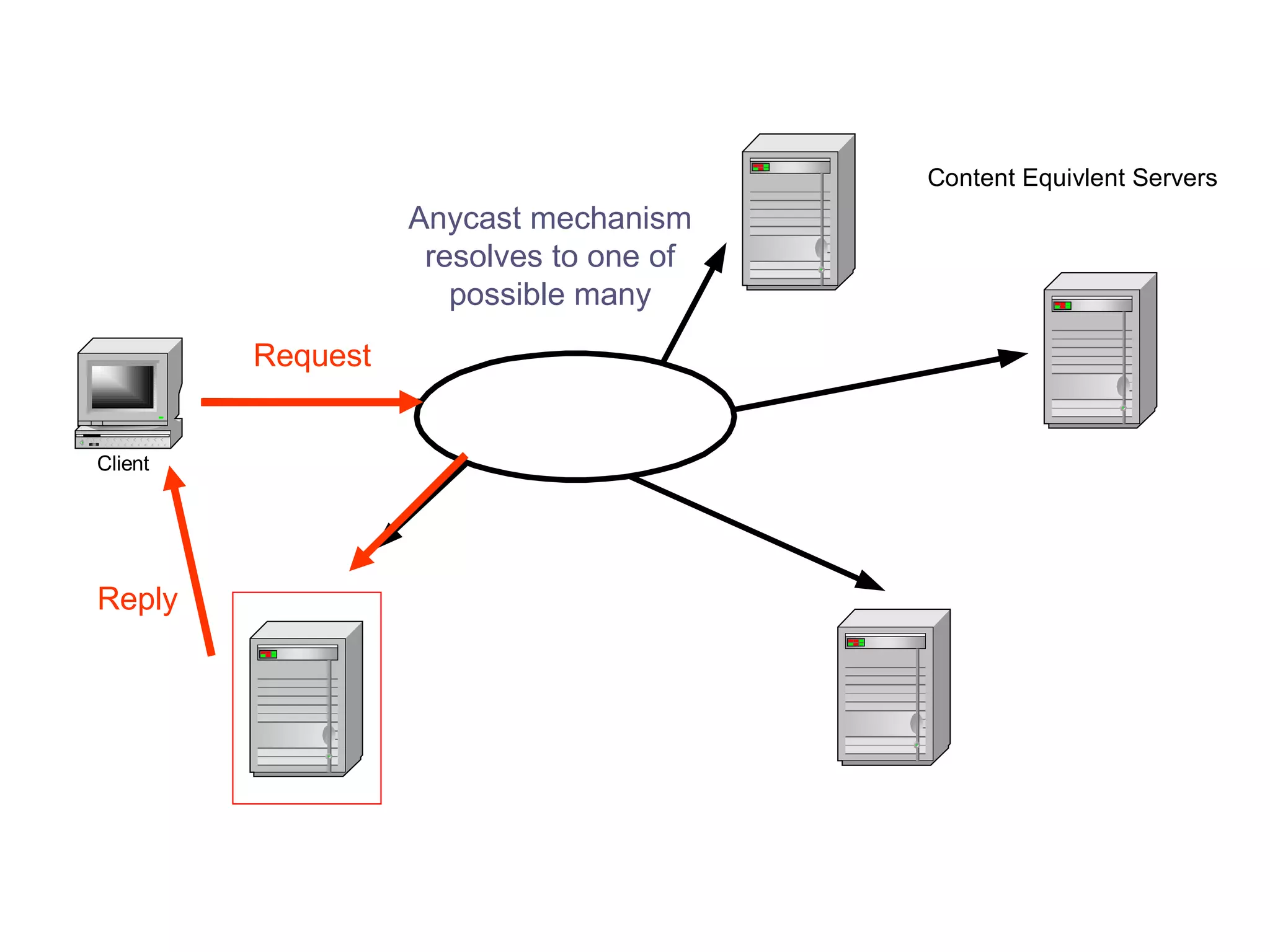
Anycast mechanism resolves to one of possible many Request Reply
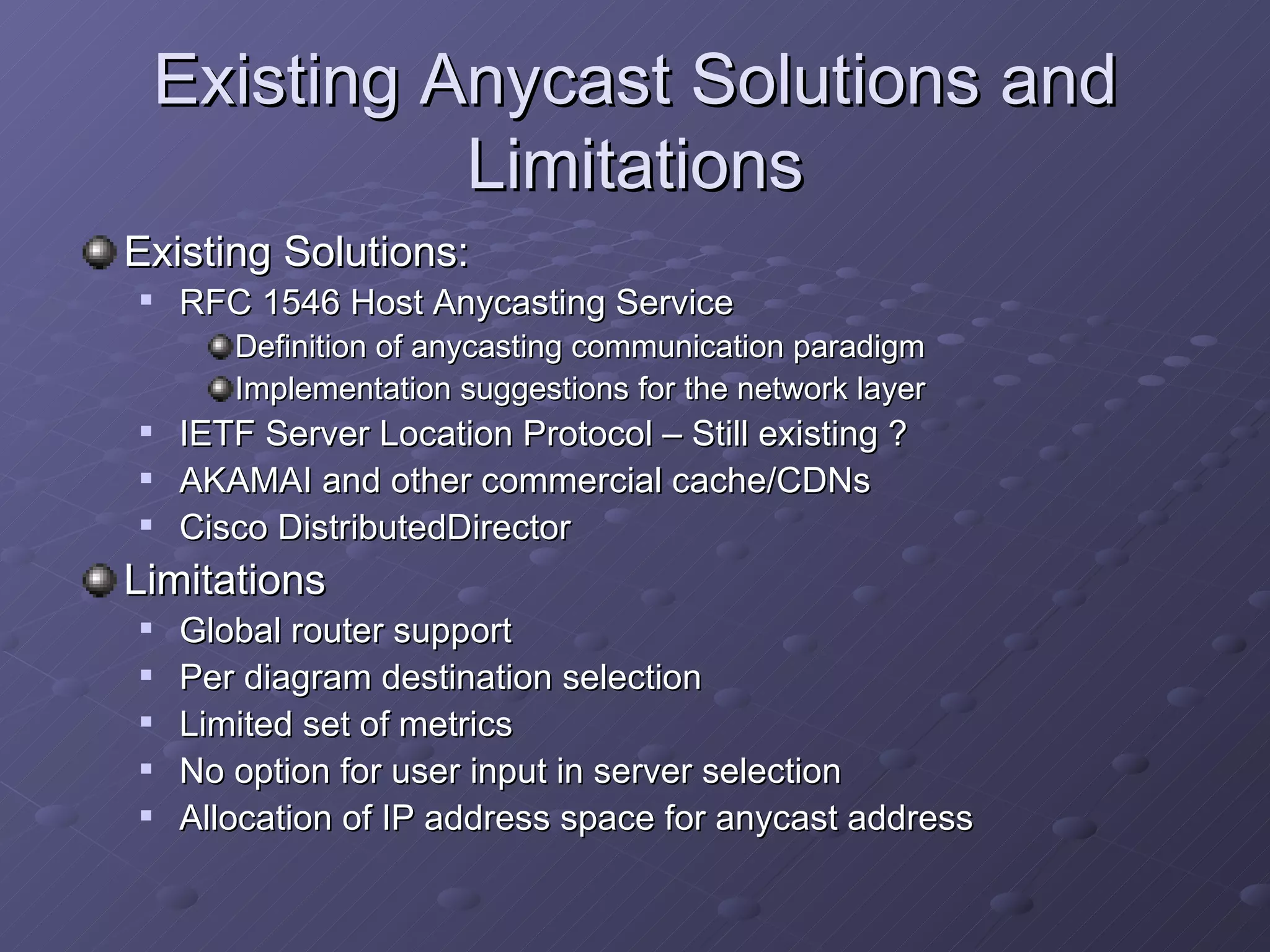
Existing Anycast Solutions and Limitations Existing Solutions: RFC 1546 Host Anycasting Service Definition of anycasting communication paradigm Implementation suggestions for the network layer IETF Server Location Protocol – Still existing ? AKAMAI and other commercial cache/CDNs Cisco DistributedDirector Limitations Global router support Per diagram destination selection Limited set of metrics No option for user input in server selection Allocation of IP address space for anycast address
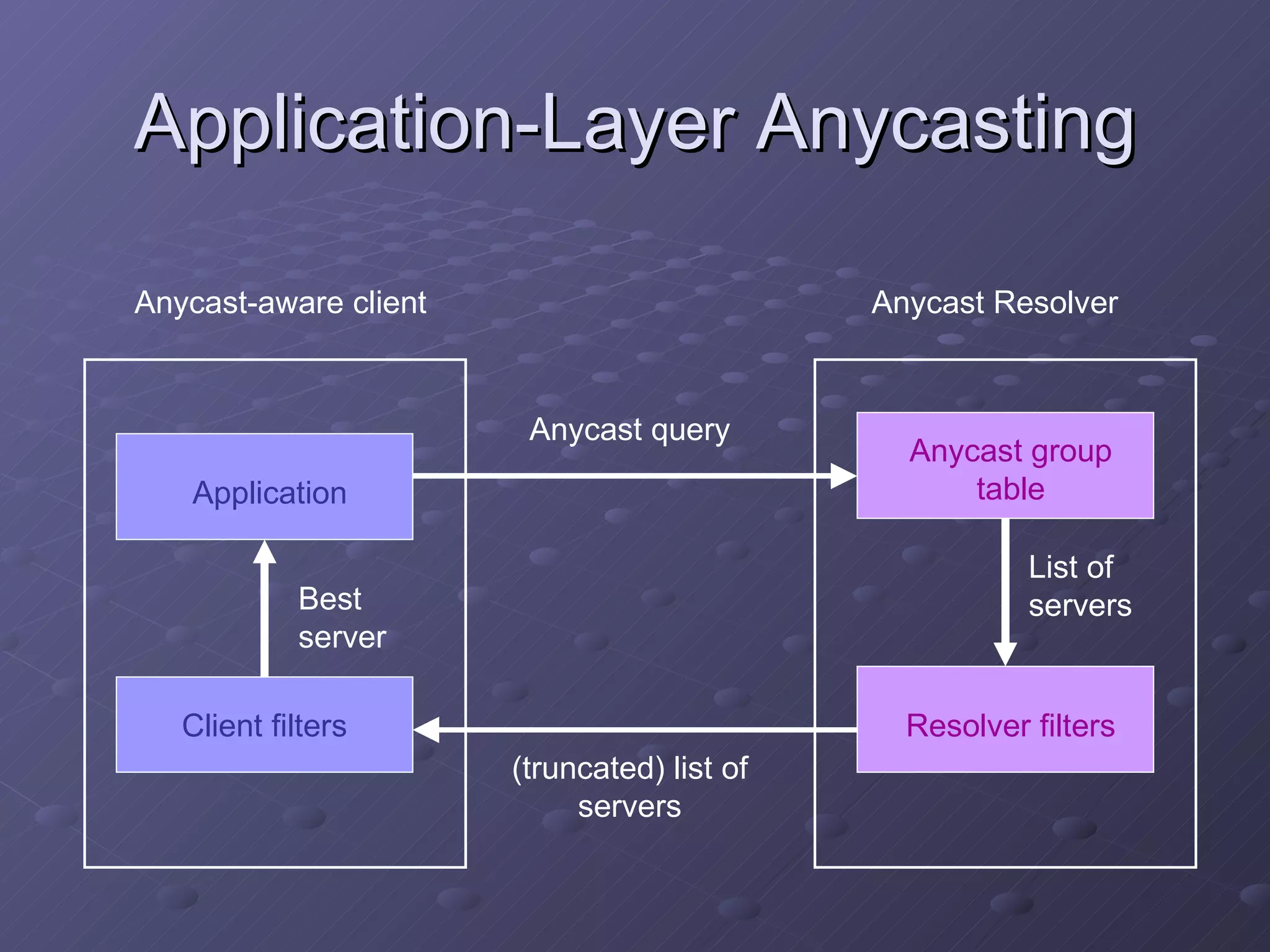
Application-Layer Anycasting Application Client filters Anycast group table Resolver filters Anycast-aware client Anycast Resolver Anycast query (truncated) list of servers List of servers Best server
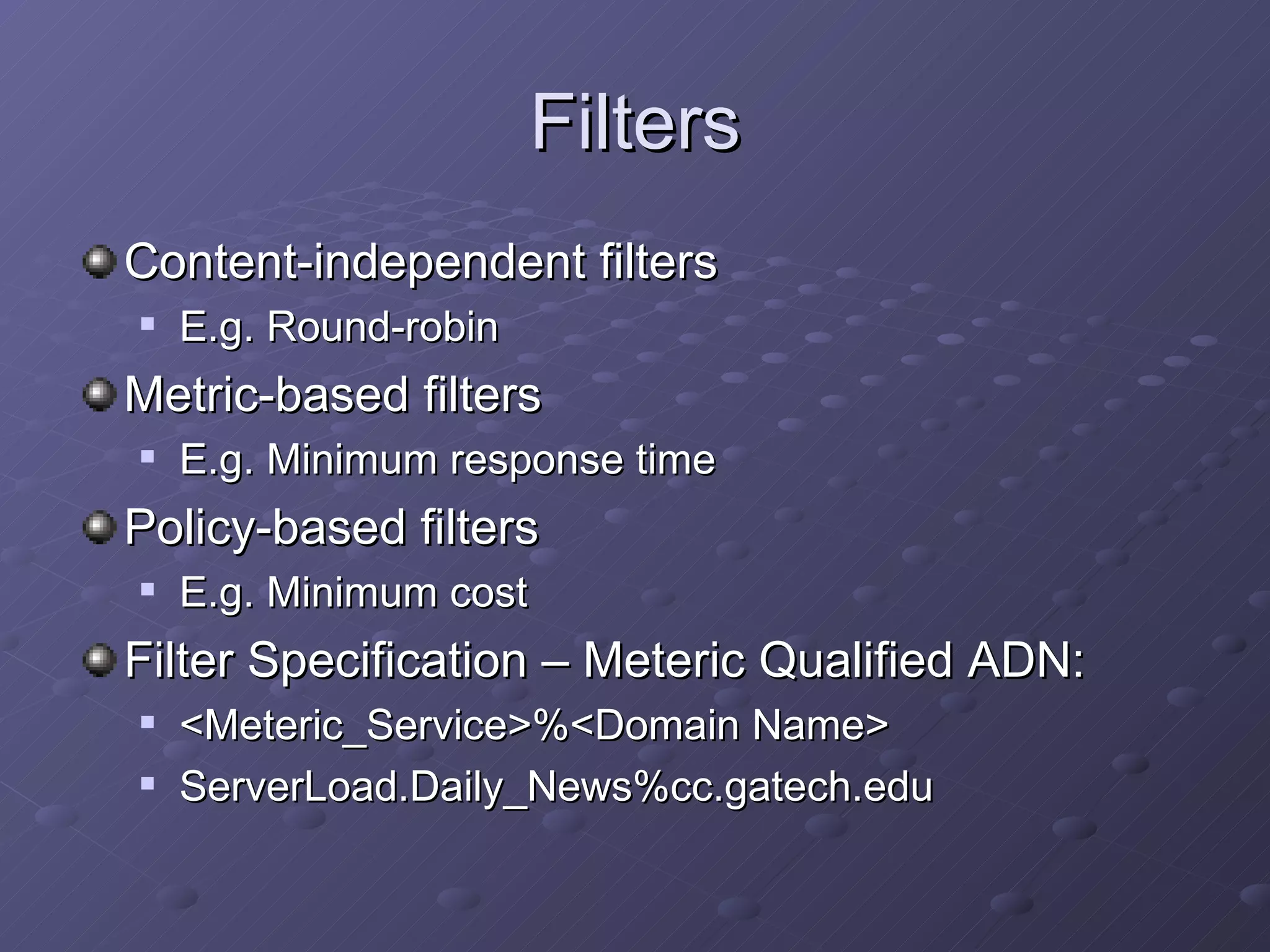
Filters Content-independent filters E.g. Round-robin Metric-based filters E.g. Minimum response time Policy-based filters E.g. Minimum cost Filter Specification – Meteric Qualified ADN: <Meteric_Service>%<Domain Name> ServerLoad.Daily_News%cc.gatech.edu
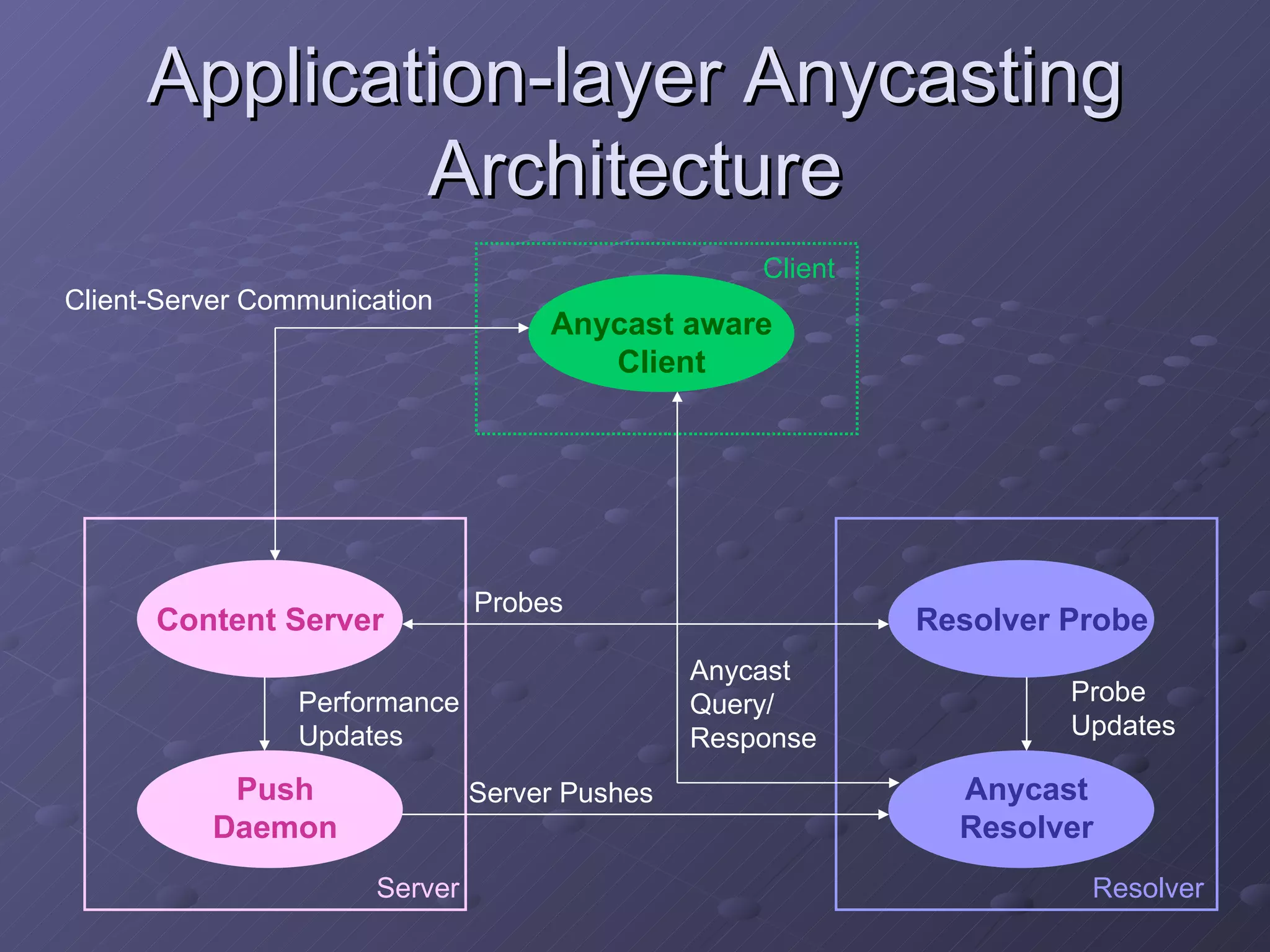
Application-layer Anycasting Architecture Client-Server Communication Push Daemon Content Server Anycast Resolver Resolver Probe Anycast aware Client Client Server Resolver Probes Server Pushes Anycast Query/ Response Probe Updates Performance Updates
Anycast Groups Anycast groups consist of collection of IP addresses, domain names or aliases Group members provide equivalent service, e.g., mirrored FTP servers or web search engines Anycast groups identified by Anycast Domain Names Group membership an orthogonal issue architecture aliases
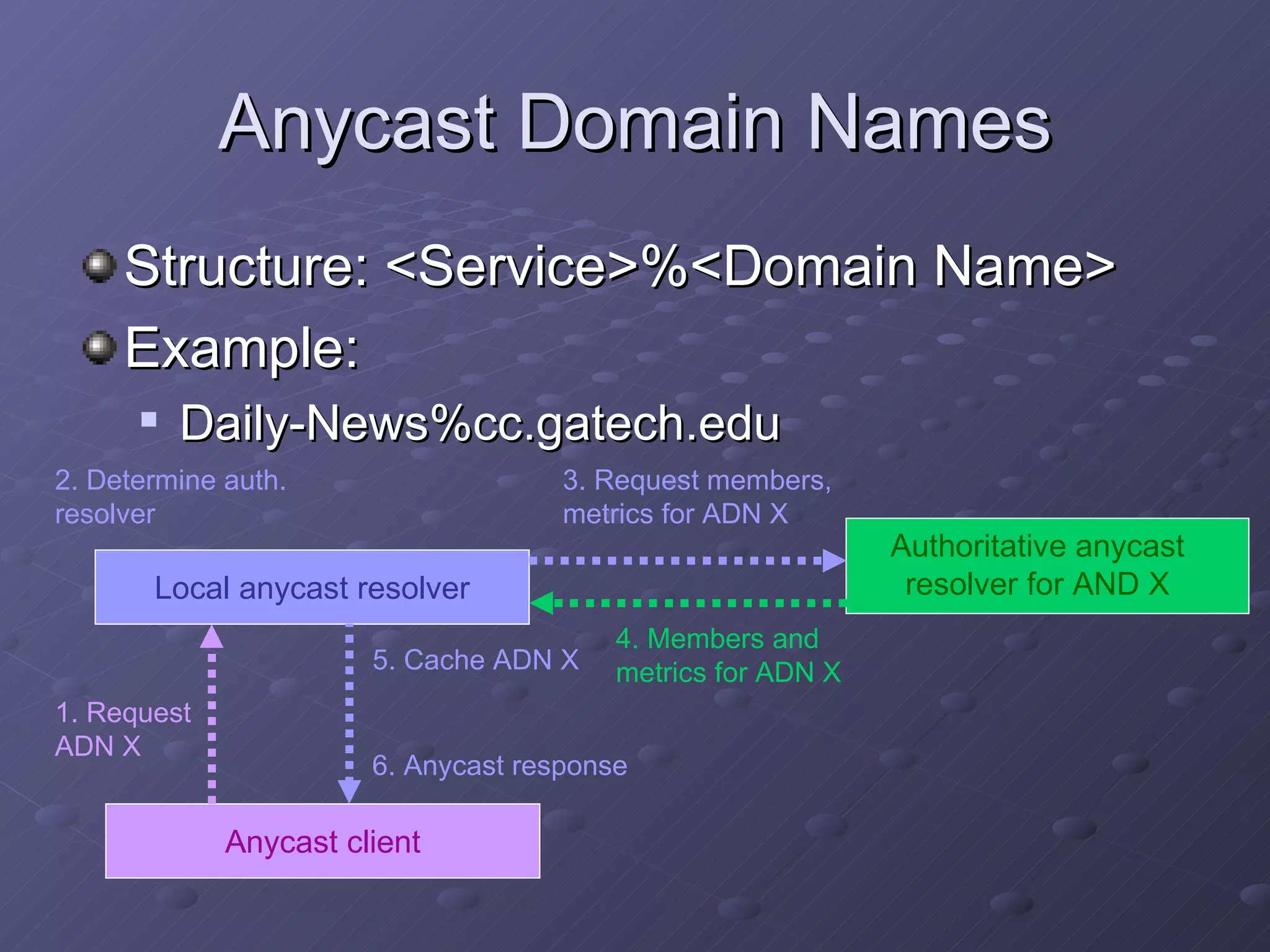
Anycast Domain Names Structure: <Service>%<Domain Name> Example: Daily-News%cc.gatech.edu 2. Determine auth. resolver 5. Cache ADN X Local anycast resolver Authoritative anycast resolver for AND X Anycast client 1. Request ADN X 3. Request members, metrics for ADN X 4. Members and metrics for ADN X 6. Anycast response
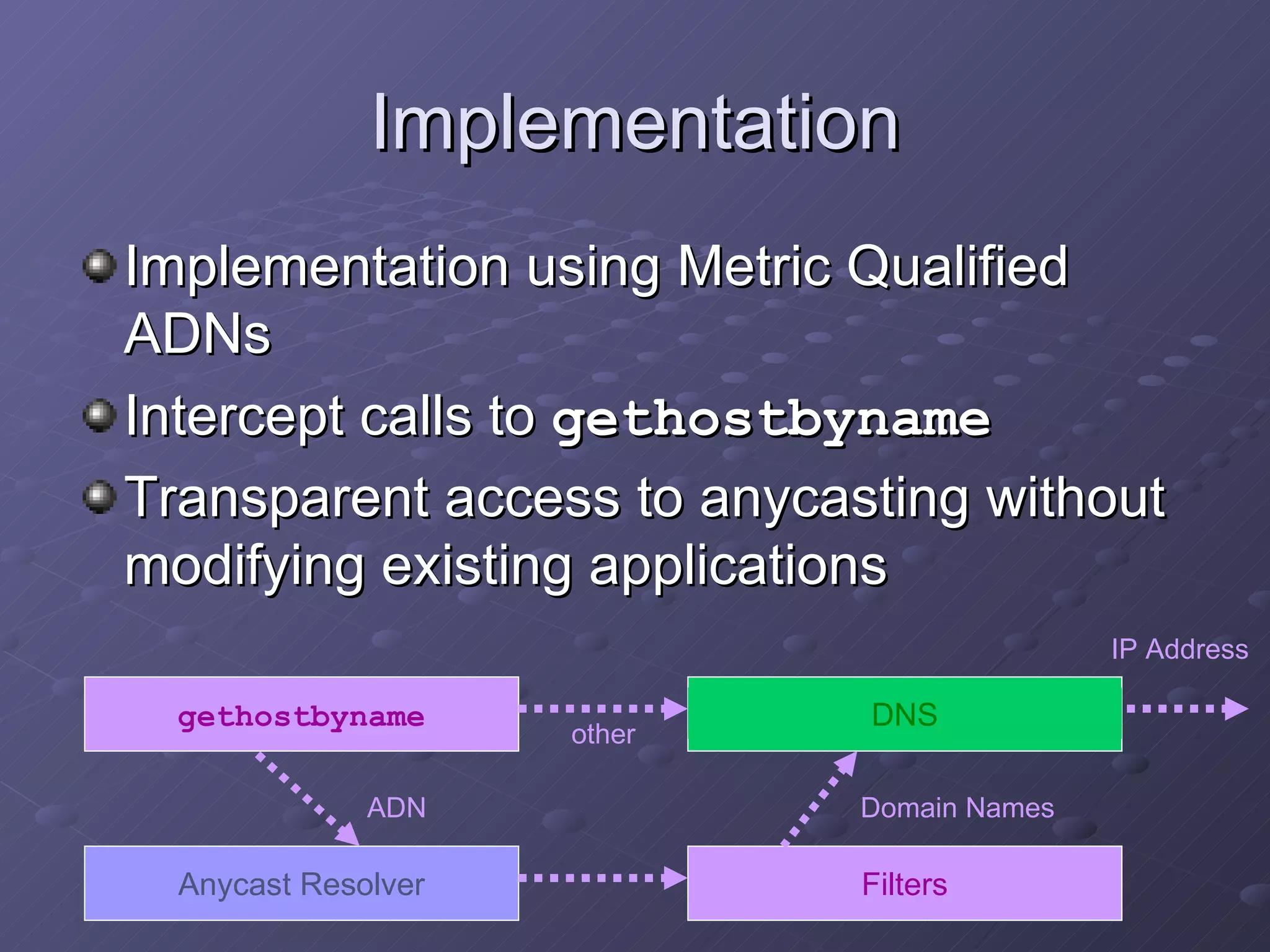
Implementation Implementation using Metric Qualified ADNs Intercept calls to  gethostbyname Transparent access to anycasting without modifying existing applications gethostbyname Anycast Resolver DNS Filters ADN Domain Names other IP Address
Response Time Determination for Web Servers Response time: Measured from time client issues request until receives last byte of file of network Round trip path delays + server processing  delays Overview of technique: Resolver probes for path-dependent response time Server measures and pushes path-independent processing time Lighter-weight push more frequent than heavier-weght probe Probe result used to calibrate pushed value
Performance Metric Determination Metric collection techniques Server push algorithm Agent probe mechanism Hybrid push/probe technique
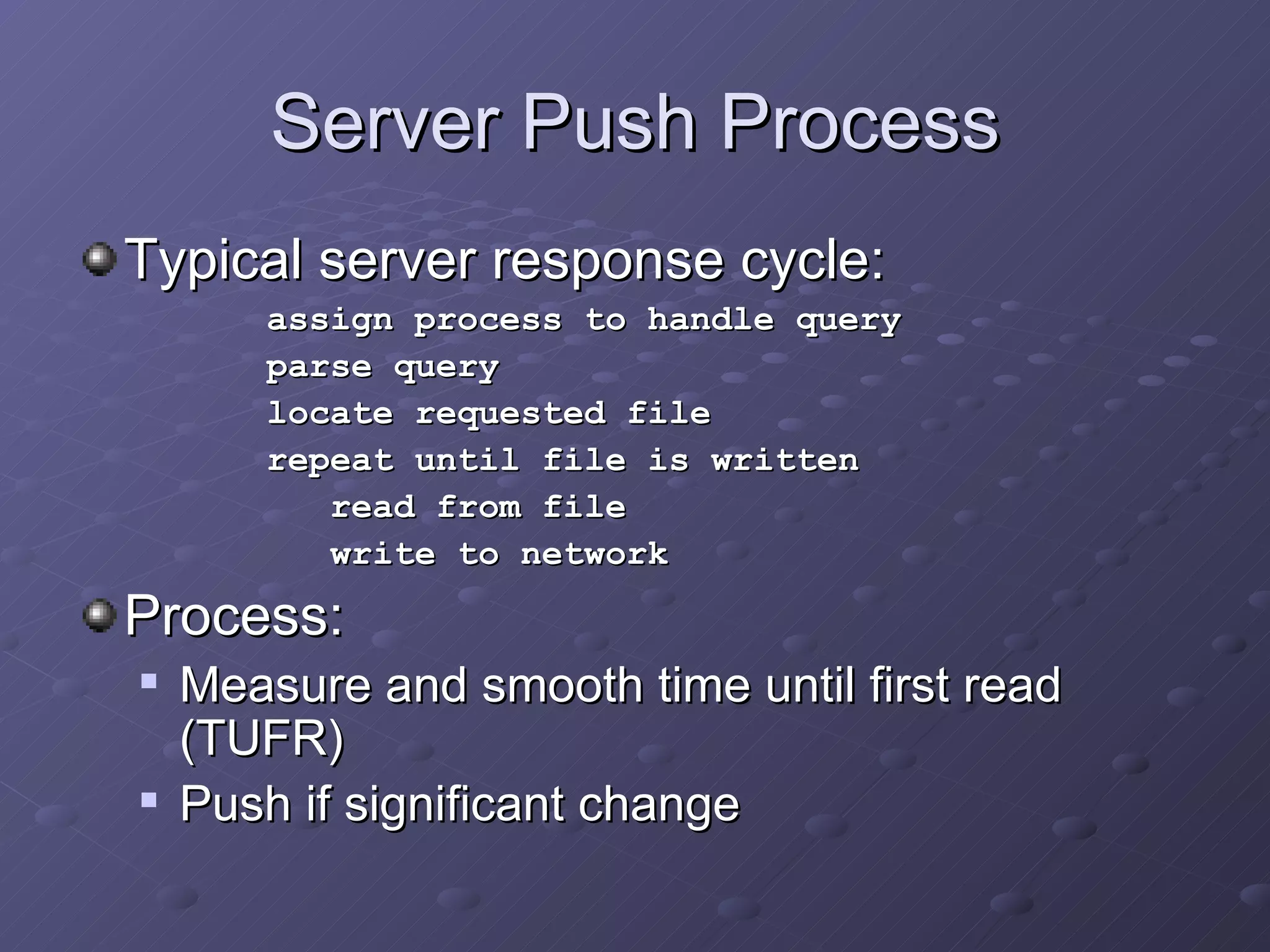
Server Push Process Typical server response cycle: assign process to handle query parse query locate requested file repeat until file is written read from file write to network Process: Measure and smooth time until first read (TUFR) Push if significant change
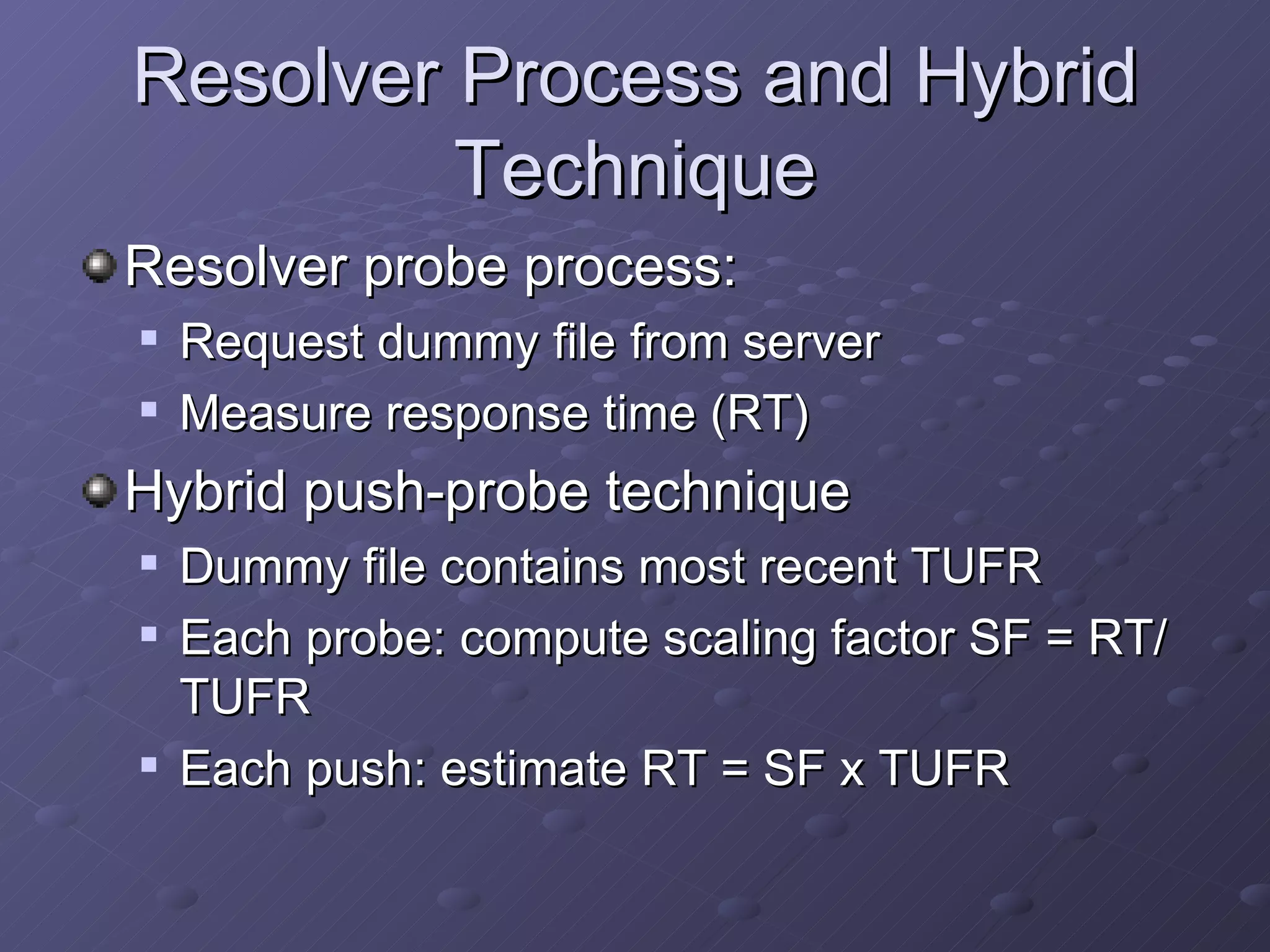
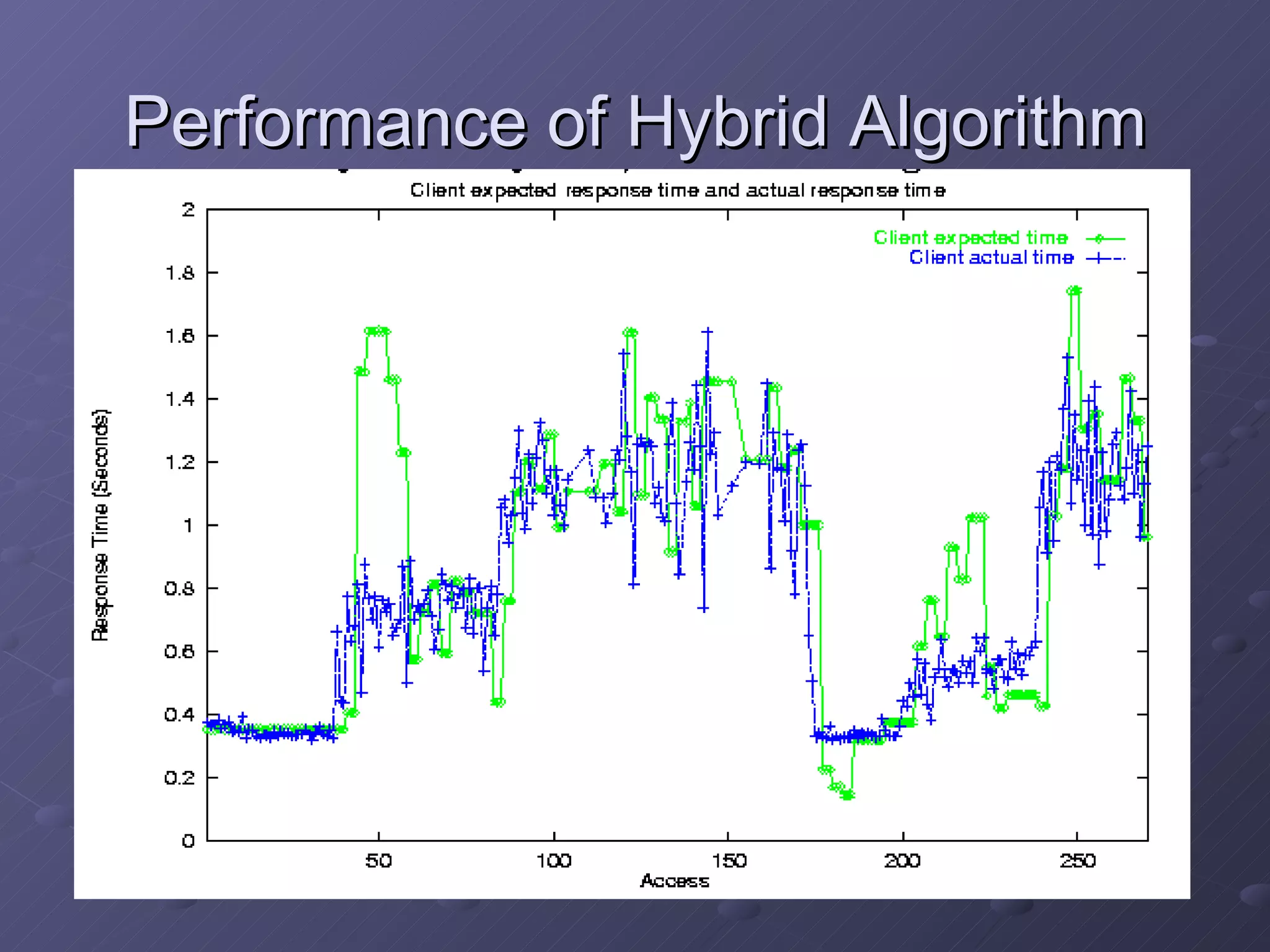
Resolver Process and Hybrid Technique Resolver probe process: Request dummy file from server Measure response time (RT) Hybrid push-probe technique Dummy file contains most recent TUFR Each probe: compute scaling factor SF = RT/TUFR Each push: estimate RT = SF x TUFR
Performance of Hybrid Algorithm
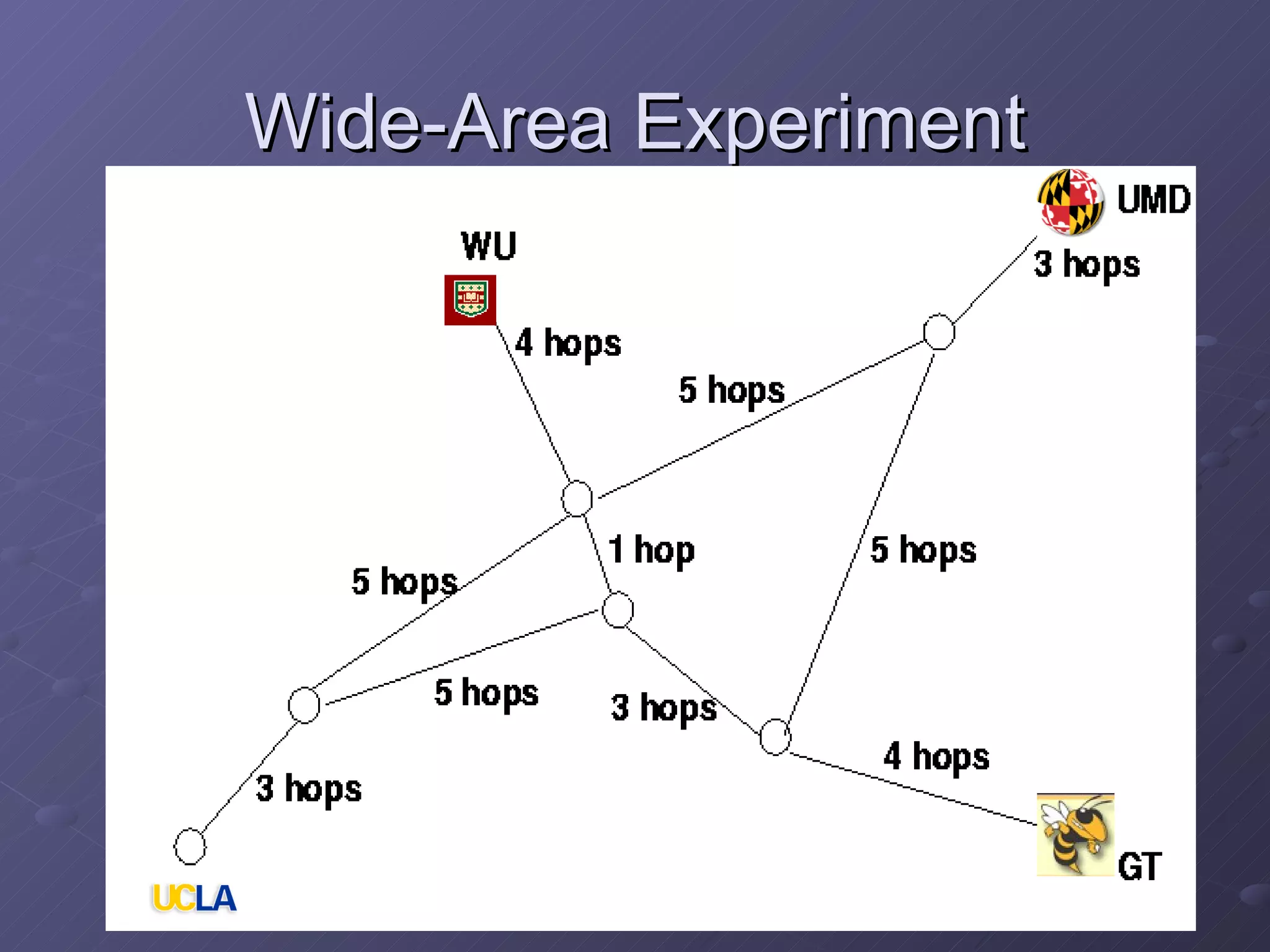
Wide-Area Experiment
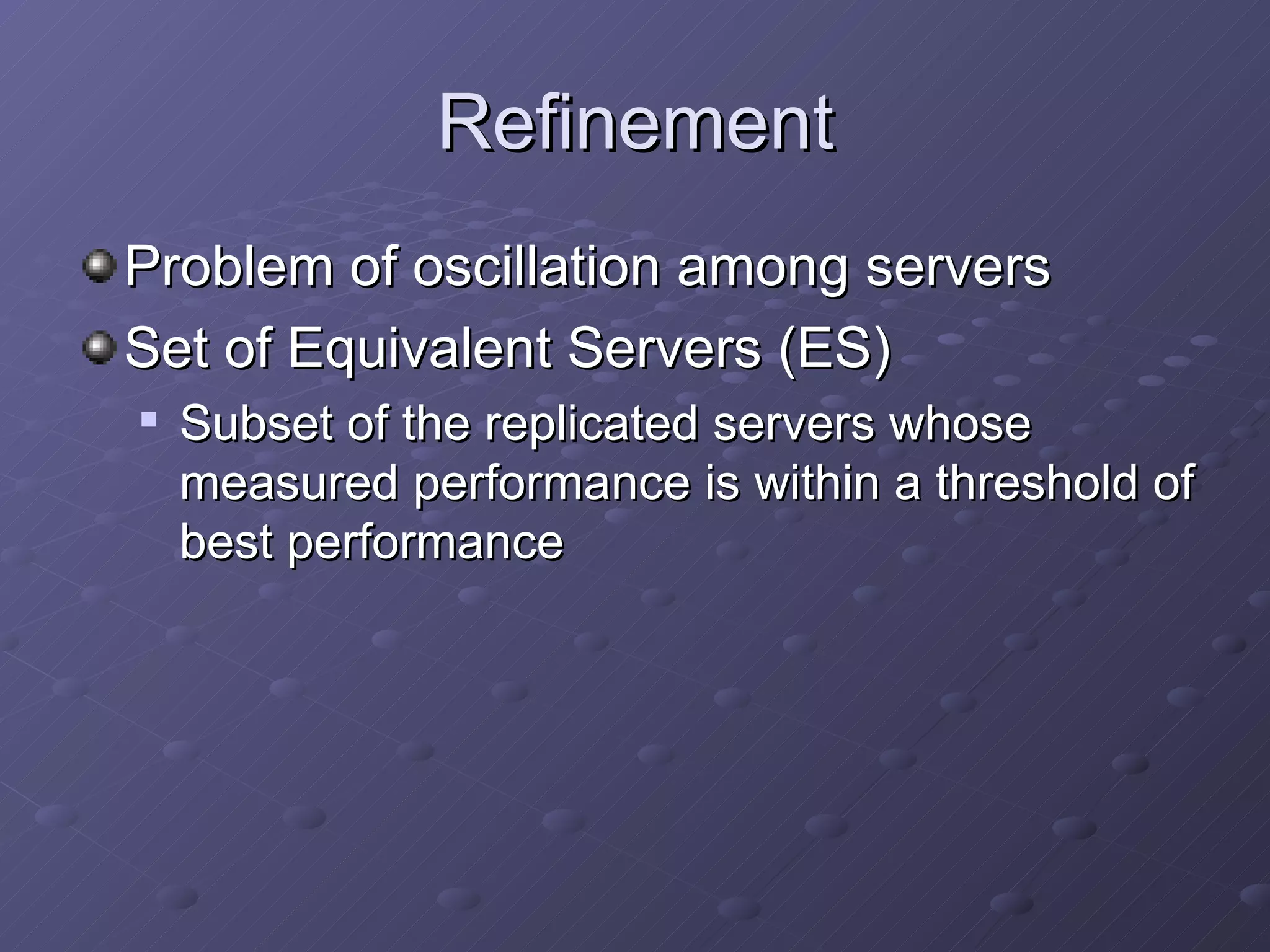
Refinement Problem of oscillation among servers Set of Equivalent Servers (ES) Subset of the replicated servers whose measured performance is within a threshold of best performance
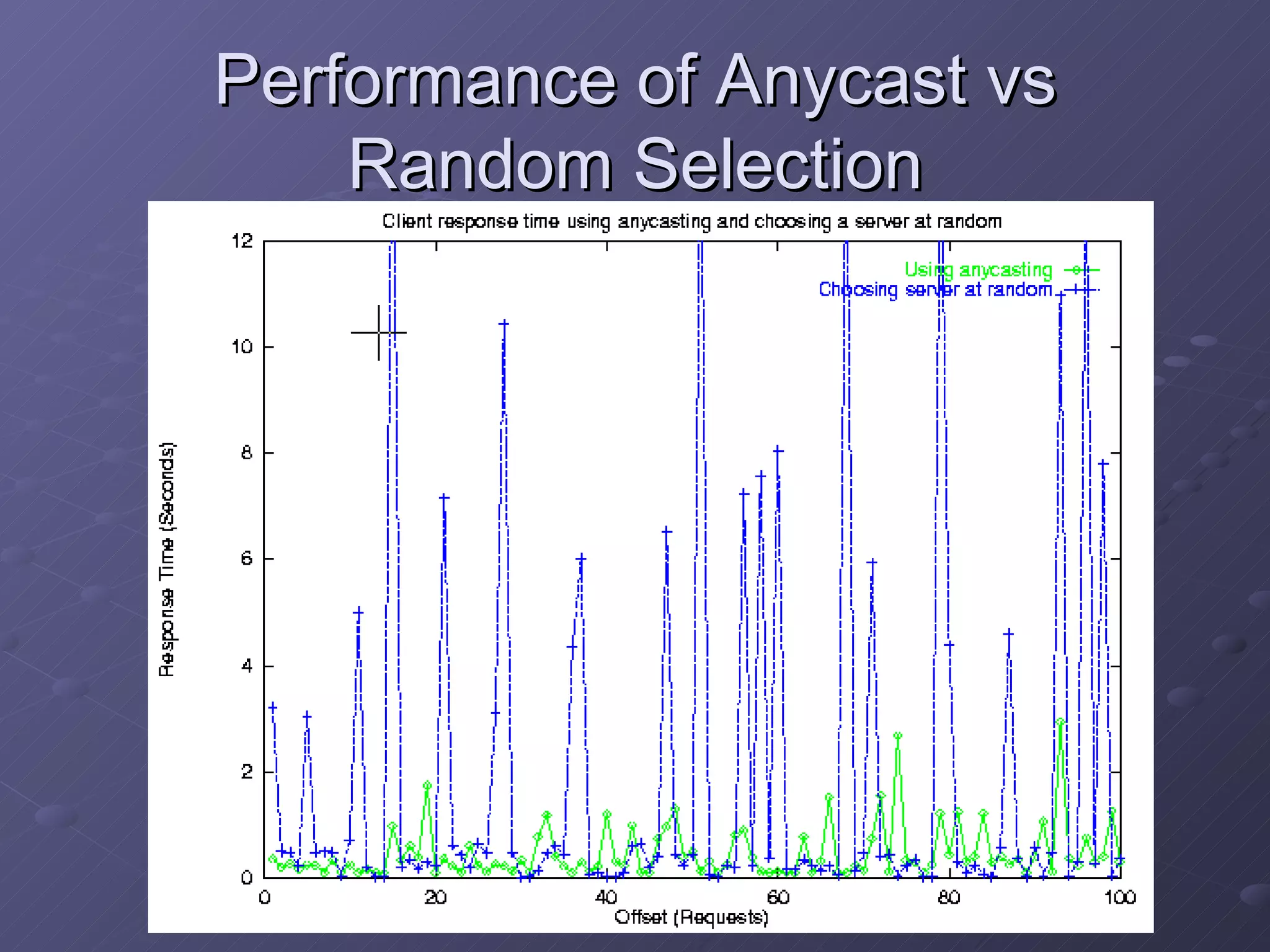
Performance of Anycast vs Random Selection
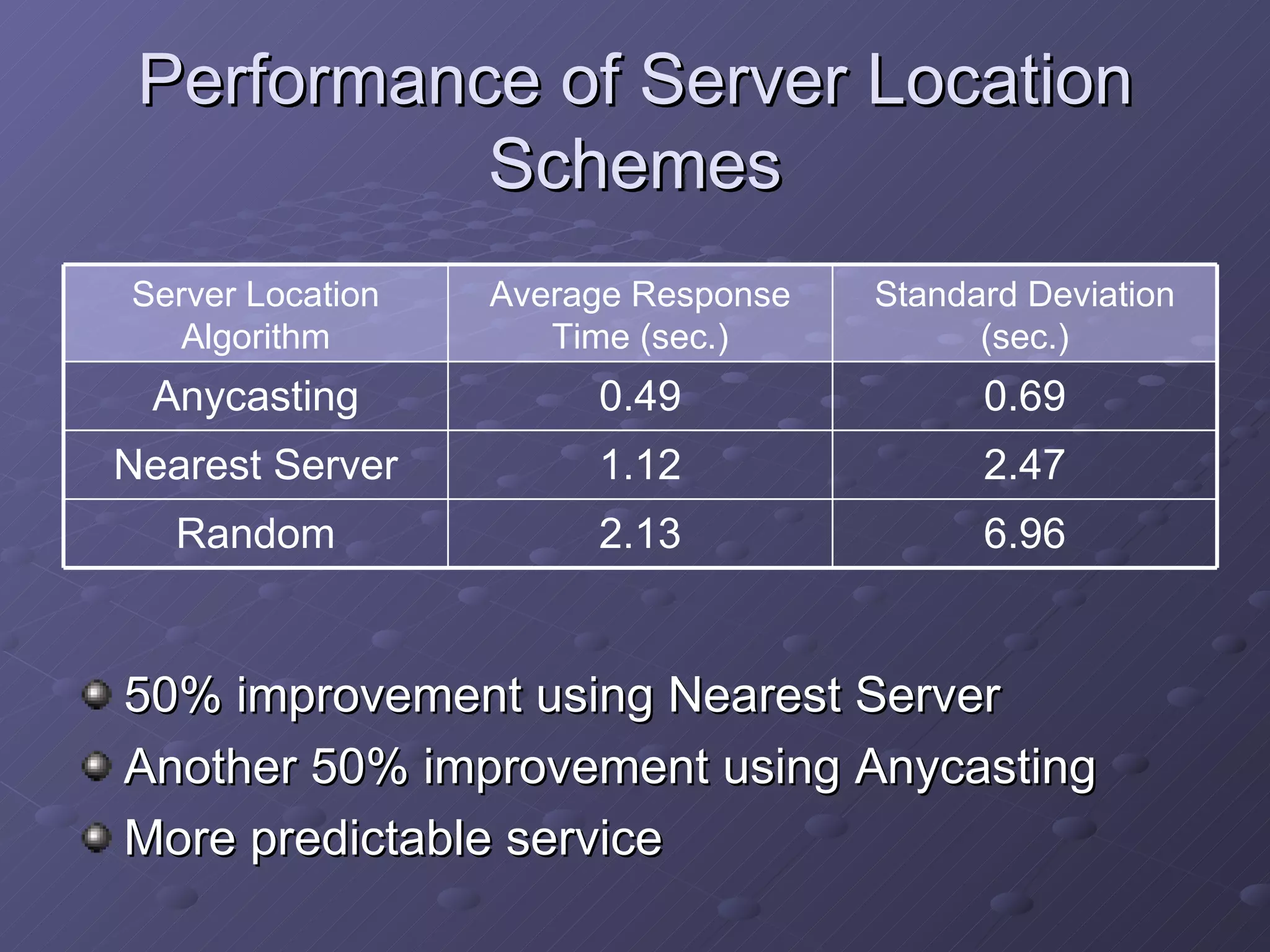
Performance of Server Location Schemes 50% improvement using Nearest Server Another 50% improvement using Anycasting More predictable service 6.96 2.13 Random 2.47 1.12 Nearest Server 0.69 0.49 Anycasting Standard Deviation (sec.) Average Response Time (sec.) Server Location Algorithm
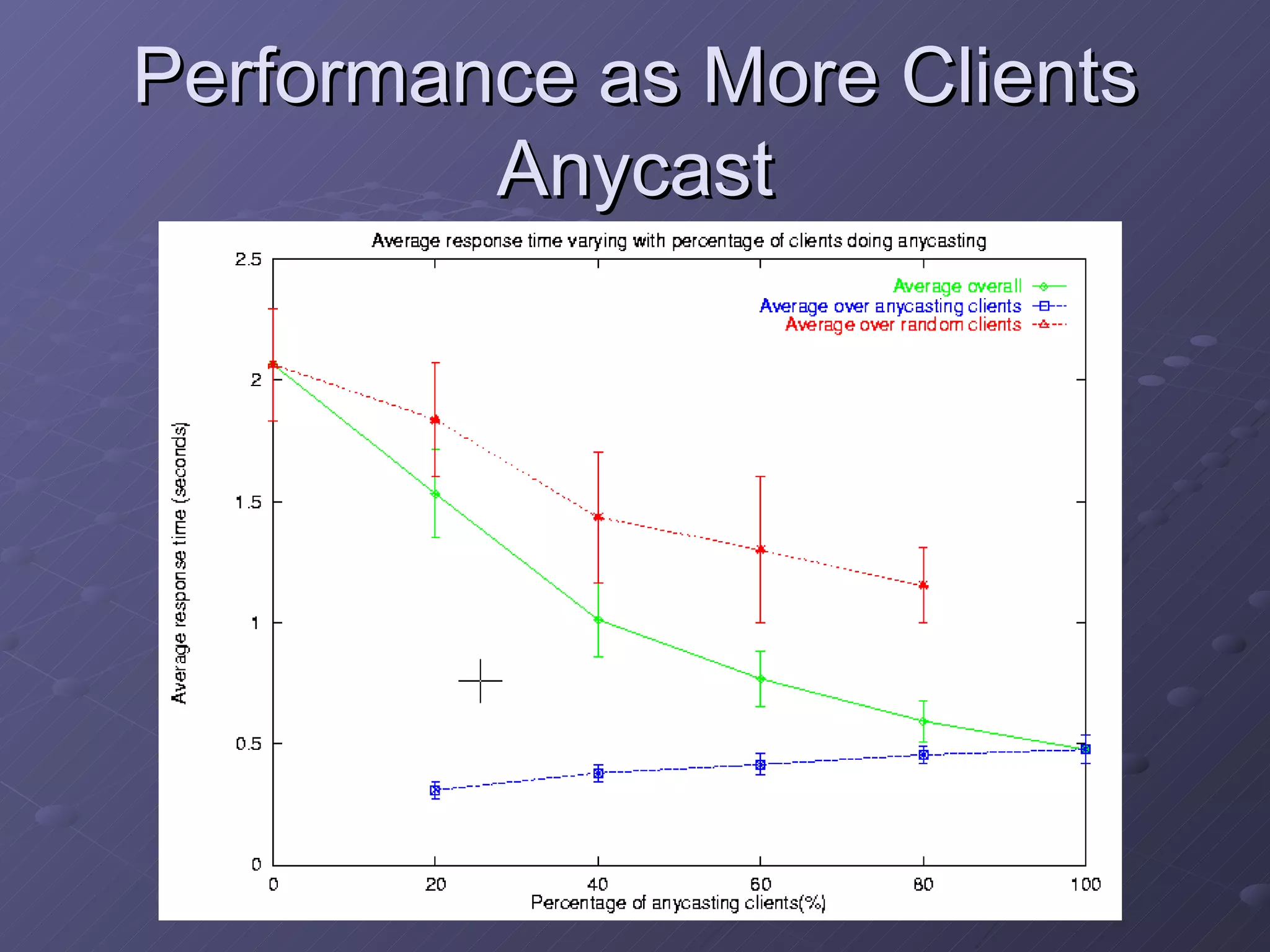
Performance as More Clients Anycast
Avoid Oscillations Among Servers Basic technique: Estimate response time for each server Indicate the best server when queried Identifying one best server can result in oscillations Use set of equivalent servers Choose randomly among equivalent servers
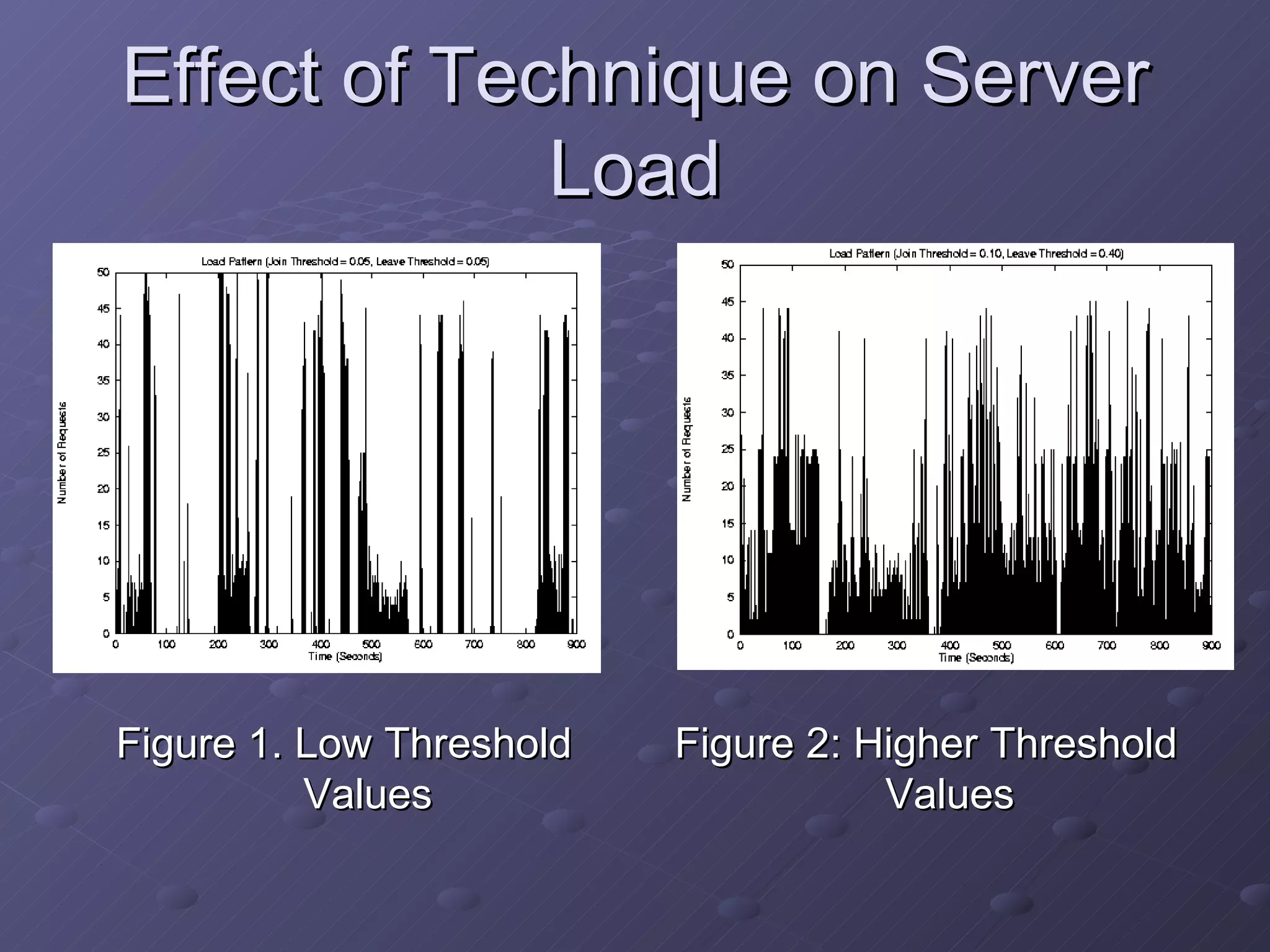
Effect of Technique on Server Load Figure 1. Low Threshold Values Figure 2: Higher Threshold Values
Scalability Techniques Server can multicast pushed data Server and resolver can control overhead System can limit number of anycast groups Resolver can track “most promising” servers Users can pay premium for service
Conclusions Summary Server replication increasingly important – web services etc.  Application layer architecture that is scalable using replicated resolvers organized in a DNS like hierarchy Web server performance can be tracked with reasonable relative accuracy. Techniques used can be generalized to other servers A hybrid push-probe technique provides scalable monitoring. May be useful in other contexts Application-layer anycasting gives significant improvement over other server selection techniques
Skeletons in the closet
Skeletons in the closet Discussions Was the study extensive enough ? 4 Anycast-aware servers – UCLA (1), WUStL(1), Gatech (2) Anycast resolvers – UMD, Gatech 20 Anycast-aware clients – UMD (4), Gatech (16) Study of anycast vs random selection Experiments done one after another – any performance difference due to cached content ? Would performance improve if network-support for path performance metrics included ? Global IP-anycast [SIGCOMM00]
LAST_ACK Prof. Jim Kurose, UMASS, Amherst Prof. Brian Levine, UMASS, Amherst Prof. Don Towsley, UMASS, Amherst Prof. Bobby  Bhattacharjee , UMCP Dr. Ellen Segura , Gatech Janhavi Rajagopal, UMASS, Amherst Sharad Jaiswal, UMASS, Amherst
Thank You !!! Anwar M. Haneef [email_address] http://www-unix.ecs.umass.edu/~ahaneef

slides

  • 1.
    Application Layer Anycasting: A Server Selection Architecture and Use in Replicated Web Service Ellen W. Zegura Mostafa H. Amamr Zongming Fei Networking and Telecommunications Group Georgia Tech, Atlanta, GA Samrat Battacharjee Department of Computer Science University of Maryland, College Park, MD Presented by Anwar M. Haneef Electrical and Computer Engineering University of Massachusetts, Amherst
  • 2.
    Agenda Problem StatementThe Anycasting Communication Paradigm Some Related Work Application Layer Anycasting Experimental Results Conclusions
  • 3.
    Problem Statement Efficientservice provision in wide area networks Replicated services Applications want access to the best server Best may depend on time, performance, policy
  • 4.
    Server Replication Standardtechnique to improve scalability of a service Issues in server replication Location of servers Consistency across servers Server selection Server selection problem How does a client determine which of the replicated servers to access ?
  • 5.
  • 6.
    Server Selection AlternativesDesignated (e.g. nearest) server Round robin assignment (e.g. DNS rotator) Explicit list with user selection Selection architecture (e.g. Cisco DistributedDirector) Application-Layer Anycasting: Client requests connection to anycast group Anycast group consists of replicated (equivalent) servers System connects client to any good server
  • 7.
    Anycasting Communication ParadigmAnycast identifier specifies a group of equivalent hosts Requests are sent to best host in the group
  • 8.
    Anycast mechanism resolvesto one of possible many Request Reply
  • 9.
    Existing Anycast Solutionsand Limitations Existing Solutions: RFC 1546 Host Anycasting Service Definition of anycasting communication paradigm Implementation suggestions for the network layer IETF Server Location Protocol – Still existing ? AKAMAI and other commercial cache/CDNs Cisco DistributedDirector Limitations Global router support Per diagram destination selection Limited set of metrics No option for user input in server selection Allocation of IP address space for anycast address
  • 10.
    Application-Layer Anycasting ApplicationClient filters Anycast group table Resolver filters Anycast-aware client Anycast Resolver Anycast query (truncated) list of servers List of servers Best server
  • 11.
    Filters Content-independent filtersE.g. Round-robin Metric-based filters E.g. Minimum response time Policy-based filters E.g. Minimum cost Filter Specification – Meteric Qualified ADN: <Meteric_Service>%<Domain Name> ServerLoad.Daily_News%cc.gatech.edu
  • 12.
    Application-layer Anycasting ArchitectureClient-Server Communication Push Daemon Content Server Anycast Resolver Resolver Probe Anycast aware Client Client Server Resolver Probes Server Pushes Anycast Query/ Response Probe Updates Performance Updates
  • 13.
    Anycast Groups Anycastgroups consist of collection of IP addresses, domain names or aliases Group members provide equivalent service, e.g., mirrored FTP servers or web search engines Anycast groups identified by Anycast Domain Names Group membership an orthogonal issue architecture aliases
  • 14.
    Anycast Domain NamesStructure: <Service>%<Domain Name> Example: Daily-News%cc.gatech.edu 2. Determine auth. resolver 5. Cache ADN X Local anycast resolver Authoritative anycast resolver for AND X Anycast client 1. Request ADN X 3. Request members, metrics for ADN X 4. Members and metrics for ADN X 6. Anycast response
  • 15.
    Implementation Implementation usingMetric Qualified ADNs Intercept calls to gethostbyname Transparent access to anycasting without modifying existing applications gethostbyname Anycast Resolver DNS Filters ADN Domain Names other IP Address
  • 16.
    Response Time Determinationfor Web Servers Response time: Measured from time client issues request until receives last byte of file of network Round trip path delays + server processing delays Overview of technique: Resolver probes for path-dependent response time Server measures and pushes path-independent processing time Lighter-weight push more frequent than heavier-weght probe Probe result used to calibrate pushed value
  • 17.
    Performance Metric DeterminationMetric collection techniques Server push algorithm Agent probe mechanism Hybrid push/probe technique
  • 18.
    Server Push ProcessTypical server response cycle: assign process to handle query parse query locate requested file repeat until file is written read from file write to network Process: Measure and smooth time until first read (TUFR) Push if significant change
  • 19.
    Resolver Process andHybrid Technique Resolver probe process: Request dummy file from server Measure response time (RT) Hybrid push-probe technique Dummy file contains most recent TUFR Each probe: compute scaling factor SF = RT/TUFR Each push: estimate RT = SF x TUFR
  • 20.
  • 21.
  • 22.
    Refinement Problem ofoscillation among servers Set of Equivalent Servers (ES) Subset of the replicated servers whose measured performance is within a threshold of best performance
  • 23.
    Performance of Anycastvs Random Selection
  • 24.
    Performance of ServerLocation Schemes 50% improvement using Nearest Server Another 50% improvement using Anycasting More predictable service 6.96 2.13 Random 2.47 1.12 Nearest Server 0.69 0.49 Anycasting Standard Deviation (sec.) Average Response Time (sec.) Server Location Algorithm
  • 25.
    Performance as MoreClients Anycast
  • 26.
    Avoid Oscillations AmongServers Basic technique: Estimate response time for each server Indicate the best server when queried Identifying one best server can result in oscillations Use set of equivalent servers Choose randomly among equivalent servers
  • 27.
    Effect of Techniqueon Server Load Figure 1. Low Threshold Values Figure 2: Higher Threshold Values
  • 28.
    Scalability Techniques Servercan multicast pushed data Server and resolver can control overhead System can limit number of anycast groups Resolver can track “most promising” servers Users can pay premium for service
  • 29.
    Conclusions Summary Serverreplication increasingly important – web services etc. Application layer architecture that is scalable using replicated resolvers organized in a DNS like hierarchy Web server performance can be tracked with reasonable relative accuracy. Techniques used can be generalized to other servers A hybrid push-probe technique provides scalable monitoring. May be useful in other contexts Application-layer anycasting gives significant improvement over other server selection techniques
  • 30.
  • 31.
    Skeletons in thecloset Discussions Was the study extensive enough ? 4 Anycast-aware servers – UCLA (1), WUStL(1), Gatech (2) Anycast resolvers – UMD, Gatech 20 Anycast-aware clients – UMD (4), Gatech (16) Study of anycast vs random selection Experiments done one after another – any performance difference due to cached content ? Would performance improve if network-support for path performance metrics included ? Global IP-anycast [SIGCOMM00]
  • 32.
    LAST_ACK Prof. JimKurose, UMASS, Amherst Prof. Brian Levine, UMASS, Amherst Prof. Don Towsley, UMASS, Amherst Prof. Bobby Bhattacharjee , UMCP Dr. Ellen Segura , Gatech Janhavi Rajagopal, UMASS, Amherst Sharad Jaiswal, UMASS, Amherst
  • 33.
    Thank You !!!Anwar M. Haneef [email_address] http://www-unix.ecs.umass.edu/~ahaneef