Review on
Load Distribution of Analytical Query Workloads
For Database Cluster Architectures
Research Paper
by
Thomas Phan
Yahoo!, Inc.,
Sunnyvale, CA, USA
Wen-Syan Li
IBM Almaden Research Center,
San Jose, CA, USA
Introduction
Database Cluster
- A group of databases
Ex: a company may have two identical database systems, one as a production
system for online transactions and one as a hot standby. And also some
additional database systems which have a subset of base tables for various
day today applications. These systems have their dedicated missions in the
day time, but they could be left idle or under-utilized in the evening when
batch workloads are processed. In such systems, query workloads can be
distributed across different servers for better performance.
Load Distribution of Analytical Query Workloads
For Database Cluster Architectures
Introduction Cont.
• Online query workloads - touch a relatively small region of the data on
the disk. Such queries are said to be selective
• Analytical Query Workloads - Touch large volumes of the disk.
• On Line Analytical Processing (OLAP)
OLAP is an approach to answer multi-dimensional analytical (MDA)
queries swiftly. OLAP is part of the broader category of business
intelligence, which also encompasses relational database, report writing
and data mining.
MQTs are required in OLAP applications as the query workloads tend
to have complex structures and syntax.
• Materialized query tables (MQT)
MQT is a table whose definition is based on the result of a query, and
whose data is in the form of pre-computed results that are taken from
one or more tables.
Idea of the Research
Framework for coordinating and optimizing execution of OLAP query
workloads across a cluster of database servers with shared-nothing
architecture.
For a database cluster, such an optimization is achieved when,
the maximum completion time of the workloads across all
database servers is minimized
Completion time at each database server includes,
MQT and index building time + query workload execution time
Expected Outcome : Server – MQT – Query mapping mechanism where
workload execution time is minimized
Current Scenario
Load distribution by dividing the workload into multiple sub-workloads
and assign each sub-workload to a database server in some greedy manner,
such as a round robin distribution.
Problems Identified
‽ Queries routed to a database server may not be collocated with their
needed MQTs
‽ Some MQTs may not t in the data server that has a limited disk space
‽ Some sub-workloads may be more expensive to execute than others, so
some server may be idle while other servers are still busy
‽ Some servers may be more powerful than others
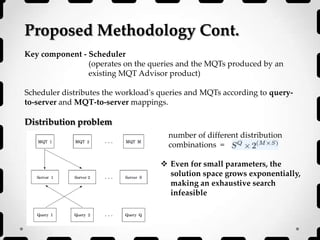
Proposed Methodology
Proposed Methodology Cont.
Key component - Scheduler
(operates on the queries and the MQTs produced by an
existing MQT Advisor product)
Scheduler distributes the workload's queries and MQTs according to query-
to-server and MQT-to-server mappings.
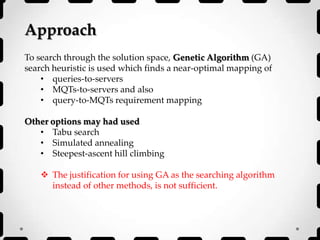
Distribution problem
number of different distribution
combinations =
 Even for small parameters, the
solution space grows exponentially,
making an exhaustive search
infeasible
Approach
To search through the solution space, Genetic Algorithm (GA)
search heuristic is used which finds a near-optimal mapping of
• queries-to-servers
• MQTs-to-servers and also
• query-to-MQTs requirement mapping
Other options may had used
• Tabu search
• Simulated annealing
• Steepest-ascent hill climbing
 The justification for using GA as the searching algorithm
instead of other methods, is not sufficient.
Genetic Algorithm Design
Chromosome - Specific mappings of queries-to-servers and MQTs-to-servers
along with its associated workload execution time
Best organism – mapping with lowest workload execution time
Previous work depicts, having two separate sets of chromosomes for a multi-
objective optimization has a hard time converging.
To overcome that a single unified chromosome is used that represents
collocations of queries and MQTs onto the same server.
Genetic Algorithm Crossover
GA Evaluation Function
• Initialize the execution times for all servers in the chromosome.
• Check to see what MQTs have been materialized and at what server and
accordingly adds these materialization times to the respective servers.
• key loop that looks across all collocations.
• If a query needs a particular MQT, the query's execution with the MQT is
added to the execution time if the query and MQT are collocated. If they
are not collocated, then the query's execution time without the MQT is
added
• The function returns the maximum execution time among the servers.
• And it is omitted from the chromosome, go for next generation.
Mapping Optimization
Developed Genetic Algorithm is compared with an exhaustive search and
three standard greedy algorithms.
And the paper shows that GA is a better solution in finding optimal mapping
mechanism.
Narrowing down the research in to OLAP query workloads and usage of
MQTs is not clearly justified.
And also there are some problems in the method followed to find the better
solution.
Literature Review
1. Need to justify the single server approach Vs database cluster approach
• Only describes the use of QCC (Query Cost Calibrator) in federated systems
and not in database clusters
2. No enough evidence to emphasize the relativity of GA to solve optimization
problem
e.g. Evolutionary Optimization of File Assignment for a Large-Scale Video-
on- Demand System by Jun Guo
3. Reasons for the use of scheduler algorithms for experiment is not clearly
mentioned
4. Purpose for the use of OLAP is not identified
• OLAP is used because MQTs are required OLAP
5. No review on the preparation of greedy algorithms
e.g. Valuated matroids: a new look at the greedy algorithm by Andreas W.M.
Dress,
Walter Wenzel
What’s new on this topic ?
• IQuery Performance Prediction for Analytical Workloads by Jennie Duggan
Uses a combination of isolated and concurrent query execution samples, as
well as new query workload features and metrics that can capture how
different query classes behave for various levels of resource availability and
contention.
• Dynamic Prioritization of Database Queries by Sivaramakrishnan
Narayanan, Florian Waas
Presents a mechanism that continuously determines and re-computes the ideal
target velocity of concurrent database processes based on their run-time
statistics to achieve
prioritization. In this scheme, every process autonomously adjusts its resource
consumption using basic control theory principles.
Sources and data collection
•5 types of scheduler algorithms
GA
Exhaustive
Greedy1-MQTs-then-queries
Greedy2-queries-then-MQTs
Greedy3-no-MQTs
•2 data sources
workload produced by the standard TPC benchmark H generator
synthetic benchmark based on the queries and MQTs from the TPC
benchmarks
Tests implemented in standard C++ and run on an off the shelf desk top
computer running Red Hat Linux.
GA run for 100 generations with a population size of 100 chromosomes.
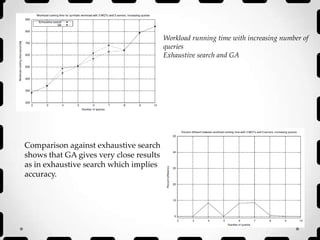
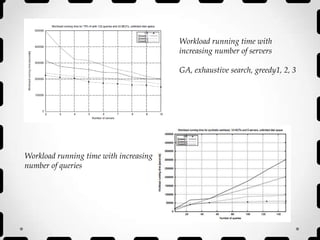
Workload running time with increasing number of
queries
Exhaustive search and GA
Comparison against exhaustive search
shows that GA gives very close results
as in exhaustive search which implies
accuracy.
Workload running time with
increasing number of servers
GA, exhaustive search, greedy1, 2, 3
Workload running time with increasing
number of queries
Issues
•Assumption as having infinite disk space
But disk space is limited
•Tested for homogeneous servers only
But if heterogeneous!!!
•Scalability tested up to limited number queries only
But when increased???
•Emphasis on the suitability of GA from the very beginning.
But results show Greedy 2 is also significant
Conclusion
-problem identification is successful
-prior conclusions of results???
-further improvements for algorithms is needed
Thank You !